Cinque Terre, Italy Travel & Photography Guide: Best Photo Spots, Things to Do & Hidden Gems
Nobody told us we were doing it wrong. But they absolutely thought it.
We were staying at the Belmond Splendido in Portofino when we asked our concierge the best way to reach Cinque Terre. Driving is complicated there, roads are narrow, parking is near impossible, and the whole experience of arriving by car tends to strip away everything that makes the place special. So we asked him to arrange the earliest possible train. He looked at us the way only an Italian can, that mix of respect and disbelief, and told us that in 25 years as a concierge, no one had ever asked him that question.
We did it anyway.
At the station, the platform was full of young Italians heading home after a long night out. They looked at us, two people loaded with camera gear at an hour when sensible people are still asleep, and you could read their faces clearly: those people are crazy. Maybe. But we stepped off that train into Riomaggiore before the light had fully broken, before the tour groups had assembled, before anyone had switched on a gelato machine or hung a laminated menu outside a restaurant door. We worked our way north, village by village, and Cinque Terre was ours.
We went back the next morning and did it again.
That is the thing about Cinque Terre that most visitors never discover. Everyone knows it is photogenic. The stacked pastel houses, the cliffs dropping into the Ligurian Sea, the terraced vineyards, the fishing boats. What fewer people know is how radically different it feels before 8am, and how much better the photographs become when you are the only one standing at the harbor wall. The light is soft, the colors are deep, and the villages look exactly like what they are: real places where real people live, not a stage set assembled for Instagram.
Cinque Terre translates simply as "Five Lands," and the five villages are Riomaggiore, Manarola, Corniglia, Vernazza, and Monterosso al Mare. They are connected by rail, by hiking trails, and in season by ferry. Each one has its own personality. Each one rewards a slow look. Together, they form one of the most photographically dense stretches of coastline anywhere in Europe, on a UNESCO World Heritage Site that manages to be both famous and, at the right hour, surprisingly quiet.
In this Photography Guide to Cinque Terre, I share the places and experiences that continue to draw me back. You will find my favorite photography locations, guidance on when and where to shoot, practical travel tips, and gear recommendations, along with cultural insights to help you explore and photograph Cinque Terre with confidence, respect, and ease.
Photographer's Notes
Before you go, here are my own takeaways.
Favorite Season: Spring
Favorite Location: Manarola's classic viewpoint
Favorite Hotel: Belmond Splendido, Portofino
Favorite Restaurant: Trattoria dal Billy, for the twelve-course seafood antipasti
Favorite Café: Bar Centrale, Riomaggiore
Favorite Lens: 24-105mm
Would I Return? Yes, I'd love to go again, next time in fall.
Where to Stay in Cinque Terre, Italy
You have two main choices: stay inside one of the five villages, or base yourself nearby in La Spezia or Levanto. Both have real advantages. Staying in a village means waking up with no commute, walking downstairs into the frame. Staying in La Spezia or Levanto means better hotel options, easier logistics, and a direct train into the park each morning.
We did it a third way. We based ourselves at the Belmond Splendido in Portofino and did Cinque Terre as day trips on the early train. If you happen to be touring the Ligurian coast and the Splendido is on your itinerary, this is a completely viable strategy, and the concierge there will eventually forgive you for the 5am request. For those coming specifically to photograph Cinque Terre, the hotels below are where I would point you, whether you want to sleep inside the park or just outside it.
Luxury Hotels in Cinque Terre, Italy
Hotel Porto Roca, Monterosso al Mare. This is the most architecturally distinguished hotel in Cinque Terre. A pink-and-white villa clinging to the cliff above Monterosso's old town, with a swimming pool, sun terraces, and wide sea views. The position alone is extraordinary for early morning light.
Grand Hotel Portovenere, Porto Venere. Just outside the national park boundary, this is the highest-end property in the area and the right choice if you want serious comfort as your home base. The location along the Ligurian coast is spectacular, and the ferry connection to the villages makes logistics smooth.
La Torretta, Manarola. Small, refined, and positioned directly inside one of the most photogenic villages in the region. The rooms have views, the atmosphere is calm, and staying here means the classic Manarola viewpoint is a five-minute walk before breakfast.
Mid-Range and Boutique in Cinque Terre, Italy
Hotel Villa Steno, Monterosso al Mare. A family-run hotel in the old town with terraced gardens and sea views. Consistently well-reviewed, genuinely Italian in feel, and a solid base for covering all five villages.
Casa Cato, Vernazza. A small boutique property above the village with some of the best views of Vernazza you will find from any room in Cinque Terre. Six rooms, no frills, pure location.
Oasi Hotel, Levanto. If you want a comfortable, well-staffed base just outside the park, Levanto is the smart choice. The town is charming, the train to Monterosso takes minutes, and the crowds are not your problem in the morning or evening.
Best Time to Visit Cinque Terre, Italy
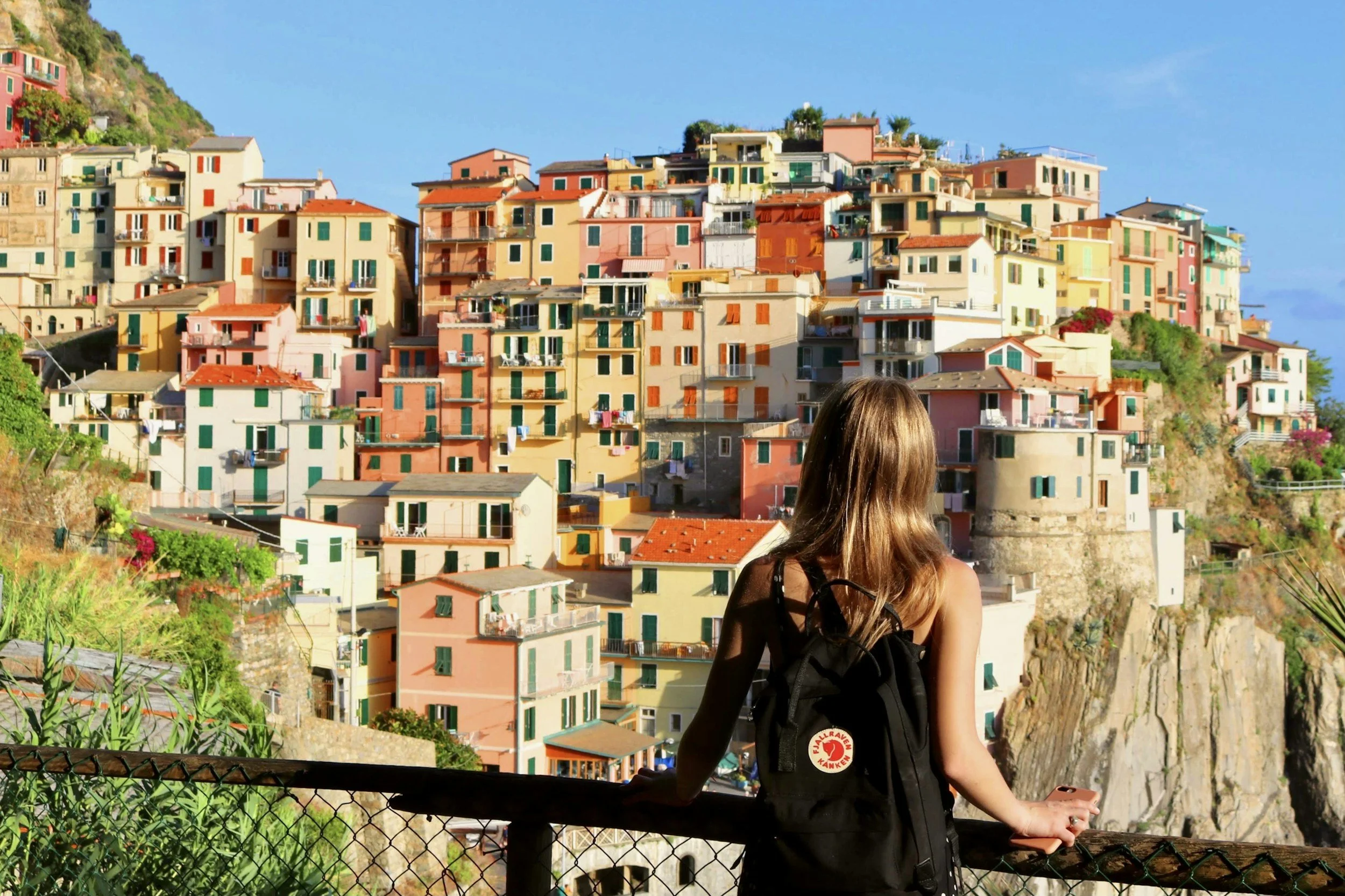
April, May, and early June are the strongest windows for photographers. The light is warm but not brutal, the crowds are manageable, the terraced vineyards are green, and the flowers along the coastal trails are at their best. Golden hour in late May stretches well past 8pm, which gives you a generous shooting window in the evening after the day-trip crowds have thinned.
September and October run a close second. The summer heat drops, the sea stays warm, the terraces glow amber as the vines begin to turn, and the light in that shoulder season takes on a depth that summer simply cannot match. This is arguably the finest time to shoot Cinque Terre if you can only come once.
July and August are the most challenging months for photographers. The crowds are significant, the light at midday is harsh, and finding a quiet frame in Manarola or Vernazza requires work. If you must visit in summer, the 5 am train strategy is not optional. It is the only way to photograph without people managing your composition for you.
Winter is quiet to the point of being closed. Many restaurants and smaller hotels shut down from November through March. The light can be extraordinary on a clear day, and hiking the trails alone in December is a genuinely different experience. But plan carefully, because the infrastructure that makes Cinque Terre easy to navigate in season largely disappears.
Getting Around Cinque Terre, Italy
The train is everything here. The regional Trenitalia line connects La Spezia, Riomaggiore, Manarola, Corniglia, Vernazza, Monterosso, and Levanto in one continuous route, with trains running frequently during peak season. The Cinque Terre Card gives you unlimited daily access to the train and the hiking trails, and is worth buying the moment you arrive in La Spezia or Levanto.
Each village has its own station, and the distances between stops are short, three to five minutes by rail. This means you can cover all five villages in a single day with minimal effort, which is exactly what we did, starting at Riomaggiore and moving north.
The hiking trails are the other option, and for photographers, they are essential. The Sentiero Azzurro connects all five villages and offers the elevated views you need for classic compositions. Some sections have been closed in recent years due to landslides and erosion; always check current trail conditions at the park visitor center before heading out. Bring water, wear proper shoes, and do not underestimate the terrain.
Ferries run seasonally between the villages and are a great way to see the coastline from the water, which offers a completely different photographic perspective. Check the seasonal schedule; ferry service does not run in winter.
Driving into the villages is strongly discouraged and effectively impossible for most visitors. Leave the car in La Spezia, Levanto, or outside the park boundary. Cinque Terre is a place you navigate on foot and by rail.
Uber is not available in this area. Taxis operate out of La Spezia and can be arranged through your hotel. Within the park, the train is faster and more practical than any road-based option.
How Many Days to Stay in Cinque Terre, Italy
Two full days is the minimum. One day is not enough, despite what every day-trip itinerary will tell you. You will spend the first day getting oriented, understanding which locations work in which light, and learning how the train schedule shapes your movement. The second day is when you start shooting well.
Three to four days is the photographer's pace. With this much time, you can shoot each village in different light across multiple mornings and evenings, explore the higher trail sections that most visitors skip, and spend time in each place with no agenda beyond the frame.
A rough framework:
Day 1: Arrive early, take the train to Riomaggiore, work north through Manarola and Corniglia. Catch the late afternoon light in Vernazza.
Day 2: Manarola at sunrise. This is non-negotiable. Take the early train, walk to the classic viewpoint before the light hardens. Spend the morning there. Afternoon in Monterosso.
Day 3: Hike a section of the Sentiero Azzurro for elevated trail views, focusing on the Vernazza-to-Corniglia or Monterosso-to-Vernazza segment. Reserve the evening for Vernazza harbor at blue hour.
Day 4: Revisit your strongest locations in the light you missed. Sleep in once.
Where to Eat in Cinque Terre, Italy
Ligurian food is one of the quiet glories of Italian cuisine, and Cinque Terre is the right place to discover it properly. Pesto originated here, made from the small-leaf basil grown on these hillsides. The anchovies are extraordinary, cured with local salt and olive oil, and the seafood is pulled from the same water you are photographing. Eat simply, eat locally, and resist the temptation of any menu that shows photos of the food.
The villages are spread across the coastline, so treat restaurant-hopping the same way you treat location-hopping: take the train between them without guilt.
Ristorante Belforte, Vernazza. Built into a historic fortress above the harbor, with the sea on three sides. The seafood is excellent, the views at sunset are exceptional, and a table close to the edge is one of the finer dining experiences on the Italian coast. Reserve well in advance.
Trattoria dal Billy, Manarola. Up a steep climb from the village center, but worth every step. The views across the rooftops and terraced hillsides are wide and quiet. The seafood antipasti is a serious commitment, twelve courses of small plates that cover the full range of what the Ligurian sea produces. This is a restaurant you plan a morning around.
Nessun Dorma, Manarola. A wine bar perched above the village with a terrace that faces directly toward the classic Manarola view. Order a glass of Sciacchetrà, the local sweet wine, and watch the evening light change. Good food, but you are here as much for the position as the plate.
Il Gambero Rosso, Vernazza. A solid, traditional trattoria in the center of the village. Fresh pasta, local fish, no performance. The kind of place you come back to every trip.
Dau Cila, Riomaggiore. Right on the water, with the boats and harbor light as your backdrop. Strong on seafood, good for a long lunch, and the position makes it easy to walk straight from your table back to the shooting locations along the harbor path.
Da Aristide, Manarola. The historic restaurant at the foot of the village is run by three generations of women. It does not have a sea view, but it has the real thing: consistent quality, genuine hospitality, and food grounded in what the region actually produces.
Coffee in Cinque Terre, Italy
Bar Centrale, Riomaggiore. A local institution, busy and loud in the best possible way. Good espresso, outdoor tables, and a useful morning base before your first train north.
Café Matteo, Vernazza. A small, no-fuss bar near the harbor. Good coffee, minimal tourist positioning, and worth knowing when you need a break between shooting the harbor and the castle trail.
Bar il Porticciolo, Manarola. Just up from the harbor on the main drag. A front-row seat to the village rhythm in the early evening, especially useful if you are waiting for the light to come around.
Photography Gear to Bring to Cinque Terre, Italy
The shooting scenarios shift quickly: you will move from wide coastal compositions to compressed telephoto frames of village facades to close detail work on boats, fishing nets, and stone textures, sometimes within the same hour.
Camera bodies worth bringing include the Canon R5 Mark II, Sony A7R V, or Nikon Z8. Any of these handles the dynamic range of a Ligurian sunrise without difficulty, and all three perform well in the low light of the pre-dawn harbor.
For lenses:
Wide angle (16-24mm): Essential for the elevated viewpoints above Manarola and Vernazza, where you want the full sweep of cliff, village, and sea in a single frame.
Standard zoom (24-70mm): Your workhorse. The villages are layered and dense, and this range gives you the flexibility to work through narrow alleyways, shoot harbor compositions, and pull tighter on architectural detail without switching glass.
Telephoto (70-200mm): Highly useful for compressing the stacked pastel houses on steep hillsides. Some of the most distinctive Cinque Terre images are made by standing back from a village with a long lens and letting the layered geometry do the work.
Prime (35mm or 50mm): If you want one lens for street work and village wandering, a fast 35mm or 50mm is ideal. Light, unobtrusive, and perfect for the narrow lanes.
Accessories
A sturdy tripod is essential for blue hour and long-exposure work at the harbors. The classic Manarola shot, in particular, is made at dawn with a tripod and a slow shutter that renders the water silky against the cliff. Do not skip this.
ND filters (3, 6, and 10-stop): Useful for shooting moving water in the harbors during daylight, and for long exposures along the coastal rocks at any time of day.
Rain cover: Spring and autumn can bring sudden weather along this coast. Weather protection for your body and a good rain cover for your bag is smart packing, not overcaution.
Extra batteries and cards: No surprise there. Long shooting days, multiple locations, and cold morning air all drain batteries faster than expected.
Samsung T7 SSD: Back up every night. When you have a once-in-a-lifetime morning at Manarola before sunrise, you want that insurance.
Drone
Leave it at home. Cinque Terre is a national park, and the entire coastal area is a protected zone where drones are prohibited, with the boundaries extending far out to sea. Drone use is largely banned due to environmental protection status and tourism density, and enforcement is strict, with steep fines for violations. Do not risk it.
iPhone Photography
Cinque Terre is genuinely one of the finest iPhone destinations in Europe. The colors are saturated, the compositions are clean and legible, and the village layouts are almost designed for a rectangular frame.
Use the standard lens (1x) for harbor compositions. The ultrawide distorts the charming geometry of the stacked houses. At Manarola, you want the buildings tall and the sea flat, and the standard lens delivers that without bending.
Shoot in ProRAW if your model supports it. The dynamic range between a bright Ligurian sky and deep harbor shadow is significant. ProRAW gives you the latitude to recover both ends in Lightroom Mobile without the orange-and-teal artificiality you get from aggressive HDR processing.
For the elevated viewpoints above the villages, use the 2x telephoto. This compresses the scene, brings the layered village facades forward, and gives you a cleaner separation between foreground and sky.
Shoot the harbor details at Portrait Mode. The wooden boats, the colored nets, the peeling paint on iron cleats. These close-up details tell a story that wide shots often miss, and Portrait Mode on these subjects at close range creates genuinely painterly results.
Use the 5 am light. Your iPhone sensor performs best in the hour after sunrise, when the light is warm, directional, and forgiving. This is not advice for pros. This works for everyone.
Best Photography Locations in Cinque Terre, Italy
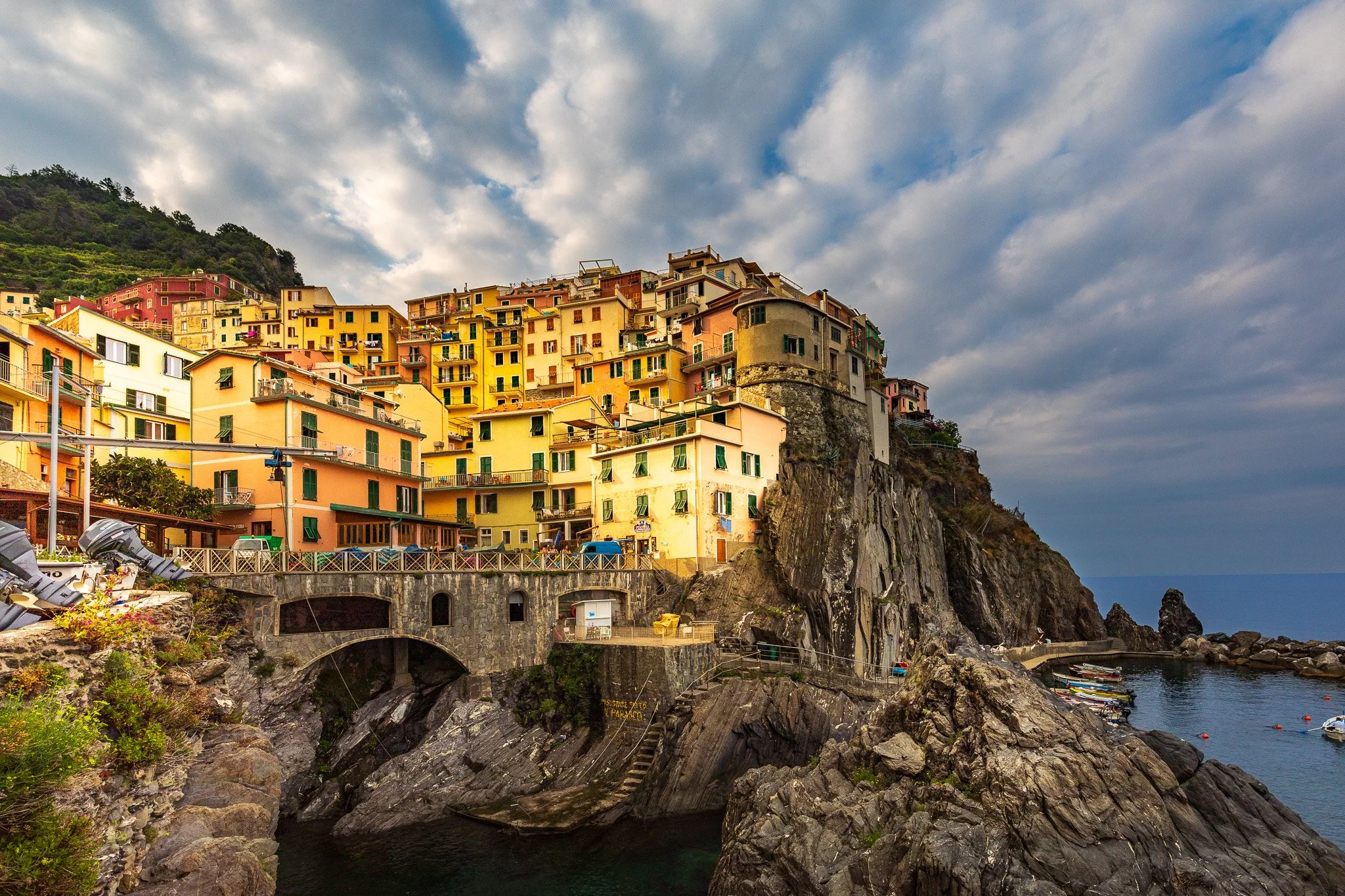
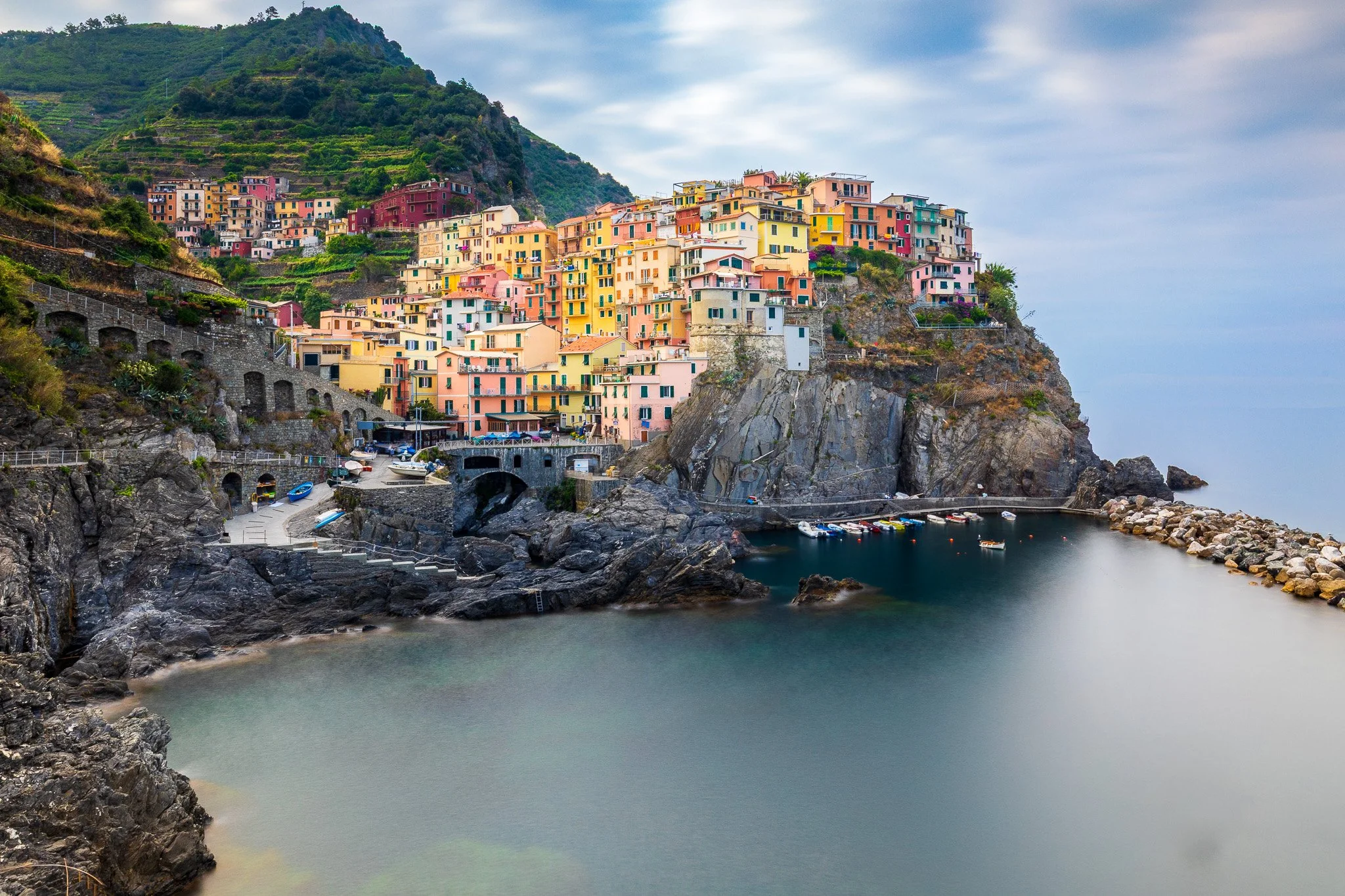
Manarola Classic Viewpoint
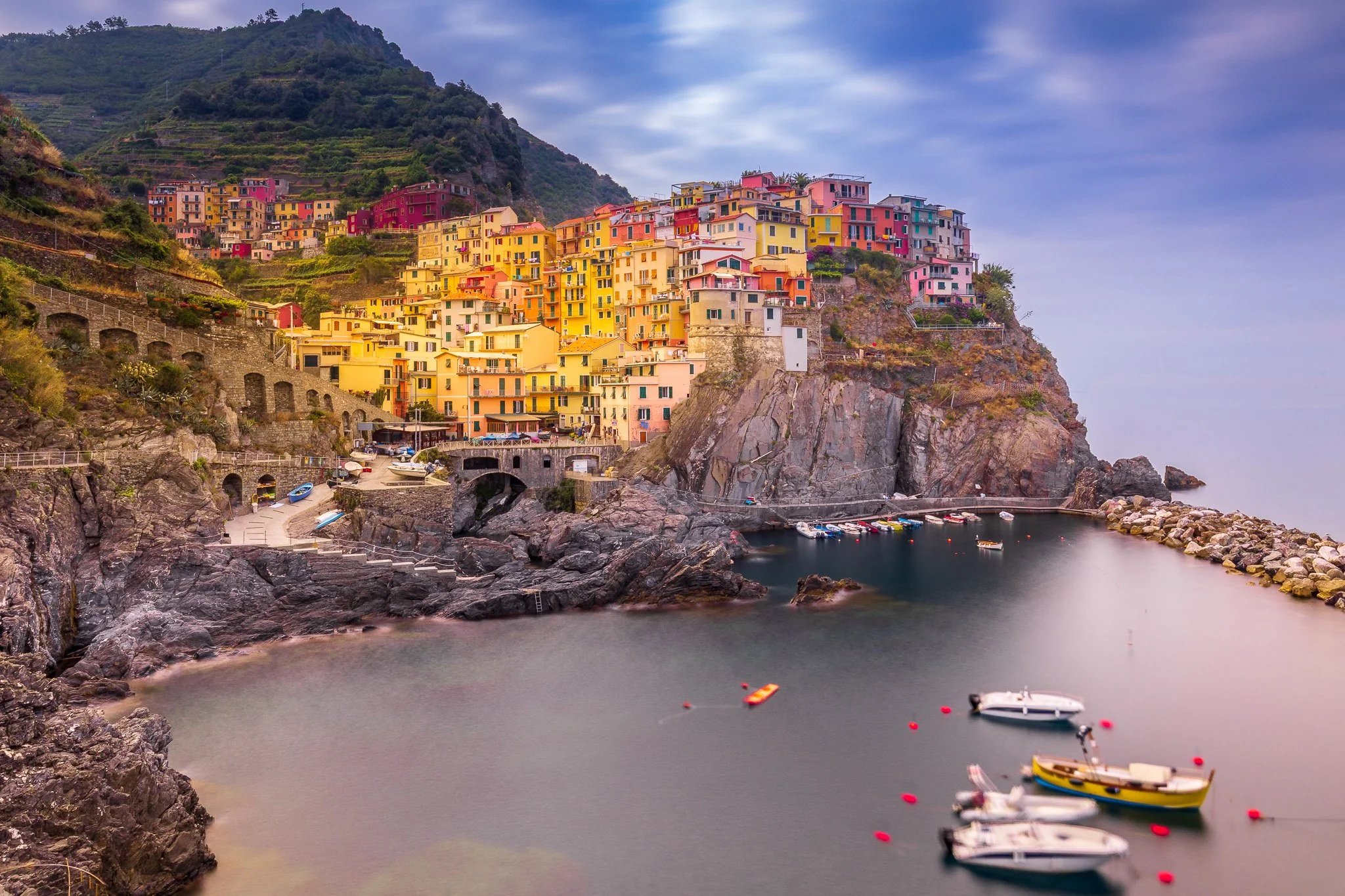
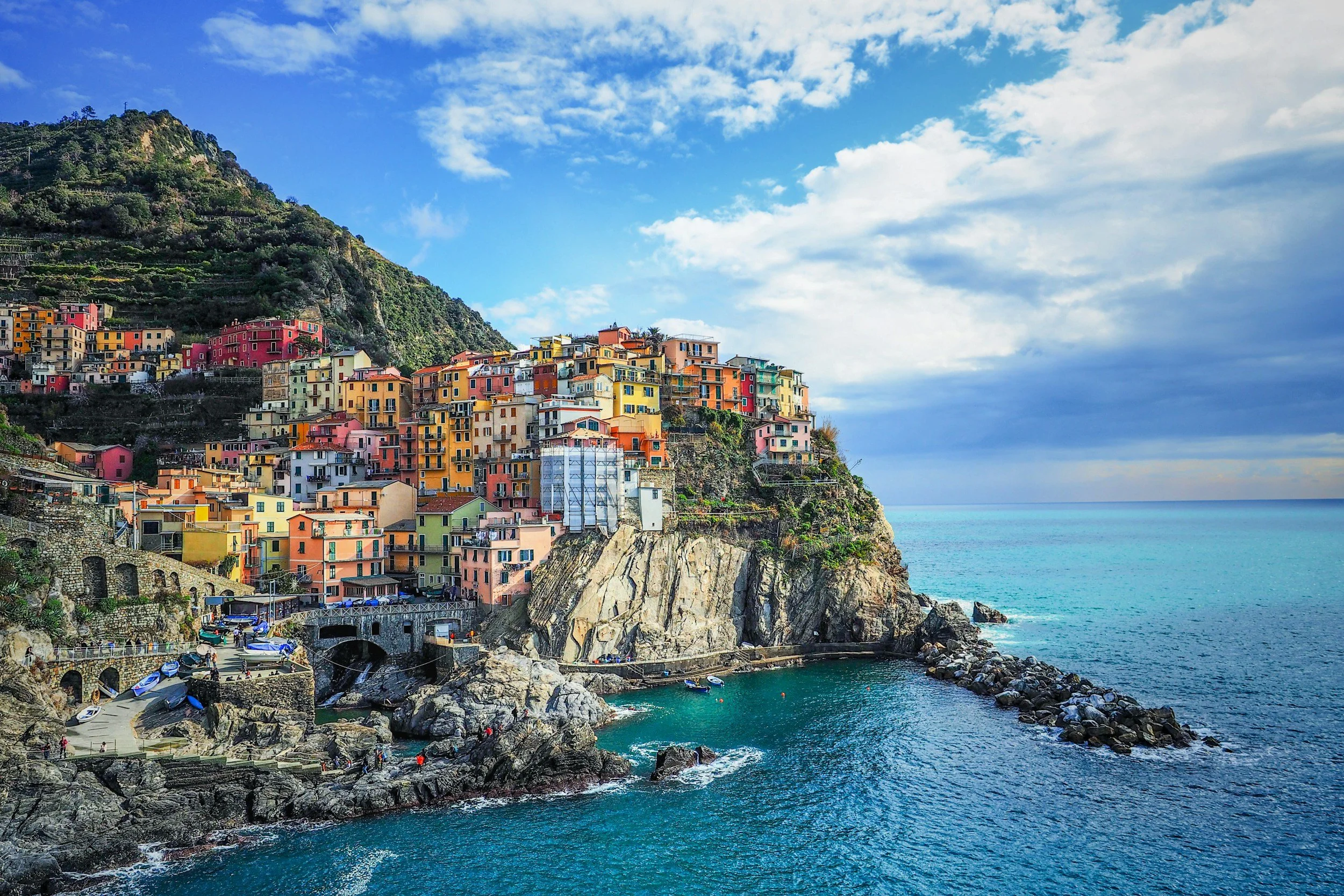
This is the photograph of Cinque Terre, the one that has appeared in every travel magazine and geography textbook you have ever seen. You reach it by walking the short path that leads right from the marina toward the cemetery. The view opens after about five minutes: the entire village stacked against the cliff, the harbor below, the sea behind it, the terraced hills on either side.
What makes it work photographically is the color separation. The pastel facades catch light differently depending on the time of day, and in the blue hour before sunrise they glow in a way that feels almost artificial. The water in the small marina goes glassy and reflective when there is no wind. When there is a long-exposure opportunity here, take it.
📷 Pro Tip: Arrive before first light. Set up your tripod on the flat section of the path before you reach the overlook, because once the full view opens up, every tripod position is already occupied by 7am in peak season. Use a shutter speed of 15 to 30 seconds at blue hour to render the water as a smooth plane beneath the village. A 24mm or wider gets the full scene. A 70-100mm focal length compresses the upper village facades beautifully for a tighter, more graphic frame. Come back in the evening for the warm light on the western faces of the buildings, but the morning shot, specifically in the ten minutes before the sun clears the hills, is the one you will not forget.
Best time: 30 minutes before sunrise. Access: Free. Short walk from Manarola station.
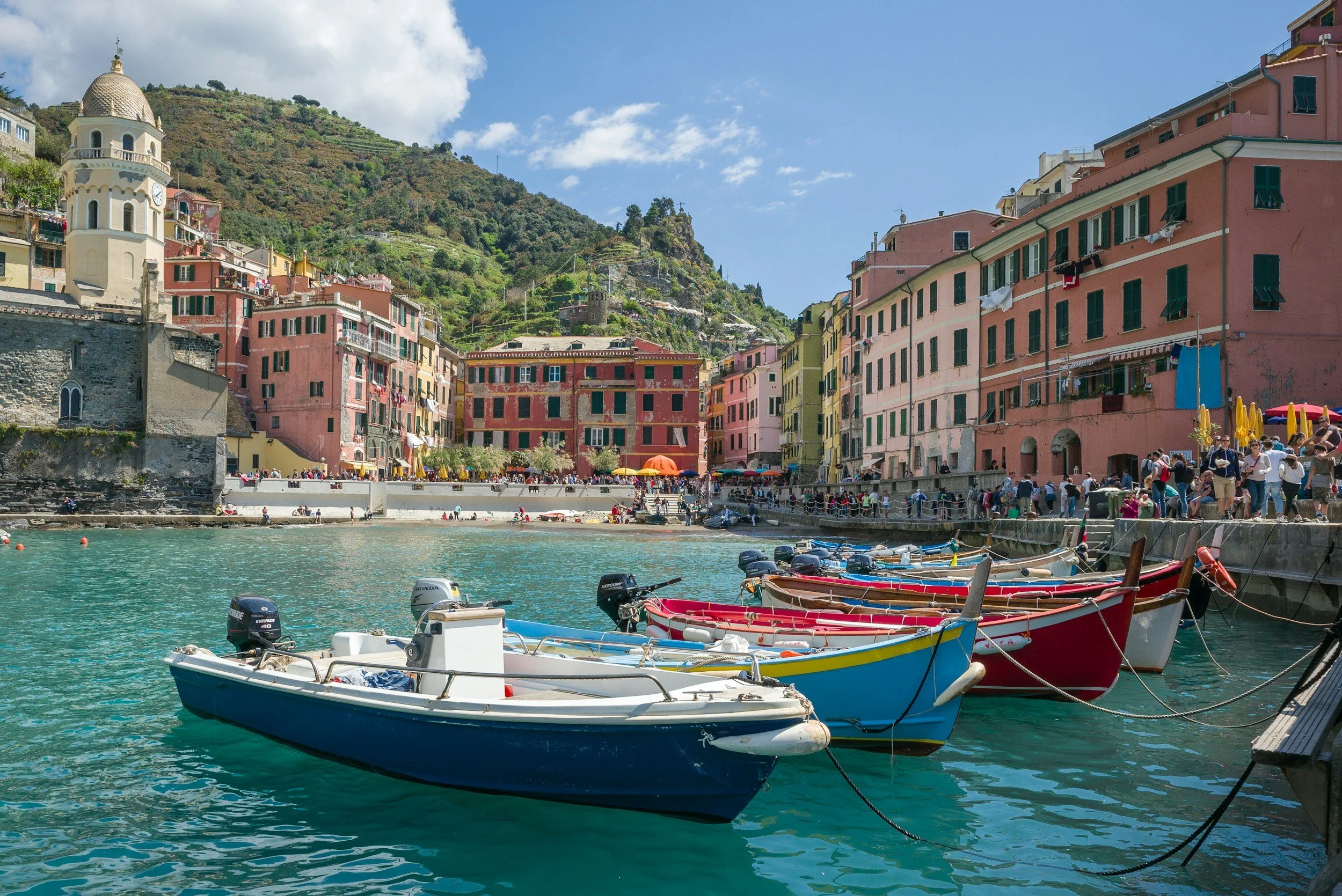
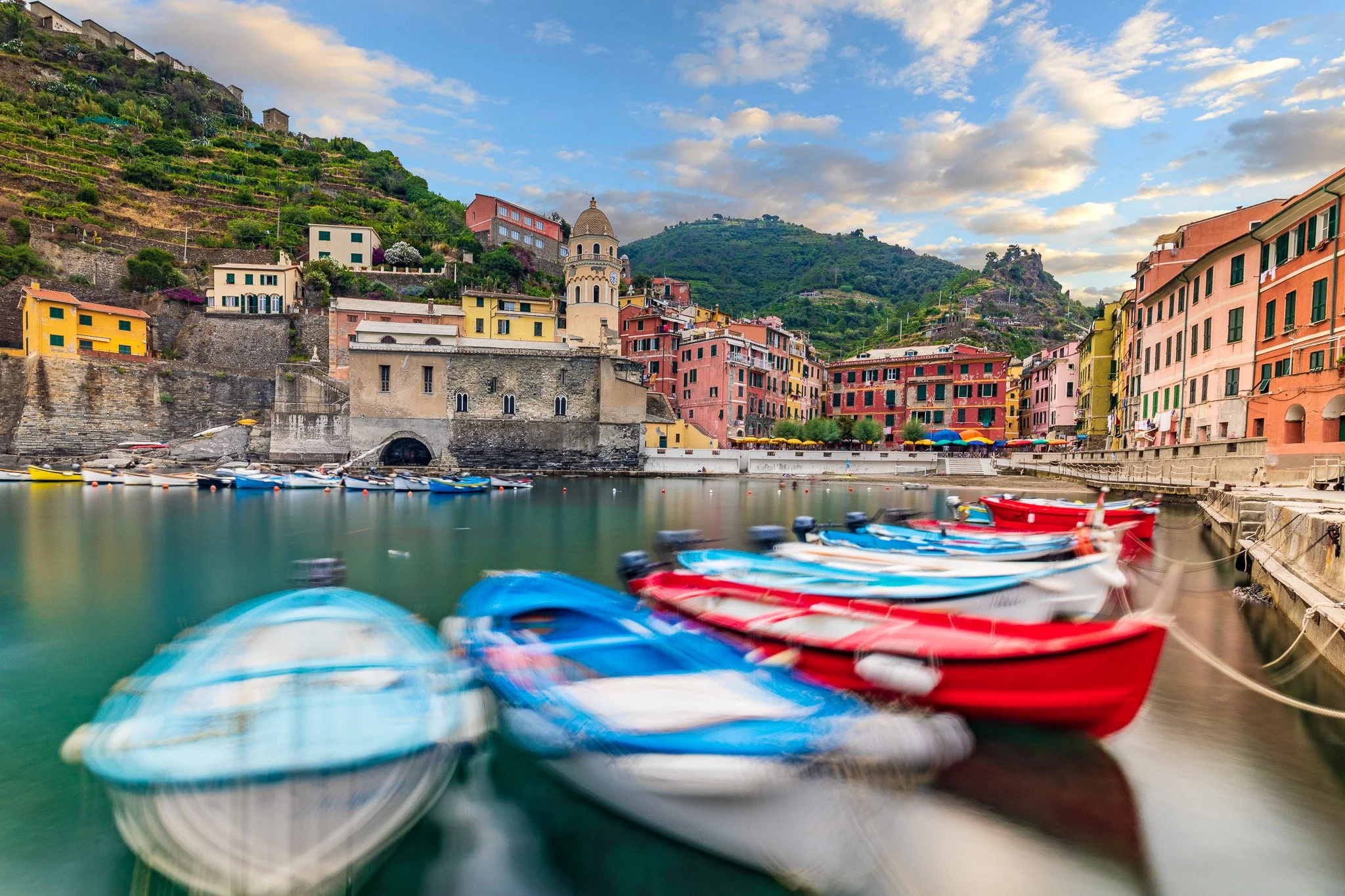
Vernazza Harbor
Vernazza is the most complete village in Cinque Terre from a photographic standpoint. The natural harbor, the castle tower, the church of Santa Margherita d'Antiochia, the dense stacking of buildings on both sides of the inlet. It is a self-contained composition that works from dozens of angles, and the light moves around it in a way that rewards multiple visits at different times of day.
The primary shooting positions are from the breakwater at the mouth of the harbor (which gives you the castle tower and village together), from the trail heading north toward Monterosso (which opens a hillside view of the entire bay), and from the castle itself (which looks down over the harbor and out to sea).
📷 Pro Tip: The trail above Vernazza toward Monterosso gives you one of the most classic elevated views in all of Cinque Terre after a five-minute climb from the trailhead. The grass in the foreground is tall in spring and summer, so shoot from a slightly elevated position to clear it. Early morning works well here because the light comes from the east and wraps around the village faces evenly. The harbor itself is best at golden hour, when the building facades on the south side of the inlet go deep orange. For the harbor itself, a 35-50mm focal length is ideal for keeping both sides of the frame in play without distortion.
Best time: Dawn for hillside view; golden hour for harbor. Access: Free. Central to Vernazza village.
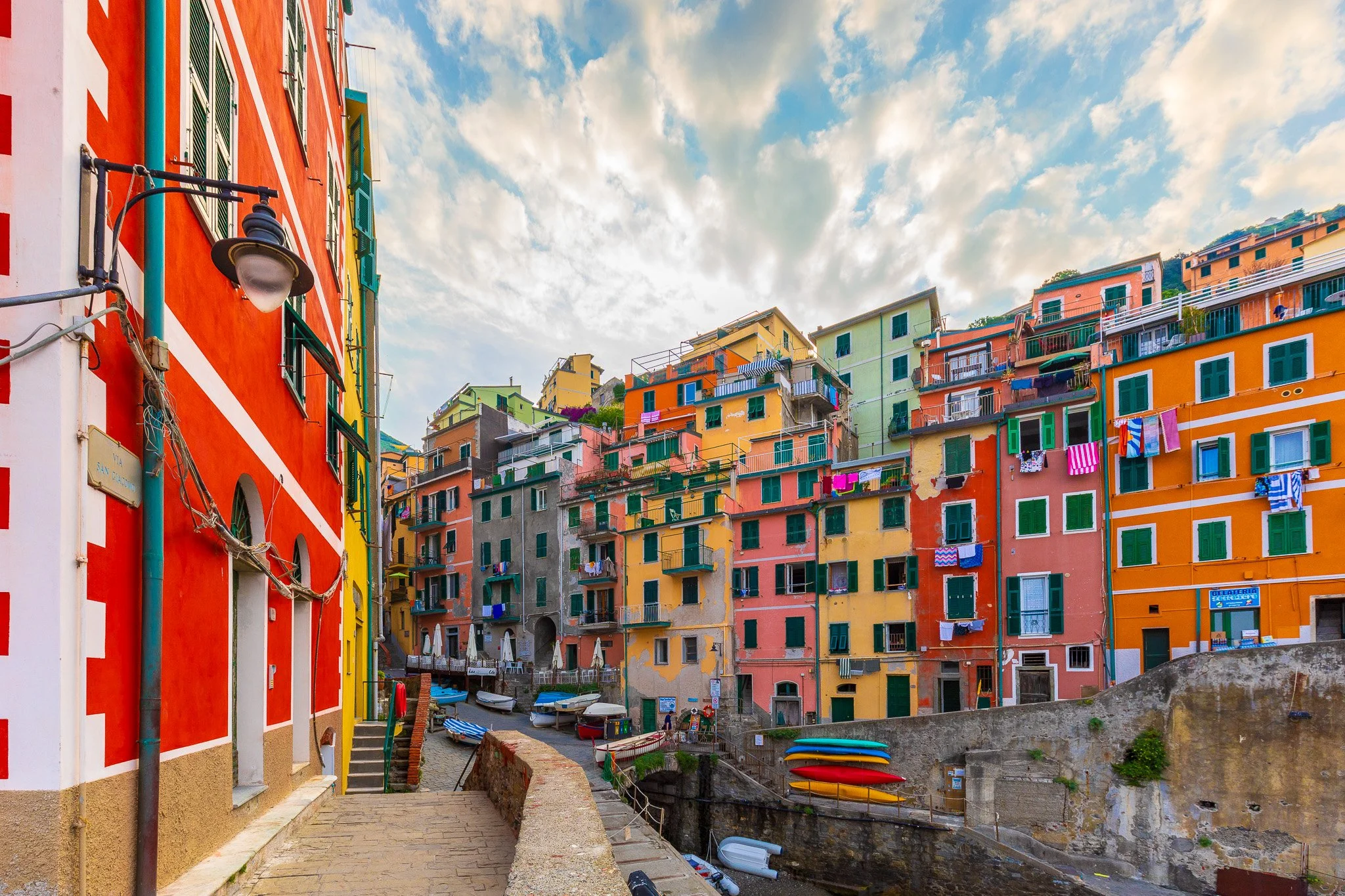
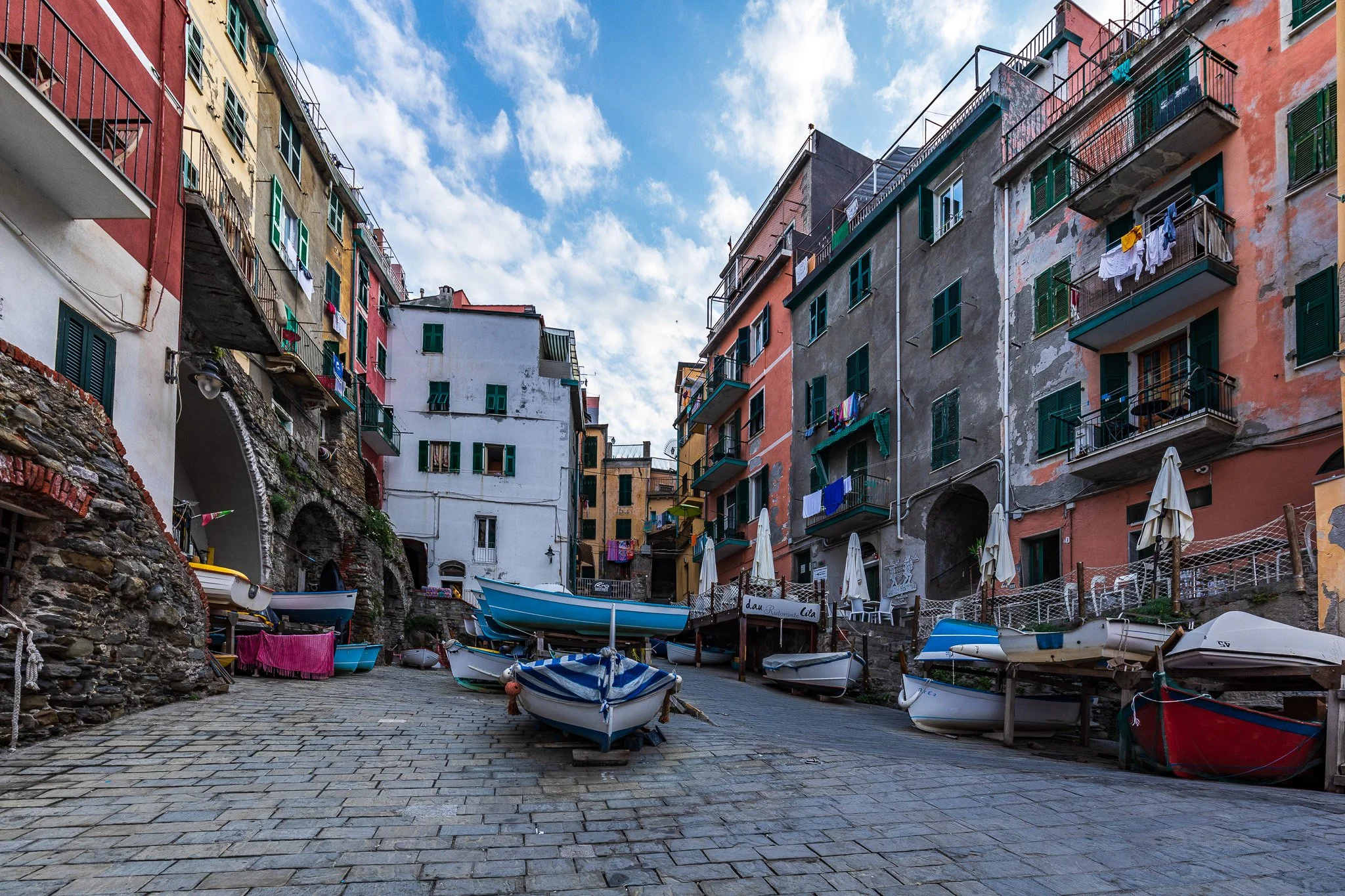
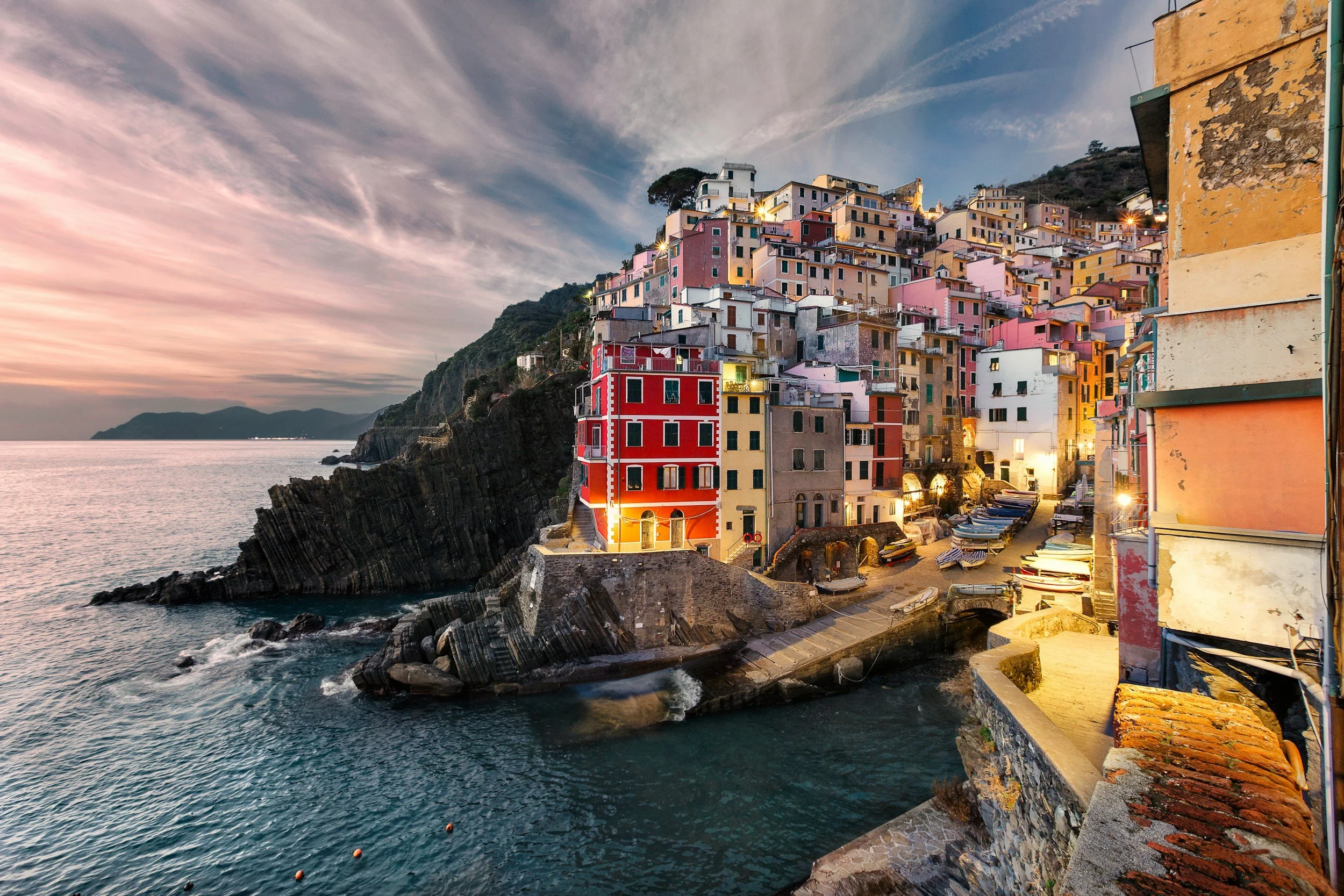
Riomaggiore Harbor Path
Riomaggiore is the southernmost of the five villages, and the first stop if you are taking the early train from La Spezia. The harbor path runs from the tunnel exit along the cliff to the small fishing harbor, past a series of viewpoints that look directly down into the boats and the water.
The harbor here is smaller and more intimate than Vernazza, and in that intimacy lies its photographic strength. The colors of the boats against the blue-green water, the weathered textures of the stone walls, and the geometric stairways cutting between the tightly packed buildings. This is close-in work: textures, layers, and the details of a working coastal town rather than wide panoramic compositions.
📷 Pro Tip: The viewpoint on Via San Giacomo, a small square partway up the hillside, gives you one of the best overviews of Riomaggiore and the harbor below. Note that metal railings have been added in recent years, which limits some of the lower framing positions you may see in older photographs. Shoot from a standing position and work with the geometry of the railing as part of your composition rather than fighting it. For the harbor itself, arrive before the fishing boats head out, typically before 7am, when they are still moored and the harbor is at its most photogenic. A 50-85mm focal length works well here for isolating individual boats against the water without pulling in too much of the surrounding noise.
Best time: Before 7am. Access: Free. Short walk from Riomaggiore station through the tunnel.
The Trail Between Vernazza and Corniglia
If you are shooting Cinque Terre over multiple days, the hiking trails between villages are not optional. They are where you get the photographs that no one else has, the wide coastal frames looking down at the villages from above, the terraced vineyards cutting across the hillside, the sea stretching flat to the horizon behind a cascade of stone walls and olive trees.
The section between Vernazza and Corniglia is particularly strong. The trail rises steeply out of Vernazza and, within fifteen minutes, delivers views back over the village and the coastline that simply cannot be reached any other way. The terraced landscape here is one of the most graphically powerful scenes in the region.
📷 Pro Tip: Check trail conditions before setting out. Some sections have been closed due to landslides. The Cinque Terre park website or the visitor center in any of the villages will have current access information. For this section, a 24-70mm zoom handles the range of compositions you will encounter, from wide coastal panoramas to tighter shots of vine rows and stone walls. Shoot in the first two hours after sunrise, when the low angle light rakes across the terraces and creates shadow definition in the stone walls. Afternoon light on this trail is flat and uninteresting.
Best time: First two hours after sunrise. Access: Cinque Terre Card required for trail access.
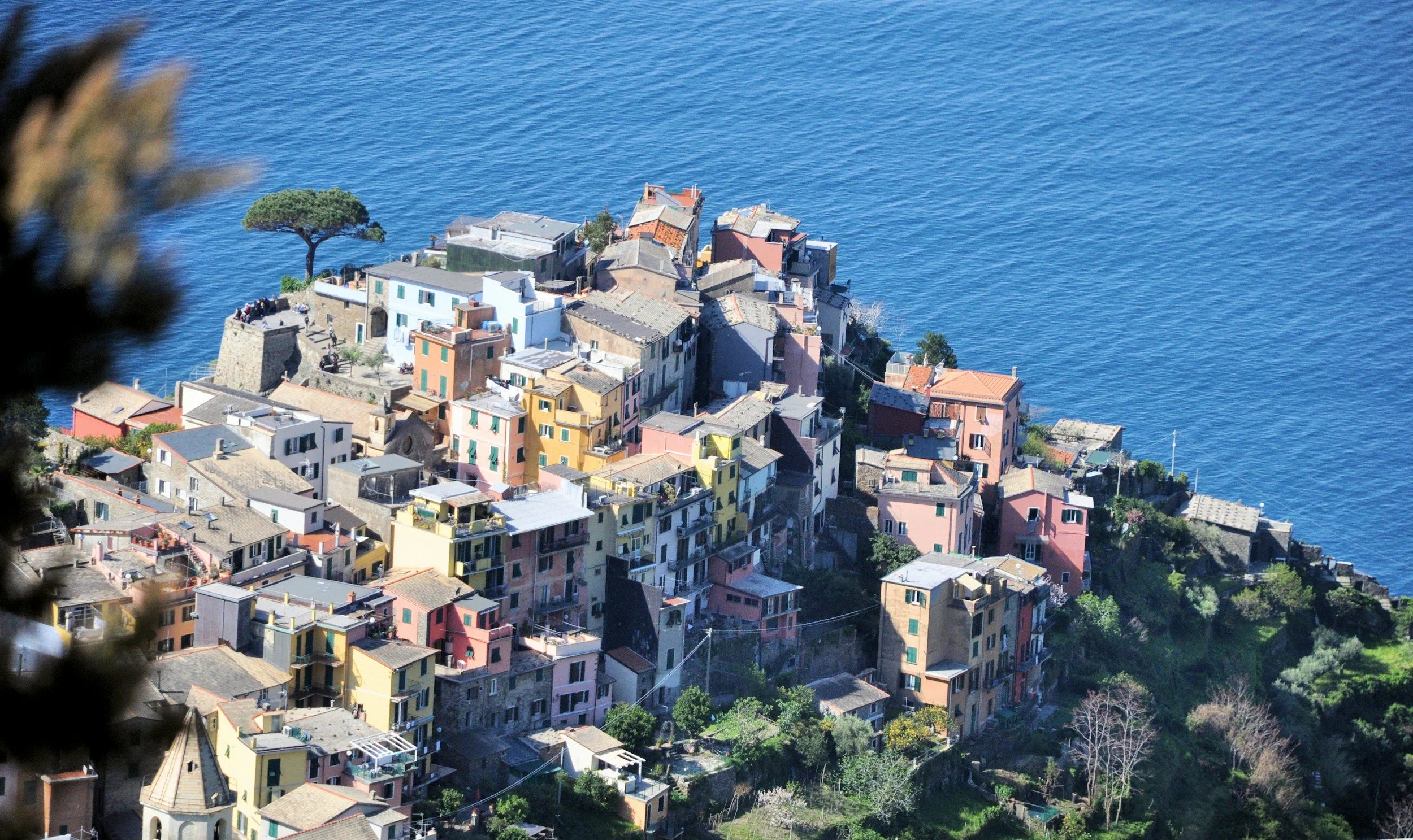
Corniglia Village and Belvedere
Corniglia sits on a promontory 100 meters above the sea, the only village in Cinque Terre with no direct harbor access. You reach it either by a long staircase of 377 steps from the station, or by a winding path from the trail. Most visitors skip it because it requires effort. This is an error, and the photographs from Corniglia are the proof.
From the belvedere at the edge of the village, you look south toward Manarola and north toward Vernazza simultaneously, with the coastline curving away in both directions. It is the only location in Cinque Terre where you can frame the broader geography of the national park in a single image.
📷 Pro Tip: The belvedere faces west, which makes it a genuine sunset shooting position, one of the few in Cinque Terre where the sun sets over open water rather than behind a hillside. Come in the last hour before sunset with a 24-70mm for wide coastal frames and a 70-200mm for compressed telephoto shots looking south toward Manarola. The village itself, with its narrow main street and flowering balconies, is strong street photography territory. A 35mm or 50mm prime and no tripod. Work slowly, be patient with the few residents you encounter, and you will find frames that feel nothing like the classic Cinque Terre postcard.
Best time: Late afternoon through sunset. Access: Free. 377 steps or trail from Corniglia station.
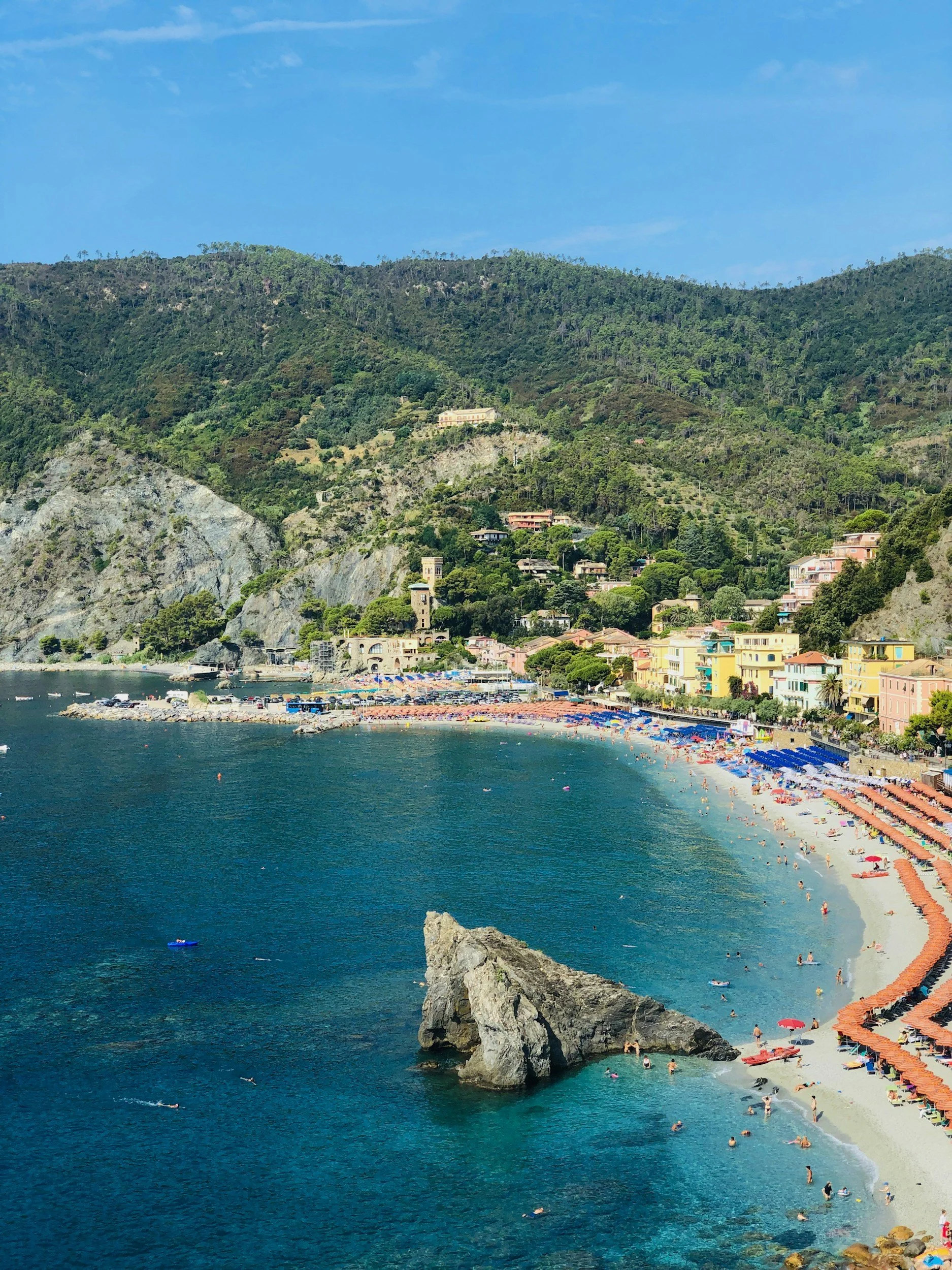
Monterosso al Mare Beach and Old Town
Monterosso is the largest, flattest, and most tourist-friendly of the five villages. It has a real beach, which makes it unlike anywhere else in the national park, and the stretch of sand at Fegina gives you a completely different visual vocabulary: beach umbrellas, swimmers, the wide open Ligurian sky, and in the background the cliffs that bookend the bay.
The old town, separated from the beach by a rock headland with a tunnel cut through it, is dense and photogenic in the classic Cinque Terre style. The Il Gigante statue, an enormous carved figure rising from the cliff above the water, is a distinctive photographic subject.
📷 Pro Tip: For the beach, arrive at first light before the umbrellas are set up and the sand is occupied. An empty Fegina beach with the old town headland in the background and the early morning sky above it is a quiet and very different image from anything else in Cinque Terre. For Il Gigante, a telephoto (100-200mm) isolates the figure against the sea without the surrounding tourist infrastructure intruding. The statue faces south, so midday light is flat; early morning gives you side light that brings out the surface texture and carved detail.
Best time: Sunrise for the beach; mid-morning for Il Gigante. Access: Free. Direct from Monterosso station.
Special Events and Festivals
Festa di San Giovanni Battista (June), Riomaggiore. The patron saint festival of Riomaggiore includes a candlelight procession through the village streets, outdoor celebrations, and fireworks over the harbor. The candlelight procession is the photographic event: slow shutter speeds, warm light, intimate village scale. Plan for this.
Wine Harvest Festival (October), various villages. Cinque Terre's Sciacchetrà wine is made from grapes grown on these coastal terraces, and the October harvest is a local event that draws visitors who want something beyond the standard tourist circuit. The vineyards above Manarola and Riomaggiore are active and accessible during harvest, and the workers, baskets, and terraced geometry make for strong documentary photographs.
Feast of the Nativity of Mary (September), Manarola. A traditional religious procession with the village dressed in lights. The combination of warm artificial light, stone architecture, and slow-moving crowds is made for long exposures and patient street photography.
Estate al Castello (Summer), Doria Castle, Vernazza. Concerts and cultural events are held in the castle above Vernazza during summer evenings. The castle's position at sunset is remarkable for photography, regardless of the event, but the added activity and crowd energy during performances create interesting documentary opportunities.
Frequently Asked Questions About Visiting Cinque Terre
Is the 5 am train really worth it?
Yes, completely, it's not a tip, it's the whole strategy. Our concierge at the Belmond Splendido told us that in 25 years, no one had ever asked him to arrange the earliest possible train to Cinque Terre. We did it anyway, stepped off in Riomaggiore before the light had fully broken, and worked our way north with the villages entirely to ourselves. We went back the next morning and did it again.
Do you need the Cinque Terre Card?
Yes, if you're using the trains or hiking trails, which you will be. It covers unlimited daily train travel between the five villages plus trail access, and it's worth buying the moment you arrive in La Spezia or Levanto.
Should you stay inside the park or nearby?
Both work. Staying in a village means no commute; you walk downstairs into the frame. Staying in La Spezia or Levanto, or even doing it as a day trip from somewhere like Portofino, gives you better hotel options and easier logistics, with a direct train in each morning.
What are the best photo spots in Cinque Terre?
Manarola's classic viewpoint at blue hour, Vernazza's harbor at golden hour, and the elevated trail between Vernazza and Corniglia in the first two hours after sunrise are three that consistently deliver. The full list with Pro Tips is above.
Can you fly a drone in Cinque Terre?
No. The entire national park and surrounding coastal waters are a protected zone where drones are prohibited, with strict enforcement and steep fines. Leave it at home.
How many days do you need in Cinque Terre?
Two full days minimum, three to four is the photographer's pace, enough to shoot each village in different light and explore the higher trail sections most visitors skip entirely.
Is Cinque Terre worth combining with Portofino or Florence?
Yes, both work beautifully. Portofino is where this particular story started, and the Italian Riviera between Genoa and La Spezia is one of the most photogenic coastlines in the Mediterranean. Florence is two hours south by train and offers an entirely different vocabulary, Renaissance architecture, and interior light rather than coastal villages. I would not combine Florence as a day trip.
Final Thoughts on Cinque Terre, Italy
Cinque Terre is one of those destinations that people either rush through or fall for completely. The difference, almost every time, comes down to timing and patience. If you arrive on the midday train with three hours before the ferry back to the mainland, you will see something photogenic and busy and vaguely exhausting. If you arrive before dawn with a tripod and a willingness to stand still, you will see something that stays with you.
The 5 am train is not a tip. It is the whole strategy. The concierge was right that no one does it. That is exactly why you should.
I have photographed Cinque Terre multiple times now, and the images I return to are never the ones made in the middle of the day. They are the harbor at Manarola before the light broke, the fishing boats in Riomaggiore before anyone was awake, the elevated trail view of Vernazza with the sea perfectly still and the village just beginning to show color. Every one of those images required arriving early and waiting.
Do that, and Cinque Terre will exceed anything you have seen in the photographs that brought you here in the first place.
If you would like to join a future photography workshop, visit my Workshops page for current offerings and upcoming dates. You can also connect with me on Instagram (@chasinghippoz) and Facebook, or subscribe to the newsletter for travel photography tips, destination guides, and behind-the-scenes stories from more than 75 countries. I look forward to sharing the journey with you.
Continue Exploring Italy and the Italian Riviera
My Photography & Travel Guide to Florence, Italy. The natural companion to a Cinque Terre trip. Florence sits two hours south by train and offers an entirely different photographic vocabulary: Renaissance architecture, marble, dramatic interior light in the Duomo and Uffizi, and one of the finest golden hours in Europe from Piazzale Michelangelo. The two together tell the full story of northern Italy.
My Photography & Travel Guide to Portofino and the Italian Riviera. Portofino is where this particular Cinque Terre story started, at a concierge desk where a man looked at us with complete disbelief. The Riviera coast between Genoa and La Spezia is one of the most photogenic stretches of shoreline in the Mediterranean, and Portofino sits at its most polished point.
My Photography & Travel Guide to the Amalfi Coast, Italy. For photographers who fall in love with the idea of colorful villages on vertical coastlines, the Amalfi Coast is the natural next chapter. The scale is different, the crowds are similar, and the photography rewards are equally significant. Positano and Ravello in particular offer elevated compositions that rival anything Cinque Terre produces.
Finally—a beginner-friendly photography guide that makes sense.
If you've ever picked up a camera and thought, "Now what?" this is the book for you.
Photography Made Simple is written for adults who are just starting out and want a clear, encouraging, real-world approach to learning photography. Whether you're using a DSLR, mirrorless, or just your smartphone, this guide walks you through the basics—without the jargon or tech overwhelm.
Inside, you'll learn:
The only camera settings you really need to know to get started
How to shoot sharper, more intentional photos using light and composition
Simple tips for portraits, landscapes, travel, and everyday life
What gear you do (and don’t) need
How to create better photos without upgrading your camera
You’ll also get practical exercises, cheat sheets, and tips for organizing and editing your images—plus the confidence to shoot off Auto Mode for good.
This is not a textbook. It’s a friendly guide to seeing the world with fresh eyes—and finally capturing what you see the way you imagine it.
📸 Format: PDF download
Pages: 100+
Perfect for: Beginners, hobbyists, and anyone ready to take better photos without the stress