Portofino, Italy Travel & Photography Guide: Best Photo Spots, Things to Do & Hidden Gems
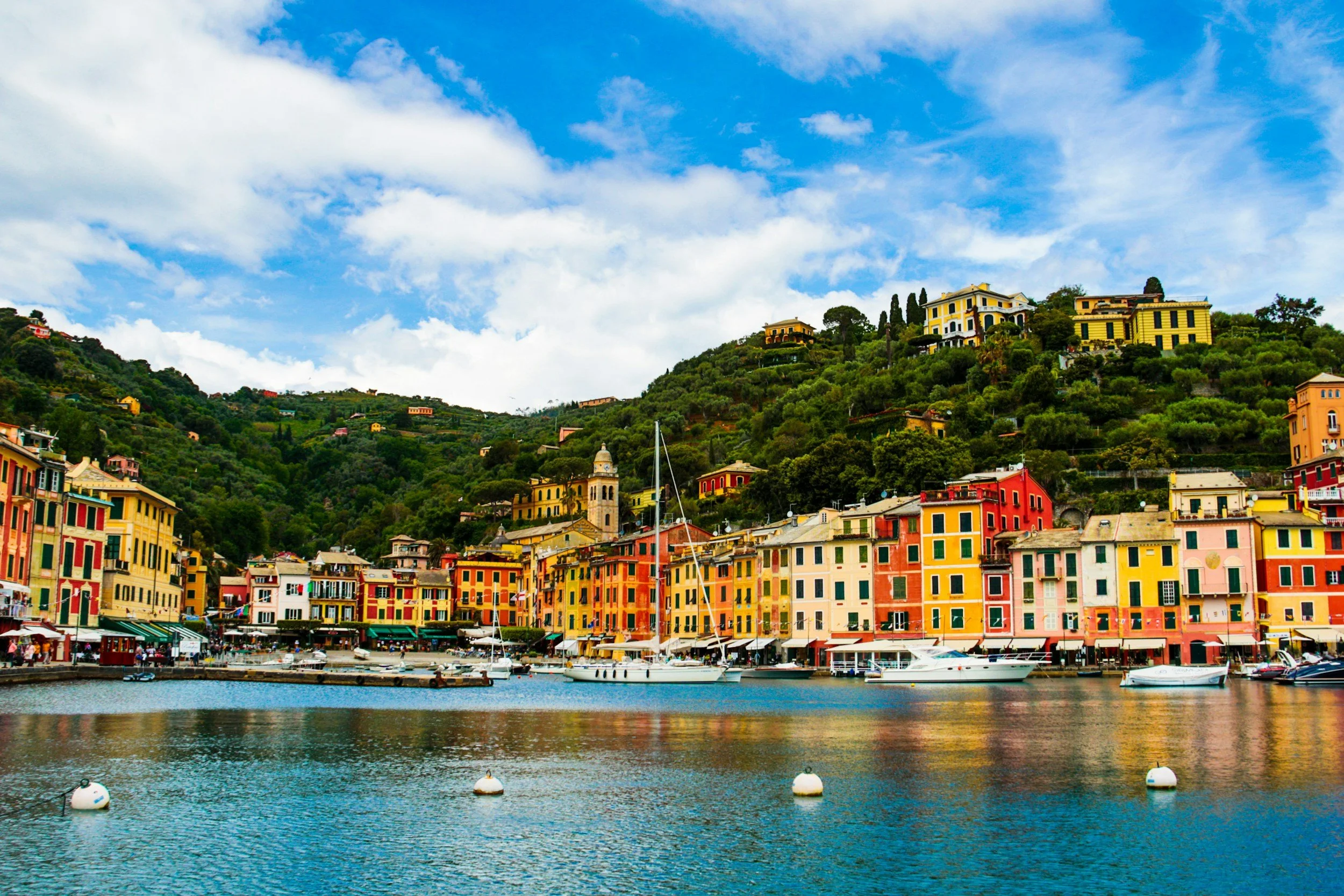
Portofino is one of those places that photographs itself. The pastel facades stacked around the harbor, the green hills folding down to the water, the yachts sitting still in the morning quiet before the day crowds arrive. Point a camera in almost any direction, and something is working in your favor. I have visited several times now, and the draw never fades.
What makes Portofino special is how compact and walkable it is. You can cover the entire village on foot in under an hour. The lighthouse trail, the climb to Castello Brown, the harbor loop, the walk over to Paraggi Beach — all of it is on foot, all of it is beautiful, and none of it requires a car or a complicated transit plan. That simplicity is part of what makes it such a satisfying place to photograph. You slow down, you wander, and the light finds you.
The Italian Riviera has no shortage of beautiful towns, but Portofino sits at the top of the list for sheer visual concentration. Cinque Terre is about an hour south by road or ferry, and the two destinations work exceptionally well together as a paired trip. If you are already making the journey to this part of Liguria, both belong on your itinerary.
In this Photography Guide to Portofino, I share the places and experiences that continue to draw me back. You will find my favorite photography locations, guidance on when and where to shoot, practical travel tips, and gear recommendations, along with cultural insights to help you explore and photograph Portofino with confidence, respect, and ease.

Portofino from Above
Photographer's Notes
Before you go, here are my own takeaways.
Favorite Season: Spring (April to early June)
Favorite Location: The Piazzetta
Favorite Hotel: Splendido Mare, A Belmond Hotel
Favorite Restaurant: Langosteria Paraggi
Favorite Café: Bar Morena
Favorite Lens: 15-35mm
Would I Return? Yes, definitely.
Where to Stay in Portofino, Italy
The harbor and piazzetta area is where you want to be. Portofino is tiny, and staying close to the center means you can walk out for sunrise before anyone else is awake. That early morning window is everything here.
Luxury Hotels
Splendido, A Belmond Hotel. Perched on the hillside above town, the Splendido is Portofino's landmark property. The 16th-century former Benedictine monastery reopened in 2025 following a full renovation by designer Martin Brudnizki, and the results are extraordinary. Rooms face the sea, the heated saltwater pool hangs over the bay, and the hotel now houses the first Dior Spa in Italy. Note that it is open April through October only. A shuttle connects you to the Splendido Mare down at the piazzetta.
Splendido Mare, A Belmond Hotel, is the sister property to the Splendido, and it was my base on one of my visits. It sits directly on the piazzetta with front-row views of the harbor. Wake up, open your window, and the harbor is right there. For a photographer, the location cannot be beaten. Breakfast here while the morning light comes across the water is one of those memories that sticks.
Eight Hotel Portofino is a stylish boutique option set in the greenery just a short walk from the harbor. Sleek interiors, a smaller feel, and a quieter position than the front-row properties. Good choice if you prefer something less formal without sacrificing quality.
Mid-Range Hotels
Hotel Piccolo Portofino is perched just above the village with a private rocky beach and clean, contemporary interiors. Solid value for Portofino, where mid-range is still relative. The beach access is a genuine bonus in summer.
Albergo Nazionale is right on the main square. The location is the selling point here. Step outside and you are in the heart of everything. Simple, well-kept, and genuinely well-positioned.
Hotel Argentina is about a 15-minute walk from the center, which in Portofino is nothing. More relaxed feel, slightly more accessible price point, and a sweet atmosphere. Good base if you want to save budget for food and boat tours.
How Many Days Should I Stay in Portofino, Italy?
Three days is the right amount for Portofino at a photographer's pace. Two is manageable if you are efficient, but you will feel the squeeze.
Day one, arrive in the afternoon, walk the harbor, get your bearings, and shoot blue hour from the piazzetta. Day two, wake up for sunrise, shoot the harbor before the boats arrive, then climb to Castello Brown for mid-morning light and continue to the lighthouse. Spend the afternoon at Paraggi Beach or take a boat tour. Day three, use the morning for any shots you want to revisit, then take a ferry over to Cinque Terre or Santa Margherita Ligure before heading out.
If Cinque Terre is on your list, and it should be, budget an extra day or two for that side trip. The two destinations together make for one of the strongest photography weeks you can build in Italy.

Best Time to Visit Portofino, Italy
Spring (April to early June) is the best window for photographers. The light is soft and directional, crowds are manageable, the hills are green, and golden hour arrives late enough to give you time after dinner to shoot. April also brings the Festa di San Giorgio, the village's patron saint festival, which adds color and life to the piazzetta.
Early fall (mid-September to October) is the other strong window. Summer visitors have left, the light takes on that warm autumnal quality, and the harbor feels calmer. You can actually get a clear frame of the piazzetta without editing out a hundred tourists.
Summer (July to August) is peak season. The village is packed, the yachts fill the harbor, and the piazzetta is crowded from mid-morning onward. That said, the energy is real, and the light in June, especially, is exceptional, with golden hour stretching toward 9 pm. If you visit in summer, your best photography happens before 8 am and after 7 pm.

Getting Around Portofino, Italy
Portofino is fully walkable. Everything you want to photograph is on foot: the harbor, the piazzetta, Castello Brown, the Church of San Giorgio, and the lighthouse trail are all connected by pedestrian paths. Comfortable shoes matter more than anything else you pack.
To get to Portofino from outside the village, the ferry from Santa Margherita Ligure is the most scenic option and takes about 20 minutes. Taxis and local buses also run from Santa Margherita, which is the nearest train station. Uber is not available here. Local taxi services and water taxis cover most transport needs, and for the best harbor shots, renting a private boat or joining a boat tour is absolutely worth it.
If you are day-tripping to Cinque Terre, ferries run seasonally along the coast and offer some of the best angles for shooting both Portofino and the Cinque Terre villages from the water. Check seasonal schedules in advance as service varies.


Where to Eat in Portofino, Italy
Portofino is an expensive destination, and the food reflects that. Most of the restaurants on the piazzetta serve a captive luxury audience. That said, a handful of places genuinely earn their reputation.
Ristorante Puny — Right on the piazzetta, Puny is an institution. The pappardelle is excellent, the fish baked in salt crust is the move for a main, and the outdoor tables give you a front-row view of the harbor. Book well in advance for summer. Closed on Thursdays and in January and February.
Trattoria Tripoli — Casual, harbor-facing, and a good place for spaghetti alle vongole without the full ceremony of a fine dining experience. Dependable and comfortable.
DaV Mare — The Belmond dining experience at sea level. Creative seafood, polished service, and the kind of atmosphere that fits the setting. Good for a special evening.
Taverna del Marinaio — Consistently rated well by people who actually eat here rather than pose for photos. Fresh, straightforward, and genuinely good.
Langosteria Paraggi — Located at Paraggi Beach, about ten minutes by road from Portofino. Luxurious beachfront dining with excellent seafood. Best for a long lunch between photography sessions.
Panificio Canale — Not in Portofino itself but in nearby Santa Margherita Ligure. Stop here on your way in or out for focaccia that will reset your expectations for what focaccia can be.

Coffee
Bar Morena — Friendly, unpretentious, and good espresso. One of the better people-watching perches on the piazzetta.
Winterose Wine Bar — A wine bar that also does coffee well, with views that justify the stop. Good spot to sit, edit a few frames, and watch the harbor wake up.
Photography Gear to Bring to Portofino, Italy
Mirrorless/DSLR Kit
Portofino rewards versatility. You will want a wide zoom for the harbor, a telephoto for compressing the coastline from the lighthouse and Castello Brown, and a fast prime for the low-light piazzetta shots.
Camera bodies: Canon EOS R5 Mark II, Sony A7R V, or Nikon Z8. Any of these handles the full range of conditions here, from bright midday reflections on the water to blue hour long exposures.
Lenses to bring:
16 to 35mm: Wide harbor shots, architecture, and interior spaces. Essential.
24 to 70mm: The workhorse. Street scenes, portraits, the piazzetta at golden hour.
70 to 200mm: Compressing the colored facades against the hillside, shooting the harbor from Castello Brown, framing boats from a distance. Brings a different dimension to the same view that everyone else is shooting.
Accessories:
Tripod or Platypod: Required for sunrise harbor long exposures and blue hour. The reflections in the water at first light are among the strongest images you can make here.
Circular polarizer: Cuts glare on the water and makes the colors of the facades pop against the sky. One of the most useful filters you can bring to a harbor town.
ND filters (6 and 10 stop): For longer daytime exposures on the water.
Extra batteries and cards: Limited charging options if you are out on the trail all day.
Samsung T7 SSD for end-of-day backup.
Drone: The Portofino peninsula sits within protected areas. Check current regulations before flying. Restrictions are in place and enforcement has increased in recent seasons. Do not assume you can fly freely here.
iPhone Tips
Portofino is excellent for iPhone photography, and the scale of the village means you are never fighting with a large kit.
Use the ultrawide lens (0.5x) for the harbor reflection shots early in the morning, when the water is flat and the pastel facades mirror cleanly. Get low to the waterfront edge to maximize the reflection in the frame.
At Castello Brown, switch to your telephoto lens (3x or 5x depending on your model) to compress the harbor from above. The layering of boats, buildings, and hillside reads best with a longer focal length.
For the lighthouse trail, use Cinematic mode in the late afternoon to capture the coastal vegetation and sea views with natural subject separation. The soft backlight through the trees on the path is one of the quieter shots most people miss.
In low light on the piazzetta, use Night mode but hold the phone steady against a wall or railing rather than handholding. The harbor lights reflect on the stone at dusk in a way that rewards a little patience.

Best Photography Locations in Portofino
Portofino Piazzetta (Piazza Martiri dell'Olivetta)
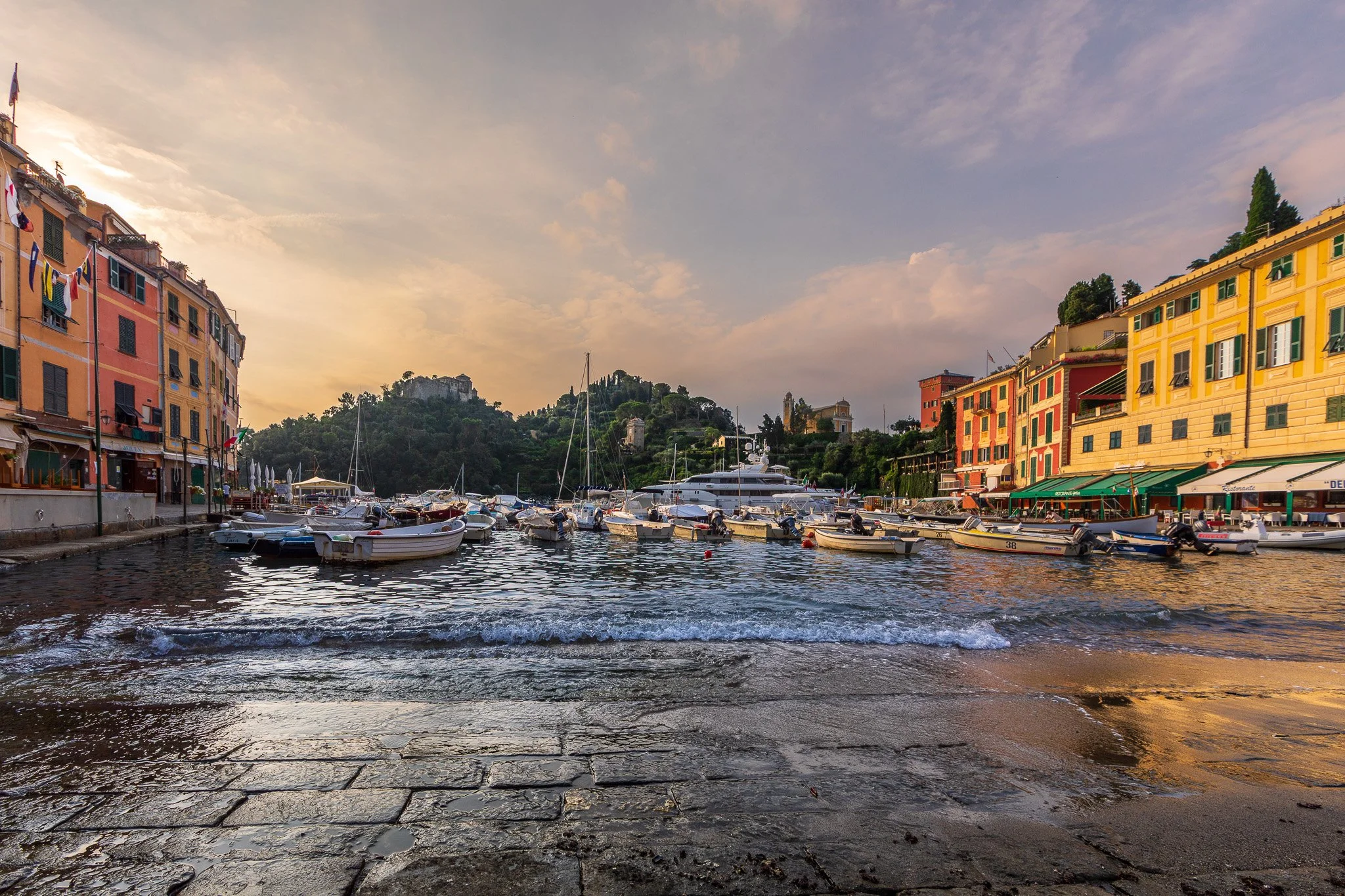
The heart of the village and the spot most people come to. The curved harbor, the pastel facades, the boats, the outdoor cafe tables — it is all concentrated in one small square. The difference between a good photo here and a great one is almost entirely about timing. At midday, with crowds and flat light, it is a snapshot. At sunrise with still water and low golden light, it is something else entirely.
The reflections are the key. When the harbor is glassy in the early morning, the facades double in the water and the geometry becomes twice as interesting. Position yourself at the far left end of the harbor wall, shooting back toward the piazzetta with the water in the foreground.
📷 Pro Tip: Arrive at or before sunrise. In summer, this means 5:30 am to 6:00 am. You will likely have the piazzetta entirely to yourself for the first 30 to 45 minutes. Set up with your tripod at the harbor edge and shoot wide at 16 to 24mm with a slow shutter speed to smooth the water. As the light comes up, shift to a 50mm or 70mm lens to isolate individual facades. By 9 am in peak season, the square is busy. Your window is narrow. Use it.
Best time: Sunrise and blue hour. Access: Free. Walk straight to the harbor from any hotel in the village center.
Castello Brown
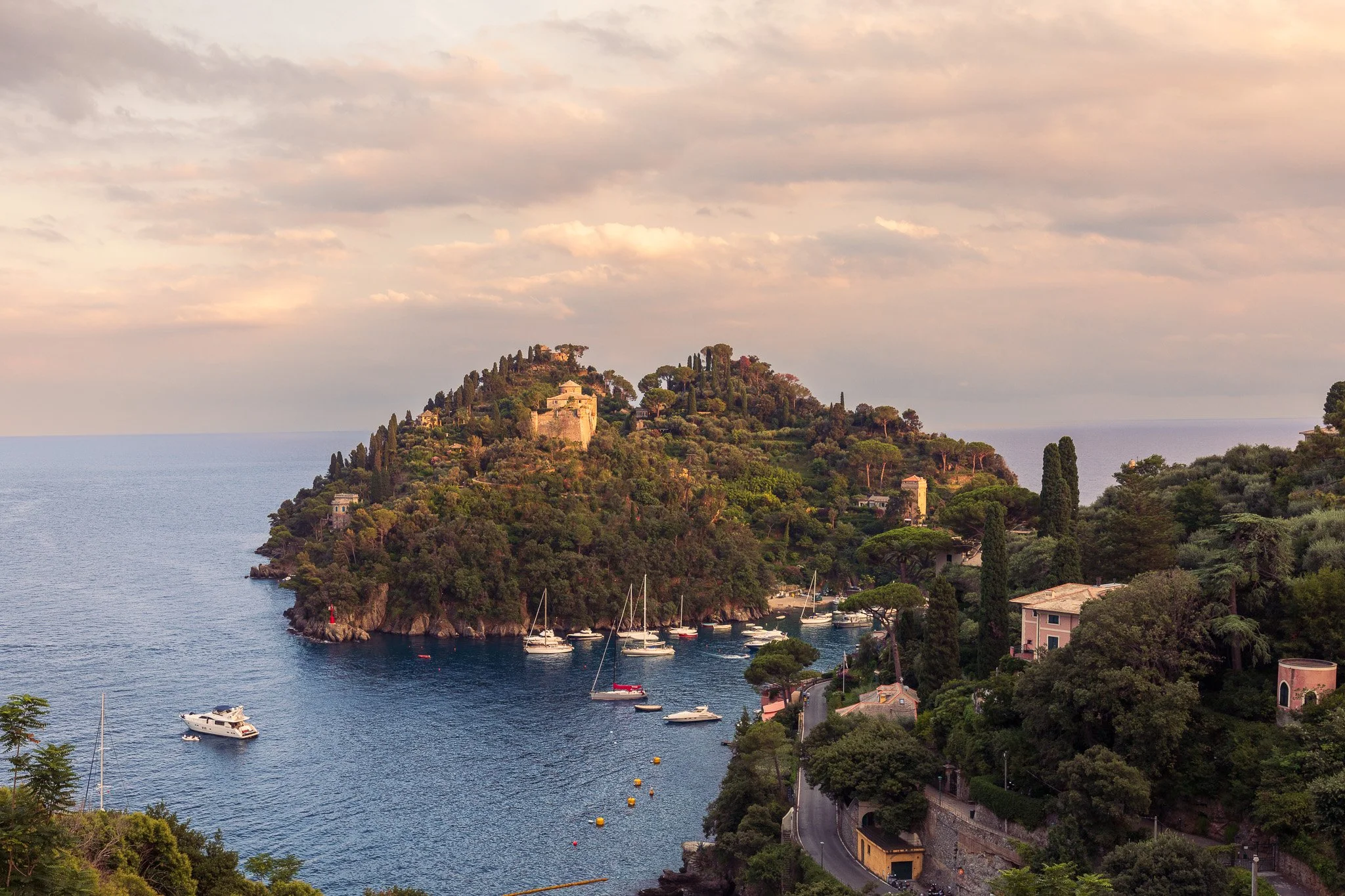
A 16th-century hilltop fortress that served as Portofino's defensive stronghold before a British diplomat named Montague Yeats Brown bought it in 1867 and transformed it into a private residence. Today it is a museum and event venue, but the reason photographers climb up here is the terrace. From those views, the entire harbor opens below you in a way that no ground-level shot can replicate. The layering of boats, the piazzetta, and the green hills behind is the defining aerial composition of Portofino.
The climb from the harbor takes 15 to 20 minutes along a steep but manageable pedestrian path. The gardens inside are well-kept and photogenic in their own right, with the Mediterranean framed through arched stone openings.
📷 Pro Tip: The best light on the harbor from Castello Brown is late afternoon, roughly two hours before sunset, when the sun comes from the west and side-lights the colored facades. Bring your 70 to 200mm and shoot down at a compression angle that stacks the boats and buildings. The wide shot from the main terrace is the obvious frame; the more interesting image is often found by moving along the terrace wall and finding a narrower composition that cuts through the yacht masts to the village. Entry is €8 per person, children under 12 free. Tickets at the gate only, no online booking.
Best time: Late afternoon. Access: €8 entry, daily 10:00 to 19:00 in peak season. 15 to 20 minute uphill walk from the piazzetta following signs to Via alla Penisola.
Faro di Portofino (Portofino Lighthouse)
The lighthouse sits at the very tip of the peninsula, built in 1917 and still operating. Getting there requires a 1.5 to 2.5km walk from the village center, depending on your route, and involves a sustained climb with steps and uneven sections. It is not technically difficult, but wear proper shoes and bring water in summer. The reward is open sea views in three directions and a completely different quality of silence compared to the busy village.
The photographic value is not just the lighthouse itself but the walk to it. The coastal path passes through Mediterranean scrub and along cliff edges with the Ligurian Sea below. There is a small bar at the lighthouse where you can recover before the return walk.
📷 Pro Tip: Go in the late afternoon and time your arrival at the lighthouse for the hour before sunset. The light hits the white structure from behind, creating a clean silhouette against the colored sky. Shoot wide at 16 to 24mm to capture the lighthouse against the sea horizon. On the walk back, stop at the viewpoints that open toward the village and look back with your 70 to 200mm. This reverse angle, with Portofino visible in the small bay below the peninsular cliffs, is one of the most underused shots in the area. The lighthouse is not open to enter, but the surrounding area and the views are the point.
Best time: Late afternoon through sunset. Access: Free. Follow signs from the piazzetta toward Via alla Penisola and continue past Castello Brown.
Church of San Giorgio (Chiesa di San Giorgio)
A small whitewashed church on the hillside above the harbor, set among trees with a terrace that looks out over the bay. It is quieter than the piazzetta and draws fewer people, which makes it more interesting for photography in some ways. The church itself is simple and elegant, and the surrounding churchyard has an intimate, non-touristy quality even in high season.
The terrace in front of the church is one of the better mid-height views of the harbor, sitting between the ground-level piazzetta and the elevated Castello Brown. Each altitude gives you a different geometry, and San Giorgio sits in between at a perspective most people skip.
📷 Pro Tip: Morning light from the east comes directly into the church facade and the terrace, making this the best location to visit early while Castello Brown is still in shade. Use a 24 to 70mm lens for the wider terrace view and a 35mm or 50mm prime lens for tighter architectural frames of the church itself. The path through the cemetery adjacent to the church is quiet and photogenic in soft light, with stone walls and cypress trees that give you a completely different visual register from the harbor shots everywhere else.
Best time: Morning. Access: Free. 10-minute uphill walk from the piazzetta.

Paraggi Beach
The only sandy beach in the Portofino area is situated in a small cove about 1.5km from the village by road. The water is a clear, shallow emerald green that photographs unlike almost any beach in northern Italy. Private beach clubs line most of the shore, with Langosteria Paraggi as the premium option, but a small public section exists.
The visual appeal for photographers is the combination of clear water color, the backdrop of green hills, and the elegant, low-key atmosphere. It lacks the dramatic cliffs of other Ligurian locations but delivers color and light in a softer register.
📷 Pro Tip: Shoot in the morning when the sun is still east-facing and the water has not yet been churned up by swimmers. A polarizer is essential here to cut the surface glare and render the water in its actual green depth. At 16 to 24mm with the polarizer dialed in, the foreground water becomes almost abstract. If you have a drone and proper permits, the aerial view of this cove is exceptional. From ground level, the best angle is from the rocky outcroppings at the south end of the beach, shooting back toward the cove with the hills as the backdrop.
Best time: Morning. Access: Public section free, beach clubs charge for sun beds. Taxi or bus from Portofino, approximately 10 minutes.
Festivals & Events
Festa di San Giorgio (April) The most important local festival of the year, celebrating Portofino's patron saint on April 23rd. The village comes alive with processions, bonfires on the hilltops, and a genuinely local energy that is rare in a destination this internationally famous. Photographers will find the evening bonfire and the piazzetta gatherings more interesting than the daytime parade, though the procession through the narrow streets is worth documenting. Arrive early to find your position before the crowd settles in.
Portofino Regata (Summer) A sailing regatta that brings a fleet of traditional and racing vessels into the harbor, creating a completely different visual dynamic from the usual luxury yacht scene. The piazzetta fills with sailors and spectators, and the harbor is layered with color and movement. For photographers, the action shots from the waterfront during the race are the priority, but the boat preparations in the early morning before the start are often the more interesting frames.
Jazz on the Harbor (June) A music event that takes over the piazzetta with live jazz performances against the backdrop of the harbor. The combination of warm evening light, an engaged crowd, and live music creates a candid photography environment that is very different from the usual composed landscape shots. Shoot wide to include the setting, then move in close for faces and instruments. Low-light performance, so fast glass at f/1.8 or f/2.8 is the tool here.
Portofino Summer Cultural Events (July to September) Throughout the summer, the village and the surrounding area host concerts, open-air cinema, and cultural gatherings. These are informal and change season to season, so check local listings closer to your travel dates. The piazzetta and the castle grounds are both used as venues, and evening events at Castello Brown offer a rare opportunity to photograph the harbor from above in a lively, populated context.

Frequently Asked Questions About Visiting Portofino
Do you need a car in Portofino?
No, the village is fully walkable, and cars are impractical given the narrow streets and limited access. Arrive by ferry from Santa Margherita Ligure, about 20 minutes and the most scenic option, or by taxi.
Is Portofino expensive?
Yes, genuinely, it's one of the pricier destinations in Italy. Most piazzetta restaurants cater to a luxury audience, though spots like Trattoria Tripoli offer good value without the full ceremony.
How many days do you need in Portofino?
Three days at a photographer's pace, two if you're efficient. Pair it with Cinque Terre, about an hour away, for one of the strongest photography weeks in Italy.
What are the best photo spots in Portofino?
The Piazzetta at sunrise before the crowds, Castello Brown at late afternoon for the elevated harbor view, and the lighthouse trail at sunset are three that consistently deliver. The full list with Pro Tips is above.
Can you fly a drone in Portofino?
Check current regulations before flying, the peninsula sits within protected areas with active enforcement. Don't assume you can fly freely.
What surprised you most about Portofino?
The elegance of the town. Photos prepare you for the color and the harbor, but the quiet, understated sophistication of the place, even amid the yachts and luxury shopping, is something you only really feel once you're standing there.
Is Portofino worth combining with Cinque Terre?
Yes, absolutely, about an hour away by road or ferry. The two destinations together make one of the strongest photography trips on the Italian Riviera.
Is Portofino worth combining with Florence?
Yes, it's a natural next stop moving south. Florence rewards a wide lens and slow walking, particularly in the Oltrarno neighborhood at late afternoon.
Final Thoughts
Portofino is small, and that is its entire appeal. You do not need a plan beyond putting on good shoes and walking. The harbor leads to the church, the church leads to the castle, the castle leads to the lighthouse, and every step of that trail gives you something worth shooting. After a few days here, you start to understand the rhythm of the light and the quiet hours when the village belongs to you and whoever else was willing to set an early alarm.
I have come back several times, and each visit I find a frame I missed the one before. That is how you know a place is worth returning to.
Want to improve your photography while exploring some incredible destinations? Join me on one of my photography workshops! You can find all the details, including upcoming destinations and dates, through the links below.
Let's Stay Connected!
My Photography & Travel Guide to Cinque Terre, Italy: A short ferry ride or one hour by road from Portofino, Cinque Terre is one of the most photogenic coastlines in the world. Five villages, dramatic cliffs, and a hiking trail that connects them all. The two destinations belong on the same trip.
My Photography & Travel Guide to Florence, Italy: The logical next stop if you are moving south through Italy after the Riviera. Florence rewards slow walking and a wide lens, and the light in the Oltrarno neighborhood in the late afternoon is among the best anywhere in Europe.
My Photography & Travel Guide to Puglia, Italy: The heel of Italy's boot and one of the most visually distinct regions in the country. Whitewashed trulli in Alberobello, the Baroque grandeur of Lecce, and the Adriatic coast stretching in both directions. A completely different Italy from the Riviera, and all the better for it.
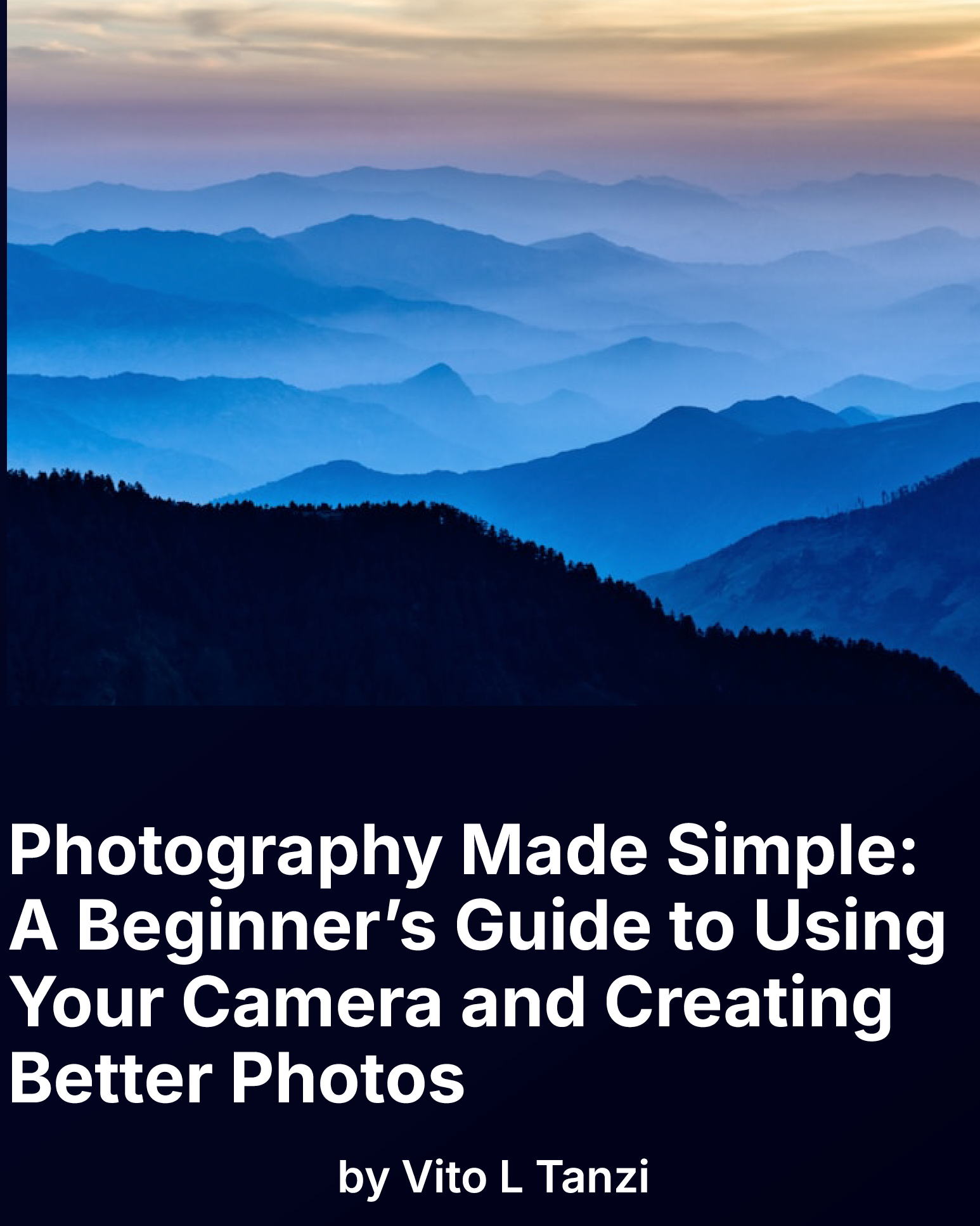
Photography should feel exciting, not confusing.
If you have ever picked up a camera and thought, “Now what?” this book was written for you.
Photography Made Simple is a clear, encouraging guide for adults who want to understand photography without getting buried in complicated terminology, technical formulas, or endless equipment advice.
Whether you use a DSLR, mirrorless camera, or smartphone, Vito L. Tanzi walks you through the essential skills you need to take more intentional, creative, and consistently better photographs.
Inside, you will learn:
• The camera settings that matter most when you are getting started
• How aperture, shutter speed, and ISO work together
• How to create sharper photographs and choose the right focus settings
• How to use light and composition to make your images more interesting
• Practical techniques for portraits, landscapes, travel, and everyday photography
• What equipment you actually need, and what you can safely ignore
• How to improve your photographs without buying a new camera
You will also find practical exercises, simple cheat sheets, and helpful advice for organizing and editing your photographs.
This is not a textbook. It is a friendly, practical guide designed to help you move beyond full Auto, understand what your camera is doing, and feel more confident every time you press the shutter.
Photography is not only about learning settings. It is about learning to notice light, color, emotion, and the small details most people walk past.
Photography Made Simple will help you see the world differently, and capture it the way you imagined.
📸 Format: PDF download
Pages: 100+
Perfect for: Beginners, hobbyists, and anyone ready to take better photos without the stress