Matera, Italy Travel & Photography Guide: Best Photo Spots, Things to Do & Hidden Gems
I first saw Matera as a child, during the summers my family spent in Puglia. I remember thinking the city looked strange and forgotten, a maze of stone that nobody seemed to care about. I did not understand why at the time. It was only years later, when I returned as an adult with a camera, that I finally read the history and understood what I had actually been looking at: one of the oldest continuously inhabited cities on earth, once called the shame of Italy, that had spent nearly four decades as a ghost town.
That contrast is what makes Matera unlike anywhere else I have photographed. You are not standing in a city that was designed to be admired. You are standing in a place that survived.
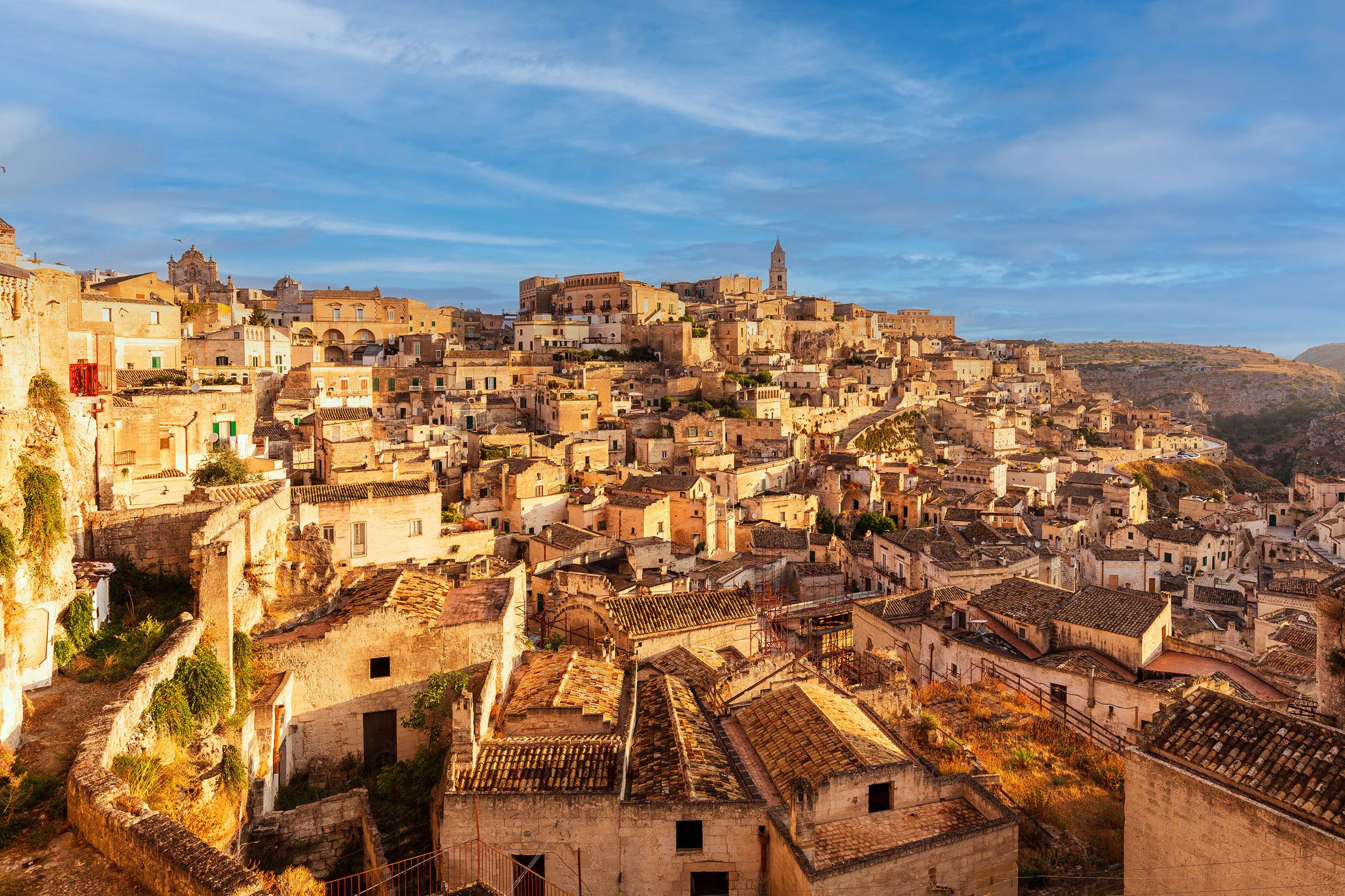
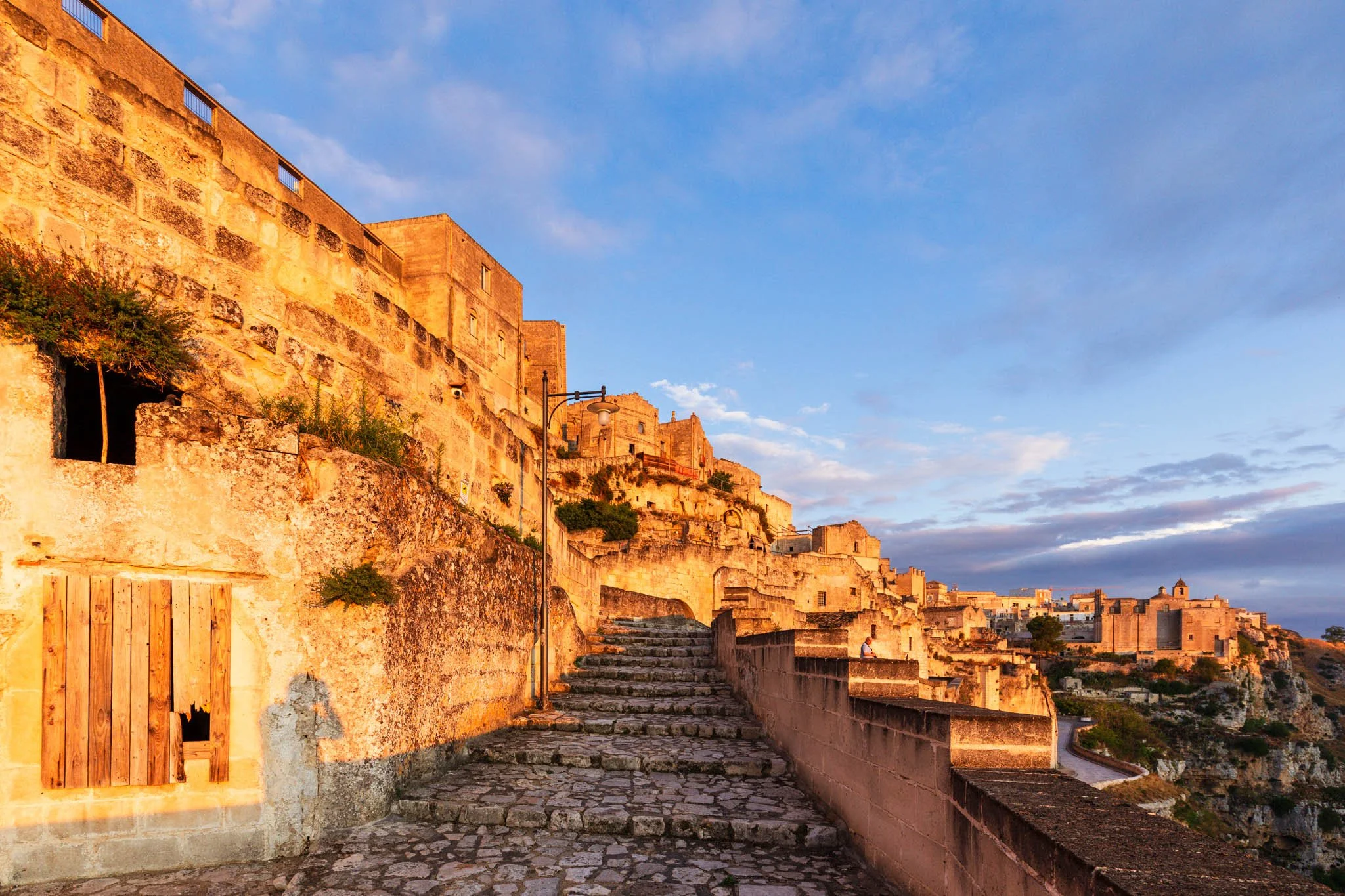
For photographers, the Sassi di Matera are extraordinary. The cave dwellings stack up the hillside in layers of warm limestone, ancient doorways, and narrow stone stairways that lead nowhere and everywhere at once. At sunrise, the light hits the rock and the whole city turns gold. At blue hour, the cave homes begin to glow from within, and the ravine below drops into shadow. The geometry is relentless: arches, doorways, domes, rooftops at different elevations, all fighting for space in the frame. Wide lenses show the scale of it. A longer focal length pulls a single door or a carved window out of the chaos. Both approaches work. So does a phone.
In this Photography Guide to Matera, I share the places and experiences that continue to draw me back. You will find my favorite photography locations, guidance on when and where to shoot, practical travel tips, and gear recommendations, along with cultural insights to help you explore and photograph Matera with confidence, respect, and ease.
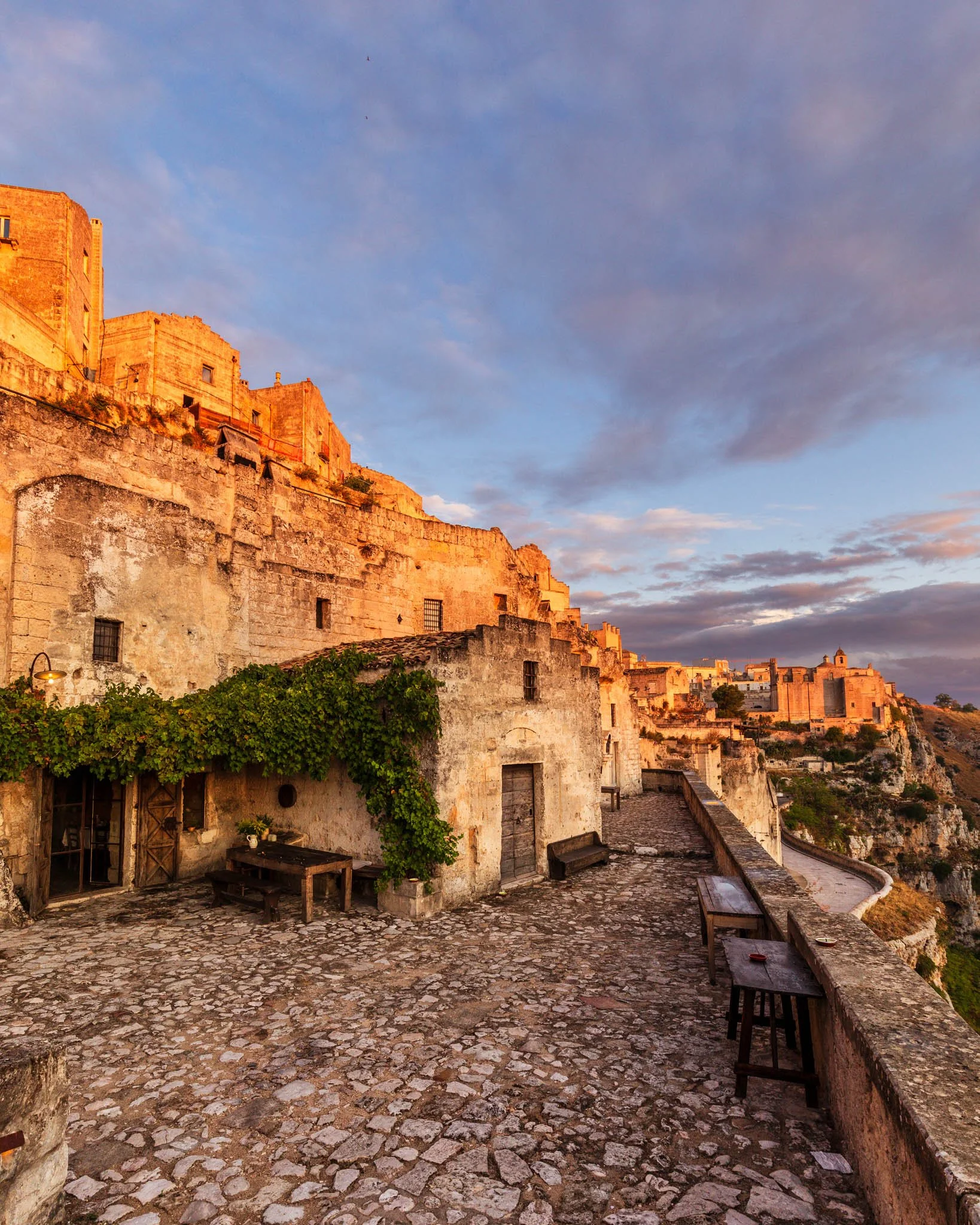
Until recently, it was not a very popular place to visit unless you lived in Puglia. Yet, Matera is one of the most unique and fascinating places to visit in Italy or anywhere in the world.
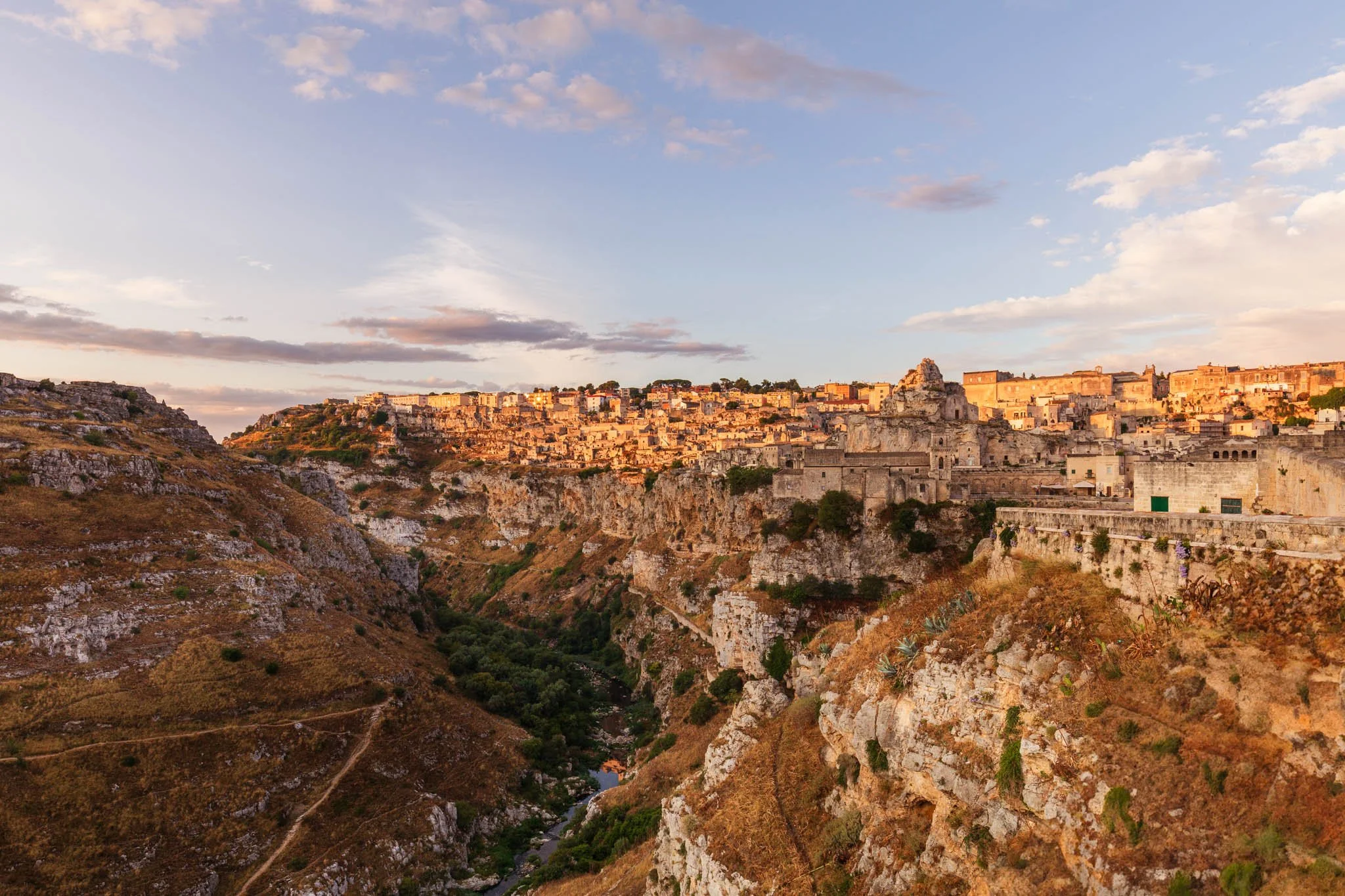
Matera's rich history dates back thousands of years, making it one of the oldest continuously inhabited cities in the world.
Photographer's Notes
Before you go, here are my own takeaways.
Favorite Season: April-May or September-October
Favorite Location: Belvedere di Piazza Giovanni Pascoli
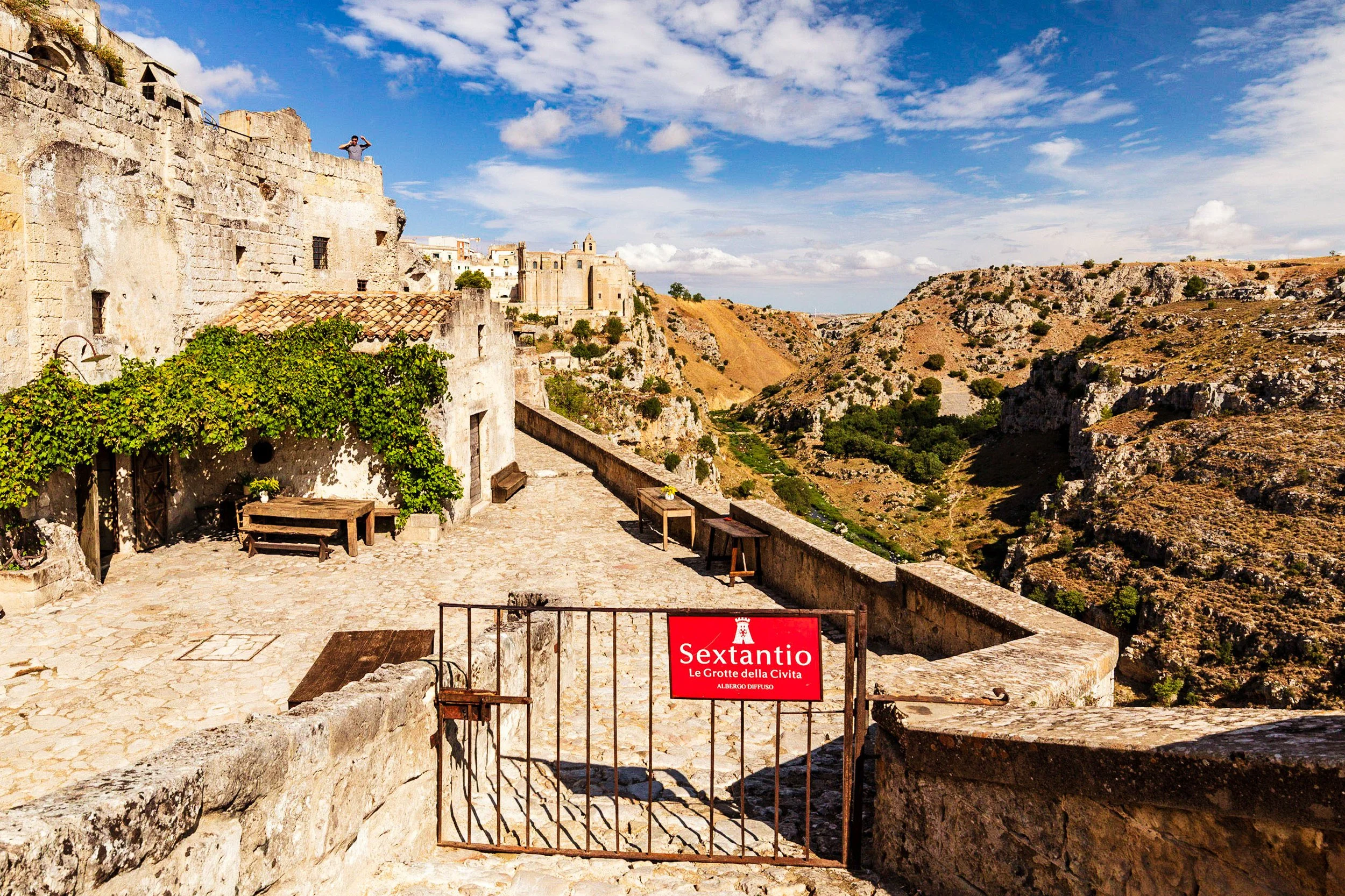
Favorite Hotel: Sextantio Le Grotte della Civita
Favorite Restaurant: Vitantonio Lombardo
Favorite Café: Caffè Lanfranchi
Favorite Lens: 15-35mm
Would I Return? Yes, even though I've been many times since childhood.
Best Time to Visit Matera, Italy
Matera rewards photographers year-round, but the season you choose matters enormously for light, heat, and how crowded the viewpoints are when you arrive at sunrise.
Spring (April to May) is the sweet spot. Temperatures sit in the low to mid-20s Celsius (low 70s Fahrenheit), the air is clear, and the limestone glows particularly warm in the afternoon light. Crowds are manageable at the main viewpoints, and golden hour in May runs late enough that you can shoot the Sassi in full evening light without rushing dinner. April can bring some rain, which is not necessarily a problem for photographers: wet stone, moody skies, and empty streets make for images you will not get in summer. May is the stronger month of the two.
Early autumn (mid-September to October) is the other prime window. The summer crowds thin out, temperatures drop back to a comfortable range, and the quality of light shifts into that warm, low-angled autumn tone that makes limestone architecture look extraordinary. October in particular delivers long golden hours and almost no haze. It is also harvest season in Basilicata, so the food scene comes alive in ways that spring cannot match.
Summer (June to August) is hot and increasingly crowded. July and August see the highest visitor numbers, and midday temperatures regularly push past 35°C (95°F). That said, blue hour and night photography in summer Matera are exceptional: the city glows from within as temperatures drop, the Sassi viewpoints fill with visitors enjoying the evening air, and the streets stay lively well past midnight. If you visit in summer, shoot early, rest midday, and work the hours between sunset and midnight.
Winter (November to March) is quiet and genuinely beautiful. Crowds shrink to almost nothing, cave hotels are cozy rather than cold, and the Sassi have an atmospheric stillness that peak season cannot offer. Occasional mist in the ravine adds real drama to wide shots from the Belvedere. The trade-off is shorter days and the risk of rain, particularly in December and March.
For photographers specifically, April to May and September to October are the strongest windows. The light is better, the heat is manageable, and you can actually position yourself at a viewpoint without competing for space.
The Miracle of Matera - From Poverty to Unesco World Heritage
I do not usually discuss history at length in my photography guides, but what happened in Matera is so remarkable that it deserves the full story.
Until the late 1940s, roughly 15,000 people, mostly peasants and farmers, still lived in the Sassi. The conditions were severe: damp cave dwellings with no natural light, no ventilation, no running water, no electricity. Malaria, cholera, and typhoid were common. This was not a remote village in a developing nation. This was Italy.
The situation only reached international attention after writer Carlo Levi, exiled by Mussolini's fascist regime to a town near Matera in 1935, described what he witnessed in his 1945 book Christ Stopped at Eboli:
"I have never seen in all my life such a picture of poverty."
In 1950, Italian Prime Minister Alcide De Gasperi visited and called the Sassi a national disgrace. His government's response was drastic: all inhabitants were evacuated and relocated to newly built housing on the edge of the city. For nearly four decades, Matera was abandoned. Nobody lived there.
Then, in the mid-1980s, a competition was held to decide the future of the caves. The winning proposal was to restore them. A 1986 law permitted people to return, and the government subsidized restoration work. Artisans, then bars, then restaurants, then boutique hotels followed. UNESCO designated the Sassi a World Heritage Site in 1993. Mel Gibson filmed The Passion of the Christ here in 2004. A James Bond film, No Time to Die, opened in 2021 with Daniel Craig in a cave hotel suite at Sextantio Le Grotte della Civita. I had already stayed there.
In a single generation, Matera went from being called the shame of Italy to drawing over 600,000 visitors a year. That is not a renovation. That is a resurrection.
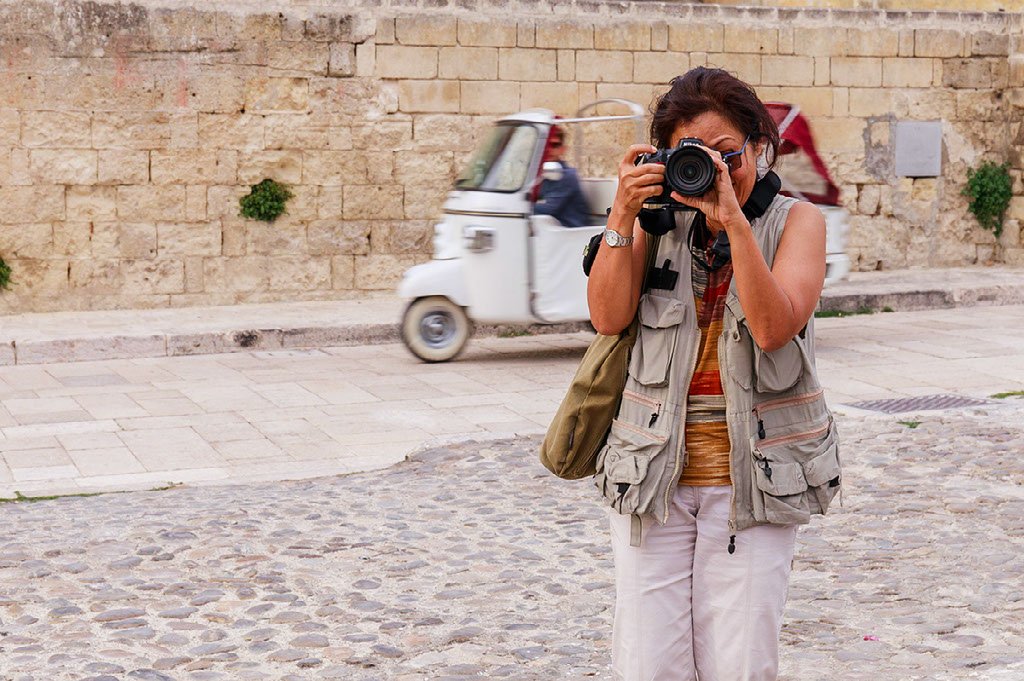
Where is Matera located?
Let's begin with understanding where Matera is located. Matera is located about 65 km or 1 hour by car from Bari. The easiest way to get there is by car, but of course, you can take trains or buses as well.
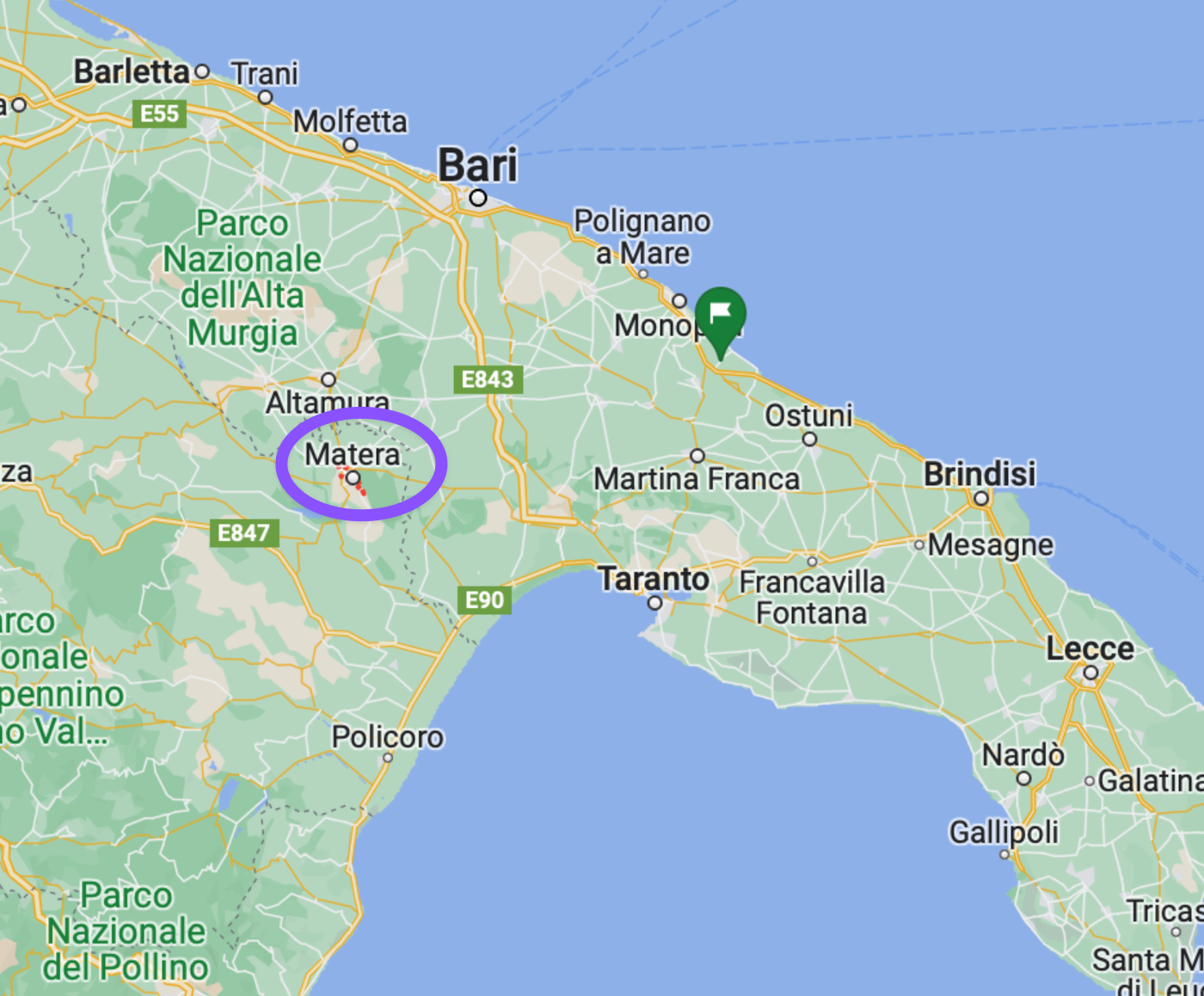
If you are arriving by car, you need to pay attention to the ZTL zones that are found in the "Centro Storico" portion of most cities in Italy. The ZTL zone is a (limited traffic zone) where you are not allowed to enter by car unless you are staying at a hotel within the zone. If you drive into the ZTL zone, you will get a traffic fine. So, it is important to know where you can park and if your hotel allows you to drive into the ZTL area.
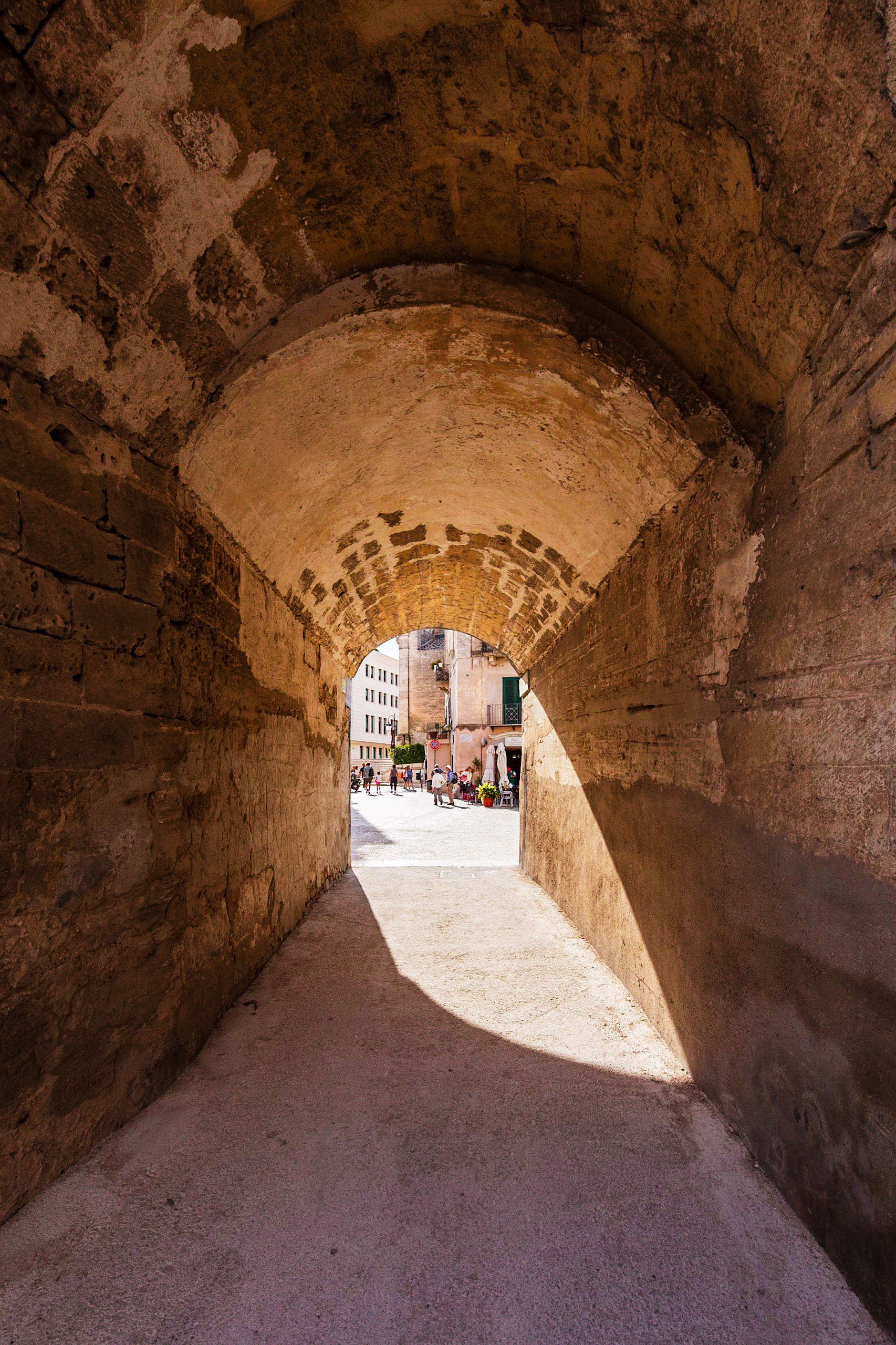
The view from our hotel was outstanding
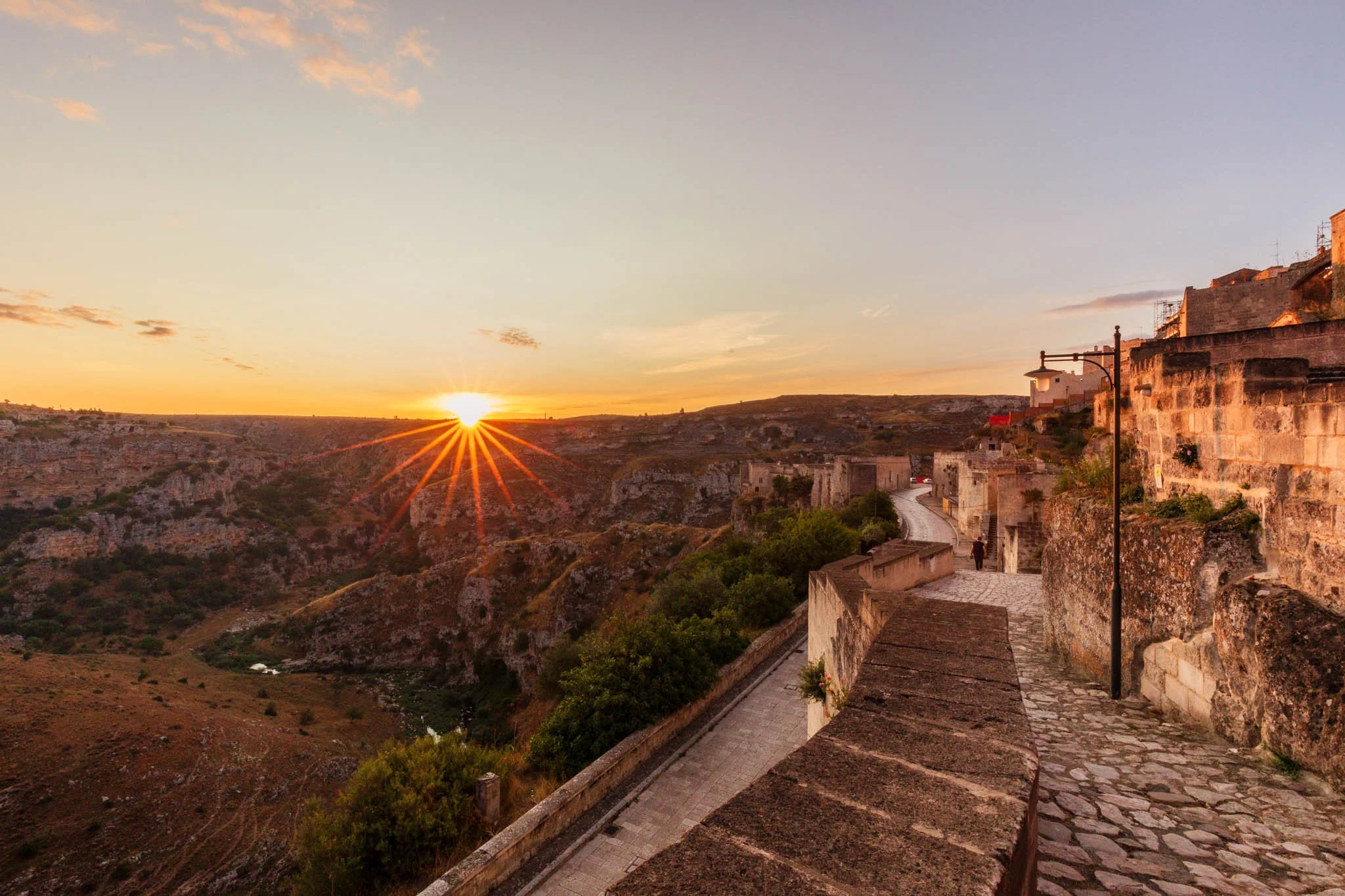
The Sassi of Matera
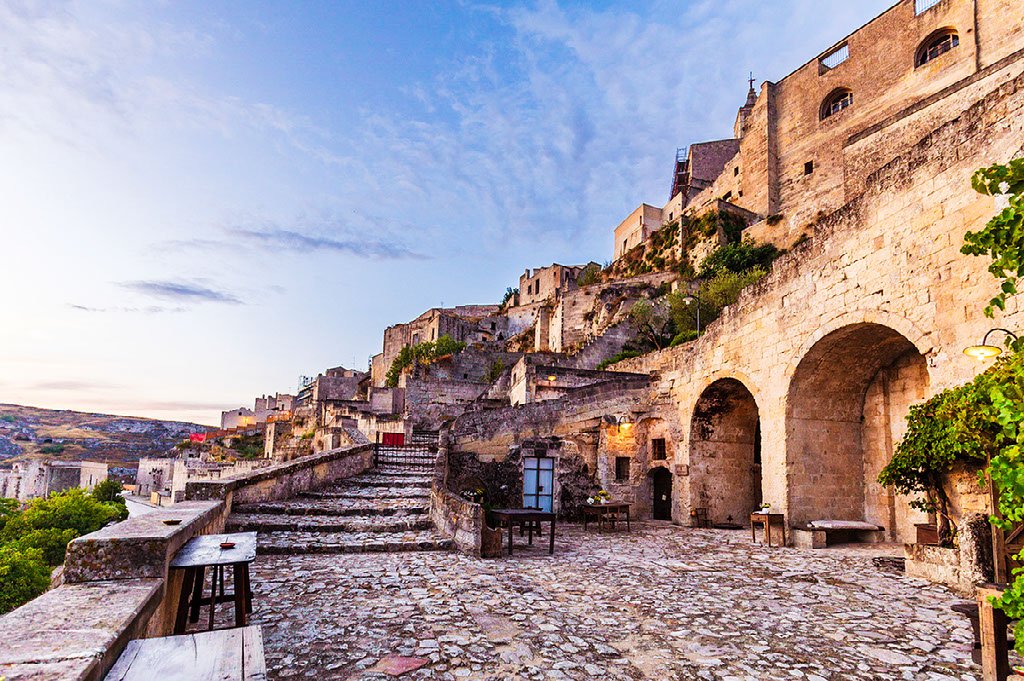
What makes Matera special is the Sassi di Matera. Sassi, "rocks in Italian", are cave dwellings that are dug into the rock and are most likely the first human settlements in Italy. They were the first 'homes' of Matera's inhabitants, which are thought to be as early as 7000 BC. Over time, these small caverns, which housed humans and livestock, were built on top of each other, creating an intricate network of homes.
Many of these caves have been beautifully restored and transformed into hotels, restaurants, and shops.
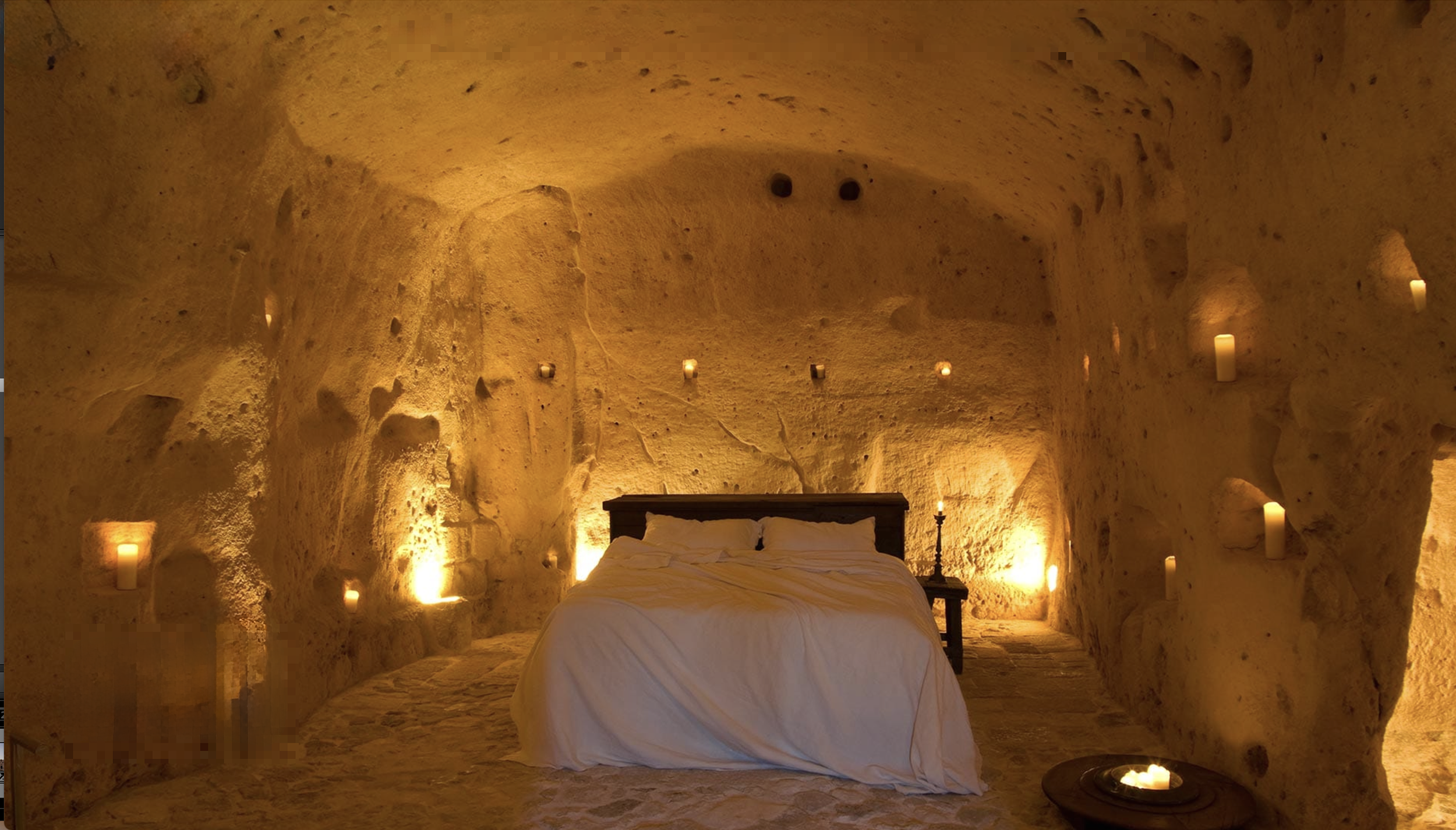
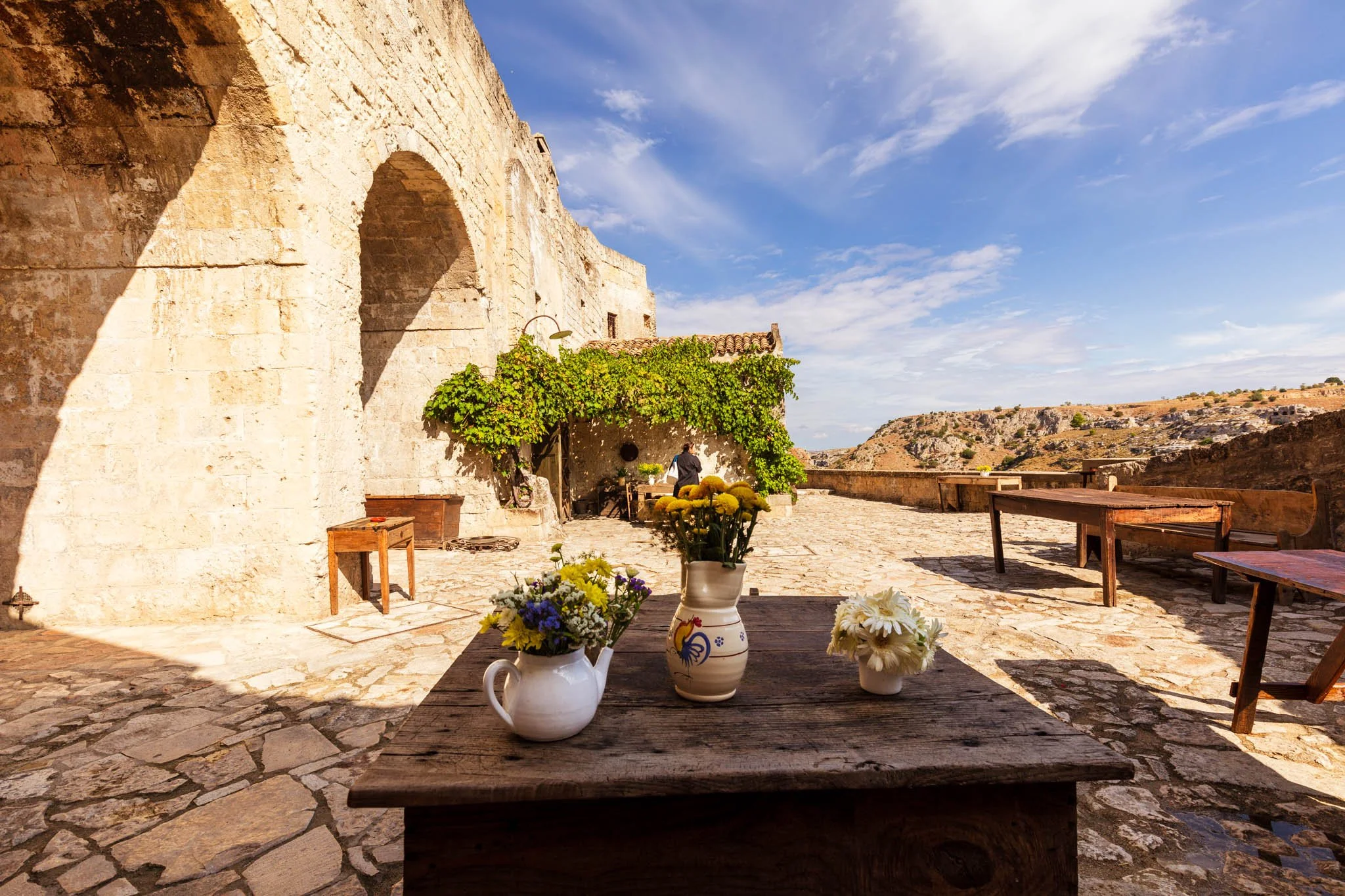
Our room in a cave
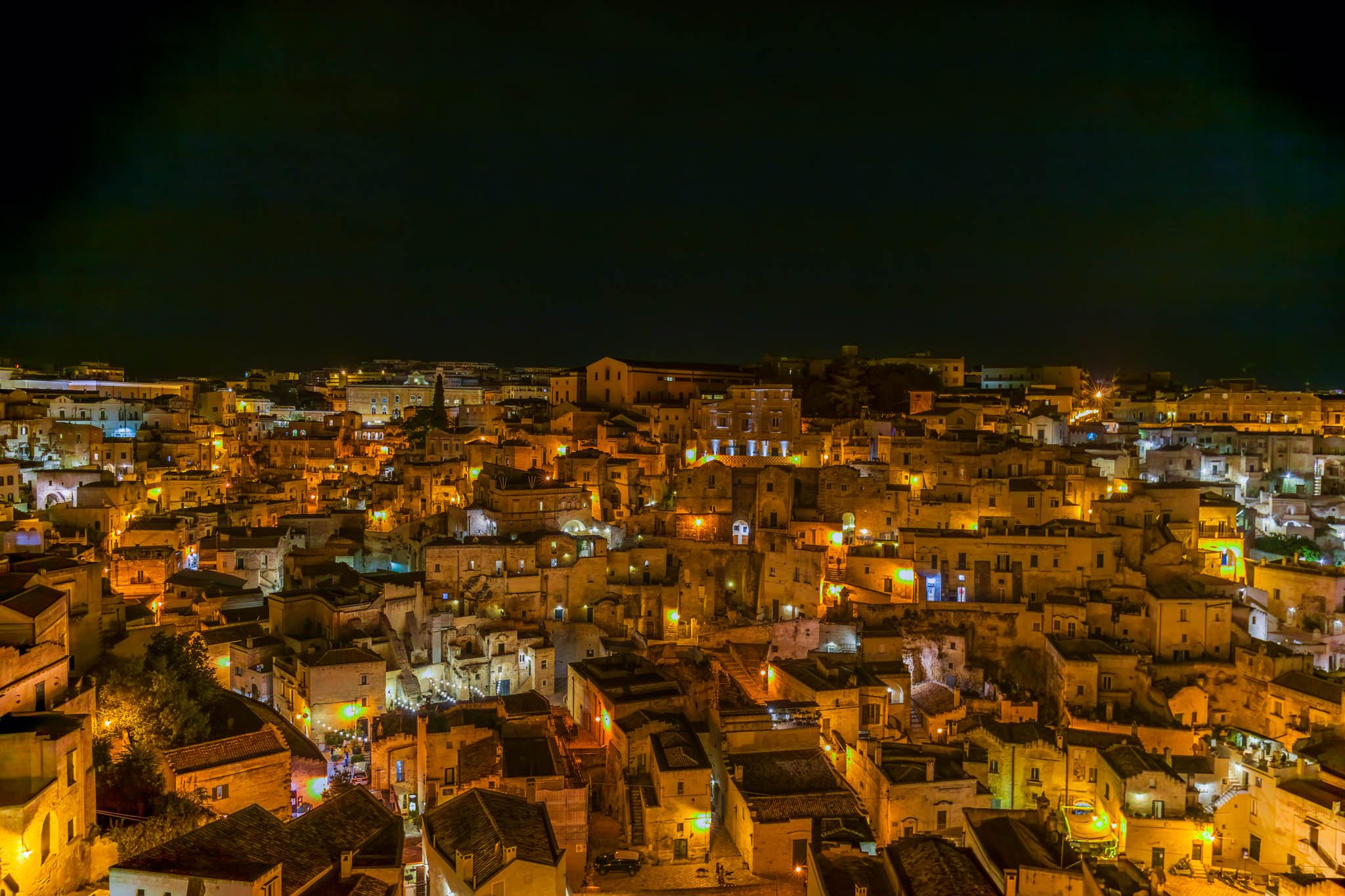
Exploring the maze of the Sassi di Matera is like stepping into an ancient civilization. The unique architecture, with its honey-colored stone buildings piled on top of each other, creates a stunning sight that seems straight out of a fairytale. The sheer beauty of the Sassi, especially when illuminated at night, immerses visitors in an ethereal atmosphere that is simply unforgettable.
How Many Days to Visit Matera, Italy
Matera is a small city, but it is not a quick one. The Sassi reward slow exploration, and photography here is entirely dependent on light. That means you need to be in position at sunrise and back out at blue hour, which eats into the middle of the day in ways a general sightseeing itinerary does not account for.
My recommendation: two nights minimum, three if you want to shoot at your own pace without feeling rushed.
One night is a day trip with a hotel. You will see the main viewpoints, walk the Sassi, and come away with decent images. But you will miss the sunrise, you will likely miss the blue hour, and you will not have time to find the quieter angles that separate a good set of Matera photographs from a great one.
Two nights give you two sunrises, two blue hours, and a full day in between to explore the cave churches, visit the Cripta del Peccato Originale, and wander without a schedule. This is the minimum for photographers.
Three nights is a comfortable pace. Here is roughly what that looks like:
Evening of arrival. Check in, walk the Sassi as the light drops, find your positions for the next morning. Shoot blue hour from the Belvedere di Piazza Giovanni Pascoli. Dinner late, as the Italians do.
Day one. Up before sunrise. Shoot the Sassi from the main viewpoints as the limestone warms up. Return to the hotel, sleep if needed, then spend the late morning exploring the cave churches at your own pace. Santa Maria di Idris, the rupestrian churches along the ravine path, the Duomo. Afternoon rest. Blue hour again from a different position, then dinner.
Day two. Morning drive to Cripta del Peccato Originale, about 20 minutes outside the city. Book tickets in advance, visits are by appointment only. Return to Matera for a late lunch, then use the afternoon for the Altamura bread detour if you have not done it yet. Final blue hour shoot from Piazza San Pietro Caveoso. Dinner in the Sassi.
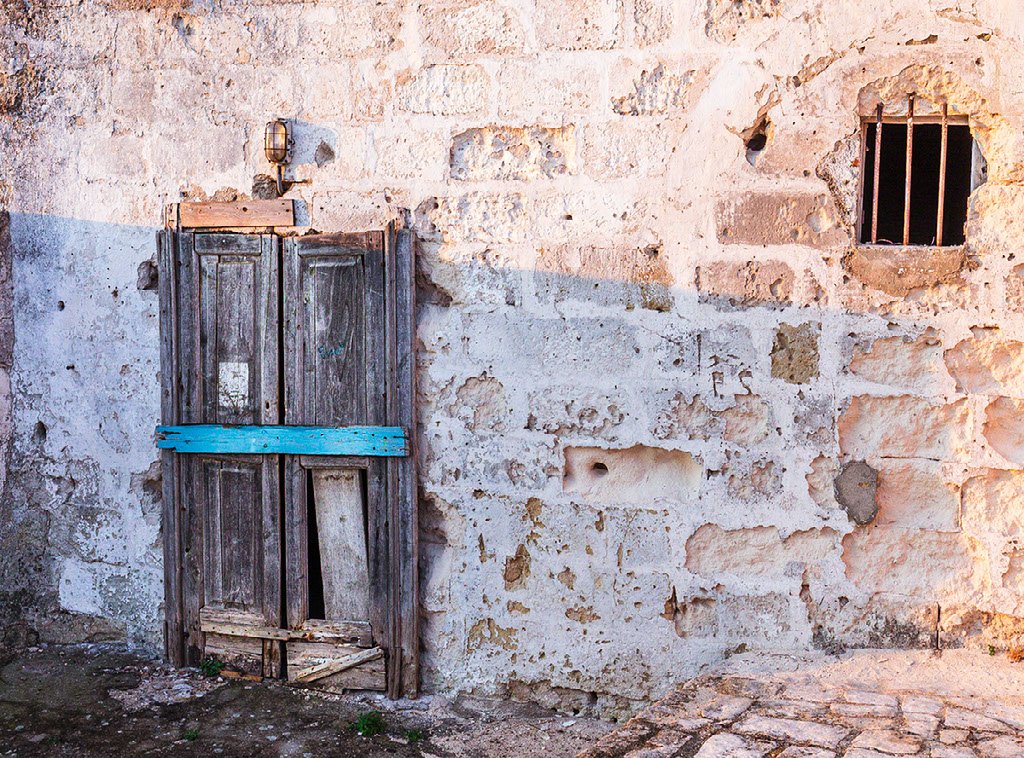
Day three. Slower morning. Walk the parts of the Sassi you have not covered. Shoot the details: doors, arches, window frames, textures in the stone. These are the images you will not see everywhere else. Depart after lunch.
If you are combining Matera with a wider Puglia trip, two nights works perfectly as a standalone base. The drive south from Bari or north from Lecce takes under two hours, so Matera fits naturally into a larger southern Italy itinerary without requiring a major detour.
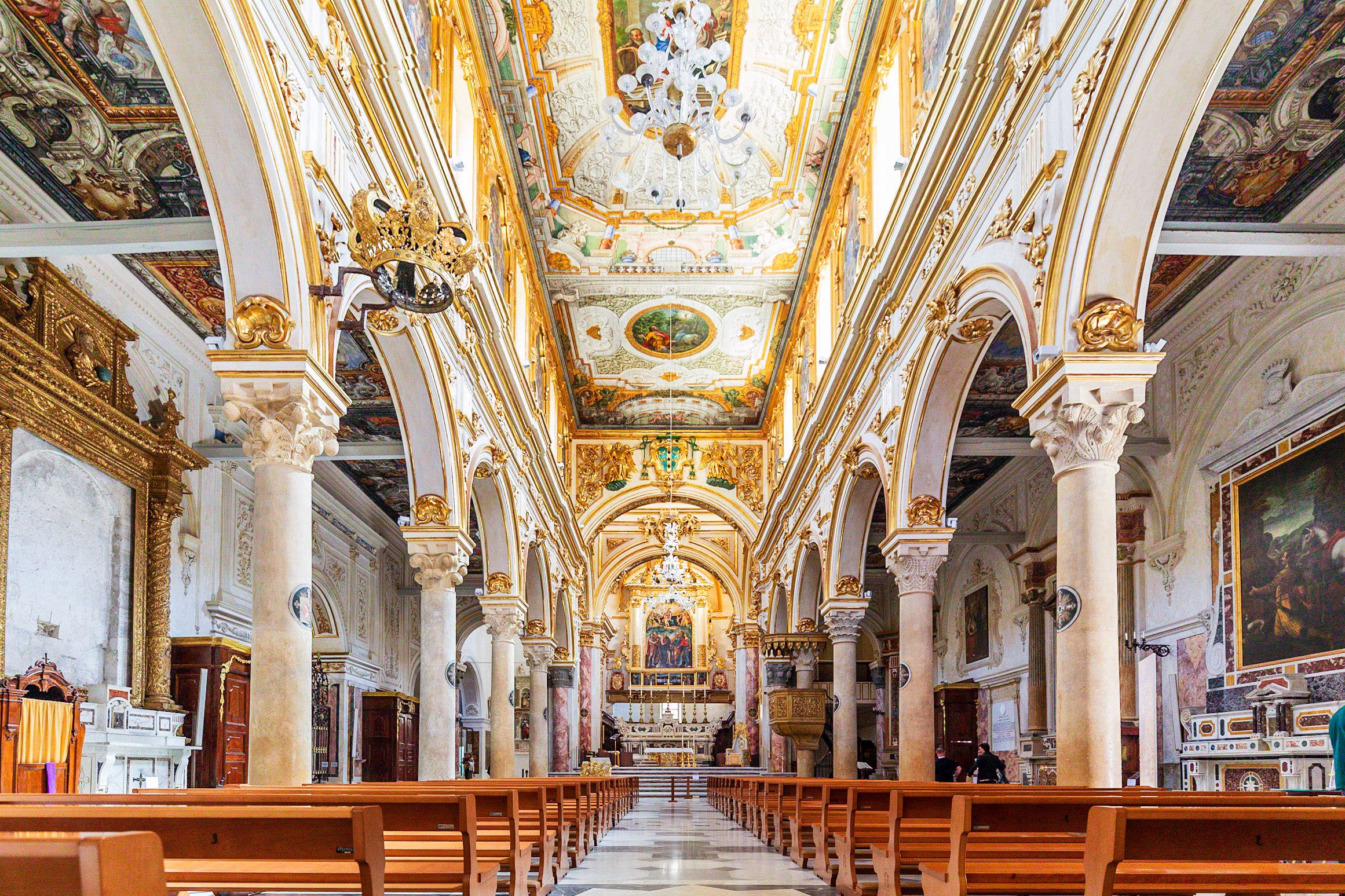
The Duomo
Where to Stay in Matera, Italy
In Matera, where you sleep is part of the experience. Many of the Sassi cave dwellings have been restored and converted into hotels, and staying inside one changes how you see the city entirely. Waking up in a room carved from limestone, looking out at a ravine inhabited for 9,000 years, is something no conventional hotel can replicate. Book a cave room if your budget allows. You will not regret it.
The Sassi are divided into two districts: Sasso Barisano and Sasso Caveoso. Both are excellent bases. Sasso Caveoso sits deeper in the ravine and tends to be quieter. Sasso Barisano sits closer to Piazza Vittorio Veneto and the modern city. Either works well for photographers.
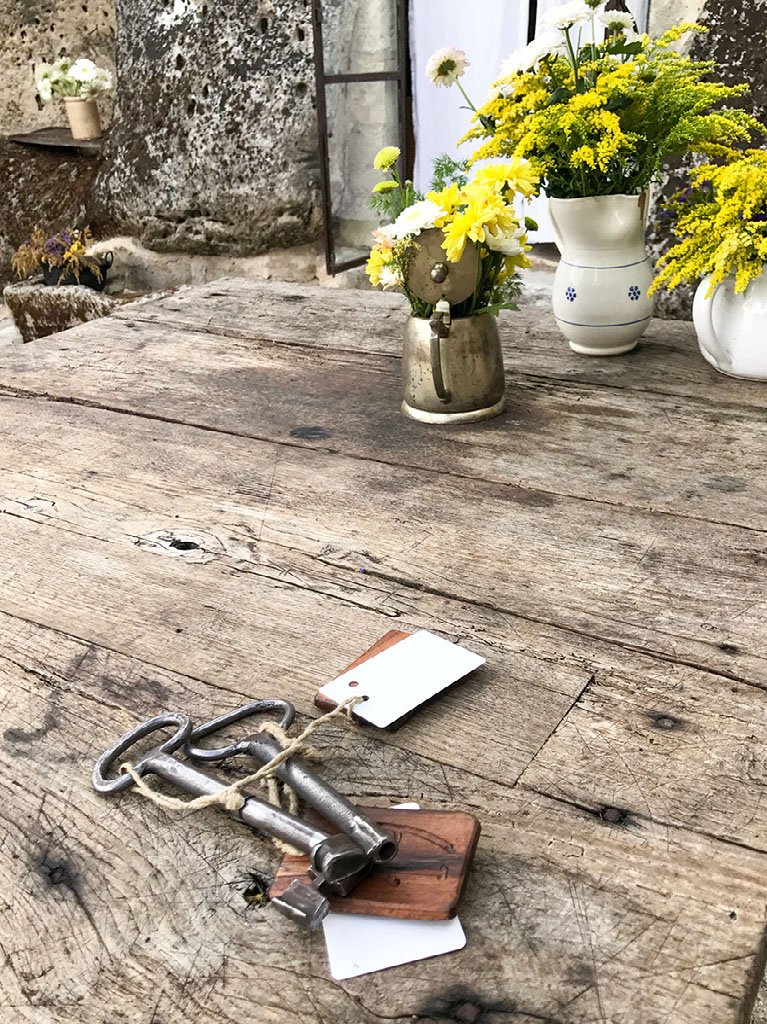
Luxury Hotels in Matera, Italy
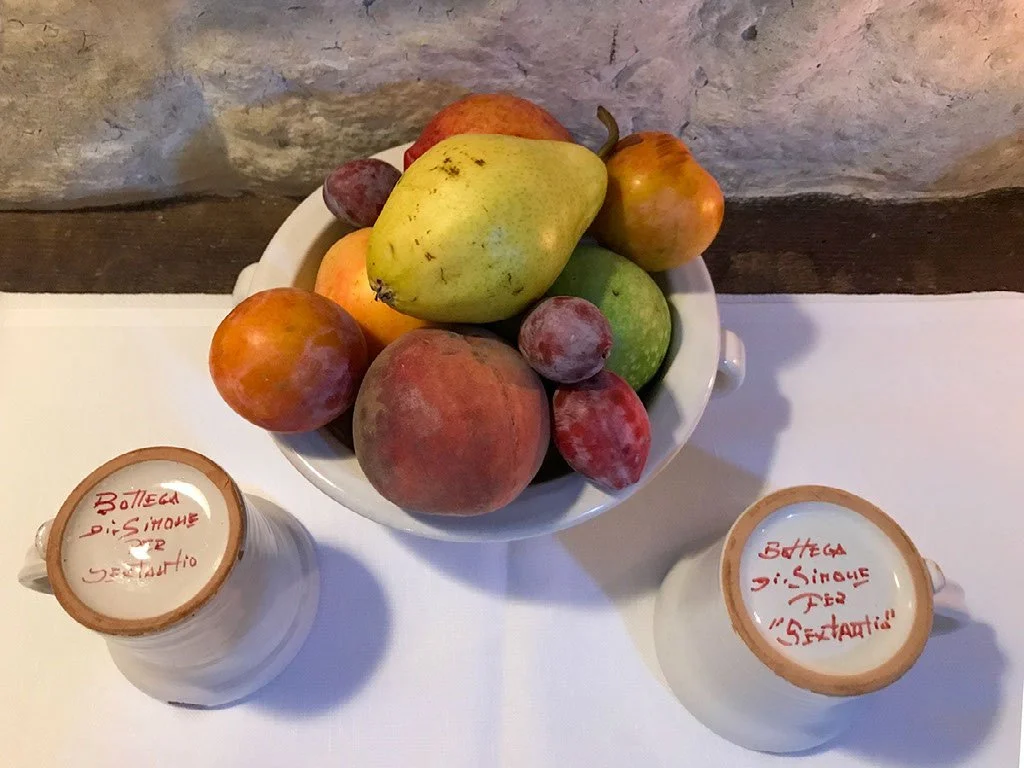
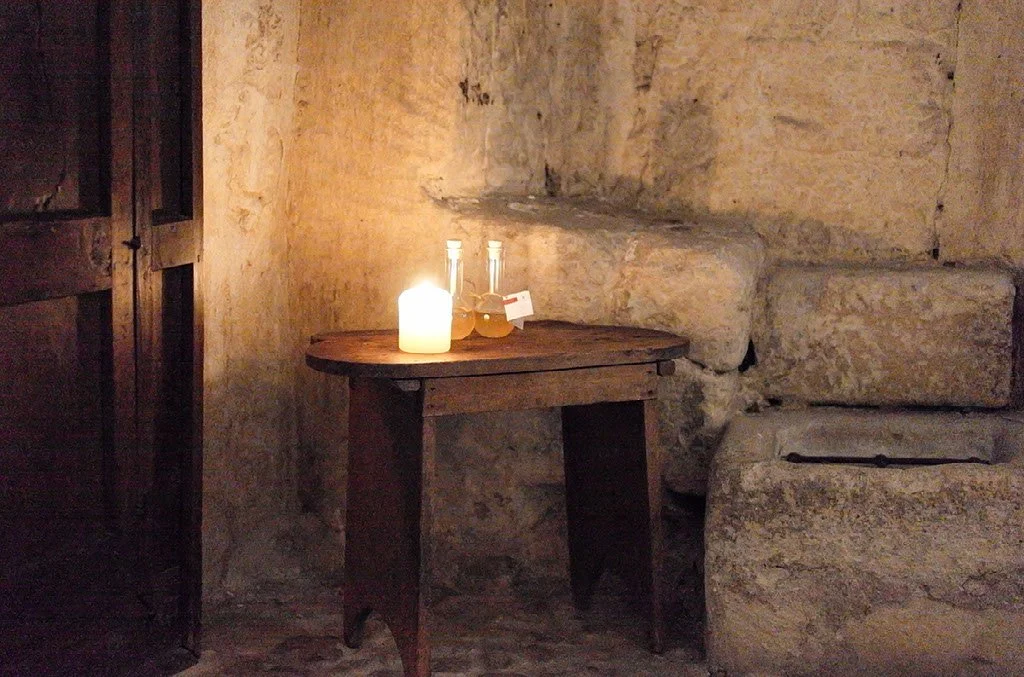
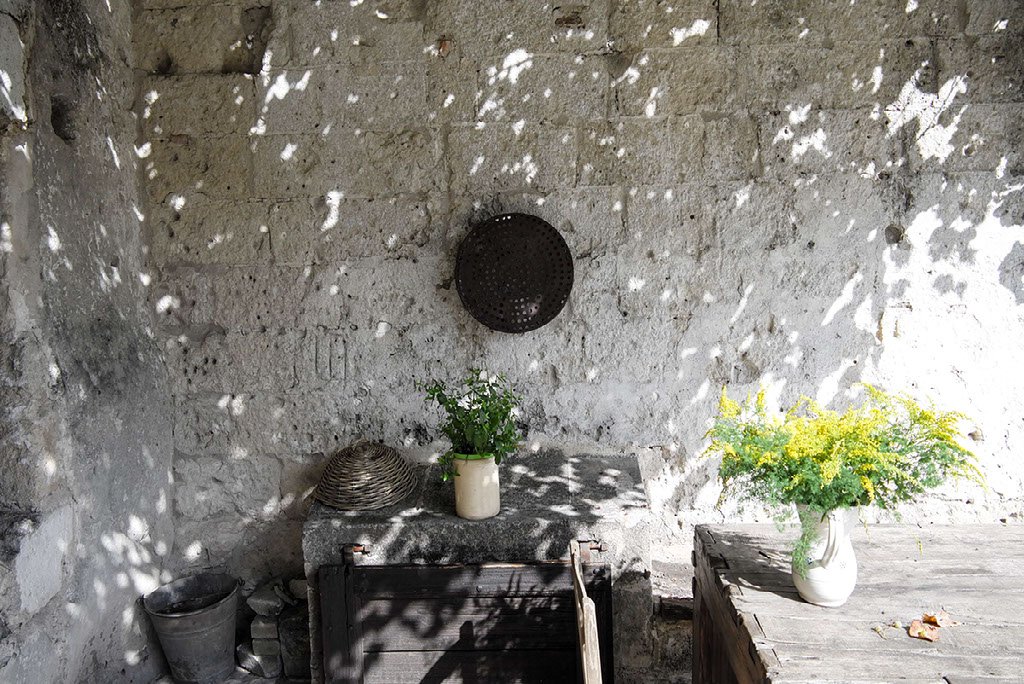
Sextantio Le Grotte della Civita is the benchmark. Eighteen cave rooms sit inside the oldest part of the Sassi, in the Civita district, looking out over the Murgia National Park and the rock churches across the ravine. The rooms are spare, almost monastic, lit by candles, with antique linens and stone floors. This is where the opening scene of No Time to Die was filmed. I stayed here before the film came out.
Aquatio Cave Luxury Hotel & SPA opened in 2018 and pairs ancient cave architecture with a modern five-star fit-out. The spa is the standout: a 9th-century underground space converted into a heated cave swimming area with a sauna and hammam. It sits in Sasso Caveoso, steps from the best photography viewpoints, and earns consistently strong reviews through early 2026.
Palazzo Viceconte occupies a 17th-century noble palace steps from the Duomo. It is not a cave hotel, but the rooftop terrace delivers panoramic views across the Sassi that are exceptional for photography. Rooms are large, lined with paintings and antique furniture, and genuinely feel like staying in someone's ancestral home.
Mid-Range in Matera, Italy
Sant'Angelo sits directly on Piazza San Pietro Caveoso, one of the best photography positions in the city. Rooms spread through a connected maze of caves, alleys, and staircases. Recently renovated, with strong reviews through 2025.
Locanda di San Martino Hotel & Thermae Romanae offers cave rooms with vaulted ceilings and Sassi-view balconies, plus a full thermal spa built into the caves below: indoor pool, sauna, and Turkish bath. Excellent breakfast and strong value, particularly for stays of two nights or more.
Casa Tudor is a small, intimate guesthouse in the Sassi run by Tudor, a local artist. The rooms are decorated with his own paintings and open onto a terrace with one of the best unobstructed views in the city. It is a boutique experience in the truest sense, personal, beautifully designed, and priced well below the larger cave hotels.
Getting Around Matera, Italy
Matera is a small city, and once you are inside the Sassi, your feet are your only real option. The alleyways are too narrow for cars, the staircases too steep for anything with wheels, and the best photography positions are found by wandering, not by following a route on a map. Budget time to get lost. It is not a problem; it is the point.
A few practical things to know before you arrive.
Getting to Matera. The most common approach is by car or transfer from Bari, roughly 65 kilometers away and about an hour's drive. If you are flying into southern Italy, Bari Karol Wojtyla Airport is your gateway. You can rent a car at the airport, which gives you maximum flexibility for day trips to Altamura, Alberobello, and the Gravine. There is also a bus service between Bari and Matera run by Flixbus and Miccolis, if you prefer not to drive.
Driving into the city. This is where visitors consistently run into trouble. The historic center operates under a ZTL zone, a limited traffic zone that applies to all vehicles without a permit. You cannot drive into the Sassi freely. If you are staying at a hotel inside the ZTL, contact them before you arrive to confirm access procedures. Most cave hotels will guide you through exactly where to park and how to bring your luggage in. Do not assume you can figure it out on arrival. The fines are real and arrive by post weeks later.
Parking. The most practical option for most visitors is to park at one of the lots on the edge of the modern city and walk or take a local bus into the Sassi. The lot on Via Pasquale Vena near the center is affordable and well-positioned.
Within the Sassi. Walking is how you shoot Matera. The distances between the main photography spots are short, but the elevation changes are significant. You will be climbing and descending uneven stone staircases with your gear, so pack light if you can. A smaller bag with your essential lenses is smarter than a full backpack here.
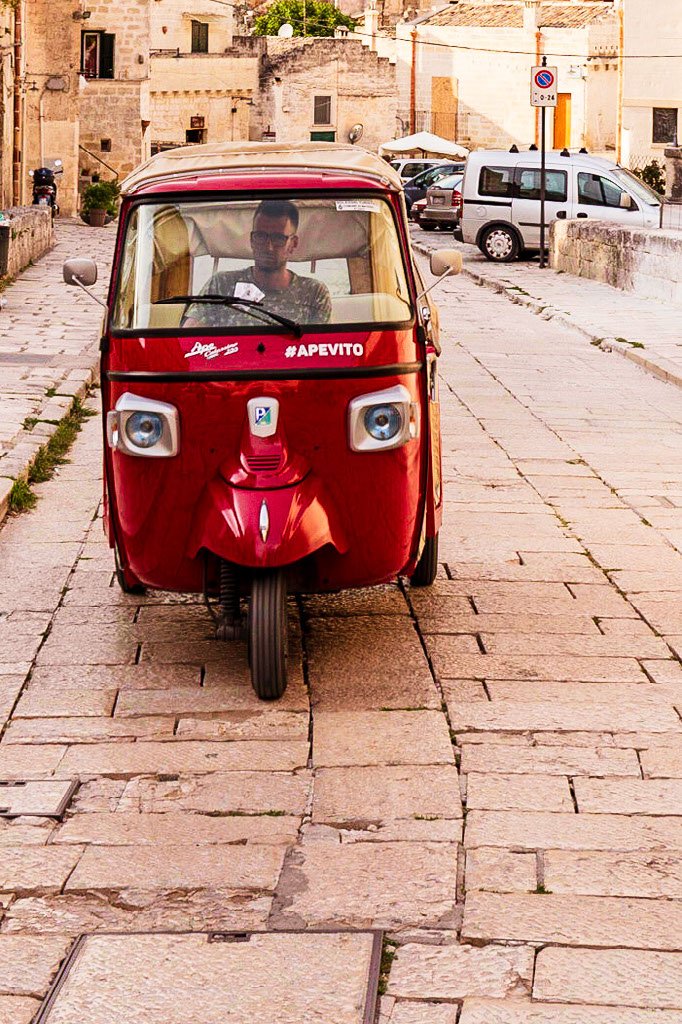
Apé taxis. These are the small three-wheeled vehicles you will see moving through the wider lanes of the Sassi. They cannot reach every corner, but they can get you between districts quickly if your legs need a break, and they make for entertaining photographs in their own right.
Taxis and Uber. Local taxis are available and can be booked via WhatsApp through the Matera Taxi Consortium. Uber operates in Italy as Uber Black only, meaning licensed professional drivers rather than standard rideshare. It works but costs more than a local taxi. For transfers to and from Bari airport, a pre-booked private transfer is the cleanest option with camera gear.
Where to Eat in Matera, Italy
Basilicata is one of the least-visited regions in Italy, which means the food here has not been softened for tourists. What you get is proper southern Italian cooking: orecchiette, cavatelli, lamb, pork, legumes, peperoni cruschi (dried sweet peppers fried in olive oil until crisp), and Aglianico wine from the volcanic soils nearby. If you eat well in Matera, you eat very well. Book dinner in advance, especially on weekends and in peak season. Most Sassi restaurants are small and fill quickly.
One note on the bread: Pane di Matera holds a protected designation of origin and is unlike anything you will find in a supermarket. Dense, chewy, made from re-milled durum wheat and baked in a wood-fired oven. Order it with every meal.
Vitantonio Lombardo is the only Michelin-starred restaurant in Matera, and it earns it. Chef Vitantonio Lombardo took an abandoned cave in the Sassi district, directly below the Cathedral, and transformed it into one of the most serious dining rooms in southern Italy. The tasting menus run from five to twelve courses, all built around Lucanian ingredients interpreted with real creativity. Reserve well in advance. This is a special occasion meal, but if you are in the region, it is worth planning around.
Il Terrazzino sits in a 17th-century cellar in the Sasso Barisano, with a rooftop terrace that delivers panoramic views over the Sassi. The kitchen turns out straightforward Lucanian cooking: generous portions, honest ingredients, fixed-price menus at approachable prices. The view at aperitivo hour, with the limestone lit by late afternoon sun, is one of the better ones you will find at a restaurant in the city.
Le Botteghe occupies a whitewashed space near Piazza San Pietro Barisano and has been a local institution for years. Reinterpreted Lucanian dishes, good wine from Basilicata and Puglia, and a terrace for outdoor dining. The pasta here is consistently praised. Ask about the orecchiette. Book ahead; it fills up.
Baccanti is a good mid-range option in the Sassi for traditional dishes without fanfare. Reliable Lucanian cooking in a cave setting, with a menu that changes with the season and a wine list that leans local. Good value for a long dinner.
La Dispensa di Aquatio is the restaurant inside the Aquatio Cave Luxury Hotel, open to non-guests. Modern interpretation of regional cuisine in a striking cave setting. Strong for lunch between photography sessions.
Coffee
Caffè Lanfranchi on Via Domenico Ridola is the pick for morning espresso. Small terrace at the back with a panoramic view over the Sassi; two tables, arrive early. This is the kind of place where the owner knows the regulars by name and a cappuccino with a cornetto costs what it should. Go before your sunrise shoot or after, when the light is already in and you need somewhere to sit and review your shots.
Vittorio Veneto Caffè on Piazza Vittorio Veneto is the central square option, consistently recommended and well-positioned for people-watching. Good for an afternoon espresso between the Sassi and the modern city.
Ambaraba is a small espresso bar with a loyal local following, strong coffee, and good breakfast pastries. Relaxed atmosphere, no pretension.
Photography Gear to Bring
Matera is a gear-friendly destination in the sense that nearly every piece of kit you bring will find a use. The challenge is not variety; it is weight. You will be climbing stone staircases and navigating uneven paths with your bag, and that reality should shape what you pack.
DSLR and Mirrorless Kit
Any of the current flagship bodies handles Matera well. The Canon EOS R5 Mark II, Sony A7R V, and Nikon Z8 are all strong choices. The high resolution of these sensors pays off here because you will frequently be shooting wide to capture the full scale of the Sassi, then cropping into the frame to isolate a specific door, arch, or staircase. That resolution gives you the flexibility to do both from a single frame.
For lenses, bring three if you can carry them comfortably.
A wide zoom in the 16 to 35mm range is essential. The Sassi are dense and layered, and wide glass lets you show the full depth of the cave dwellings stacked up the hillside. This is the lens you will use most at the main viewpoints, particularly for the panoramic shots from Piazza Giovanni Pascoli at sunrise and blue hour.
A standard zoom in the 24 to 70mm range covers your walking-around work: the streets, the cave church interiors, the market textures, the candid moments in the alleys. This is your workhorse for everything that is not a landscape or a tight detail shot.
A telephoto in the 70 to 200mm range lets you compress the layers of the Sassi from across the ravine and pull specific architectural details out of the chaos. Some of the most interesting Matera images are made at longer focal lengths, isolating a single carved doorway or a rooftop cross against the sky.
A tripod is not optional here. Blue hour and sunrise shots from the viewpoints require one, and the cave church interiors are dark enough that handheld shooting at reasonable ISOs is difficult. Bring something sturdy but portable. A carbon fiber travel tripod or a Platypod with a good ball head both work well on the stone surfaces.
A circular polarizer is worth carrying for midday shooting. The limestone reflects a lot of light and the polarizer cuts the haze and adds contrast to the sky. It also reduces glare on wet stone after rain, which as noted is not a bad time to be in Matera.
ND filters in the 6 and 10 stop range open up long exposure options at the viewpoints, particularly useful if you want to smooth out cloud movement above the Sassi during the day. Not essential, but worth having if you shoot long exposures regularly.
Drone note: drones are permitted in Matera but the Sassi district falls within a UNESCO World Heritage site. Check current Italian CAA regulations and local restrictions before flying. The aerial view of the cave dwellings is extraordinary if you can get authorization, but do not assume permission is automatic. Plan ahead.
Extra batteries are essential. Cold mornings and extended blue hour sessions drain batteries faster than midday shooting, and there are no easy charging stations in the middle of the Sassi.
iPhone Tips
Matera is genuinely excellent for iPhone photography, particularly because the contrast between light and shadow is so strong that even a smaller sensor handles it well when you work with it rather than against it.
At sunrise and blue hour, switch to Night Mode for the viewpoint shots but watch the shutter time carefully. A one to three second exposure on Night Mode produces sharper results than the full auto duration, which can blur moving elements. Prop the phone against a wall or railing for stability if you do not have a small tripod.
For the cave church interiors, use the ultrawide lens and let the ambient candlelight or window light do the work. Do not use flash; it kills the atmosphere and flattens the texture of the frescoes entirely. ProRAW if your iPhone supports it gives you much more latitude in post to bring out shadow detail in the dark stone.
For the alleyways and staircase shots, the standard lens at 1x is usually the better choice over the ultrawide. The ultrawide distorts the geometry of the narrow passages and makes the stone walls bow outward. Keep it straight and let the leading lines do their job.
The limestone texture of the Sassi responds particularly well to Lightroom Mobile's Texture slider. Shoot ProRAW, edit in Lightroom, and pull the Texture up before touching anything else. The result on a well-exposed frame is noticeably stronger than what the default Photos app processing delivers.
Photography Spots in Matera, Italy
The best thing to do in Matera is wander and get lost. Roam through the narrow alleyways, up and down uneven stone staircases, discovering dead ends and tiny courtyards decorated with flower pots, cave churches, and expansive views of the Sassi.
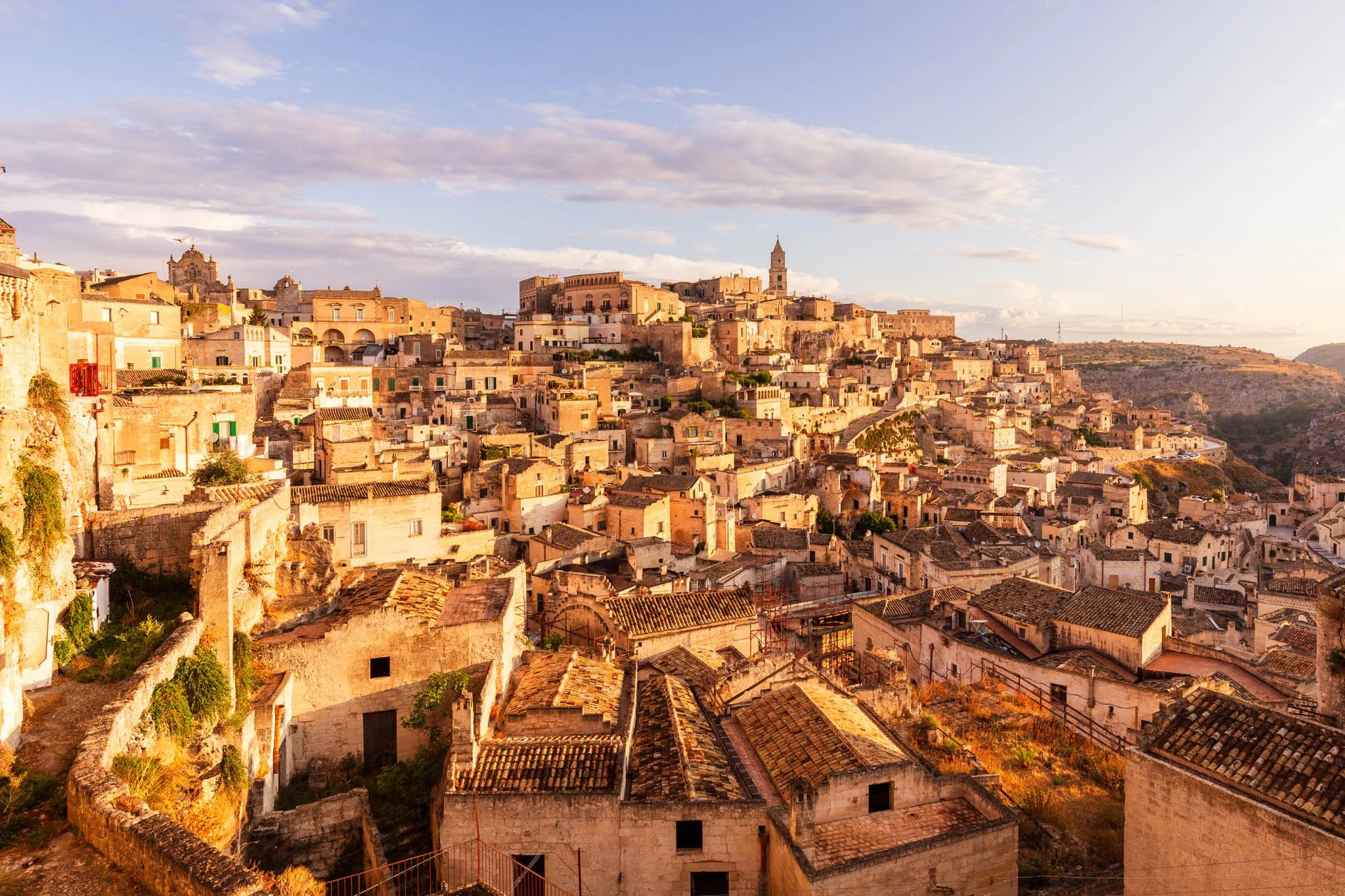
Belvedere di Piazza Giovanni Pascoli
This is the viewpoint most photographers head to first, and for good reason. Standing here, you look directly down into the Sasso Caveoso, with the cave dwellings cascading below you in layers of warm limestone, the bell tower of the Duomo rising to the left, and Santa Maria di Idris perched on its rock to the right. It is the classic Matera composition, and it is classic for a reason.
The challenge is making it your own. At peak season, this viewpoint gets crowded, and the obvious shot is the obvious shot. The light at sunrise here is transformative: the limestone catches the warm tones before the sky fully brightens and the contrast between the glowing stone and the dark ravine below is at its most dramatic. Blue hour is equally strong when the cave homes begin to light up from within, and the whole hillside appears to glow.
📷 Pro Tip: Arrive at least 20 minutes before sunrise to secure your position and set up your tripod without rushing. Shoot with your wide zoom at 16 to 24mm to capture the full sweep of the Sassi, then switch to 70 to 100mm to compress the layers and isolate the bell tower against the sky. At blue hour, bracket your exposures: the range between the lit cave interiors and the darkening sky is significant, and blending two exposures in post will give you a cleaner result than trying to pull it all from a single frame. In summer, the sun rises to the left of the frame; in autumn and spring it tracks more centrally, which tends to produce warmer, more even light across the cave dwellings.
Best time: Sunrise and blue hour. Access: Free. A short walk from the Sasso Caveoso, signposted from the main pedestrian path.
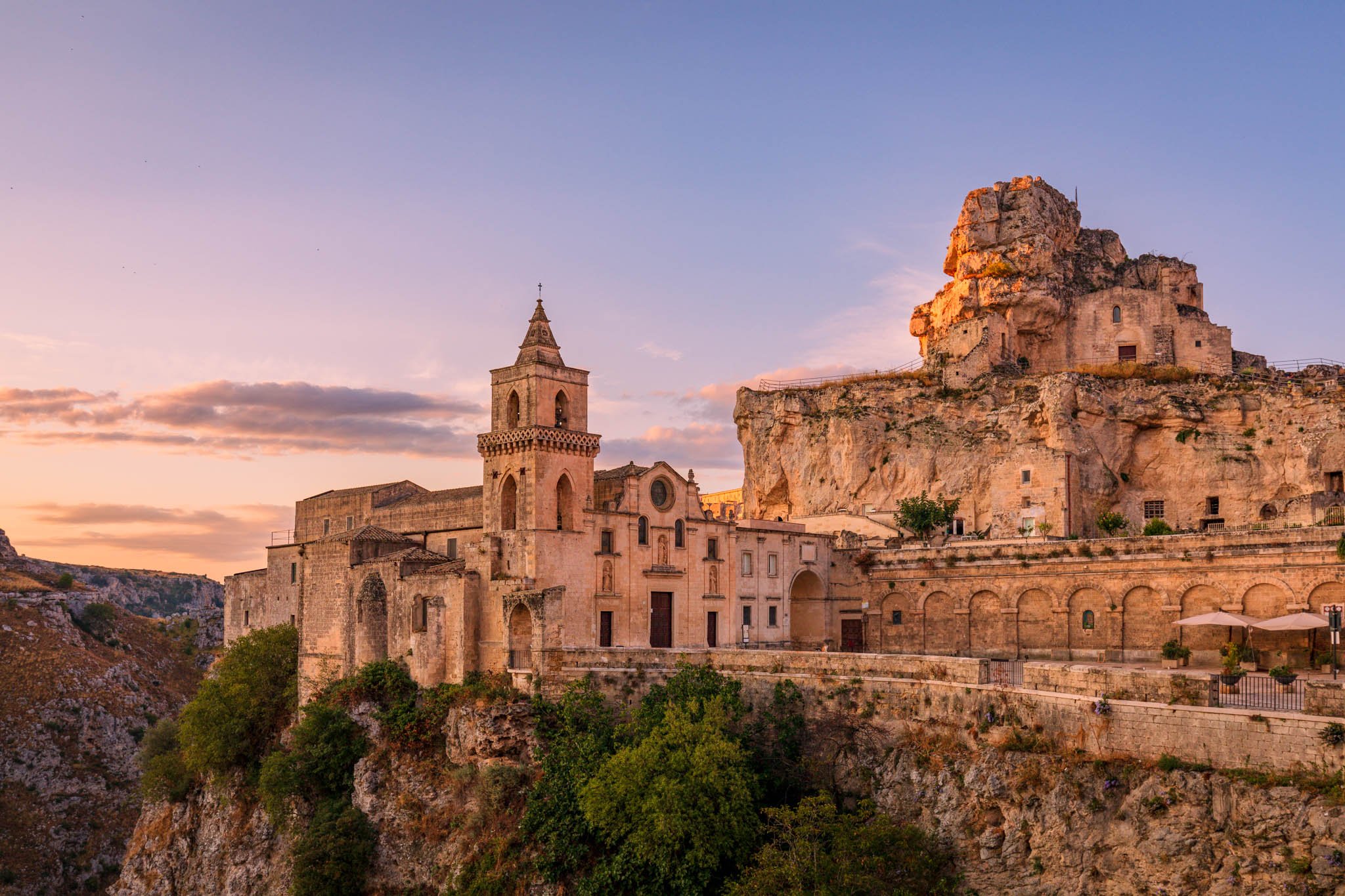
Piazza San Pietro Caveoso –
This piazza sits at the lower end of the Sasso Caveoso, next to the Church of San Pietro e Paolo, and gives you a completely different angle on the Sassi than the upper viewpoints. From here, you are looking back up at the cave dwellings rather than down into them, with the ravine dropping away to your right and Santa Maria di Idris visible on its rock directly ahead.
What makes this spot particularly useful for photographers is the variety it offers. The church facade in the foreground, the rock church across the ravine, the layers of cave homes behind, and the Murgia plateau beyond: there are multiple compositions available within a few meters of each other. Walk along the road east of the piazza to find additional angles looking back at the rock church with the full sweep of the Sassi behind it.
📷 Pro Tip: The best light here is in the late afternoon, when the sun drops toward the west and rakes across the face of the cave dwellings at a low angle. A 24 to 70mm lens covers most of the compositions from this position. For a tighter shot of Santa Maria di Idris against the cliff face, pull out your 70 to 200mm and shoot from the far east end of the piazza. If you are here at blue hour, turn around occasionally: the modern city lights on the ridge behind you create an interesting contrast with the ancient stone in front. Sant'Angelo hotel sits directly on this piazza, and its rooftop is worth asking about if you are a guest.
Best time: Late afternoon through blue hour. Access: Free. Central to the Sasso Caveoso, walkable from all cave hotels in the district.
Santa Maria di Idris
This cave church is carved directly into a massive free-standing rock at the edge of the ravine in Sasso Caveoso, and it is visually distinctive from almost every viewpoint in the city. You can see it from the upper belvedere, from Piazza San Pietro Caveoso, and from across the ravine at Murgia Timone: a small door and bell tower emerging from raw limestone, surrounded by nothing but air and ancient stone.
From the outside, it reads as a pure sculptural form against the sky. From the inside, two small cave chapels contain Byzantine frescoes dating to the 12th century. The space is intimate and very dark; the frescoes are fragile, and photography inside is a genuine challenge.
📷 Pro Tip: The exterior is the stronger photography subject. Position yourself on the path below the church and shoot upward with a wide lens at 16 to 24mm to emphasize the scale of the rock and the smallness of the carved doorway. Early morning gives you clean light on the stone face without harsh shadows. For interior shots, switch off your flash entirely and use your widest aperture at ISO 3200 to 6400. Brace against the wall to stabilize. The light from the small windows is the only source and it falls unevenly, which can produce compelling images if you work with the contrast rather than trying to expose the whole space evenly. A small entrance fee applies. Check hours before visiting as they can vary by season.
Best time: Exterior: early morning. Interior: any time during opening hours. Access: Small entrance fee. Located in Sasso Caveoso, a short walk from Piazza San Pietro Caveoso.
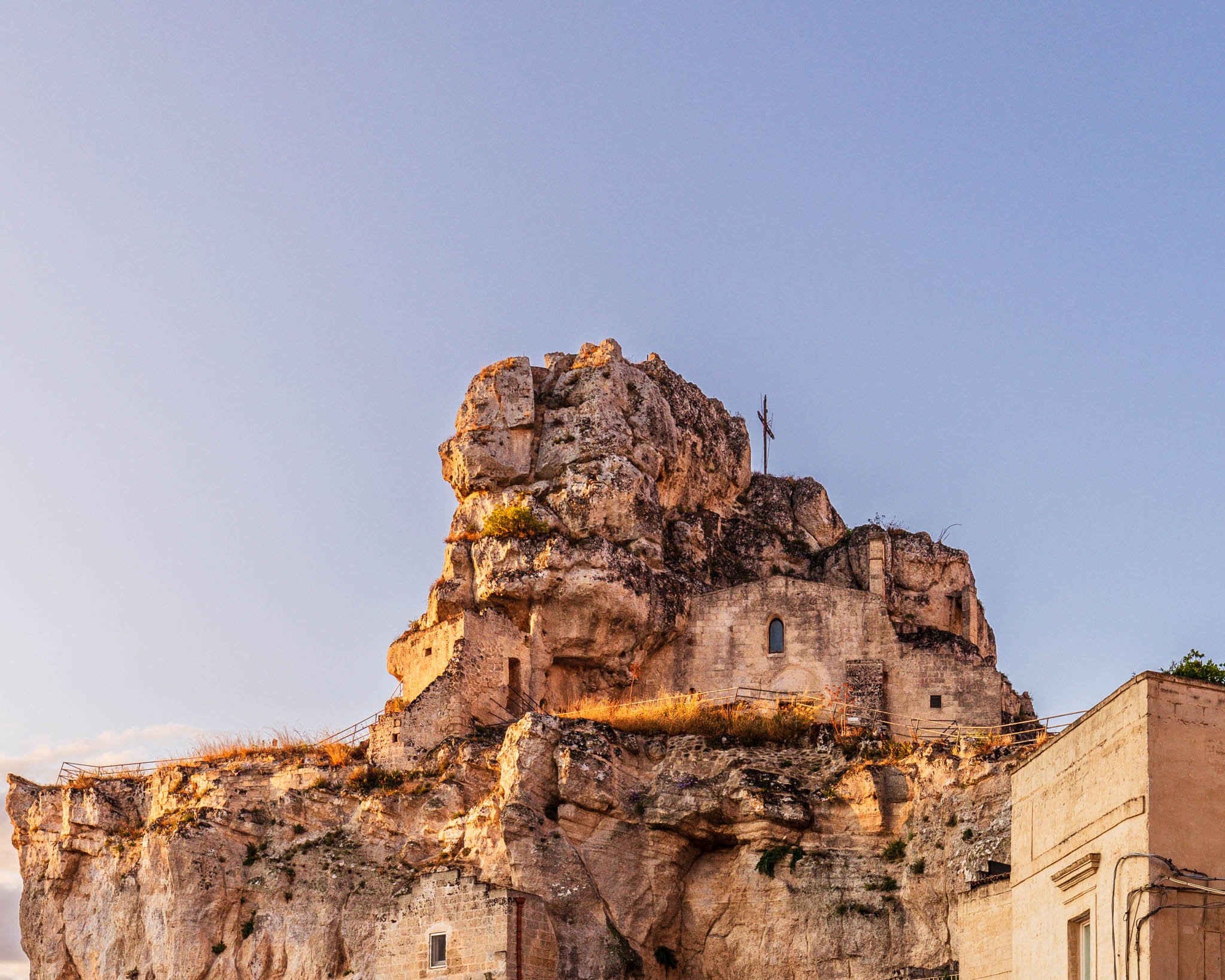
Santa Maria di Idris
The most famous cave church is Santa Maria di Idris with its dramatic location built into a huge rock on the edge of the ravine. It’s a distinctive sight from viewpoints throughout the city.
If you only have time for one Matera Rock church, make it this one. It’s most impressive from the outside, but inside there are two small cave chapels featuring frescos from the 12th century.
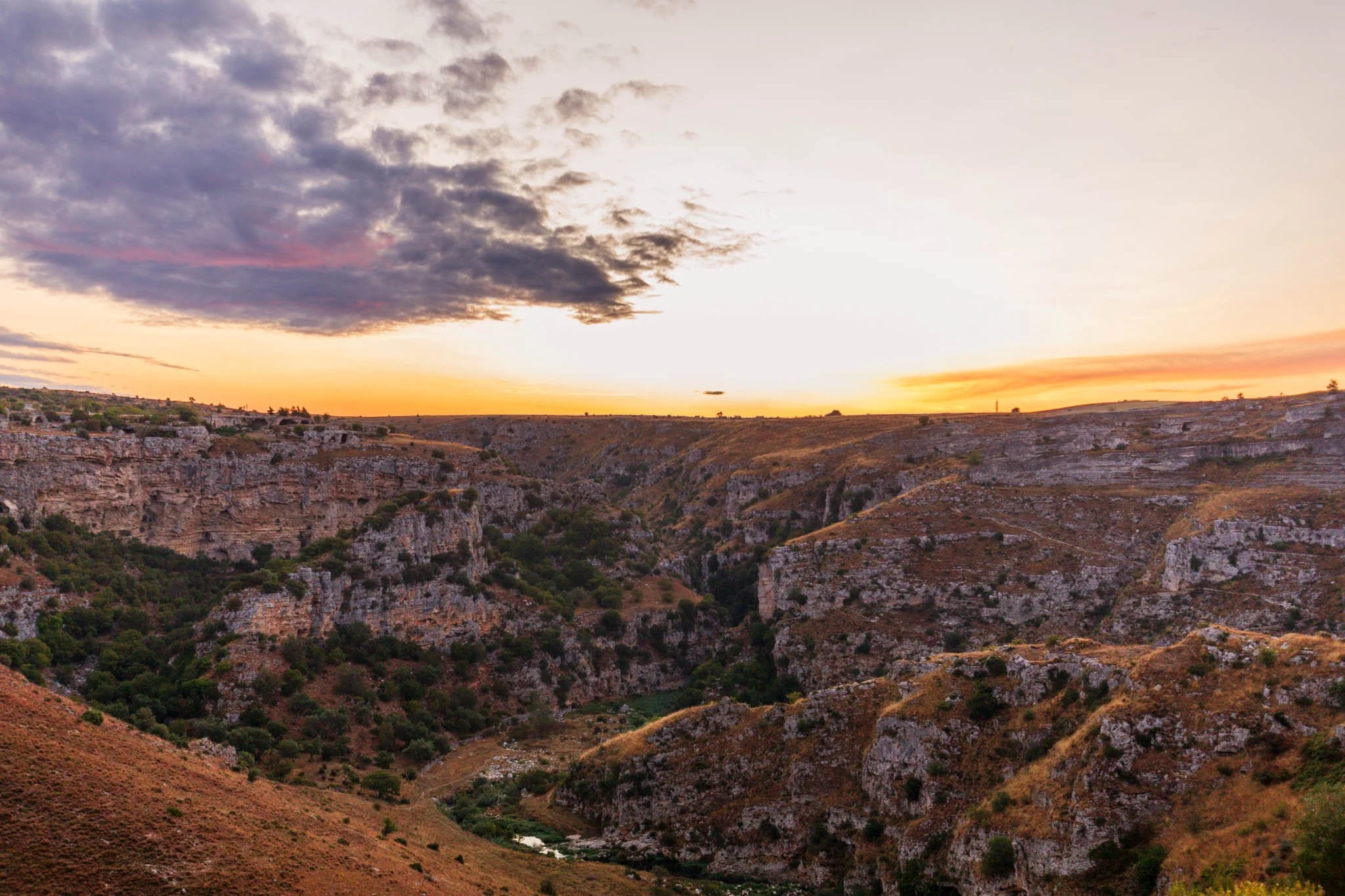
The Ravines of Matera
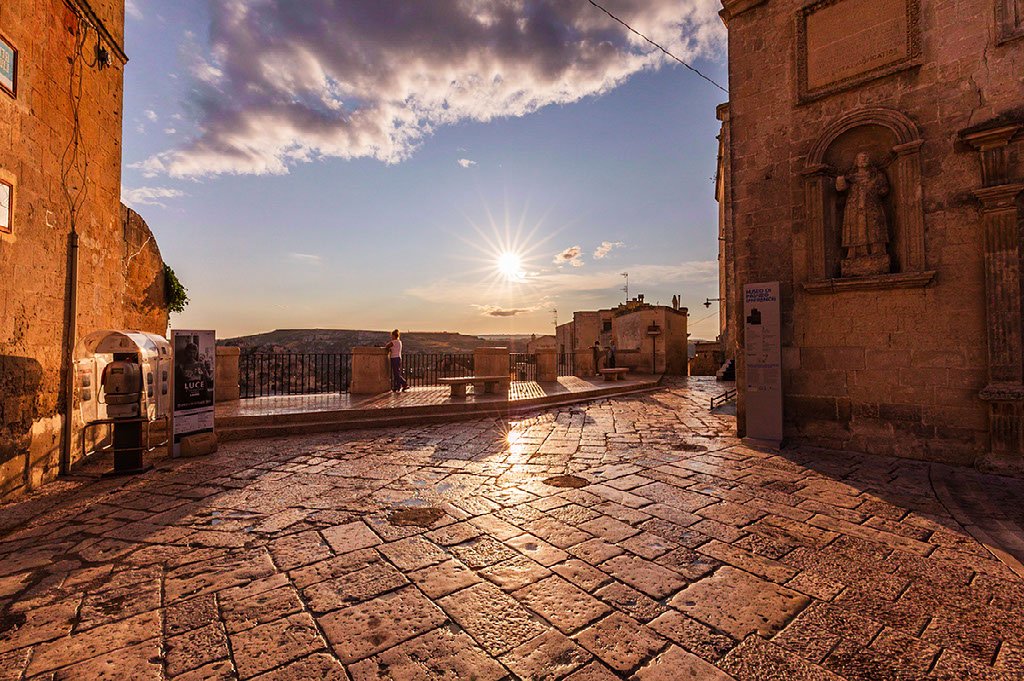
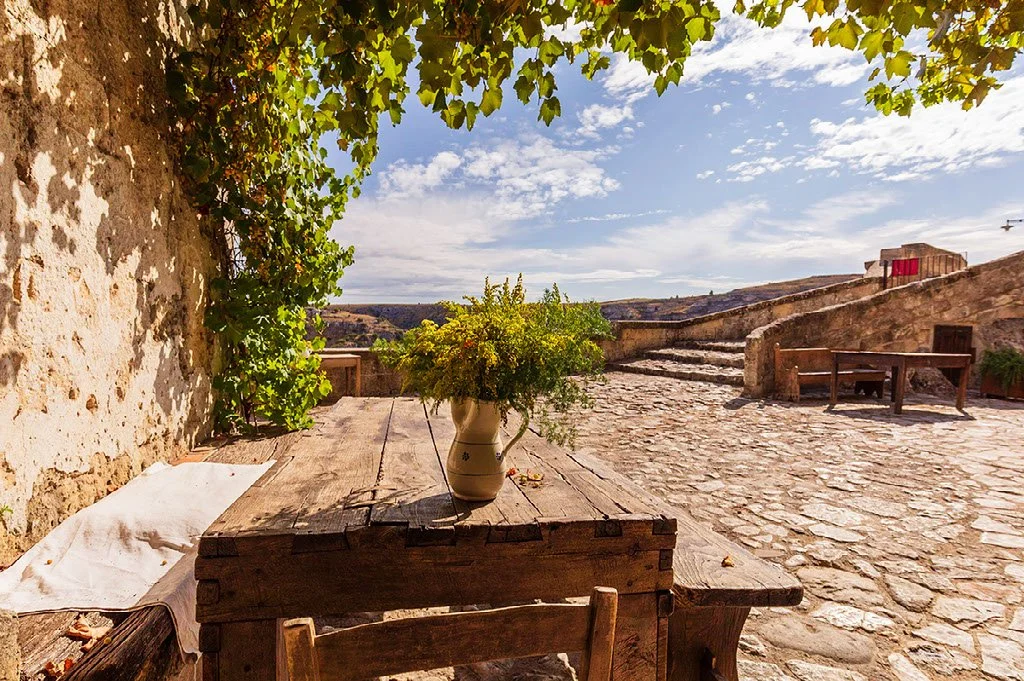
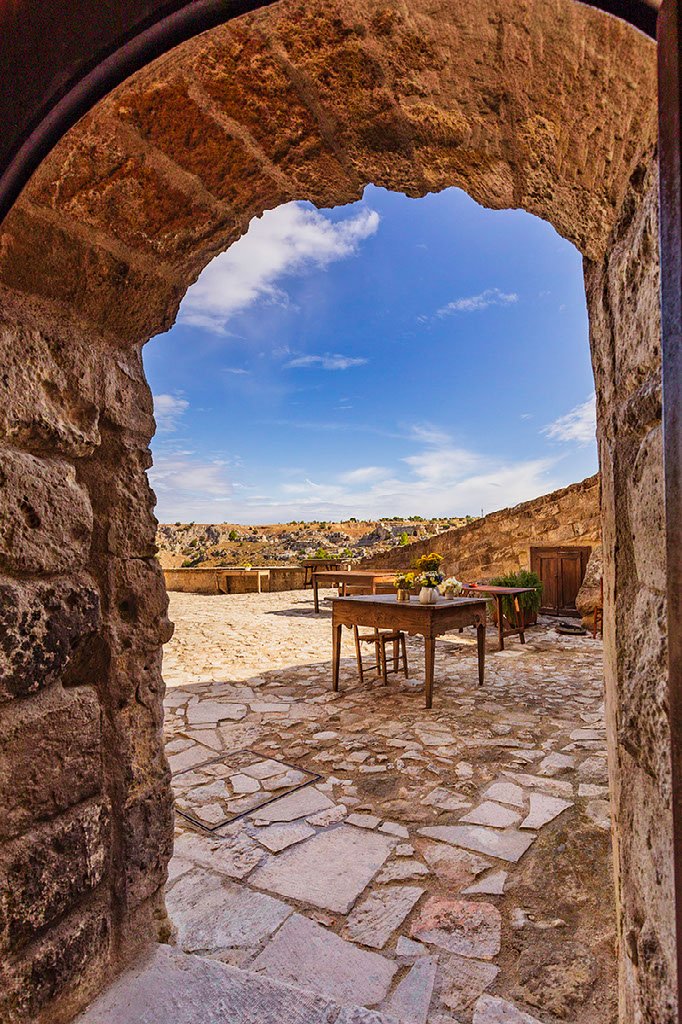
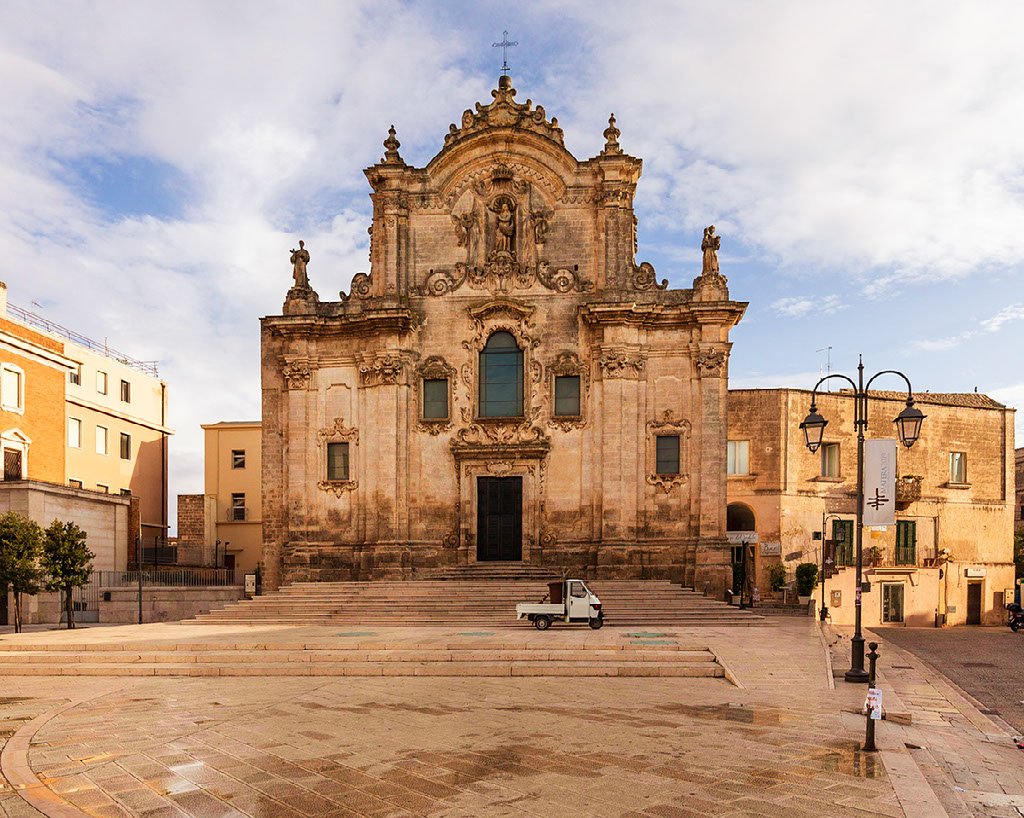
Belvedere Murgia Timone
This is the viewpoint that changes how you see Matera. Where all the city-side belvederes look down into the Sassi, Murgia Timone sits on the opposite hillside across the ravine, giving you a complete panoramic view of the entire cave city from the outside. The full scale of the Sassi, the ravine, the Cathedral, and the limestone plateau behind the city all appear in a single frame. It is a fundamentally different image from anything you can make while standing inside Matera.
Getting here requires either a short drive around the gorge or a hike across the suspension bridge from the city, roughly 45 minutes to an hour on foot. The hike is worth doing at least once: the path passes several cave churches and Neolithic remains along the way, and the approach through the Murgia Materana Park adds context to what you are photographing.
📷 Pro Tip: Despite being known as a sunset spot, sunrise is actually stronger for photography here. At sunrise, the light hits the face of the Sassi directly and the entire cave city glows in warm tones while the ravine below remains in shadow. At sunset, the sun drops behind the city and you are shooting into the light, which can produce beautiful silhouette and backlit images but requires more exposure work. Bring your 16 to 35mm for the full panoramic and your 70 to 200mm to pull specific sections of the Sassi out of the wider scene. If you drive, there is a small parking area near the viewpoint. At the viewpoint itself, descend slightly from the main platform to find a cave entrance that frames the Sassi perfectly; this is a stronger composition than the open platform shot most visitors take.
Best time: Sunrise or blue hour after sunset. Access: Free. Drive around the gorge or hike via the suspension bridge from Piazza San Pietro Caveoso.
The Duomo and Piazza Duomo
The Cathedral of Matera, the Basilica Cattedrale di Santa Maria della Bruna e di Sant'Eustachio, stands at the highest point of the Civita, the oldest section of the Sassi, and its bell tower appears in the background of almost every wide photograph you will take in Matera. It is worth getting to know it as a subject in its own right.
The Piazza Duomo offers one of the highest viewpoints within the city, looking out over the rooftops of the Sassi toward the ravine. The Cathedral's Romanesque facade faces south and catches strong direct light in the morning. The interior is lavishly decorated: coffered ceiling, carved stonework, and a Byzantine-influenced apse that photographs well in available light.
📷 Pro Tip: For exterior photography, arrive in the morning when the facade is fully lit and the shadows fall away from the building. A 24 to 50mm lens gives you the best balance between the facade and the surrounding piazza. For the interior, use a wide lens and shoot from the back of the nave toward the altar to capture the full length of the space. The light from the side windows creates strong directional shafts in the late morning; these last only a few minutes and are worth waiting for. From the viewpoint platform adjacent to the Piazza Duomo, shoot with a 35 to 50mm lens for a mid-range view of the Sassi below that includes rooftop details and the ravine edge without going so wide that the scene loses its sense of depth.
Best time: Exterior: morning. Interior: mid-morning for window light. Access: Free exterior. Small entrance fee for the interior. Located at the top of the Civita, walkable from Sasso Barisano.
Cripta del peccato Originale
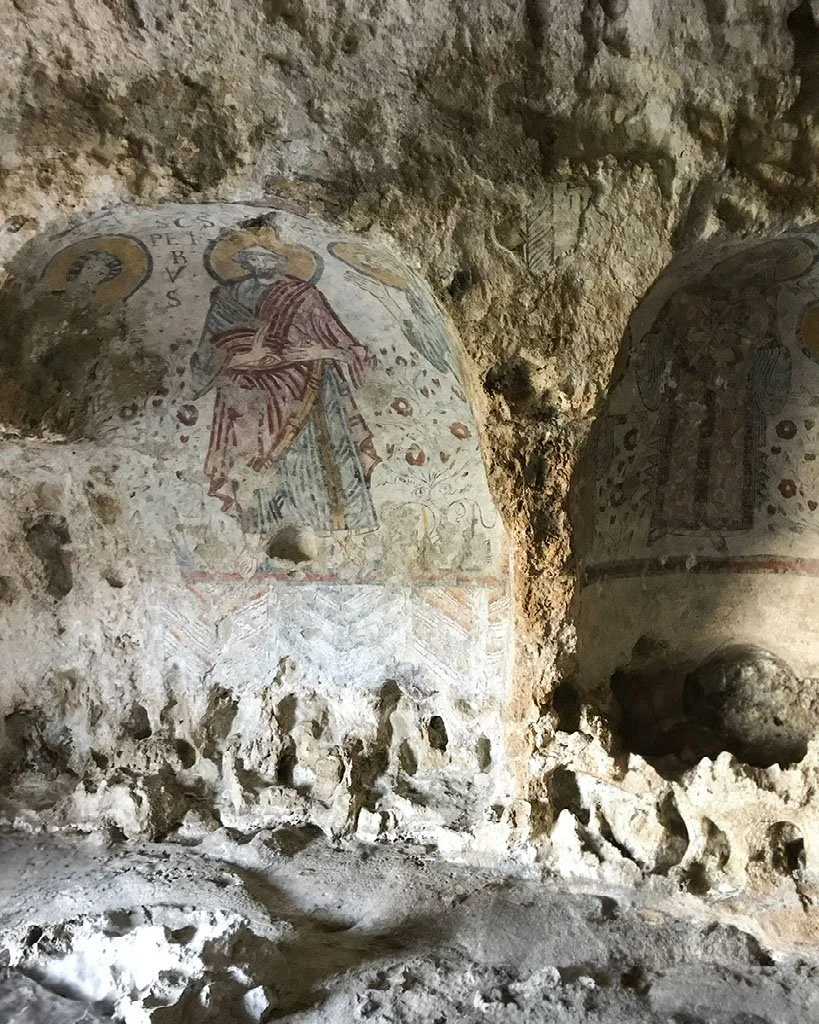
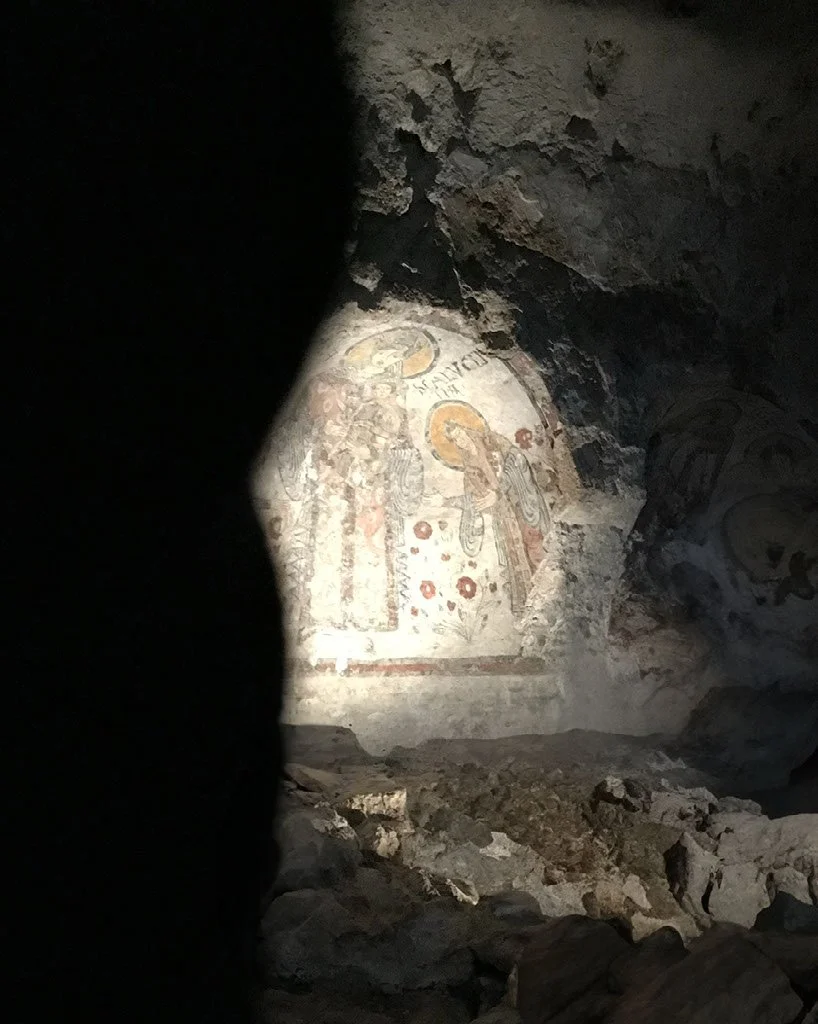
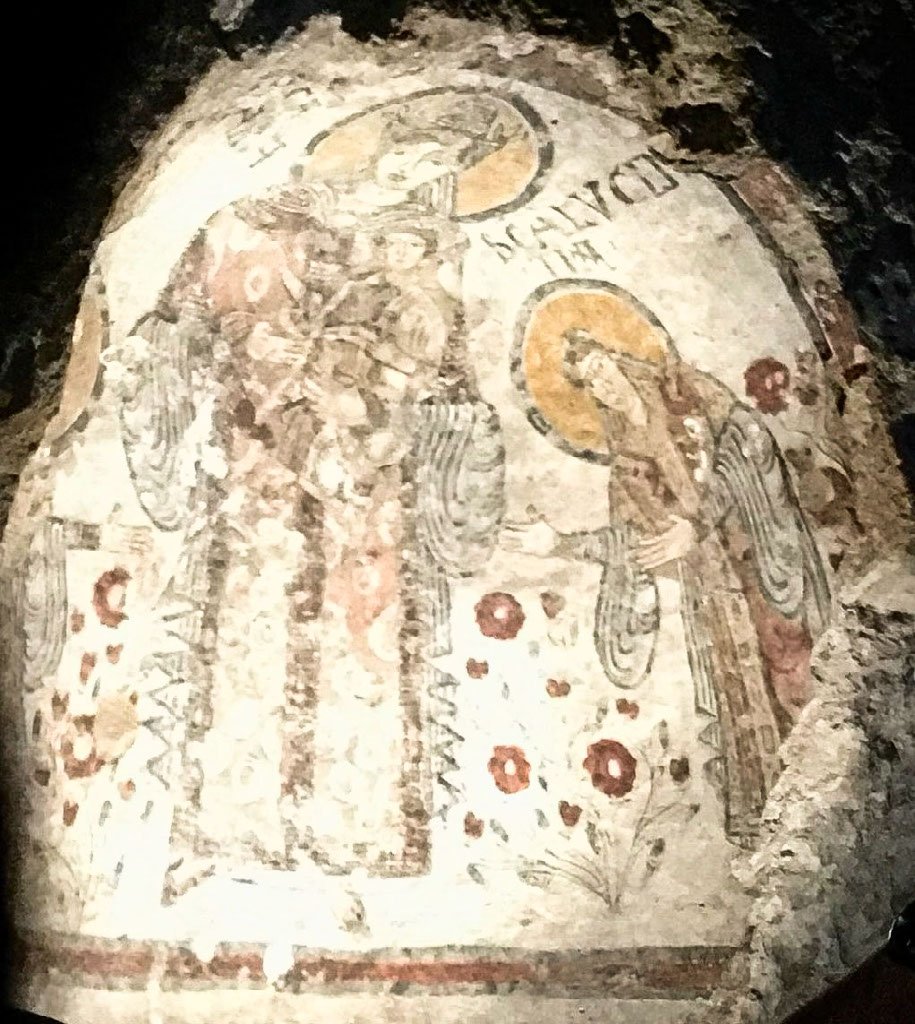
Nothing in Matera quite prepares you for this. The Crypt of the Original Sin is a natural cave church located roughly 7 kilometers south of the city, and when you arrive at the unremarkable farmstead that serves as the entry point, every instinct says turn around. Do not. Inside, 8th-century Benedictine frescoes cover an entire wall of the cave: the Apostles, the Virgin, the Archangels, scenes from Genesis, and the extraordinary floral paintings that gave the unknown artist the name the Painter of Flowers of Matera. It is consistently described as the Sistine Chapel of rupestrian art, and that comparison is not an overstatement.
The space is small, visits are timed and guided, and only a handful of people enter at once. This is not a quick stop. It is an experience.
📷 Pro Tip: Photography inside the crypt is permitted but flash is strictly prohibited. The space is lit by controlled artificial light specifically designed to protect the frescoes, which means the lighting is consistent but dim. Shoot at a wide aperture, ISO 3200 minimum, and brace against whatever surface you can find. A 16 to 24mm lens covers the full wall painting in one or two frames from the limited positions available inside. The most compelling detail shots are of the flower paintings, which sit at eye level along the lower register of the fresco wall. Book tickets in advance through the official website at criptadelpeccatooriginale.it. Visits run Tuesday to Sunday by appointment only. The crypt can only be reached by car; it is not accessible on foot from the city.
Best time: Any time during opening hours; all visits are guided and timed. Access: Paid entry, advance booking required. Located at Contrada Pietrapenta, approximately 7km south of Matera by car.
The Famous Bread of Altamura
Have you heard about the bread of Altramura? This bread has been sought after since the time of the Roman Empire:
“Altamura bread, by far the best bread to be had, so good that the wise traveler takes a supply with him for his onward journey.” Horace’s Satires, 37 BC
On your way to Matera, or as you leave, make sure to stop in Altamura. It is a small town located about 20 minutes from Matera. In Altamura, they make a very unique and special kind of bread called Pane di Altamura DOP. It is truly something you do not want to miss!!
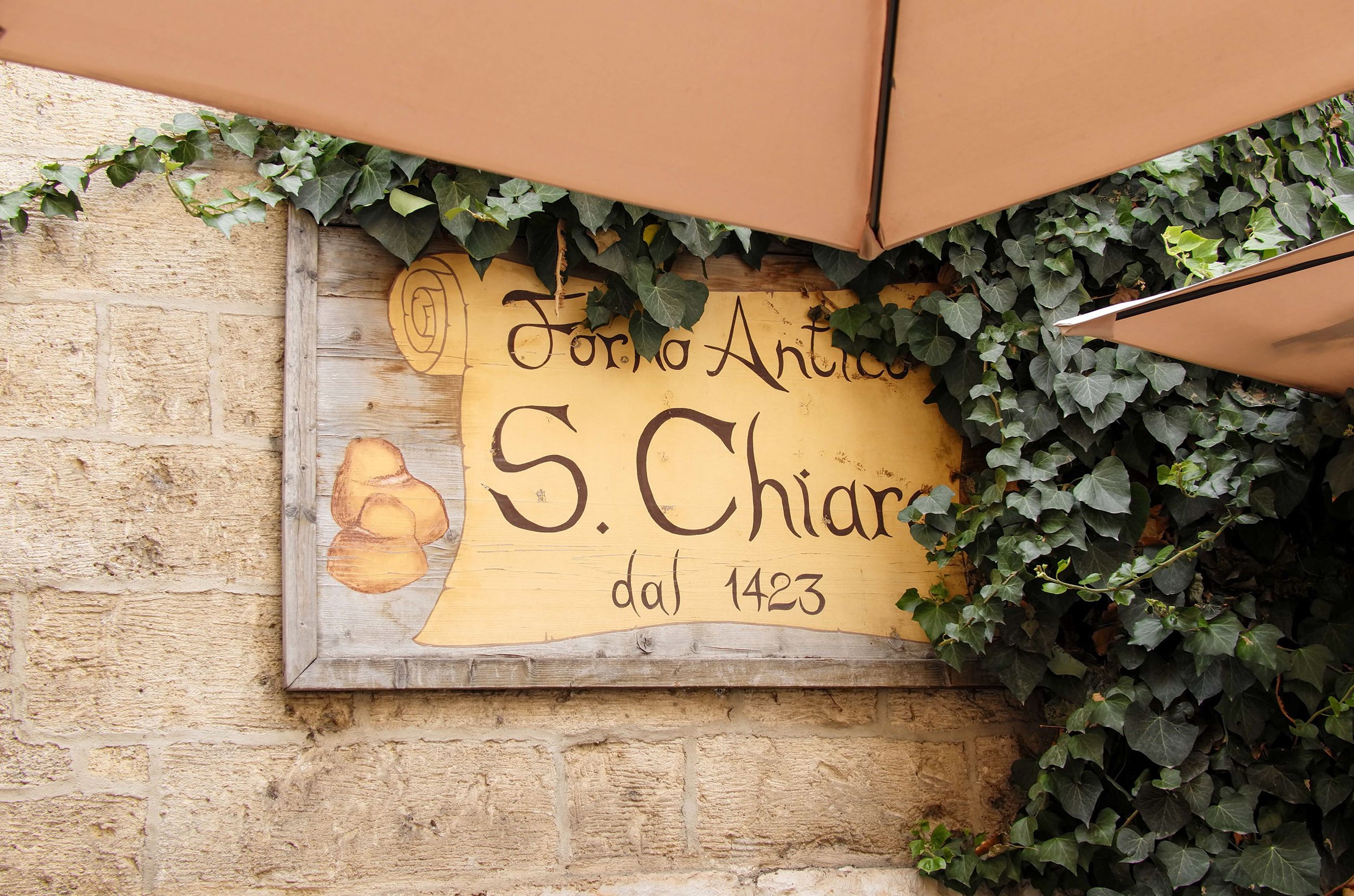
Forno Antico S. Chiara
The European Union granted, in 2003, the bread a P.D.O. (protected designation of origin) to describe the strict recipe that only a few bakeries follow. The bread is made using re-milled durum wheat flour, naturally leavened with a sourdough that has risen three times and baked in a wood-fired oven.
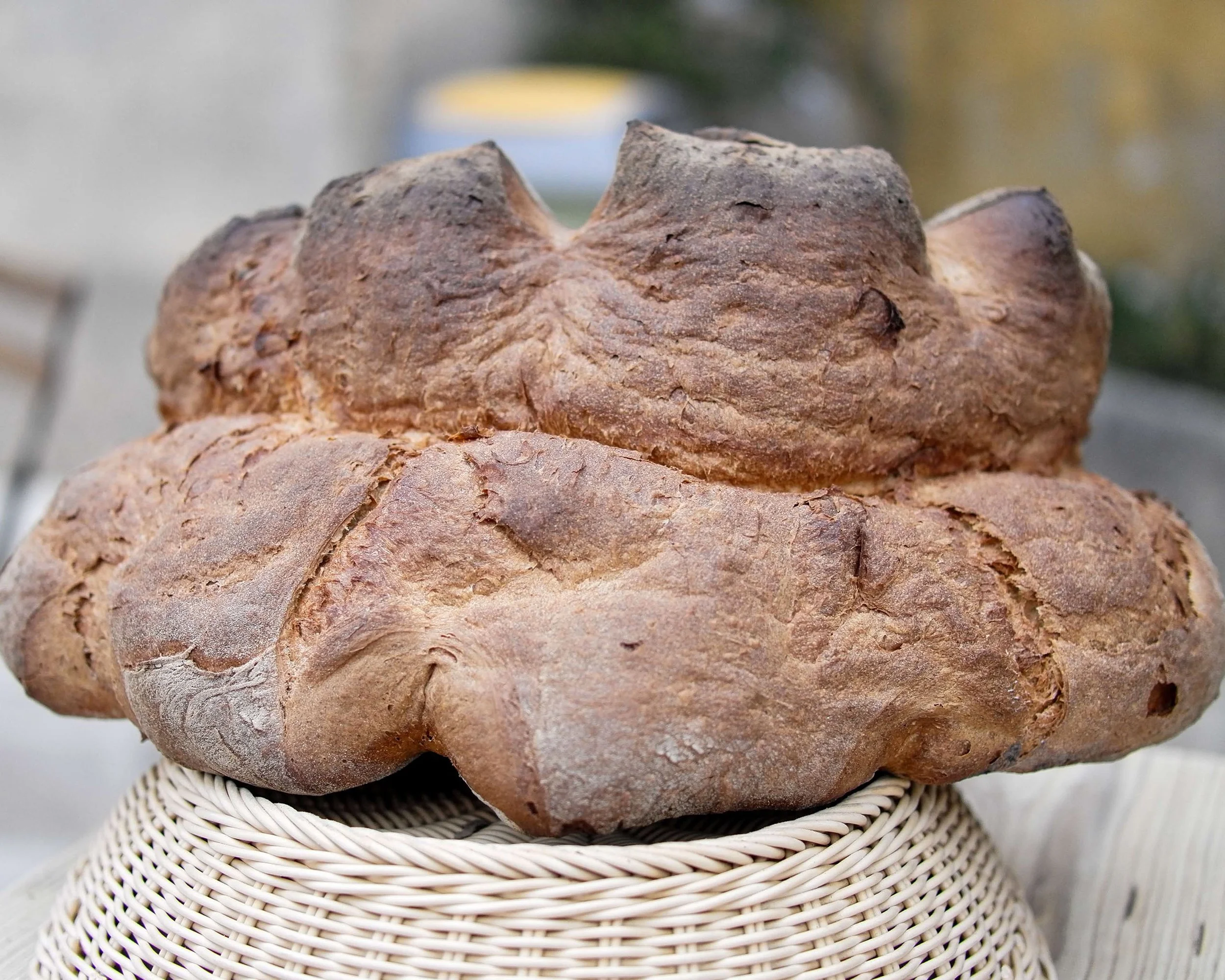
The Bread of Altamura
A wonderful place to stop for lunch and try the Altamura bread is a restaurant & bakery called Forno Antico S. Chiara, via Ambrogio del Giudice 2. The bakery has been in the same location since 1423. That was before America was discovered!! That's just incredible.
They have an outdoor seating area where you can order pasta, sandwiches, focaccia, and delicious fresh cheeses.
Good. Three strong events confirmed and verified. Here is the section:
Festivals & Events
Matera's festival calendar is not large, but the events it does have are extraordinary. Two of them rank among the most photogenic celebrations in southern Italy.
Festa della Madonna della Bruna — July
This is the one. Every year on July 2nd, Matera celebrates its patron saint with a festival that has run without interruption since 1389. It begins before dawn with a torchlit procession of shepherds through the Sassi, a throwback to the city's pastoral roots that is among the most atmospheric things you can photograph in the city. Through the morning, the Archbishop leads a solemn procession carrying a Byzantine icon of the Madonna through streets packed with Materani who have waited all year for this day.
The climax is the assalto al carro: a massive papier-mâché float, months in the making, is pulled through the Sassi by mules. Once the Madonna's statue is safely removed, the crowd rushes the float and tears it to pieces in minutes. Fragments are kept as lucky talismans. The destruction is sanctioned, complete, and breathtaking to watch. Fireworks over the Gravina canyon follow in the evening.
For photographers: arrive very early for any viewpoint. The pre-dawn procession through the Sassi is the most atmospheric moment and the least crowded. A 24 to 70mm lens handles the street scenes; switch to a 70 to 200mm for the float procession to compress the crowd and isolate the detail of the papier-mâché work. The chaos of the assault is genuinely difficult to photograph cleanly; position yourself at an elevated point above the crowd if you can. Book your hotel months in advance. The city fills up completely.
Settimana Santa — March or April (Holy Week, date varies with Easter)
The week before Easter brings solemn candlelit processions through the Sassi that are among the most quietly powerful things you can witness in Matera. This is not a festival of noise and spectacle; it is a deeply felt religious observance that has been practiced in these same stone streets for centuries. Hooded penitents carry life-sized religious figures through the narrow alleyways at night, moving slowly through the darkness by candlelight.
For photographers: this is one of those rare moments when Matera's ancient architecture and living religious tradition align in a single frame. The lighting is almost entirely candlelight and torch, which means high ISO and a steady hand or a small tripod. Shoot at f/2 or wider and let the flicker and warmth of the light do the work. Respect the solemnity of the event: keep your distance, do not use flash, and ask before moving close to participants.
Matera Film Festival — November
The Matera Film Festival runs each November and screens international independent films, documentaries, and short films across venues in the Sassi and the modern city. Piazza San Pietro Caveoso is used as an outdoor screening venue, which is exactly as cinematic as it sounds. For photographers, the combination of a film festival atmosphere and Matera's autumn light in November makes this a strong shoulder-season reason to visit when crowds are at their lowest.
Frequently Asked Questions About Visiting Matera
Do you need a car in Matera?
Not once you're inside the Sassi, the alleyways are too narrow and the staircases too steep for anything with wheels. A car is essential for reaching the Cripta del Peccato Originale and for day trips like Altamura, but within the historic center, you walk everywhere.
Is Matera worth visiting outside of summer?
Yes, and arguably it's better outside of summer. April-May and September-October both offer better light and manageable crowds compared to the heat and density of July and August.
Is Matera expensive?
It can be for cave hotels like Sextantio, but there's a real range. Basilicata is one of Italy's least-visited regions, and the food, orecchiette, cavatelli, and Pane di Matera, is honest and reasonably priced outside the handful of Michelin-level restaurants.
What are the best photo spots in Matera?
The Belvedere di Piazza Giovanni Pascoli at sunrise, Piazza San Pietro Caveoso in late afternoon, and Belvedere Murgia Timone across the ravine are three that consistently deliver. The full list with Pro Tips is above.
Can you fly a drone in Matera?
Permitted but restricted, since the Sassi district falls within a UNESCO World Heritage site. Check current Italian CAA regulations before flying, and don't assume authorization is automatic.
What surprised you most about Matera?
The transformation I've witnessed since I was a child. I first saw Matera as a strange, forgotten place and didn't understand why until years later, when I learned it had spent nearly four decades as a ghost town after being called the shame of Italy. Watching it go from that history to a UNESCO World Heritage Site drawing over 600,000 visitors a year, in a single generation, is something I don't think I'll ever stop being moved by.
How many days do you need in Matera?
Two nights minimum, three for a comfortable pace. One night is enough for the main viewpoints but not enough for both a sunrise and blue hour session, which is where the real photography happens.
Is Matera worth combining with the rest of Puglia?
Yes, absolutely, it's a natural pairing, under two hours from Bari or Lecce. Together they make one of the strongest photography itineraries in southern Italy.
Final Thoughts
Matera does not reveal itself quickly. You have to walk it slowly, lose your sense of direction in the alleys, climb staircases that lead somewhere unexpected, and stand still long enough for the light to change. When it does, and it will, you understand why this city has held onto people for 9,000 years.
I first came here as a child and thought it looked abandoned. I came back as a photographer and understood it was something else entirely: a place that had survived everything thrown at it, including four decades of being emptied out and left to the elements, and come back stronger. That kind of history gets into the stone. You can feel it when you are standing at the Belvedere at blue hour, watching the cave homes light up across the ravine, and you realize that people have stood on this same ledge looking at that same view since before recorded history.
Bring your camera, but bring patience too. The best images here are not taken by rushing between viewpoints. They are found by slowing down, staying longer, and returning to the same spot when the light changes. Matera rewards that approach every time.
Want to improve your photography while exploring some incredible destinations? Join me on one of my photography workshops! You can find all the details, including upcoming destinations and dates, through the links below.
Let's Stay Connected!
For more guides from the region, these three pairs naturally pair with a Matera trip.
My Photography & Travel Guide to Puglia covers the full sweep of the region that borders Basilicata to the east, from Bari and Alberobello to Lecce and Polignano a Mare. Matera and Puglia together make one of the strongest photography itineraries in southern Italy.
My Photography & Travel Guide to Rome, Italy. Rome sits roughly four hours north of Matera by car or train via Naples, making it a natural bookend to a southern Italy trip. Where Matera is raw, ancient, and quietly resurrected from ruin, Rome is grand, layered, and endlessly photographed. Together, they tell two very different stories about what survives in Italy and how.
My Photography & Travel Guide to Florence, Italy. Florence is a longer journey, about five hours by car, but a logical extension if you're building a broader Italy itinerary. The contrast is the point: Matera's cave dwellings and rupestrian churches against Florence's Renaissance grandeur, two entirely different chapters of the same country's history.
Photography should feel exciting, not confusing.
If you have ever picked up a camera and thought, “Now what?” this book was written for you.
Photography Made Simple is a clear, encouraging guide for adults who want to understand photography without getting buried in complicated terminology, technical formulas, or endless equipment advice.
Whether you use a DSLR, mirrorless camera, or smartphone, Vito L. Tanzi walks you through the essential skills you need to take more intentional, creative, and consistently better photographs.
Inside, you will learn:
• The camera settings that matter most when you are getting started
• How aperture, shutter speed, and ISO work together
• How to create sharper photographs and choose the right focus settings
• How to use light and composition to make your images more interesting
• Practical techniques for portraits, landscapes, travel, and everyday photography
• What equipment you actually need, and what you can safely ignore
• How to improve your photographs without buying a new camera
You will also find practical exercises, simple cheat sheets, and helpful advice for organizing and editing your photographs.
This is not a textbook. It is a friendly, practical guide designed to help you move beyond full Auto, understand what your camera is doing, and feel more confident every time you press the shutter.
Photography is not only about learning settings. It is about learning to notice light, color, emotion, and the small details most people walk past.
Photography Made Simple will help you see the world differently, and capture it the way you imagined.
📸 Format: PDF download
Pages: 100+
Perfect for: Beginners, hobbyists, and anyone ready to take better photos without the stress