Assisi, Italy Travel & Photography Guide: Best Photo Spots, Things to Do & Hidden Gems
Some places slow you down the moment you arrive. Assisi is one of them.
The town sits high on the slope of Monte Subasio, built almost entirely from the same pale pink limestone that glows warm at sunrise and turns almost amber by late afternoon. That stone is everywhere: the streets, the walls, the archways, the churches. It gives Assisi a visual consistency you rarely find in Italy, a coherence that makes every frame feel considered. Point your camera in almost any direction during golden hour, and the light does the work for you.
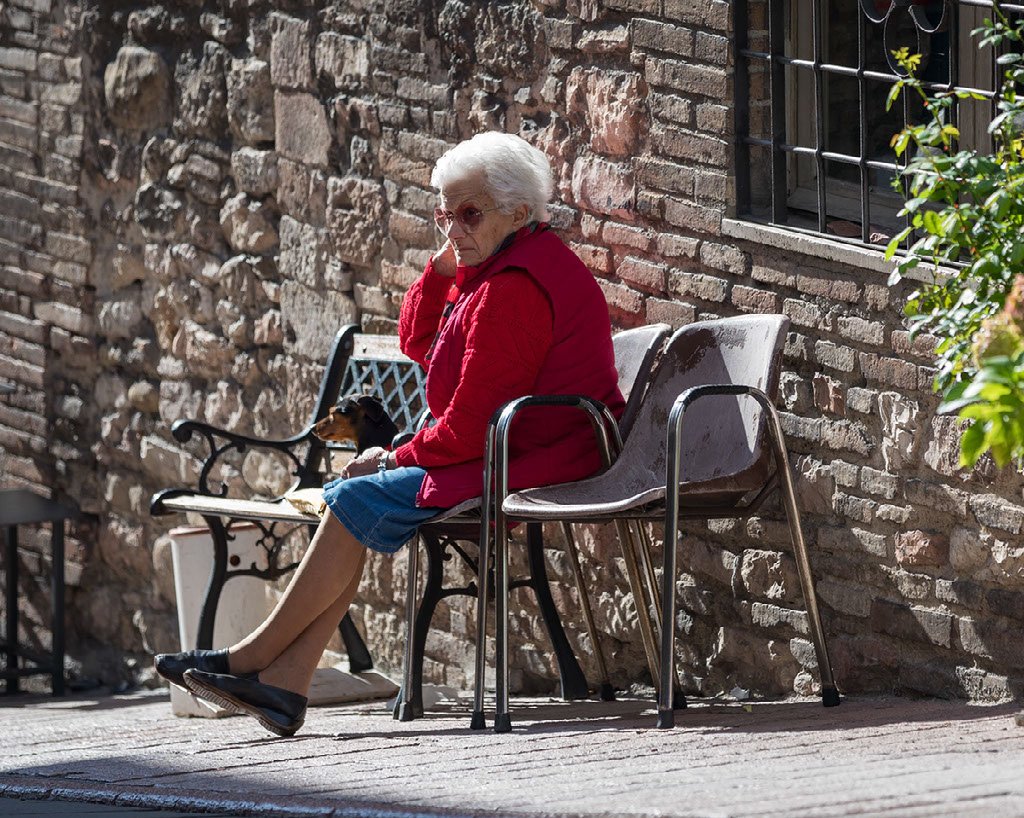
I visited Assisi for the first time shortly after we lost our dog, drawn partly by the connection to St. Francis, the patron saint of animals. What I did not expect was how much the town itself would move me. There is a stillness here that goes beyond the religious. It is in the narrow lanes that wind uphill toward the Rocca Maggiore. It is in the views from the terraces of the Basilica of Saint Francis, where the Umbrian valley stretches out below you in shades of green and gold. It is in the quiet of early morning, when the pilgrims have not yet arrived, and the light is soft and clean and completely yours.
Assisi is a UNESCO World Heritage site, and it earns that designation not just for the Basilica but for the whole of the historic center: the Roman temple converted to a church, the medieval towers, the flower-draped alleyways, the frescoed interiors. For photographers, it is a compact, walkable, endlessly layered subject. For travelers, it is one of those rare Italian towns where the atmosphere is just as important as the sights.
In this Photography Guide to Assisi, Italy, I share the places and experiences that continue to draw me back. You will find my favorite photography locations, guidance on when and where to shoot, practical travel tips, and gear recommendations, along with cultural insights to help you explore and photograph Assisi with confidence, respect, and ease.
View of the Basilica St. Francis
Photographer's Notes
Before you go, here are my own takeaways.
Favorite Season: Autumn (September-October)
Favorite Location: Basilica of Saint Francis
Favorite Hotel: Nun Assisi Relais & Spa Museum
Favorite Restaurant: Bibenda Assisi
Favorite Café: Caffè Duomo
Favorite Lens: 15-35mm
Would I Return? Yes, 100 percent, it's a beautiful town.
Best Time to Visit Assisi
For photographers, the honest answer is spring and autumn. Both seasons give you the light, the manageable crowds, and the kind of atmosphere that makes Assisi worth the trip.
Spring (April to June) is when the Umbrian countryside comes alive. The hillsides around Monte Subasio are green and dotted with wildflowers, the light is soft and long, and the air is cool enough to walk comfortably with a full camera bag. Late April and early May are particularly good. Calendimaggio, Assisi's medieval festival, takes place in early May and transforms the town into a living photograph, with costumes, torchlit processions, and music spilling through the streets. If your schedule allows it, plan around that.
Autumn (September to October) is my personal preference. The summer crowds thin out, the light turns warm and directional, and the Umbrian valley below the Basilica takes on shades of gold and amber that you simply cannot replicate at other times of year. October brings the Feast of St. Francis, one of the most photographically significant events in the region, and truffle season means the restaurants are at their best. Temperatures are comfortable for walking and shooting all day.
Summer (July to August) works if it is the only window you have. The days are long, which gives you more hours to shoot, but midday heat above 30°C makes it genuinely unpleasant to be outside with gear. The crowds peak in summer, and the narrow streets around the Basilica can feel overwhelming by mid-morning. Go very early and plan to be back at your hotel by noon.
Winter (December to February) is the overlooked option. Assisi is quiet, almost meditative, and the pale limestone takes on a cooler, moodier quality in the low winter light. Fog rolls through the valley some mornings and produces extraordinary atmospheric shots from the terraces near the Basilica. It is cold, occasionally below freezing, and a few restaurants and smaller hotels close for the season. But if solitude and serious photography are the priorities, winter deserves a look.
For light specifically: the Basilica of Saint Francis faces west, so late afternoon and golden hour are when the exterior glows. The valley views from the terraces are best in the morning, when the light comes in low across the fields. Build your shooting days around those two windows regardless of when you visit.

Getting Around Assisi
The short version: once you are inside the historic center, you walk. Assisi is small enough that nearly every photography location in this guide is reachable on foot within 15 to 20 minutes from anywhere inside the walls. That is genuinely one of the town's great advantages for photographers. No taxis needed between shots, no time wasted on logistics.
On foot is the primary and best mode of transport inside Assisi. The streets are narrow, cobblestoned, and steep in places, so wear shoes with real grip, especially if you are visiting in wet weather. The limestone lanes polish over time and can be slippery. For photographers carrying a full kit, a comfortable shoulder bag or backpack matters more here than almost anywhere else in Italy.
By car to get to Assisi, and then park and walk. The entire historic center is a ZTL (Zona a Traffico Limitato), meaning it is a restricted traffic zone with cameras at every entry point. Unauthorized access results in fines that arrive in the mail months later. Do not test this. Your hotel can arrange a temporary ZTL pass for luggage drop-off on arrival; always contact them in advance with your license plate number. The main parking lots sit just outside the historic walls: Parcheggio Saba Porta Nuova is closest to the Basilica, Parcheggio Piazza Matteotti has elevator access up into the center, and Parcheggio Mojano is a solid mid-point option. All are paid lots.
By train is an excellent option if you are coming from Rome, Florence, or Perugia. The Assisi train station sits in Santa Maria degli Angeli at the base of the hill, not in the historic center itself. From there, Bus Line C runs up to the upper town regularly and is the standard connection for arriving visitors.
Taxis are available and useful for reaching outlying locations like the Eremo delle Carceri (the hermitage on Monte Subasio) or for a day trip to Gubbio if you do not have a rental car. There is no Uber or Bolt operating in Assisi. Arrange taxis through your hotel or at the taxi stand near Piazza del Comune.
One practical note for photographers: if you are driving between Assisi and nearby towns like Spello or Spoleto, a rental car is the most flexible option. The Umbrian countryside between those towns is beautiful and worth stopping to photograph along the way.
How Many Days Should You Spend in Assisi
Two full days is the honest minimum. One day is doable if Assisi is a stop on a larger Umbria itinerary, but you will feel rushed, and rushed photography rarely produces your best work.
Three days is the sweet spot if photography is a serious priority. Here is how I would structure it.
Day One: The Historic Center
Start before sunrise at the Basilica of Saint Francis. The western facade catches the first warm light, and the terraces below it give you unobstructed views over the Umbrian valley before a single tour bus has arrived. Work the exterior, the loggia, and the wide stairs leading up from the lower piazza. After the light softens, go inside to the Lower Basilica and spend time with the frescoes. Mid-morning, walk Via San Francesco toward Piazza del Comune and photograph the Temple of Minerva and the Torre del Popolo while the streets are still relatively quiet. In the afternoon, climb up to the Rocca Maggiore for panoramic views over the town and valley. Come back down for golden hour at the Basilica from the opposite angle, shooting back toward town.
Day Two: Churches, Side Streets, and the Valley
Give the morning to the Basilica di Santa Chiara and the Cathedral of San Rufino. Both are quieter than the Franciscan complex and offer strong architectural subjects. Spend the middle of the day exploring the side streets between those two churches, the flower-draped lanes and arched passageways that are some of the most photogenic corners of the town. In the afternoon, drive or walk down to Santa Maria degli Angeli to photograph the enormous Baroque basilica that encloses the tiny Porziuncola chapel, an extraordinary subject that most photographers miss entirely. Return to the historic center for blue hour.
Day Three: Day Trip to Spello or Gubbio
Use a third day for a day trip. Spello is 12 kilometers south of Assisi and is one of the most photogenic towns in Umbria, with flower-lined streets, Roman gates, and far fewer crowds. It is an easy 20-minute drive. Gubbio is about 50 kilometers north and requires more commitment, but the medieval piazza, the Roman theater, and the funicular ride up to the Basilica of Saint Ubaldo are worth a half day. Both pair naturally with a return to Assisi for sunset.
If you only have one day, prioritize the Basilica of Saint Francis at golden hour, a walk along Via San Francesco, and Piazza del Comune. That is the essential Assisi in three hours.
Where to Stay in Assisi
Assisi is a small, walkable historic center, and almost everything worth photographing is within a 15-minute walk of anywhere you stay inside the walls. That said, location still matters. If you want to be close to the Basilica of Saint Francis for early morning shots before the crowds arrive, stay on the western end of town, near Via San Francesco. If you prefer to be near Piazza del Comune and the Cathedral of San Rufino, the center works just as well. Avoid staying in Santa Maria degli Angeli, the modern town at the base of the hill. It is convenient for parking and the train station, but you will spend too much time commuting up to the historic center.
Luxury Hotels in Assisi
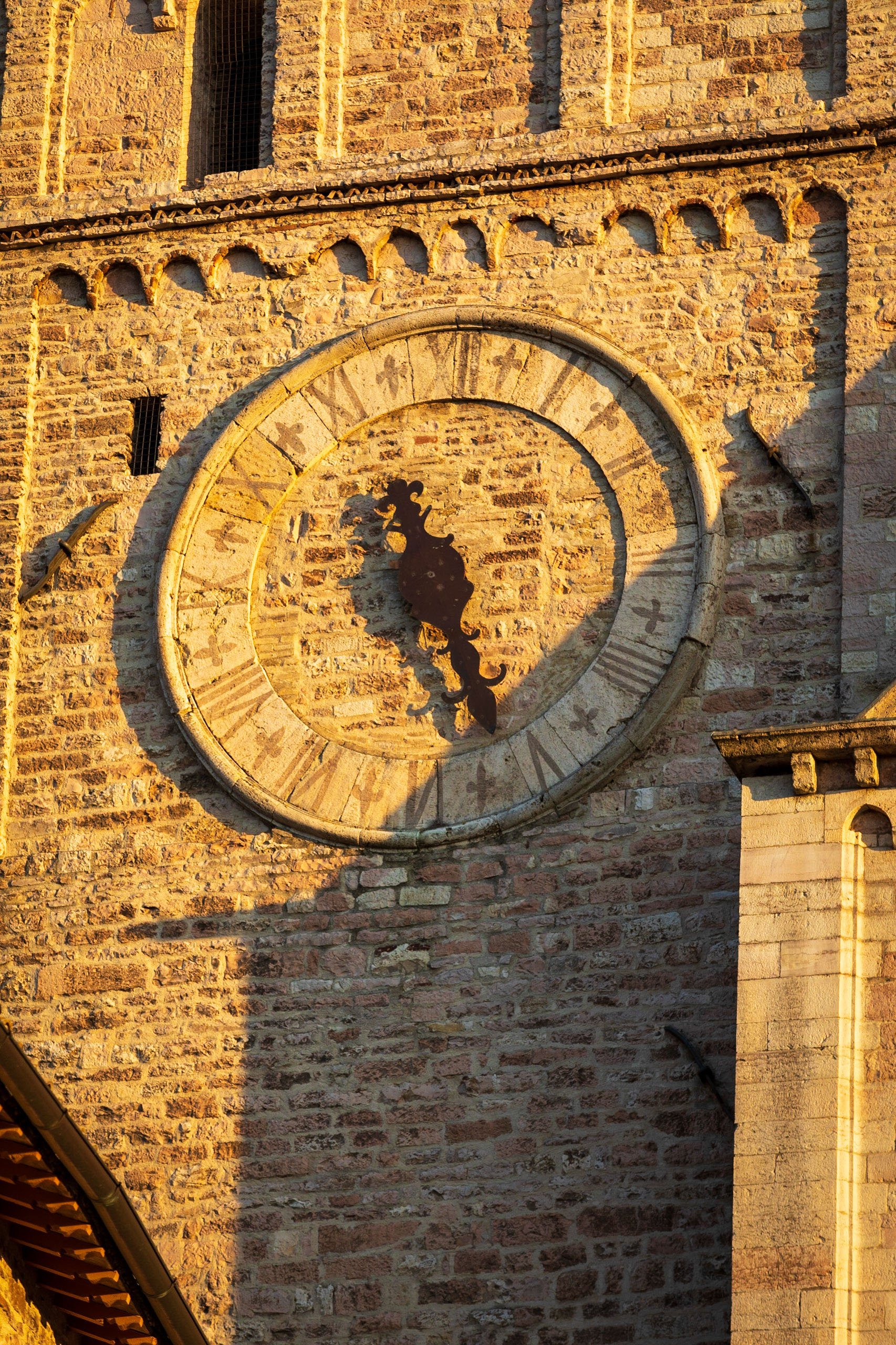
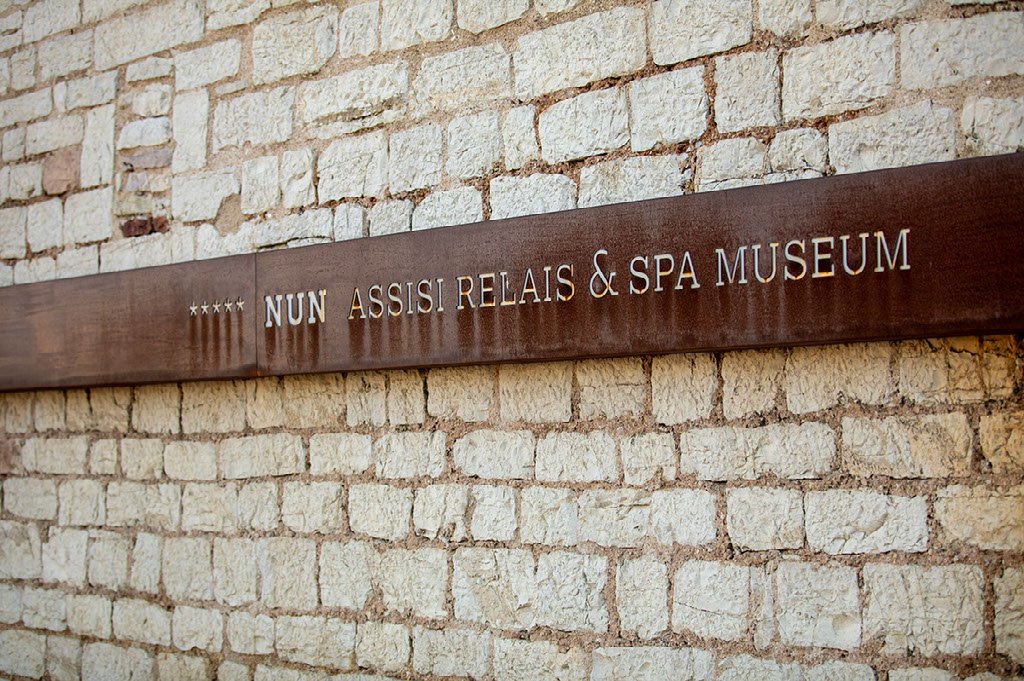
Nun Assisi Relais & Spa Museum is the most distinctive place to stay in town. The hotel occupies the carefully restored Monastery of Saint Catherine, built in 1275 for a community of Benedictine nuns. The rooms are modern and beautifully appointed, but the bones of the building are very much still there: original stonework, vaulted ceilings, 17th-century frescoes. The spa is set in the ruins of a Roman amphitheater beneath the hotel, which is as extraordinary as it sounds. We enjoyed both breakfast and dinner here, and the restaurant is genuinely good. Rooms with views toward the valley are worth requesting.
Fontebella Palace Hotel sits on Via Fontebella, roughly halfway between the Basilica and Piazza del Comune, which is about as central as you can get for a photographer. The building is a Renaissance-era palace, and the rooms on the valley-facing side look out over the Umbrian countryside. Request one of those. The restaurant, Il Frantoio, has a strong local reputation, and the breakfast is above average for a hotel of this size.
Giotto Hotel & Spa is a larger property with a rooftop terrace and panoramic views over the valley that are genuinely worth the stay. Three restaurants, a spa, and a central location make it a solid choice if you want more amenities than the boutique options offer. The Belvedere Lounge and terrace is a good spot for evening drinks after a long day of shooting.
Mid-Range & Boutique
Asisium Boutique Hotel sits steps from Piazza del Comune in the heart of the historic center. Rooms are clean, well-maintained, and several have views across the rooftops and valley. No elevator, which matters if you are carrying heavy gear, but the location compensates for it. Recent guests consistently praise the service and the breakfast.
Hotel Sorella Luna is a smaller, quieter option in the historic center, popular with travelers who want a more personal experience without the larger hotel feel. The name is a nod to the Canticle of the Creatures by St. Francis, which tells you something about how thoughtfully it is run. Good value and well-positioned for walking to the major photography locations.
Borgo Antichi Orti Assisi sits just outside the historic walls and offers a different kind of stay: a restored farmhouse property with a garden, a pool, and a calmer atmosphere than the center. It is a good base if you plan to shoot the exterior of the Basilica at golden hour and then want to retreat somewhere quiet. Slightly more driving involved, but parking is easier.
Where to Eat in Assisi
Umbrian food is honest, earthy, and deeply seasonal. Truffles, wild boar, strangozzi pasta, porchetta, lentils from Castelluccio, and Sagrantino wine from nearby Montefalco. This is not a cuisine that chases trends. It rewards patience and a willingness to eat the way the locals do: a proper two-course lunch with wine, a slower dinner, no rush. Assisi is small enough that you are never far from a good meal, but the best places fill up quickly in peak season, so book ahead.
Bibenda Assisi is the most characterful stop in town for wine and food. It is less a traditional restaurant than a rustic wine bar where the owner, Nila, personally introduces you to Umbrian producers and pours wines you will not find anywhere else. Order the local charcuterie, aged Canestrato cheese from Assisi, and bruschetta with the house olive oil. Go in the late afternoon before dinner and let the tasting run long. This is the place most photographers and travelers remember most from Assisi.
Trattoria Pallotta sits just off Piazza del Comune and is one of the most reliable spots in town for traditional Umbrian cooking. The strangozzi al tartufo nero, hand-rolled pasta with black truffle, is the dish to order. The room is simple, the prices are reasonable, and the cooking is the real thing. Closed Tuesdays.
Taverna dei Consoli is a solid local trattoria near Piazza del Comune with a comfortable atmosphere and a straightforward Umbrian menu. Good for dinner after a long day of shooting when you want something dependable without the fuss of a reservation.
Osteria Piazzetta dell'Erba is a more creative option, with a menu that moves between traditional Umbrian dishes, fusion cooking, and even sushi in the evening. The vaulted interior is beautiful and the outdoor terrace on the small piazza is one of the nicest places to sit in Assisi. A good choice if you want something slightly different from the standard trattoria format.
Ristorante Il Vicoletto is tucked down a narrow lane and easy to walk past without noticing it. Go through the door. The kitchen does refined, modern takes on Umbrian ingredients, truffle taglierini, pistachio-crusted lamb, careful presentations. It is more expensive than the others on this list, but the quality justifies it for a special dinner.
Le Terrazze di Properzio earns its place for one reason above all others: the view. The terrace looks out over the Umbrian valley, and on a clear evening the light across the fields is extraordinary. The food is good, the Umbrian tasting menu is worth ordering, and the wine list leans local. Make a reservation and ask for an outside table.
Coffee in Assisi
Caffè Duomo sits in Piazza San Rufino directly in front of the cathedral. It is the most photogenically placed café in town, with outdoor tables facing the Romanesque facade. Good espresso, reliable pastries, and one of the better spots for people-watching in the morning.
Bar Sensi is a local favorite for pastry. The Rocciata di Assisi, a traditional pastry rolled with apricot jam, apple, walnuts, raisins, and cinnamon, is exceptional here. Simple, warm, exactly the kind of place you hope to find when you are somewhere new.
Bar La Piazzetta di Agnese sits just below the historic center with a panoramic terrace looking out over the valley. An excellent spot for a morning cappuccino before heading up to shoot the Basilica, with views that more than justify the stop.
Photography Gear to Bring to Assisi
Assisi is a compact, walkable destination, which is good news for your back. You do not need to carry everything. The town rewards thoughtful, light shooting more than a heavy kit, and the narrow streets will occasionally make a large bag a genuine obstacle. Here is what to bring and what to leave behind.
DSLR and Mirrorless Kit
Camera bodies: Any of the current-generation mirrorless bodies handle Assisi beautifully. I shoot with the Canon EOS R5 Mark II, the Sony A7R V, and the Nikon Z8. For this destination, sensor resolution matters because the architectural details, the fresco textures inside the churches, and the wide valley landscapes all reward high-resolution files. If you have one high-resolution body, bring it.
Wide angle (16 to 24mm): Essential. The streets are narrow, the Basilica is large, and the valley views demand wide coverage. This is the lens that stays on the camera most of the day. A 16 to 35mm f/2.8 is ideal.
Standard zoom (24 to 70mm): Your second most-used focal length. Street scenes, interior details in the churches, food photography at dinner, portraits of pilgrims and locals in the piazzas. This lens handles the middle of the day when you are wandering without a specific shot in mind.
Telephoto (70 to 200mm): Worth packing for the valley views from the Basilica terraces and the Rocca Maggiore. Compressing the landscape layers from those viewpoints produces some of the strongest images in Assisi. Also useful for isolating architectural details on facades too high to reach with a wide lens.
Prime (35mm or 50mm): If you enjoy street photography and quiet documentary work, a fast prime is a pleasure in the narrow lanes. The 35mm f/1.4 or 50mm f/1.8 gives you a natural field of view and performs well in the lower light of the church interiors and early morning side streets.
Tripod: Bring a compact travel tripod. Blue hour at the Basilica, long exposures of the valley in morning mist, and interior shots where flash is prohibited all require one. A Platypod is a good alternative if you want to minimize weight. Photography is not permitted inside the Basilica of Saint Francis, so the tripod stays outside, but the exterior work at dawn and dusk is where it earns its place.
ND filters (3 to 6 stop): Useful for the valley landscape shots in full daylight when you want to slow a shutter speed for a more painterly effect. A circular polarizer is also worth having for managing reflections on the pale limestone surfaces in bright sun.
Extra batteries and cards: Assisi has limited camera shops. Bring at least two spare batteries and more storage than you think you need.
Samsung T7 SSD: Back up every evening. This is not optional.
iPhone Tips for Assisi
Assisi is genuinely excellent for iPhone photography. The pale limestone, the flowers against stone walls, and the strong graphic lines of the churches all work beautifully in the camera's natural rendering. A few specific tips:
Use Portrait Mode on pilgrims, monks, and nuns you encounter near the Basilica. The soft backgrounds separate your subjects from the busy stone walls behind them in a way that feels natural rather than over-processed.
Use the ultrawide lens inside the upper Basilica atrium and on Via San Francesco. The narrow street with its arched buildings framing the Basilica in the distance is one of the classic compositions in Assisi, and the ultrawide captures the full depth of it.
Shoot the valley views in ProRAW if your iPhone supports it. The dynamic range in those landscapes, bright sky against dark valley floor, is exactly where ProRAW gives you the most recovery latitude in post.
In the early morning side streets, switch to Night Mode even if it is not technically dark. The deep shadows under the arches and the soft ambient light produce a moodier, more atmospheric result than the standard mode.
Drone note: Assisi is a UNESCO World Heritage site and sits within controlled airspace near religious and historical monuments. Drone flights require prior authorization from Italian civil aviation authorities (ENAC) and in some zones are prohibited entirely. Do not fly without researching current regulations and obtaining the required permits. Violations are taken seriously.
What to Photograph in Assisi
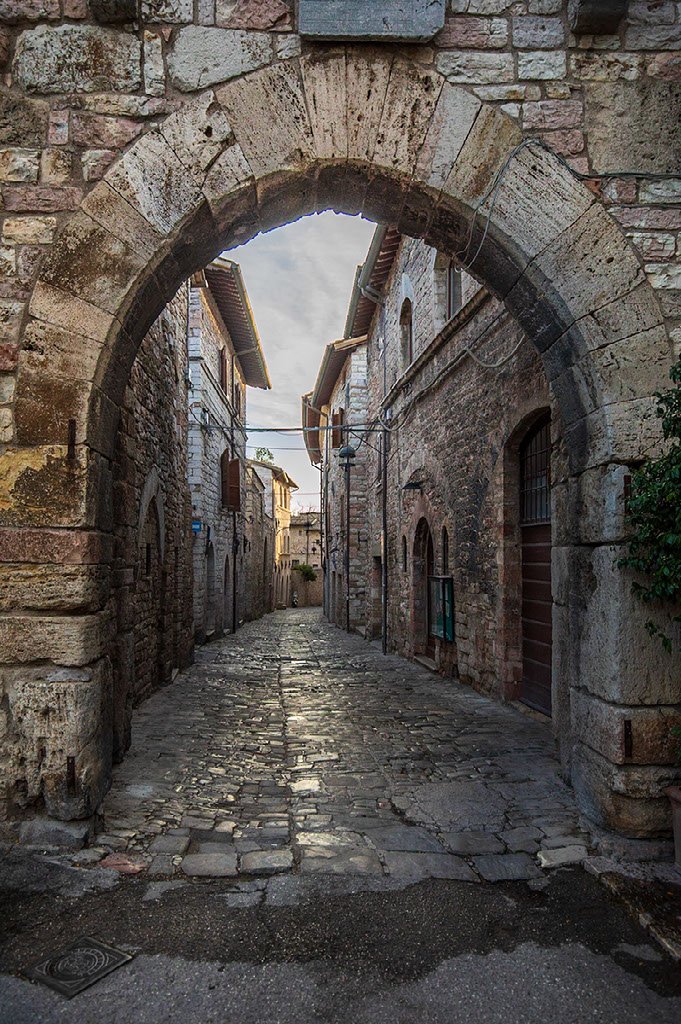
The Side Streets and Alleyways of Assisi
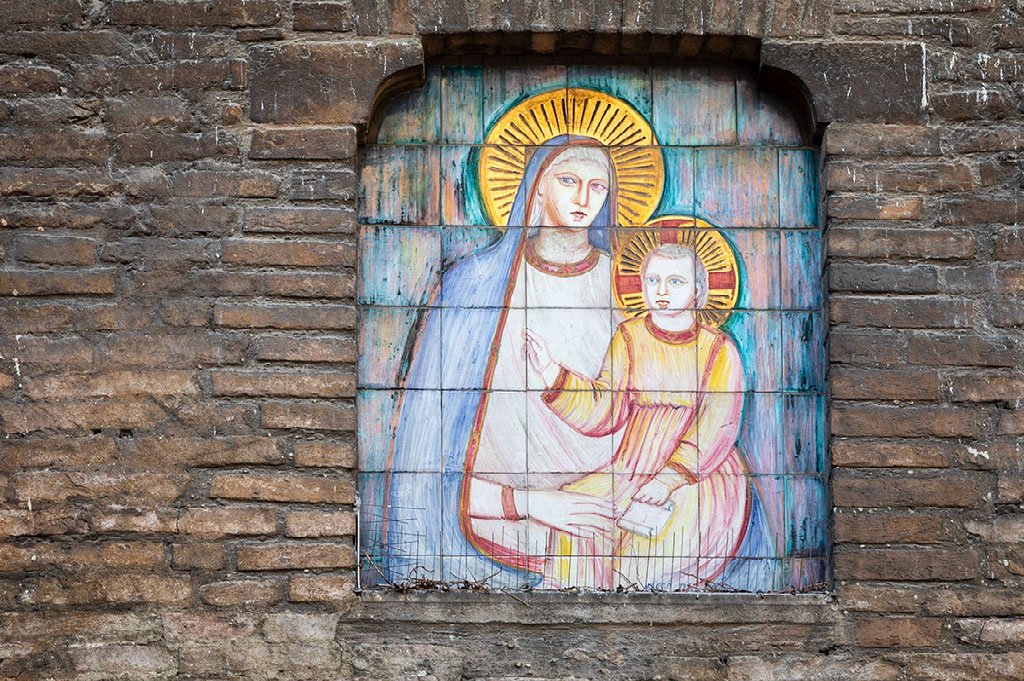
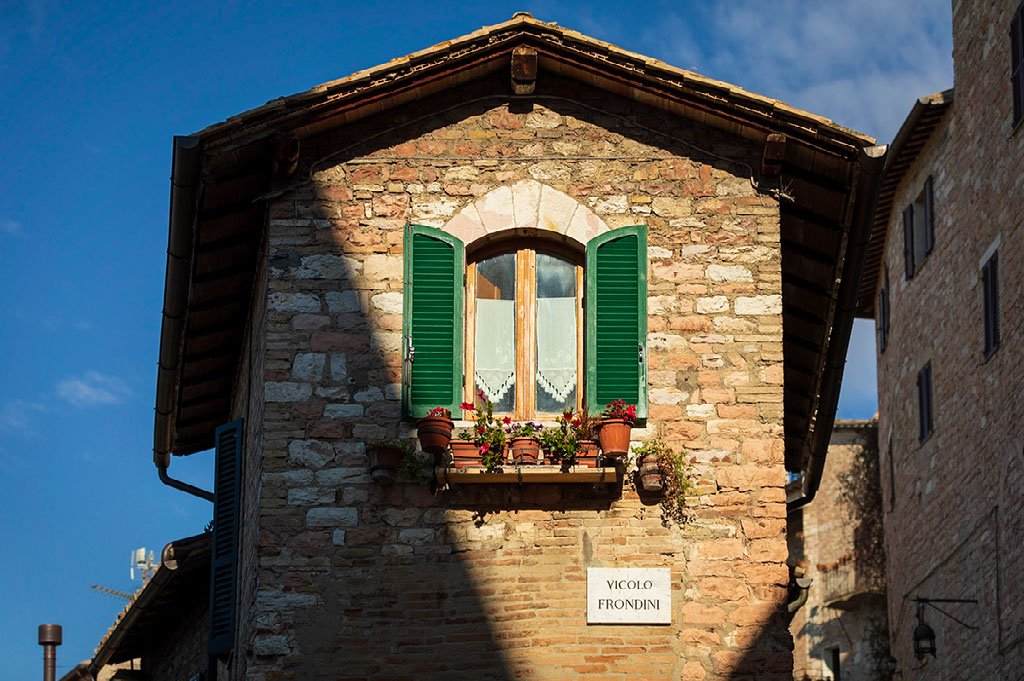
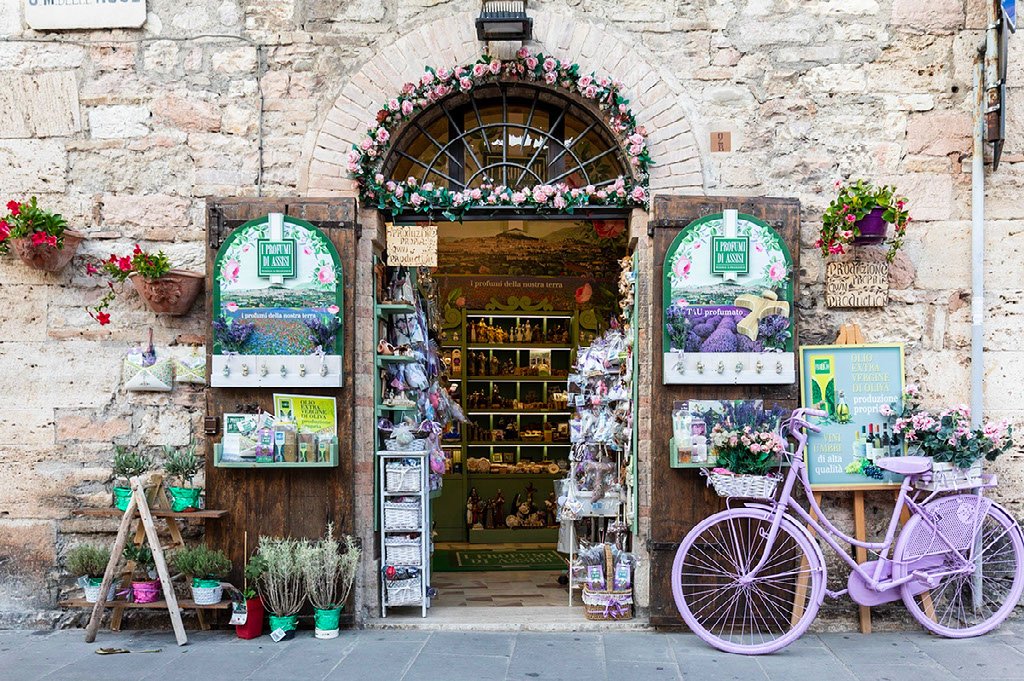
Do not make the mistake of spending all your time at the major monuments. The real photographic character of Assisi lives in the narrow lanes between them. Stone walls draped in wisteria and roses, arched passageways framing distant views of the valley, doorways worn smooth by centuries of foot traffic, flower boxes in every window. The streets between the Basilica di Santa Chiara and the Cathedral of San Rufino are particularly good, as are the lanes climbing uphill toward the Rocca Maggiore. The light in these streets is best in the early morning, before the tour groups arrive and when the shadows are long and directional.
📷 Pro Tip: Work with a 35mm or 50mm prime for this kind of shooting. It forces you to engage with the scene rather than standing back and zooming. Look for compression shots where a narrow lane leads the eye toward a distant archway or a glimpse of the valley beyond. The most powerful alley compositions in Assisi have three elements: foreground texture close, a strong leading line, and an open sky or view in the distance. In autumn, the geraniums and roses are still in bloom and add color contrast against the pale stone. In winter, the same streets are almost entirely yours.
Best time: Early morning, first two hours after sunrise. Access: Free, all streets are public. Getting there: On foot from anywhere in the historic center.
Basilica of Saint Francis of Assisi
This is the reason most people come to Assisi, and for photographers, it is both the most rewarding and the most important location to plan carefully. The Basilica is actually two churches stacked into the hillside. The upper Gothic church sits above the lower Romanesque one, connected by a long descending portico and wide terraces with unobstructed views over the Umbrian valley. The building faces west, which means the exterior glows at sunset in the warm pink and amber tones that Assisi's limestone does so well.
One thing to know before you go: photography is completely prohibited inside both the Upper and Lower Basilica, without exception. No cameras, no phones, no matter the lighting condition. Respect it. The frescoes by Giotto, Cimabue, Lorenzetti, and Martini are irreplaceable, and the silence inside is part of the experience. Your photographs happen outside.
📷 Pro Tip: Arrive at the lower piazza before sunrise. The wide open space below the Basilica gives you a clean composition with the full facade rising above the arched buttresses, and in the minutes before the sun clears the horizon the limestone turns a pale violet that disappears quickly. A wide-angle, 16 to 24mm, captures the full scale. For the valley views from the terrace on the north side of the complex, bring your telephoto. The layered Umbrian landscape compresses beautifully at 100 to 200mm. Come back at blue hour after sunset when the exterior lights come on and the building glows against a deep blue sky. That is one of the strongest shots in Assisi.
Best time: Sunrise and blue hour. Access: Free. Getting there: 15-minute walk west along Via San Francesco from Piazza del Comune.

It’s one of the most important places of Christian pilgrimage in Italy, and unsurprisingly, we saw plenty of monks and nuns who had come to worship.

This basilica was built in 1228 and construction began just two days after St. Francis was canonized as a saint. This is one of the most beautiful churches we have visited.
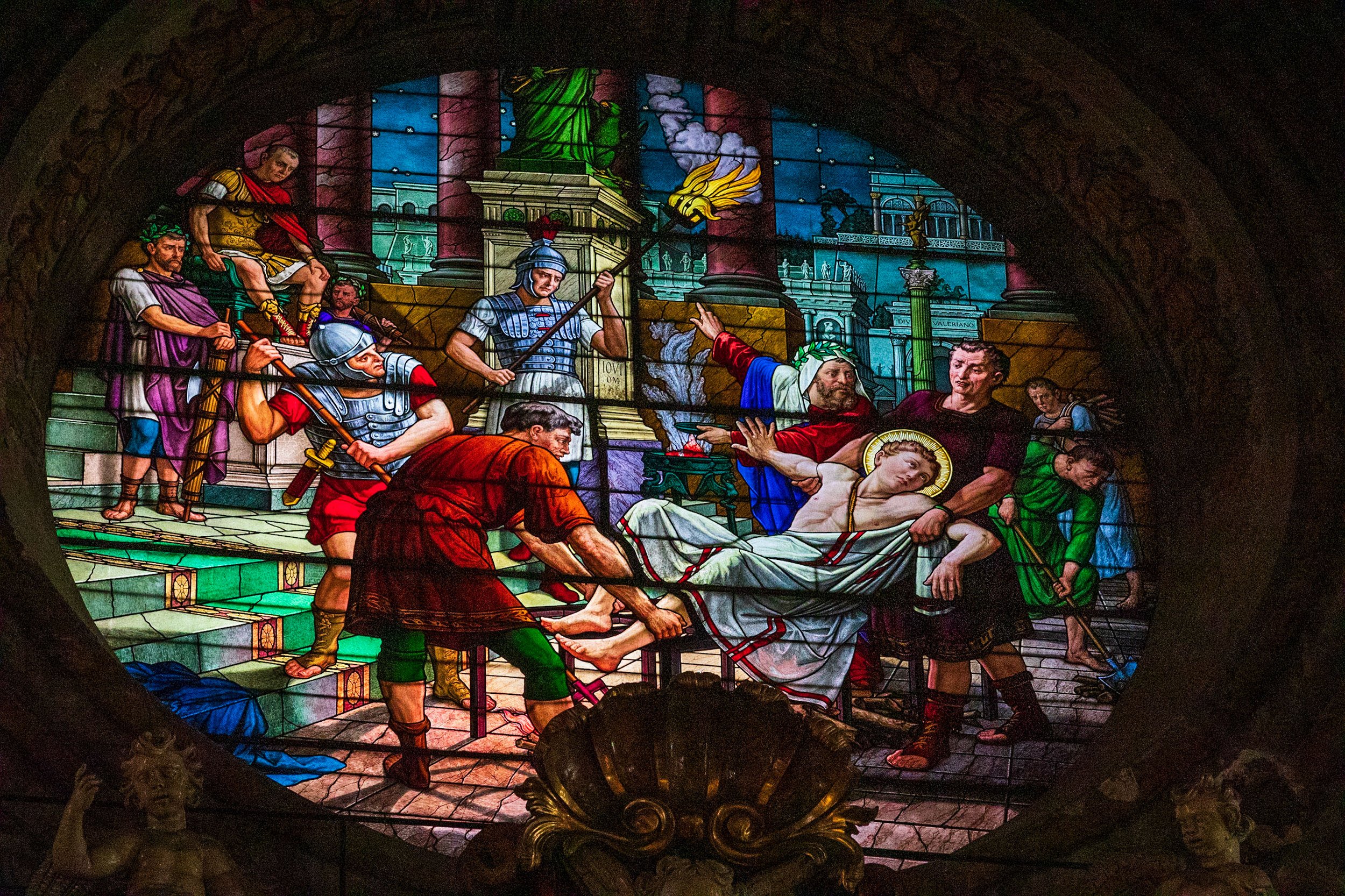
Two churches are built at this site, one on top of the other. On top sits an enormous Gothic cathedral, and below it is a much smaller Romanesque church. The lower church preserves the remains of St. Francis. Once you exit the upper church just take the stairs down to the lower church. This church is much smaller and more solemn than the upper church. It is here that you can enter the crypt of St. Francis. The frescoes on the walls of the lower church were painted by artists Cimabue, Giotto, Lorenzetti, and Marti.
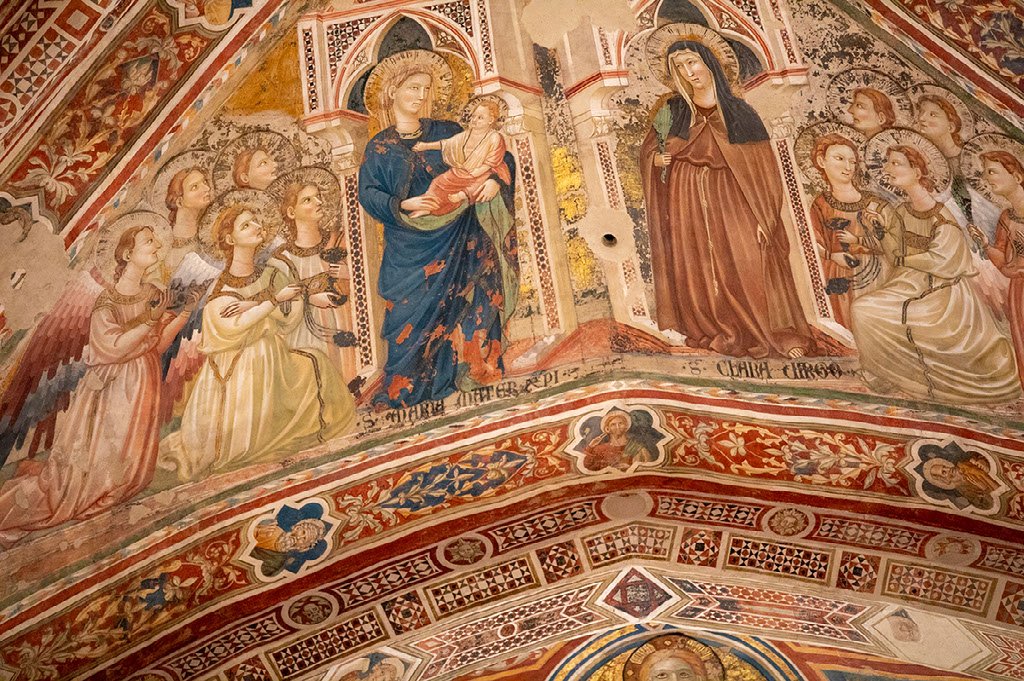
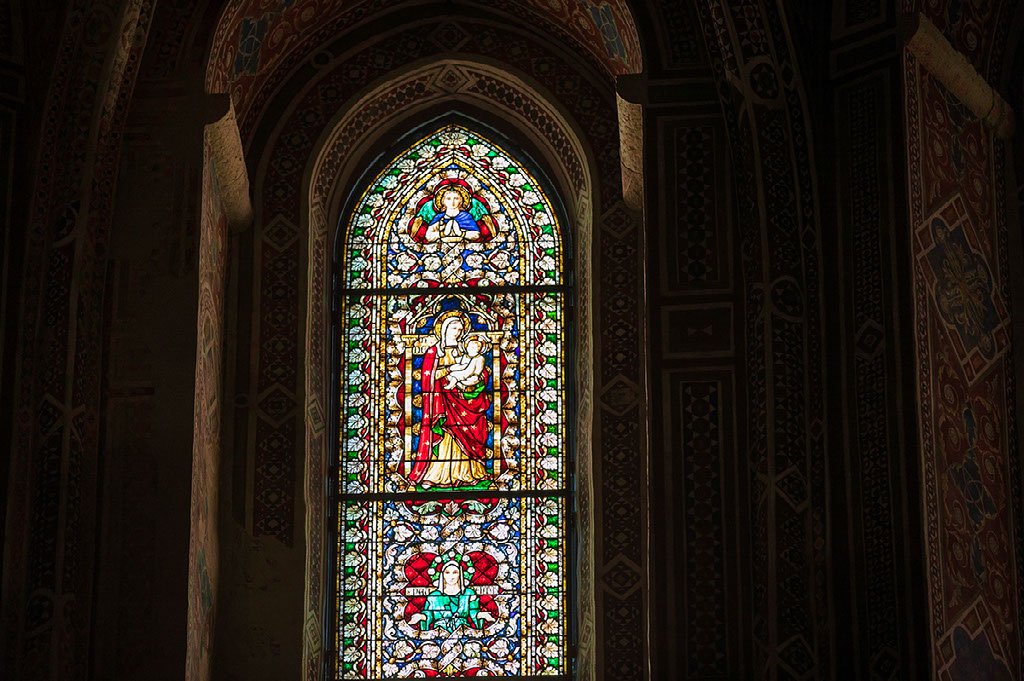
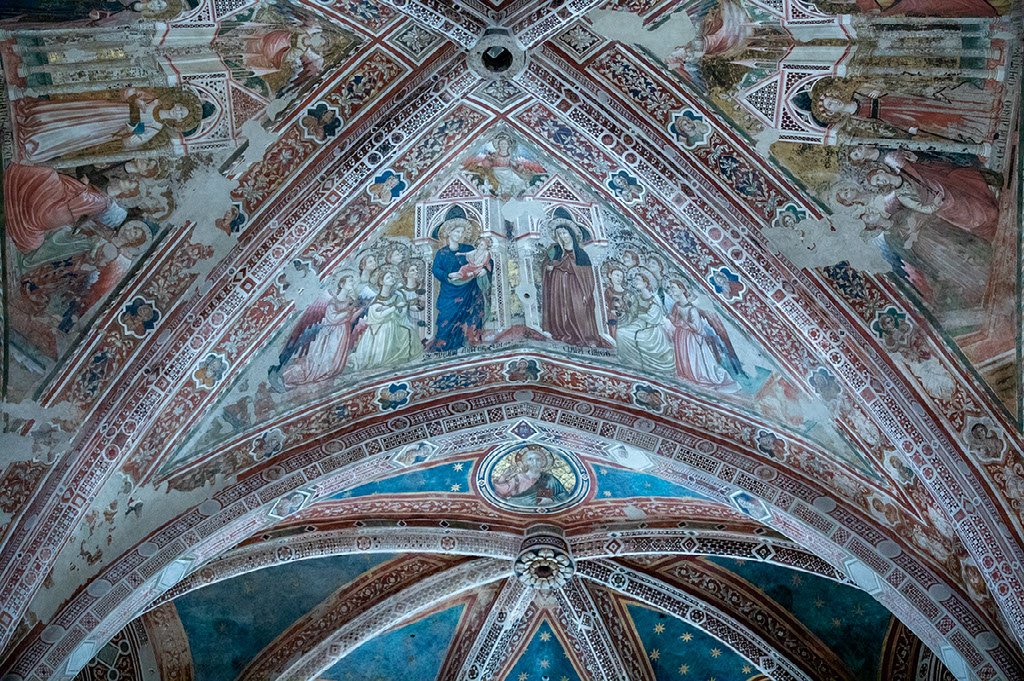
The walls and ceiling are covered with brightly colored frescoes and stained-glass windows. Along the nave, the frescoes on the lower walls tell the Stories from the Life of Saint Francis (painted by Giotto), and the frescoes on the upper walls tell the Stories from the Old and New Testament.

The Walk Up to the Church
The frescoes found on the walls and ceiling are some of the finest examples of Italian Renaissance art and depict scenes from the life of St. Francis. Even at night, the Church is simply beautiful!

Via San Francesco
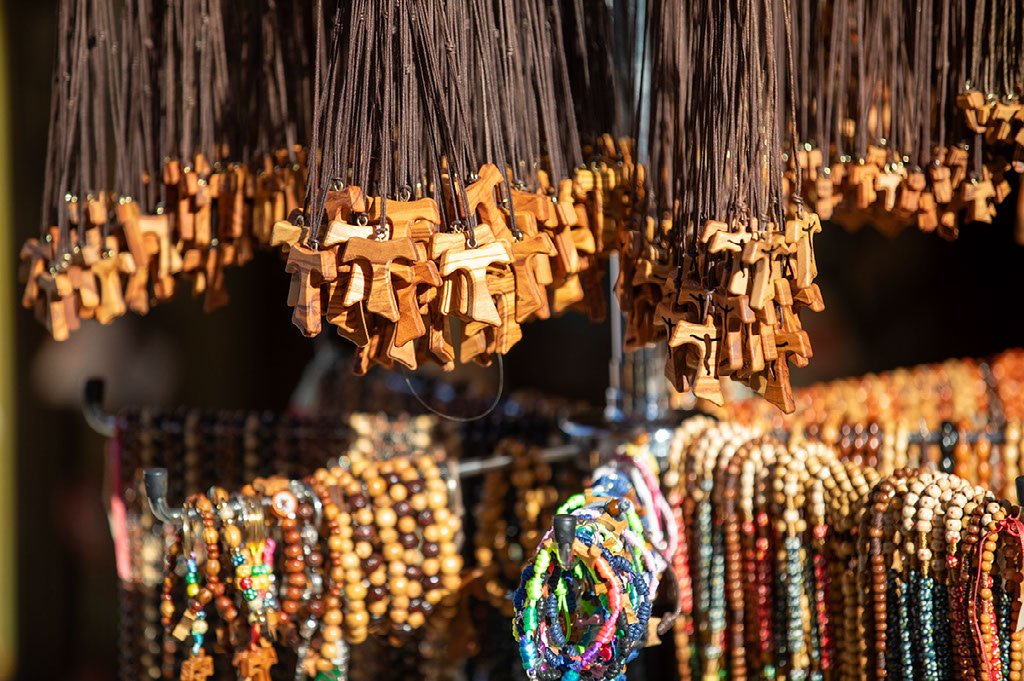
Via San Francesco is the main road connecting Piazza del Comune to the Basilica of Saint Francis, and it is one of the most photogenic streets in central Italy. Both sides are lined with medieval stone buildings housing small shops, religious artifact sellers, and the occasional trattoria. The street narrows and widens in irregular intervals, creating natural framing opportunities at nearly every corner. It is also the street that pilgrims walk on their way to the Basilica, which gives you a constant stream of human subjects moving through the scene.
📷 Pro Tip: The best shot on Via San Francesco is from the Piazza del Comune end, looking west toward the Basilica. In the early morning, the street is quiet, and the light comes in low from the east, casting long shadows across the cobblestones and lighting the far end of the street where the Basilica facade is just visible. Use a 35 to 50mm focal length and find a position slightly to one side of the street center to add diagonal depth. In the afternoon, reverse direction and shoot east from the Basilica end, with the late light skimming the stone surfaces. The street is busiest between 10am and 4pm; early morning and early evening are when it belongs to the light.
Best time: Early morning or golden hour. Access: Free, public street. Getting there: Runs directly between Piazza del Comune and the Basilica of Saint Francis.

Piazza del Comune and the Temple of Minerva
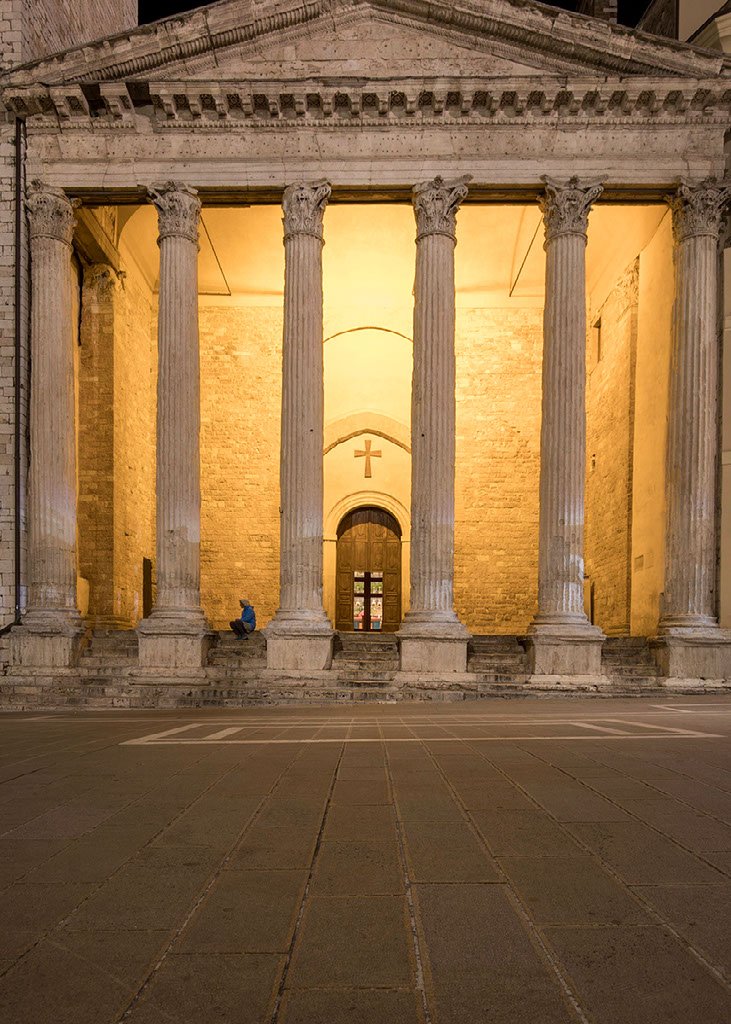
Piazza del Comune is the heart of Assisi and one of the most architecturally layered squares in Umbria. A Roman temple converted to a church stands at its center, flanked by the medieval Torre del Popolo and the town hall. The contrast between Roman columns, medieval stone, and Renaissance facades in a single frame is genuinely extraordinary. The piazza is lively from mid-morning onward with pilgrims, locals, and visitors filling the outdoor café tables, which makes it an excellent subject for street photography as well as architecture.
📷 Pro Tip: The Temple of Minerva faces east, so morning light hits the columns directly and produces the clean, warm tones that make the Roman stonework sing. Get here before 9 am. A 24 to 70mm zoom gives you flexibility to work both wide compositions of the whole square and tighter detail shots of the column capitals and carved entablature. In the evening, the square lights up and the café tables fill with people, giving you a completely different, warmer atmosphere for candid and street work. Bring a tripod for blue hour when the interior lights of the bars and restaurants spill out onto the piazza stones.
Best time: Early morning for architecture, evening for atmosphere. Access: Free. Getting there: Center of the historic town, a 5-minute walk from almost anywhere.

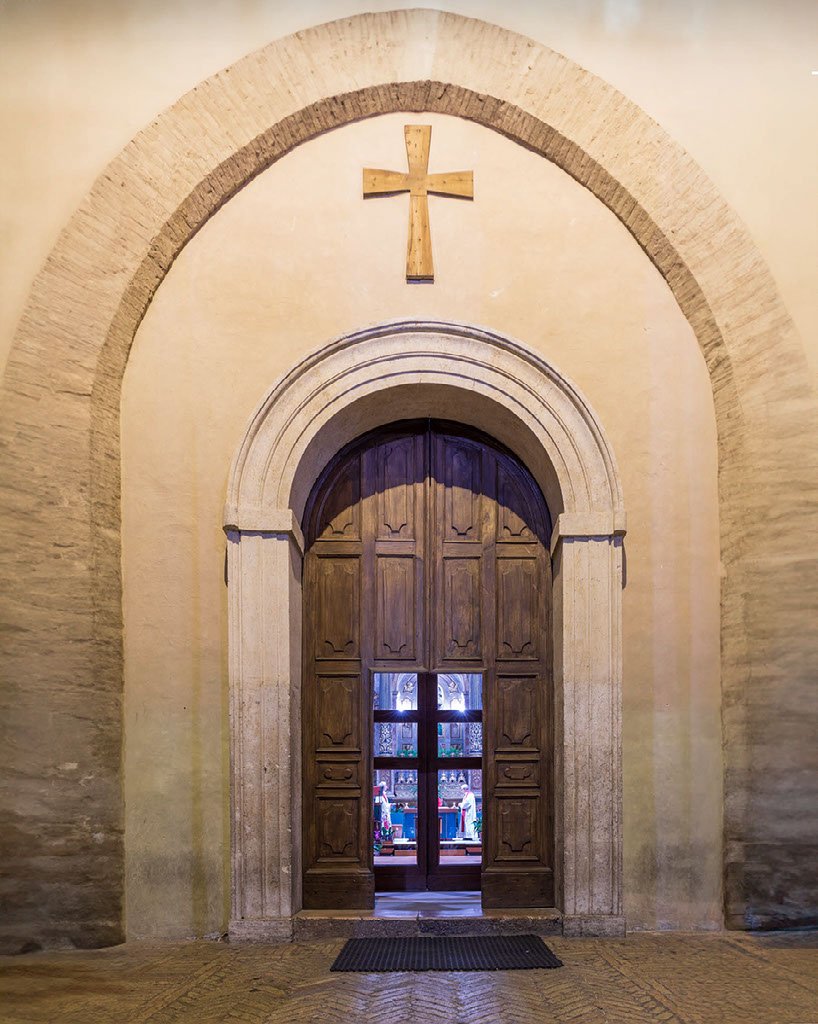
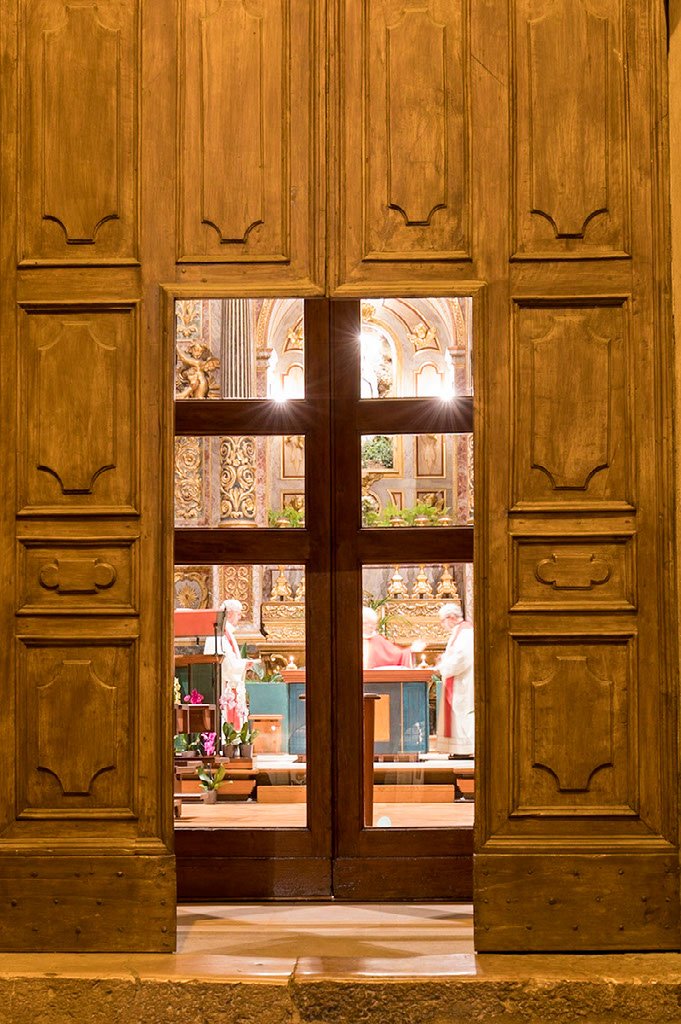
The Temple of Minerva, which dates back to the first century BC, is the oldest building on the square. Sitting next to the Temple of Minerva is Torre del Popolo, which was built in the 13th century. Also lining the square is the town hall and the tourist information point.
Cathedral of San Rufino
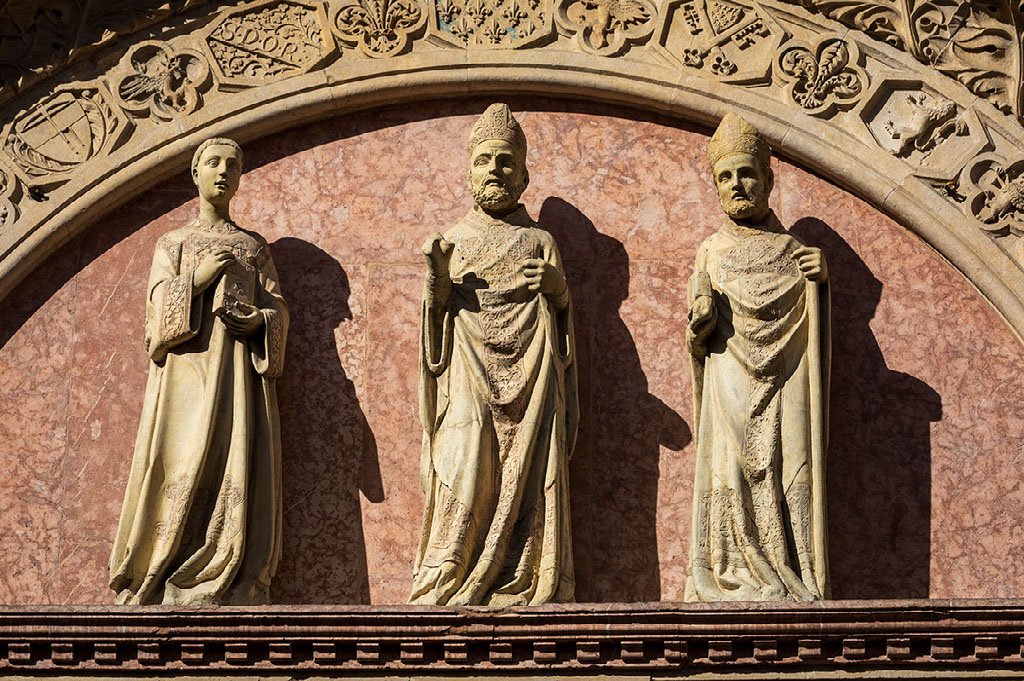
The Cathedral of San Rufino is Assisi's main cathedral, dedicated to the city's first bishop and patron saint, and it is one of the finest examples of Umbrian Romanesque architecture anywhere in Italy. The facade, completed in the 12th century, is extraordinarily detailed: carved lions flank the doorways, biblical scenes and symbolic figures fill every surface, and a large rose window anchors the upper register. This is the church where both St. Francis and St. Clare were baptized, at a font that still stands inside. The square in front of it, Piazza San Rufino, is quieter than Piazza del Comune and sits at a slightly higher elevation, with a different view over the rooftops.
📷 Pro Tip: The facade faces roughly south, which means it catches good light from mid-morning through early afternoon. Position yourself at the far side of the piazza and use a 24 to 35mm lens to capture the full facade with the piazza stones in the foreground. The carved detail on the central portal rewards a tighter lens, 70 to 100mm, for isolating specific sculptural elements. The Caffè Duomo sits directly across the square, which makes this a natural combination: coffee first, then shoot the facade in the morning light before the square fills up. Flash photography is not permitted inside the cathedral, but the interior is freely photographable with available light. The bell tower is climbable for a paid ticket and gives you an elevated view over the rooftops and toward the valley.
Best time: Mid-morning for the facade. Access: Free (museum and tower require paid ticket). Getting there: Via San Rufino, uphill from Piazza del Comune, 5-minute walk.

From the Basilica of St. Francis, you can also take some beautiful photos of the valley below

Basilica di Santa Chiara
Santa Chiara stands at the eastern end of Assisi and is, visually, one of the most striking buildings in the town. The facade is striped in alternating bands of pink and white stone, and the wide terrace in front of it looks out over the Umbrian valley. It is quieter than the Franciscan Basilica, the crowds are smaller, and the atmosphere is more intimate. St. Clare, one of the first followers of St. Francis and founder of the Order of Poor Ladies, is buried in the crypt here.
📷 Pro Tip: The facade faces south-southwest, which means it catches afternoon light well from about 2 pm onward. For a clean architectural shot of the full facade, position yourself at the far end of the terrace in front and use a 24 to 35mm. The striped stone reads best when the light is slightly angled rather than flat on. The terrace itself, with the stone balustrade framing the valley view, is a strong compositional element in its own right. Include it in the foreground of wide shots for depth. Note: Photography is not permitted inside the Basilica di Santa Chiara either, similar to the Franciscan Basilica.
Best time: Mid to late afternoon. Access: Free. Getting there: Eastern end of the historic center, 10-minute walk from Piazza del Comune toward Via San Rufino.

Chiesa Nuova
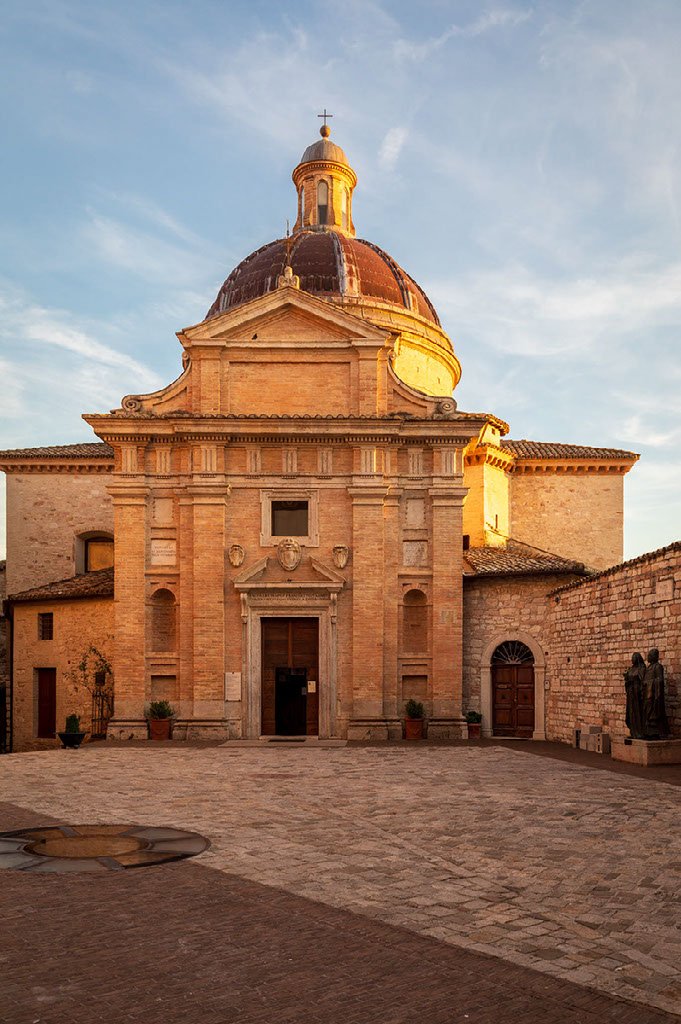
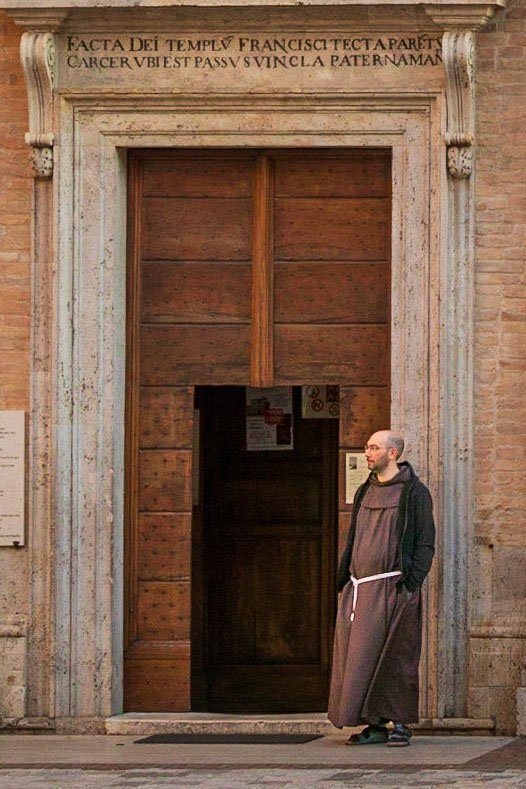
Chiesa Nuova, meaning simply "New Church," sits tucked just off Piazza del Comune, half-hidden behind the town hall, and most visitors walk past it without realizing what it is. It was built in 1615 on the site of the house where St. Francis was born and grew up, commissioned by King Philip III of Spain as an act of devotion. When you step inside, you can still see the small grated cell where Francis's father, the cloth merchant Pietro di Bernardone, locked up his son after Francis began giving away the family's wealth to the poor. Downstairs, the original shop floor of the Bernardone family home is visible through a medieval wooden door. It is one of those locations where the historical weight of a small, quiet space hits you harder than a grand basilica can.
📷 Pro Tip: Chiesa Nuova is a rare Assisi interior where photography is permitted. The 17th-century dome lets in a soft, diffused light that works well for interior architectural shots without a tripod. Use a wide angle, 16 to 24mm, to capture the full dome and nave together. The small bronze statues of Francis's parents in the forecourt, Monna Pica and Pietro di Bernardone, are strong portrait subjects with a 50 to 85mm lens. The statue of Pietro, with cloth draped over his arm, tells the whole story of Francis's background in one frame. The forecourt is also a pleasant, quiet corner of the town for a few minutes of street photography away from the main pilgrimage routes.
Best time: Any time of day; interior light is consistent. Access: Free. Getting there: Piazza Chiesa Nuova, 1-minute walk from Piazza del Comune.

This was one of my favorite churches in Assisi.
Rocca Maggiore
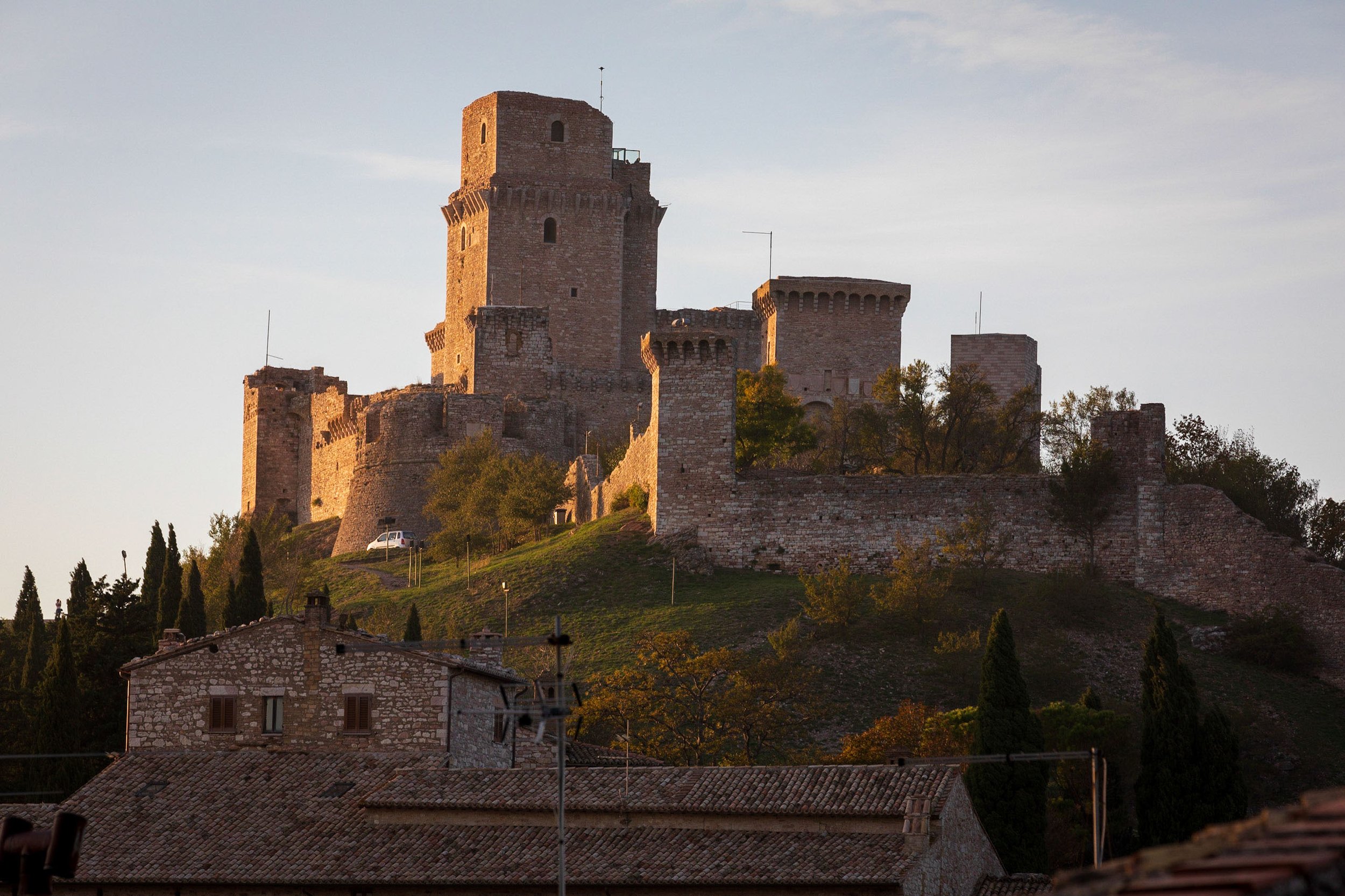
The medieval fortress sits at the highest point above Assisi on Colle Asio, 500 meters above sea level, and the climb to reach it is worth every step. From the ramparts, you get a panoramic view that takes in the entire town below, the Basilica of Saint Francis to the west, the valley floor spreading out to the south, and on a clear day, the distant hills of Umbria rolling toward Perugia. It is the one location in Assisi where you can photograph the town itself as a subject rather than photographing from within it.
📷 Pro Tip: Come in the late afternoon, roughly two hours before sunset, when the light comes in low from the west and the pale rooftops of Assisi glow below you. A telephoto at 70 to 200mm lets you compress the town against the valley and pull the Basilica into a strong mid-ground anchor. For a wider establishing shot showing the full scale of the fortress and town together, back up along the path above it and use a 24 to 35mm. The view is best on clear days; haze in summer can flatten the distance significantly. Admission is paid and the ticket office closes 45 minutes before the fortress itself. Check current hours before visiting as they vary by season.
Best time: Late afternoon. Access: Paid entry (verify current price on arrival, approximately €8). Getting there: 20-minute uphill walk from Piazza del Comune; follow signs from the historic center.
Day Trip: Gubbio
Gubbio deserves its own guide, but as a day trip from Assisi, it is one of the most photographically rewarding drives in Umbria. The town sits about 50 kilometers north of Assisi, roughly an hour by car through rolling hill country, and it is one of the best-preserved medieval towns in Italy. Unlike Assisi, which processes millions of pilgrims annually, Gubbio feels genuinely local. The streets are steep and stone-paved, the buildings are the same grey limestone as the mountain behind them, and the atmosphere is quieter and less curated.
The three subjects worth your time are Piazza Grande, the Roman Theater, and the funicular.
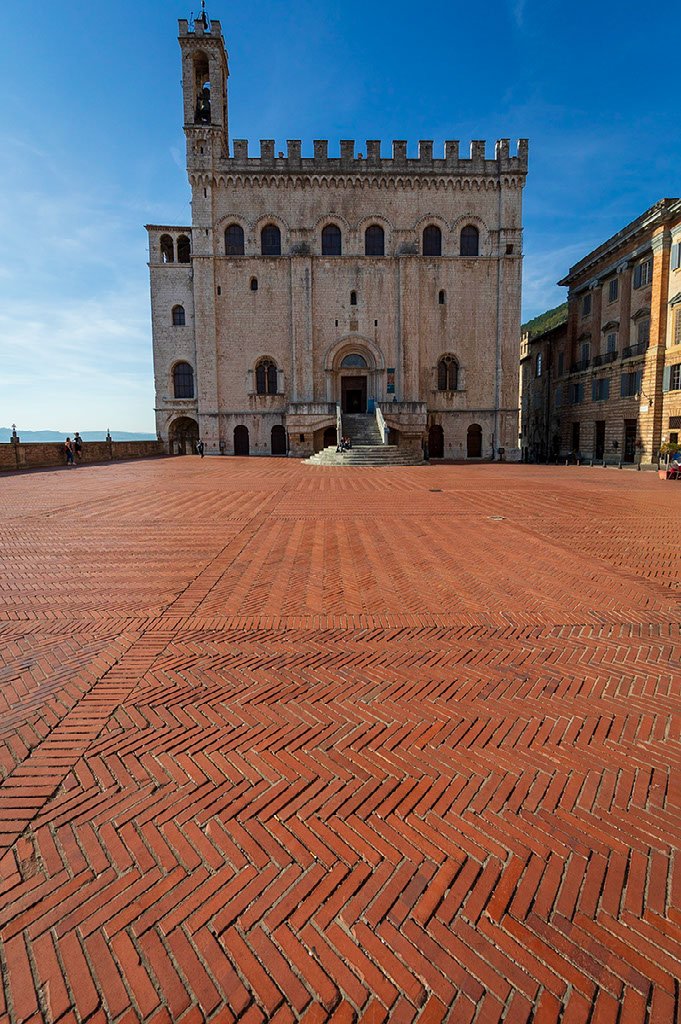
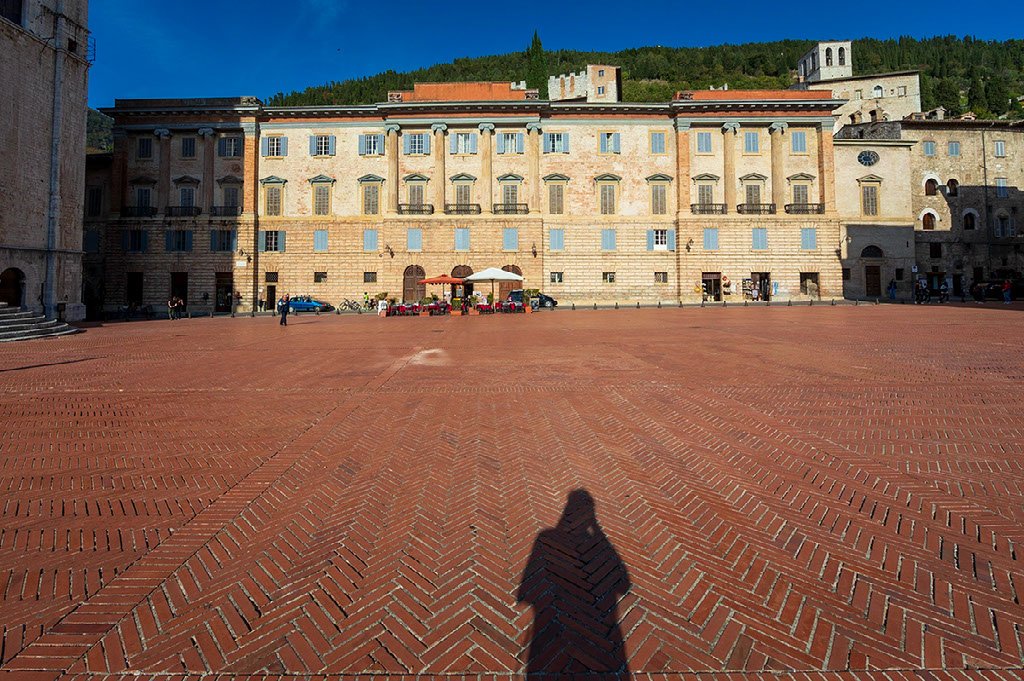
Piazza Grande is one of the most architecturally audacious medieval squares in Italy. It is essentially a terrace cantilevered out over the hillside, supported by an enormous vaulted substructure below. The Palazzo dei Consoli, a 14th-century Gothic palace, dominates one side. From the open edge of the square you look down over the lower town and across the valley, a view that rewards both wide and telephoto work.
The Roman Theater at the base of the hill dates to the 1st century BC and is one of the better-preserved examples in central Italy. The curved stone seating tiers are still largely intact, and from outside the theater the view back up toward the medieval town rising behind it is one of the strongest compositional contrasts in Gubbio.
The funicular, the Funivia Colle Eletto, takes you up to the Basilica of Sant'Ubaldo on Monte Ingino in open two-person basket cars. It is not for the anxious, but the views from the top across Gubbio and the valley are extraordinary.
📷 Pro Tip: Start at the Roman Theater early in the morning when the light comes in from the east and the stone seating glows warm. Then work your way up through the medieval streets to Piazza Grande, which is best in the mid-morning before tour groups arrive. Take the funicular in the late afternoon when the light is directional and the valley below takes on the layered tones that make Umbrian landscapes worth shooting. Bring a 70 to 200mm for the long views from the top. A 24 to 70mm handles everything in the town itself. Allow at least four hours in Gubbio to shoot it properly.
Best time: Morning at the theater, mid-morning at Piazza Grande, late afternoon from the top of Monte Ingino. Access:Theater entry approximately €3; funicular is paid (verify current price on arrival). Getting there: Approximately 50km north of Assisi; rental car strongly recommended. No practical public transport connection.

The town is just charming!
Gubbio is famous for its Roman ruins, beautiful Piazza Grande, and the thrill-inducing funicular ride up to the Basilica of Saint Ubaldo.
Special Events and Festivals
Assisi's calendar is shaped by its religious identity and its medieval history. The events below are the ones that matter most for photographers, either because they transform the visual character of the town or because they draw an energy and scale that you simply cannot find on an ordinary visit.
Calendimaggio (Early May)
This is Assisi's most spectacular secular festival and one of the most photogenic medieval events in Italy. The town divides into two competing factions, the Noble Upper Part and the Magnificent Lower Part, and for four days the historic center fills with torchlit processions, costumed performers in 13th to 15th century dress, archery competitions, flag-throwers, musicians, and theatrical performances. The main events take place in Piazza del Comune and in front of the Basilica di Santa Chiara, and the whole town is draped in medieval banners and flowers. It is genuinely extraordinary to photograph, with torchlight at night producing exactly the kind of dramatic, warm-toned images you cannot manufacture any other time of year.
Book accommodation months in advance. Hotels inside the historic center fill immediately, and the festival runs Wednesday through Saturday of the first week after May 1st.
Photography etiquette: The performances are staged events with paying audiences in some areas. Respect barriers and ticketing. Street processions are fully open and accessible for photography.
Feast of St. Francis (Early October)
The 4th of October is the Feast of St. Francis, patron saint of Italy, and Assisi marks it with religious ceremonies, processions, and a Mass at the Basilica that draws pilgrims, religious orders, and dignitaries from across the world. The streets fill with Franciscan friars, Poor Clares, and pilgrims in traditional habit, which offers documentary photographers some of the most authentic human subjects of any event in Umbria. The Umbrian countryside is also at its autumn best at this time, with the valley colors shifting toward gold.
Photography etiquette: This is a religious observance, not a performance. Dress respectfully, keep your camera at a respectful distance during Mass and prayer, and avoid directing people or staging shots near the Basilica entrance.
Palio di San Rufino (Late August)
The Palio di San Rufino is a crossbow competition between the three medieval districts of Assisi, the Terzieri, held in late August in honor of the town's patron saint. It is a smaller, more local event than Calendimaggio, which makes it in some ways more rewarding to photograph. The medieval costumes are elaborate, the atmosphere in Piazza del Comune is festive rather than ceremonial, and the crossbow competition itself is a genuinely unusual visual subject.
Le Infiorate di Spello (June)
Not in Assisi itself, but 12 kilometers south in the town of Spello, Le Infiorate is one of the most visually extraordinary events in Umbria. The streets of the town are carpeted with enormous, intricate designs made entirely from flower petals, created overnight by local families for the Corpus Christi procession. The designs can run for hundreds of meters and the color and detail are extraordinary. Arrive early in the morning when the petals are fresh and the light is low. It is a one-day event, and the carpets are walked over by the procession by mid-morning, so timing matters.
Frequently Asked Questions About Visiting Assisi
Is Assisi worth visiting if you're not religious?
Yes, genuinely. The town's appeal goes beyond the pilgrimage, the pale pink limestone architecture, the Umbrian valley views, and the quiet atmosphere of the early mornings offer something meaningful regardless of faith.
Do you need a car in Assisi?
Not once you're inside the historic center, which is small enough to walk entirely on foot. A car is useful for reaching Gubbio or Spello as day trips, but the historic center itself is a ZTL restricted zone, don't attempt to drive in without prior arrangement with your hotel.
Is photography allowed inside the Basilica of Saint Francis?
No, completely prohibited in both the Upper and Lower Basilica, no exceptions. The frescoes are irreplaceable, and the rule is taken seriously. Plan your photography for the exterior, sunrise and blue hour are both strong.
What are the best photo spots in Assisi?
The Basilica of Saint Francis at sunrise, Via San Francesco in early morning light, and Rocca Maggiore at golden hour for the panoramic town view are three that consistently deliver. The full list with Pro Tips is above.
Can you fly a drone in Assisi?
No, not without prior authorization. Assisi is a UNESCO World Heritage site within controlled airspace, and permits from Italian civil aviation authorities (ENAC) are required, with some zones prohibited entirely.
What surprised you most about Assisi?
The unexpected calm I found there. I visited shortly after we lost our dog, drawn partly by St. Francis being the patron saint of animals, and didn't expect the town itself to move me the way it did. There's a stillness in the narrow lanes and the early mornings that goes beyond anything religious.
How many days do you need in Assisi?
Two full days minimum, three if photography is a serious priority and you want to add a day trip to Gubbio or Spello.
Is Assisi worth combining with Florence or Rome?
Yes, both work well. Florence is about three hours north through Tuscan countryside, offering a contrast between Franciscan simplicity and Renaissance grandeur. Rome is about two hours south, forming what feels like the spiritual and imperial poles of Italian history.
Final Thoughts
Assisi is the kind of place that stays with you longer than you expect it to. I arrived for the first time still grieving a loss, drawn by the connection to St. Francis and his love for animals, and left with something I had not anticipated: a genuine sense of calm. The town did that. The light did that. The quiet of the early mornings, when the streets belong to the stone and the birds and the occasional brown-robed friar, did that.
For photographers, it rewards patience and early rising above almost everything else. The best images here are not taken at noon in a crowd. They happen at 6 am from the lower piazza of the Basilica, or at dusk from the Rocca Maggiore when the valley goes amber below you, or in a side street where a shaft of morning light cuts across a flower-draped doorway and everything aligns for about thirty seconds. Show up before the tour buses. Come back at golden hour. Let the light do its work.
Assisi is not the most dramatic destination in Italy. It does not have the architectural scale of Rome or the Renaissance density of Florence. What it has is coherence. A single material, pale pink limestone, a single hillside, a single story told across a dozen churches and a thousand years. For photographers who prefer mood over spectacle, that coherence is a gift.
Go. Go in spring when the wildflowers are on Monte Subasio. Go in October when the valley turns, and the Feast of St. Francis fills the streets with pilgrims. Go in winter if solitude matters more to you than warmth. Any of those versions of Assisi is worth the trip.
Want to improve your photography while exploring some incredible destinations? Join me on one of my photography workshops! You can find all the details, including upcoming destinations and dates, through the links below.
Let's Stay Connected!
Other Photography Guides
My Photography & Travel Guide to Florence, Italy, is a natural companion to Assisi. Florence is three hours north by car through some of the most beautiful landscapes in Tuscany, and the contrast between the Franciscan simplicity of Assisi and the Renaissance grandeur of Florence tells the fuller story of Italian culture and faith.
My Photography & Travel Guide to Rome is the other essential pairing. Assisi and Rome are two hours apart, and together they form the spiritual and imperial poles of Italian history. If you are making a central Italy trip, combining the two makes complete sense.
My Photography & Travel Guide to Tuscany is the logical third stop. Assisi sits on the Umbrian side of the Apennines, but the Tuscan hill towns, Siena, San Gimignano, Montepulciano, are close enough to combine into a single itinerary. The landscapes share the same golden quality, but Tuscany adds cypress-lined roads, vineyard terraces, and a different architectural character that makes the pairing feel complete rather than repetitive.

Are you carrying too much camera equipment, but still coming home disappointed with your travel photographs?
You are not alone. Many photographers fall into the packing trap. They bring too much, plan too little, and spend their trip scrambling to capture photographs instead of enjoying the experience.
Capture the World offers a better approach.
In this practical guide, travel photographer Vito L. Tanzi shares the five step system he uses to plan photography trips, pack with purpose, work with the best light, and return home with stronger images.
Inside, you will learn how to:
• Travel lighter without sacrificing image quality
• Choose destinations that match your photography goals
• Visit at the right time for weather, light, wildlife, festivals, or seasonal conditions
• Build a photography itinerary around sunrise, sunset, blue hour, and changing weather
• Select the equipment you will actually use
• Find promising locations before you arrive
• Avoid the stress and exhaustion that can ruin a photography trip
• Stay flexible when weather, crowds, or travel plans change
This guide includes practical planning advice, useful photography tools, real travel examples, and a complete system you can use again and again.
Whether you are preparing for your first international photography trip or planning a weekend closer to home, Capture the World will help you travel with greater purpose, photograph with more intention, and spend less time worrying about what is inside your camera bag.
Because the best photography trip is not the one where you carry everything.
It is the one where you are ready when the right moment appears.
📸 Format: PDF download
Instant Download