Val d'Orcia, Tuscany, Italy Travel & Photography Guide: Best Things to Do, Photo Spots, Map & Hidden Gems
Val d'Orcia does not look real. That is the first thing I think every time I arrive, and I have lost count of how many times I have made the drive into the valley. The hills roll in long, slow curves. Cypress trees line the roads like sentinels. Stone farmhouses sit in the middle of fields as if placed there by hand. The light in this part of Tuscany is unlike anything I have found anywhere else in Italy. It is golden, directional, and generous, especially in the early morning when mist fills the low points between the hills and the first warm rays skim across the landscape at a flat angle that photographers chase their whole careers.
What keeps drawing me back is the way this place rewards patience and early mornings. The famous spots — Podere Belvedere, Madonna di Vitaleta, the cypress-lined roads near Castiglione d'Orcia — are genuinely extraordinary when the conditions come together. But the valley also rewards wandering. Some of my favorite frames from this area came from pulling over on an unmarked road between San Quirico and Pienza, pointing the camera at nothing more than a curve in a dirt track and a single tree catching the last light of the day. That kind of discovery is rare, and it is what makes Val d'Orcia special for photographers who go looking beyond the postcard shots.
In this Photography Guide to Tuscany (Val d'Orcia), I share the places and experiences that continue to draw me back. You will find my favorite photography locations, guidance on when and where to shoot, practical travel tips, and gear recommendations, along with cultural insights to help you explore and photograph Val d'Orcia with confidence, respect, and ease.
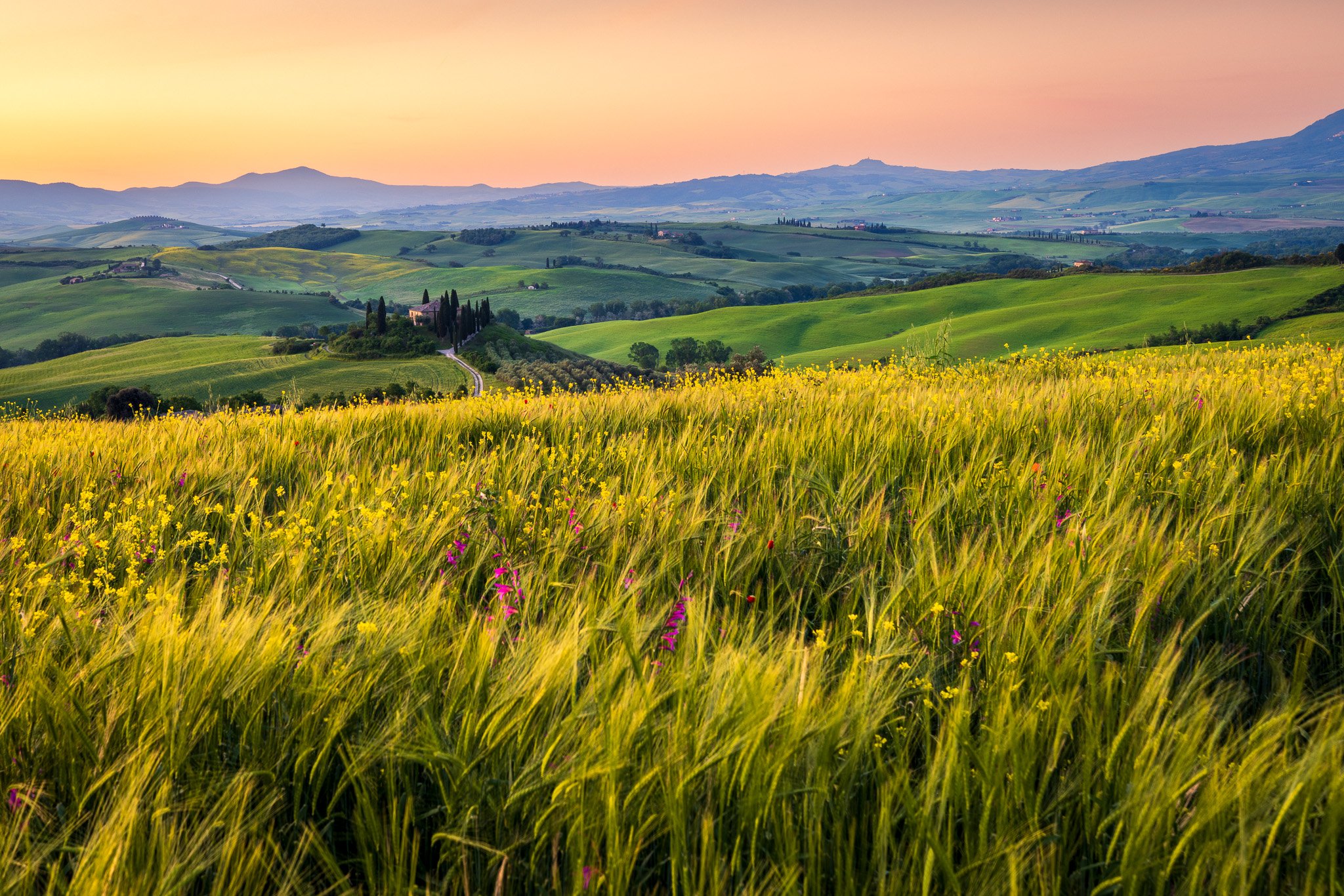
The rolling hills of Val d'Orcia glowing in the soft light of sunrise in Tuscany, Italy.
Photographer's Notes
Before you go, here are my own takeaways.
Favorite Season: Spring
Favorite Sunrise Location: Podere Belvedere
Favorite Sunset Location: Poggio Covili
Favorite Landmark: Cappella della Madonna di Vitaleta
Favorite Village: Pienza
Favorite Winery: Capanna Winery
Favorite Restaurant: Osteria La Porta
Favorite Scenic Drive: SP146 between Pienza and San Quirico d'Orcia
Favorite Lens: 16-35mm
Best Time to Visit Val d'Orcia, Italy
Val d'Orcia is photographable in every season, but two windows stand out.
Spring (late April through May) is the most spectacular for landscape photography. The hills are intensely green, poppies bloom in the fields, and the light is warm and long. Sunrise comes early, and the colors are as saturated as they get. This is peak season, so expect more photographers at the famous spots, but the landscape is worth sharing.
Autumn (late September through November) is the season I prefer. The golden light is lower and warmer, the tourists thin out dramatically, the green cypresses stand sharper against brown and copper hillsides, and the overall mood is quieter and more contemplative. October is the sweet spot. The weather is reliable, the harvest brings activity to the wineries and farms, and the morning mist arrives more often.
Summer (June through August) gives you long days and golden fields of wheat, but heat and crowds are real factors. Midday shooting is nearly impossible in the glare; plan to work at dawn and dusk and rest during the afternoon.
Winter is quiet and underrated. Snowfall, while not guaranteed, transforms the valley into something extraordinary. Fewer visitors, softer light, and a completely different palette. If you can tolerate cold mornings and the occasional road closure, January and February can produce some of the most dramatic frames of the year.
The photographer's answer: autumn is best. Spring is second. Both beat summer by a wide margin.
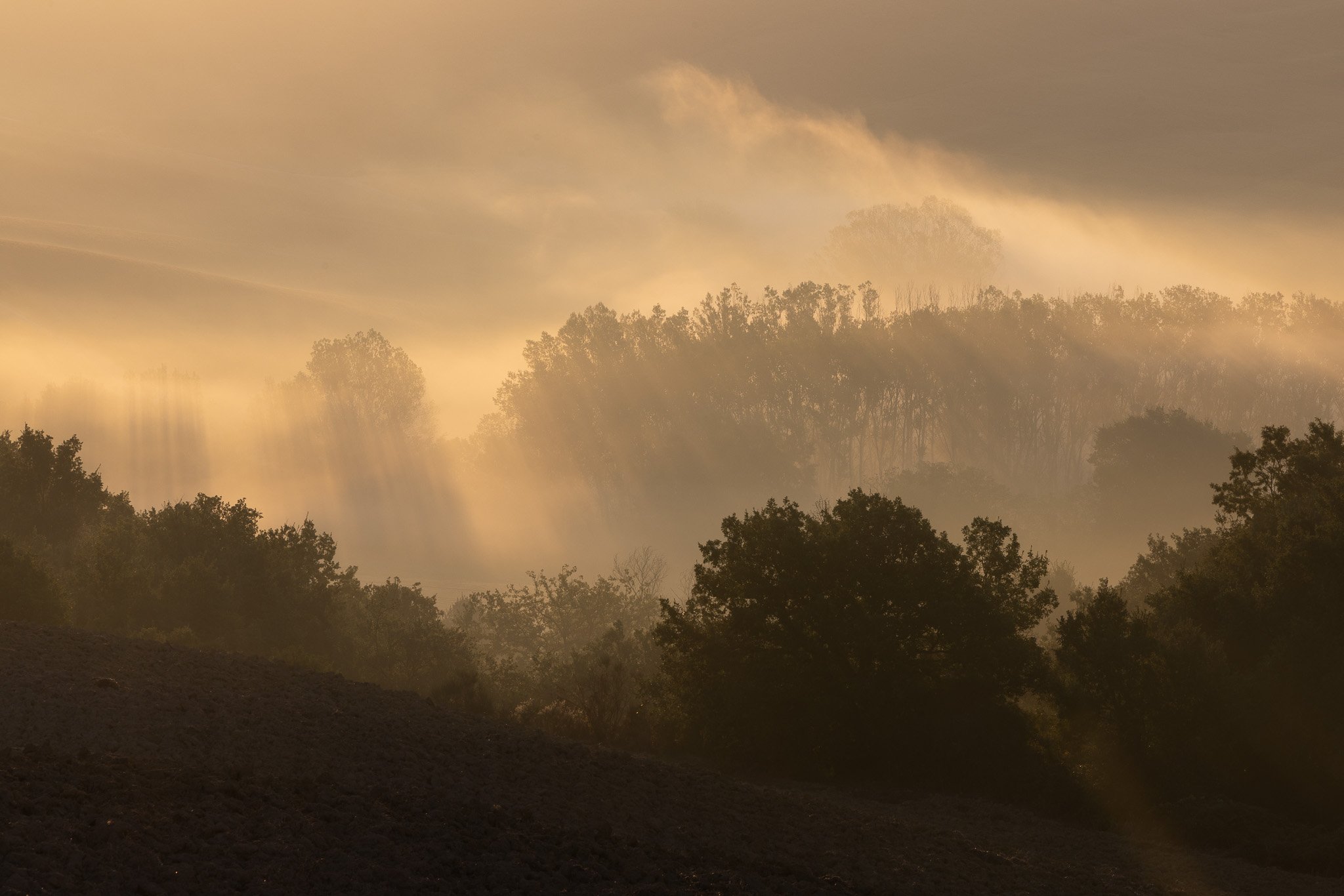
Early morning light sweeping across the rolling hills and cypress trees of Val d'Orcia.
Getting Around Val d'Orcia, Italy
You need a car. There is no way around it. Val d'Orcia is a rural landscape spread across dozens of kilometers, and the photography locations are almost all roadside, off minor provincial roads, or at the edge of working farmland. Without a car, you will miss 90 percent of what makes this place worth visiting.
Rent a car in Rome, Florence, or Siena. The drive from Rome is about two hours on the A1 autostrada, exiting at Chiusi-Chianciano Terme. From Florence, allow about 90 minutes to the Betolle exit on the A1. From Siena, it is less than an hour on the SR2.
Use Google Maps or Waze for navigation, but also download offline maps before you go. Rural Tuscany has patches of weak signal, and the provincial roads between shooting locations are not always well-signed.
A few practical notes: most of the hilltop towns operate ZTL zones (Limited Traffic Zones) that restrict car access to their historic centers. You can typically park outside the walls and walk in, which takes 5 to 10 minutes at most of these towns. Do not try to drive into the centro storico of Pienza or San Quirico without checking first; the fines arrive quietly weeks later and are not negotiable.
Uber is not available in this part of Tuscany. Local taxis exist but are not reliable for early morning shoots. Car rental is the only practical option.

I love the rolling hills of Tuscany at Sunrise
Where to Stay in Val d'Orcia, Italy?
The best base for photographers is San Quirico d'Orcia or Pienza. Both towns put you within a few minutes of the most important shooting locations, which matters when your alarm goes off at 4:30 am. Pienza is the more polished town with better dining options. San Quirico is quieter, more local, and a better base if your priority is being close to Belvedere at first light.
Luxury Hotels in Val d'Orcia, Italy
Rosewood Castiglion del Bosco — Located on a 5,000-acre private estate near Montalcino, this is one of the finest resort hotels in all of Italy. The property includes a working Brunello winery, a private golf course, an excellent spa, and 42 suites and villas set within a restored medieval borgo. The views from the estate alone are worth the visit. Note that it is seasonal, typically open late March through early November. Book far in advance for spring and autumn.

Rosewood Castiglion del Bosco surrounded by vineyards and rolling Tuscan countryside from above.
Castello Banfi Il Borgo — Set on a hilltop overlooking its own vineyards about 10 kilometers from Montalcino, this is a beautiful and intimate property with exceptional views, outstanding rooms, and bikes available to borrow for rides around the estate. We loved our stay here. It is a more relaxed and slightly more accessible version of the Rosewood, and none the worse for it.
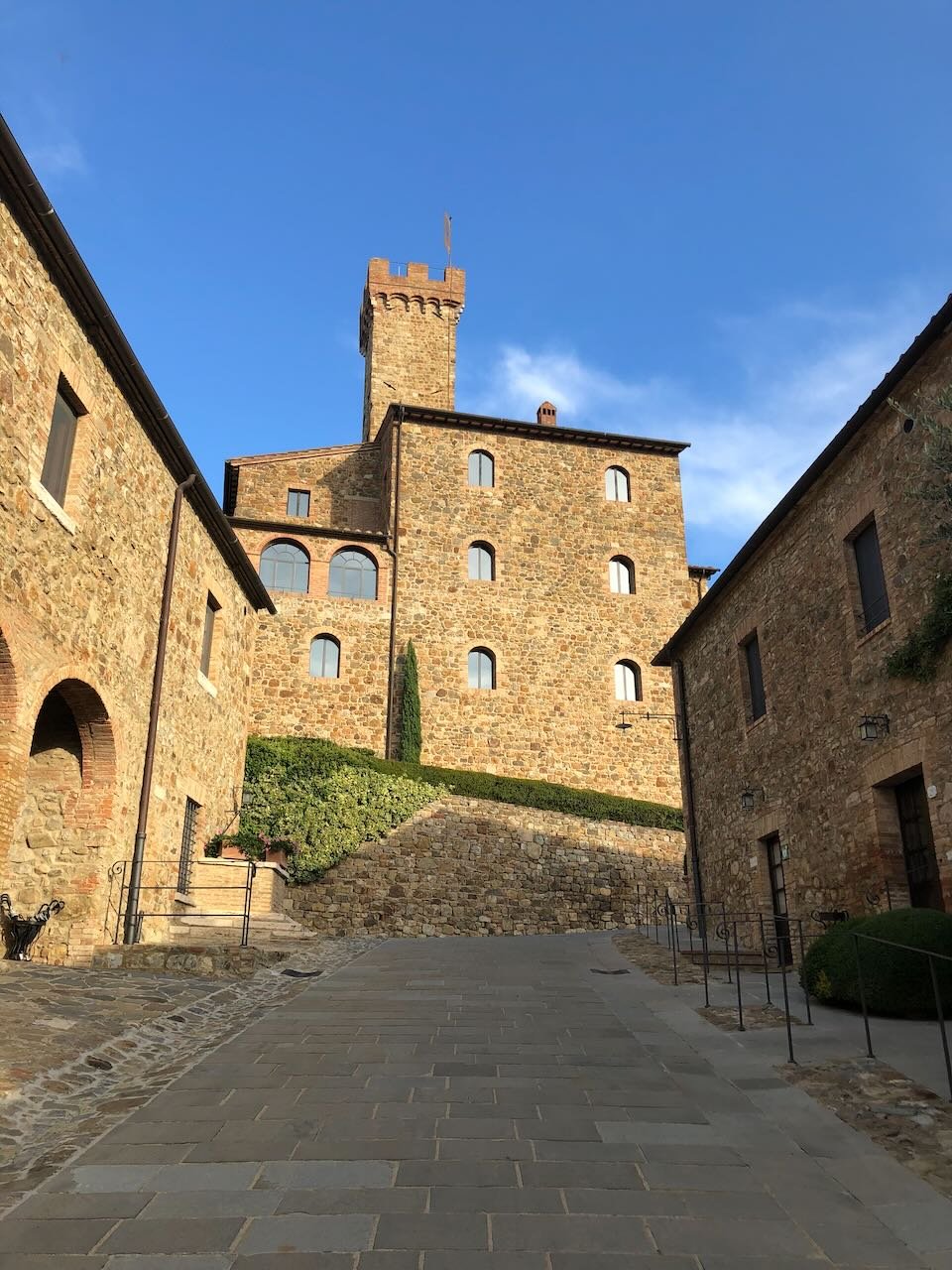
Castello Banfi Il Borgo overlooking the vineyards near Montalcino in southern Tuscany.
Palazzo del Capitano Wellness & Relais — A 15th-century building set inside the historic walls of San Quirico d'Orcia. The location is outstanding for photographers; you are already inside one of the most photogenic towns in the valley. One practical note: parking is in a public lot about seven minutes away on foot, which matters when you are loading gear before a 5 am shoot.
Mid-Range / Boutique Hotels
Relais Chiostro di Pienza — A former Franciscan convent dating to the 15th century, right in the center of Pienza. The veranda looks out over the Tuscan hills and is one of the better views you will get from a hotel terrace in the valley. Like Palazzo del Capitano, there is no private parking, so factor that into your planning.

The historic Relais Chiostro di Pienza in the heart of one of Tuscany’s most beautiful hill towns.
Wellness Center Casanova — My top recommendation specifically for photographers. It sits just outside the walls of San Quirico d'Orcia and is within walking distance of Belvedere, Tuscany's most iconic photo spot. Crucially, parking is right in front of the hotel. That matters more than it sounds when you are heading out before sunrise with a tripod and a bag of gear.
Agriturismo options in the countryside — There are several well-run agriturismi between San Quirico and Pienza that offer comfortable rooms, home-cooked dinners, and the kind of quiet that lets you hear the sunrise. Worth researching if you want a more immersive, off-the-grid experience.
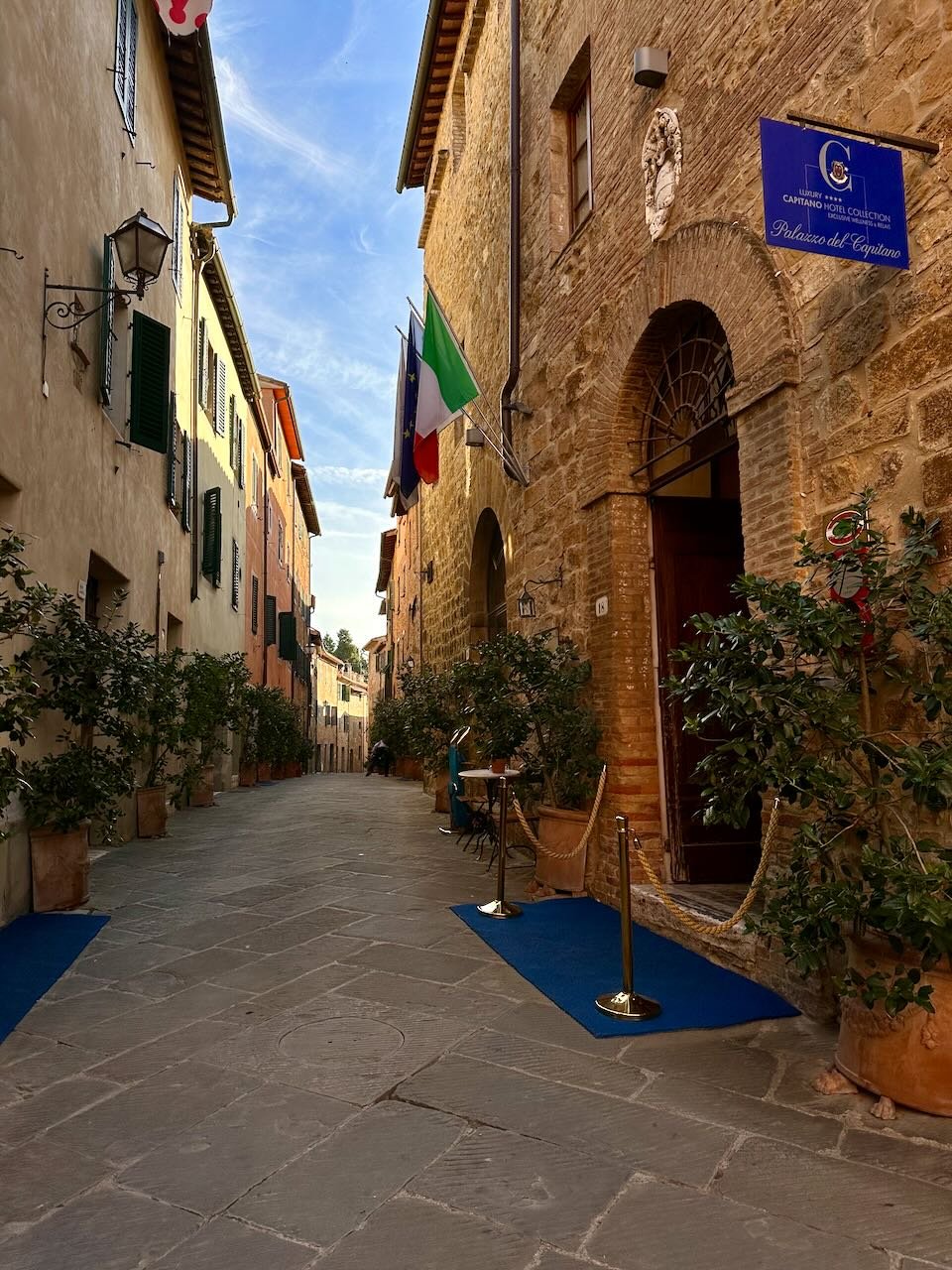
The medieval streets and stone buildings of San Quirico d'Orcia in Val d'Orcia.
How Many Days to Visit Val d'Orcia, Italy
Minimum: 4 days. Val d'Orcia rewards a slow pace and repeat visits to the same locations in different light. Rushing through it is a waste.
5 to 6 days is the photographer's ideal window. Here is how I would structure it:
Day 1: Arrive, settle in, and do a sunset drive between San Quirico and Pienza to get oriented. No pressure to shoot; just learn where the roads go.
Day 2: Pre-dawn shoot at Podere Belvedere and Croce di Prata, then breakfast in San Quirico. Afternoon exploration of Pienza on foot; gelato, pecorino, and an early dinner.
Day 3: Pre-dawn at Madonna di Vitaleta viewpoint on the SR22, then the Agriturismo Poggio Covili cypress row. Afternoon visit to Montalcino or Montepulciano.
Day 4: Sunset shoot around the Cipressi di San Quirico options. Evening in town.
Day 5: Day trip to Siena or San Gimignano. Return for golden hour at any location you want to revisit.
Day 6 (if you have it): Abbazia di San Galgano and Crete Senesi. These are further afield and deserve their own unhurried morning.

Podere Belvedere surrounded by the rolling hills of Val d'Orcia in the first light of sunrise.
It’s a quick drive up from Rome, about two hours to San Quirico/Pienza on the A1 autostrada, exiting at the town of Chiusi-Chianciano Terme. It will take you about 1.5 hours to arrive from Florence on the A1 to the Betolle exit. The drive from Siena is less than an hour on the SR2.
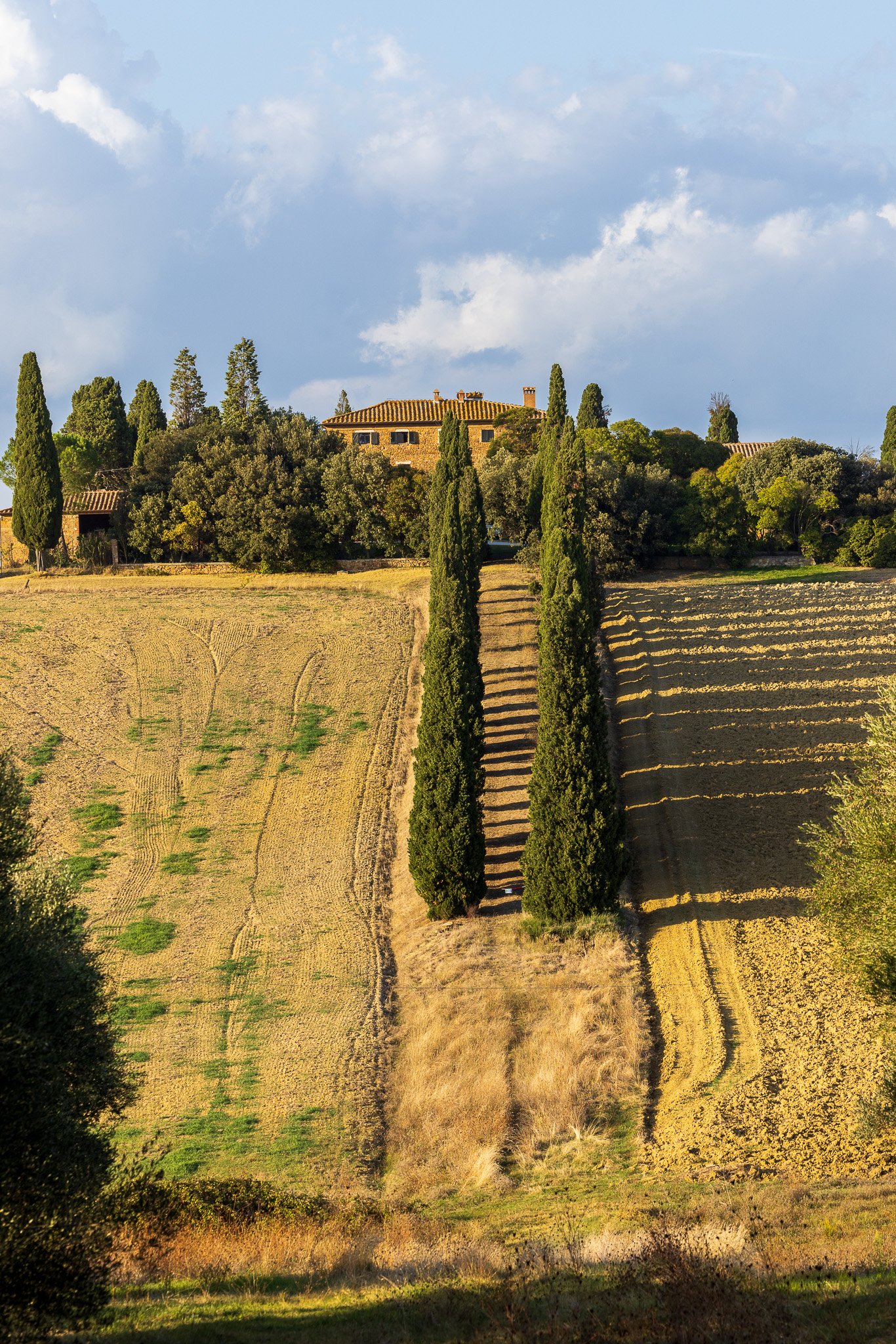
Arriving at the historic hill town of San Quirico d'Orcia in the heart of Tuscany.
Where to Eat in Val d'Orcia, Italy
The food in Val d'Orcia is as good as the landscape. This is the territory of pici (thick hand-rolled pasta), wild boar ragu, Chianina beef, Brunello di Montalcino, and Pecorino di Pienza aged in local cellars. Eat simply, eat locally, and make reservations. These are small restaurants with limited seats, and they fill up, especially in spring and autumn.
Restaurants Val d'Orcia, Italy
Osteria La Porta, Monticchiello — One of the best restaurants in the valley. Daria runs a warm, precise kitchen in a ridiculously picturesque walled village just outside Pienza. The terrace looks out over the Val d'Orcia and is one of the better dining views you will find anywhere. Book ahead. Closed Thursday.
Il Rossellino, Pienza — A tiny, intimate restaurant with only about 15 seats on a quiet side piazza in Pienza. The pici with meat sauce is exceptional, and the tiramisu is unlike any other you will try. Reservations are essential, especially in summer.
La Bottega di Portanuova, Pienza — A relaxed spot with an excellent selection of local cheeses, cured meats, and wines. Better for a long, unhurried lunch than a formal dinner.
Trattoria La Loggia del Chianti, San Quirico d'Orcia — Traditional Tuscan dishes in a rustic setting. The homemade pasta is the reason to go.
Ristorante Daria, Monticchiello — Creative takes on Tuscan classics in a charming setting. Worth the visit, especially if Osteria La Porta is fully booked.
Coffee
Bar Il Casello, Pienza — Good espresso, good pastries, and a relaxed spot to sit and watch the morning unfold after a dawn shoot.
Caffe del Corso, San Quirico d'Orcia — The local bar in the heart of town. Unpretentious and exactly right for a mid-morning stop.
Bar La Posta, Bagno Vignoni — A coffee in this ancient thermal village, with views over the outdoor hot spring pool, is one of the more memorable cafe experiences in Tuscany. Go on a quiet weekday morning.
Photography Gear to Bring
Val d'Orcia is a wide-angle and standard-zoom destination. The landscape is vast and horizontal; you want to capture scale, not compress it. That said, a telephoto is essential for isolating cypress trees, layering hills, or compressing the view of the Madonna di Vitaleta chapel against the rolling hills behind it.
Camera bodies: Canon EOS R5 Mark II, Sony A7R V, or Nikon Z8. Any of these handles the high dynamic range of Tuscan dawn skies without issue.
Lenses:
16-35mm or 17-28mm: Your primary workhorse for landscape work at Belvedere, Vitaleta, and the cypress roads.
24-70mm: The most versatile choice for the hill towns, architecture, and market photography.
70-200mm: Essential for compressing layers of hills and isolating the chapel or farmhouses from a distance.
50mm or 85mm prime: Useful for street photography in Pienza and San Quirico.
Accessories:
Sturdy tripod: Non-negotiable. Blue hour and long-exposure work requires stability on uneven ground.
ND filters (6-stop and 10-stop): Useful for long exposures on misty mornings.
Extra batteries: Cold autumn and winter mornings drain batteries faster than you expect.
Rain cover for camera and bag: Tuscan autumn weather can change quickly.
Samsung T7 portable SSD for daily backup.
Drone: Italy allows recreational drone flight, but check the ENAC (Italian Civil Aviation Authority) rules before you go. Many of the most dramatic images from Val d'Orcia are aerial. The cypress rows and rolling farmland read completely differently from above. Fly early, fly low, and always check for restricted airspace near the hilltop towns.
iPhone Tips
For the wide landscape shots at Belvedere, use the main 1x lens rather than the ultrawide. The ultrawide distorts the gentle curves of the hills into something unnatural.
In the blue hour before sunrise, switch to ProRAW if your iPhone supports it. The dynamic range in the sky and shadow detail in the hills is dramatically better than standard JPEG.
For the cypress tree allées shot from ground level, use Portrait Mode at 2x to blur the background slightly and give the trees a painterly separation from the landscape behind them.
The Madonna di Vitaleta Chapel viewed from the SR22 is a strong iPhone subject when backlit. Lock focus and expose for the highlights; bring the shadows up in Lightroom Mobile afterward.
Photography Locations in Val d'Orcia, Italy
Interactive Val d'Orcia Travel & Photography Map
Val d'Orcia is perfect for one of your interactive maps because it's not a destination with one main town—it's a landscape. I'd organize it around iconic photography locations, hill towns, scenic drives, wineries, sunrise/sunset viewpoints, and hidden gems.
San Quirico
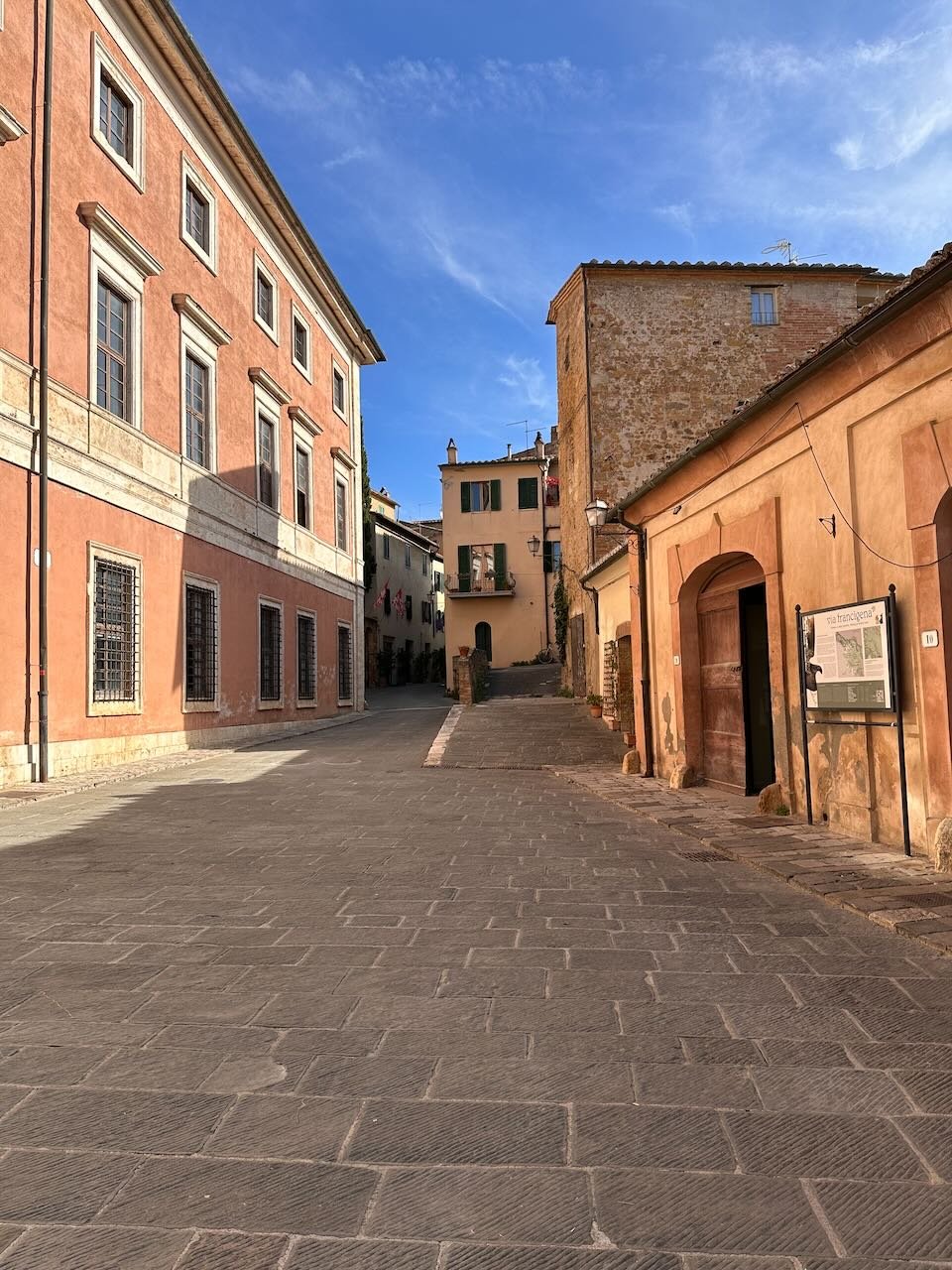
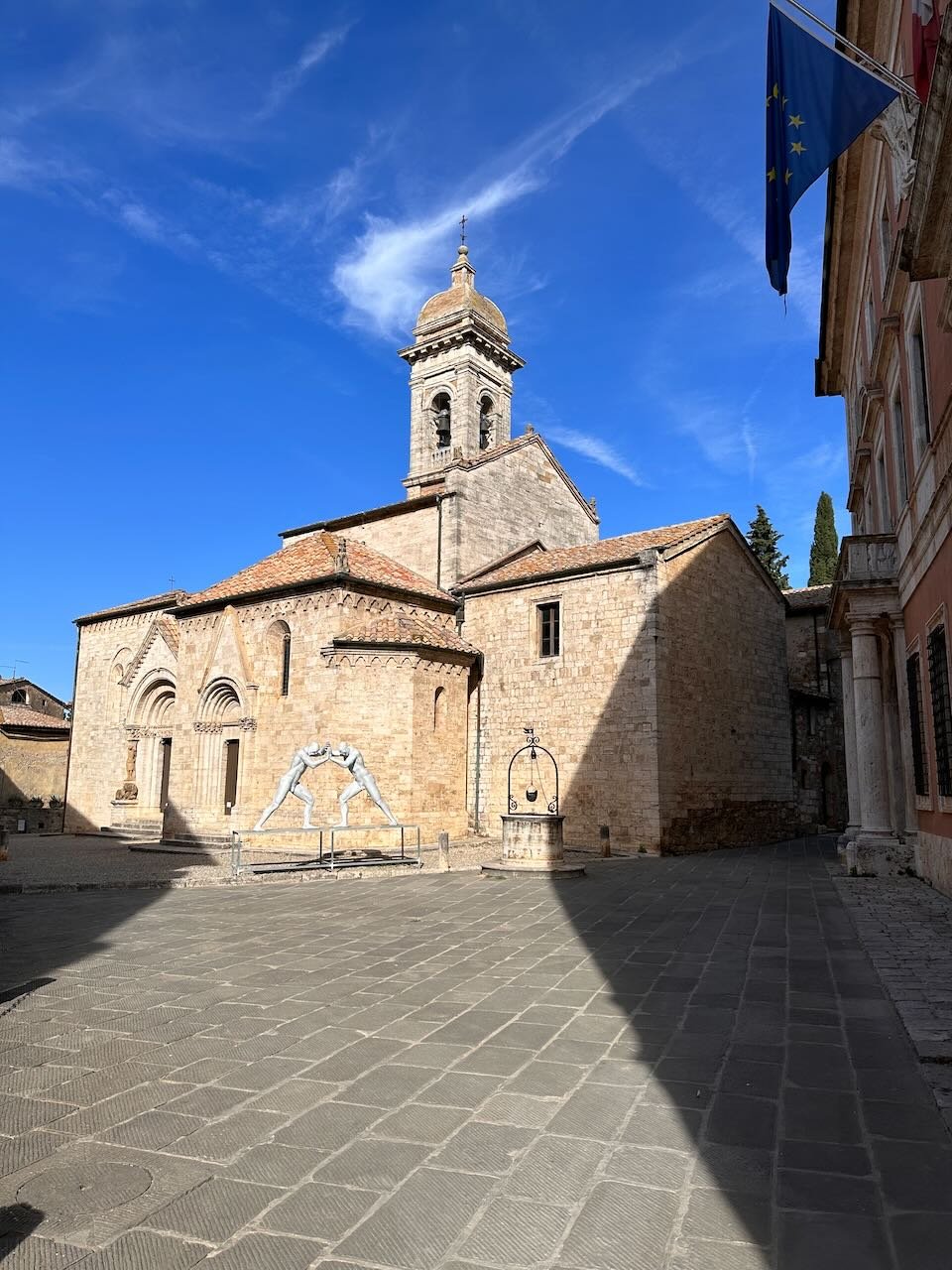
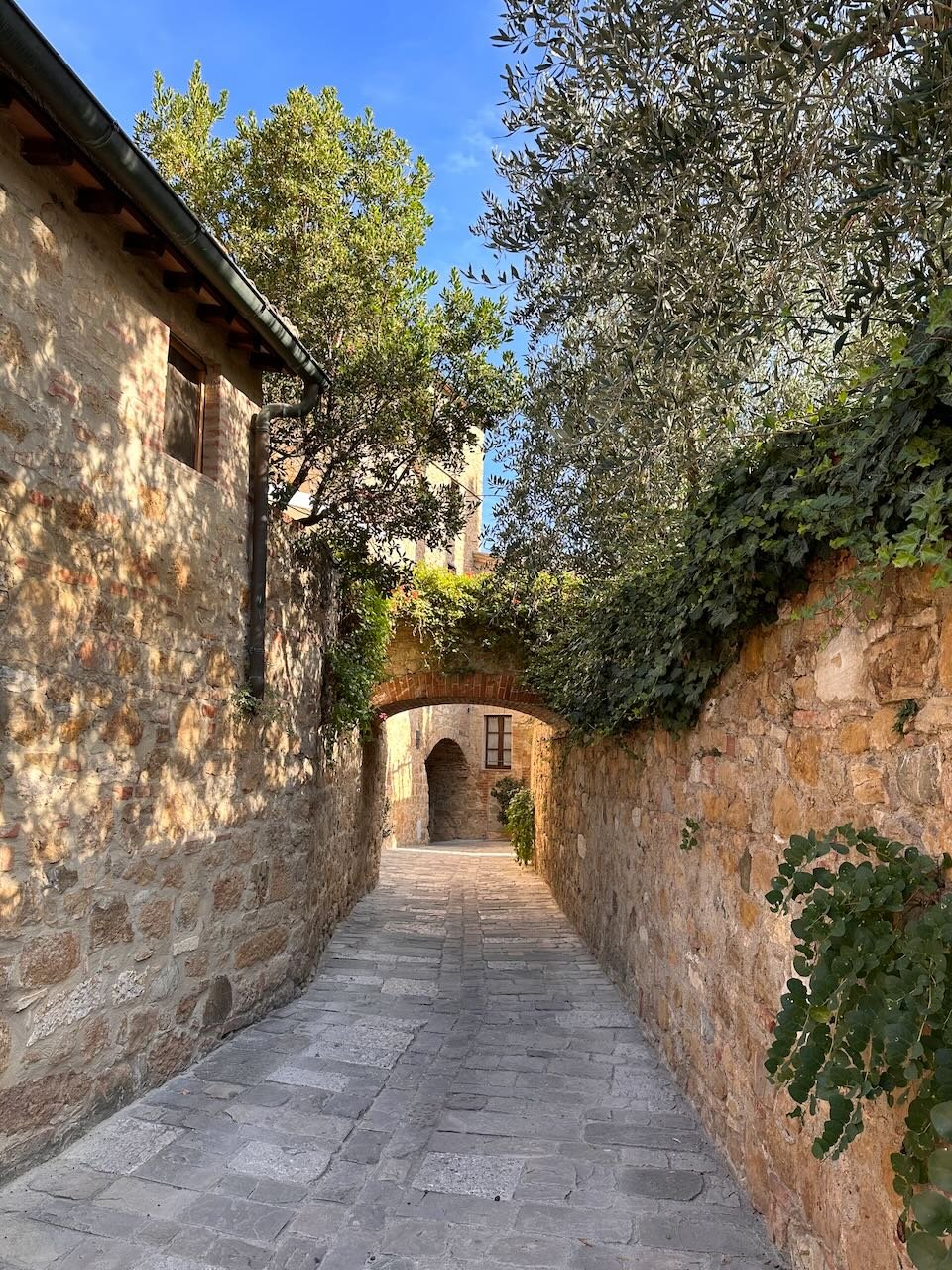
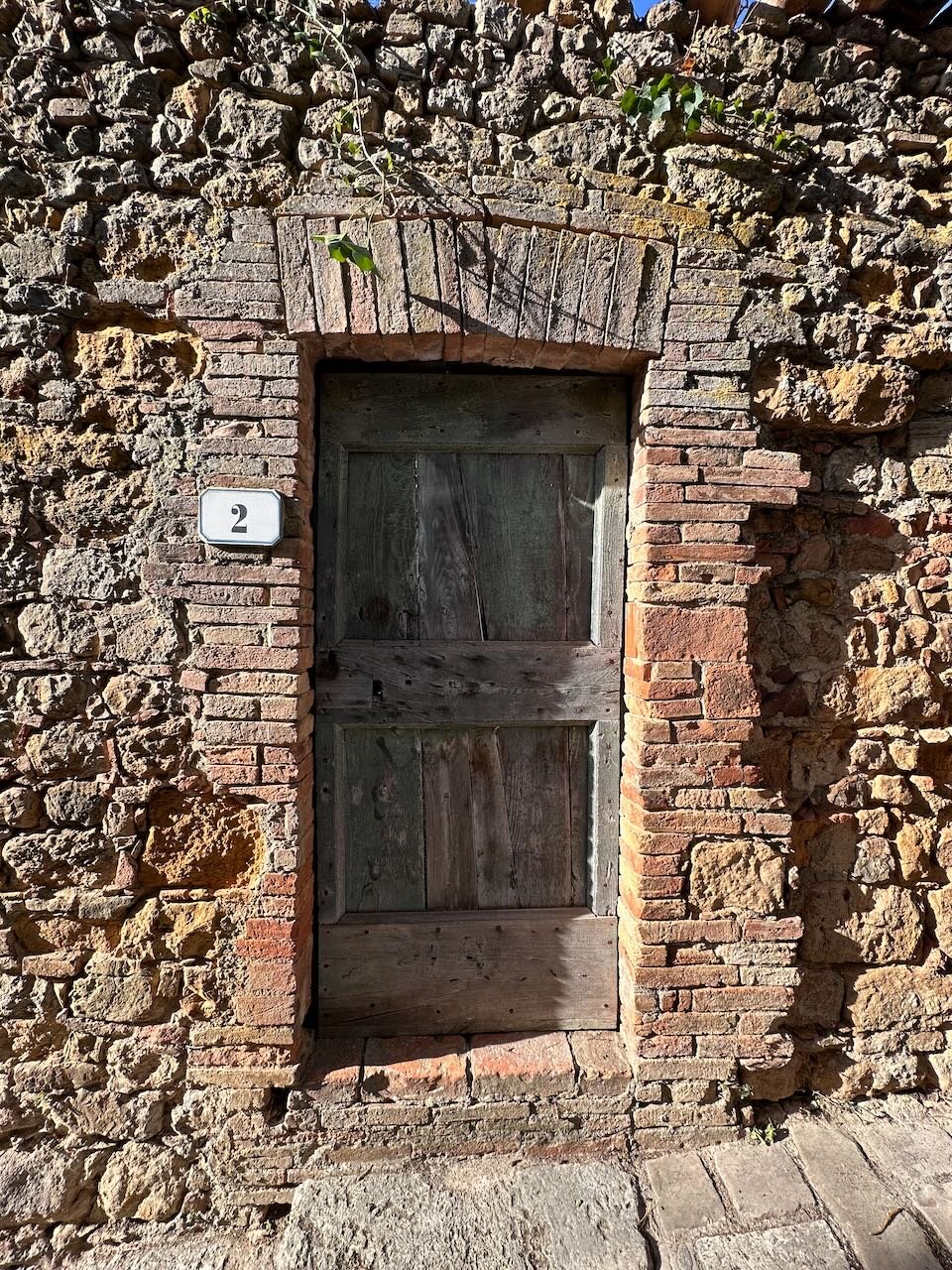
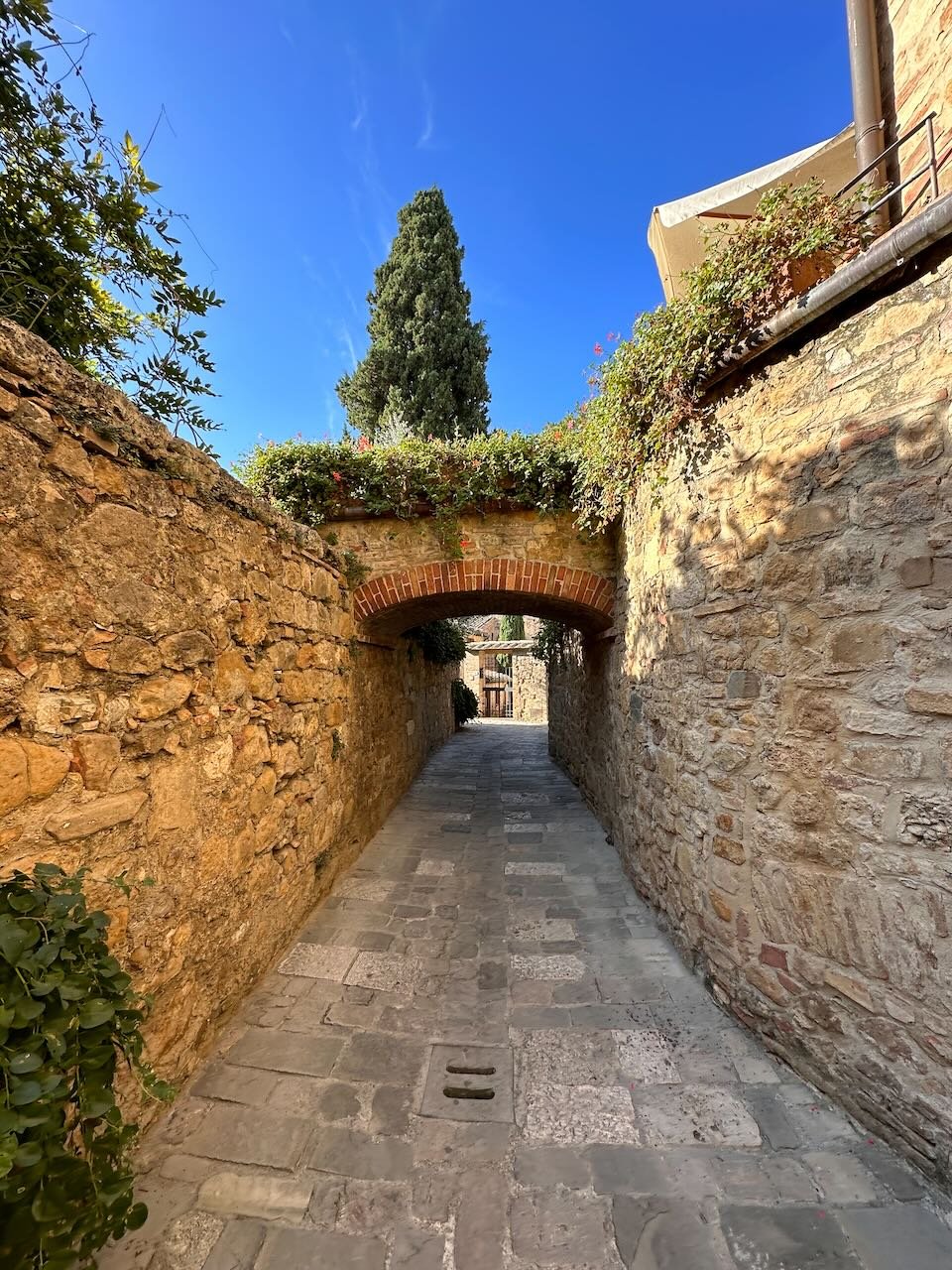
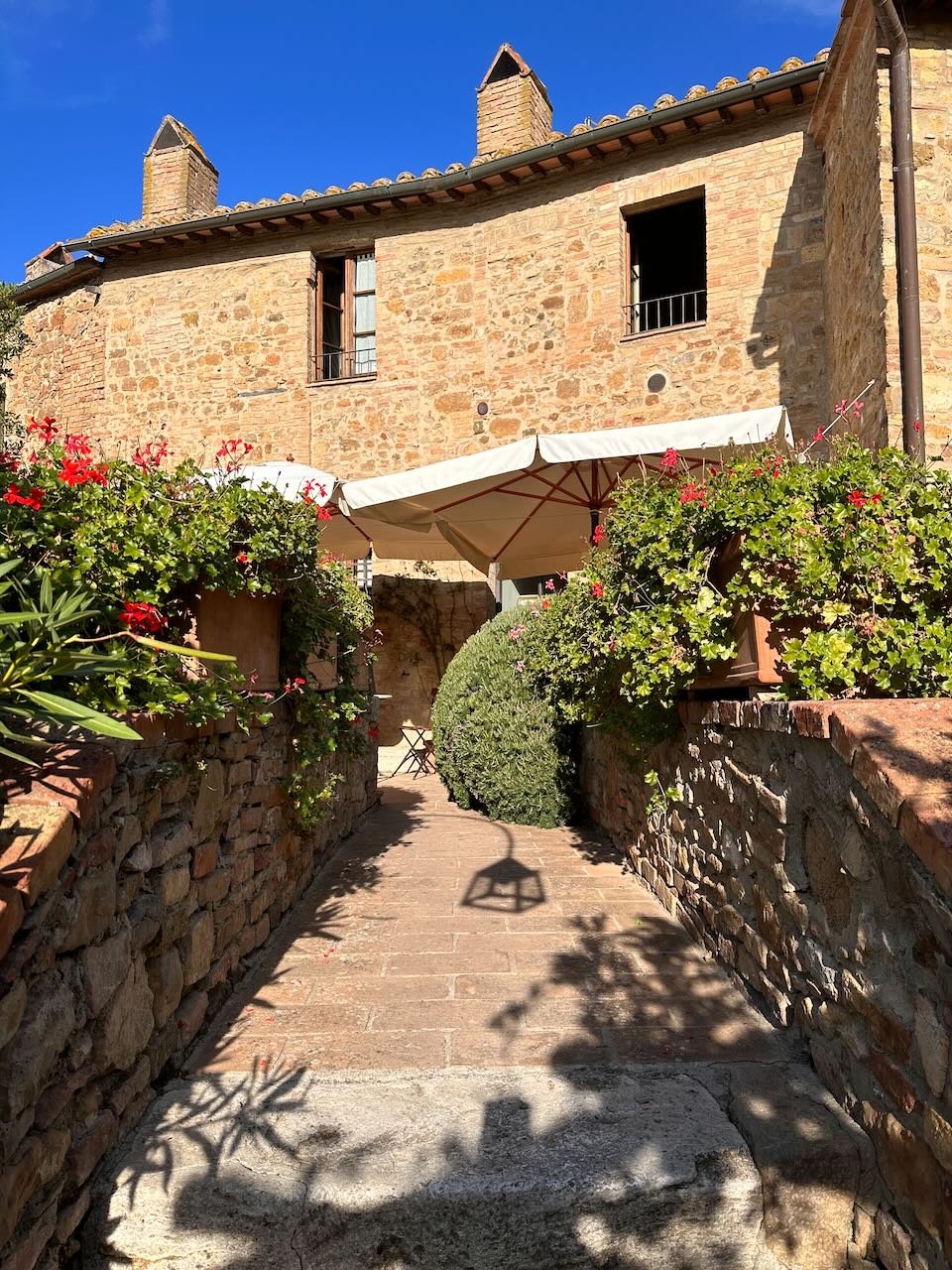
The beautiful town of San Quirico d'Orcia sits atop a hilltop halfway between Pienza and Montalcino. This small, picturesque village is surrounded by fortified walls, and rows of cypress trees stand above the surrounding countryside.
It is a wonderful town to walk through, and make sure to stop for dinner in the small family-owned restaurants.
Podere Belvedere
Belvedere is the most photographed spot in Italy, and when you stand there at 5 am with mist pooling in the valleys below and the first orange light touching the farmhouse roof, you understand exactly why. The composition is almost too perfect: a single stone house on a gentle rise, flanked by cypress trees, with hills rolling in every direction. It sounds like a cliché until you are there with a camera.
The shot changes completely with fog, which appears most reliably in autumn and on cool spring mornings after rain. Without fog, the image is still beautiful. With fog, it is extraordinary.
📷 Pro Tip: Park on the small road directly adjacent to the property and position yourself slightly elevated from the main viewpoint to get the house framed against the horizon rather than the lower hillside. Shoot with a 24-70mm at the longer end to keep the composition tight and eliminate distracting foreground. Arrive 30 to 40 minutes before sunrise; the sky changes quickly once the light comes. Return for golden hour in the late afternoon for a completely different look.
Best time: Sunrise and blue hour. Autumn for fog. Spring for poppy fields in the foreground. Access: Free, roadside. GPS: 43.06616, 11.61493.
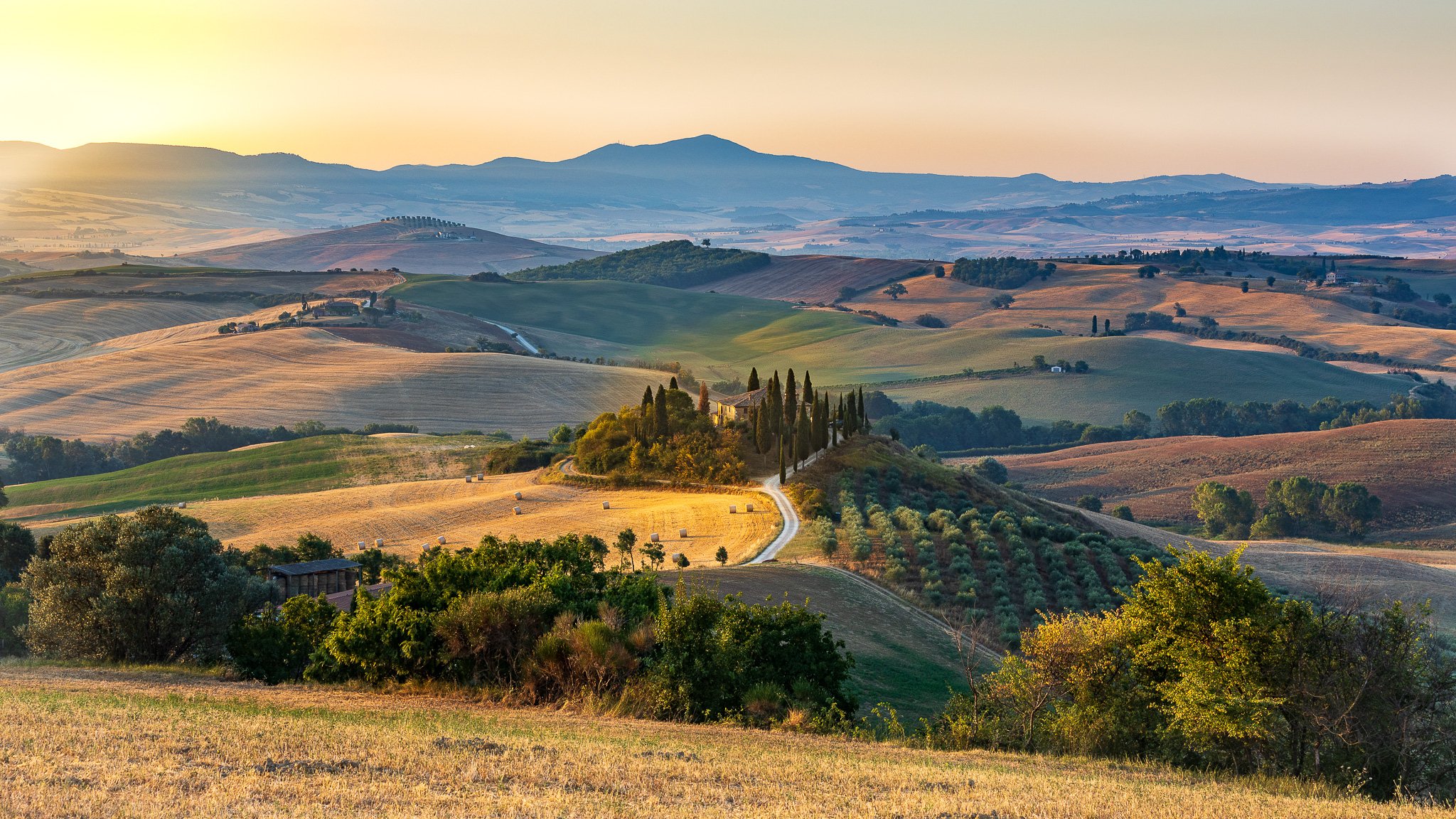
Podere Belvedere surrounded by the rolling hills of Val d'Orcia in the first light of sunrise.
You might not see fog every morning but when you do it is magical.

Morning fog drifting through the hills around Podere Belvedere in Tuscany.
Croce di Prata ("The Four Trees")
From Belvedere, turn left and walk down the same road for about 90 seconds. Follow the hedge until you find an opening, turn right, and cut through. You will see four cypress trees in a simple cluster that reads as a nearly abstract composition against the sky. This is not on any tourist map. Most people miss it entirely.
The shot is quieter than Belvedere and more geometric. Four trees, a horizon line, and light.
📷 Pro Tip: Shoot wide at 16-24mm to isolate the four trees against a clean sky with minimal foreground. Try a low angle to get the trees rising dramatically from the ridge. Works best in the same pre-dawn and blue hour window as Belvedere, so plan them as a single early morning block.
Best time: Sunrise. Access: Free, walk from Belvedere. No parking needed.
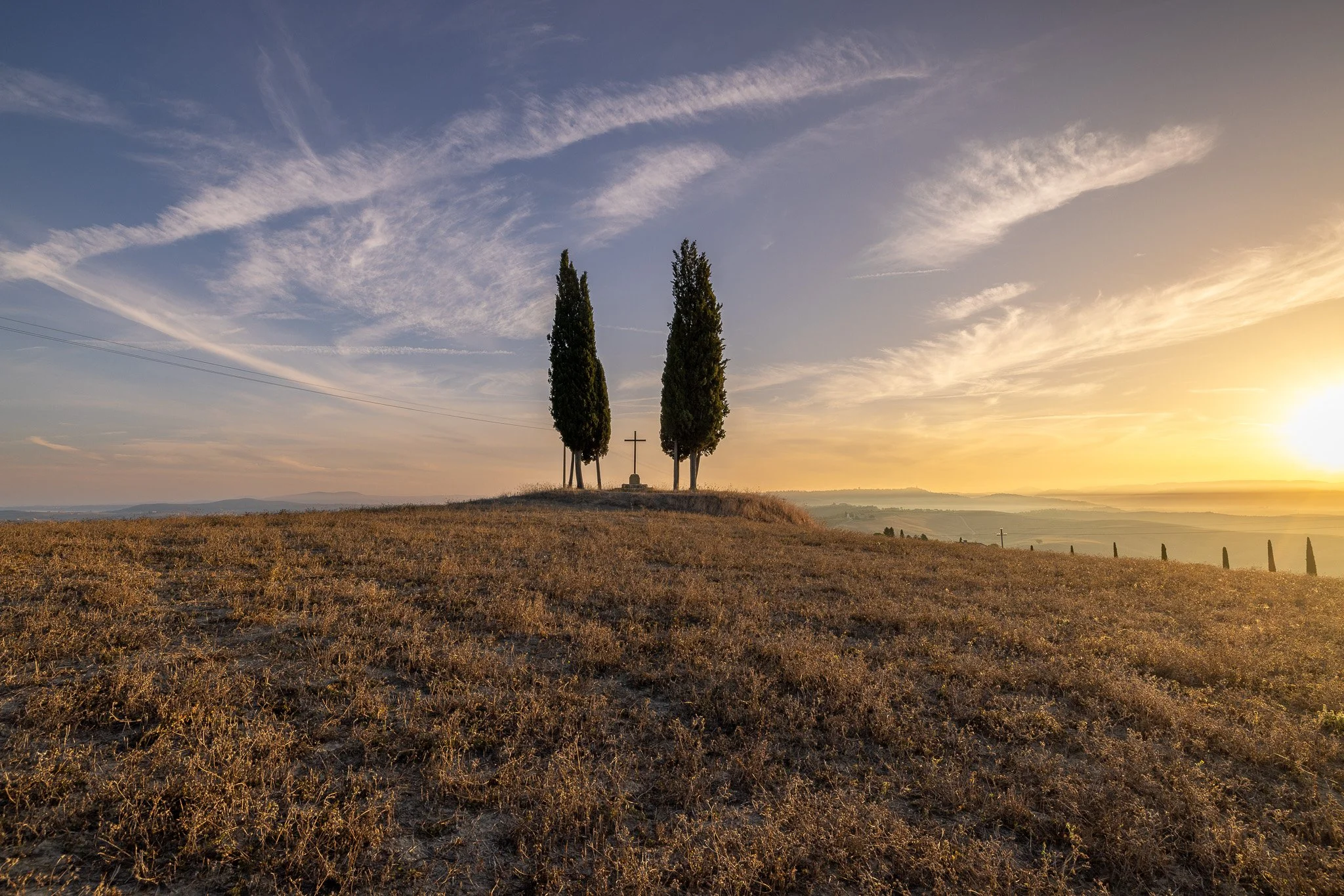
Four cypress trees silhouetted against the early morning sky at Croce di Prata near San Quirico d'Orcia.
Madonna di Vitaleta Chapel
The second most iconic spot in Val d'Orcia. The small chapel sits on a gentle rise flanked by cypress trees, and it photographs beautifully from two different positions: up close from the dirt track below, and from a distance on the SR22 where the chapel becomes a small element in a much larger landscape composition.
I prefer the SR22 viewpoint at sunrise for the backlit look of the chapel glowing against the morning sky. Drive the SR22 slowly a couple of times first to identify where other photographers have positioned themselves; there are several good stopping points along the road.
📷 Pro Tip: At the SR22 viewpoint, use a 70-200mm to compress the layers of hills and bring the chapel into a tight frame with the rolling landscape. For the close-up visit, walk down the dirt track toward the chapel in late afternoon when the warm light hits the stone walls directly. If you have a drone, fly here in spring for the aerial view of the chapel surrounded by green fields and poppy colors.
Best time: Sunrise from SR22. Late afternoon for a close-up. Spring for color. Access: Free. GPS: approximately 43.08, 11.64 for SR22 viewpoint area.

The Cappella della Madonna di Vitaleta surrounded by cypress trees and rolling Tuscan farmland.
You can walk down to the church which I highly recommend doing during the late afternoon. If you are lucky, you might see a couple getting married.
If you have a drone you can getting some beautiful images like the one below.

The Madonna di Vitaleta chapel surrounded by the green fields of Val d'Orcia from above.
Madonna di Vitaleta Chapel Viewpoint
I think the best shot of the church is at Sunrise from the SR22. There are multiple spots to stop, so it’s a good idea to drive down the SR22 road a few times to know the best place to stop. Usually, you see where to stop because there are lots of photographers with tripods taking photos. I love the look of the backlit light on the church.

The chapel and surrounding hills just before sunrise in Val d'Orcia.
Just before Sunrise the views are equally beautiful.

The Madonna di Vitaleta chapel glowing in the soft backlight of sunrise from the SR22 viewpoint.
Agriturismo Poggio Covili and Viale di Capressi
These are two separate compositions at the same farmhouse, and I always shoot them back to back in the same pre-dawn window.
From above: Drive up the hill on SP323 toward Castiglione d'Orcia and pull into the long turnout on the left. From here, you are looking down at a long row of cypress trees leading to the farmhouse below. The elevated angle gives you a sweeping, almost graphically flat perspective. This also shoots brilliantly from a drone.
From below: Descend to the entrance of the farmhouse and shoot the same cypress row from ground level. The famous Instagram version. In midday light, this place is full of visitors; just after dawn, it is quiet and yours.
📷 Pro Tip: The elevated viewpoint works with a 24-70mm to capture the full sweep of trees and farmhouse. Ground level is better with a 70-200mm to compress the row of cypresses into a dense, layered composition. Both shots benefit from early light coming in from the left side, so position yourself accordingly. Park at the elevated turnout and walk down.
Best time: Sunrise and blue hour. Autumn light is exceptional here. Access: Free. Address: SP323, 53023 Castiglione d'Orcia.
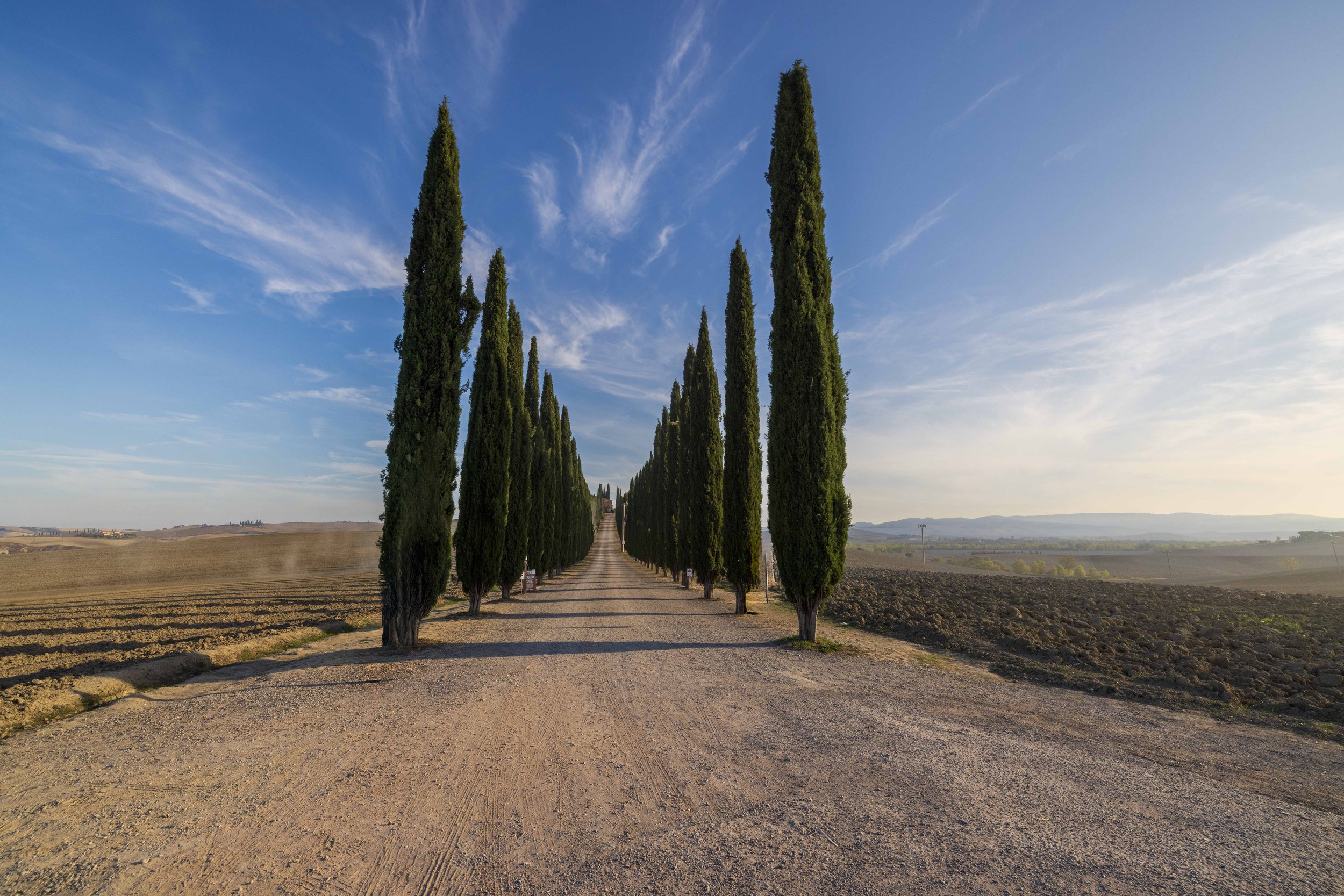
The famous cypress lined road leading to Agriturismo Poggio Covili, photographed from above.
This is another location that looks amazing from above with a drone.

Aerial view of the long row of cypress trees leading through the Tuscan countryside to Poggio Covili.
Viale di Capressi
After you shoot that view from up high on the hill, you can go down to the entrance of that same Farmhouse and shoot its Instagram-famous row of trees from ground level. In the day, in awful light, it’s full of Instagrammers, but just after dawn, you’ll be all alone with no distractions.
Address: SR2, 53023 Castiglione d’orcia SI, Italy
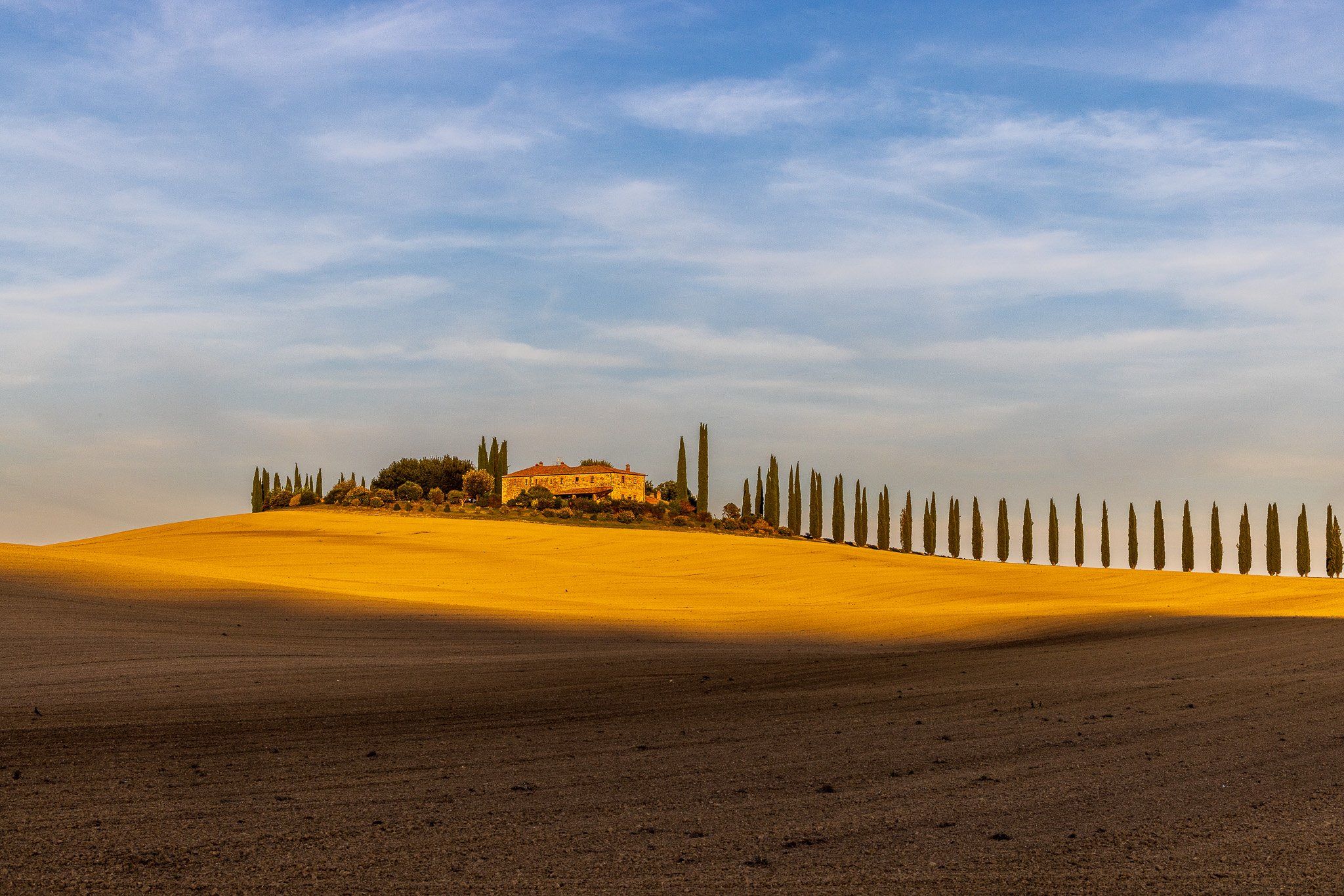
The famous cypress trees of San Quirico d'Orcia glowing in the warm light of sunset.
Cipressi di San Quirico d'Orcia (Options 1 & 2)
Option 1 is a classic sunset drive. Head out from San Quirico and spend the last hour of daylight driving the roads west and south of town. You will find groups of cypress trees at almost every curve, and the low evening light makes them dramatic against warm golden sky.
Option 2 is more specific and more rewarding. Drive out of San Quirico in the opposite direction, away from Pienza, and look for the small parking area on the left (space for 3 to 4 cars). The lower group of cypress trees here forms a cluster that reads beautifully at ground level. Cross the bridge from the parking area, step over the guardrail into the field, and shoot from there. Walk up the hill from the parking area and you will find a circular formation of cypresses that is exceptional from a drone.
📷 Pro Tip: For Option 2 at ground level, use a 24-70mm to get the cluster of trees rising from the gentle slope with open sky behind them. Arrive at golden hour so the warm light rakes across the grass and gives the scene depth. The circular formation visible from a drone is best photographed in spring when the surrounding fields are green.
Best time: Sunset. Drone: best in spring. Access: Free. Address: SR2, 53027 San Quirico d'Orcia.
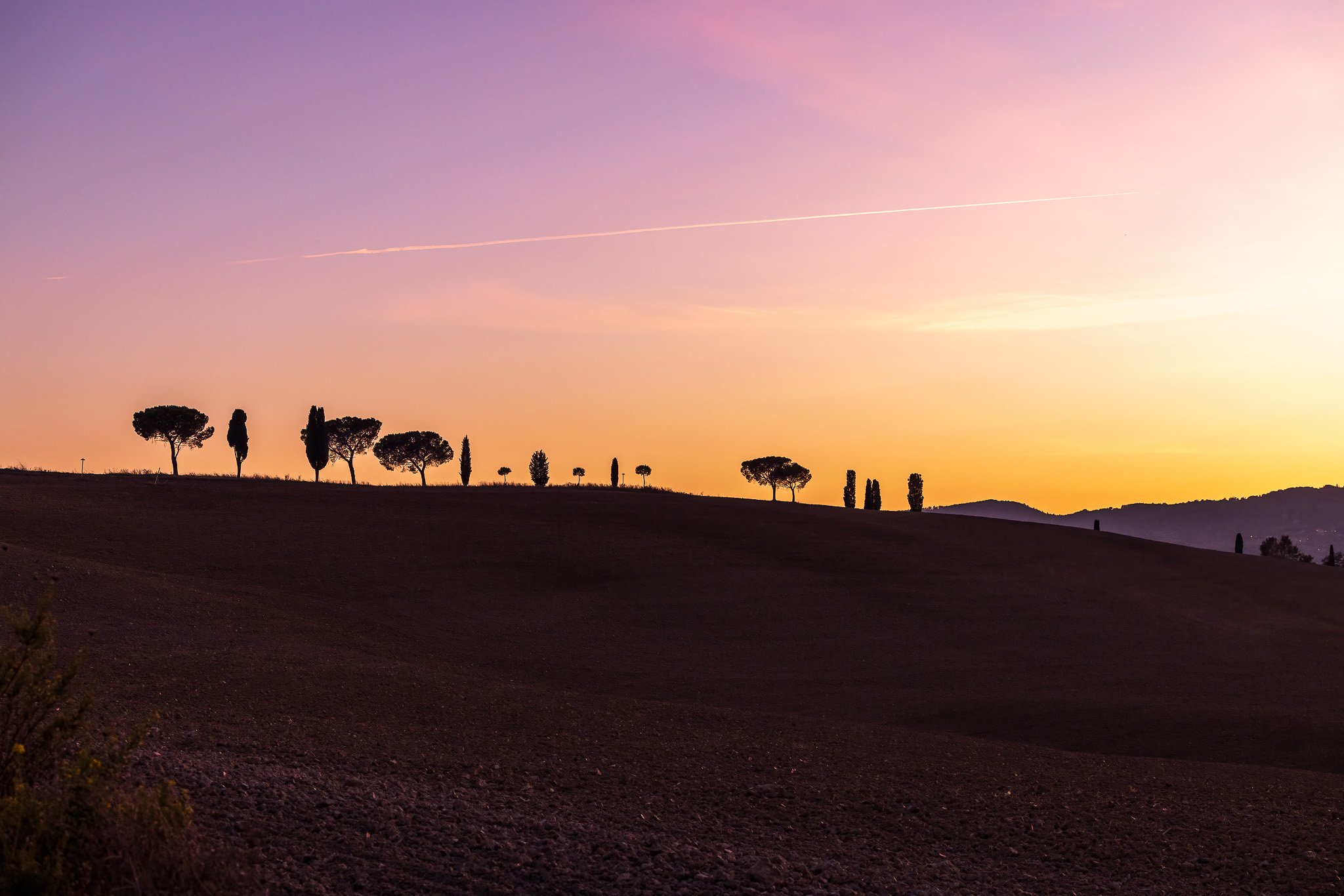
A cluster of cypress trees rising above the rolling fields outside San Quirico d'Orcia.
Cipressi di San Quirico d’Orcia Option 2
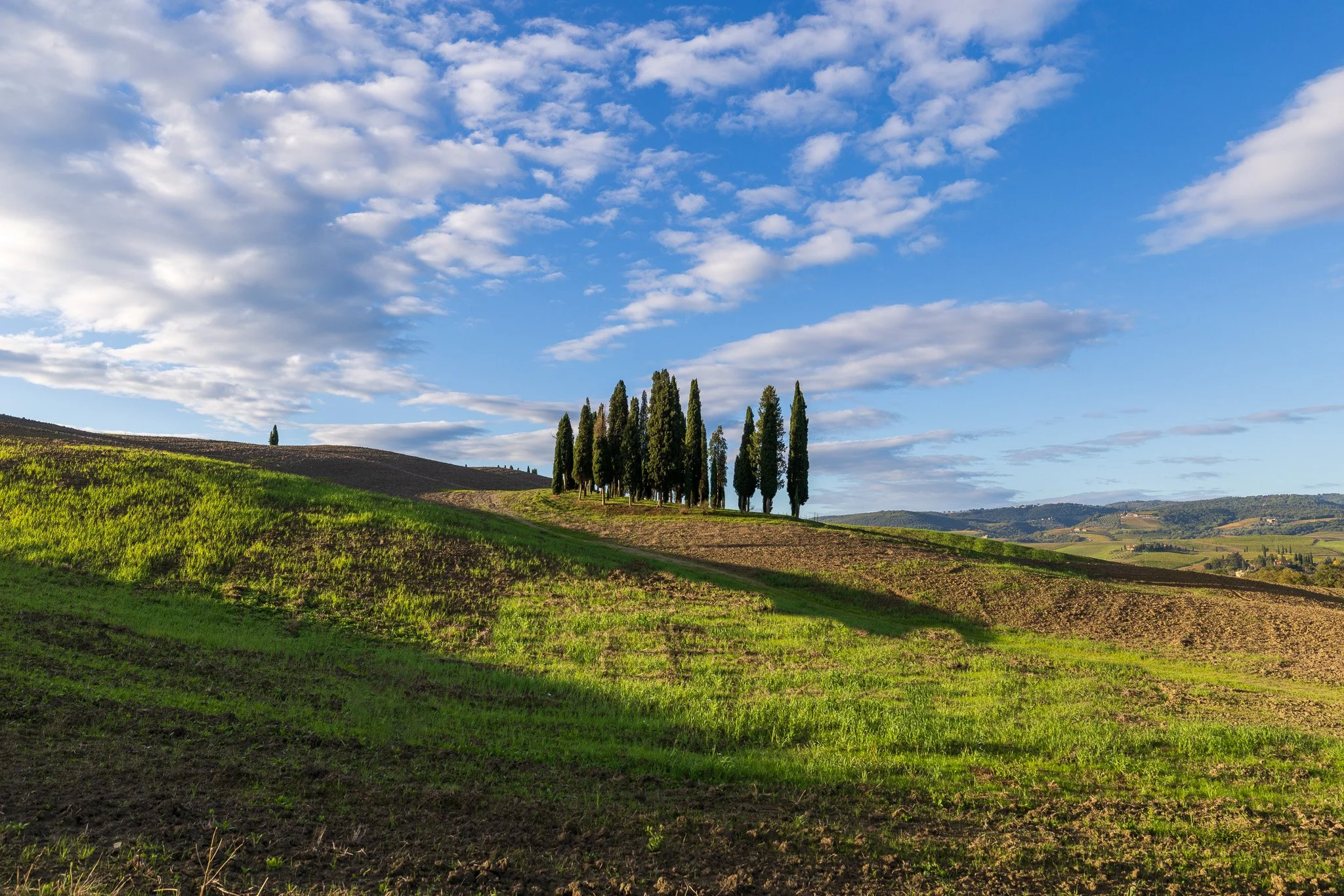
A circular grove of cypress trees hidden in the hills outside San Quirico d'Orcia.
To find this location, you need to drive out of the other side of San Quirico, not towards Pienza.
Once you are on the highway, you will see the trees on your left side. There is a small parking for 3-4 cars.

The circular formation of cypress trees near San Quirico d'Orcia photographed from above.
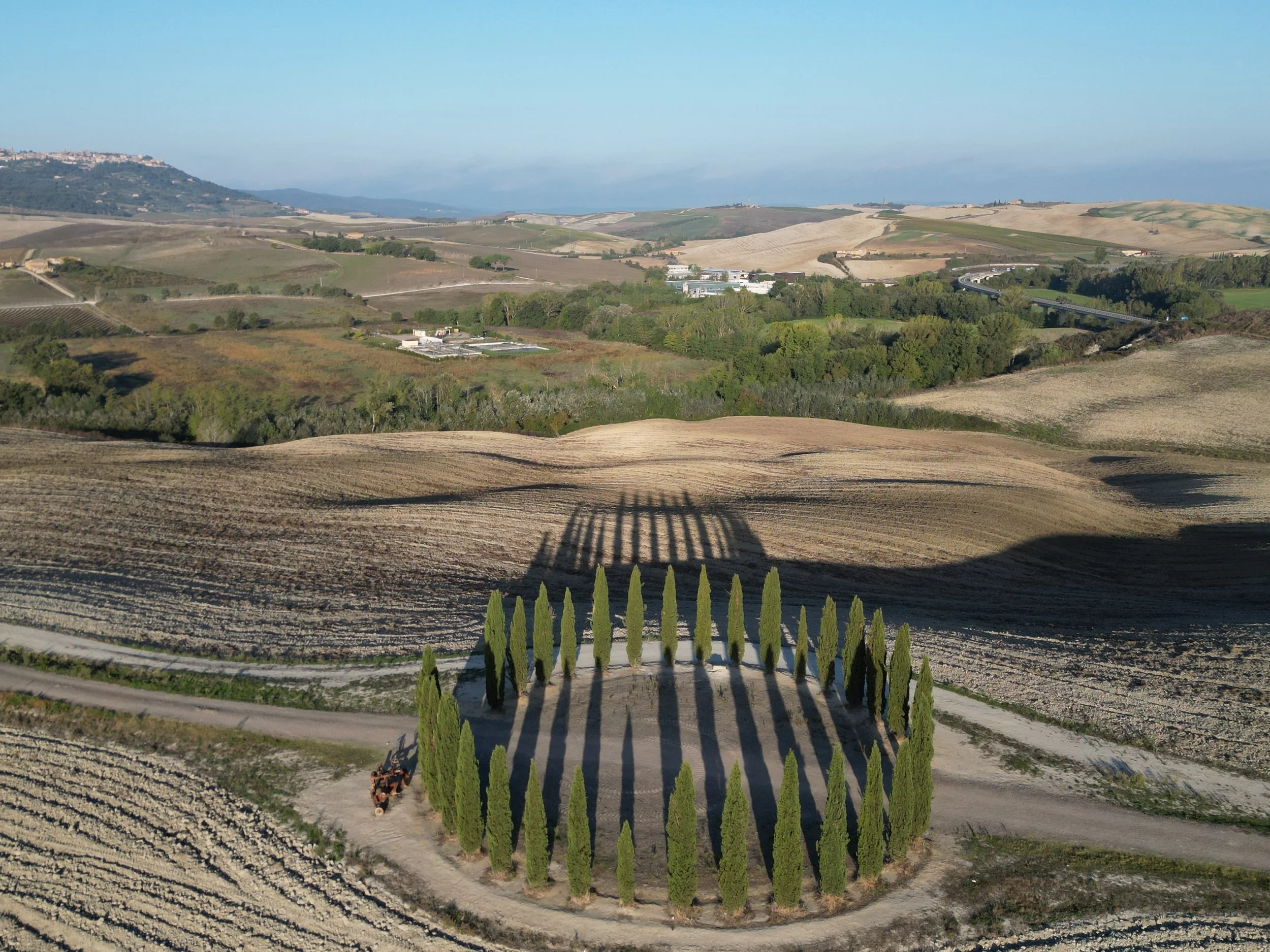
The circular formation of cypress trees near San Quirico d'Orcia photographed from above.
The most photogenic ones are the lower group of trees. This is best shot from the other end of the bridge from where you park (there’s a walkway on the bridge), then head over the guardrail into the field.
The Gladiator House (Podere Terrapille)
If you have seen Ridley Scott's Gladiator, you have already seen this farmhouse. The opening sequence, where Maximus walks through golden fields with his hand trailing through wheat, was filmed right here outside Pienza. The property is privately owned, which means access is not guaranteed, but it has been reachable to visitors on foot for years and remains one of the most atmospheric locations in the valley.
There are two ways to photograph it. The first is to drive to the Pieve dei Santi Vito e Modesto a Consignano church and walk down the pathway from there. You approach the farmhouse on foot through the fields, which gives you the same low, intimate perspective the film used. In spring, when the wheat is green and the poppies are out, this walk alone is worth the effort. The second option is to drive toward the Punto Panoramico di Pienza, about five minutes from town, and fly a drone from there to capture the farmhouse in its full landscape context against the rolling hills.
📷 Pro Tip: The close-up approach from the church path is best in late afternoon when the light rakes low across the stone walls and the surrounding fields. A 24-70mm gives you the flexibility to shoot wide for context and tighter for the farmhouse facade. In spring, get low and use the poppy field in the foreground as a color element. The drone shot from Punto Panoramico is most effective at golden hour; the long shadows from the cypress trees stretch across the field and give the scene depth. Confirm access conditions before planning a specific shoot around this location, as it is private property.
Best time: Late afternoon and golden hour. Spring for poppies. Access: On foot from Pieve dei Santi Vito e Modesto a Consignano. Drone from Punto Panoramico di Pienza. GPS: approximately 43.07, 11.70.

Pieve dei Santi Vito e Modesto a Consignano Church
During the day the Gladiator house looks incredible during Spring time.
The other option is to drive from Pienza to the “Punto Panaramico Pienza” which is about 5 minutes down the road. From here I put up my drone and took the shot below.

Podere Terrapille, better known as the Gladiator House, surrounded by the green fields of Tuscany in spring.
The Lone Cypress
Another famous location is the Lone Cypress. This is probably a nicer shot during the Spring with a field of green grass and poppies.

A solitary cypress tree standing against the rolling landscape of Val d'Orcia.
And here is what it looks like in the Spring

The Lone Cypress surrounded by green spring fields and wildflowers in Tuscany.
Abbazia di San Galgano
This is the ruined abbey with no roof, where sky and stone coexist in a way that feels entirely cinematic. Park outside, walk down a tree-lined path, turn left, and follow another tree-lined path to the entrance. Easy, flat, five minutes of walking. There is a small entrance fee.
The interior is open to the sky, which means the light behavior inside changes by the hour. Morning light streams in from the east and creates strong directional shafts. Overcast days produce a soft, even light that works beautifully for architecture. Do not skip this one.
📷 Pro Tip: A wide angle at 16-24mm captures the full length of the nave with the open sky above. Try shooting straight up from the center of the nave for a dramatic overhead composition. Bring a tripod for low-light interiors. If you visit when the grass on the floor is green and long (late spring, early summer), the contrast with the stone arches and open sky is exceptional.
Best time: Morning or overcast days. Spring for green interior. Access: Small entrance fee. Address: Strada Comunale di S. Galgano, 53012 Chiusdino.
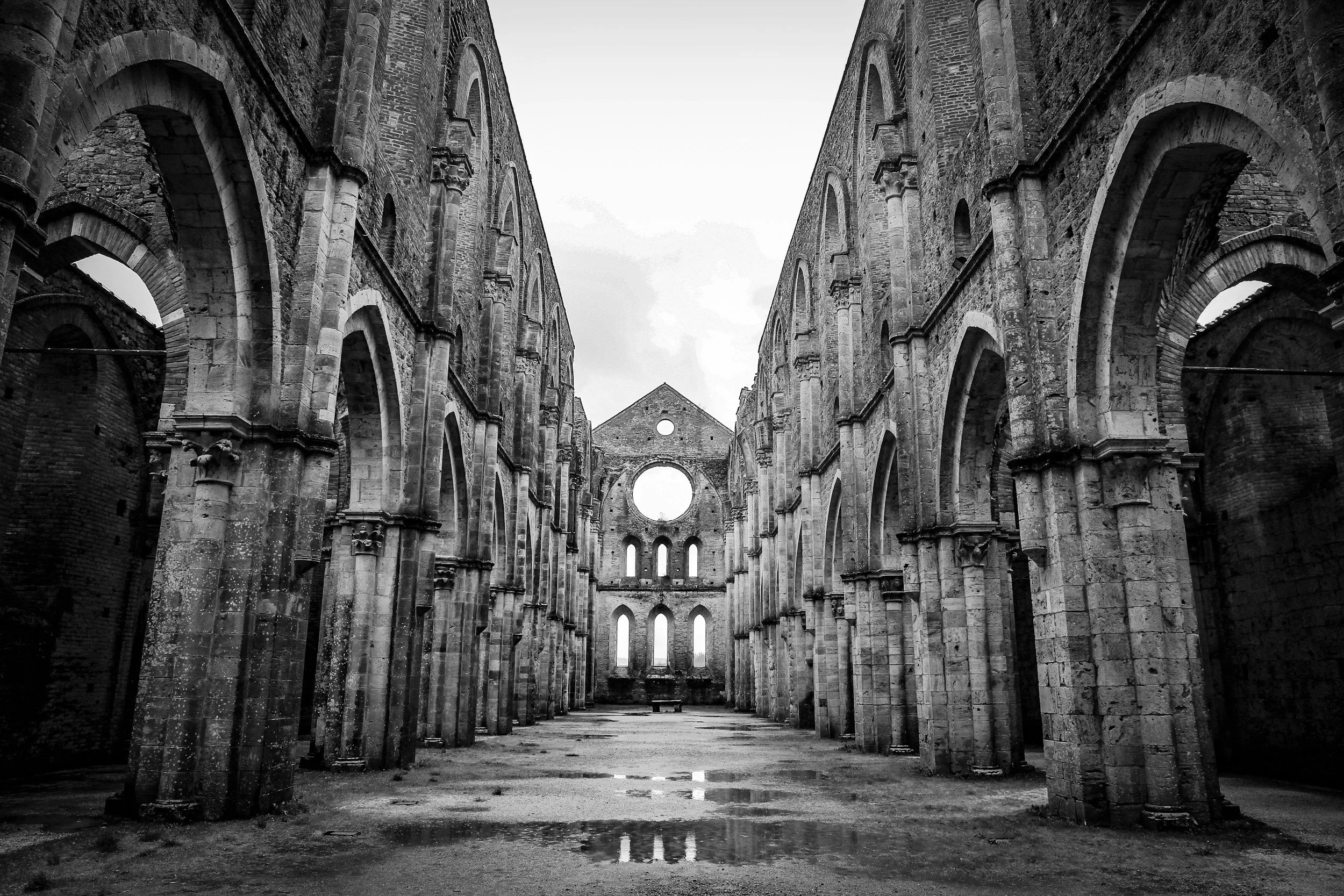
The roofless nave of Abbazia di San Galgano, where Gothic stone arches open directly to the Tuscan sky.
Cipressi di Monticchiello
This location (SP88, 53026 Montepulciano SI, Italy) is just a 10-minute drive from Pienza. The curvy road with the cypress trees is magnificent.

The winding cypress lined road near Monticchiello, one of Tuscany’s classic landscape compositions.
The City of Montepulciano or Montalcino
There are 2 charming towns located about 40 minutes from San Quiraco d’Orcia - Montepulciano and Montalcino. It is worth the drive. You will find great views and restaurants.
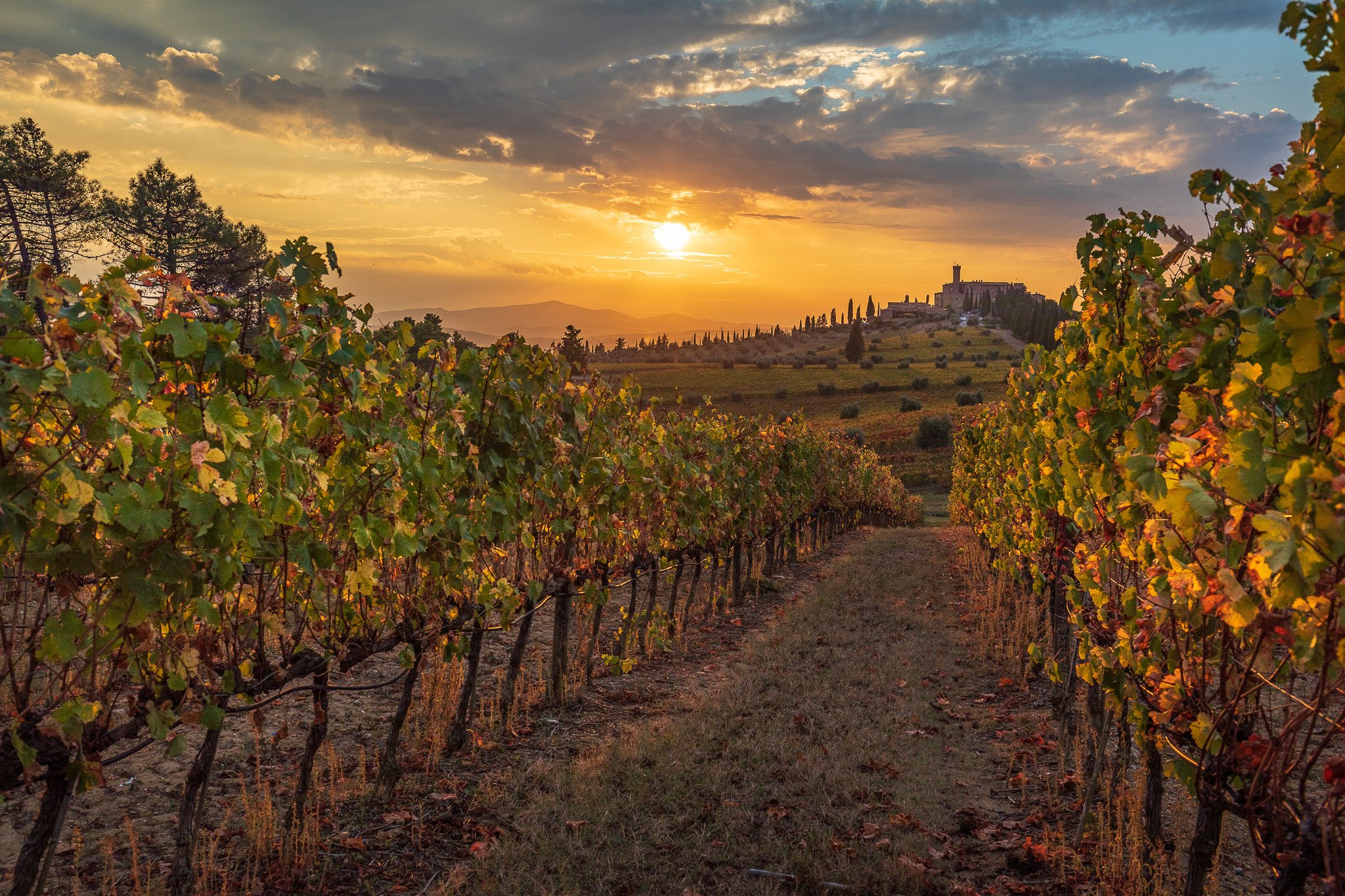
Rolling vineyards and Tuscan countryside along the road near Castello Banfi and Montalcino.
Pienza Viewpoint
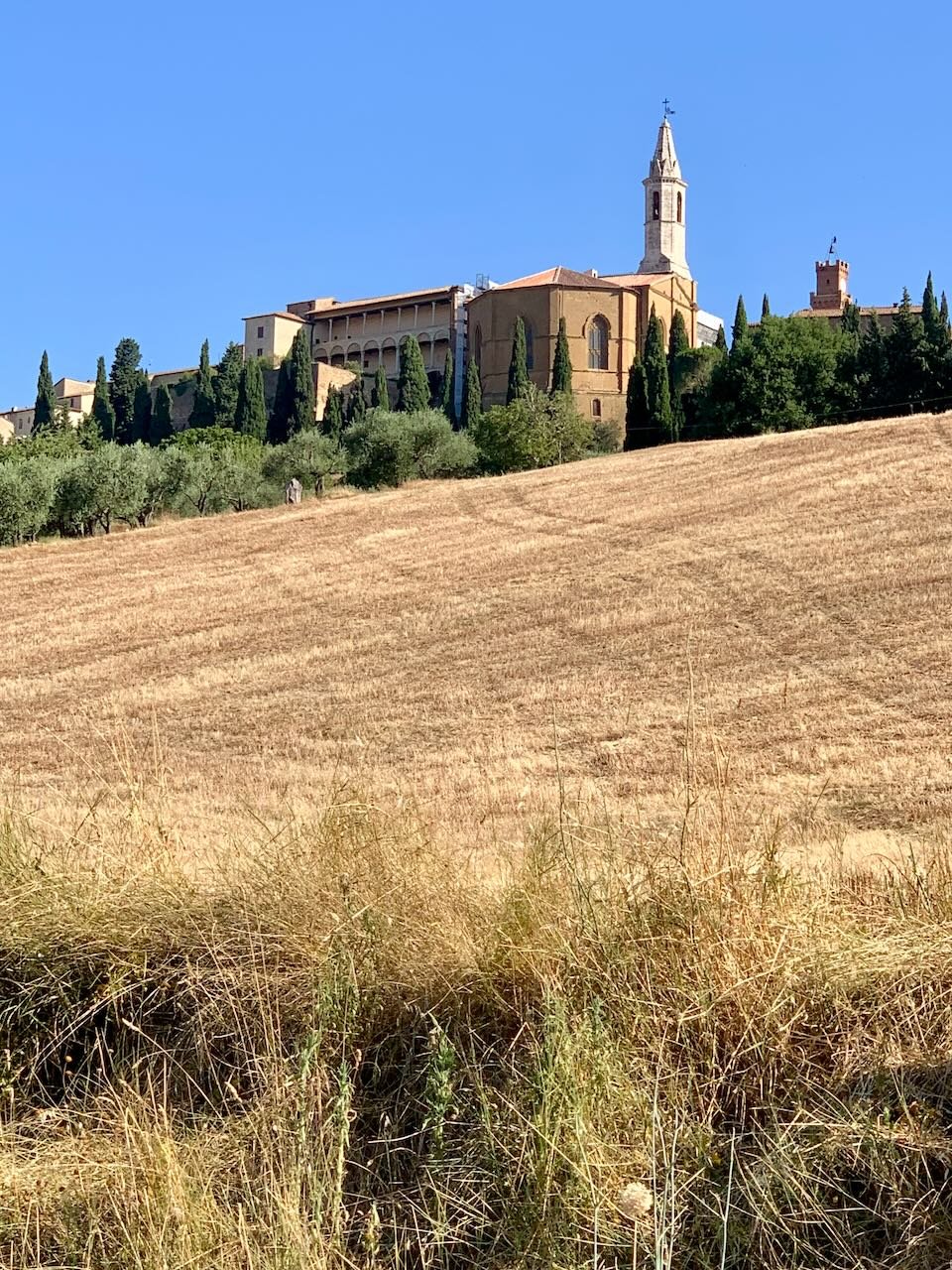
Another town to stop and visit is Pienza. It is located about 10 kilometers from San Quirico. Shops along the little lanes sell pecorino (sheep’s milk cheese), honey, and lots of other delicious treats.

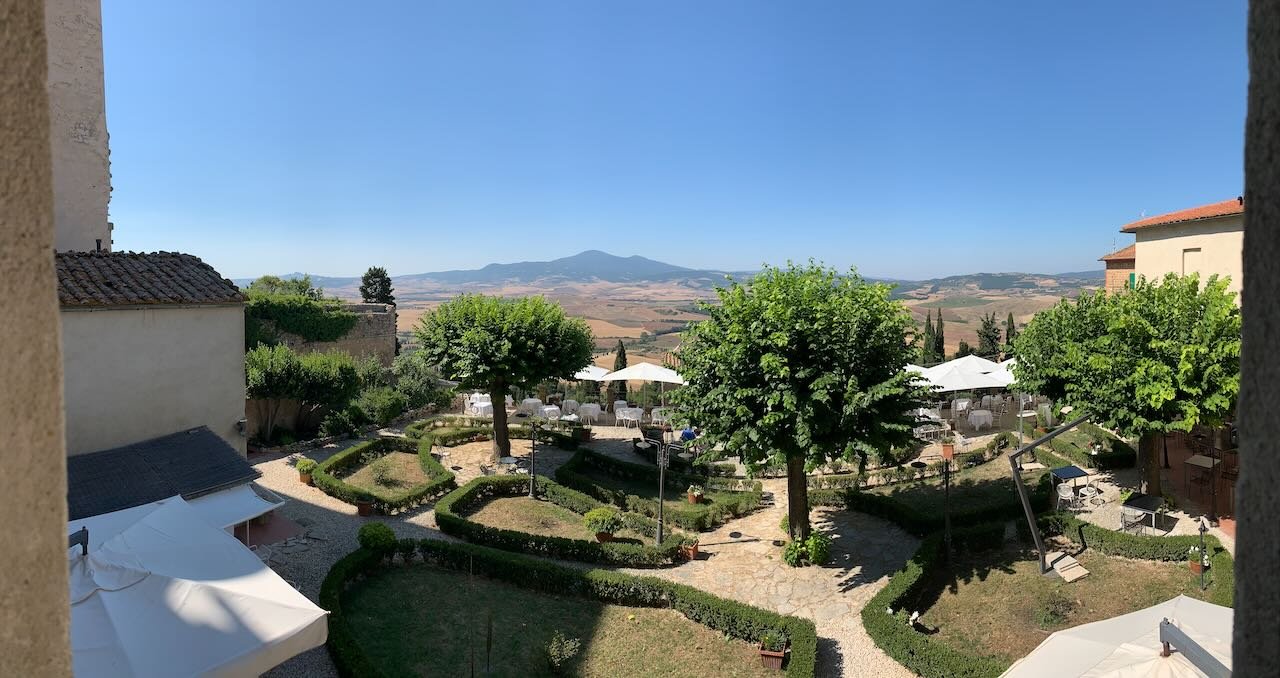
The rolling hills of Val d'Orcia viewed from the medieval hill town of Pienza.
It is worth a trip to Pienza. I love going in the afternoon for a coffee, gelato or an early dinner.

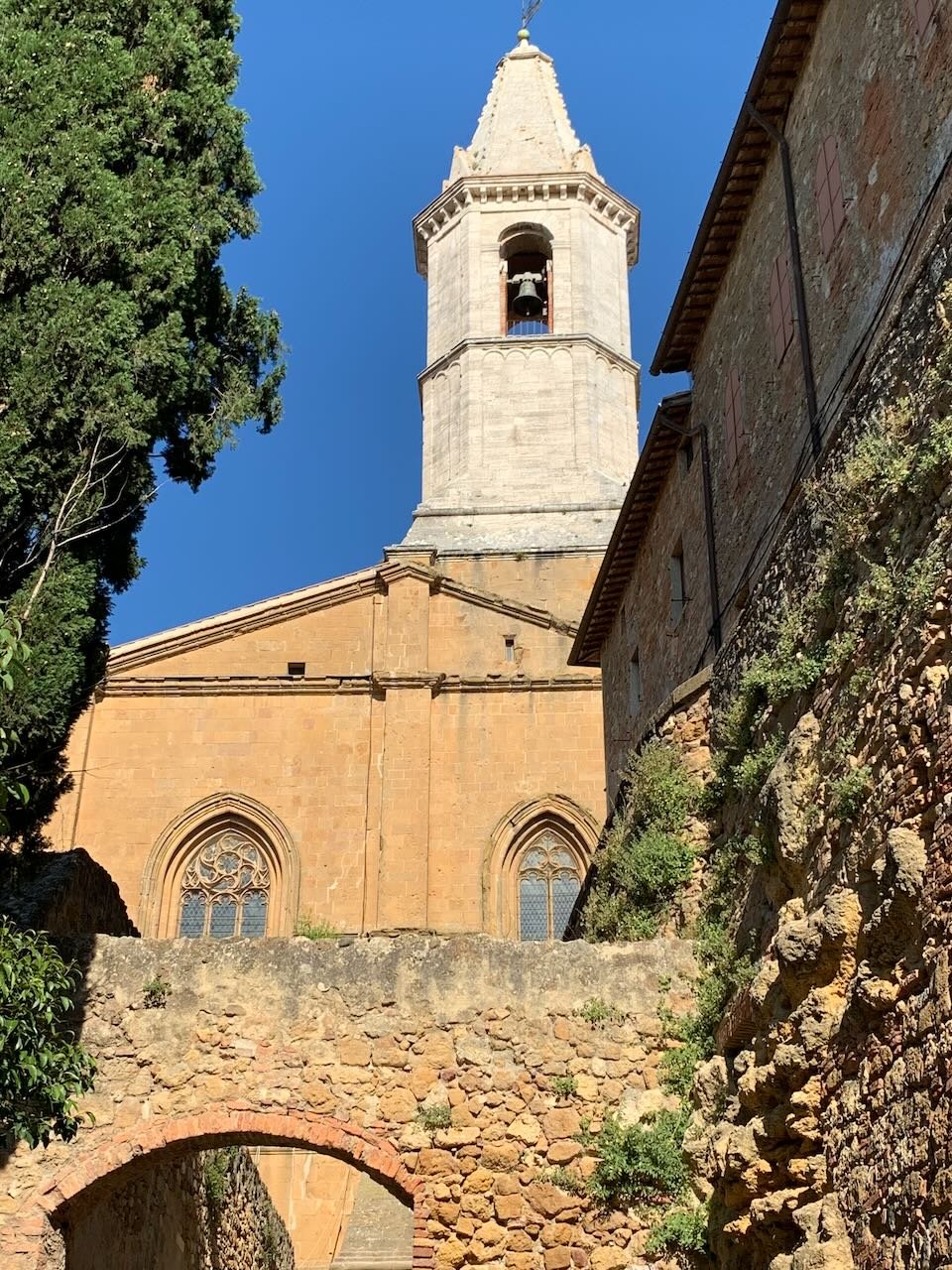
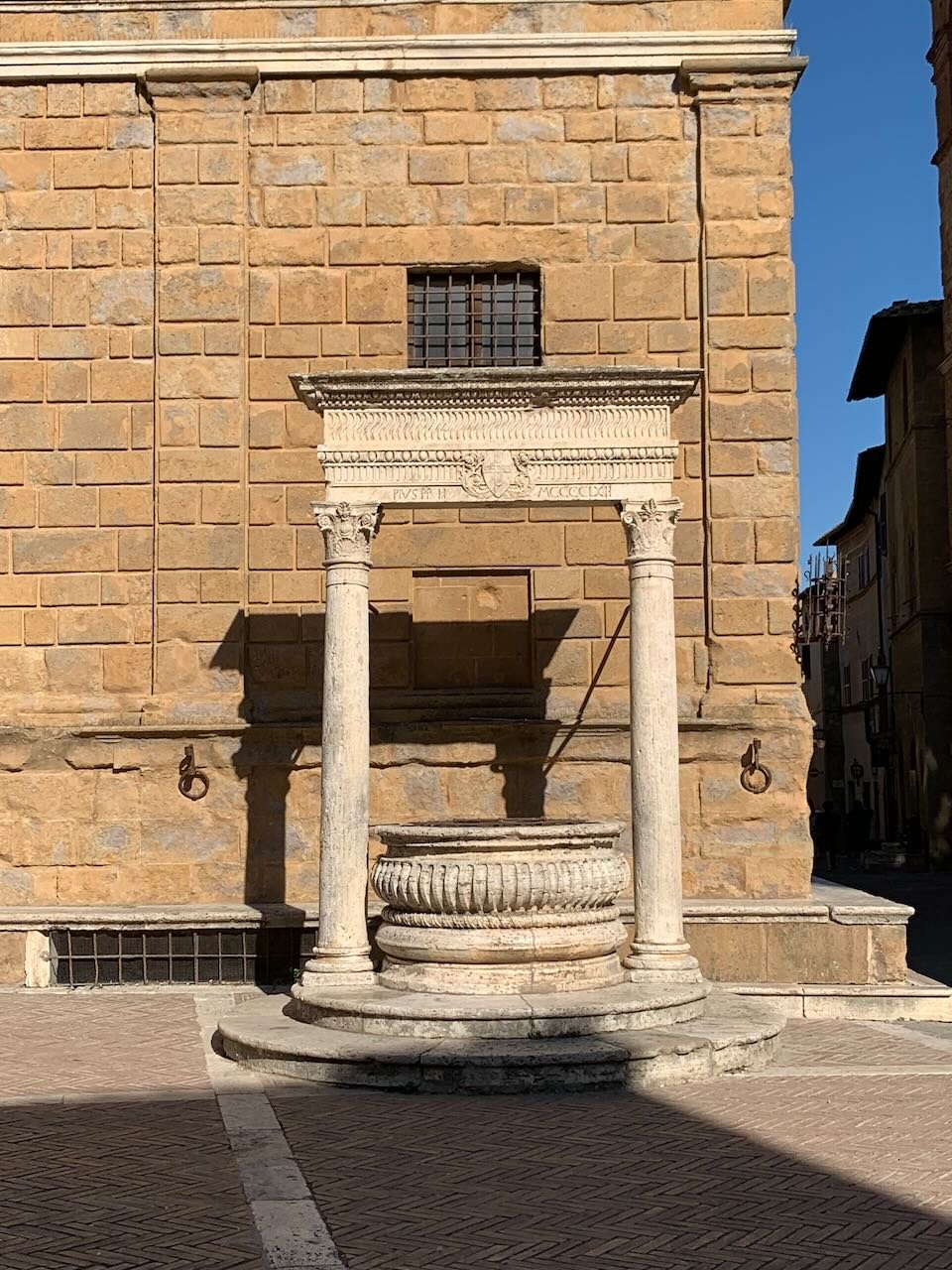
The narrow stone streets and small shops of Pienza in southern Tuscany.
Madonna di San Biagio Church, Montepulciano
This Renaissance church sits alone in the fields just below Montepulciano and is one of the most architecturally impressive subjects in the entire region. The travertine stone turns warm gold in the late afternoon and glows even more at golden hour. It is also far less crowded than Belvedere or Vitaleta.
📷 Pro Tip: Shoot from the parking area to the right of the church entrance for a clean angle that captures the full facade and dome with open sky. A 24-70mm is ideal. In late afternoon, position yourself so the light is hitting the facade from a low angle; the texture of the travertine stone becomes three-dimensional. Stay for blue hour to capture the church lit from below against a darkening sky.
Best time: Late afternoon and golden hour. Access: Small parking lot nearby. Address: Via dell'Artigianato, 3, 53045 Montepulciano.
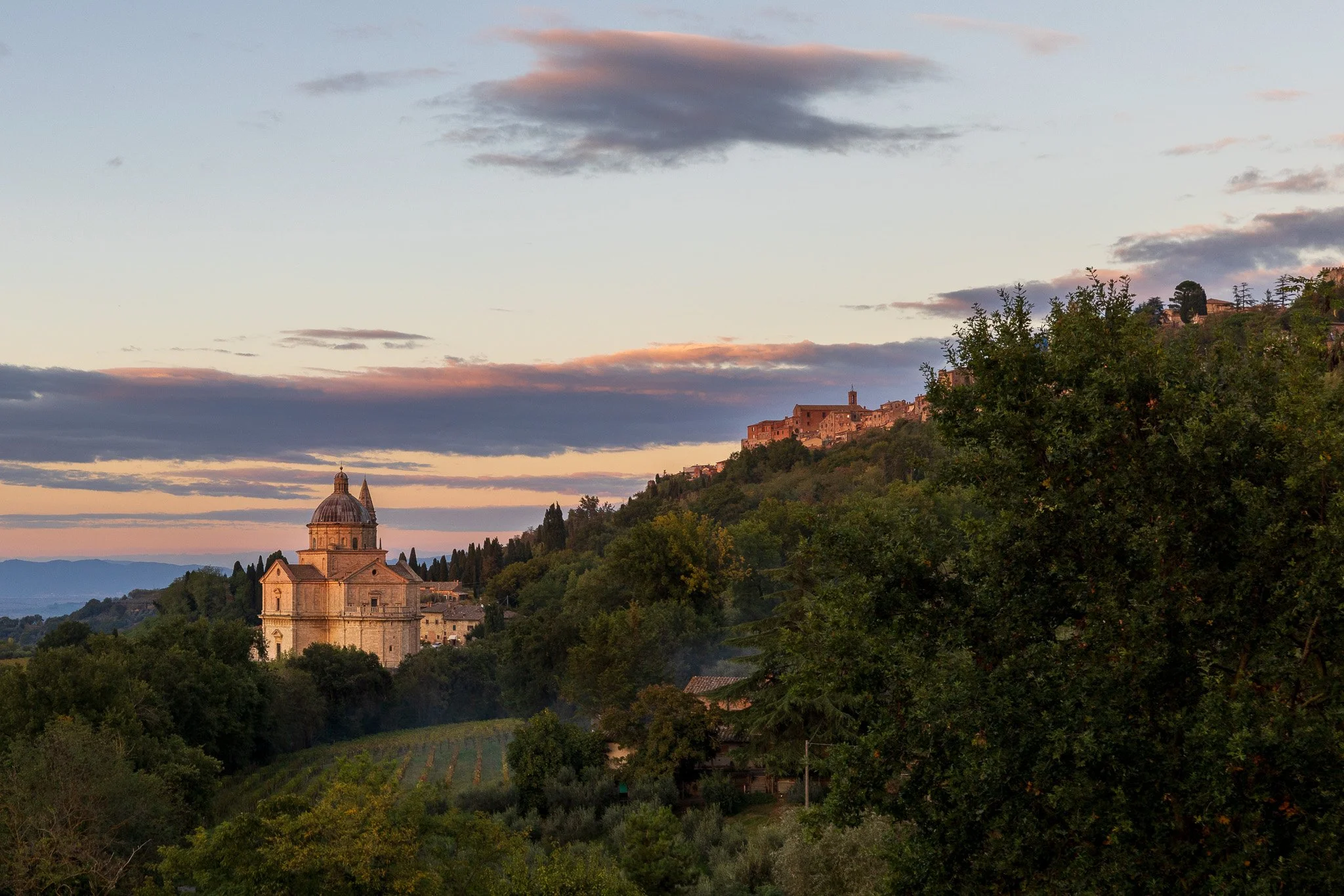
The Renaissance church of Madonna di San Biagio surrounded by the countryside below Montepulciano.
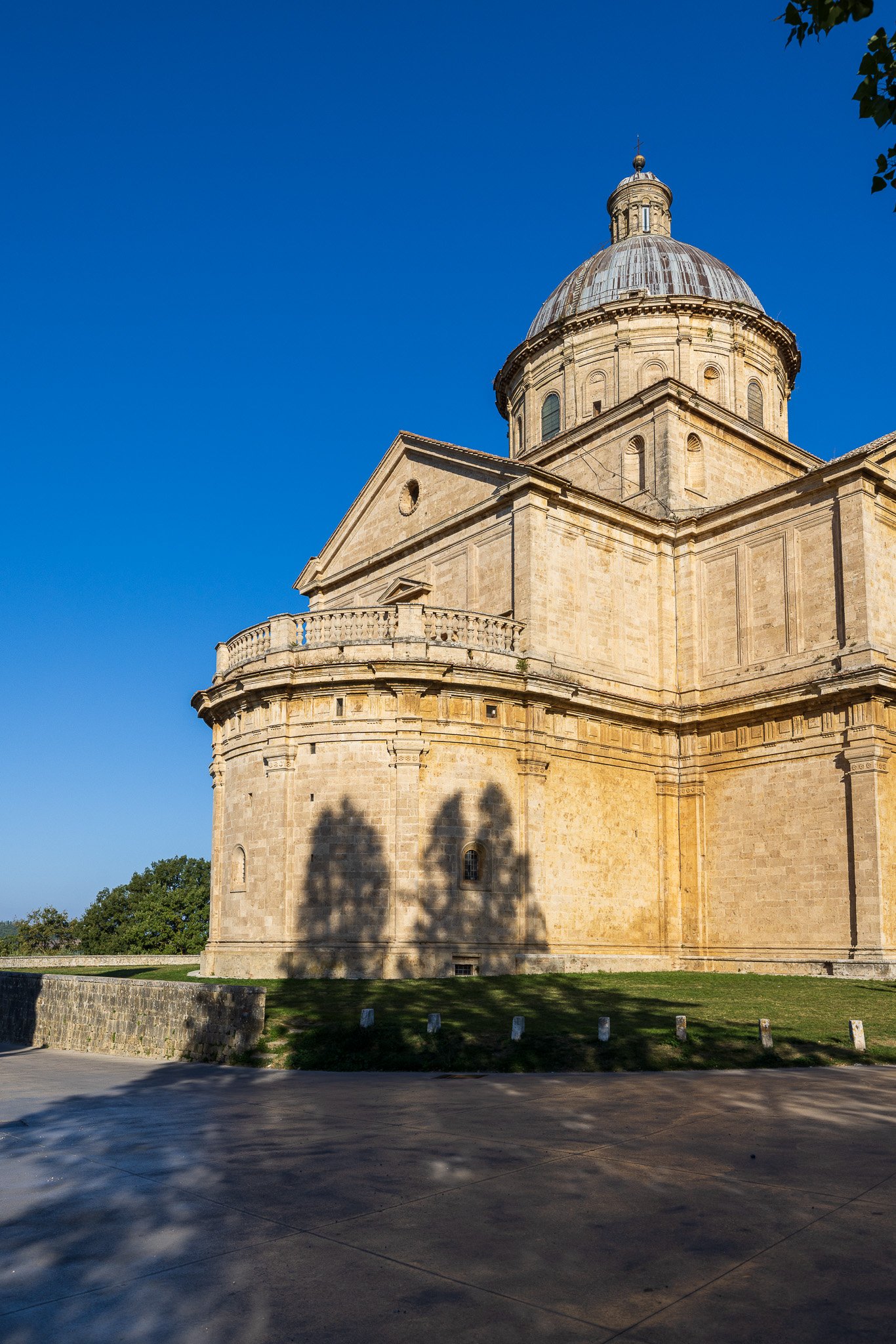
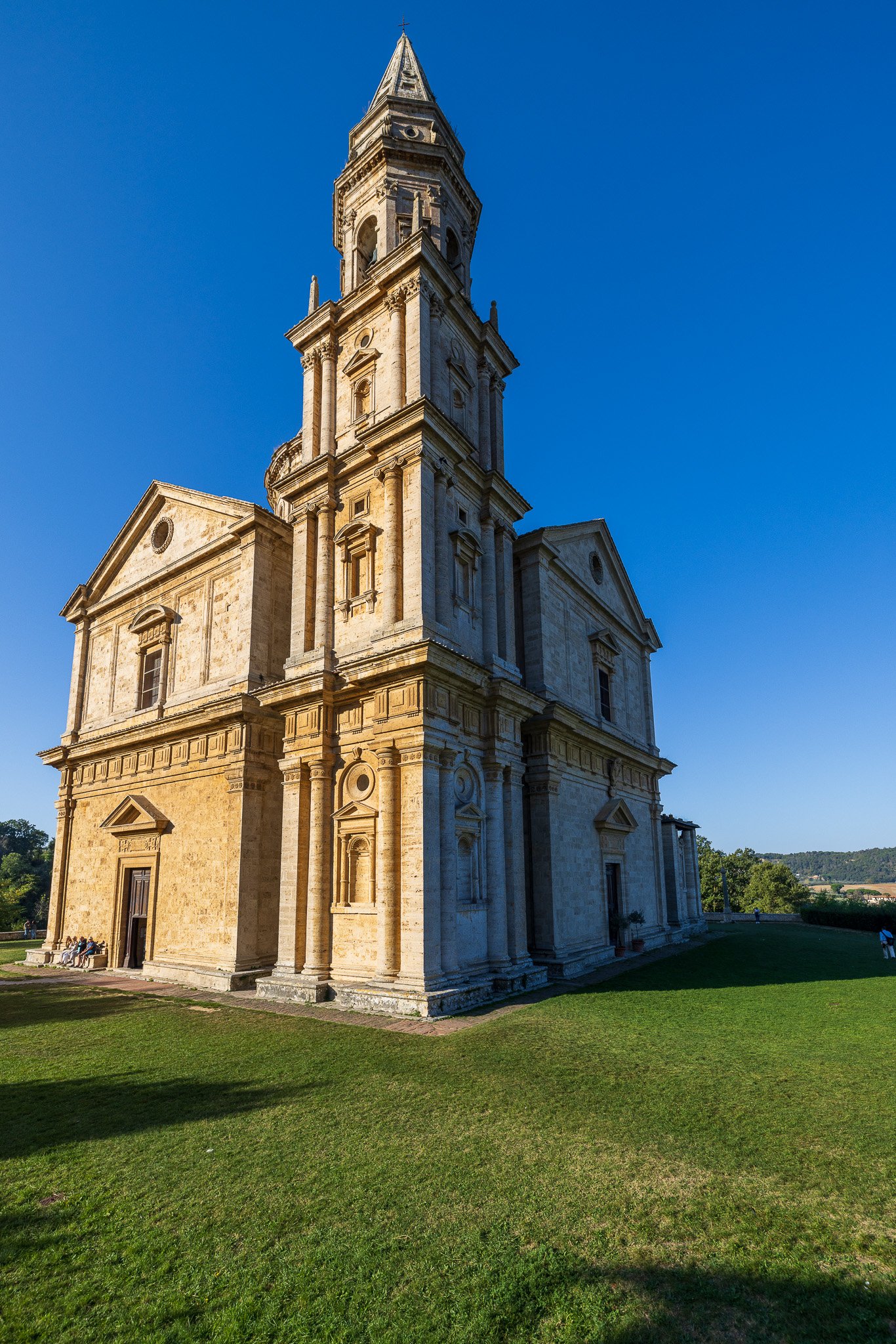
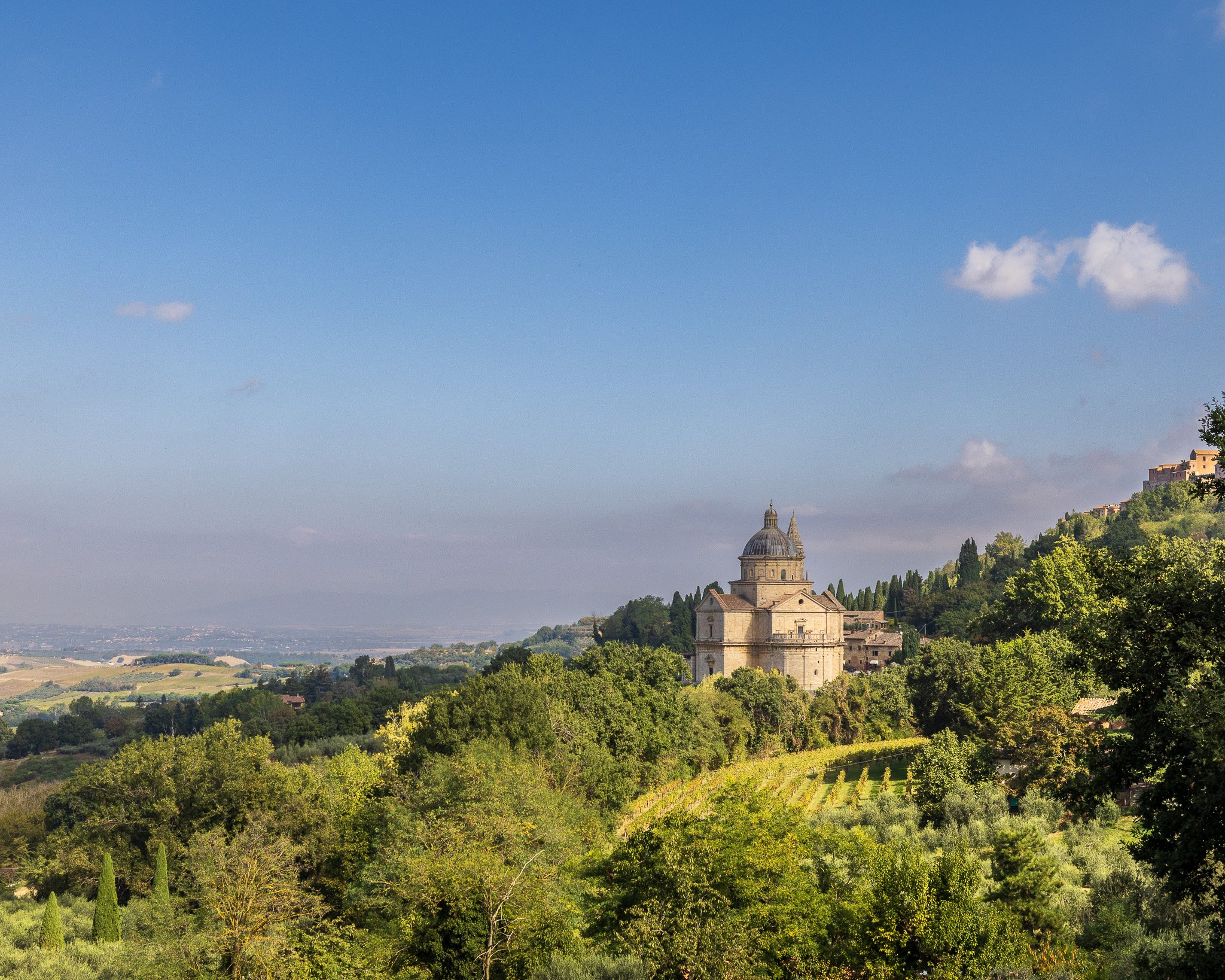
Address: (Small parking lot nearby) Via dell’Artigianato, 3, 53045 Totona SI, Italy
Crete Senesi
Crete Senesi sits just outside the boundaries of Val d'Orcia proper, about 30 minutes north of San Quirico near the town of Asciano, and it is a completely different visual experience. Where Val d'Orcia is all cypress trees and stone farmhouses, Crete Senesi is raw and lunar: vast open clay hills with almost no vegetation, eroded into smooth biancane mounds that turn from silver to gold depending on the light and the season. In autumn and winter, after the harvest, the hills are bare and the landscape feels ancient and quietly severe.
The most photographed view is a classic composition: a lone farmhouse or a tight cluster of cypress trees set against the rolling clay hills, with no horizon clutter and nothing to compete with the geometry of the scene. The visual logic is the same as Val d'Orcia but stripped further down. Less pastoral, more elemental.
📷 Pro Tip: The best light here is early morning in autumn and winter, when low-angle sun hits the clay hills from the side and creates strong texture and shadow. A 70-200mm is your primary lens; the distance between the road and the farmhouses means you need compression to isolate the subject against the hills behind it. Overcast days can also work well here because the clay reflects diffused light evenly and the tonal range is easier to manage in post. If you drive the SS438 between Asciano and San Giovanni d'Asso, you will find multiple pull-off points with clean sightlines. Early October through November is the peak window.
Best time: Early morning, autumn and winter. Access: Free, roadside. Nearest town: Asciano, approximately 30 minutes from San Quirico d'Orcia.
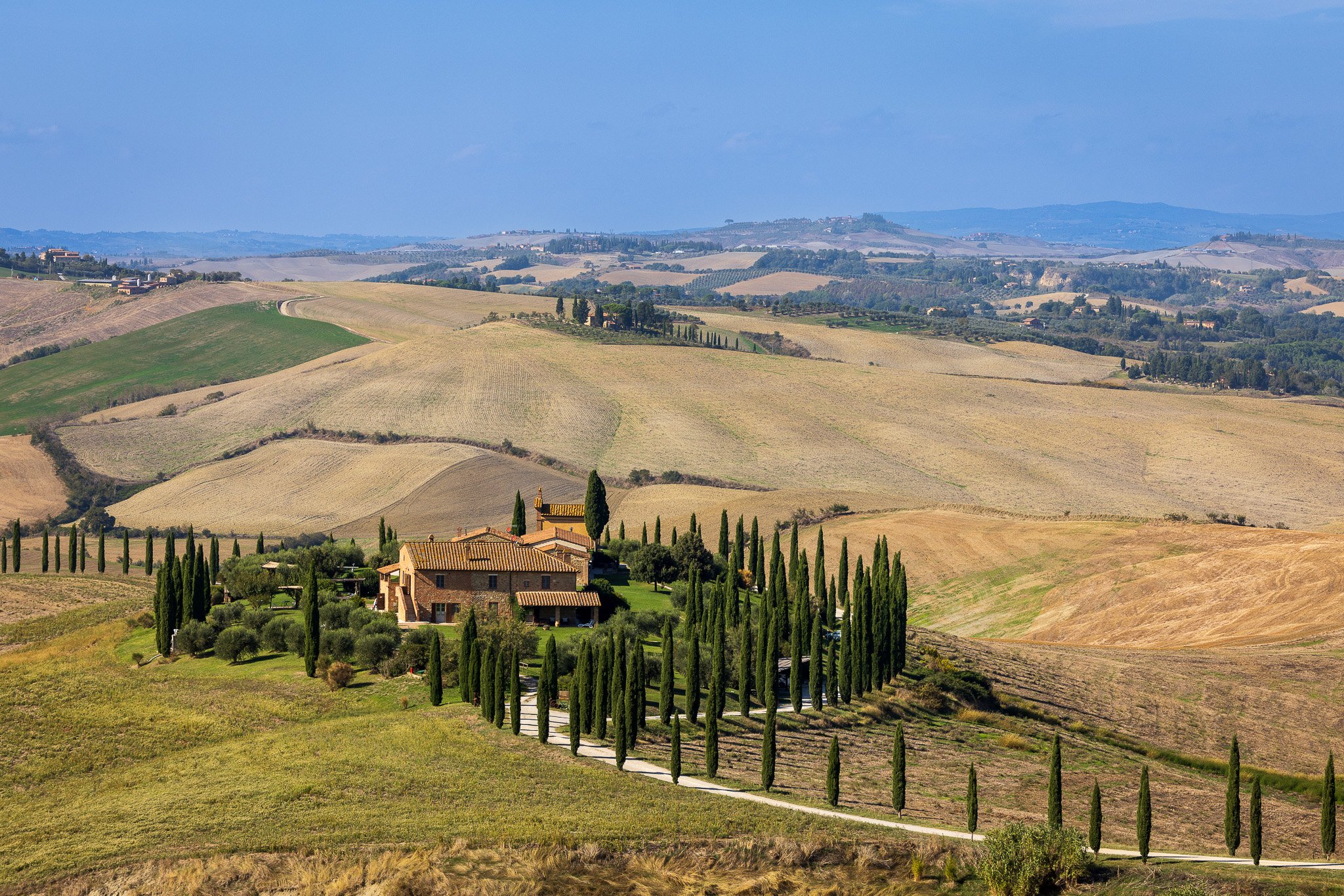
The sculpted clay hills of Crete Senesi creating layers of light and shadow in the Tuscan countryside.
Driving Around
Even if you just drive around the area between San Quirico and Pienza, you will find so many beautiful locations to photograph. It is one of the most stunning locations in the world. I love to find locations with Cypress Trees.

Green fields and cypress trees covering the rolling hills of Val d'Orcia in spring.
I recommend driving through the area. You will find so many special locations.
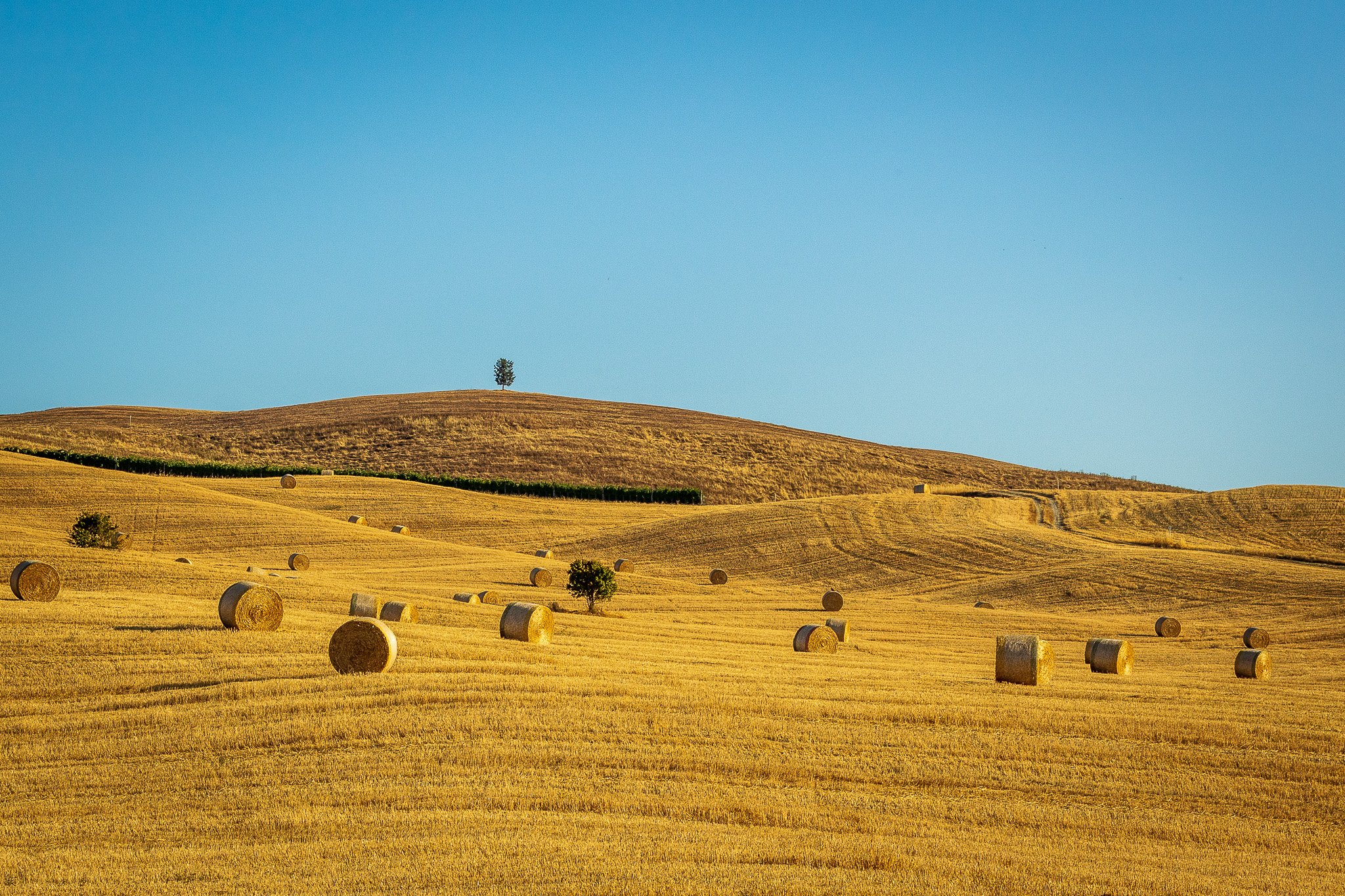
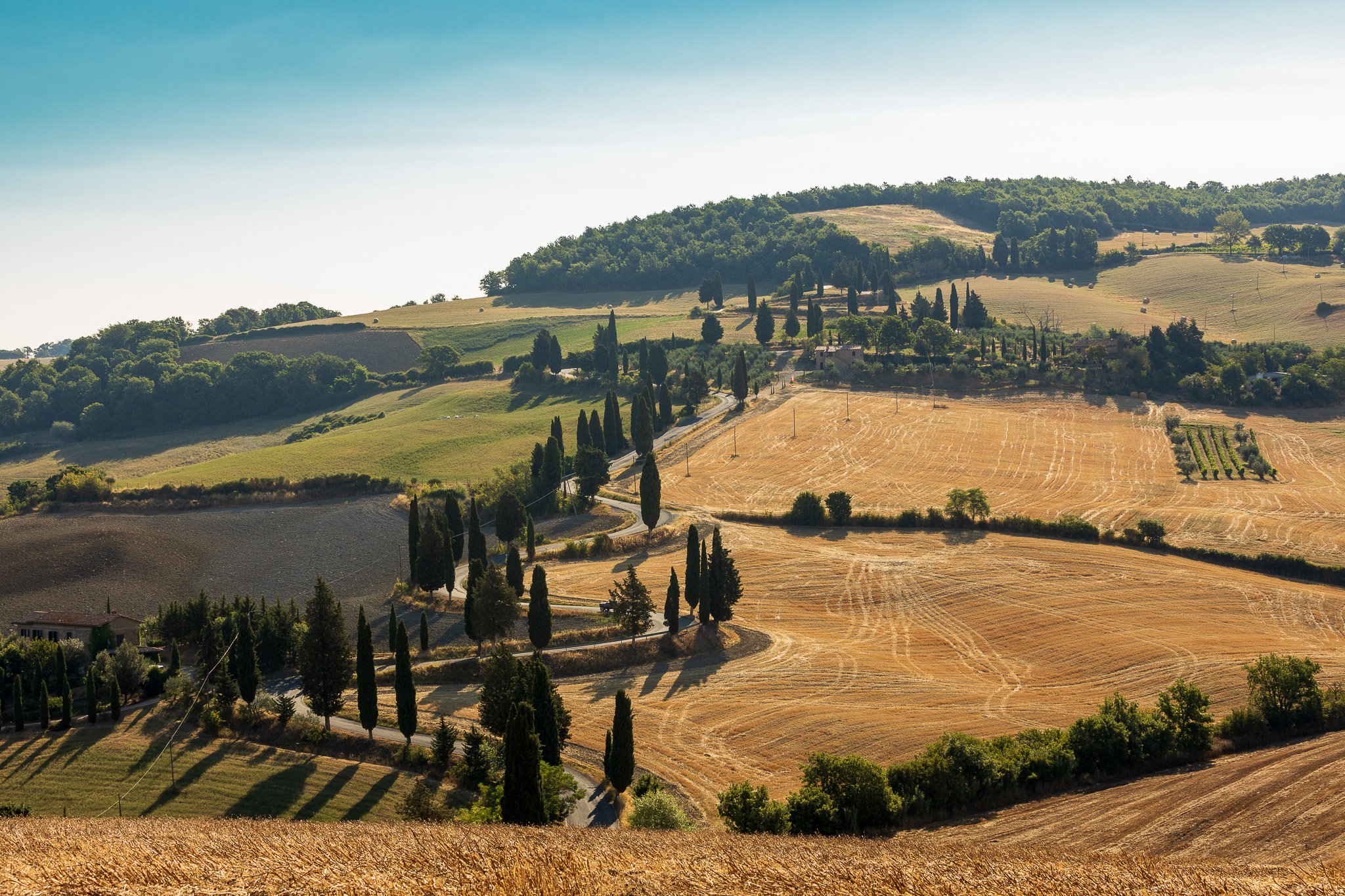
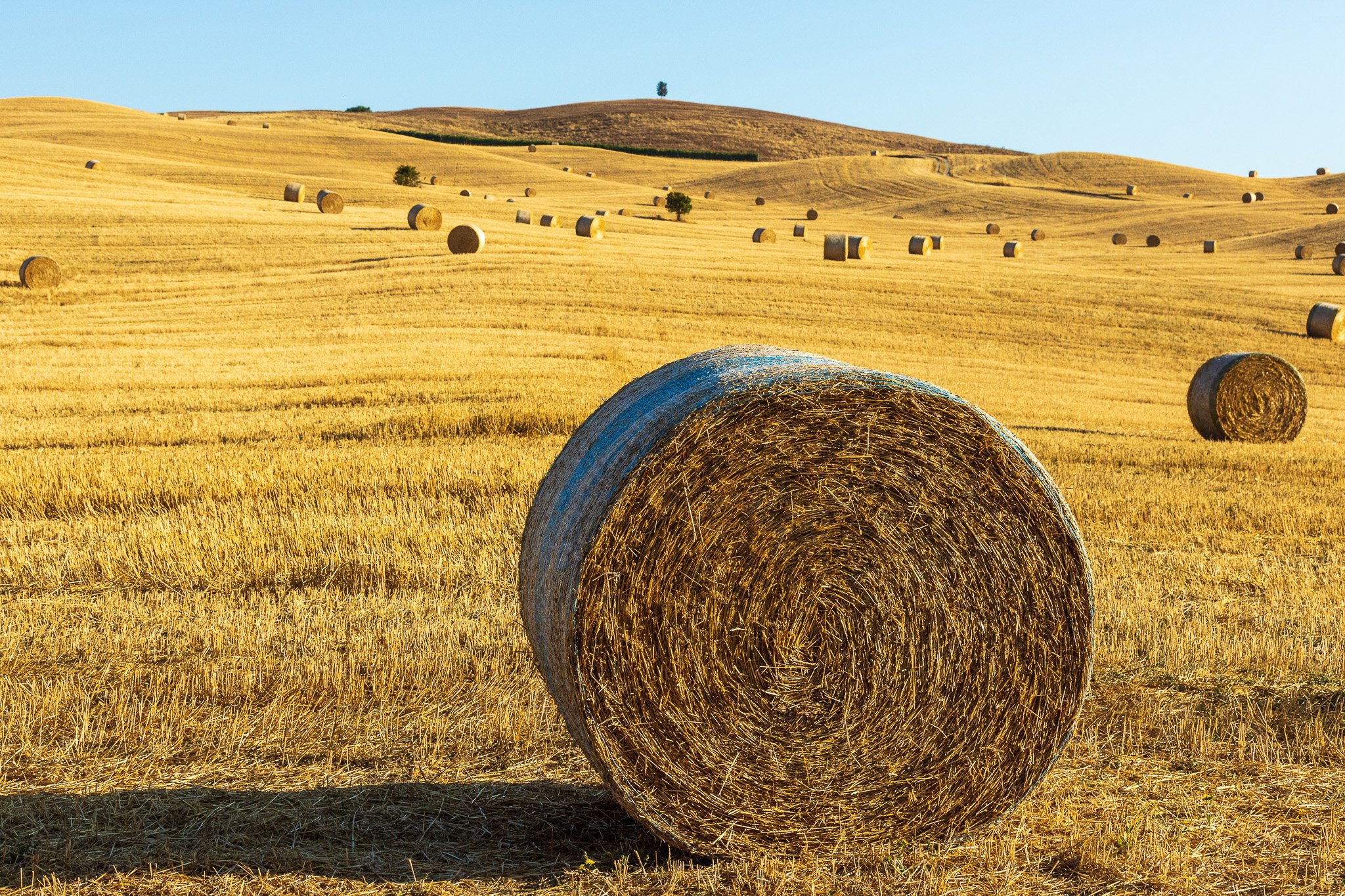
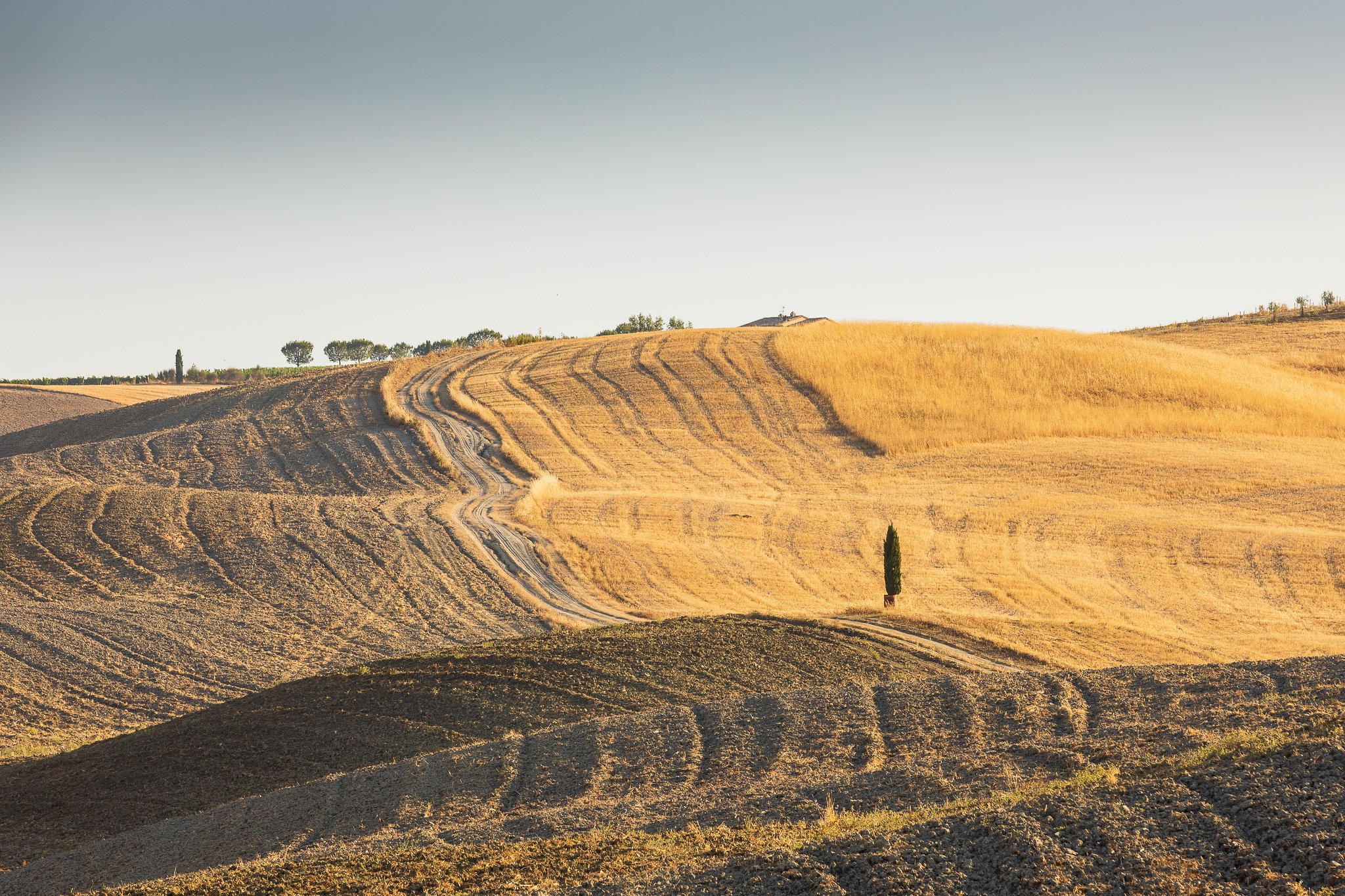
There is so much beauty in Tuscany every where you look.
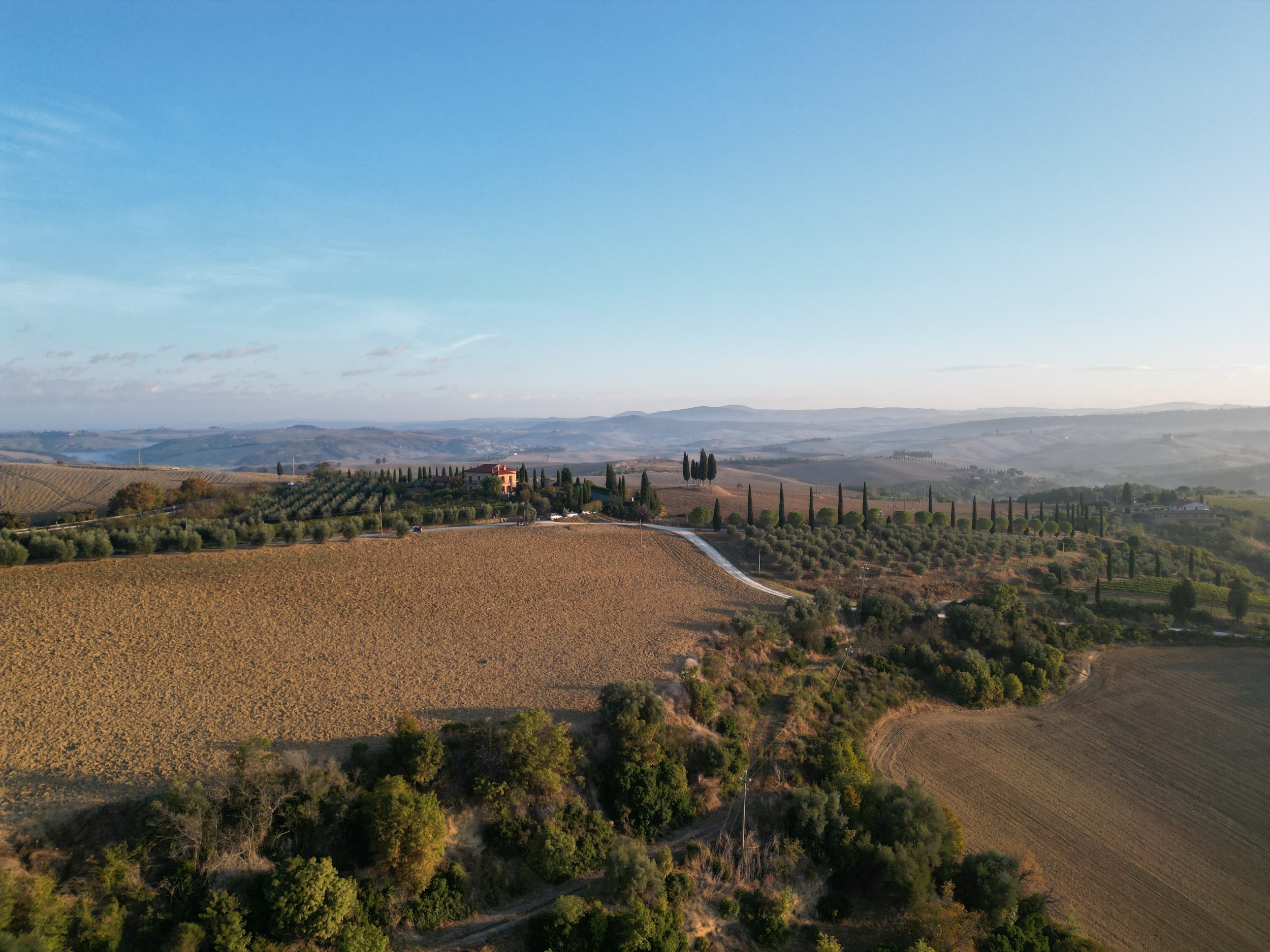
One of the countless unmarked landscapes you discover simply by driving the small roads of Val d'Orcia.
I have included a map of the photography locations below.
Day Trips From Val d’Orcia, Italy
Because of its location, there are lots of options for day trips from Val d'Orcia. Here are 3 places that are definitely worth a visit and that can be easily reached on a day trip.
Siena
Siena is one of Italy's greatest cities and deserves at least a full day, preferably an overnight stay. The Piazza del Campo is among the most beautiful public squares in Europe. The Duomo di Siena is extraordinary inside and out. Walk the medieval streets in the evening when the day-trippers have gone and the light is golden on the pale stone.

The medieval architecture of Siena, an easy day trip from Val d'Orcia.
San Gimignano
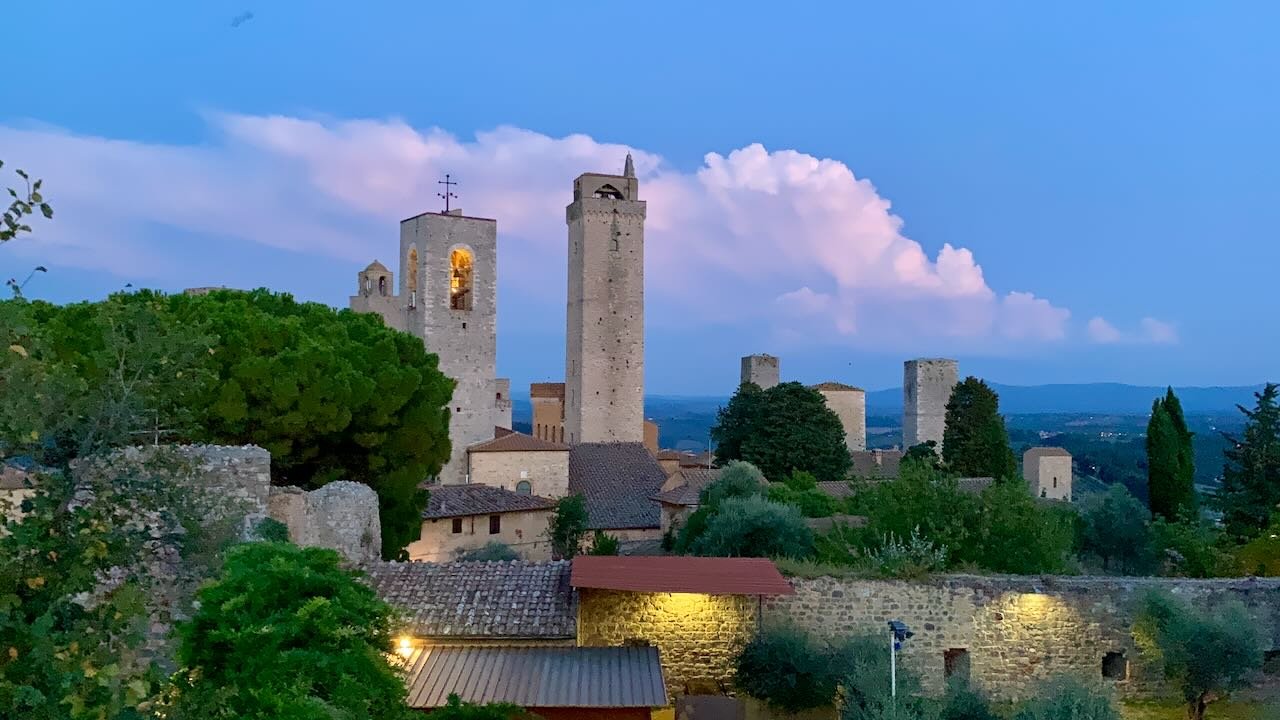
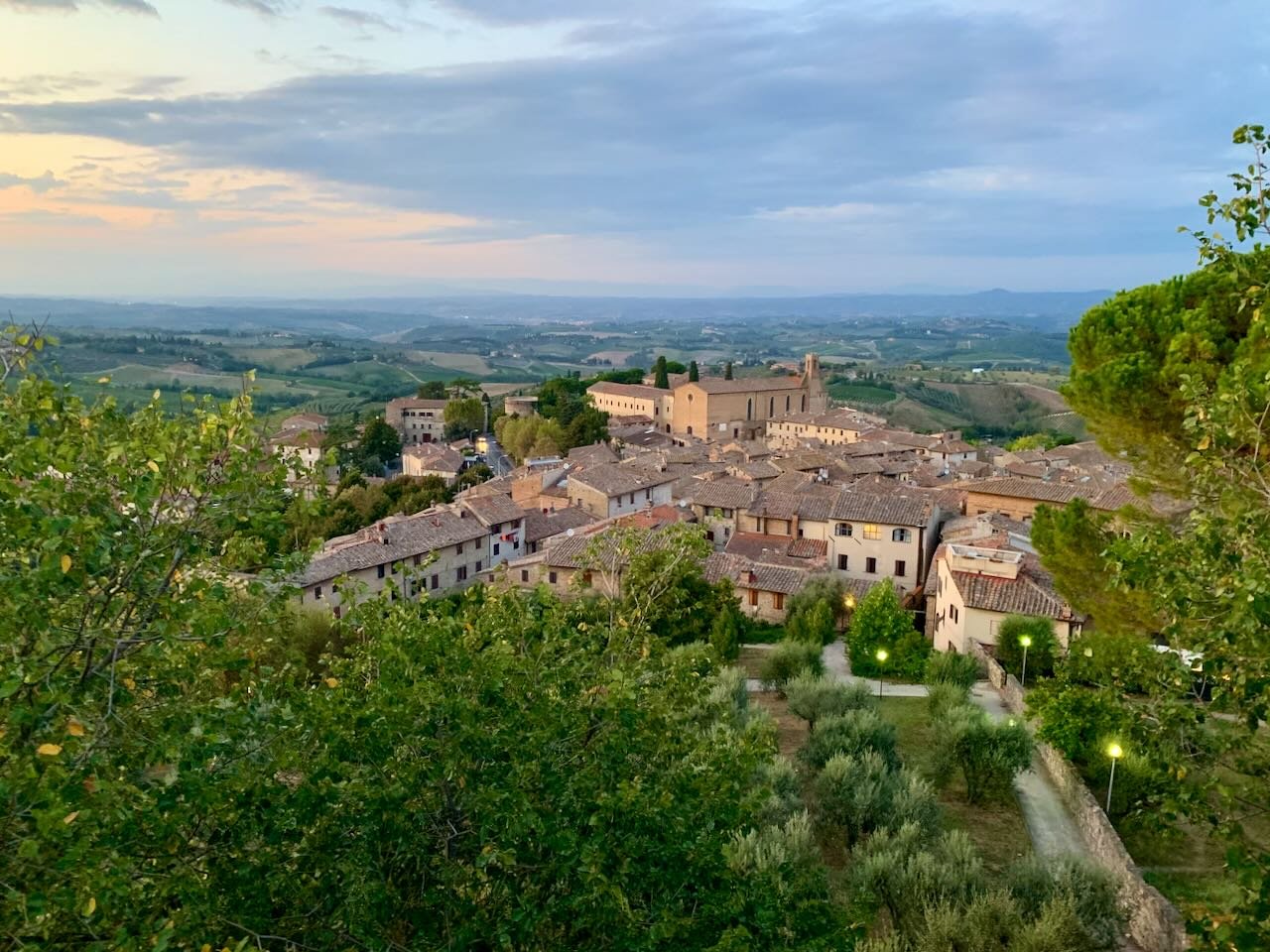
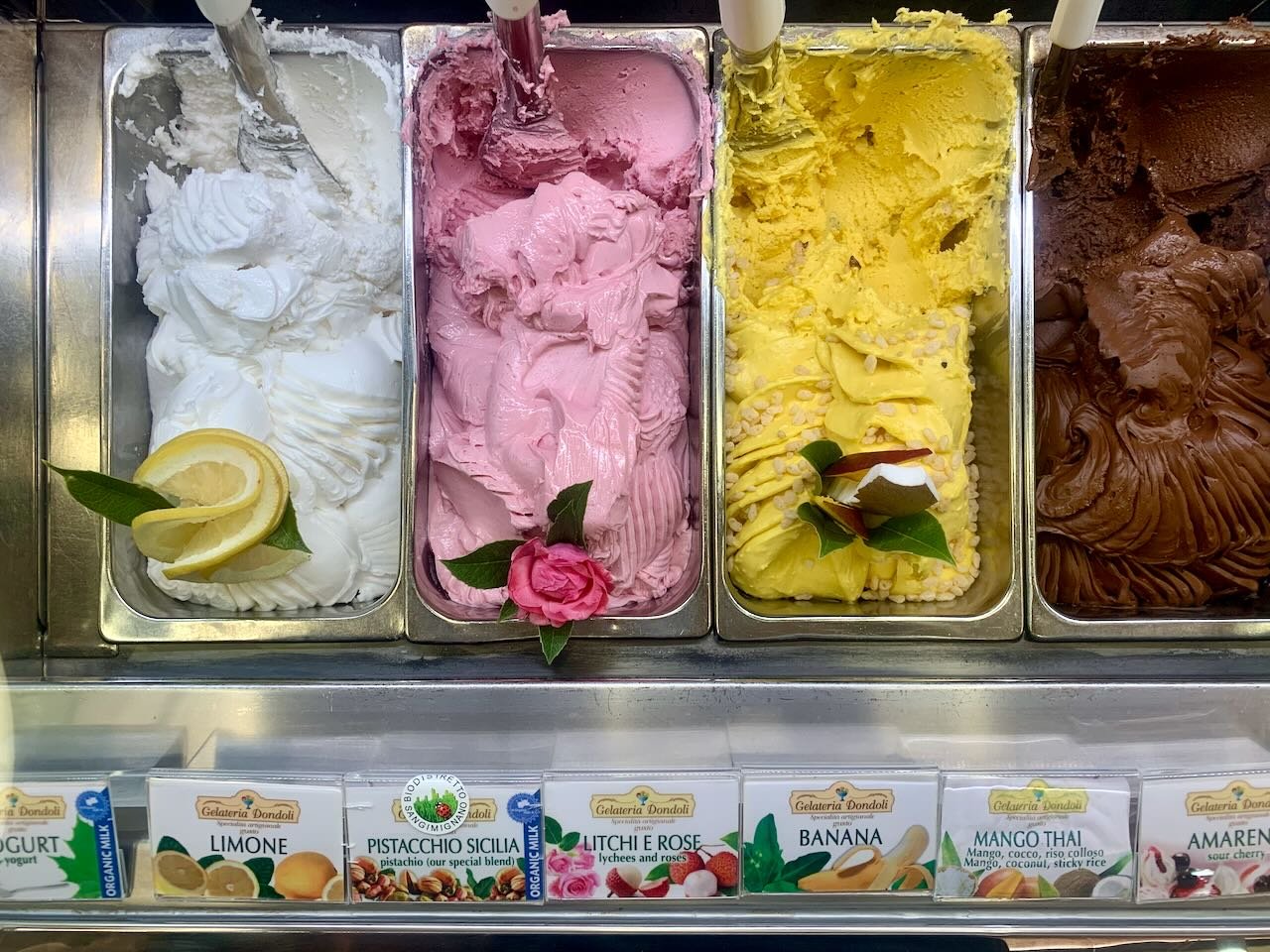
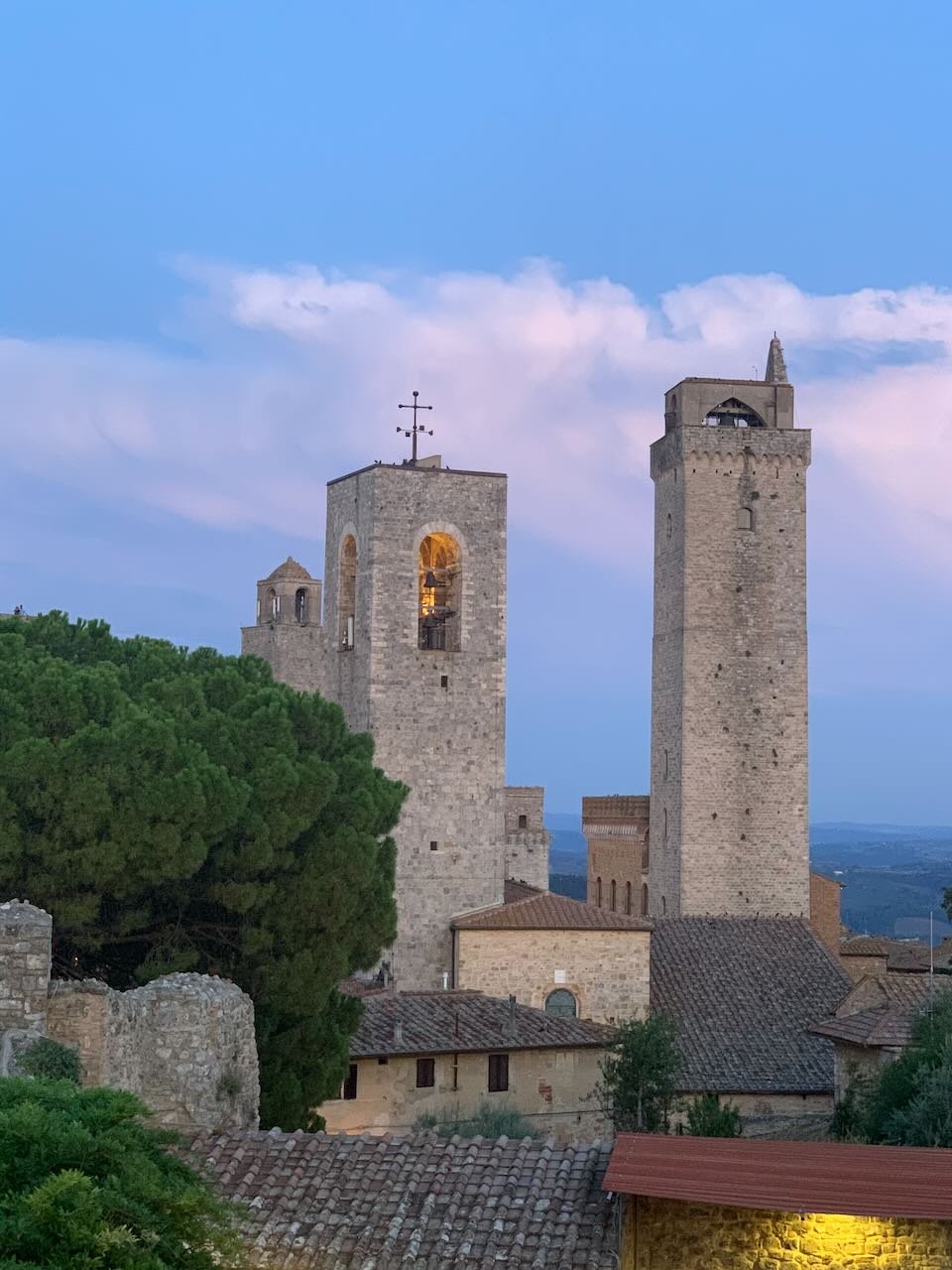
The medieval hill town is famous for its towers, which were essentially the 12th-century version of a skyline. Walk toward Piazza della Cisterna and try the gelato at Gelateria Dondoli, which has won the World Gelato Championship. The towers photograph best from the surrounding countryside at golden hour.
Orvieto
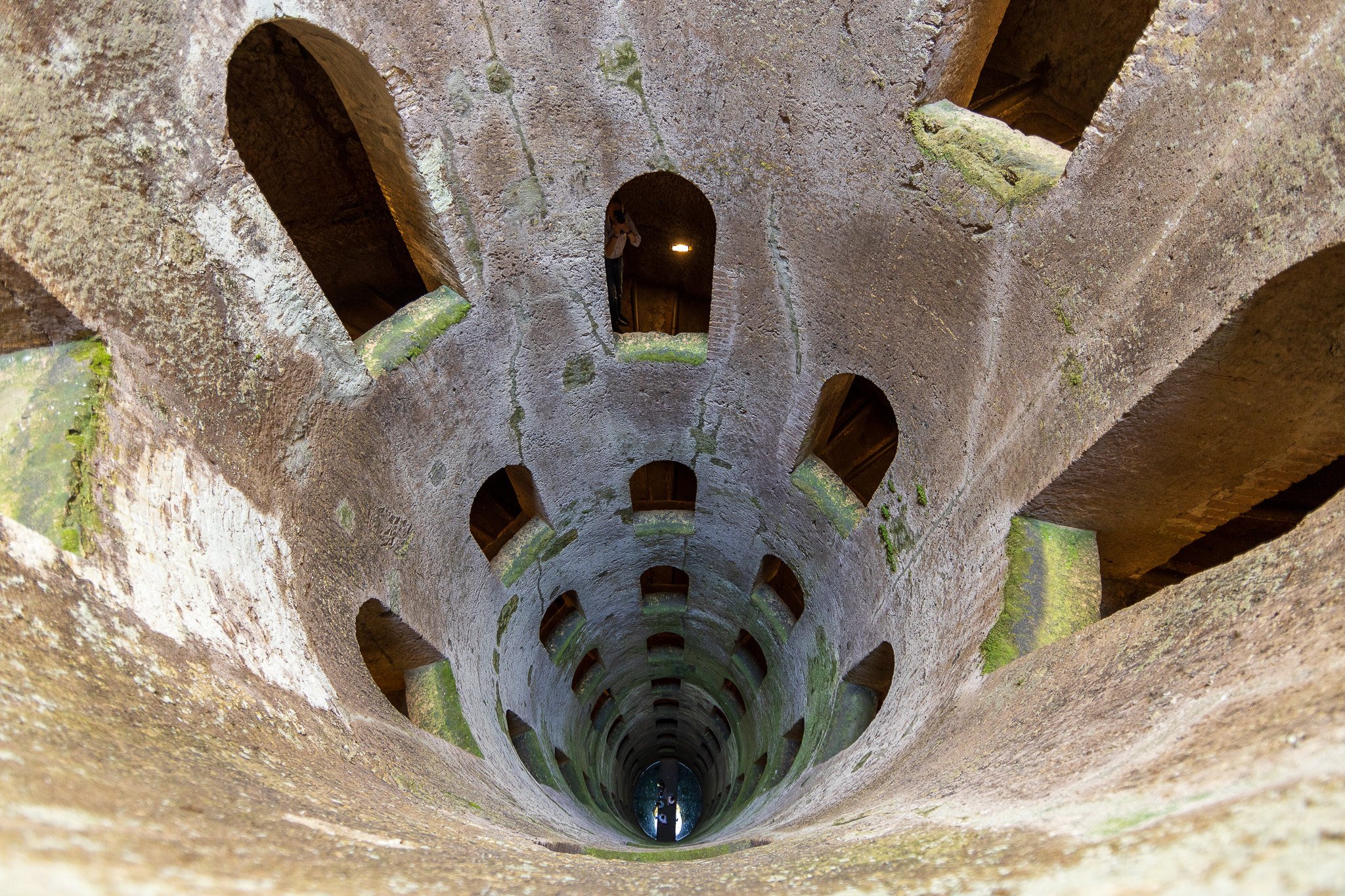
Closer to Rome, Orvieto offers one of Italy's most dramatic Duomo facades and the extraordinary Pozzo di San Patrizio, a double-spiral well built in 1527 that descends 54 meters without the two staircases ever intersecting. A fascinating architectural subject.
The extraordinary Gothic façade of the Duomo di Orvieto, one of central Italy’s most impressive churches.
The well has a depth of 54 meters and is lined with a double spiral staircase structure of 248 steps. The reason a double spiral staircase was used was so that those descending the well and those coming back up would never run into each other.

The double spiral staircase inside Pozzo di San Patrizio in Orvieto.
Festivals & Events
Palio di Siena (July and August) — The Palio is one of the most dramatic photographic events in Italy. Held twice a year in Siena's Piazza del Campo, the pageantry before the race — the flag-throwing, the medieval costumes, the neighborhood rivalries — is as compelling to photograph as the race itself. The piazza fills completely; get there early and find a fixed position. A 70-200mm is essential for the race. The pre-race procession is better with a 24-70mm from street level. This is an intense crowd event, so be prepared for close quarters and use it to your advantage.
Fiera del Cacio, Pienza (September) — Pienza's annual celebration of Pecorino cheese, held in the main piazza. Locals in Renaissance costume roll wheels of cheese down the street in a traditional competition. It is festive, colorful, and completely unpretentious. Great for portrait and reportage work. Arrive in the morning to photograph the setup before the crowds build.
Festa Medioevale di Contignano (July) — A small medieval festival in the hamlet of Contignano near Radicofani. Less visited than the Siena events and more intimate. Worth including if you are in the valley in July.
Vendemmia (Grape Harvest, September through October) — Not a formal festival, but the harvest season activates the wineries around Montalcino and Montepulciano in ways that are worth seeking out. Many estates welcome visitors during harvest, and the combination of vineyard landscapes, working activity, and warm autumn light makes for strong documentary photography.
Sagra del Raviolo, Contignano (August) — A local village food festival celebrating handmade ravioli. Small, authentic, and exactly the kind of event that reminds you why travel photography is about more than landscapes.
Frequently Asked Questions About Visiting Val d'Orcia
Do you need a car to visit Val d'Orcia?
Yes, essentially. This is a rural landscape spread across dozens of kilometers, and nearly every photography location is roadside or on minor provincial roads. Without a car, you'll miss the majority of what makes this region worth visiting.
How many days do you need in Val d'Orcia?
Four days minimum. Five to six is the ideal window for photographers, enough time to shoot the same locations in different light and still fit in a day trip to Siena or San Gimignano.
Is the tap water safe to drink in Val d'Orcia?
Yes, tap water is safe throughout Tuscany. If you want it in a restaurant, ask for "acqua del rubinetto," since bottled water is the default unless you specify.
What are the best photo spots in Val d'Orcia?
Podere Belvedere at sunrise, the Madonna di Vitaleta chapel from the SR22, and the cypress groves outside San Quirico at golden hour are three I return to constantly. The full list with Pro Tips is above.
Can you fly a drone in Val d'Orcia?
Yes, recreational drone flight is allowed in Italy, but check current ENAC (Italian Civil Aviation Authority) rules before you go, and always confirm there's no restricted airspace near the hilltop towns you're shooting.
What surprised you most about photographing Val d'Orcia?
How much the valley rewards wandering over planning. Some of my favorite frames came from pulling over on an unmarked road and finding a single tree catching the last light, not from any of the famous, mapped-out spots.
Are the thermal springs worth a visit?
Yes, if you have the time. Bagno Vignoni's central square built around a hot spring pool and Bagni San Filippo's white calcium rock formations are both worth a detour, and a coffee overlooking the Bagno Vignoni pool is one of the more memorable café experiences in Tuscany.
Do hotels and restaurants close in the off-season?
Many do. Winter in particular sees a lot of properties and restaurants close entirely, especially around Montalcino. Confirm opening dates directly if you're planning a winter or early spring trip.
Final Thoughts
Val d'Orcia is one of those places that stays with you. I have been here in October fog so thick I could barely find the road, in spring with poppies in every field, and in winter with snow on the hills and nobody else around. Every visit feels different, and every visit produces something worth keeping.
The landscape is patient. It does not rush. The light changes slowly, the mist lifts gradually, and the best frames arrive when you stop chasing them and simply wait. That is the lesson this place teaches, and it is one worth learning more than once.
Go in autumn if you can. Wake up early every morning. Drive the small roads between shoots. Stop when something looks interesting. Eat well, drink the Brunello, and stay one day longer than you planned.
Want to improve your photography while exploring some incredible destinations? Join me on one of my photography workshops! You can find all the details, including upcoming destinations and dates, through the links below.
Let's Stay Connected!
My Photography & Travel Guide to Florence, Italy — Just two hours north of Val d'Orcia, Florence is the natural extension of any Tuscan itinerary. Uffizi, Ponte Vecchio, the rooftops from Piazzale Michelangelo at golden hour. The two destinations together cover everything Tuscany offers.
My Photography & Travel Guide to Rome, Italy— Val d'Orcia is two hours from Rome on the A1. Rome deserves three days before or after any Tuscan trip. The ancient city, the light in the late afternoon, the food: it is the ideal gateway or farewell to this part of Italy.
My Photography & Travel Guide to the Cinque Terre, Italy — On the other side of Tuscany, the five villages of the Ligurian coast offer a completely different Italy: vertical, colorful, and surrounded by sea. A strong pairing with a Val d'Orcia visit if you have the time.
Finally—a beginner-friendly photography guide that makes sense.
If you've ever picked up a camera and thought, "Now what?" this is the book for you.
Photography Made Simple is written for adults who are just starting out and want a clear, encouraging, real-world approach to learning photography. Whether you're using a DSLR, mirrorless, or just your smartphone, this guide walks you through the basics—without the jargon or tech overwhelm.
Inside, you'll learn:
The only camera settings you really need to know to get started
How to shoot sharper, more intentional photos using light and composition
Simple tips for portraits, landscapes, travel, and everyday life
What gear you do (and don’t) need
How to create better photos without upgrading your camera
You’ll also get practical exercises, cheat sheets, and tips for organizing and editing your images—plus the confidence to shoot off Auto Mode for good.
This is not a textbook. It’s a friendly guide to seeing the world with fresh eyes—and finally capturing what you see the way you imagine it.
📸 Format: PDF download
Pages: 100+
Perfect for: Beginners, hobbyists, and anyone ready to take better photos without the stress