Rothenberg ob der Tauber, Germany Travel & Photography Guide: Best Photo Spots, Things to Do & Hidden Gems
There are destinations you visit once and remember fondly. Then there are destinations that stop you cold, mid-street, camera halfway to your eye, because you genuinely cannot believe a place this intact still exists.
Rothenburg ob der Tauber is the second kind.
I visited in December 2023 as part of a Christmas market tour that wound through Zurich, Colmar, Freiburg, Baden-Baden, Heidelberg, and Nuremberg. Every one of those stops had its charm. But when we stepped through the gates of Rothenburg's medieval walls, the trip changed. The cobblestone streets. The half-timbered houses in soft pastels and deep ochres. The Reiterlesmarkt fills the market square with candlelight, the smell of mulled wine in the cold air, and the low hum of a town that has been doing this same thing since the 15th century. We were supposed to stay one night. We stayed two, and it still wasn't enough.
For photographers, this town is a gift. The scale is human. Nothing is overwhelming. Every street corner offers a frame, and the light here, especially at blue hour when the warm glow of windows begins to compete with the deep blue sky, is unlike anywhere else I've photographed in Germany. You don't need a shot list. You just need to be there early, stay late, and slow down.
In this Photography Guide to Rothenburg ob der Tauber, I share the places and experiences that continue to draw me back. You will find my favorite photography locations, guidance on when and where to shoot, practical travel tips, and gear recommendations, along with cultural insights to help you explore and photograph Rothenburg with confidence, respect, and ease.
Sunrise
Best Time to Visit
Winter (Late November to December): Best for Photography
This is when Rothenburg reaches its peak. The Reiterlesmarkt, one of Germany's oldest and most intimate Christmas markets, runs from late November through December. The crowds are real, but they are manageable compared to markets in larger German cities, and the atmosphere is as close to genuinely medieval as you will find anywhere.
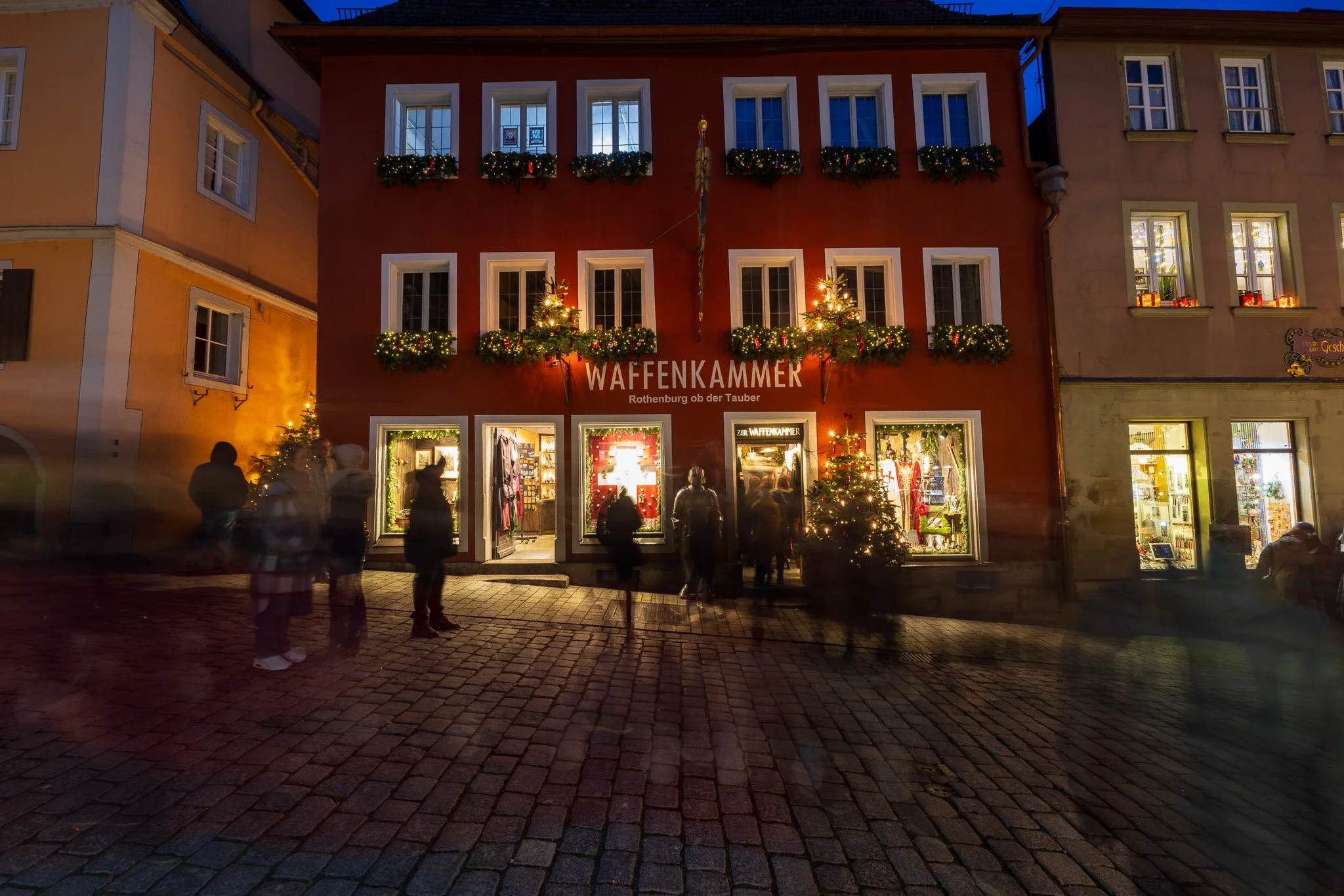
Arrive in the late afternoon. Walk the streets while there is still soft light on the half-timbered facades, then stay through blue hour as the market lights and window glows begin to compete with the darkening sky. That window, roughly 30 to 45 minutes after sunset, is when Rothenburg is at its most photogenic.
Go on a weekday if possible. The market draws weekend visitors from across Germany and neighboring countries, and the crowds show in the frames.
Spring (April to June): Fewer Crowds, Beautiful Light
Flowers appear along the medieval walls and in window boxes across the old town. The streets are quiet compared to summer and the Christmas season. Golden hour in late spring stretches well past 8pm. If you want the classic Rothenburg shots without fighting tourist groups for position at Plönlein, late April and May are the smart windows.
Summer (July to August): Busiest Season
The town is at full tourist capacity in July and August. The streets are beautiful but crowded. If you visit in summer, the only real solution is to be out before 7am and back after 8pm. The light is worth it; the crowds between those hours are not.
Fall (September to October): Underrated
Warm tones on the half-timbered facades, cool morning air, and noticeably thinner crowds than summer. The Tauber Valley turns golden below the town walls. This is an underrated window for photography, especially for anyone making the Romantic Road as a driving route through Bavaria.
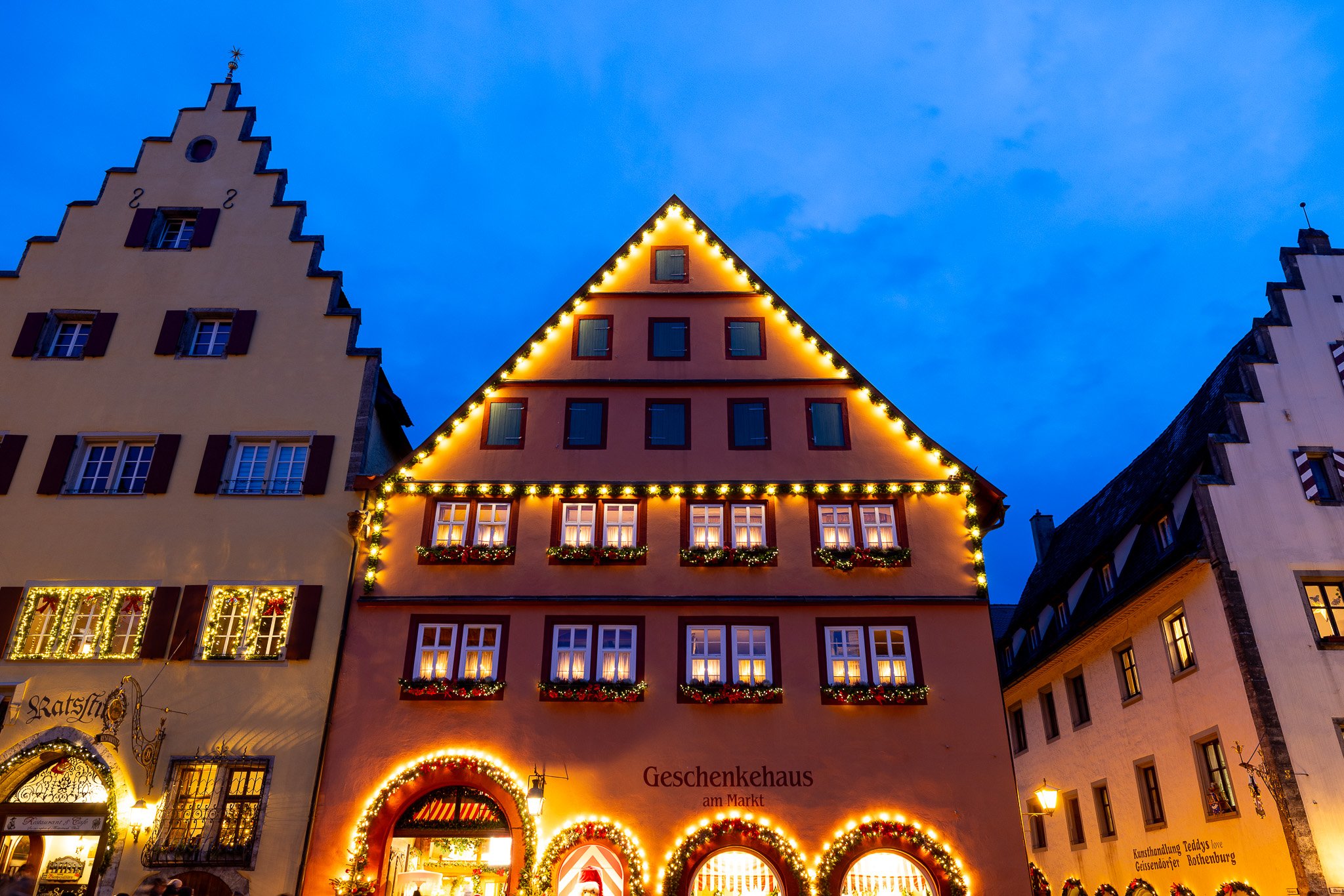
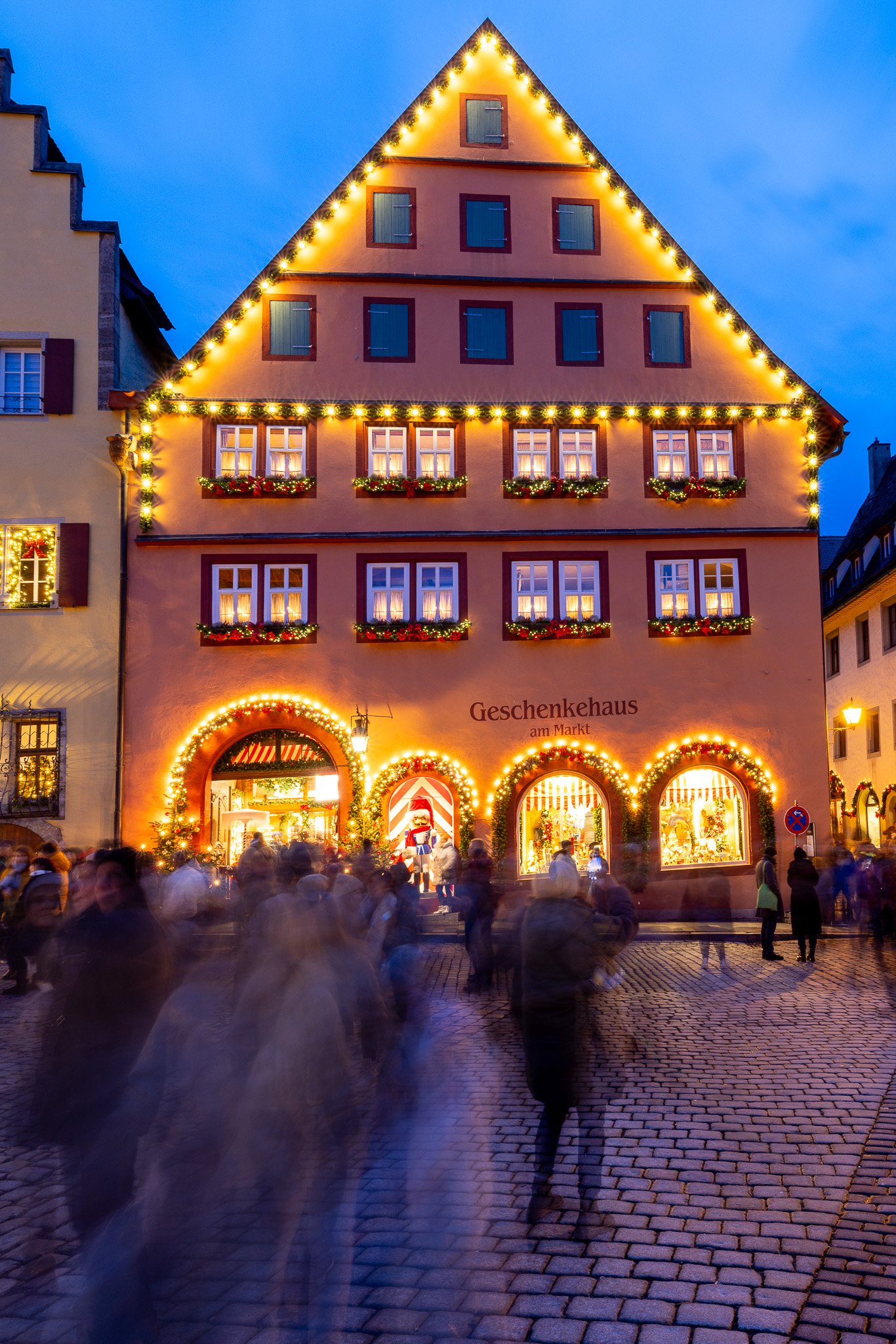
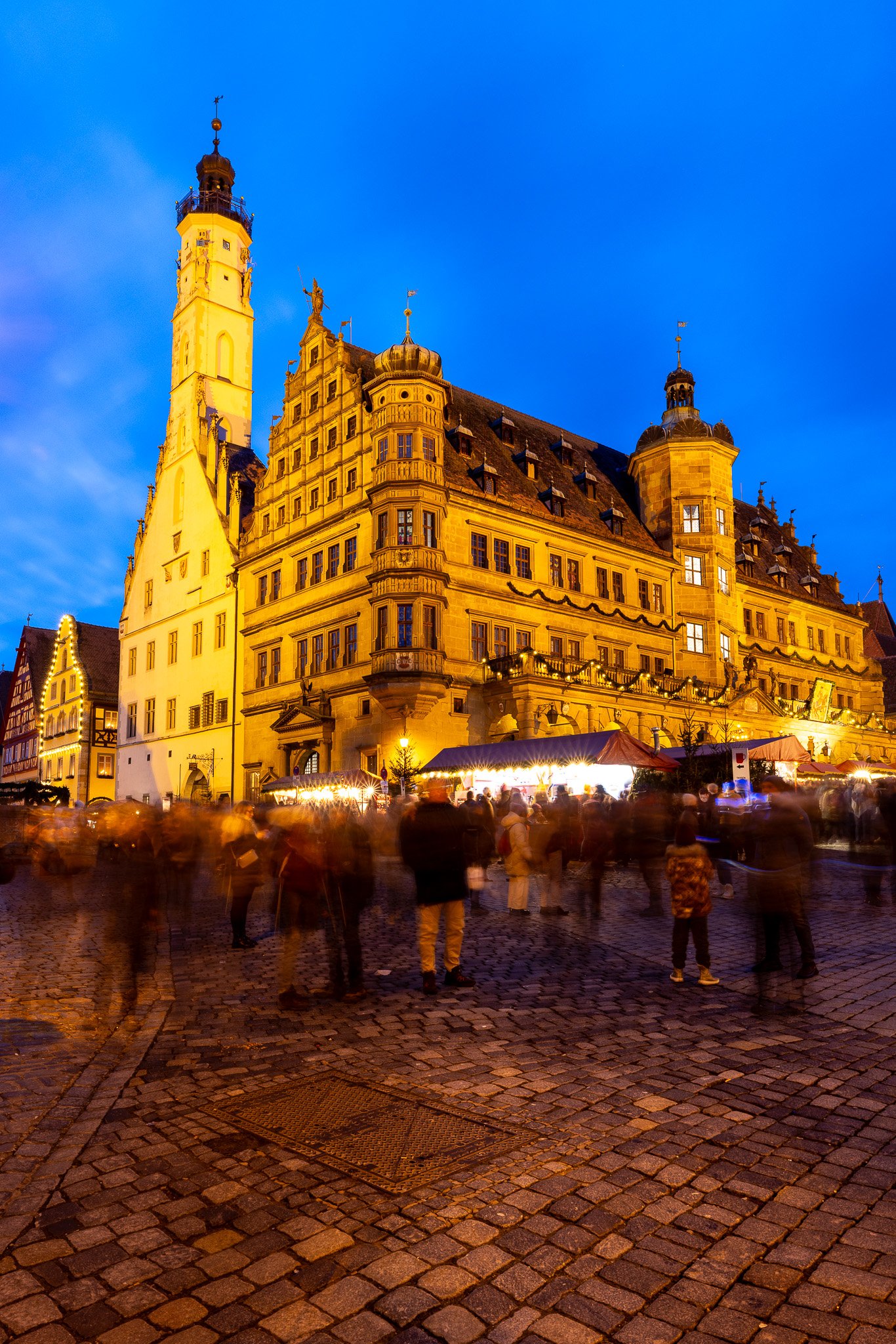
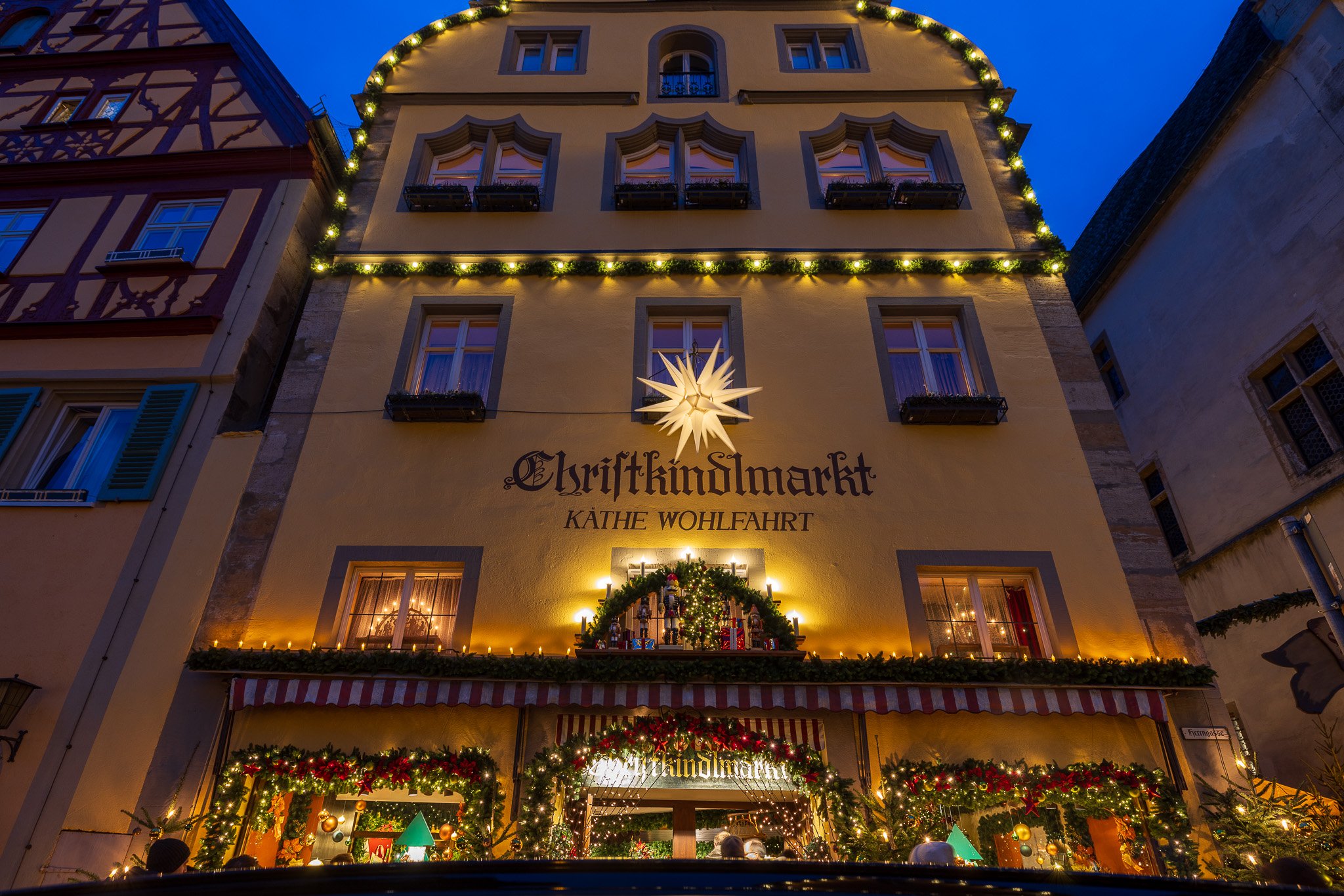
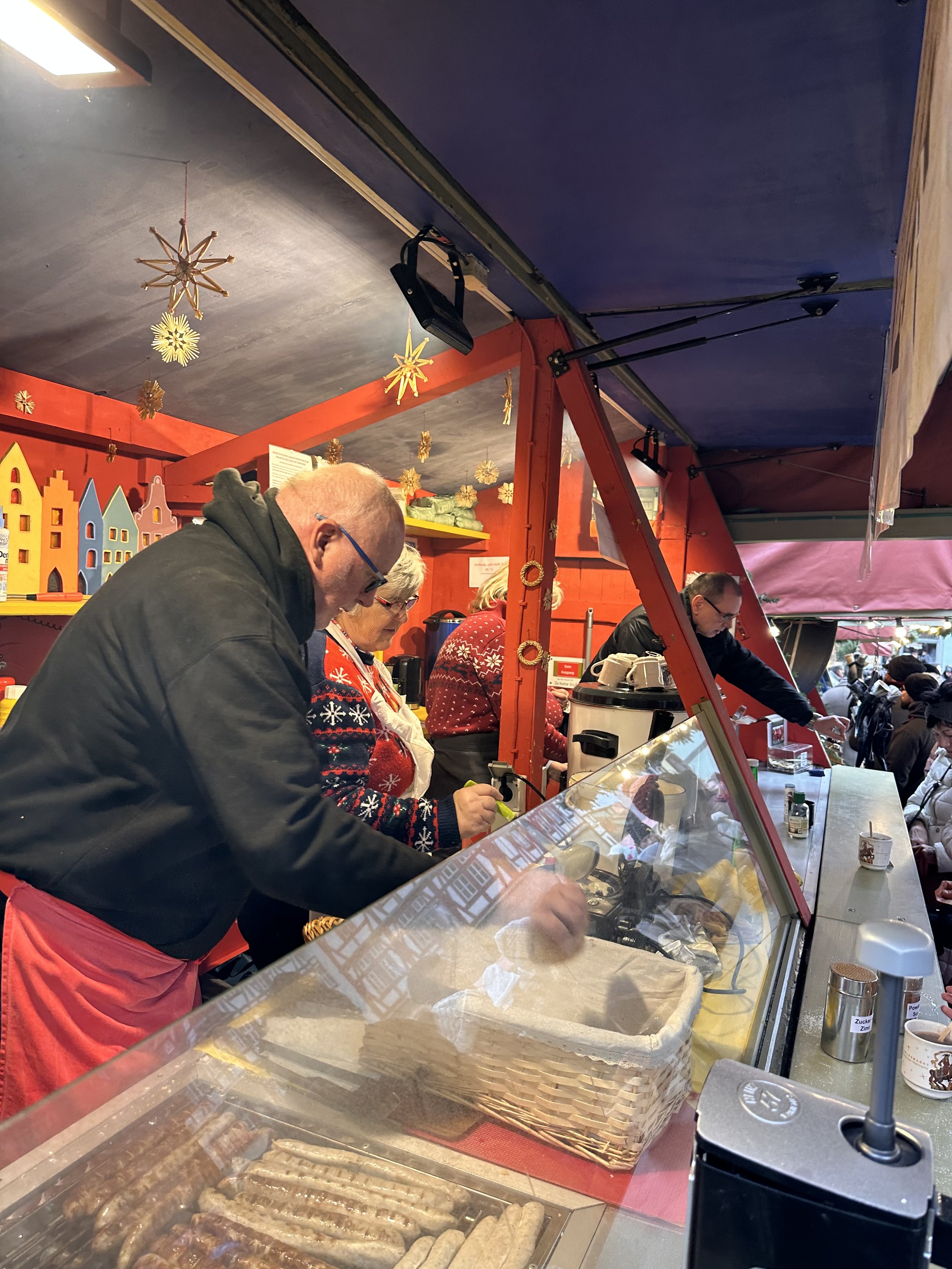
The Christmas market is one of Germany's most beautiful Christmas Markets. As you walk through the streets, you will smell mulled wine, “Gluewein,” roasted chestnuts, and all sorts of delicious treats.
Where to Stay?
Rothenburg is compact. You are staying inside the medieval walls or just outside them. The good news is that nearly every hotel in the old town puts you within a 10-minute walk of every photography location in this guide.
Luxury
Hotel Herrnschlösschen is where we stayed, and I would book it again without hesitation. The building has roots going back more than 1,000 years. It has only eight rooms, which gives it the feel of a private residence rather than a hotel. The location, steps from the Town Hall on Herrngasse, is as central as it gets. The restaurant is quiet, refined, and genuinely excellent after a cold evening on the cobblestones. [VERIFY: Confirm hotel still operating and restaurant still open before publishing.]
Burg-Hotel Relais du Silence sits on the western edge of the old town, built directly into the city wall with views over the Tauber Valley. Recent reviews from early 2026 are very strong. For a photographer who wants to wake up and shoot the valley in morning light before anyone else is moving, this location is hard to beat.
Romantik Hotel Markusturm occupies a 13th-century building in the heart of the old town, adjacent to the historic Markus Tower and Röderbogen gate arch. Both the architecture and the immediate surroundings are highly photogenic. This is one of the most consistently recommended properties in Rothenburg for atmosphere and service.
Mid-Range & Boutique
Hotel Eisenhut is one of the most historically significant hotels in town, spanning four 16th-century patrician houses on Herrngasse. The location is excellent and the building itself is worth photographing. Solid mid-range option with a long reputation.
Villa Mittermeier / Mittermeiers Alter Ego offers something different: a contemporary, design-forward aesthetic inside a historic building near the city gate. If you find most medieval town hotels too dark and heavy, this is the antidote. Strong 2026 reviews cite great service and a refreshingly modern feel.
Hotel Reichsküchenmeister sits directly beside St. Jakob's Church on Kirchplatz, making it one of the best-positioned hotels in town for early morning photography. The building dates to the medieval period, the rooms are comfortable, and the in-house restaurant consistently draws strong reviews.

Getting There
Rothenburg is not on a major rail line, which is part of what kept it intact for centuries and part of what makes getting there slightly more involved than most German destinations.
By Train: The most common approach is to travel to Würzburg or Ansbach on the main Deutsche Bahn network, then transfer to a regional train via Steinach to Rothenburg. The Steinach to Rothenburg leg is short and direct. From Frankfurt, expect about three hours total. From Munich, about two and a half. Book through the Deutsche Bahn app or website. The train station sits just outside the old town walls, about a five-minute walk to the main gate.
By Car: Rothenburg is roughly 1 hour 45 minutes from Frankfurt and 2 hours 20 minutes from Munich by car. If you are driving the Romantic Road, it is a natural stop. Note that cars are restricted inside the city walls. Park in the lots just outside the gates. The P1 lot near the Rödertor gate is the most convenient.
Day-Trip Bus: Organized day-trip buses run from Frankfurt and Munich, particularly in summer and during the Christmas market season. Practical for a single day, but two nights inside the walls is a different experience entirely.
Getting Around
Once you are inside the medieval walls, forget about transport. Rothenburg is entirely walkable. You can cross the entire old town in 10 to 15 minutes. This is not an exaggeration. The compactness is one of its great gifts for photographers because you can cover every major location in a single morning without rushing.
Cars are effectively excluded from the historic center. There are no ride apps operating within the walls. You will not need them. Wear comfortable shoes, carry a day bag with your gear, and just walk.
If you want to explore the Tauber Valley below the town, the path from the Burggarten down toward the double bridge is an easy 20-minute descent on foot.
How Long to Stay
The honest answer is two nights minimum.
Most people visit Rothenburg as a day trip from Frankfurt, Munich, or Nuremberg. Those people leave wishing they had stayed. A single afternoon gives you the market square and Plönlein. Two nights give you the town at dawn, the blue hour glow after the day-trippers have gone, and the chance to see the streets quiet.
A suggested two-night framework:
Afternoon of arrival: Walk the city walls, photograph the Ramparts and gates, orient yourself without the camera pressure of getting specific shots.
First full day: Plönlein at dawn before 7am. Town Hall Tower for the rooftop view in the morning. The old town streets mid-morning. Burggarten in the late afternoon for valley views and golden hour. Blue hour at the Christmas market or market square.
Morning of departure: One more pass at your best location in different light. The town feels completely different at 6am than it does at noon.
If you are doing the Romantic Road by car, budget three nights to really do this town justice.
Where to Eat?
Rothenburg is a small medieval town, not a culinary capital. But it eats better than you might expect, and the experience of sitting down to a warm Franconian meal after a cold evening on the cobblestones is genuinely one of the pleasures of being here.
Restaurant Herrnschlösschen (in the hotel of the same name) was the best meal we had on the entire Christmas market tour. The room is intimate and quietly elegant. The service is warm and attentive. The menu leans into seasonal, regional ingredients. Reserve ahead. [VERIFY: Current status and reservation policy.]
Zur Höll is the oldest building in Rothenburg, with foundations dating back around 900 years, and it shows. Stone walls, low ceilings, an atmosphere that earns the word medieval without trying. The food is traditional Franconian, the Franken wine selection is exceptional, and reservations are essential. Cash only. This is the place to go if you eat at only one restaurant in town.
Alter Keller consistently draws strong reviews for its traditional German menu and vaulted cellar setting. Pork knuckle, schnitzel, goulash. Unfussy, well-executed, and honest about what it is. Good value and solid service.
Goldener Greifen on Obere Schmiedgasse is a long-standing local favorite for Franconian food in a comfortable, unpretentious setting. Good for lunch after a morning shoot.
Ratsstube on the market square puts you right at the center of the town for a meal. The food is solid German fare and the location, facing the Town Hall, makes it an easy stop before or after photographing the square.
Coffee
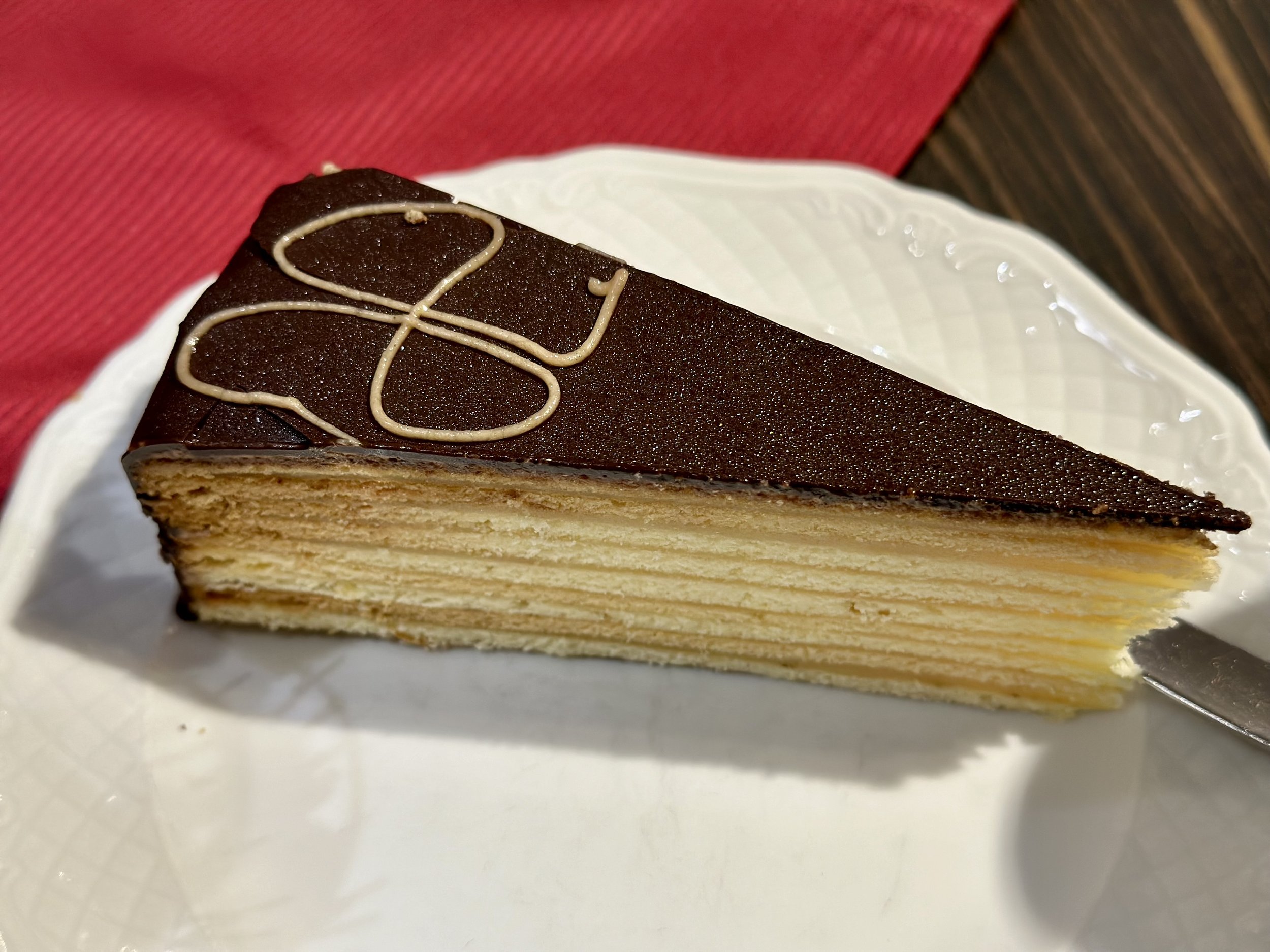
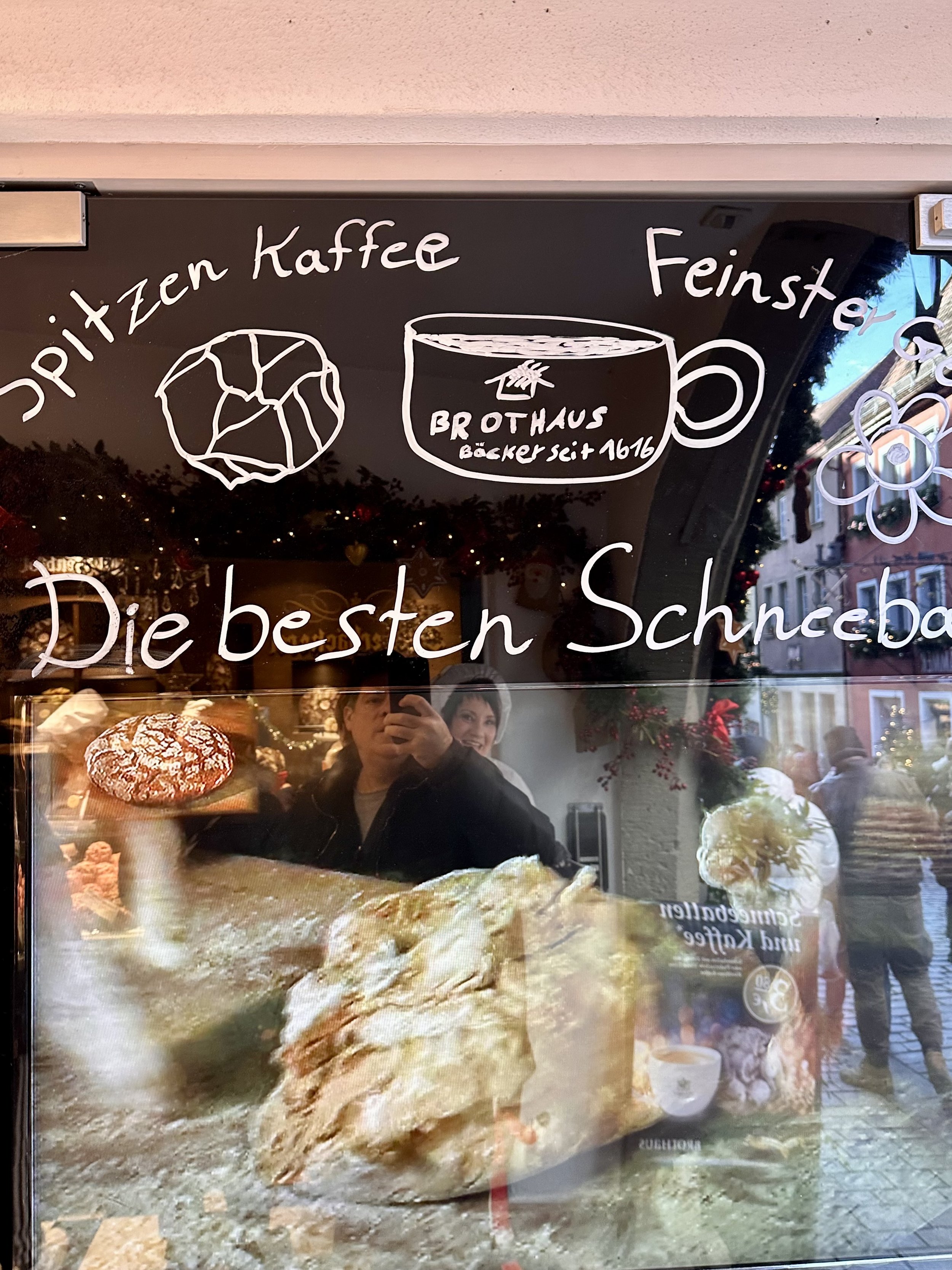
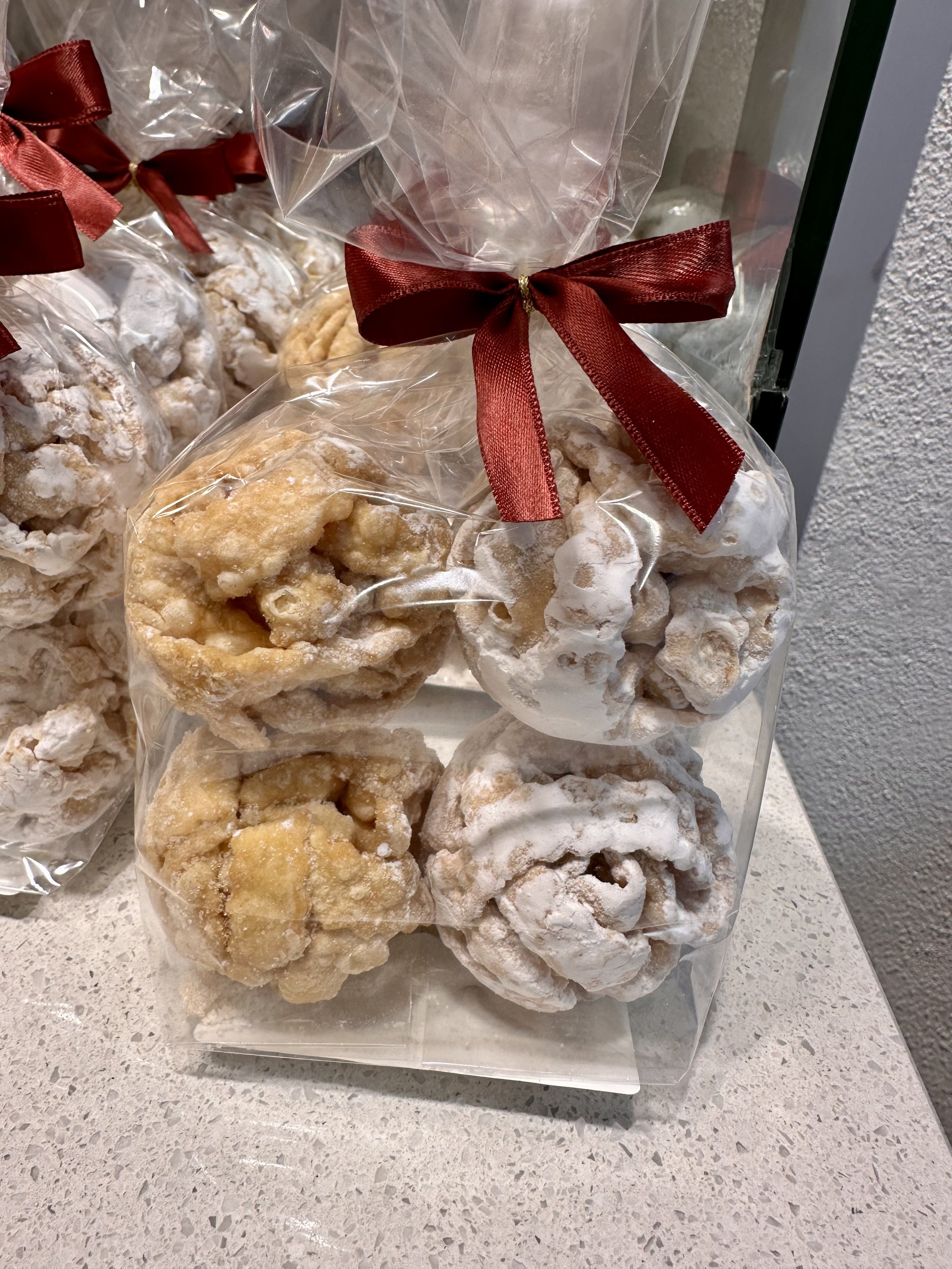
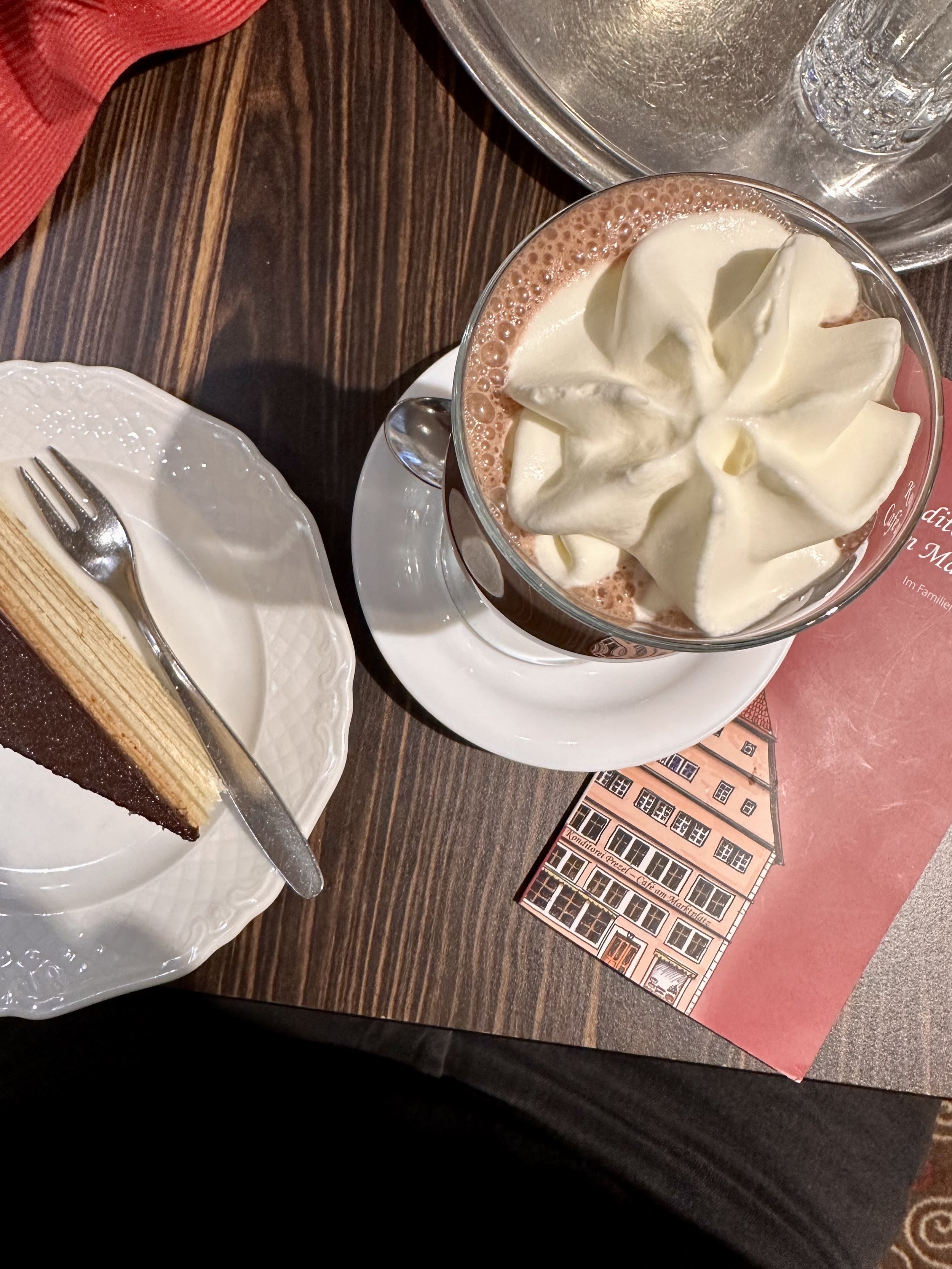
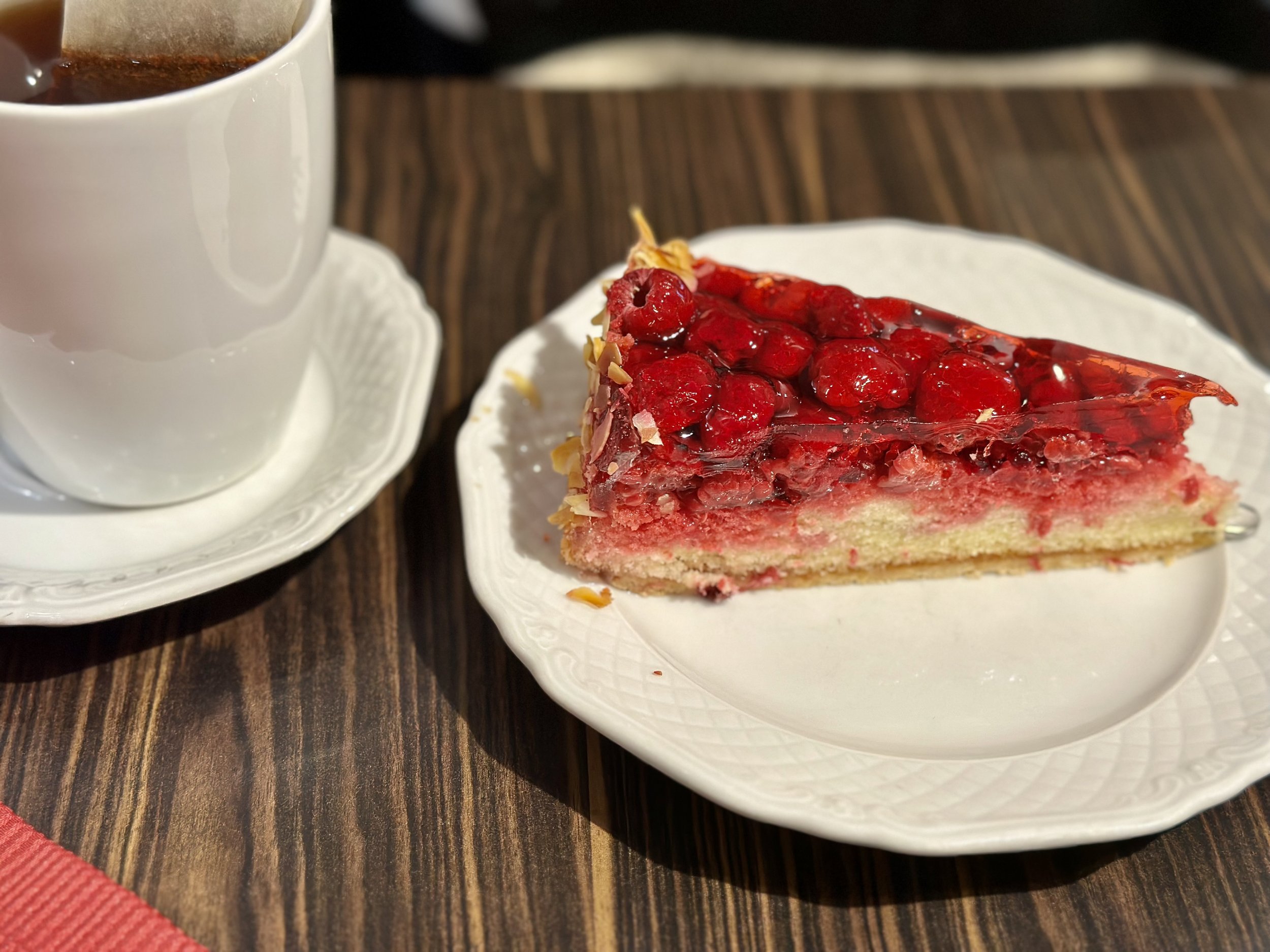
Bäckerei-Konditorei-Café Walter Friedel e.K. was our morning ritual: strong coffee, fresh bread, a pastry before heading out with the camera. Classic German bakery in the best sense. [VERIFY: Still operating.]
Café Gotisches Haus is described by recent visitors as an elegant gothic cave and stone café. Perfect for warming up mid-shoot. Note that it closes around 6pm and focuses on coffee, wine, and light lunch rather than full meals.
Hotel Herrnschlösschen also serves a proper breakfast, and if you are staying there, take it. Starting the day in that dining room before the town wakes up is worth it.
Photography Gear to Bring
Rothenburg rewards a compact, flexible kit more than a heavy one. The streets are narrow, the interiors are dark, and you will be on your feet for hours.
Camera Body: Any modern mirrorless body handles this well. I was shooting with the Canon R5. The Sony A7RV and Nikon Z8 are equally suited. What matters more than the body is the lens choice.
Wide Zoom (16 to 35mm): The narrow streets and tight alley compositions make a wide zoom the most-used lens in Rothenburg. The 16mm end lets you include both sides of a lane in a single frame. Essential for the Ramparts sections and the Plönlein approach.
Standard Zoom (24 to 70mm): The workhorse for market scenes, portrait-style architectural details, and compressed street shots. If you only bring one lens, this is the one.
Telephoto (70 to 200mm): Useful from the Town Hall Tower for compressed rooftop views and from the Burggarten for pulling the valley and town walls into the same frame. Not essential but earns its weight on a two-day visit.
Prime (35mm or 50mm): If you shoot street and want to work fast in the Christmas market crowds, a fast prime at f/1.8 handles the low light well without a tripod in many situations.
Tripod: Bring a compact travel tripod. Blue hour and night shots of the market and Plönlein are among the best shots this town offers, and you need stability at 3 to 10 seconds to get the glow right. A Platypod works well on cobblestone surfaces.
ND Filters: Less essential here than at a waterfall destination, but a 6-stop ND is useful for long daytime exposures to smooth the movement of market crowds.
Extra Batteries: Cold weather drains batteries significantly faster. If you are visiting in winter, carry at least two extras and keep one warm in an inside pocket.
Rain Cover: Even in December, conditions change fast. A basic cover for your bag and camera takes up no space and matters when it matters.
iPhone Photography
Rothenburg is one of the best towns in Europe for iPhone photography because the visual subjects are immediate, the light quality at blue hour is forgiving, and the compact scale means you are always close to your subject.
At Plönlein: Use the standard lens rather than the ultrawide. The ultrawide distorts the half-timbered geometry in an unflattering way at close range. Step back slightly and shoot at 1x. At dusk, Night Mode activates automatically and does a genuinely good job with the glow of the street lamps on the cobblestones.
At the Christmas Market: Portrait Mode works well on individual stall details like wooden ornaments, candles, and food displays. The subject separation against the blurred market background reads beautifully on screen. For wider shots of the whole market, switch off Portrait Mode and let Night Mode handle the exposure.
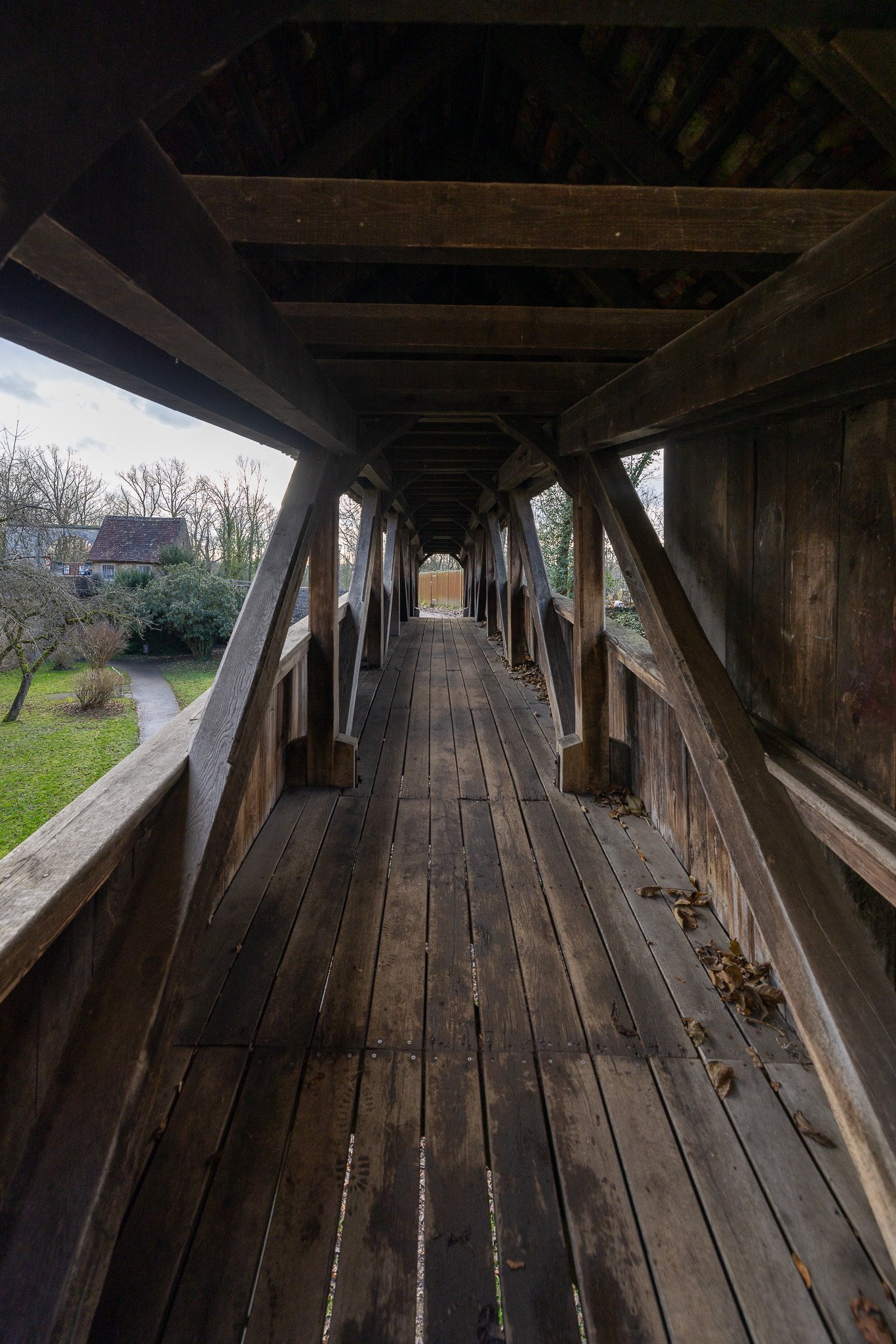
On the Ramparts: The standard iPhone lens is ideal for the long covered walkway shots looking down the wooden-roofed corridor. The geometry is strong and the light from the wall openings creates a natural leading line. Use Exposure Lock by pressing and holding on the brightest part of the frame to avoid blowing out the window light.
General tip for Rothenburg: The pastel facades of the half-timbered houses photograph better in overcast or softly lit conditions than in harsh midday sun. Do not write off a grey sky day. The colors saturate beautifully without the contrast problems of direct sunlight.
Photography Locations
One of the things I love about Rothenburg is its compactness. You can walk from one side of town to the other in 10 to 15 minutes. That means no rushing, no taxis, no complicated logistics. Just wander with your camera and look up.
The Medieval Streets and Doorways
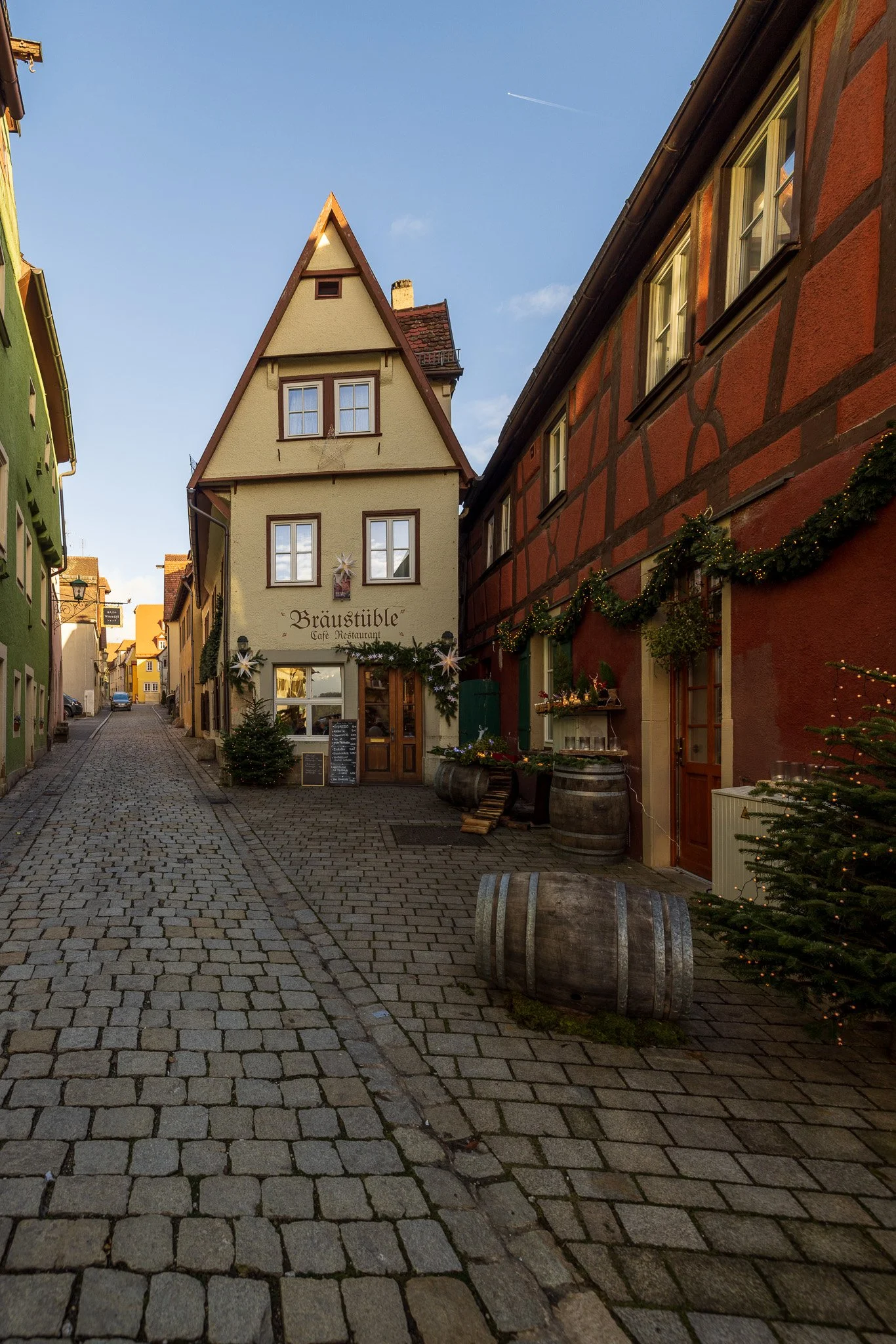
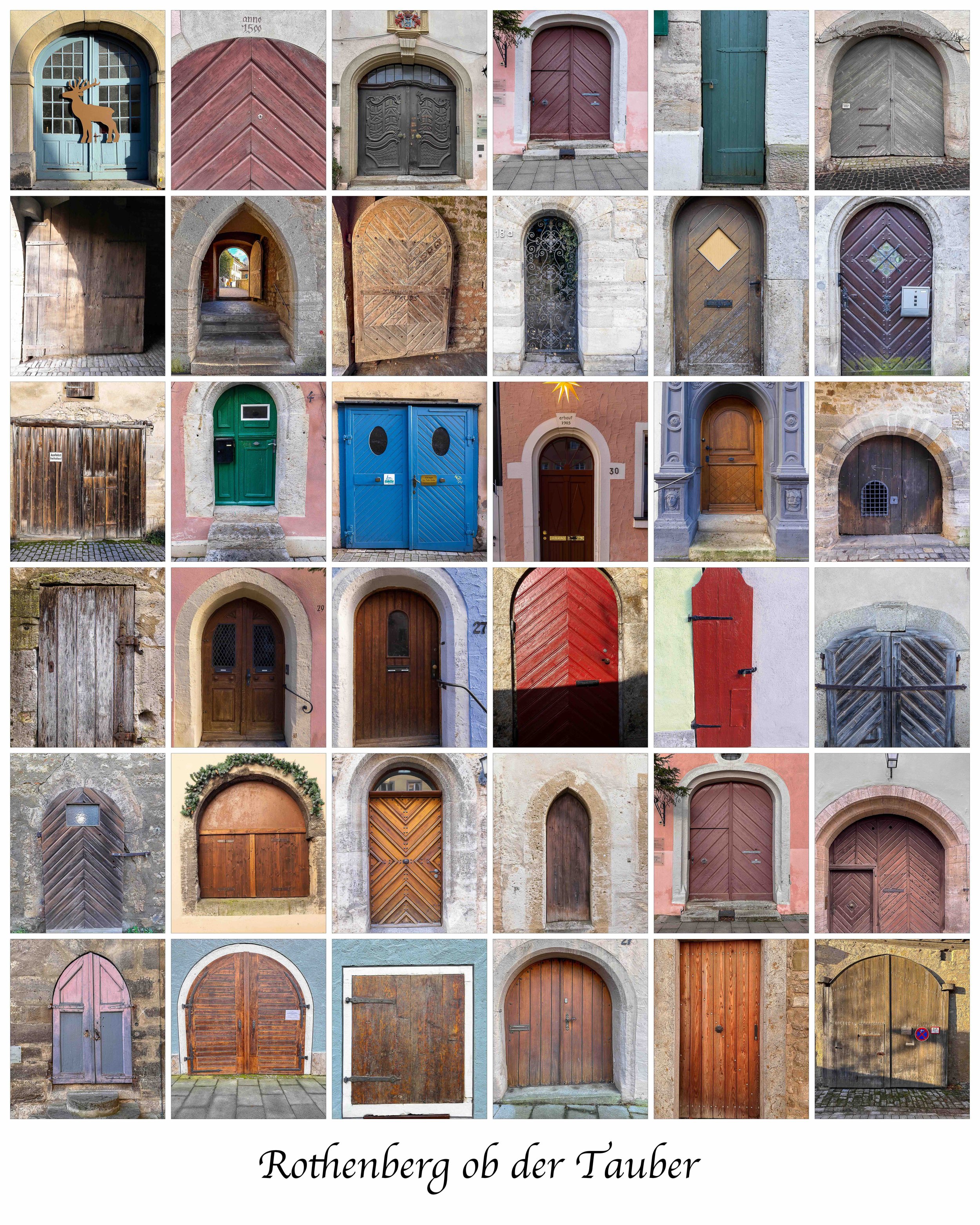
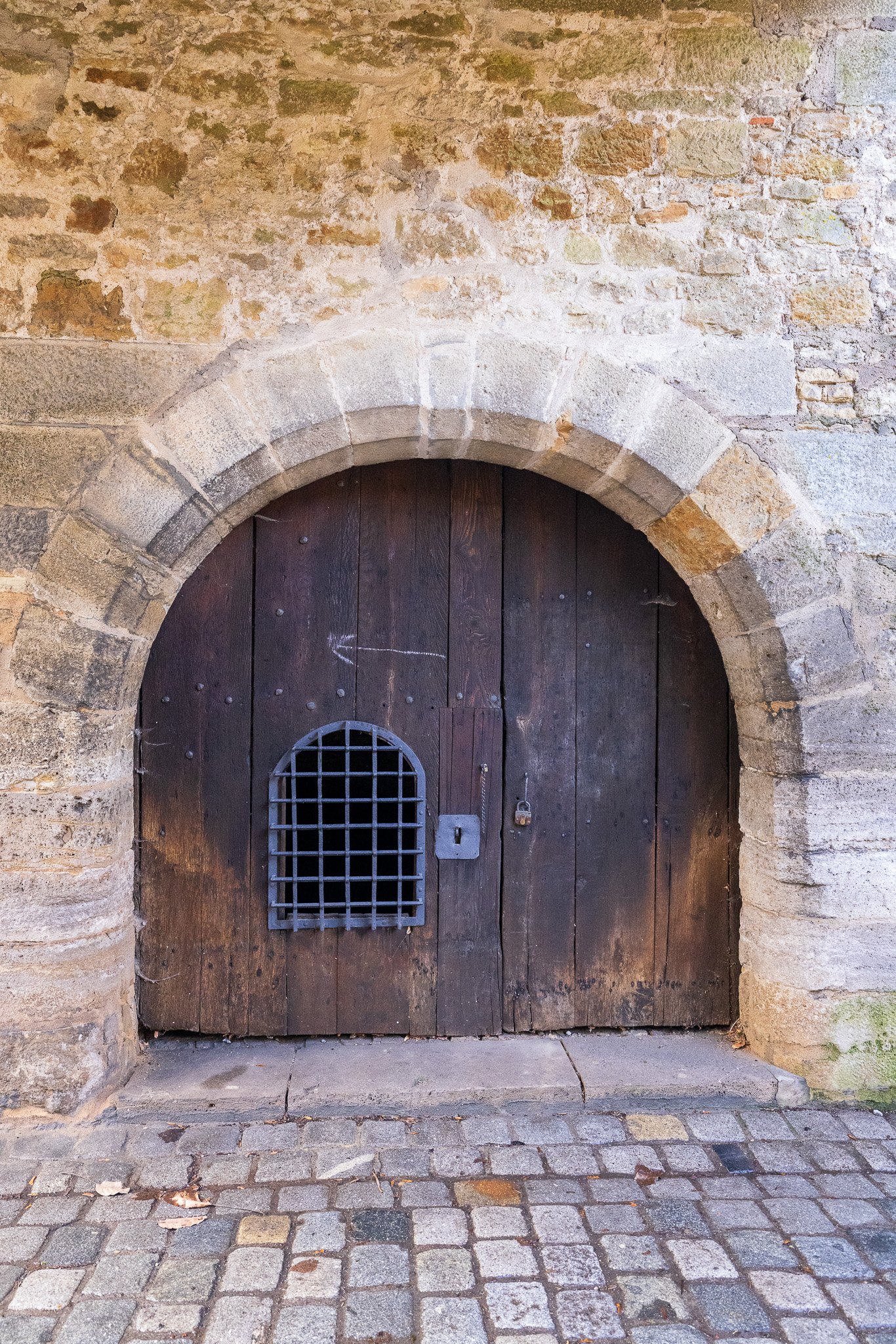
This is not a single location. It is the entire old town treated as a subject. Rothenburg's residential streets away from the main tourist circuit, particularly the lanes running north and south of Herrngasse, are full of doorways, window boxes, painted facades, and incidental detail that reward slow walking with a camera.
The doors alone could occupy a morning. They come in every age, color, and condition: iron-studded oak doors from the 16th century, painted wooden doors in deep red and green, arched stone doorways with carved keystones, simple plank doors with hand-forged hardware. Every one of them tells you something about the building it belongs to and the century it came from.
📷 Pro Tip: For door and detail shots, a 35mm or 50mm prime is ideal. Get close. Fill the frame with the door and its immediate context, including the stone surround, the step, the door knocker. A standard zoom works fine, but the prime forces you to move your feet and find the right distance rather than zooming from where you stand, and the results are usually stronger. Morning light on the east-facing streets and late afternoon light on the west-facing streets gives you the most directional illumination for bringing out the texture of old wood and stone. In December, many doors are decorated with evergreen wreaths and candles, which adds color and warmth to an already strong subject.
Best time: Morning on east-facing streets; late afternoon on west-facing streets. Access: Free, public streets. Getting there: Explore the lanes between Herrngasse and the city walls on both the north and south sides.
The Christmas Market at Marktplatz
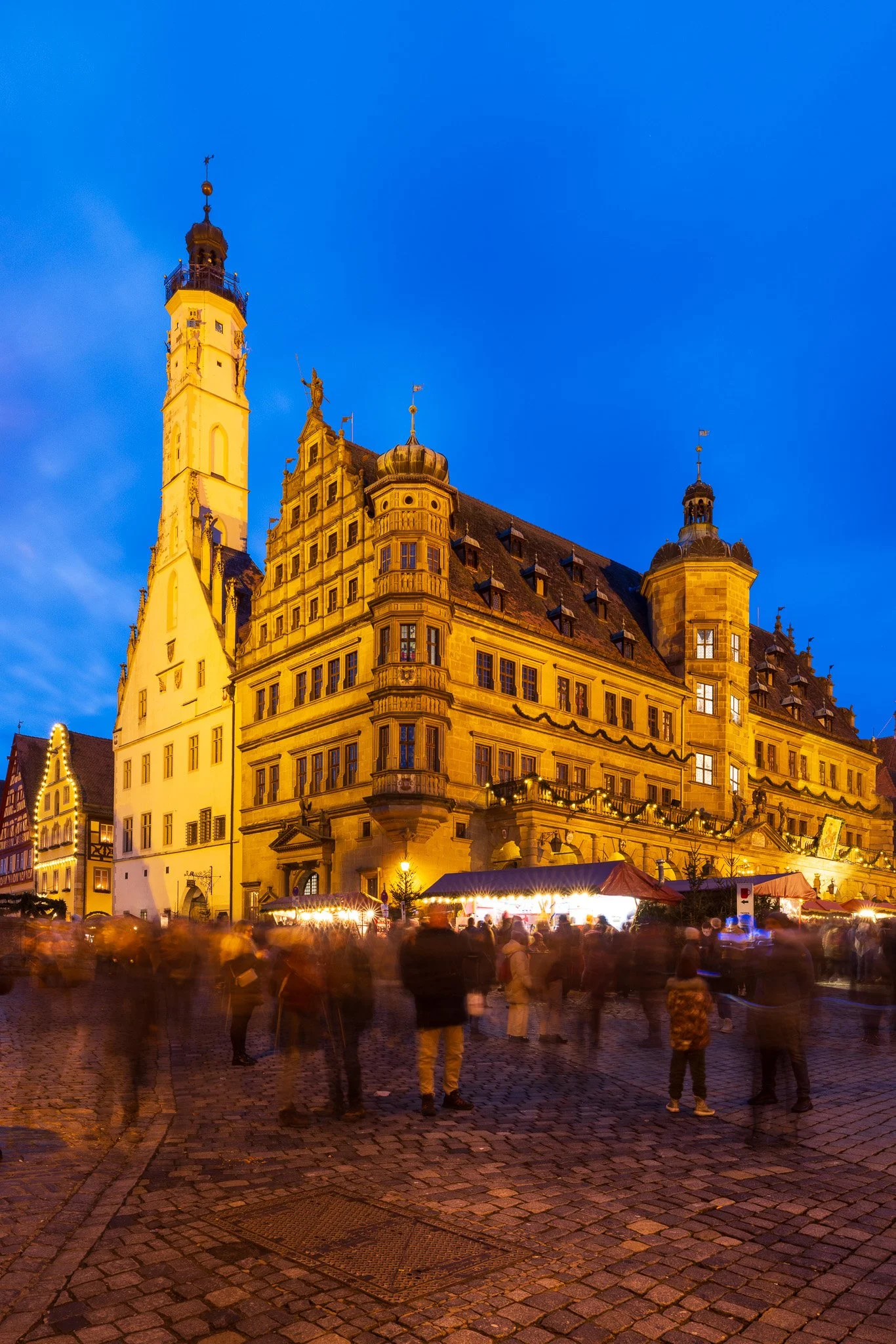
The Reiterlesmarkt on the main Market Square has been running since the 15th century. It is smaller and more intimate than the markets in Nuremberg or Cologne, which is exactly what makes it worth photographing. The wooden stalls are built around the perimeter of the square, the Town Hall forms the backdrop on the north side, and the St. Georg Fountain sits in the center. At dusk, the combination of market lights, candle glow, and the illuminated facades of the surrounding buildings creates a warm, layered scene that looks like a painting.
📷 Pro Tip: The best position is in the square itself, mid-afternoon before the evening crowds arrive, when you can find a clear sightline between the stalls toward the Town Hall facade. A 24 to 70mm zoom at around 35mm gives you a natural-feeling wide shot. At dusk, switch to a tripod for exposures of 2 to 8 seconds to capture the market light without noise. Include people in motion during longer exposures only if you want blur as an intentional effect; for cleaner shots, wait for a pause in foot traffic or use a faster shutter with a higher ISO. The market runs evenings only on weekdays, so the light-to-crowd ratio is best on a Tuesday or Wednesday around 4:30pm as it opens.
Best time: Late afternoon through blue hour. Access: Free to enter. Getting there: Market Square (Marktplatz), center of the old town.
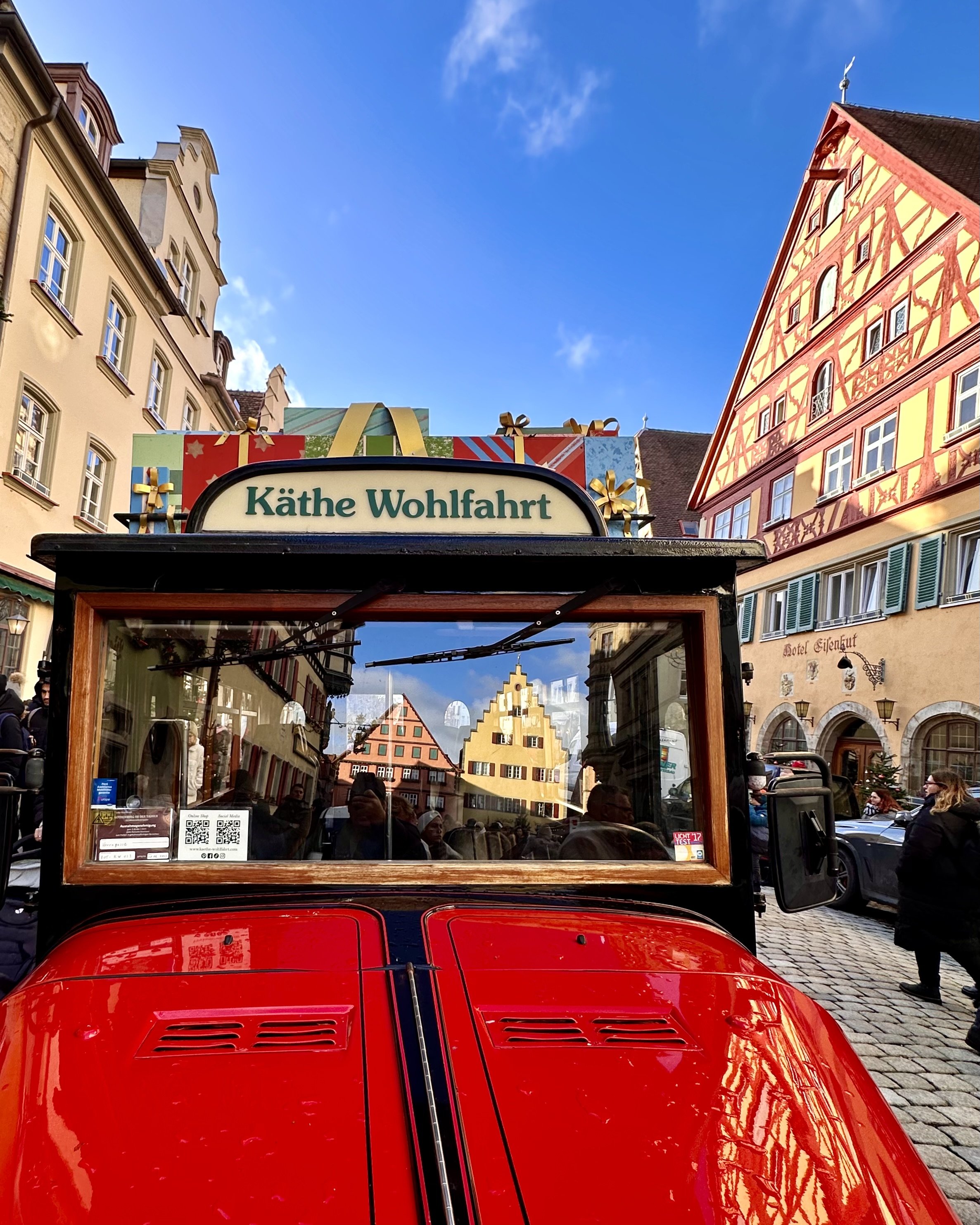
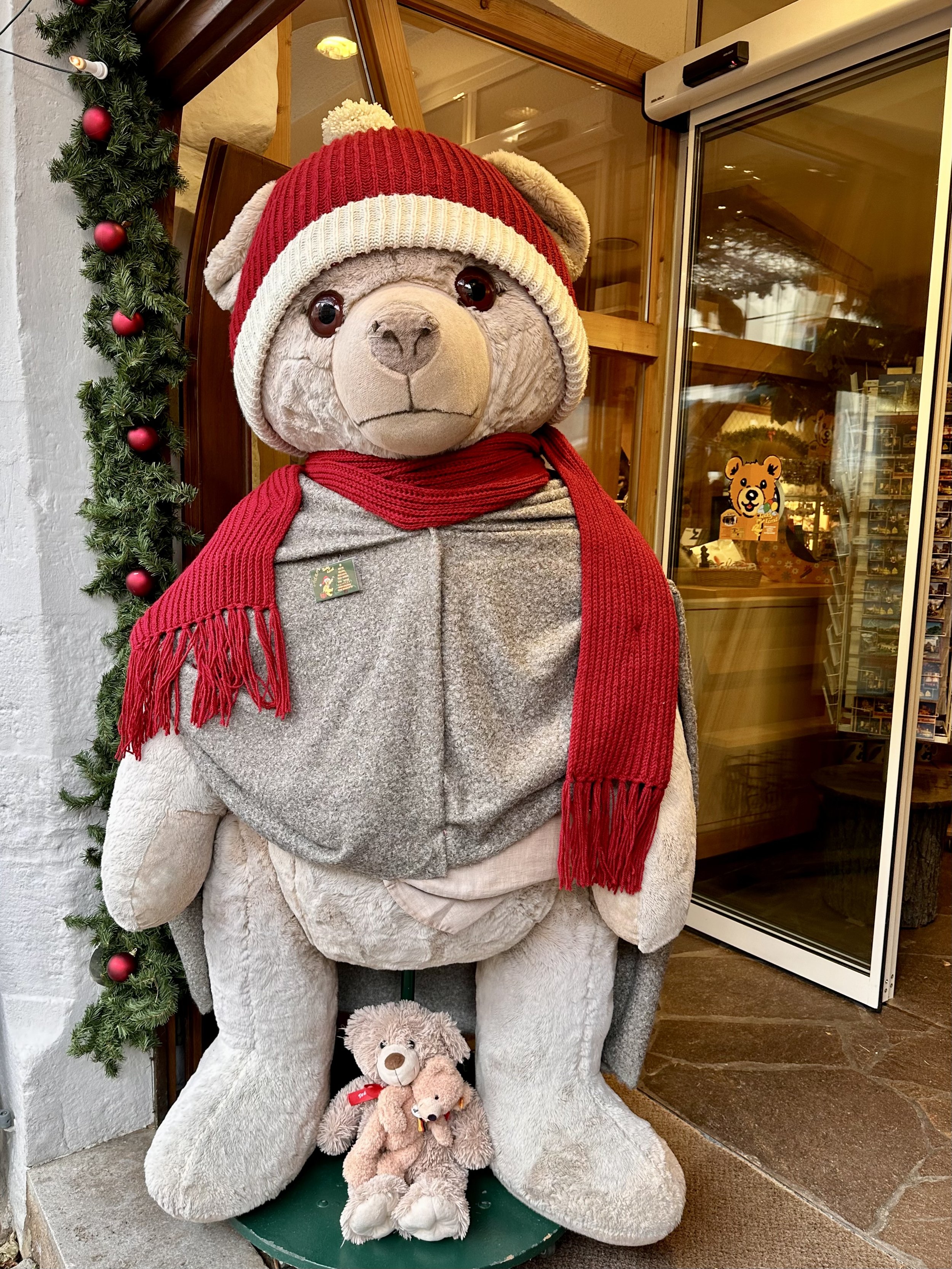
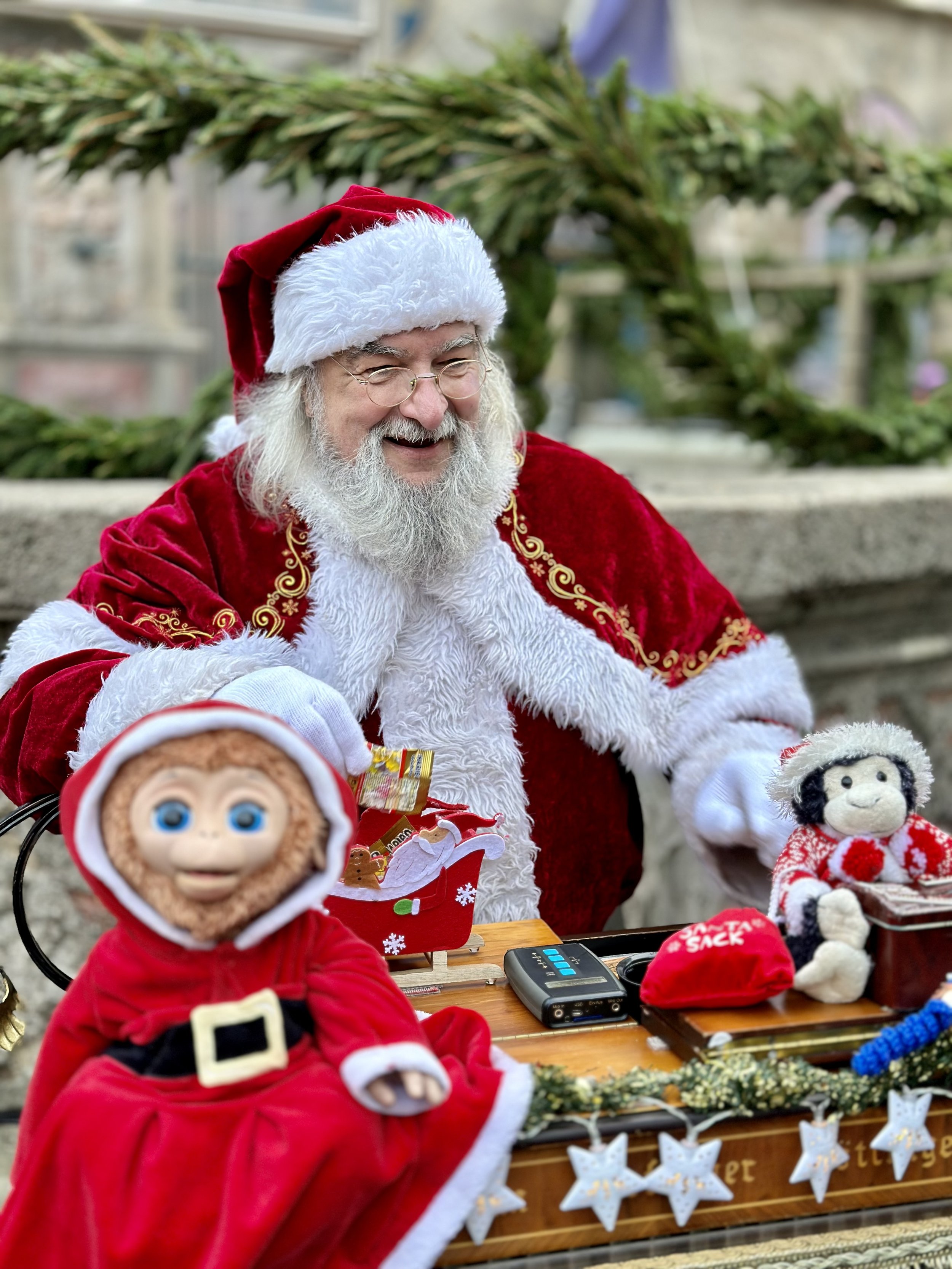
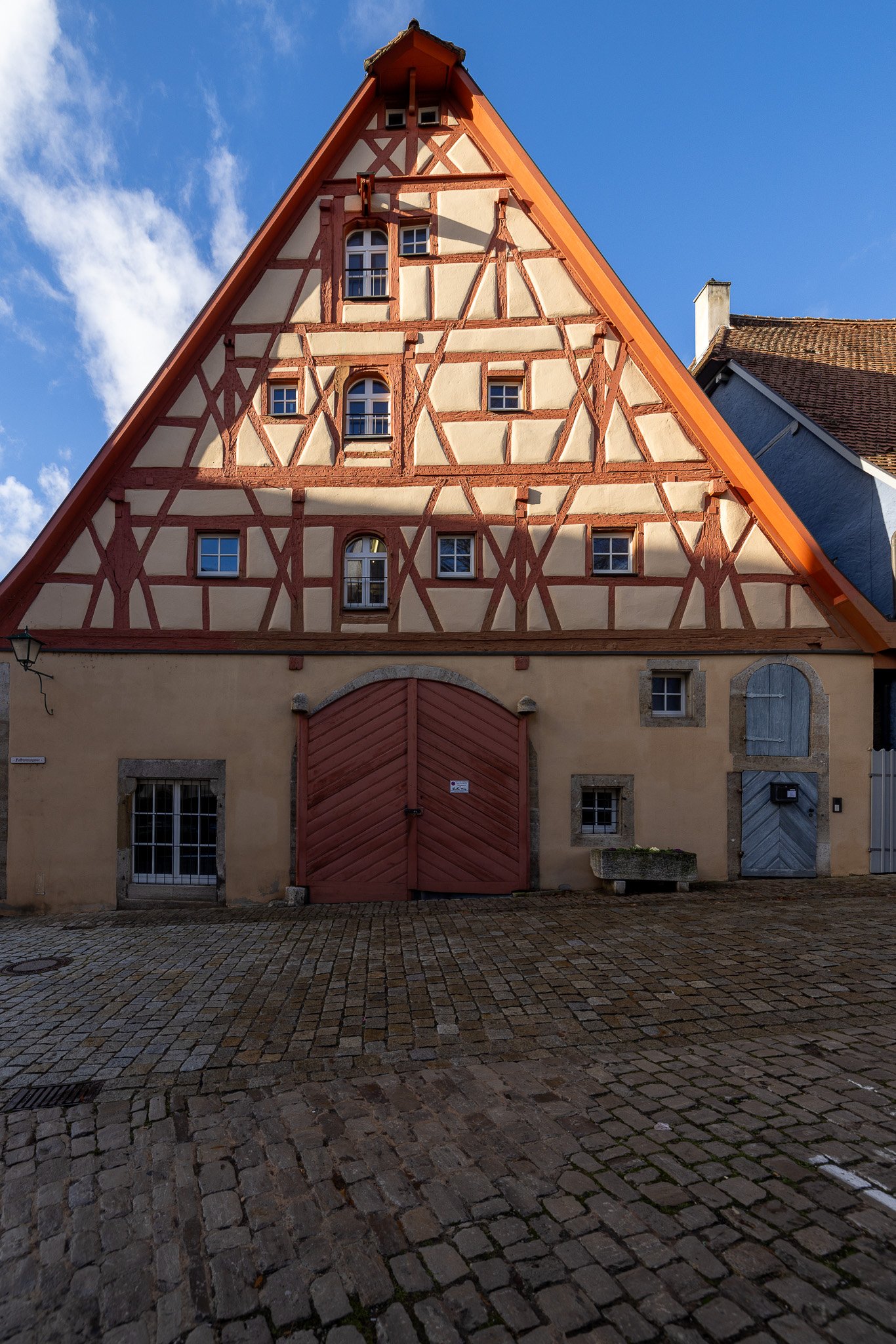
Walking Through the Town
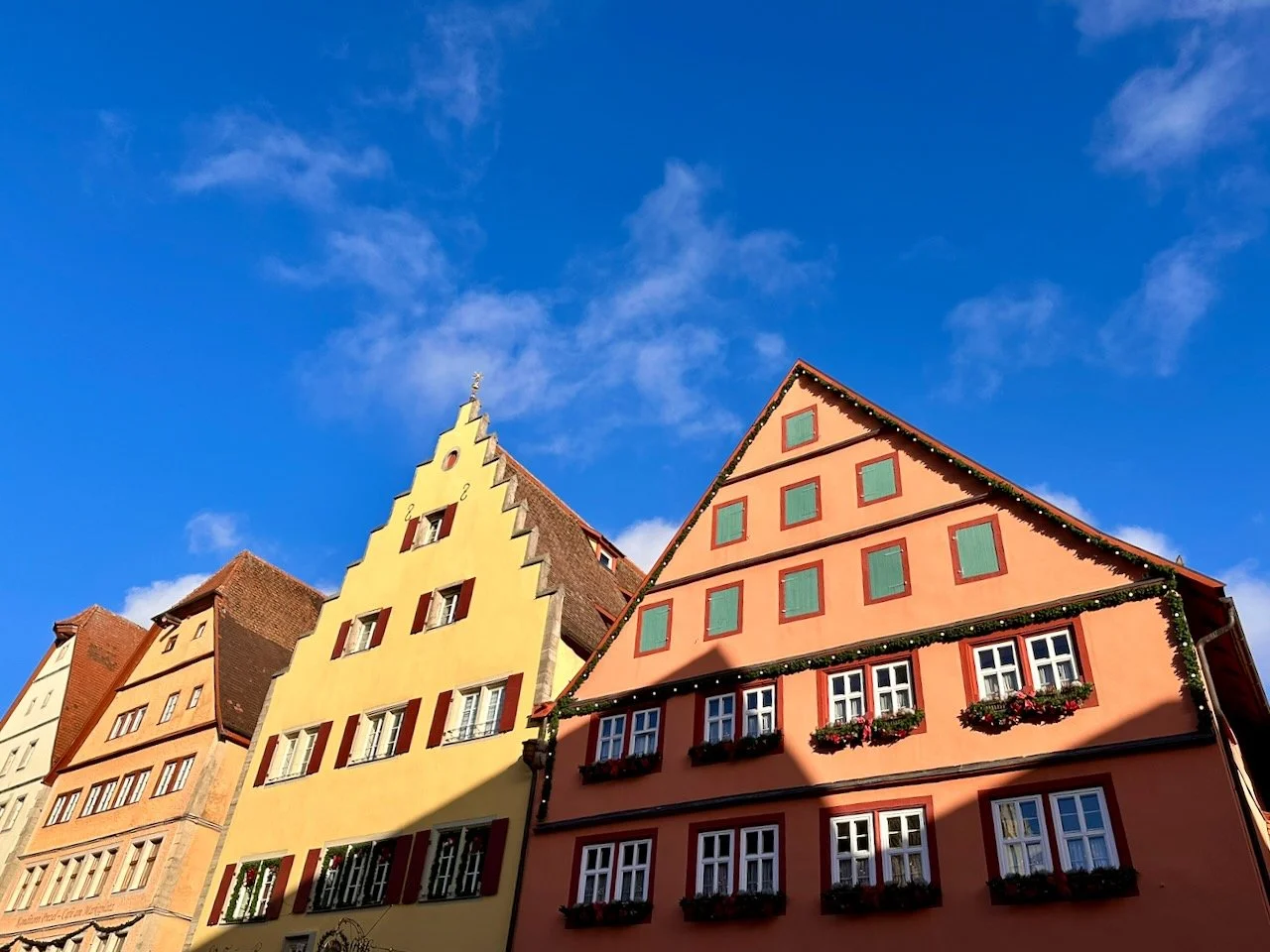
I loved walking through the streets of the town. There are just so many charming spots to photograph. I loved the colors of the homes and their shapes.


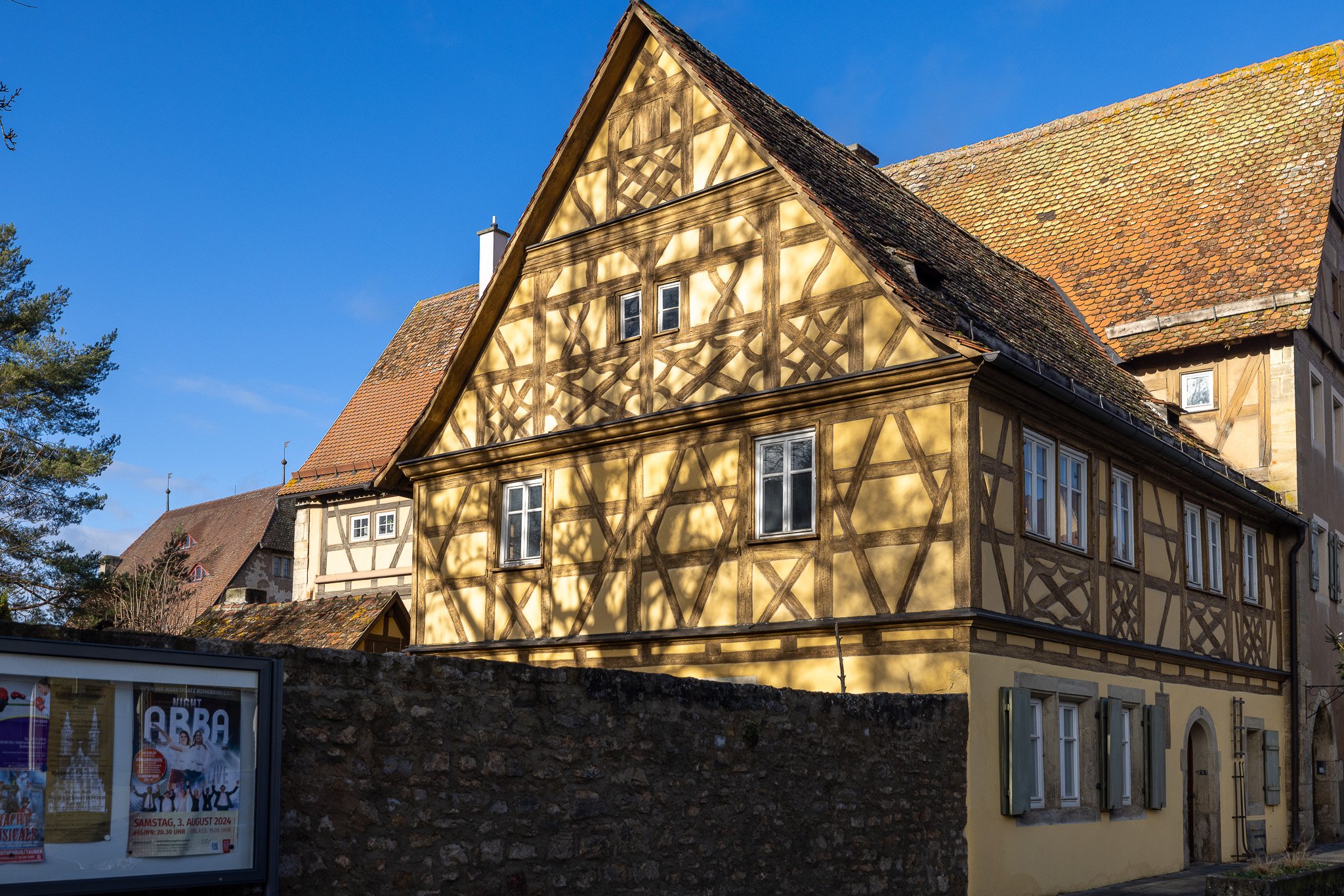



Plönlein
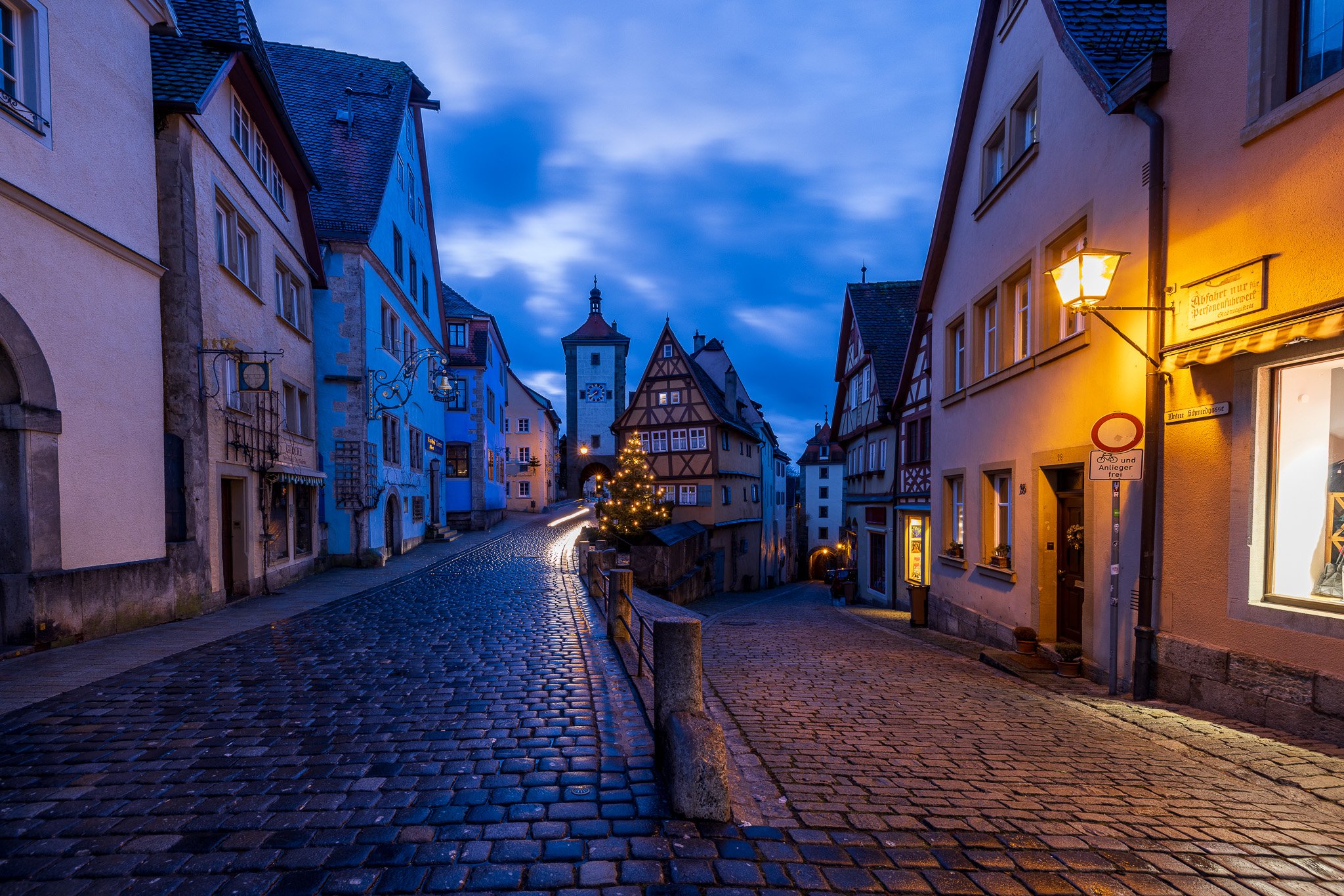
Plönlein is the most photographed corner in Rothenburg and arguably one of the most recognized medieval street scenes in all of Europe. It sits at a fork in Schmiedgasse near the southern end of the old town, where the street splits around a small yellow half-timbered house, one lane rising toward the Siebers Tower and the other descending toward the Kobolzell Gate. The geometry alone would make it a compelling shot. The colors of the building, a warm ochre against the grey cobblestones and the stone towers behind it, make it one of those frames that works at almost any time of day.
The challenge is crowds. By 9am in summer or by mid-afternoon during the Christmas market season, you are competing with dozens of photographers and tour groups for the same position. The solution is obvious and it works: be there early.
📷 Pro Tip: Position yourself at the top of the fork, roughly 8 to 10 meters back from the yellow house, to include both towers in the frame with the street leading your eye through the center. A standard zoom at 35 to 50mm gives you the most balanced composition without distorting the architecture. Blue hour is the single best time to be here, roughly 20 to 40 minutes after sunset, when the warm light in the windows glows against the deep blue sky. In December, the Christmas lanterns add another layer of warmth. If you are shooting at night and want smooth cobblestones without people, a 10 to 15 second exposure at low ISO will blur any passing foot traffic into nothing. Bring a tripod and check your footing on the uneven cobblestones before setting up.
Best time: Pre-dawn, or blue hour after sunset. Access: Free, always open. Getting there: 10-minute walk south from the Market Square along Schmiedgasse.

Evening Shot After All the Tourist Left
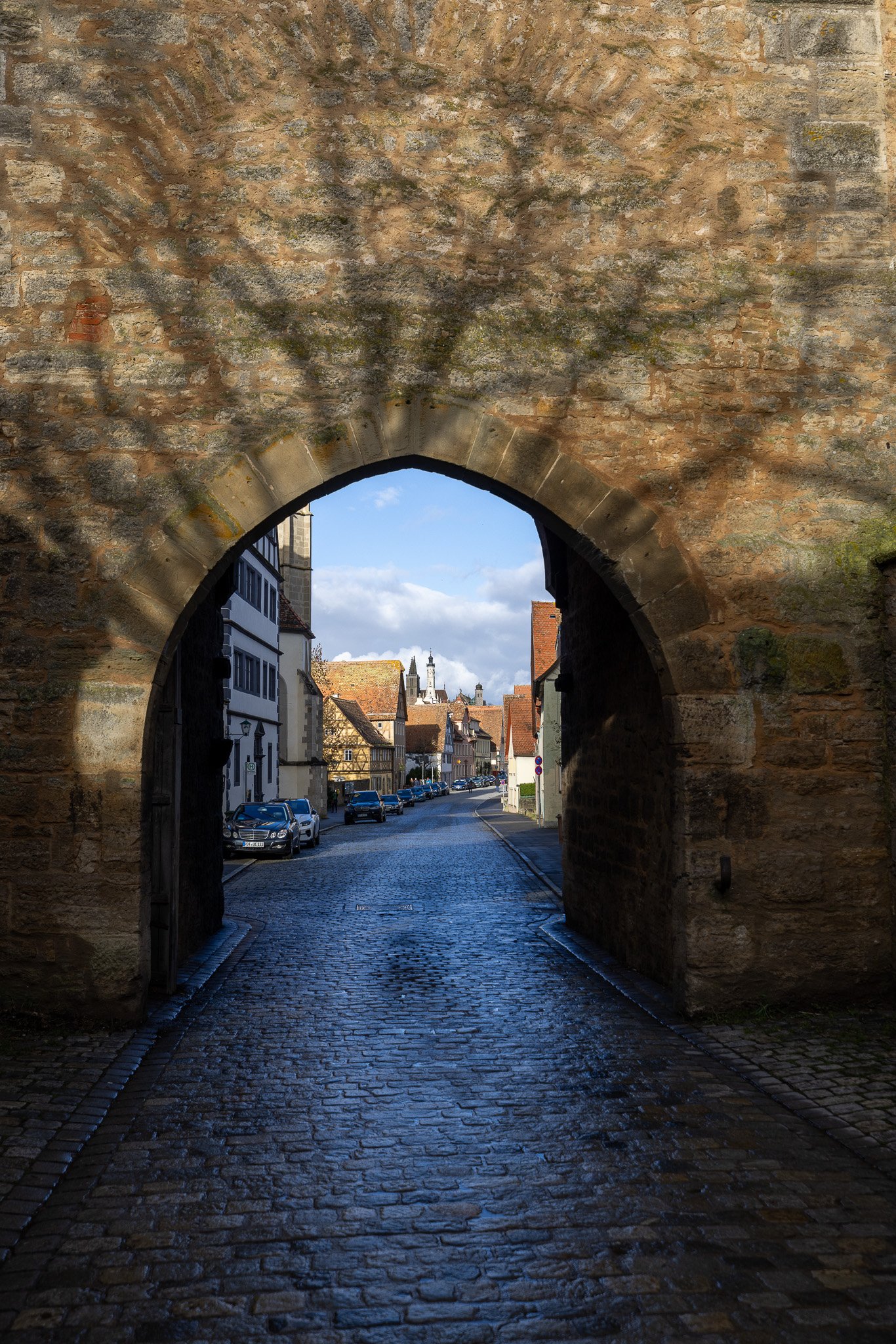
The Ramparts
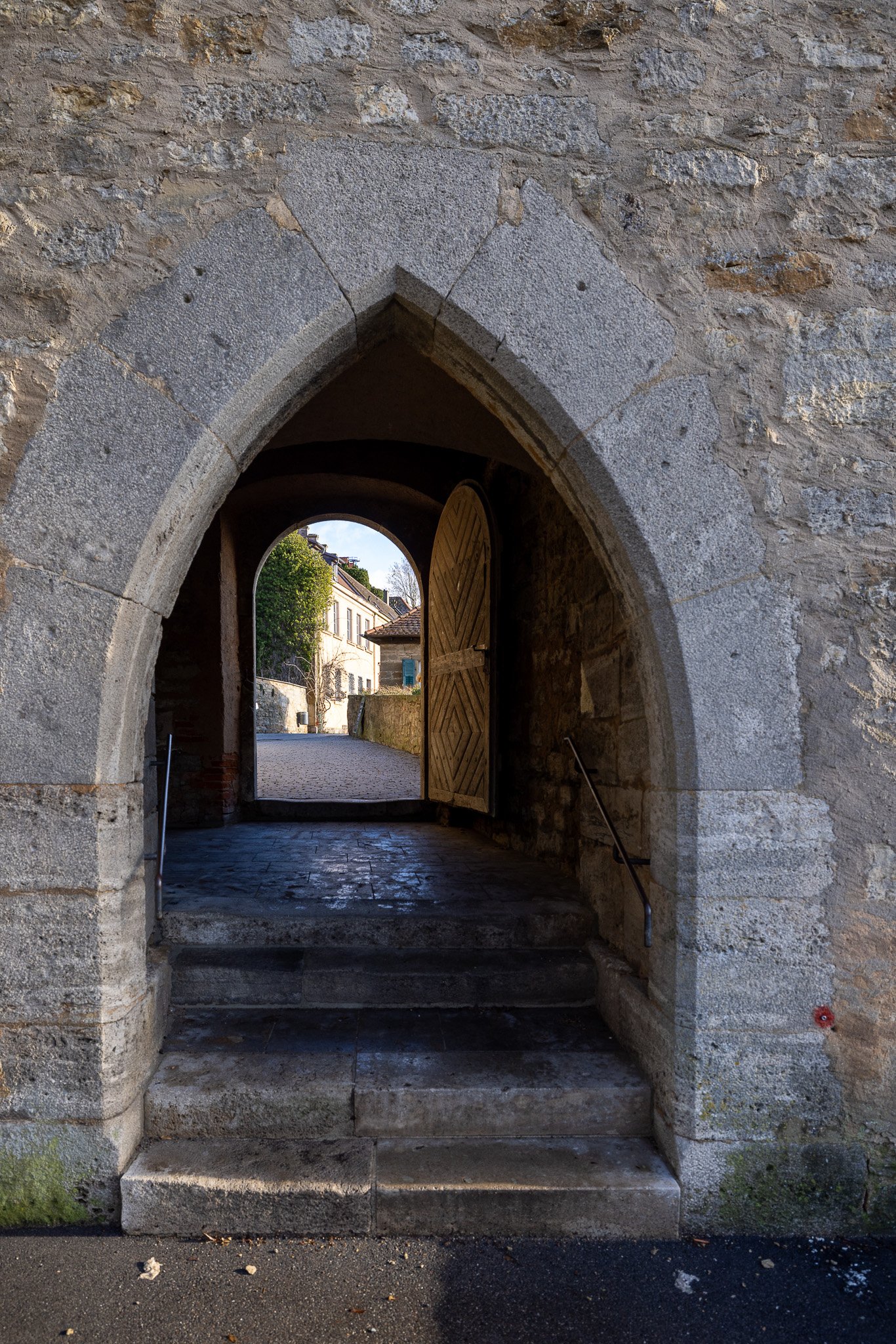
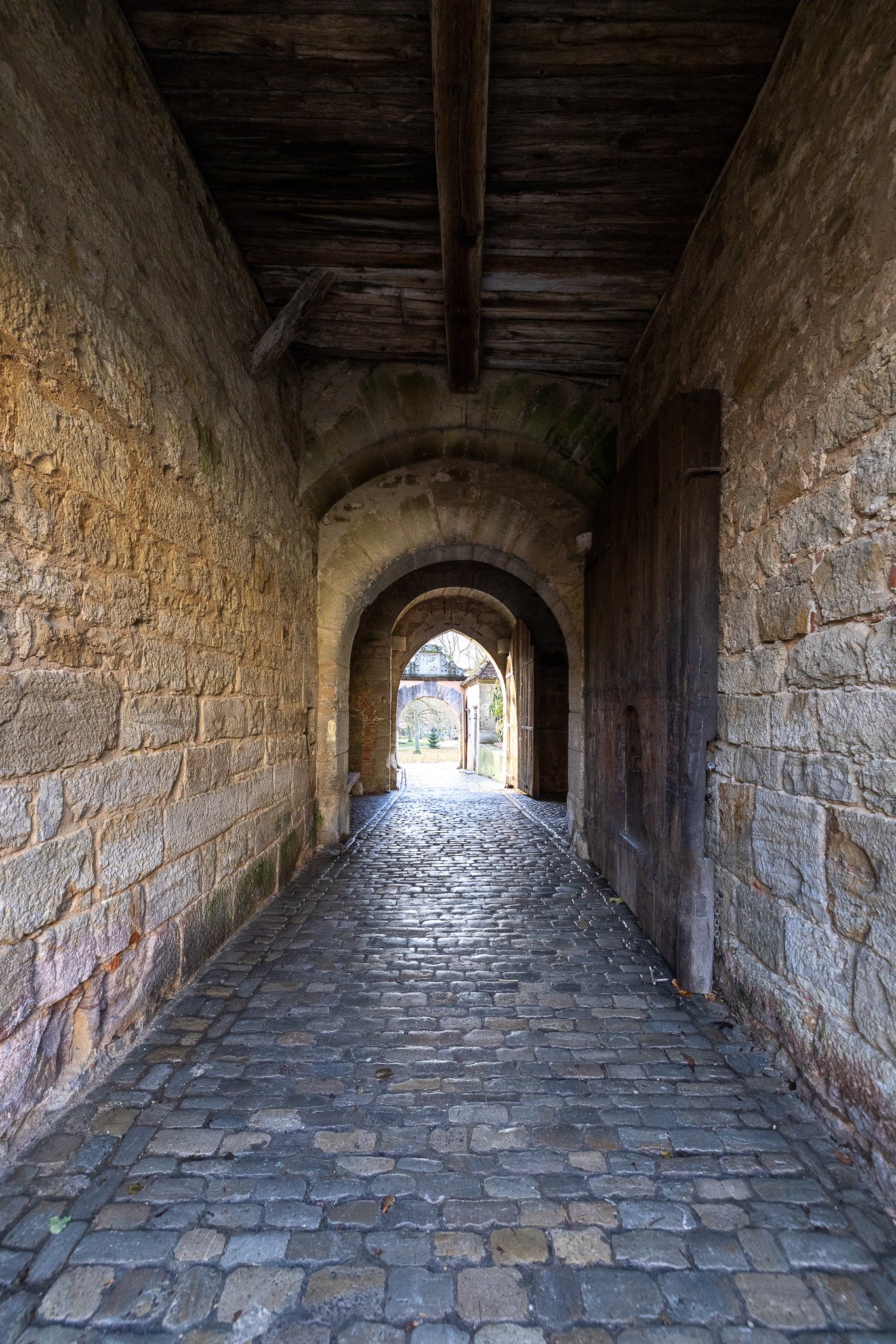
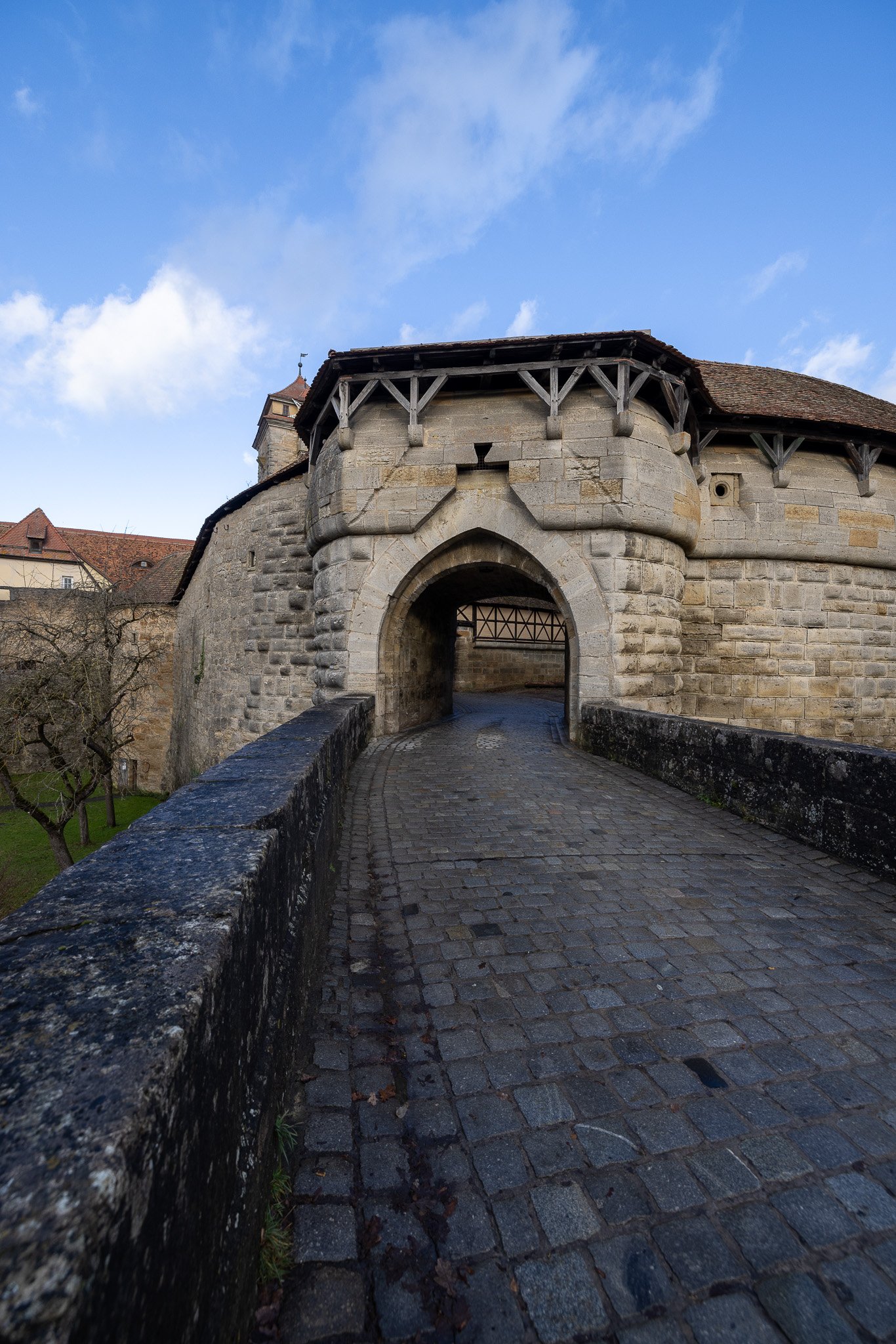
Rothenburg has one of the best-preserved medieval city walls in Germany, and you can walk most of its 2.5-mile circuit along the covered wooden walkway on top. The wall is a photography subject in itself: the rhythm of the arched openings, the views inward over the rooftops, the views outward over the Tauber Valley, and the towers that punctuate the circuit at regular intervals.
The interior walkway, a long wooden-roofed corridor with window openings on both sides, creates one of the strongest architectural leading-line compositions in the entire town. In winter morning light, the contrast between the dark interior and the bright window openings is dramatic and clean.
📷 Pro Tip: The section of wall near the Klingentor gate on the northwestern side gives you a strong view that includes the gate tower framing St. Jakob's Church spire in the background. Shoot with a wide zoom at 24mm or wider for this composition. For the interior walkway shots, position yourself at one end of a long straight section and use a 35mm or 50mm focal length to pull the corridor into a deep perspective frame. Morning is best when low light rakes across the stone and wood at an angle. In December, the wall walk is largely empty by 7am and you often have entire sections to yourself. Dress warmly; the walkway is open to the elements at the window openings and the wind picks up.
Best time: Early morning or late afternoon for raking light. Access: Free. Getting there: Multiple entry points throughout the old town; nearest to Plönlein is the Kobolzell Tower section.
The Rathaus Tower (Town Hall Tower)
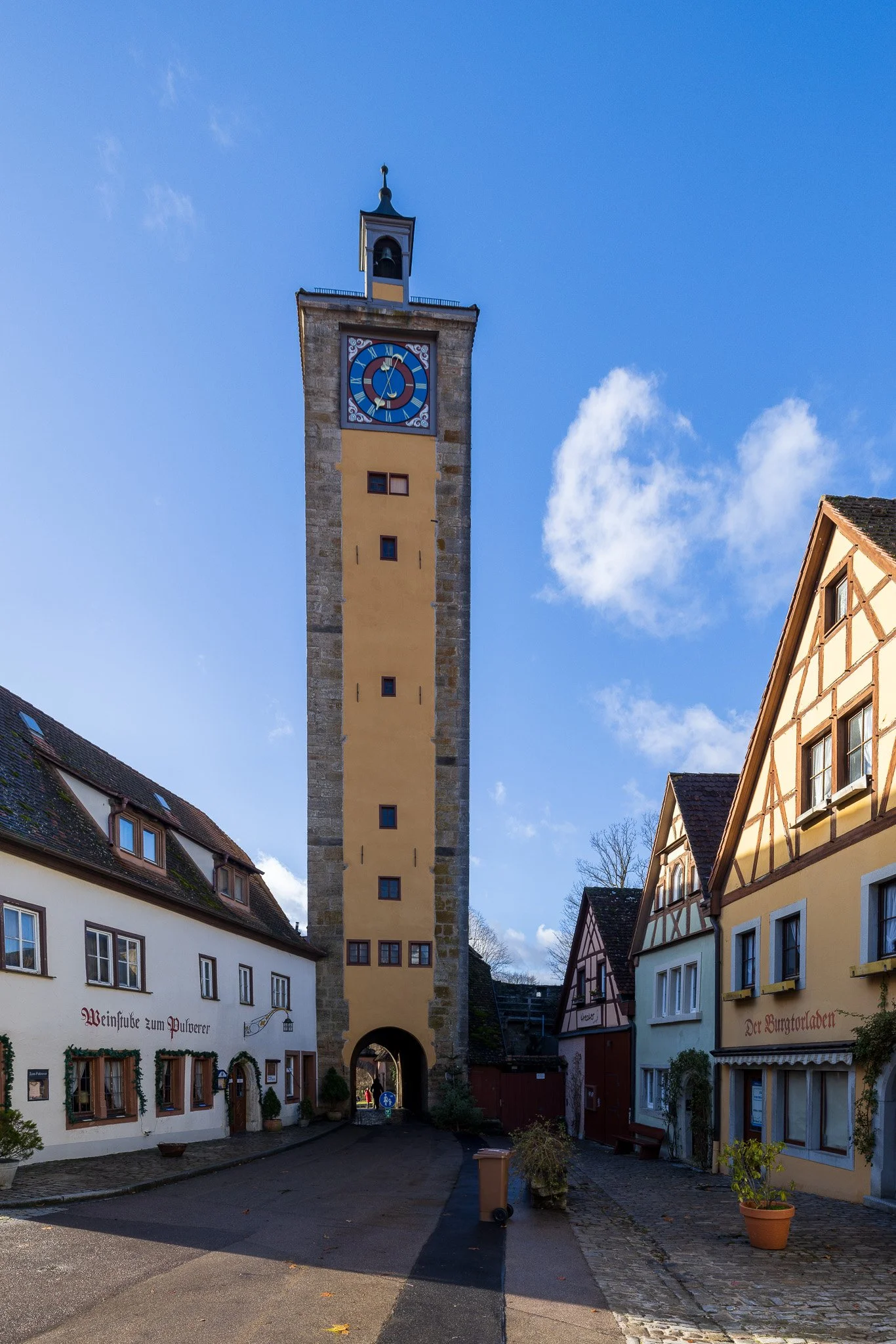
The Rathaus on the Market Square is one of the most architecturally distinctive buildings in Rothenburg, a combination of a 13th-century Gothic section and a 16th-century Renaissance addition. But the real reward is the tower. Climb 220 steep steps and you reach a narrow observation platform with a 360-degree view over the entire old town, the red-tiled rooftops, the church spires of St. Jakob, the surrounding wall towers, and, on a clear day, the Tauber Valley stretching out beyond the town.
The views are intimate in a way that larger city observation decks are not. You are close to the roofline, not far above it, and the scale of the medieval town reads perfectly from this height.
📷 Pro Tip: Go up in the morning for the best light on the eastern rooftops. The view looking toward St. Jakob's Church from the tower platform is the strongest single composition, particularly with a 70 to 200mm lens to compress the rooftops and pull the church spire into close relationship with the surrounding tiles. If you visit in winter, midday light from the south bathes the entire old town in warm tones that morning and late afternoon miss entirely. The platform is narrow and shared, so a compact telephoto or standard zoom is far more practical than a tripod here. Use your camera's image stabilization and a high shutter speed for sharp handheld shots at longer focal lengths. [VERIFY: Tower opening hours and admission cost before publishing.]
Best time: Morning for eastern views; midday in winter for warm southern light. Access: Small admission fee. Getting there: Market Square, center of the old town.
Festivals & Events
Reiterlesmarkt (Christmas Market) is the single most compelling reason to visit Rothenburg. Running from late November through December, it is one of Germany's oldest Christmas markets, dating to the 15th century. The scale is intimate compared to the major city markets. The setting inside the medieval walls makes it feel genuinely historic rather than staged. For photography, the overlap of candlelight, market glow, and blue hour sky is exceptional. Go on a weekday and go early in the season, before December weekends bring the biggest crowds.
Meistertrunk (Master Draught) reenactment takes place over the Whitsun weekend in late May or early June, commemorating a legend from the Thirty Years' War in which the town's mayor saved Rothenburg by drinking a massive tankard of wine in one go. The festival involves period costumes, a historical pageant, and street celebrations throughout the old town. For photography, the costumed processions against the medieval architecture are highly photogenic. Check local listings for the exact date as it varies by year.
Reichsstadttage (Imperial City Festival) happens over a long weekend in early September, with the entire old town dressed in medieval costume for markets, performances, and historical reenactments. This is an underappreciated event from a photography standpoint: medieval clothing, period crafts, and the town at its most theatrical, with far fewer visitors than the Christmas market season.
Rothenburg Herbstfest (Autumn Festival) in October marks the transition into fall with local wine, traditional food, and a relaxed atmosphere. Less spectacular than the Christmas market or the Meistertrunk, but a pleasant time to visit if you want the town at its quietest with a little added event energy.
Final Thoughts
Rothenburg ob der Tauber is one of the rare places that lives up to what you imagine before you arrive. Most medieval towns have a historic center, and then the reality of the 21st century is pushing in around the edges. Rothenburg's walls held. The town inside them is the real thing: intact, lived-in, and quietly extraordinary.
Come for two nights. Get up early. Stay late. Walk the walls before the first tour bus arrives and stand at Plönlein after the last one leaves. The version of this town that most visitors see, in the two-hour window between arrival and departure, is only a fraction of what it offers.
Looking for more guides from this region?
My Photography & Travel Guide to Nuremberg, Germany. Rothenburg is an easy 90-minute drive from Nuremberg, one of Germany's most historically layered cities. Medieval churches, a reconstructed imperial castle, and the traces of the 20th century sit alongside centuries of prior history. A natural companion trip on the Romantic Road.
My Photography & Travel Guide to Colmar, France. We visited Colmar on the same Christmas market tour. It is three hours west of Rothenburg across the Rhine and into Alsace. Half-timbered houses in bolder colors, canals running through the old town, and a Christmas market that rivals anything in Germany. If Rothenburg is your base, Colmar deserves a day or two.
My Photography & Travel Guide to Munich, Germany. Rothenburg sits roughly two hours from Munich by car, making it a natural extension of any Bavaria trip. Munich rewards photographers with a completely different energy: grand Baroque architecture, the vast English Garden, the controlled chaos of the Viktualienmarkt, and a beer hall culture that is deeply photogenic in its own right. Two cities, one trip, no overlap.
If you are interested in joining one of my photography workshops, you can find the details through the link. You can also follow along on Instagram, Facebook, or subscribe to my newsletter for more travel photography tips and behind-the-scenes insight.
Let Rothenburg surprise you.
✈️ Travel Photography Planning Sessions
One-on-One Trip Planning with a Professional Travel Photographer
Don’t miss the shot. Let me help you plan for it.
Overview
Planning a photography-focused trip can be overwhelming. From figuring out the best places to shoot, to when the light is just right, to knowing which lens to pack — there are a lot of decisions to make.
This one-on-one Zoom session is your chance to get personalized travel photography advice from someone who’s spent the past 25 years exploring cities, coastlines, and wild places around the world — camera in hand.
Whether you're headed to Paris, Patagonia, Tokyo, or Tuscany, I’ll help you make sure your photography trip is well-planned and creatively inspired, so you come home with the images you dreamed of (and then some).
What’s Included
✅ Photography Location Planning
I’ll help you create a customized itinerary of the best photo spots, including off-the-beaten-path gems and iconic views.
✅ Best Times to Shoot
Get expert advice on lighting, golden hour, blue hour, and seasonal conditions for each location.
✅ Gear Recommendations
Not sure whether to bring the telephoto or the prime? We’ll walk through your gear and make sure you’re bringing the right tools for your destination and style.
✅ Hotel and Base Recommendations
Stay where it’s convenient for sunrise shoots and late-night strolls with your camera. I’ll recommend hotels that are photographer-friendly and well-located.
✅ Custom Travel Tips
From sunrise entry times to tripod rules at major landmarks, you’ll get insider tips to save time, avoid tourist traps, and make the most of your trip.
Who It’s For
This service is for anyone who:
Is planning a trip and wants to prioritize photography
Wants expert insight on the best places to shoot and how to get there
Is tired of missing the shot because of poor planning or bad timing
Is a beginner, enthusiast, or professional photographer looking for guidance before a trip
How It Works
Book a Session
Choose a time that works for you and tell me where you're headed.Share Your Plans
You’ll fill out a quick questionnaire so I know your travel dates, interests, and photography style.One-on-One Zoom Call (60 minutes)
We’ll meet via Zoom and walk through your trip together — from location ideas to gear and timing. You'll leave with a custom PDF full of notes and suggestions.Follow-Up Support
Get one round of email Q&A after your session to clarify anything as your plans evolve.
Why Work With Me?
I’ve spent the last 25 years photographing the world — from major cities to remote islands. I know what it’s like to travel and shoot under pressure, and I love helping people get the most out of their trips. This is not just about hitting “popular spots” — it’s about crafting a creative and efficient plan tailored to your trip, your gear, and your goals.
Pricing
$125 / Session
Includes:
60-minute Zoom call
Custom PDF summary with photography spots, gear tips, and travel recommendations
One follow-up email with additional Q&A
Introductory rate available through September 2025
Ready to Plan Your Trip?
Let’s make sure you’re ready — so when the light is perfect, you’re in the right place with the right gear.
Questions?
Please email me at vito@chasinghippoz.com if you're not sure whether this is right for you. I'm happy to chat.
Finally—a beginner-friendly photography guide that makes sense.
If you've ever picked up a camera and thought, "Now what?" this is the book for you.
Photography Made Simple is written for adults who are just starting out and want a clear, encouraging, real-world approach to learning photography. Whether you're using a DSLR, mirrorless, or just your smartphone, this guide walks you through the basics—without the jargon or tech overwhelm.
Inside, you'll learn:
The only camera settings you really need to know to get started
How to shoot sharper, more intentional photos using light and composition
Simple tips for portraits, landscapes, travel, and everyday life
What gear you do (and don’t) need
How to create better photos without upgrading your camera
You’ll also get practical exercises, cheat sheets, and tips for organizing and editing your images—plus the confidence to shoot off Auto Mode for good.
This is not a textbook. It’s a friendly guide to seeing the world with fresh eyes—and finally capturing what you see the way you imagine it.
📸 Format: PDF download
Pages: 100+
Perfect for: Beginners, hobbyists, and anyone ready to take better photos without the stress