Rome, Italy Travel & Photography Guide: Best Photo Spots, Map & Hidden Gems
I have been coming to Rome since I was a child. My father lived here for a couple of years, and we visited often enough that Rome stopped feeling like a destination and started feeling like a second home. Dozens of trips later, it still does.
What I keep coming back to is this: Rome rewards the people who wake up early. Step outside at 5:30 in the morning, and the city belongs to you. The cobblestones are wet from the street cleaners. The Pantheon sits in silence. The Forum glows in pre-dawn light without a single tour group in sight. That version of Rome, quiet and golden and impossibly old, is the one I fell in love with as a kid and the one I keep chasing every time I return.
Rome is not a museum you visit. It is a living city built on top of two thousand years of history, and around every corner, something will stop you mid-stride. A Baroque church tucked into a side street. A fountain that has been running since the 16th century. Ancient columns rising out of a neighborhood piazza like it is the most normal thing in the world. For photographers, it is almost unfair. The city was designed, over centuries, to be looked at.
In this Photography Guide to Rome, I share the places and experiences that continue to draw me back. You will find my favorite photography locations, guidance on when and where to shoot, practical travel tips, and gear recommendations, along with cultural insights to help you explore and photograph Rome with confidence, respect, and ease.

The Vatican at Sunrise
Photographer's Notes
Before you go, here are my own takeaways.
Favorite Season: September
Favorite Sunrise Location: The Colosseum
Favorite Sunset Location: Ponte Umberto I
Favorite Neighborhood: Trastevere
Favorite Hotel: Hotel Eden Rome
Favorite Restaurant: Dillà
Favorite Café: Sant'Eustachio Il Caffè
Favorite Gelato: Gelateria del Teatro
Favorite Lens: 15-24mm f/2.8
Would I Return? I could go back to Rome a thousand times. That is not a figure of speech.
Where to Stay in Rome, Italy
For most visitors, I recommend staying in Centro Storico, the historic center. It puts you within walking distance of the Pantheon, Piazza Navona, the Trevi Fountain, and the Campo de' Fiori. Staying here means you can be at your first location before sunrise without dealing with transit. Prati, just across the Tiber from Castel Sant'Angelo, is also excellent if the Vatican is your priority. Trastevere is worth considering if you want more of a neighborhood feel and less tourist density.
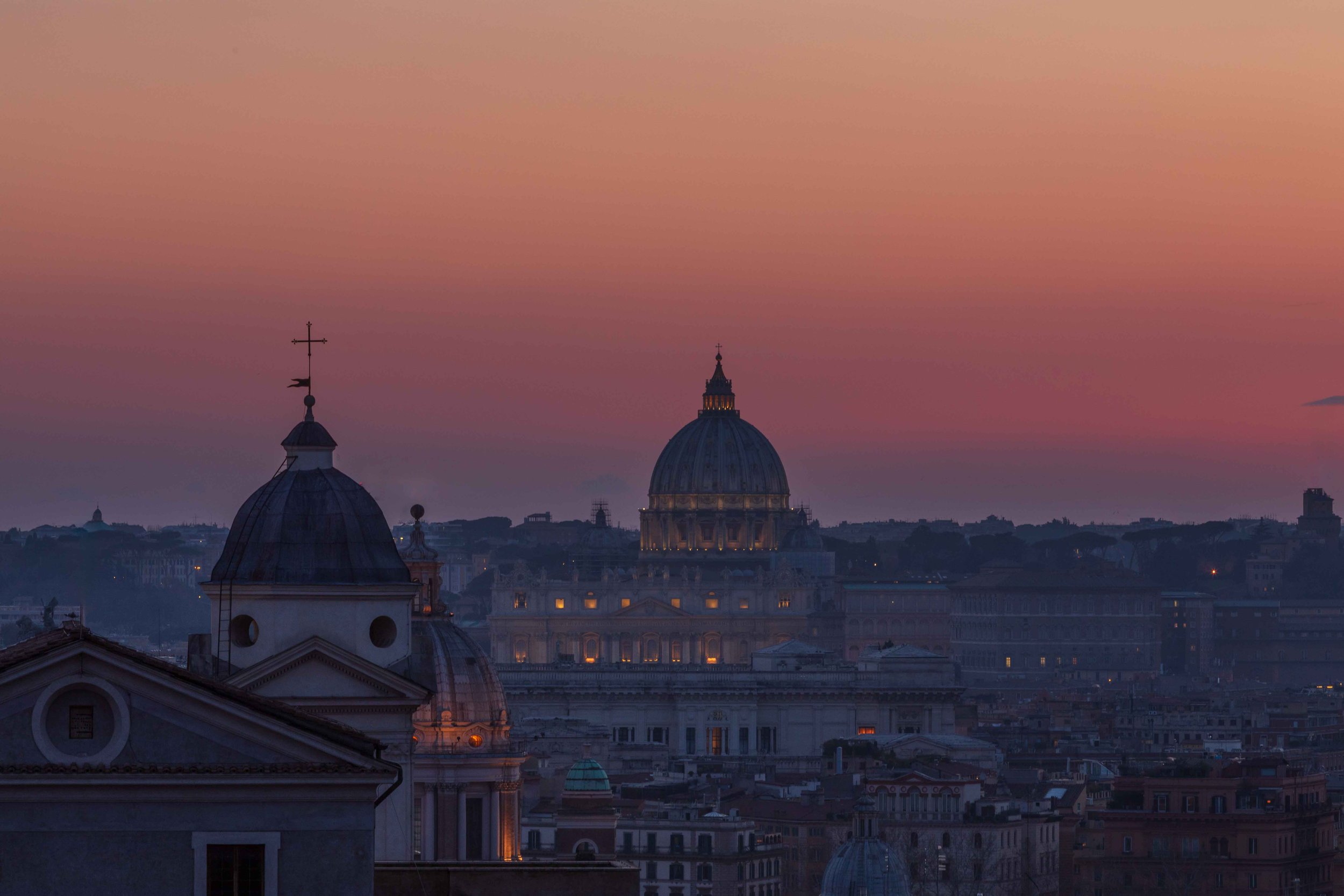
The View from Hotel Eden
Luxury Hotels in Rome
Hotel Eden Rome (Dorchester Collection, Via Ludovisi) — One of Rome's great hotels, with a rooftop terrace that delivers a sweeping view over the city at sunset. This is a place that earns its reputation. The location near the Borghese Gardens gives you good access to the north end of the city.
Hotel de Russie (Rocco Forte, Via del Babuino) — Positioned between Piazza del Popolo and the Spanish Steps, this hotel has a lush secret garden that feels entirely removed from the chaos of the city outside. Elegant without being cold.
Bulgari Hotel Roma (Via del Gesù) — Opened inside a 15th-century palazzo, this is one of the newer additions to Rome's luxury scene and already one of the best. The rooftop terrace has panoramic views over all of Rome. Worth it if you want to shoot the skyline from a private perch.
Six Senses Rome (Via del Corso) — Set inside the 15th-century Palazzo Salviati Cesi Mellini, this is a genuinely beautiful property on one of Rome's main arteries. The wellness focus makes it a strong choice for a longer stay.
The Portrait Rome (Via Condotti) — Owned by the Ferragamo family and set on Rome's most exclusive shopping street, this is a refined, intimate option for those who want luxury without scale.
Mid-Range Hotels in Rome
Hotel Artemide (Via Nazionale) — Centrally located, well-run, and comfortable. Via Nazionale puts you within easy walking distance of most of Centro Storico.
Nerva Boutique Hotel (Via Tor de' Conti) — Right next to the Roman Forum. Wake up early, walk downstairs, and you are at one of the best photography locations in the world before the crowds arrive. For photographers, this location is almost strategic.
Albergo del Senato (Piazza della Rotonda) — Sitting directly across from the Pantheon, this is one of those hotels where the view from the room is the amenity. Mid-range price, unforgettable address.
How Long Should You Stay in Rome
Four to five days is the right amount of time for Rome. Three days is possible but you will feel rushed, and Rome does not reward rushing. With four or five days, you can shoot the major locations at the right time of day, revisit the ones that surprised you, and still have time to get lost in a neighborhood without a plan.
A rough outline: spend your first morning at the Vatican and St. Peter's Square at sunrise, your second at the Colosseum and Roman Forum, your third at the Pantheon, Piazza Navona, and Trevi Fountain before 7am. Save your afternoons for the churches, the smaller piazzas, street photography in Trastevere, and long lunches. Ponte Umberto I at sunset deserves its own evening.
If you have a fifth day, consider a half-day trip to Ostia Antica or Tivoli. Both are accessible by public transit and both are exceptional for photography.
Best Time to Visit Rome
April through June and September through October are the best windows for Rome photography. The light is warm, the days are long, and the heat has not yet turned the city into an oven. April is exceptional: spring blooms around the Borghese Gardens and the Circus Maximus, and the quality of light in the late afternoon is some of the best you will find anywhere in Europe.
September is my personal favorite. The summer crowds thin out, the light turns golden earlier in the evening, and the city settles back into its own rhythm. You can shoot the Trevi Fountain at 6am and have it nearly to yourself.
Avoid July and August if you can. The heat is punishing, the crowds are at their worst, and early morning is your only real window for photography. If you go in summer, plan your shoots for before 8am and after 7pm, and accept that midday is for air conditioning and a long lunch.
Holy Week deserves a special mention. If you have never been to Rome in the week leading up to Easter, put it on your list. The processions, the ceremonies at St. Peter's, the pilgrims from every country in the world gathered in the square for the Pope's address: it is one of the most photographically and spiritually charged environments I have ever stood in. The city feels different during Holy Week. Quieter in some ways, more concentrated. If you are going to be in Rome once, and you can choose your timing, consider this.
Winter (November through February) has its rewards: few tourists, dramatic skies, and Christmas at the Vatican is genuinely moving. Golden hour arrives early, which means you do not need a 5am alarm to catch good light.

Getting to Rome
Most international flights arrive at Fiumicino Airport (FCO), also called Leonardo da Vinci Airport. This is your best option and the one I use. It is about 30 kilometers from the city center.
The Leonardo Express train runs directly from Fiumicino to Roma Termini (the main train station) in about 32 minutes and runs every 30 minutes. It is efficient, reliable, and your best option if you are traveling with a carry-on. If you are traveling with heavy camera gear, a private transfer or taxi is worth the premium. Licensed taxis from Fiumicino to the city center operate on a fixed rate; confirm the rate before you get in.
Ciampino Airport (CIA) handles mostly budget carriers. It is closer to the city but less convenient overall. Shuttle buses run to Roma Termini, or you can take a taxi.
Tour Recommendation VisitRome
If you would rather hand the logistics to someone else, especially for the Vatican, the Colosseum, or the Borghese Gallery, a guided tour is worth considering. Skip-the-line access alone can save you two hours at peak sites. For curated options that go beyond the standard tourist circuit, explore some of the best tours in Rome at VisitRome.com.

Getting Around Rome
Walking is how you see Rome. Most of Centro Storico is best explored on foot, and many of the best photography locations are within 20 to 30 minutes of each other. Wear comfortable shoes. Cobblestones are hard on your feet and your tripod legs.
The Metro has two useful lines for photographers: Line A hits the Spanish Steps (Spagna), the Vatican area (Ottaviano), and connects to Termini. It is useful for covering distance, but the most interesting neighborhoods are rarely at a Metro stop.
Buses cover the city thoroughly but can be slow in traffic. Useful for getting to Trastevere or the Borghese area when you do not want to walk.
Uber operates in Rome and is reliable. Standard taxis are also plentiful. For longer hauls with gear, I prefer a taxi or Uber over the Metro.
Renting a scooter is a Roman rite of passage, and I will not talk you out of it. Just know that Rome's traffic is genuinely chaotic, ZTL (restricted traffic zones) cover much of the historic center, and you cannot bring a scooter into most of the areas you want to photograph anyway. Enjoy it for the outer neighborhoods.

Where to Eat in Rome?
Roman food is one of the great arguments for staying an extra day. The cuisine is specific and unapologetic: pasta made four or five ways, fried artichokes, offal, cured meats, and bread that does not need anything on it.
The one thing I cannot leave Rome without eating is Cacio e Pepe. Every visit. Lunch, dinner, sometimes both. If you have never had it made properly in Rome, nothing else I tell you about this city matters as much as finding a good bowl of it.
Vito's Favorite Food Stops in Rome
🍝 Dillà — Favorite restaurant near the Spanish Steps.
🍕 Bonci Pizzarium — Best pizza by the slice.
☕ Sant'Eustachio Il Caffè — Favorite espresso.
🍨 Gelateria del Teatro — Favorite gelato.
🥐 Forno Campo de' Fiori — Favorite bakery.
🛒 Roscioli — Favorite deli, wine bar, and restaurant.
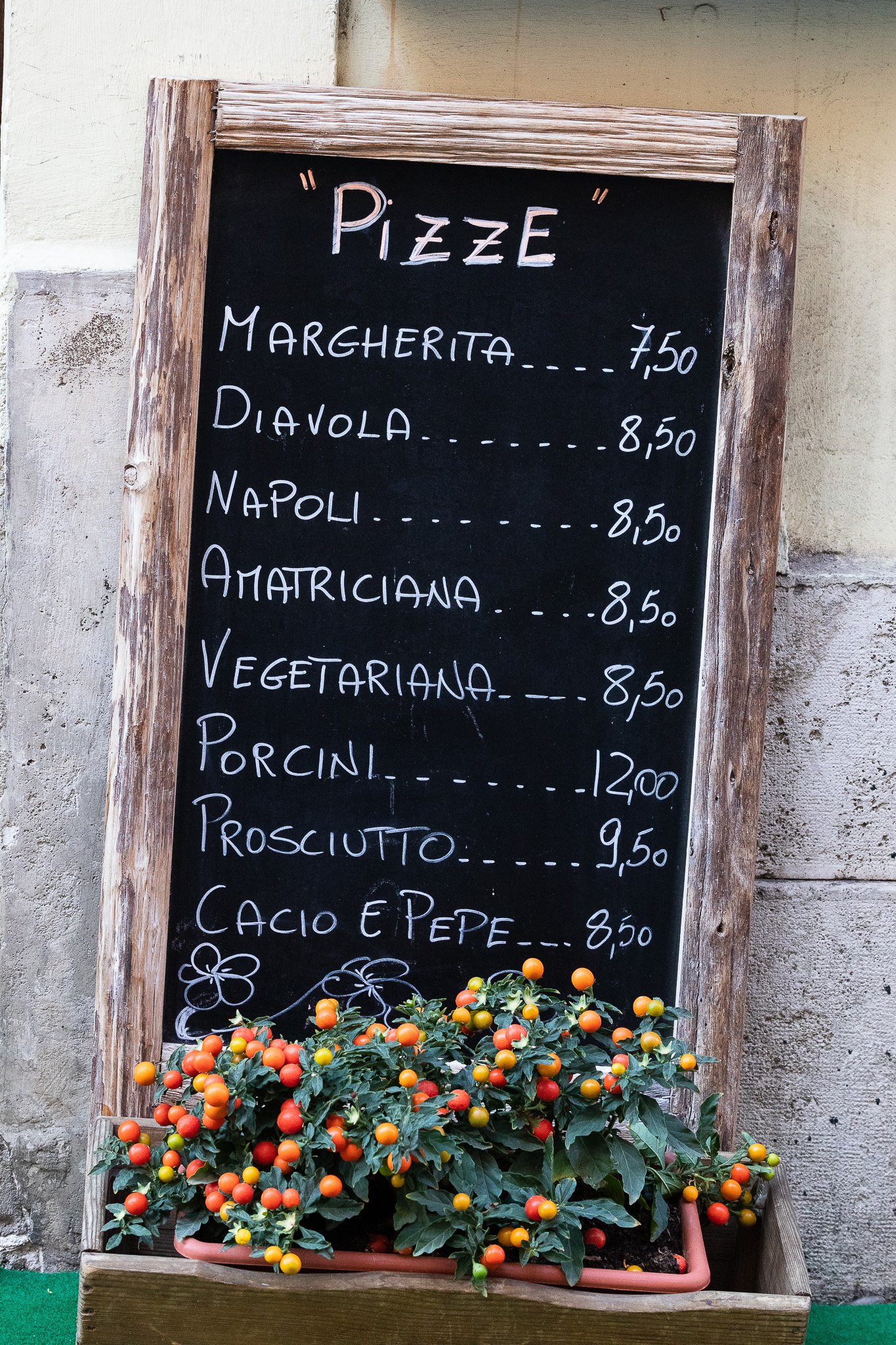
There is Pasta and then Pasta in Italy
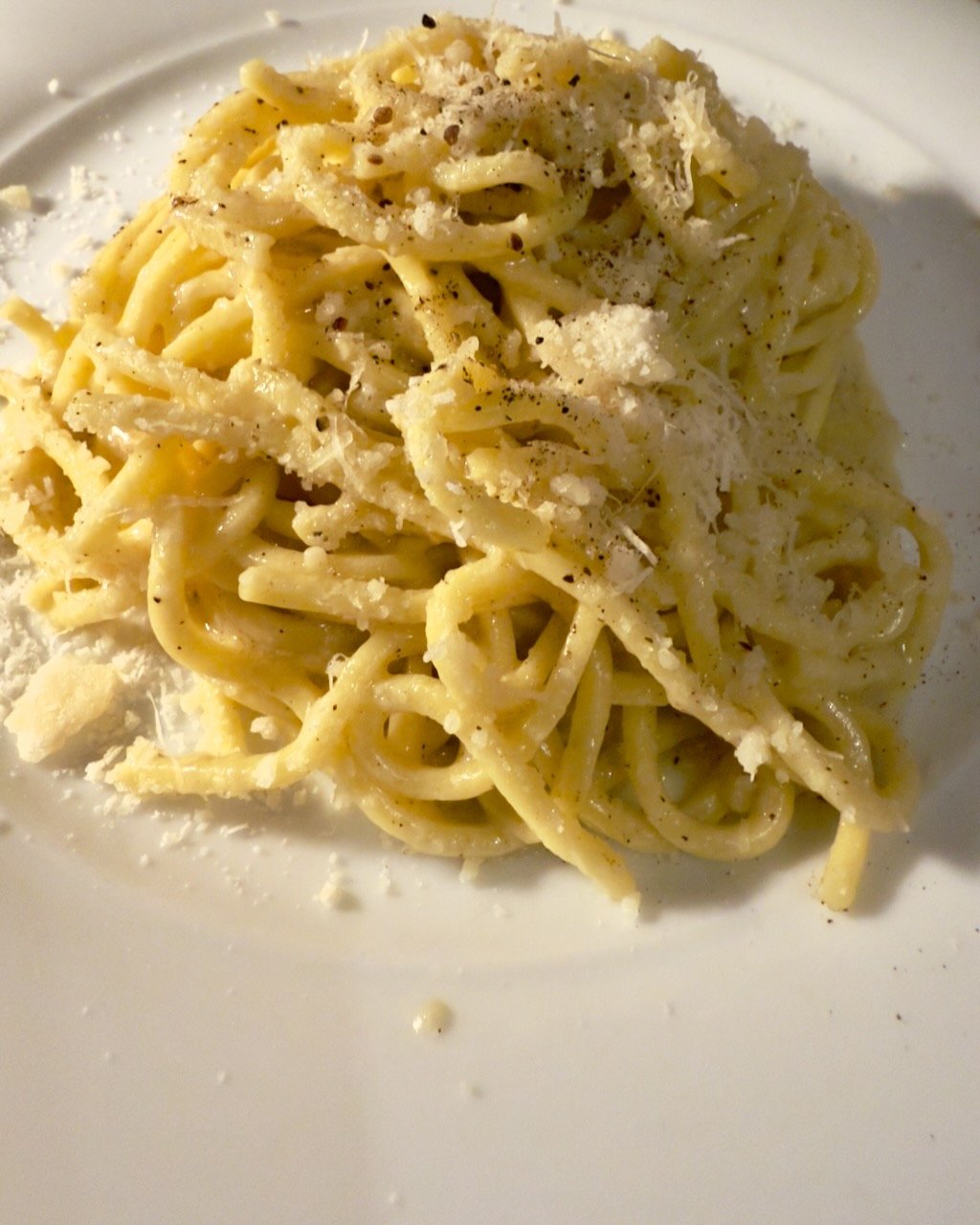
There are so many different shapes of varieties of pasta in Italy.

Da Enzo al 29 (Trastevere) — A classic Roman trattoria that does the basics better than almost anyone else. Carbonara, cacio e pepe, carciofi. Reserve in advance; this place books out.
Roscioli (Via dei Giubbonari) — Part salumeria, part restaurant, entirely essential. The pasta here is serious, the cheese and charcuterie selection is one of the best in the city, and the wine list rewards attention. Reserve ahead.
Piperno (Via Monte de' Cenci) — One of Rome's most respected Jewish-Roman restaurants, in the Ghetto neighborhood. The carciofi alla giudia, fried whole and crisped at the edges, is a dish worth planning a trip around.
Armando al Pantheon (Salita dei Crescenzi) — Literally steps from the Pantheon. Family-run, warm, and serves traditional Roman food without any tourist-trap shortcuts. Reserve well in advance; it is small and fills up.
Trapizzino (Multiple locations) — Street food at its best. Triangular pockets of pizza dough filled with traditional Roman stews (coda alla vaccinara, pollo alla cacciatora). Cheap, fast, and genuinely delicious.
200 Gradi (Prati neighborhood, near the Vatican) — One of the best sandwiches I have had in Rome. Fresh ingredients, generous portions, fast service. Perfect before or after a Vatican visit.
Dillà - Just a short walk from Piazza di Spagna, Dillà combines traditional Roman cooking with a modern touch in a warm, stylish setting. The atmosphere is lively without feeling touristy, the service is excellent, and it's a place I happily return to whenever I'm in Rome. Location: Via Mario de' Fiori 41, just a few minutes from the Spanish Steps.
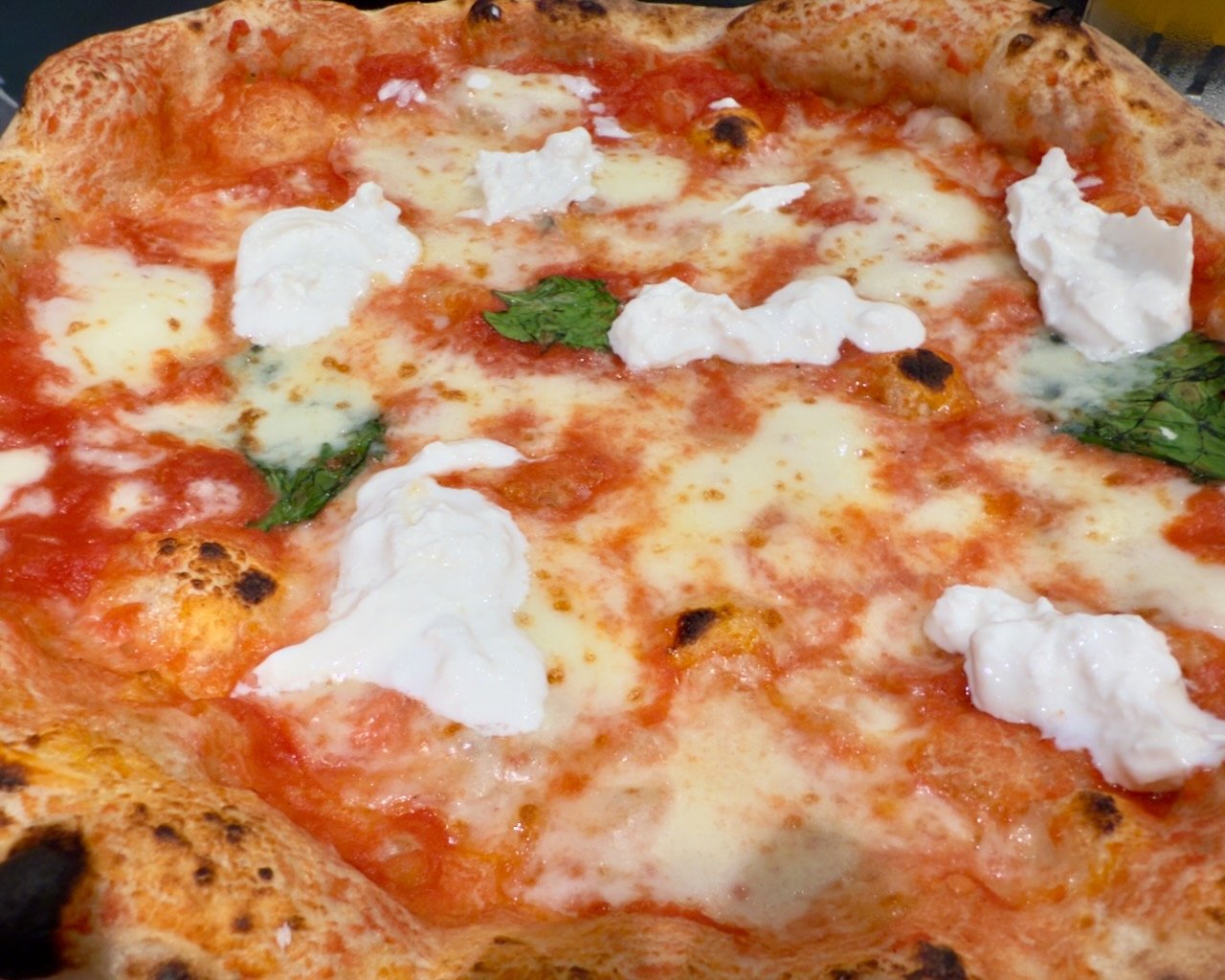
Coffee Shops in Rome
Sant'Eustachio Il Caffè (Piazza di Sant'Eustachio) — Near the Pantheon, famous for its secret coffee preparation. Order the gran caffè. Do not ask them to change anything about it.
Tazza d'Oro (Via degli Orfani) — Another classic near the Pantheon. The granita di caffè in summer is worth the trip alone.
Bar San Calisto (Piazza di San Calisto, Trastevere) — No-frills, cash only, frequented almost entirely by locals. This is where you sit outside with a small espresso and watch Trastevere wake up.

The shop has been open since 1760
The Best Gelato in Rome
Here is my honest take on gelato in Rome: there is no definitive answer. I have spent more visits than I care to count chasing the perfect scoop, and I have come to accept that the rankings shift depending on the flavor, your mood, the weather, and whether you are on your third gelato of the day or your first. Take my favorites as a starting point, not a verdict.
What I can tell you is that searching for the best gelato is one of the best reasons to explore a city. The same way we hunt for the perfect croissant every time we are in Paris, in Rome we hunt for gelato. It takes you off the tourist trail, into neighborhoods you might not have found otherwise, and it almost always ends well.
My flavor of choice is pistachio. Judge everything by the pistachio.
Here are the places I keep coming back to:
Giolitti — One of the oldest gelaterias in Rome, open since 1900. Classic flavors, generous portions, and always reliable.
Il Gelato di San Crispino — Near the Trevi Fountain and famous for using only natural ingredients. No artificial colors, no compromise. The honey flavor alone is worth the trip.
Gelateria del Teatro — Tucked along a cobblestone street near Piazza Navona, this is one of my favorites for creative, artisanal flavors made fresh daily.
Gelateria dal Romana — A Roman institution. The kind of place that has been scooping gelato long enough that the recipe has been handed down more than once.
Fatamorgana — If you want to try something unexpected, this is your place. Unusual flavor combinations that somehow work, made with natural ingredients.
Come il Latte — The name means "like milk," and the gelato here is exceptionally creamy. Worth seeking out near Via Nazionale.

Photography Gear to Bring for Rome
Rome is a city of wide spaces and intimate detail. You will want range.
Camera body: Any current full-frame mirrorless handles Rome well. I shoot with the Canon R5 Mark II. The Sony A7RV, Nikon Z8, and Leica Q3 are all excellent choices. High dynamic range matters here, particularly for interior church photography where the contrast between dark nave and bright windows is extreme.
Wide-angle lens (15 to 24mm): Essential. The Colosseum, St. Peter's Square, and the Piazza Navona fountains all require wide coverage. Inside the churches, you will not be able to back up far enough without it. This is the lens you will use most.
Standard zoom (24 to 70mm): Your workhorse for street photography, the Forum, and anywhere you want compression without going full telephoto. Flexible and fast to adjust.
Telephoto (70 to 200mm): Useful for isolating architectural details on facades and columns from a distance, and for candid street photography where you want to shoot without being obvious about it.
Prime (35mm or 50mm): If you shoot street photography seriously, a fast prime at f/1.4 or f/1.8 is worth the bag space. Rome's narrow alleys and low-light church interiors reward a fast lens.
Tripod: Bring one. Blue hour at the Colosseum, long exposures at the Trevi Fountain, sunrise at the Forum: all of these are better on a tripod. A compact travel tripod is fine.
ND filters (3, 6, and 10 stop): Long exposures at the Trevi Fountain and the Vatican fountains reward ND filtration. A 6-stop at sunrise can turn moving tourists into blur and give you a cleaner frame.
Extra batteries and cards: Long days in Rome mean long shooting days. Bring two extra batteries minimum. Back up to a Samsung T7 SSD at the end of each day.
iPhone Photography Tips
Rome is one of the best cities in the world for iPhone photography, and the scenes here play directly to the iPhone's strengths.
At the Trevi Fountain: Use ProRAW mode if you have it. Shoot from a low angle, close to the water's edge, and let the sculpture fill the upper two-thirds of the frame. The iPhone's wide lens at this distance creates a natural sense of depth that a longer lens cannot replicate.
Inside the churches: Switch to Night mode for interior shots. The iPhone handles the high-contrast lighting in a church nave better than most people expect. Lock your exposure on the brightest window and let the foreground go slightly darker for atmosphere.
Street photography in Trastevere: Use the standard 1x lens rather than ultra-wide for street portraits and alley shots. The perspective is more natural and less distorted. Shoot in the blue hour just after sunrise when the alleys are still in shade and the light at the far end is warm.
Ponte Umberto I at sunset: Switch to Cinematic mode for video, or shoot stills on the 2x telephoto lens. St. Peter's dome at this distance and focal length looks exactly the way it should.
Photography Locations in Rome
My list of the best photography locations in Rome is found below
Interactive Rome Travel & Photography Map
St. Peter's Square and the Vatican
St. Peter's Square is one of the most photographically rewarding locations in Rome, and it is almost entirely dependent on timing. Arrive at sunrise, before 6 am, and you will have Bernini's colonnade and the central obelisk to yourself. The light comes in low from the east and hits the facade of the Basilica directly. The fountains, lit against the pale morning sky, are worth photographing on their own.
The square is vast, which gives you multiple compositions: from the center looking toward the Basilica, from the colonnade looking across to the other side, and from the ground looking up at the statues lining the roofline. Each angle is different. Plan at least an hour.
📷 Pro Tip: Position yourself at the center of the square, aligned with the obelisk and the Basilica facade, for a symmetrical composition. A wide lens at 16 to 24mm works best here. Arrive by 5:30 am in spring and summer; the light moves fast. The colonnade side alleys are also worth exploring for frame-within-frame compositions using the columns. If you are inside the Basilica, the light through the upper windows in the morning is extraordinary; a 24-70mm lens gives you flexibility to shoot the dome from below and the nave from the entrance.
Best time: Sunrise. Access: Free (square); timed entry tickets required for Vatican Museums and Sistine Chapel, book weeks in advance online. Transit: Metro Line A to Ottaviano, then a 10-minute walk.

There are lots of different angles to photograph. I love the fountains.

Vatican Spiral Staircase (Vatican Museums)
This is a double helix staircase located at the exit of the Vatican Museums, near the bookstore and gift shop. It is one of the most photographed architectural details in Rome, and for good reason: the geometry is extraordinary.
The challenge is people. This is a high-traffic location inside one of the busiest museums in the world.
📷 Pro Tip: The only way to photograph this without a crowd is to be at the museum when it opens. Book the earliest available entry time and move directly to the exit staircase before the main flow of visitors arrives. Shoot from directly above, leaning over the railing, with your widest lens, at least 15mm. A vertical orientation works best. Turn off your flash; the natural light from the atrium above is sufficient and more flattering. Watch your exposure: the center of the staircase is darker than the outer edges, and you need detail in both.
Best time: Museum opening, as early as possible. Access: Paid entry to Vatican Museums; book online in advance. Transit: Metro Line A to Ottaviano.
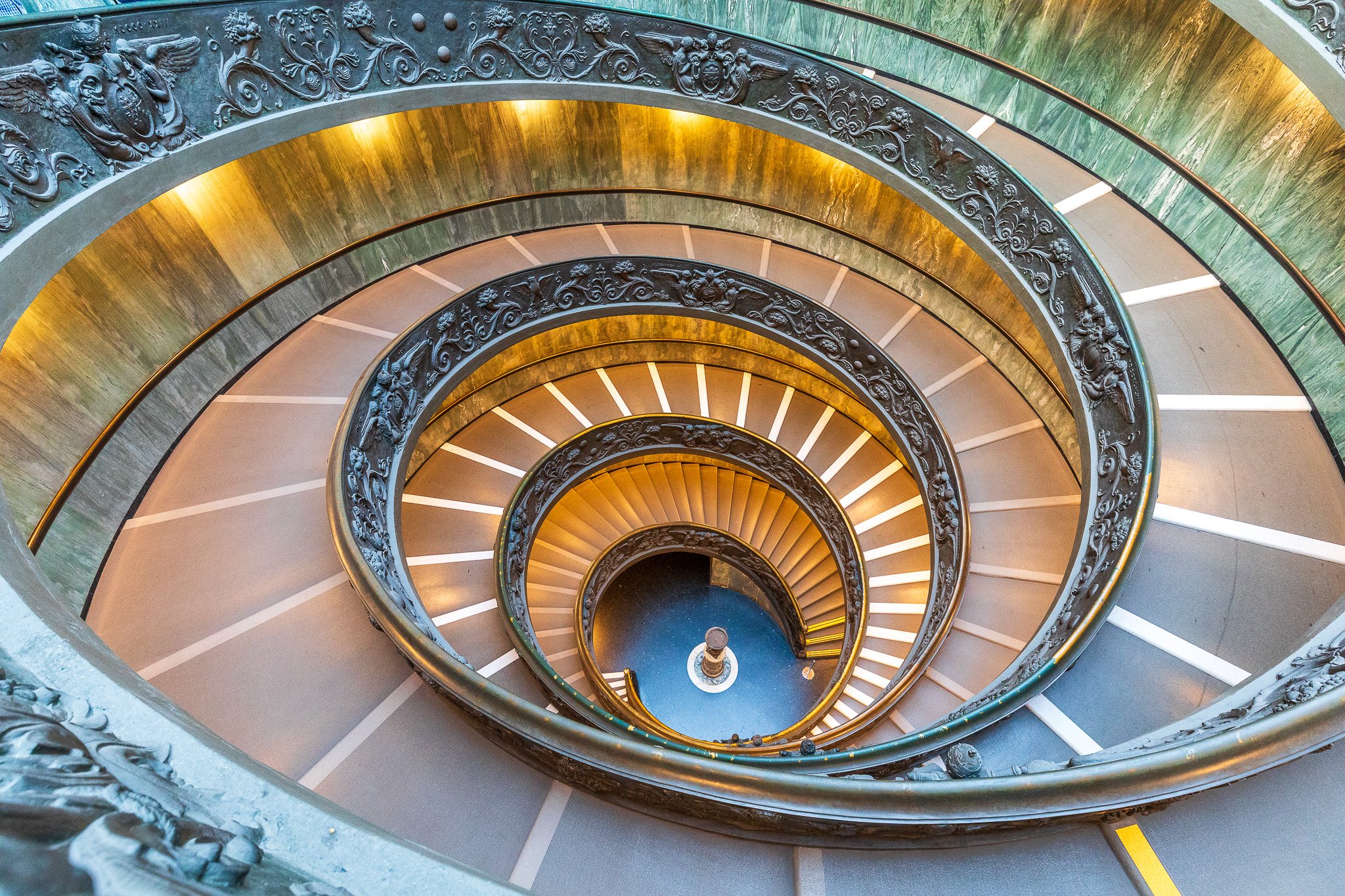
Inside the Vatican Museum
I would highly recommend taking a tour of the Vatican. Some of the private tours will take you to places that are not open to the general public.

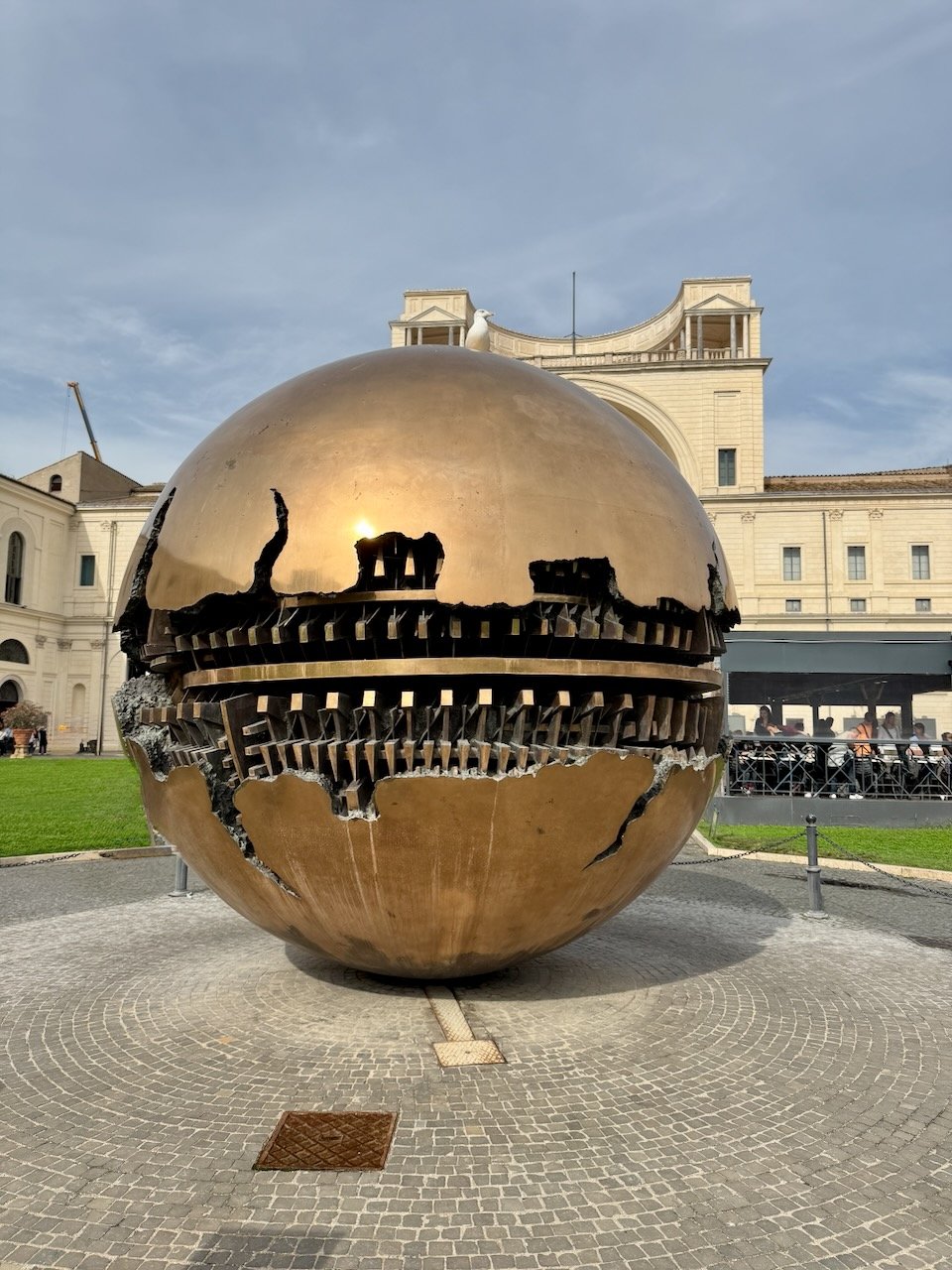


Shots inside St. Peter’s Basilica (Piazza San Pietro, The Vatican)
The inside of the Basilica is incredible. This is a location that I need to go back and photograph again.
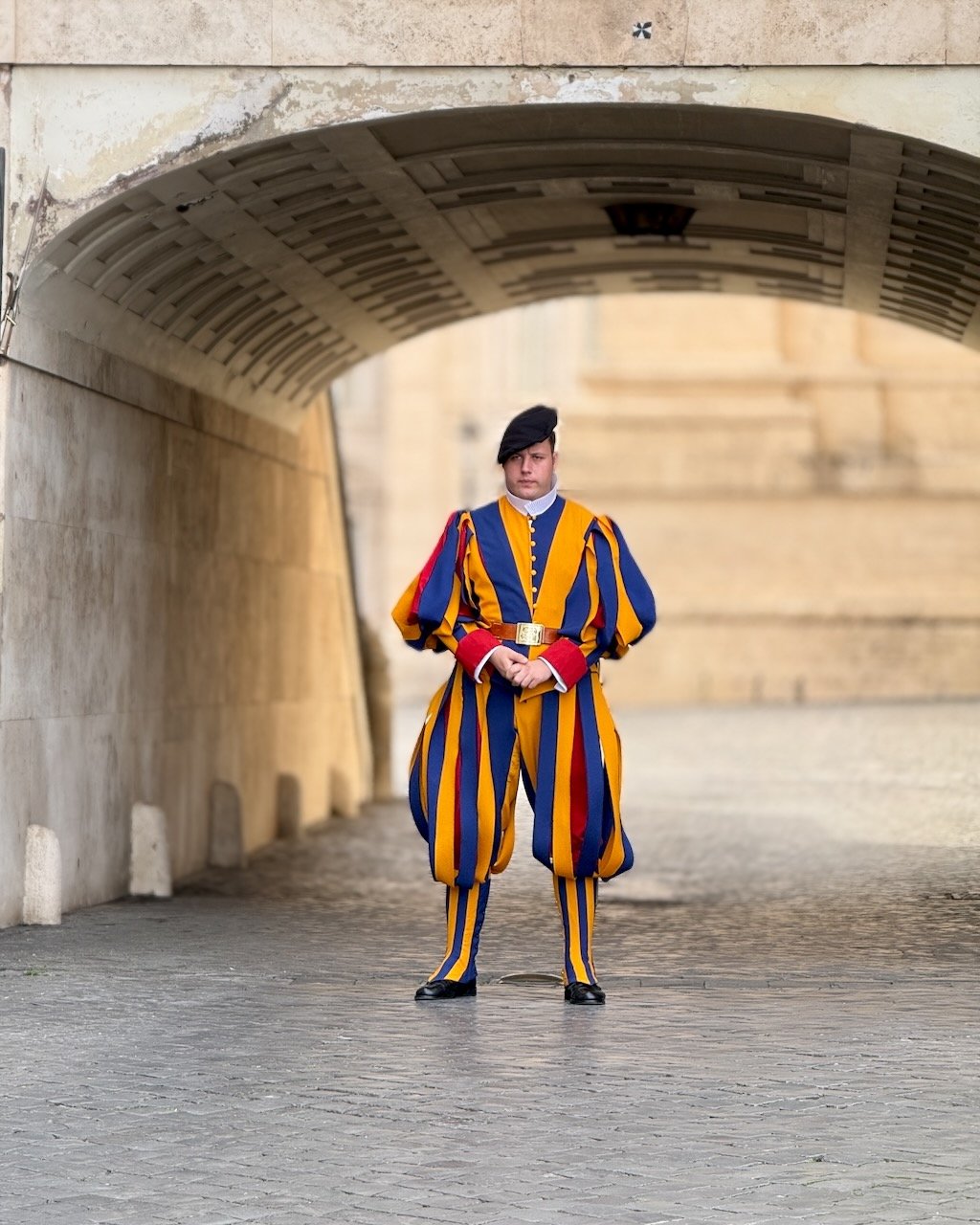
The Swiss Guard
Sistine Chapel
The Sistine Chapel is one of the most famous religious and artistic sites in the world, located in Vatican City. It is known for its stunning Renaissance art, particularly the frescoes by Michelangelo.
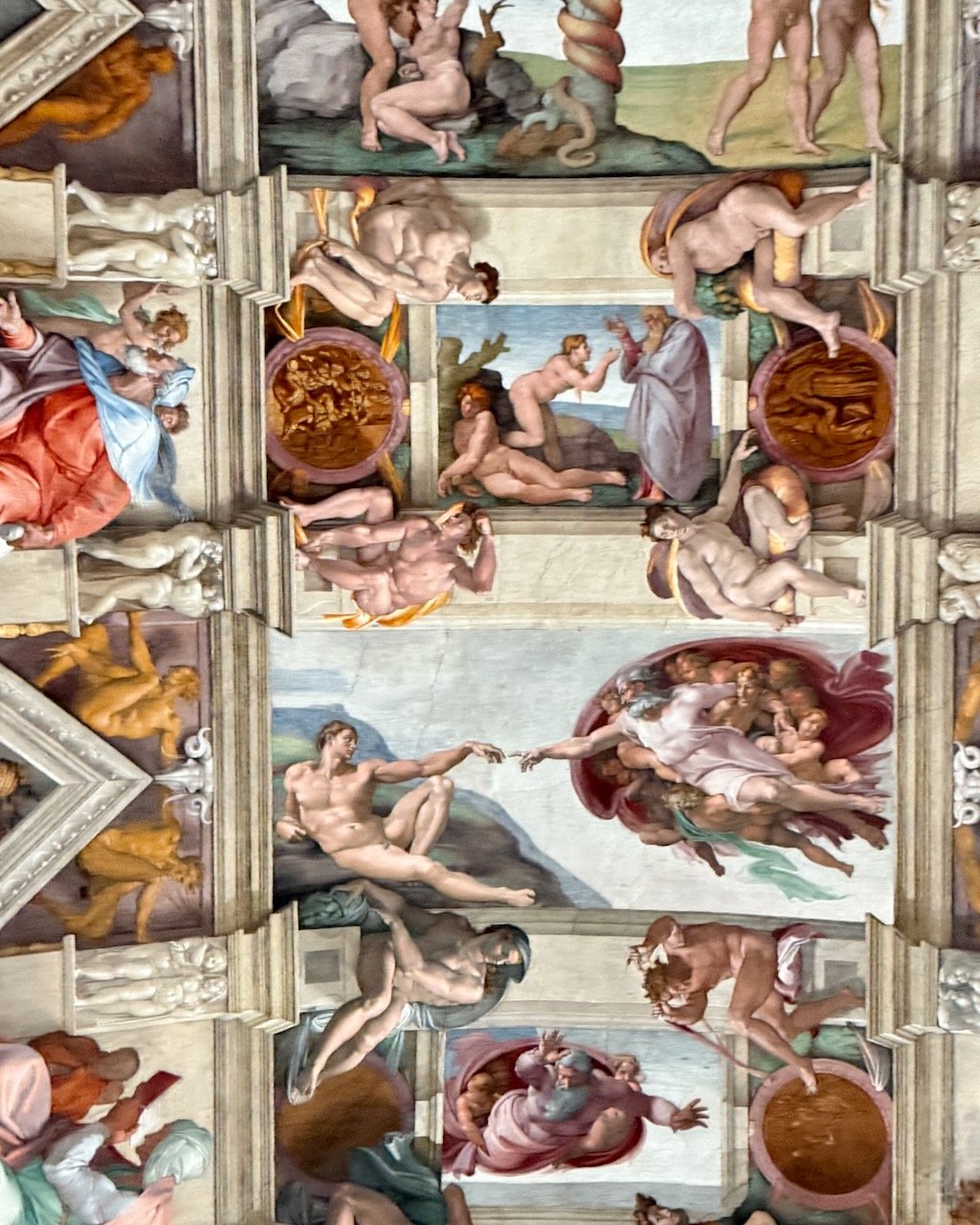
One of the most iconic masterpieces in art history, the Sistine Chapel ceiling was painted by Michelangelo between 1508 and 1512. The ceiling features a series of Biblical scenes, with the most famous being the Creation of Adam, in which God reaches out to touch the hand of Adam.

Ponte Umberto 1
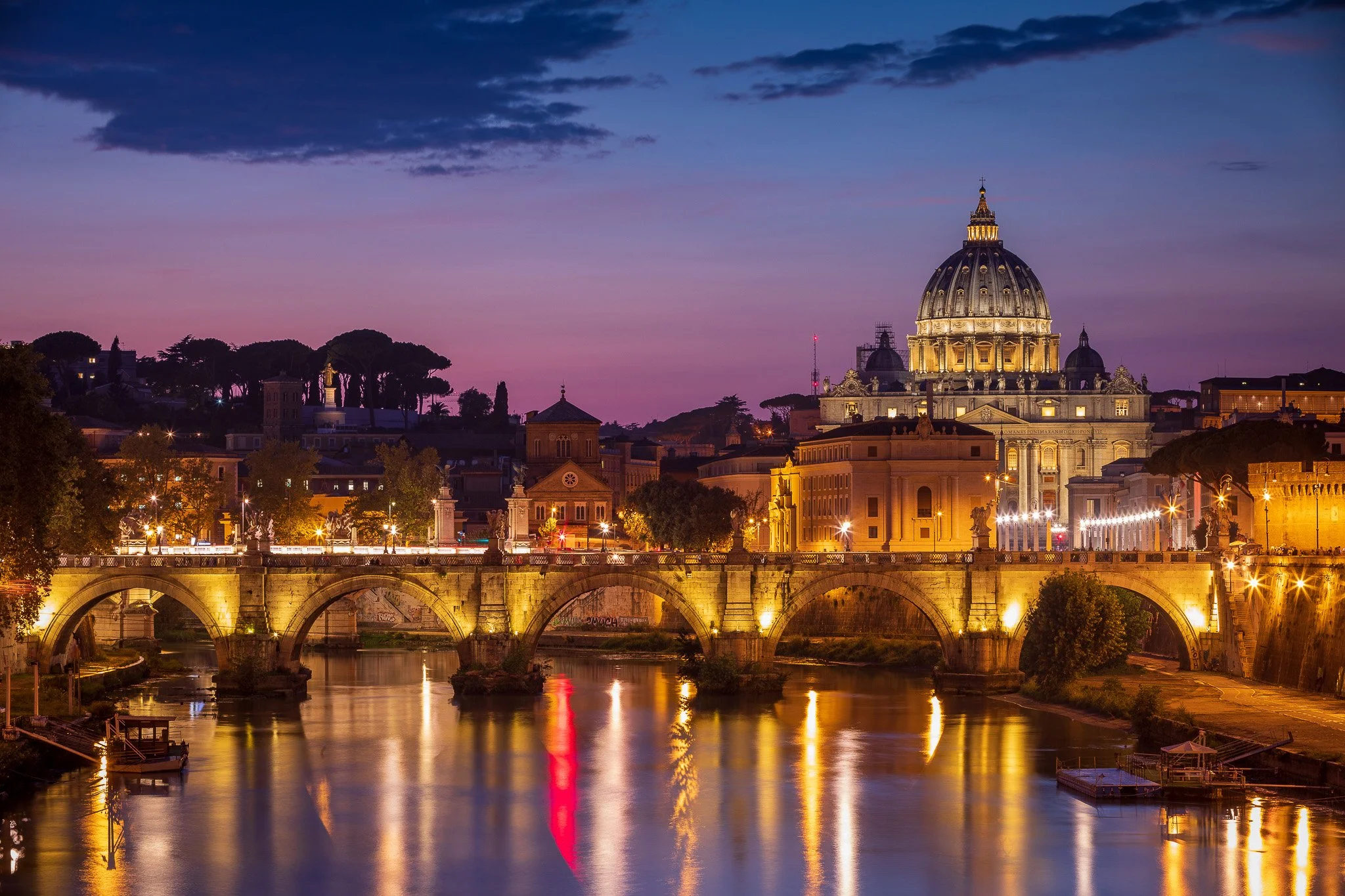
This is my favorite photography location in Rome. It is not the most famous bridge on the Tiber, but for photographers, it may be the best one. Standing on Ponte Umberto I at sunset, looking south toward Castel Sant'Angelo with St. Peter's dome rising behind it in the background, you have one of the great city compositions in Europe.
📷 Pro Tip: Stand on the east side of the bridge, facing south-southwest. At sunset, St. Peter's dome aligns almost perfectly above Castel Sant'Angelo from this position. A 70 to 200mm lens at the longer end compresses the distance between the castle and the dome and makes the composition much more powerful. Shoot in RAW; the dynamic range between the warm sky and the darker bridge structure is significant. Arrive 30 minutes before sunset to check the light direction and adjust your position. The bridge is wide enough that you can experiment with different focal lengths without feeling crowded. Blue hour, about 20 minutes after the sun drops below the horizon, often produces the best colors here.
Best time: Sunset and blue hour. Access: Free. Transit: Walk from Piazza Navona (10 minutes) or take a bus to Lungotevere.
Victor Emmanuel II Monument
Romans call it "The Typewriter." Some call it "The Wedding Cake." Whatever you call it, the Victor Emmanuel II Monument is impossible to miss and impossible to ignore. The white Brescian marble gleams against the warm ochre and terracotta of the surrounding city, and the scale is frankly absurd in the best possible way. Built in the late 19th and early 20th century to honor the first king of unified Italy, it anchors the south end of the Piazza Venezia and marks the point where several of Rome's major streets converge.
For photographers, it is a location that works best at the extremes of the day when the marble catches warm light and the massive scale becomes an asset rather than an obstacle.
📷 Pro Tip: Shoot from the Piazza Venezia at sunset when the white marble turns gold and the columns of the portico glow. A 24-70mm lens at the wider end captures the full facade, but a tighter composition focusing on the equestrian statue of Victor Emmanuel II against the upper colonnade is often more interesting. The free terrace at the top of the monument (accessible by elevator for a small fee) offers one of the best 360-degree panoramic views in Rome, including a direct sightline to the Roman Forum and Colosseum to the east and the dome of St. Peter's to the west. For the exterior, late afternoon light from the west catches the facade most favorably. Avoid the harsh midday light, which bleaches out the marble detail entirely.
Best time: Sunset for exterior; any time for the rooftop panorama. Access: Free exterior; small fee for the rooftop elevator (Vittoriano terrace). Transit: Walk from the Roman Forum (5 minutes) or Piazza Navona (15 minutes).

The Pantheon (Piazza della Rotonda)
The Pantheon has been standing for nearly two thousand years, and walking up to it through the narrow streets of the surrounding neighborhood still produces a genuine jolt of awe. The oculus, the proportions, the sheer weight of the place: there is nothing else like it in the world.
Note: Since 2023, the Pantheon charges an admission fee. It is modest, but plan for it. Hours vary by season; check before you go.
📷 Pro Tip: Arrive at the Piazza della Rotonda at sunrise, before 7 am. The square is quiet at this hour, and the morning light catches the portico columns cleanly. Shoot from the far side of the piazza to include the Egyptian obelisk fountain in the foreground; a 24-35mm lens frames the facade without distortion. Inside, the oculus is the central subject. Position yourself directly beneath it and shoot upward for an abstract composition, or step back toward the entrance and use the floor geometry (the alternating marble patterns) as a leading line toward the altar. The light through the oculus moves across the interior as the morning progresses; this is a location that rewards patience.
Best time: Sunrise exterior; mid-morning interior when light through the oculus is highest. Access: Paid entry. Transit: Walk from the Trevi Fountain (10 minutes) or Piazza Navona (5 minutes).

There are some very interesting fountains in this location

The Roman Forum
For centuries, the Forum was the center of Roman public life. What remains today is a field of columns, arches, and foundations that somehow communicates the scale of what was there. For photographers, it is a study in layers: ancient stone, worn paths, distant domes, and open sky.
The Forum is best photographed at sunrise when the low light creates long shadows between the columns and the site is almost completely empty.
📷 Pro Tip: Enter from the Colosseum side (Via Sacra entrance) and walk west toward the Arch of Septimius Severus. The view back toward the Colosseum from the upper end of the Forum is one of the best compositions in Rome, with columns in the foreground and the amphitheater in the background. Use a 24-70mm and shoot from a slightly elevated position on the path for depth. The golden hour light on the columns from the east is the main event; plan to be there no later than 30 minutes after sunrise. The Palatine Hill above the Forum offers elevated views over the entire site; worth the climb.
Best time: Sunrise. Access: Paid entry; combo ticket with the Colosseum. Transit: Metro Line B to Colosseo, or walk from the Colosseum.
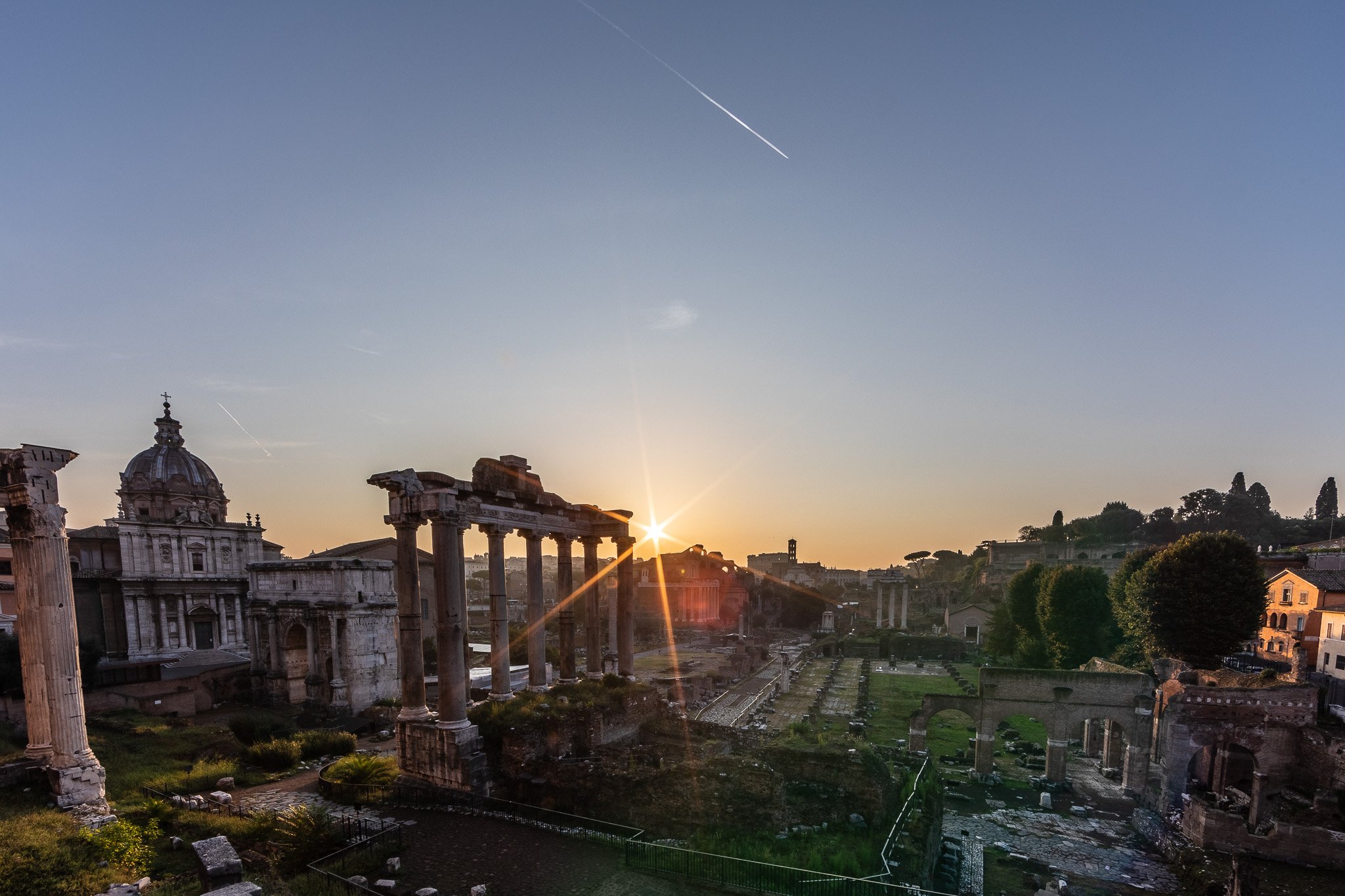
If you go at sunrise, you will have the forum to yourself.

Piazza Navona
Piazza Navona is the most elegant of Rome's great public squares, and it is best experienced at the extremes of the day. Early morning, before the cafés open and the street performers arrive, it is completely still. At night, the Baroque fountains are lit and the surrounding buildings glow.
📷 Pro Tip: Shoot at sunrise with a 16 to 24mm lens from the south end of the piazza, looking north toward the Fountain of the Four Rivers and Sant'Agnese in Agone church beyond it. The axis of the piazza gives you a natural leading line, and the low morning light creates depth across the fountain's sculptural detail. Return at blue hour and shoot from the opposite end; the lit fountains against a deep blue sky are a different and equally strong composition. The fountain basins reflect the surrounding buildings in still conditions; get low to use the reflection as a secondary frame.
Best time: Sunrise and blue hour. Access: Free. Transit: Walk from the Pantheon (5 minutes).

If you are lucky, you might catch a photo of a priest.

With a wide lens at sunrise, you can photograph the entire piazza without the tourists.

The Spanish Steps (Piazza della Trinità dei Monti)
The Spanish Steps connect the Piazza di Spagna at the base to the Trinità dei Monti church at the top in 135 curved and tiered steps, built in the early 18th century. The steps are one of the most iconic public spaces in Rome and, for most of the day, one of the most crowded. The church at the top, with its twin bell towers, frames the view from the piazza below in a way that is immediately compositionally satisfying.
Early morning changes everything here. Before the boutiques on Via Condotti open and before the first tour buses arrive, the steps are quiet and the warm stone catches the low light cleanly.
📷 Pro Tip: Arrive at sunrise and shoot from the base of the steps, framing the Trinità dei Monti church between the staircase balustrades with a 24-70mm lens. The symmetry of the upper steps and the twin towers rewards a centered composition. For an alternative angle, climb to the top and shoot down: the steps cascading toward the Barcaccia fountain in the piazza below, with the city spreading out beyond, is a strong vertical frame with a 35mm prime. The Barcaccia fountain itself, designed by Pietro Bernini, is worth a separate close-up with a wide lens at water level. Return in the evening when the steps are lit and the piazza below fills with people; it is one of the better street photography environments in the city.
Best time: Sunrise for empty steps; evening for atmosphere and street photography. Access: Free. Transit: Metro Line A to Spagna.

Palazzo Sciarrico
Palazzo Sciarra, officially known as Palazzo Sciarra Colonna di Carbognano, is a historic palace located at Via del Corso 239 in Rome's Colonna district. Constructed in the late 16th century for the Sciarra branch of the Colonna family, the palace showcases architectural contributions from Flaminio Ponzio and Orazio Torrioni.

Sant Agnese in Agona church
The Sant'Agnese in Agone is a stunning Baroque church in Rome’s Piazza Navona, known for its dramatic architecture and rich history. Designed by several prominent architects of the 17th century, including Giacomo della Porta, Carlo Rainaldi, and the famous Francesco Borromini, this church showcases the exuberance and intricate detailing characteristic of Roman Baroque art.

Parochial Santa Maria in Via
Santa Maria in Via, often referred to as the "Madonna del Pozzo" (Madonna of the Well), is a historic church located near the intersection of Via del Corso and Via del Tritone in Rome's Trevi district. The church's name, "in Via," refers to its proximity to the ancient Via Flaminia, historically known as "La Via" due to its significance.

Sant Ignazio in Loyola Church
This is one of Rome's most extraordinary interiors and one that many visitors walk past without entering. The ceiling fresco by Andrea Pozzo, painted in 1685, creates a trompe-l'oeil dome that appears to extend the architecture of the church straight into the sky. It is a flat ceiling. The illusion is so complete that most people do not realize this until they look for the dome and cannot find it.
There is a small white disc on the floor of the nave. Stand on it. The ceiling resolves into perfect perspective from that point. Step off it, and the illusion collapses.
📷 Pro Tip: Shoot the ceiling from the white disc on the floor, directly beneath the apparent dome, with a wide-angle lens tilted straight up. A 15 to 20mm focal length captures the full ellipse of the fresco. Shoot in RAW; the interior is lit by a combination of natural and artificial light that creates mixed color temperatures, and you will want the latitude to correct in post. The church is free to enter and is often quieter than more famous churches nearby; visit in the mid-morning when the light through the upper windows is strongest. Tripods are not permitted inside, but you can brace against a pew for stability at a slower shutter speed.
Best time: Mid-morning for interior light. Access: Free. Transit: Walk from the Pantheon (3 minutes).

Andrea Pozzo, a master of perspective painting, created the church’s famous ceiling fresco in 1685. This artwork, titled Apotheosis of Saint Ignatius, is a visual masterpiece that appears to extend the church’s architecture into the heavens. Pozzo used trompe-l'œil techniques to create an optical illusion of a grand dome, and as you stand in the right spot on the floor, the ceiling looks like it opens up to infinity.

One of the most fascinating aspects of the church is its flat “dome.” Instead of a real dome, Pozzo painted a perspective illusion of one on the ceiling, creating a sense of depth that tricks the eye into seeing a three-dimensional structure. The effect is so convincing that many visitors don’t realize it’s flat until they get closer.
Colonna di Marco Aurelio
The Column of Marcus Aurelius stands in Piazza Colonna, one of Rome's busiest and most overlooked piazzas, in the middle of the city's financial and political district. Erected in 193 AD to commemorate Emperor Marcus Aurelius's victories in the northern wars, the column is 30 meters tall and covered in a continuous spiral relief of carved scenes depicting the campaigns. At the top, a statue of Saint Paul replaced the original figure of Marcus Aurelius in the 16th century.
Most visitors walk past it on the way somewhere else. That is a mistake. Viewed up close, the carved reliefs are extraordinarily detailed and tell a coherent visual story that spirals from ground level to the sky.
📷 Pro Tip: Shoot from the base of the column looking straight up with a wide-angle lens at 16 to 20mm for a dramatic foreshortened perspective that makes the column appear to disappear into the sky. A circular polarizer helps manage reflections and deepens the blue sky contrast if shooting on a clear day. The surrounding piazza includes a central fountain and is framed by the Palazzo Chigi on one side; a wider composition including the piazza context gives the column a sense of place. Early morning and late afternoon produce the best side light across the carved relief surfaces, making the sculptural detail readable. Midday flat light flattens the relief entirely.
Best time: Early morning or late afternoon for raking light on the relief. Access: Free. Transit: Walk from the Pantheon (5 minutes) or Piazza Navona (8 minutes).

Sant’Ivo alla Sapienza Church
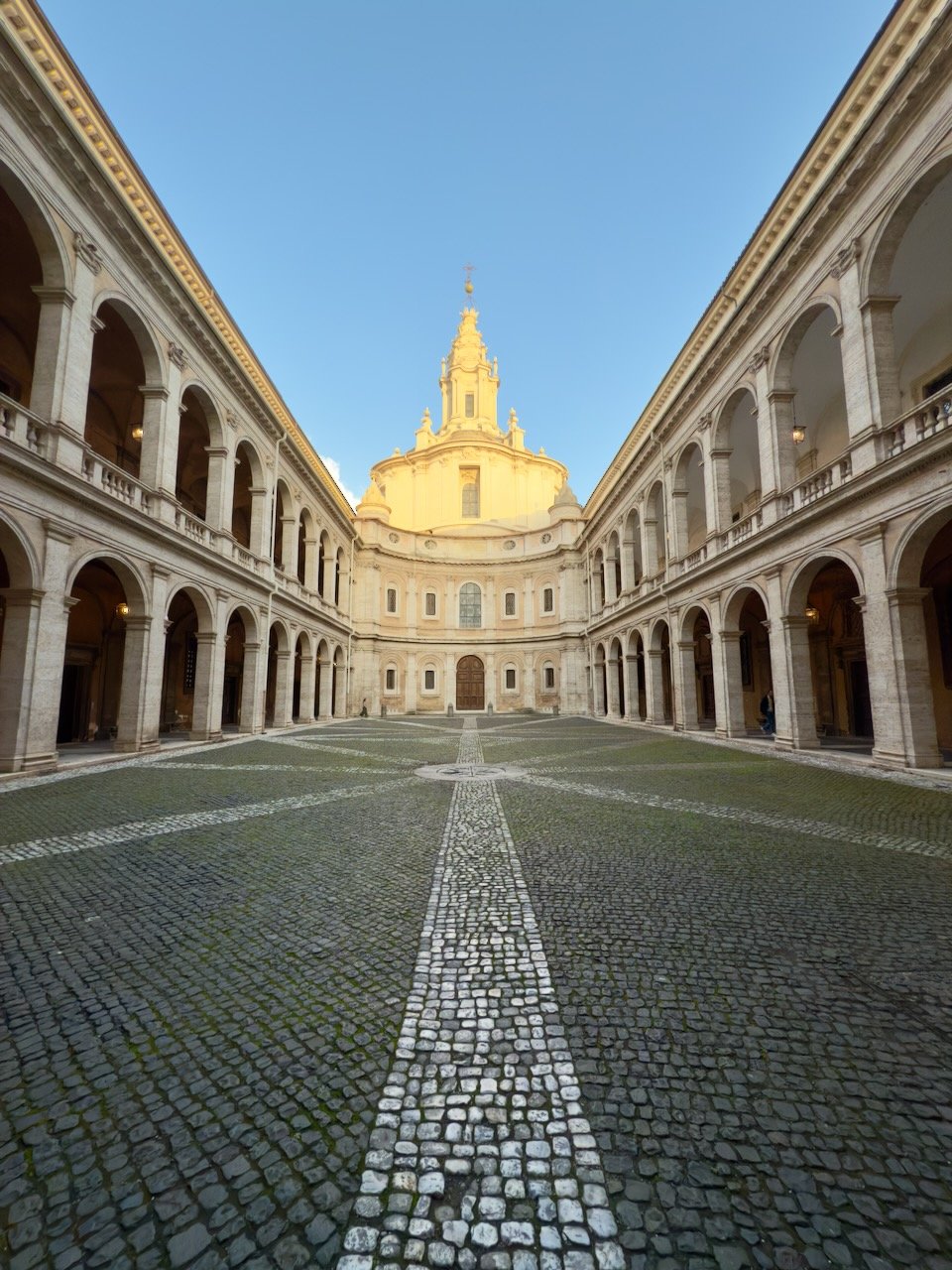
Sant'Ivo alla Sapienza is Francesco Borromini at his most inventive. Built in the mid-17th century inside the courtyard of the Palazzo della Sapienza, the former seat of Rome's university, the church is tucked away enough that many visitors never find it. That is their loss. The exterior spiral lantern on the roofline is one of the most unusual silhouettes in Rome. The interior is a geometric masterpiece: a floor plan based on a six-pointed star, walls that curve and fold in ways that feel simultaneously mathematical and organic, and light that floods the white surfaces from windows you cannot quite locate.
Standing inside and looking up, you feel the architecture working on you. It is not a large space, but it is a deeply considered one.
📷 Pro Tip: The courtyard arcade outside the church is worth photographing on its own: a long, symmetrical portico with repeating arches that rewards a wide lens and a centered composition. For the interior, position yourself near the entrance and shoot toward the altar to capture the full depth of the floor plan. A 16 to 24mm lens works well here. The white walls and dome reflect light evenly, so exposure is more forgiving than in darker churches, but shoot in RAW to manage the contrast between the bright dome and the shadowed lower walls. The church has limited opening hours; check current times before visiting, as it is not open every day.
Best time: Mid-morning when natural light fills the dome. Access: Free; verify current opening hours before visiting. Transit: Walk from the Pantheon (5 minutes) via Corso del Rinascimento.
Castello Angelo
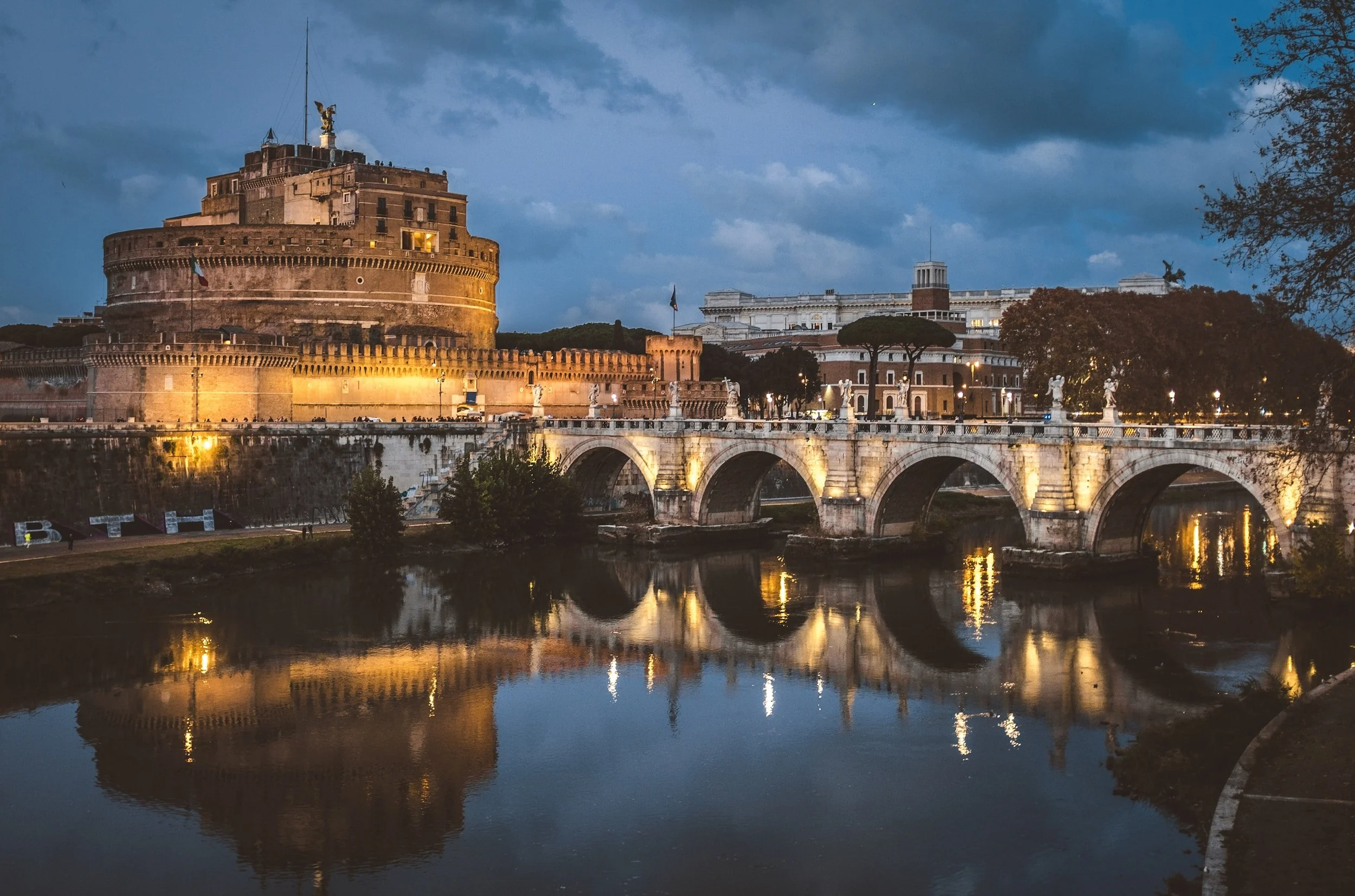
Castel Sant'Angelo started as the mausoleum of Emperor Hadrian in 135 AD and spent the next two thousand years being repurposed: papal fortress, prison, military stronghold, and now a museum. The building has a mass and presence on the Tiber that nothing else in Rome quite matches. The cylindrical form, the angel statue on top, the bridge of angels leading to it across the river: this is one of the great riverside compositions in any city in Europe.
The Ponte Sant'Angelo, the pedestrian bridge lined with Bernini-designed angel statues leading up to the castle entrance, is a location in its own right. Each angel holds an instrument of the Passion, and the figures are expressive and photographically rich at close range.
📷 Pro Tip: For the classic exterior shot, position yourself on the Lungotevere embankment to the east of the bridge, shooting west at golden hour with the castle lit from the side and the Tiber in the foreground. A 70 to 200mm lens compresses the castle against the sky and eliminates the modern riverbank clutter. For the angel statues on the bridge, shoot at ground level with a 35 to 50mm lens; the statues are tall enough that a slight upward angle makes them monumental. At night, the castle is dramatically floodlit; a tripod and a 30-second exposure captures the reflection in the Tiber if the water is calm. For the view from the top of the castle, bring a 24-70mm and shoot toward St. Peter's; the panorama from the terrace is one of the best elevated views of the city.
Best time: Golden hour exterior; night for floodlit reflection shots; daytime for bridge angel details. Access: Paid entry to the museum and terrace; bridge is free. Transit: Walk from Piazza Navona (10 minutes) or Ponte Umberto I (5 minutes).
The Colosseum
The Colosseum is one of the most recognizable structures on earth, and it is possible to make a photograph here that still surprises people if you shoot at the right time and from the right position.
The exterior at sunrise is where I start every visit. The warm light comes in from the east and rakes across the travertine, throwing the arched openings into relief. There is almost no one there at that hour.
📷 Pro Tip: Stand to the south of the Colosseum, facing north-northwest, with the sun rising behind you and to your right. Position yourself so the sun appears just inside one of the upper arched openings for a sunburst effect; a small aperture (f/11 to f/16) with a 24-70mm lens gives you the best result. The Metro station to the west can be used as a foreground anchor with a wide lens. Be aware: the Colosseum frequently has scaffolding on sections of the exterior. Check current renovation status before you plan your shoot, and if necessary, adjust your position to exclude it. Interior photography is allowed but tripods are not permitted inside.
Best time: Sunrise, exterior. Access: Paid entry; book online in advance. Combo tickets include the Roman Forum and Palatine Hill. Transit: Metro Line B to Colosseo.

There is always construction at the Colosseum. So make sure you check it out beforehand so that you do not go at sunrise and find the structure full of scaffolding.

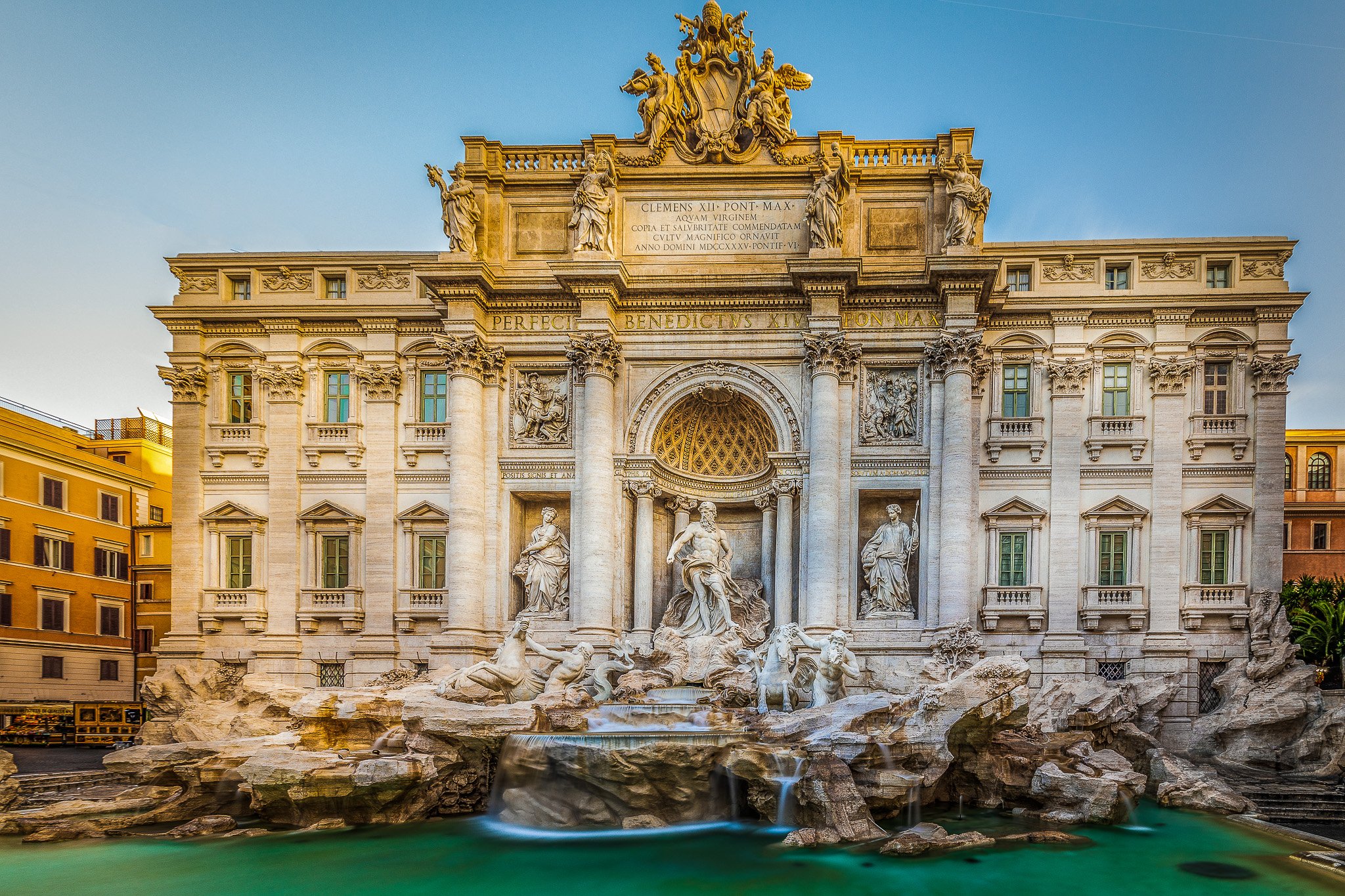
Trevi Fountain
The Trevi Fountain is one of the most photographed locations in Rome and one of the most crowded. The only way to photograph it well is to arrive early.
Note: The city of Rome has piloted timed-entry ticketing for the Trevi Fountain to manage overcrowding. This is likely to become more structured going forward. Check current access requirements before your visit, as the rules may have changed since this guide was written.
📷 Pro Tip: Arrive before 6 am. In the summer months, you may still find a handful of other photographers, but the crowd is manageable. Position yourself on the lower steps, close to the water, and shoot from a low angle with a wide lens (16 to 24mm) to let Neptune and the sculpture fill the upper frame while the water and basin anchor the foreground. A 6-stop ND filter on a tripod will smooth the water surface and, if there are a few people still present, blur them out of the frame over a 10 to 20 second exposure. The fountain is illuminated at night; late evening after 11 pm is also a viable alternative. For iPhone shooters, ProRAW at the water's edge at this hour is hard to beat.
Best time: Pre-sunrise or very early morning. Access: Verify current ticketing requirements. Transit: Walk from the Pantheon (10 minutes) or Spanish Steps (8 minutes).
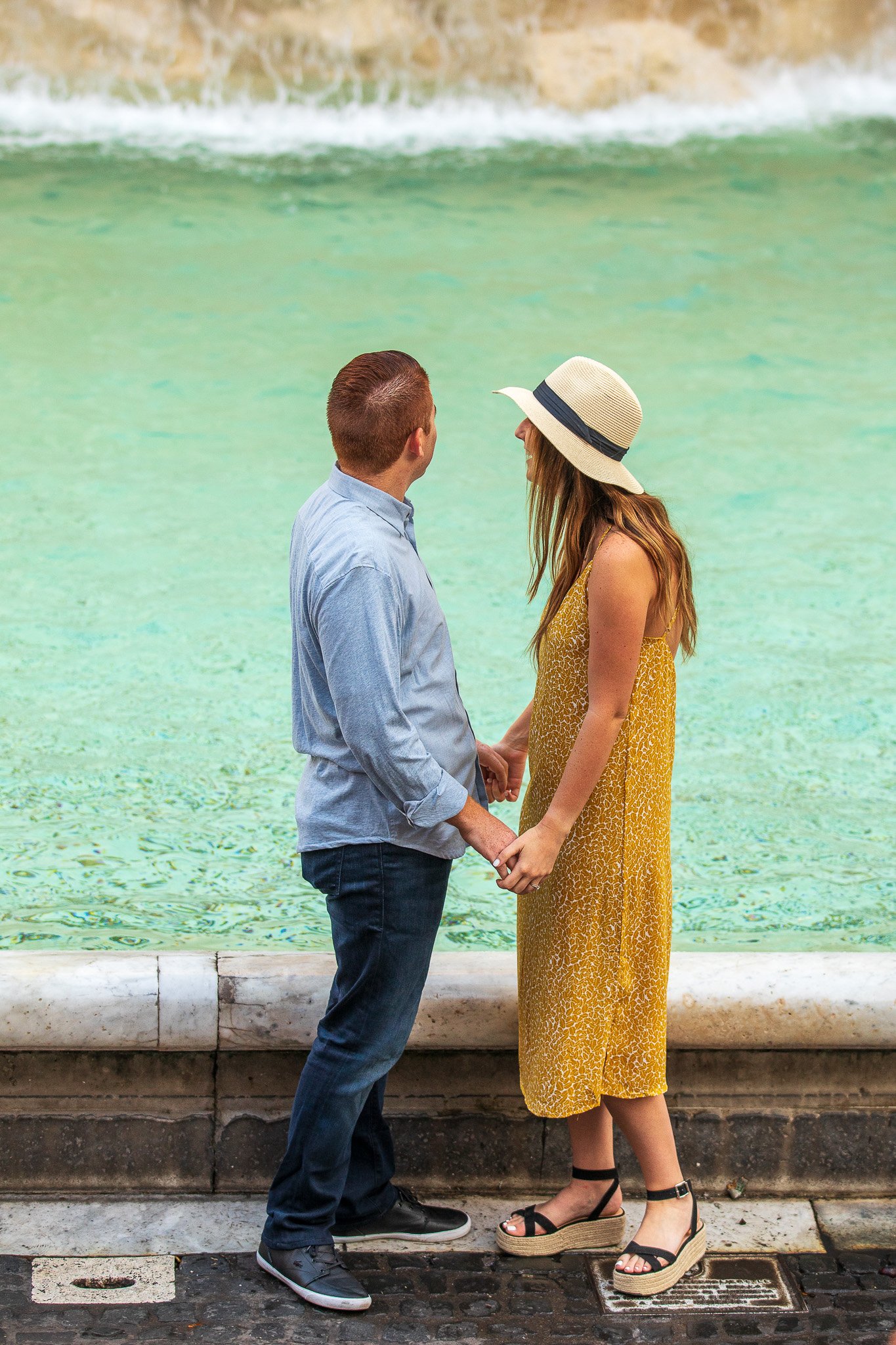
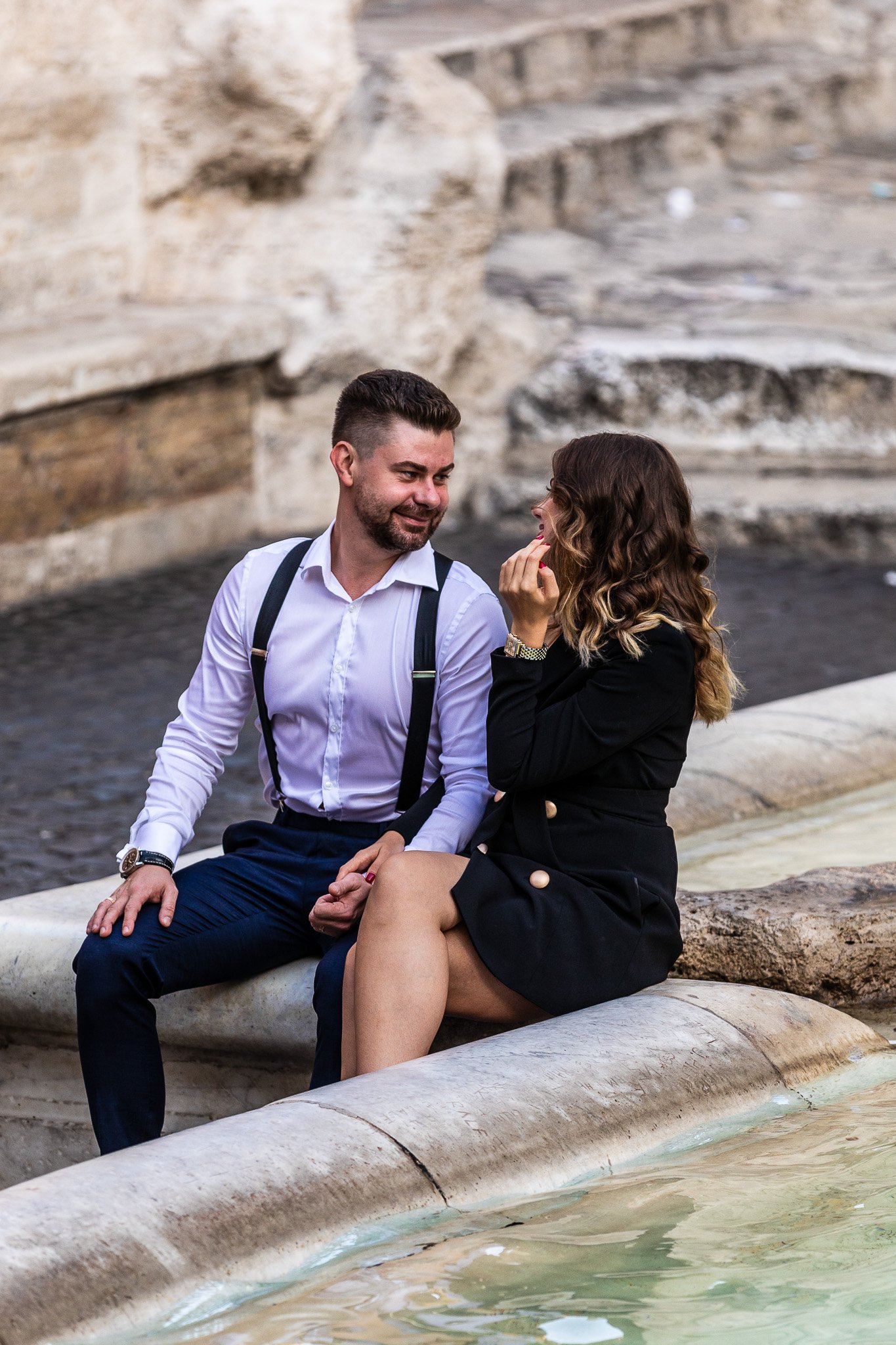
It is also fun to capture couples in this location
Street Photography in Rome
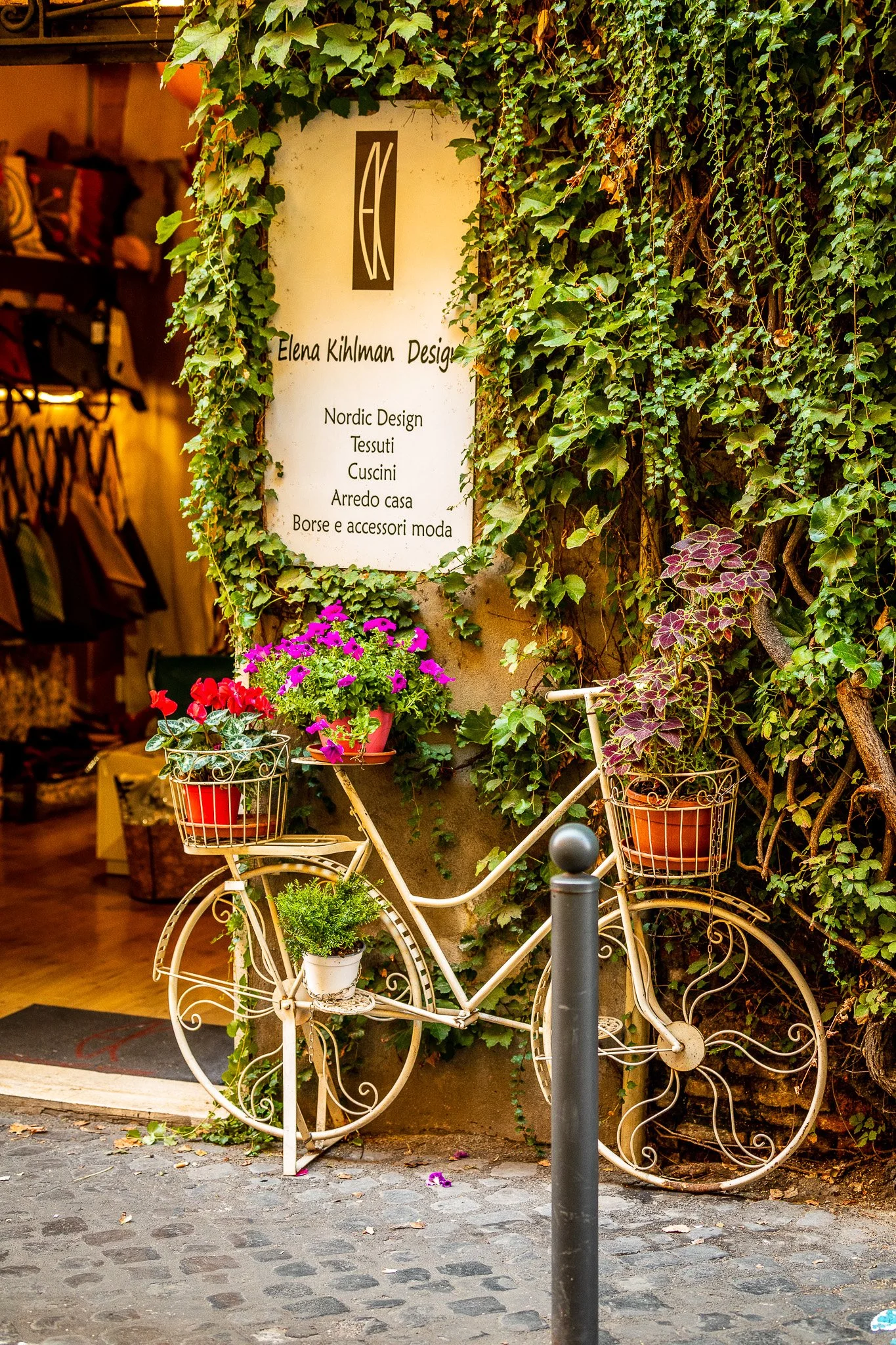
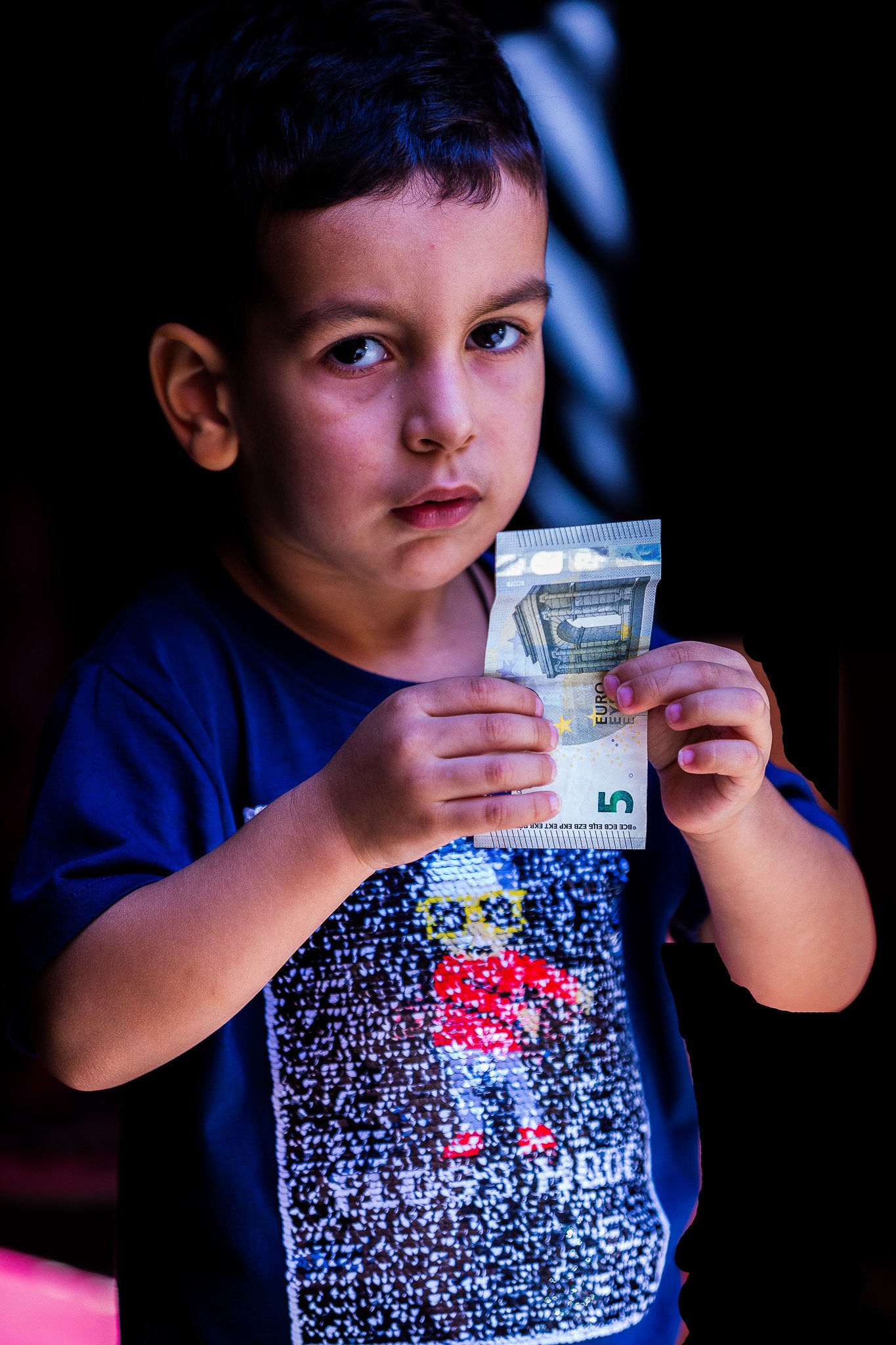
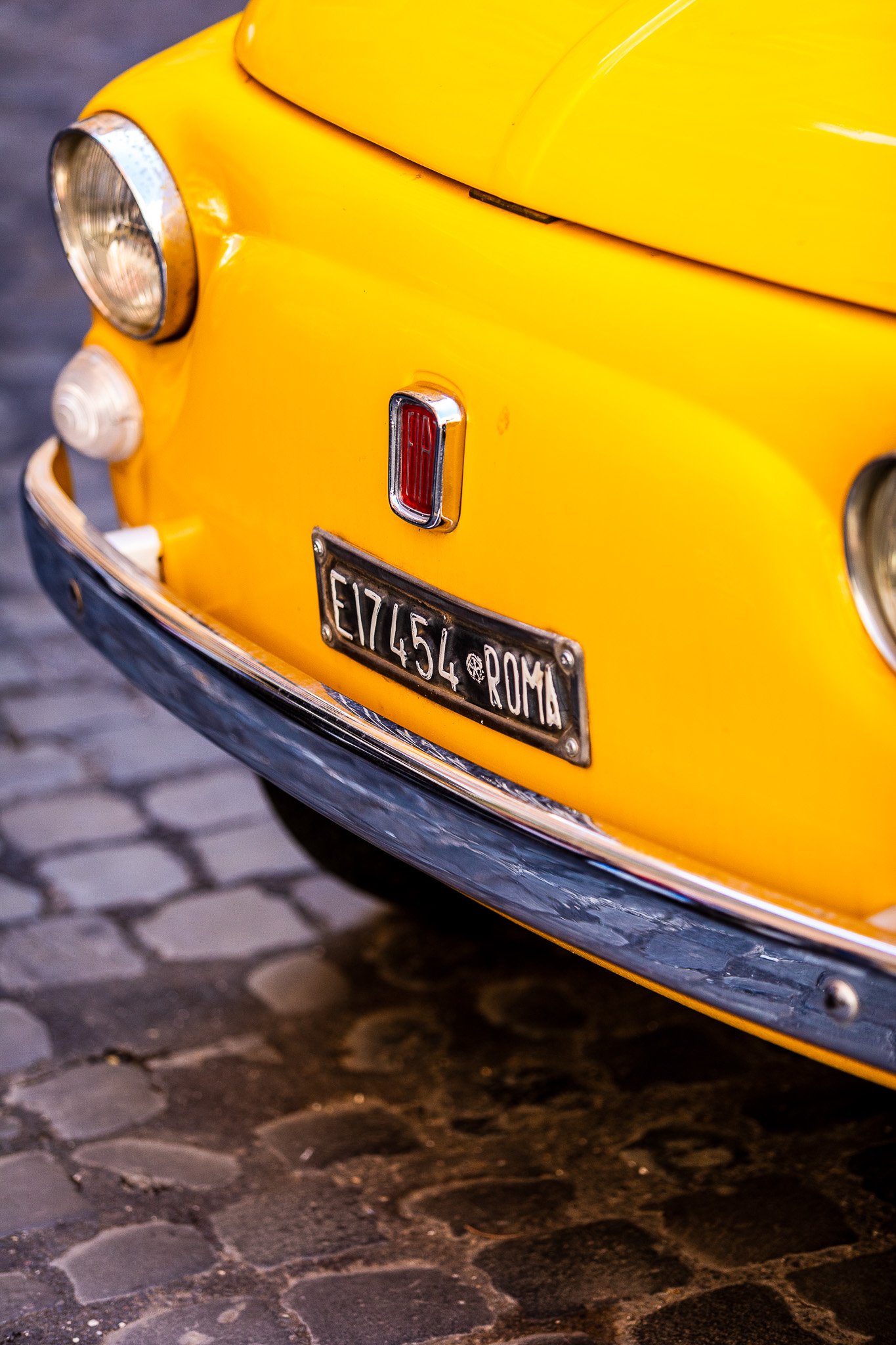
Beyond the iconic landmarks, some of my favorite images have come from wandering quiet streets, watching life unfold in neighborhood cafés, and capturing the daily rhythm of Romans. Early mornings offer beautiful light and peaceful streets, while late afternoons and evenings bring the city to life with conversations spilling onto piazzas, Vespas weaving through narrow lanes, and locals enjoying aperitivo.
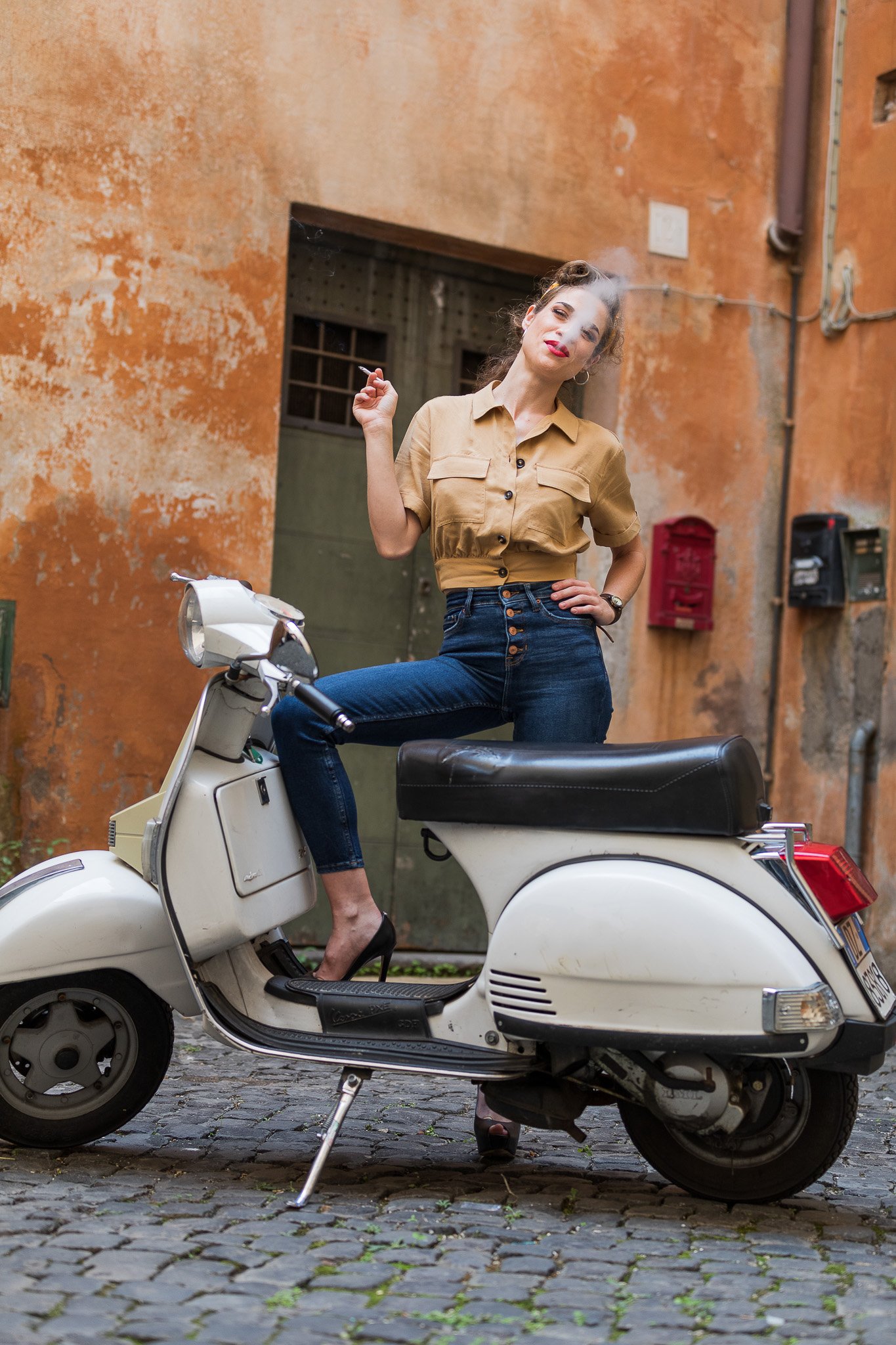
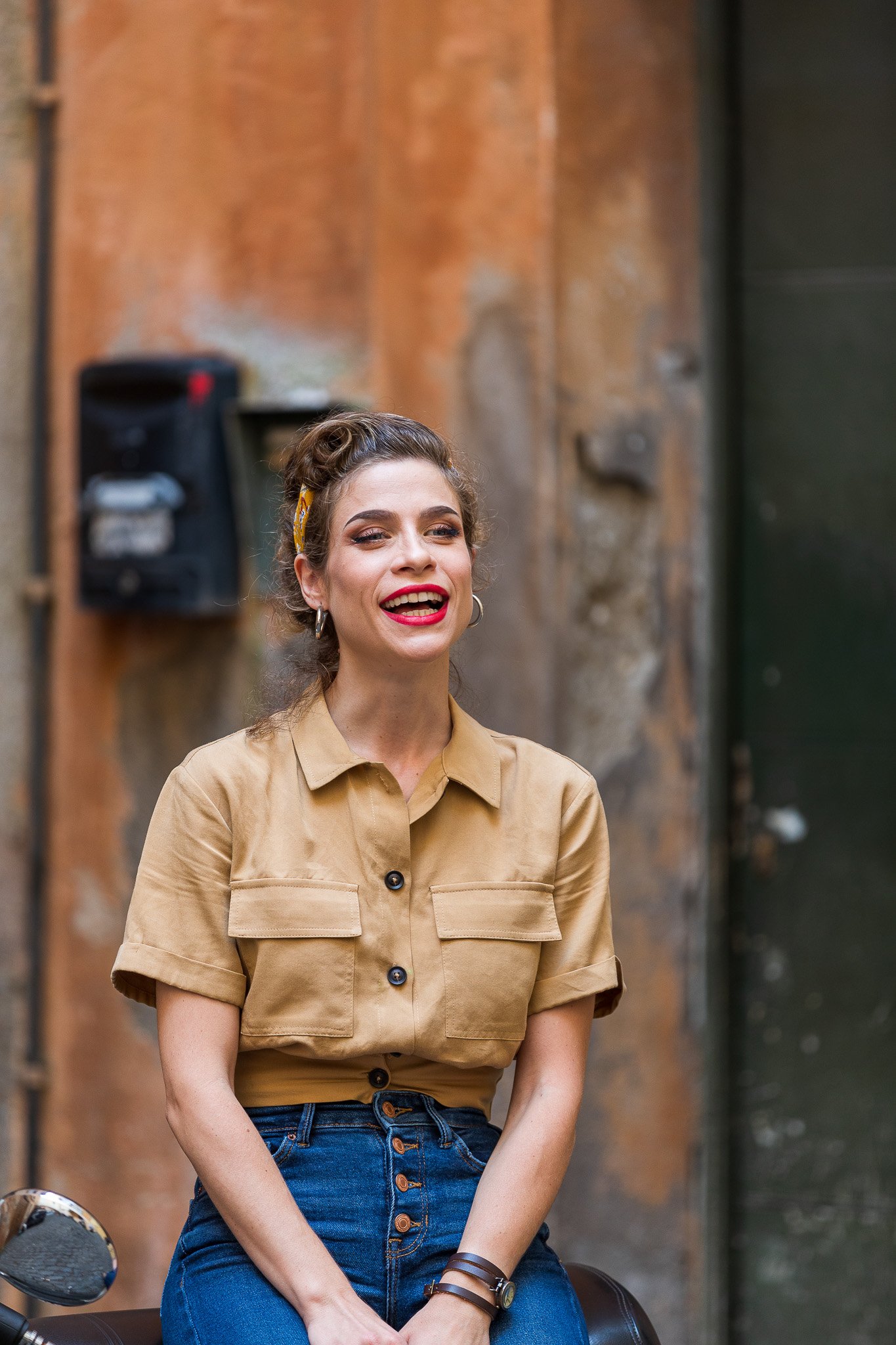
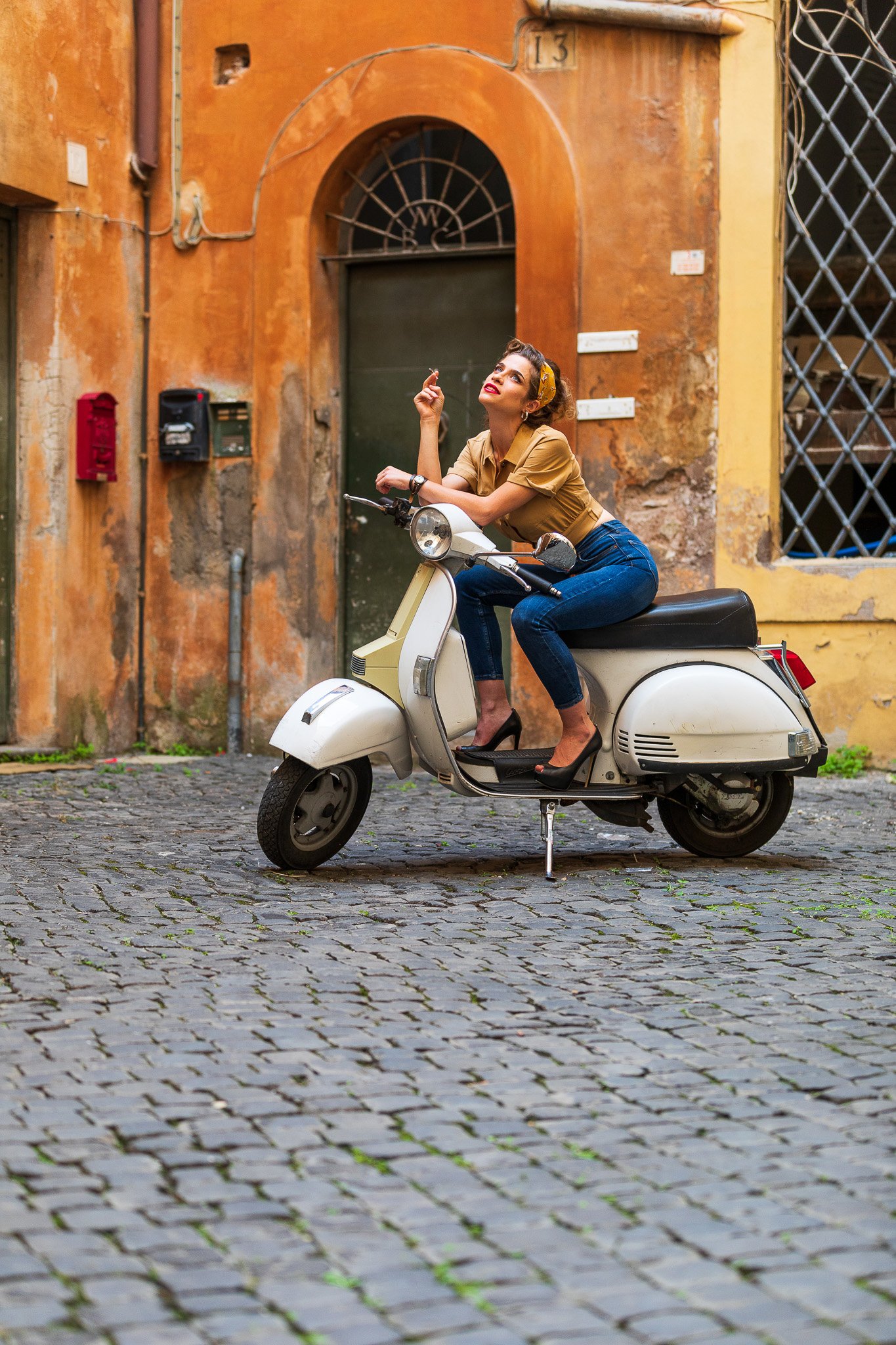
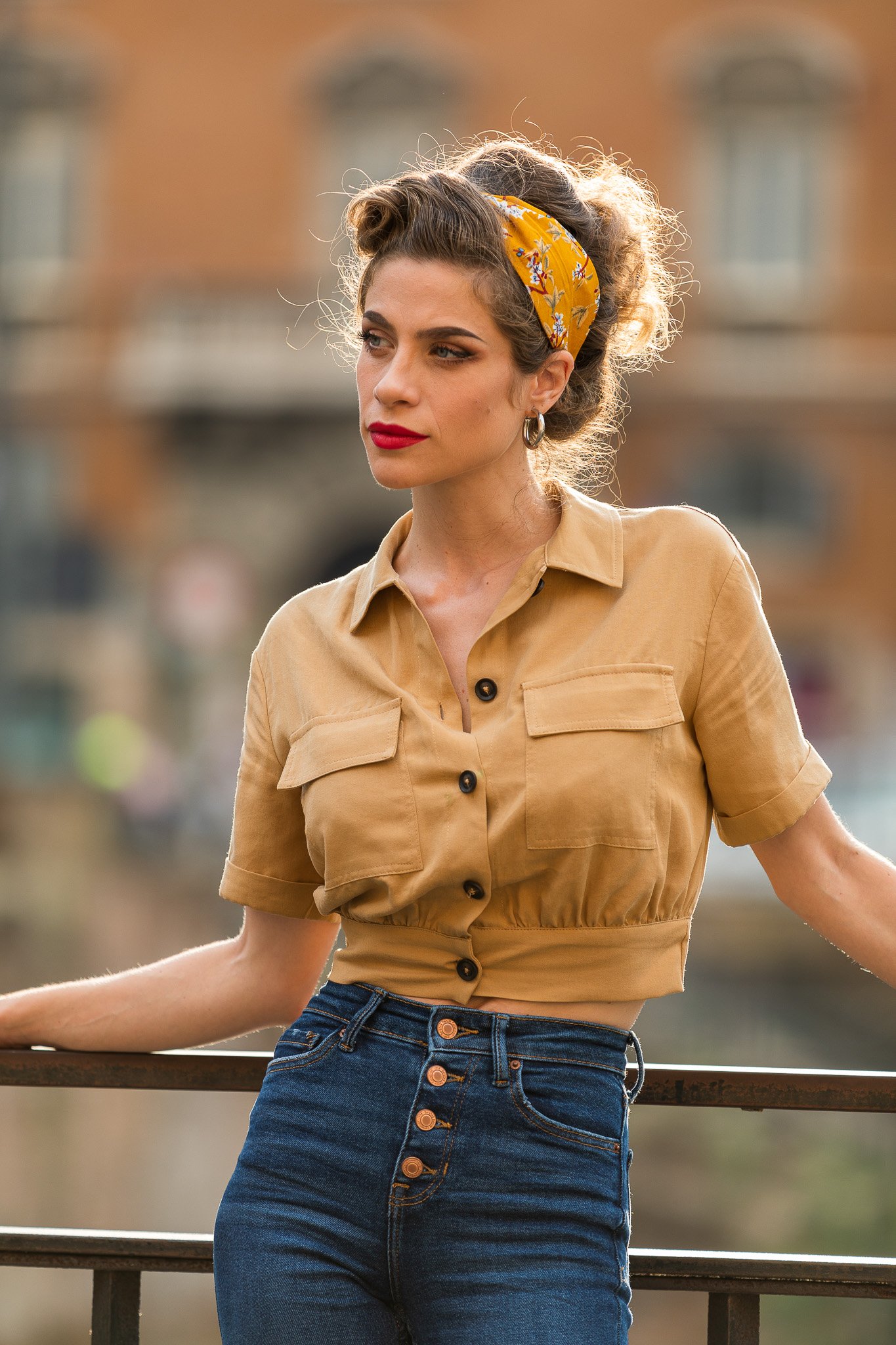
Willey, one of my favorite persons and travel photographers.

The one and Only Willey
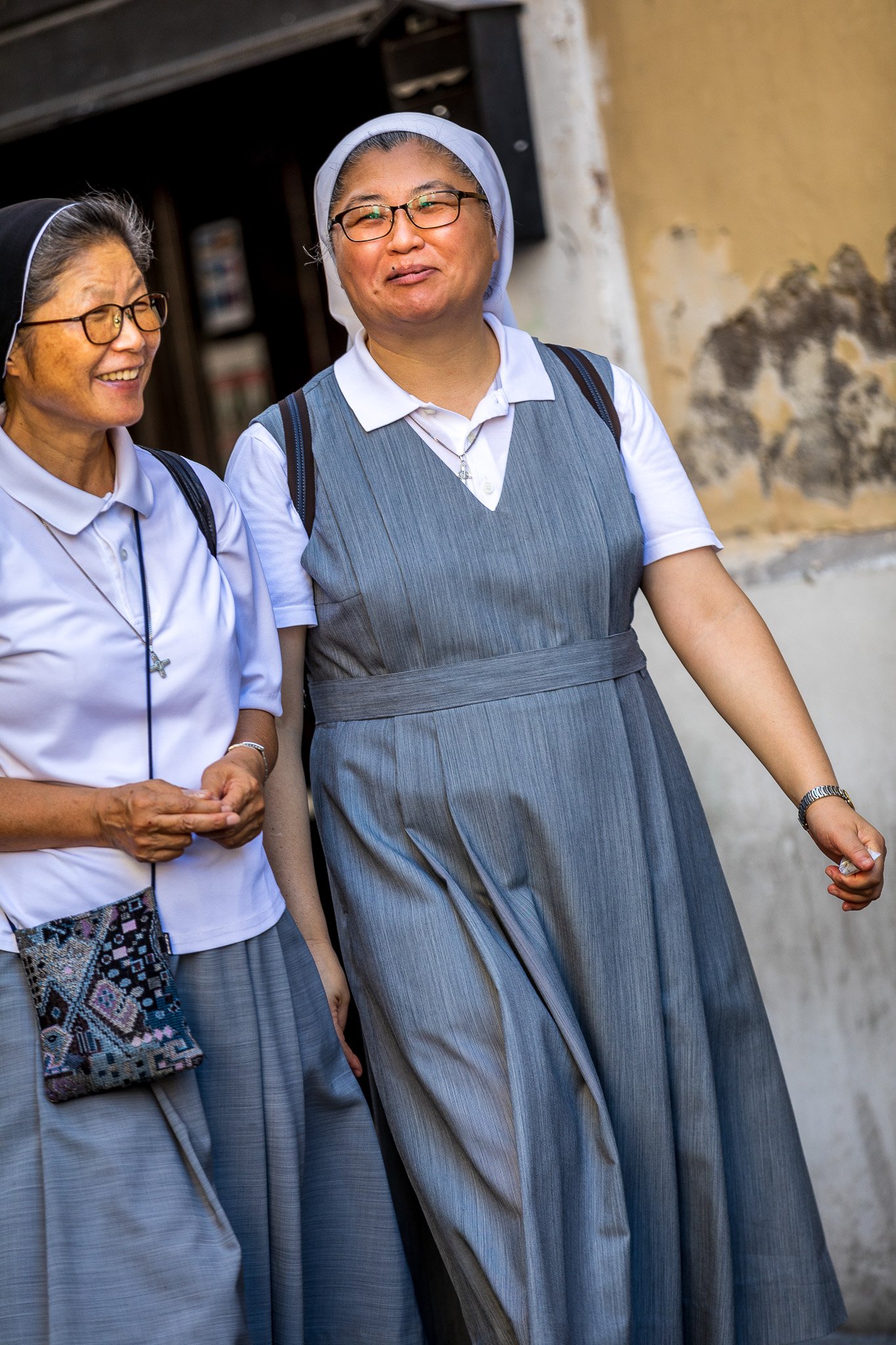
I noticed the woman on the left sitting on the bench. Her friend joined her. Then Willey sat down next to them. More friends joined them, and finally, our model sat with them.

My Street Photography Tips for Rome
Get out early. The soft morning light and quieter streets create cleaner, more intimate images.
Explore the side streets. Rome's magic often lies just one block away from the famous landmarks.
Include layers by framing people against ancient architecture to tell a richer story.
Slow down. Spend time in one location and let scenes develop naturally rather than constantly moving.
Be respectful. A smile or a simple "Posso?" ("May I?") goes a long way when photographing individuals.
Carry one versatile lens. A 35mm or 50mm equivalent is perfect for capturing both the environment and the people who bring Rome to life.

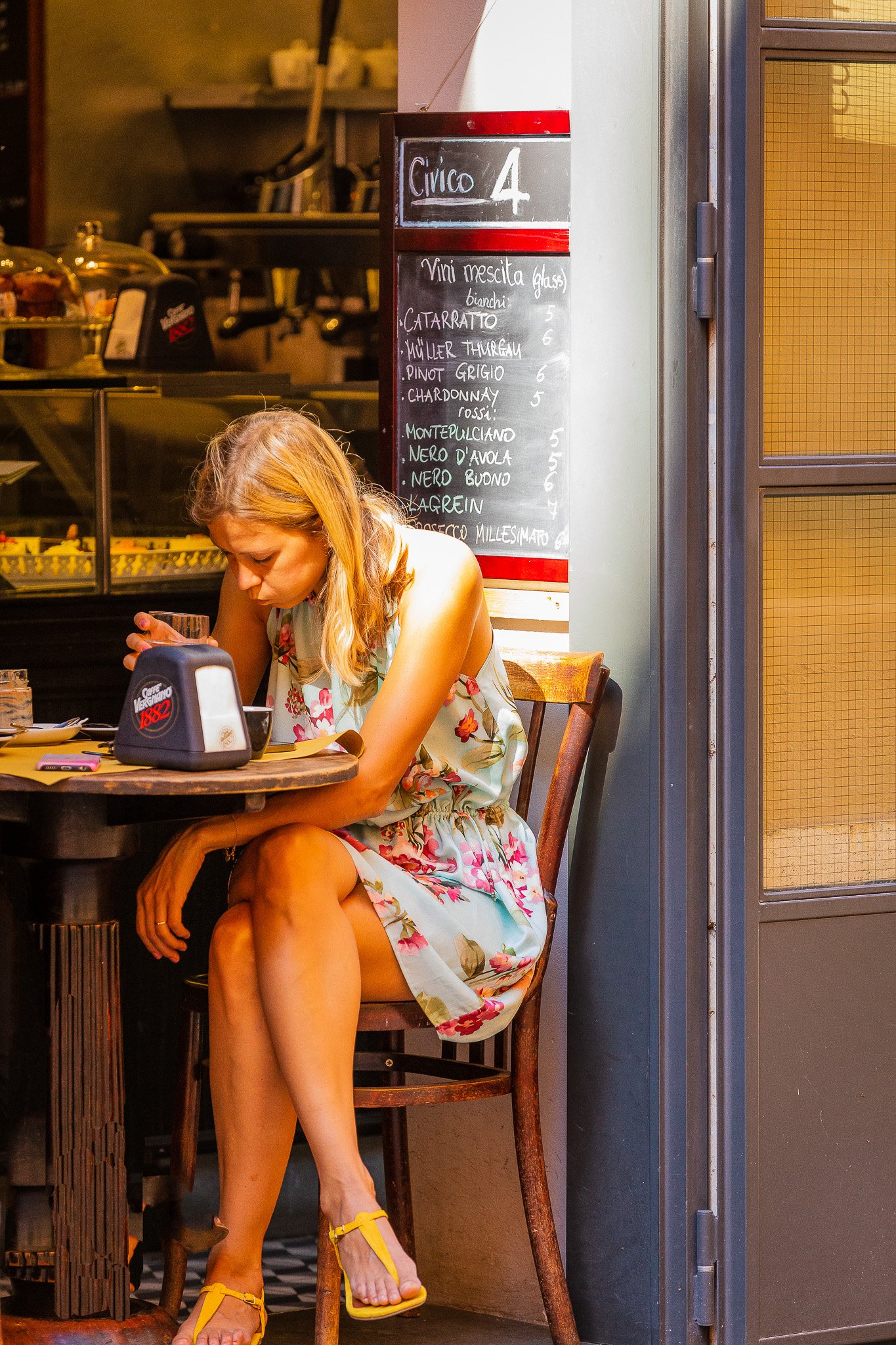
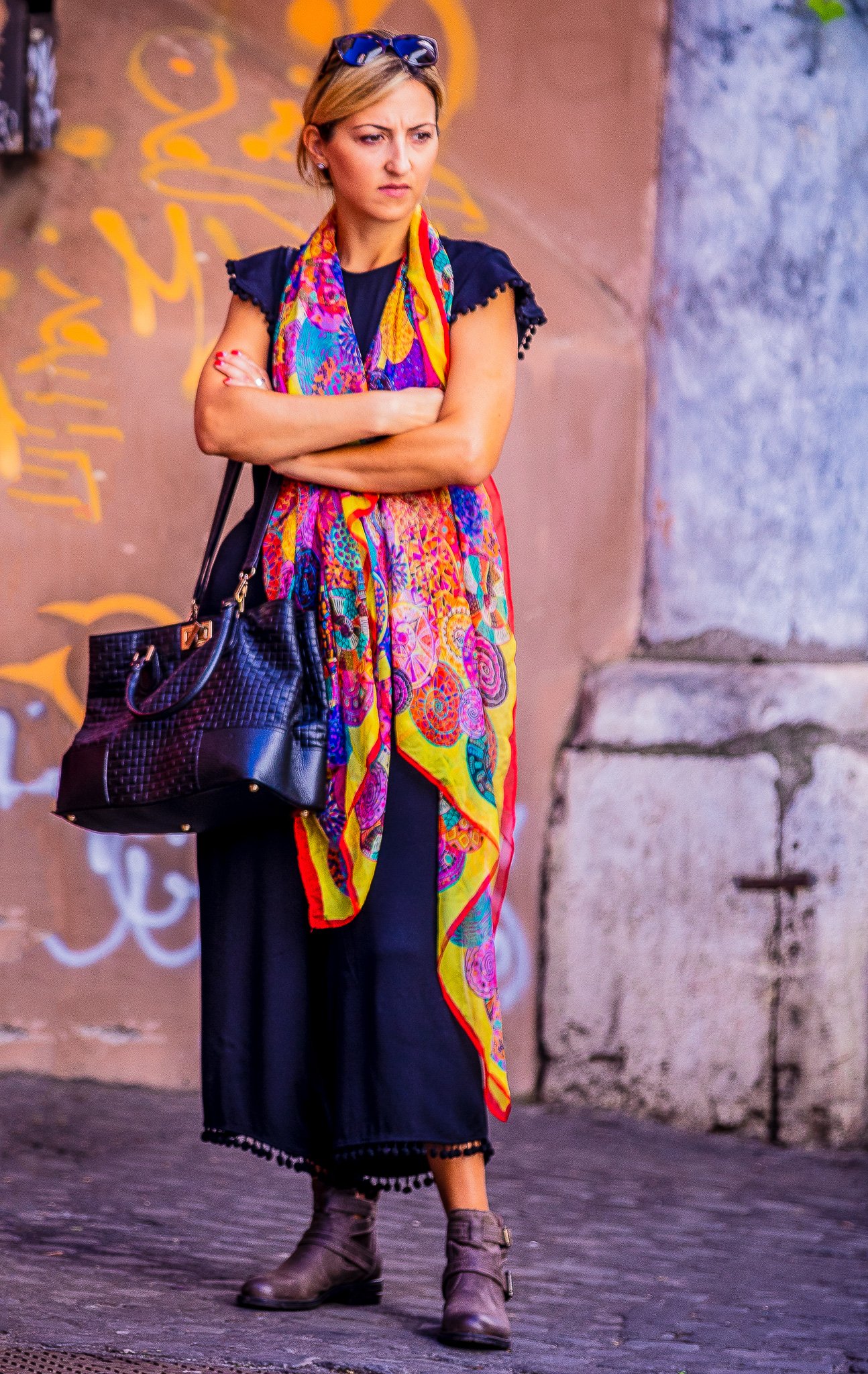
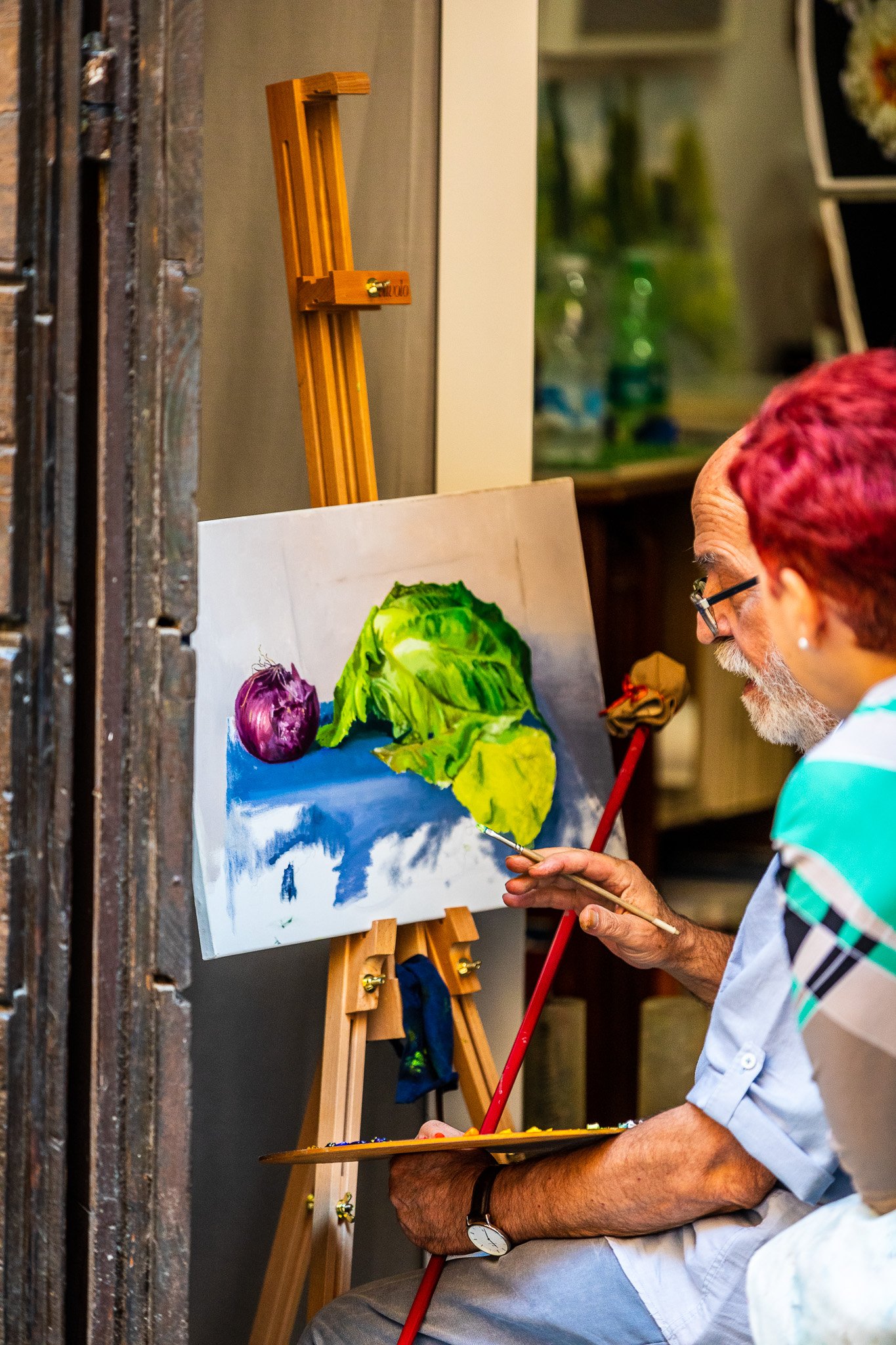
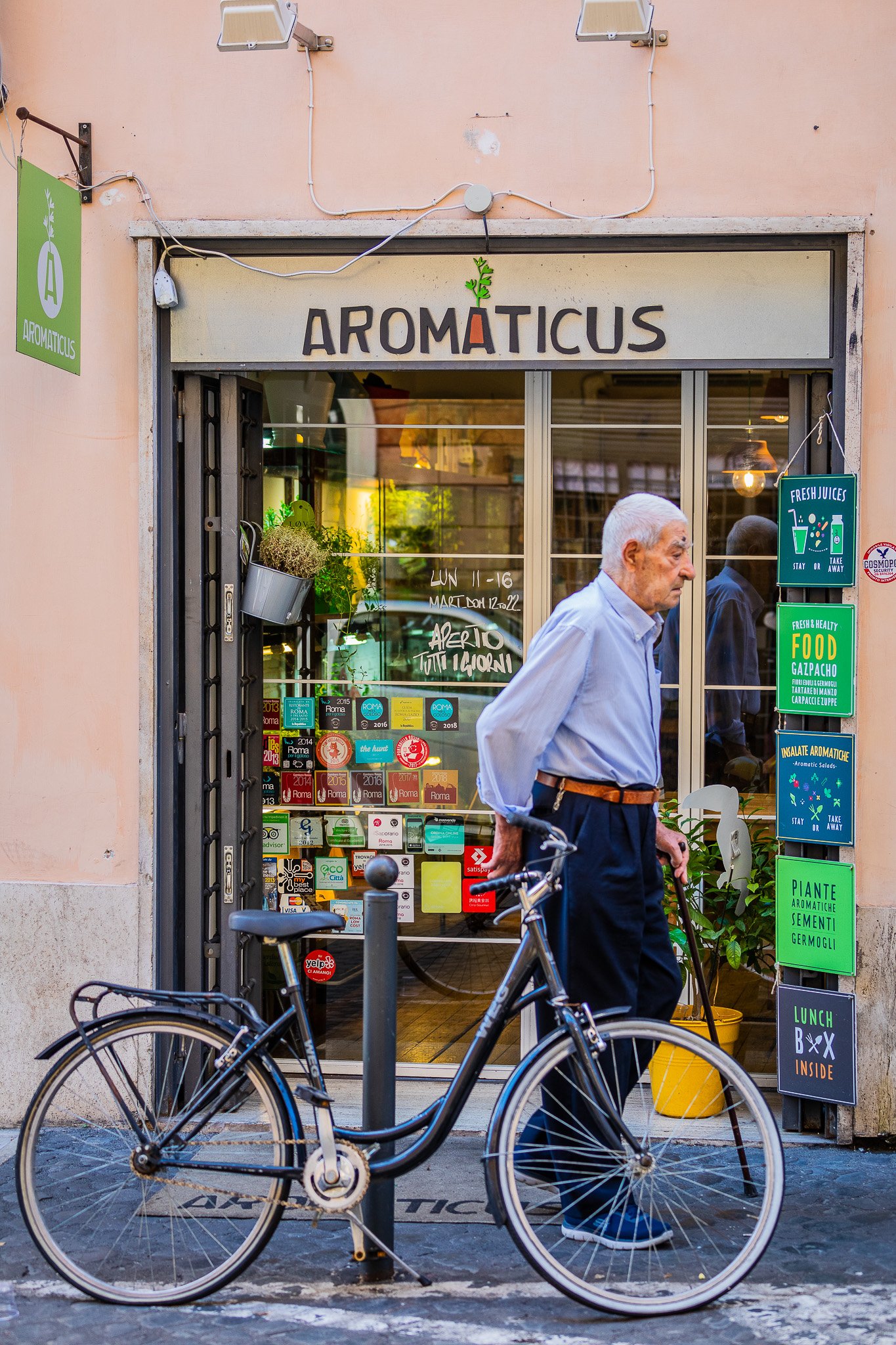
A few photos from my walks around Rome
Festivals and Events
Holy Week (Settimana Santa)
If you can visit Rome during Holy Week, it is one of the most unforgettable experiences the city has to offer. Pilgrims from around the world gather at the Vatican, creating an atmosphere that is both deeply spiritual and visually extraordinary. Whether you're religious or not, witnessing these traditions in the heart of Christianity is something you'll remember for a lifetime.
The highlight for me is the Via Crucis (Way of the Cross) on Good Friday. Held after dark at the Colosseum, thousands of pilgrims carrying candles gather as the Pope leads the Stations of the Cross. The combination of candlelight, ancient Roman ruins, and the illuminated Colosseum creates one of the most dramatic scenes you'll photograph anywhere in Europe.
On Easter Sunday, St. Peter's Square fills with hundreds of thousands of people for the Pope's Urbi et Orbi blessing. The scale of the gathering is incredible, but be prepared to arrive several hours before the ceremony if you hope to secure a good viewing spot.
📷 Photography Tip: A telephoto lens is invaluable for capturing the emotion on people's faces and the details of the ceremonies, while a wide-angle lens showcases the immense scale of St. Peter's Square.
Travel Tip: Security is extensive during Holy Week, so allow extra time for screening and expect large crowds throughout the Vatican.
Natale di Roma (April 21)
Every April, Rome celebrates its legendary founding with Natale di Roma, a festival featuring historical reenactments, Roman legionaries, gladiators, parades, and cultural performances throughout the city.
The area around Circus Maximus and the Colosseum becomes especially lively as participants dressed in authentic Roman costumes recreate scenes from ancient history. It's one of the few times you'll see the Eternal City come alive with echoes of its past.
📷 Photography Tip: The combination of costumed performers and ancient monuments creates wonderful storytelling opportunities. Arrive early for the best light and fewer crowds.
Estate Romana (June–September)
Rome doesn't slow down in the summer. Instead, the city transforms into one giant outdoor cultural festival. Concerts, film screenings, theatre performances, art exhibitions, and food events take place across parks, piazzas, and along the banks of the Tiber River.
One of my favorite places during this time is Lungo il Tevere, where restaurants, markets, music, and lights line the river each evening. It's a wonderful place to enjoy Rome after sunset.
📷 Photography Tip: Summer evenings provide beautiful soft light, and blue hour often stretches well into the evening. The reflections along the Tiber make excellent long-exposure compositions.
Christmas at the Vatican (December)
Rome is magical during the Christmas season, and nowhere captures that spirit better than the Vatican.
St. Peter's Square is decorated with a magnificent Christmas tree and an impressive Nativity scene, while Midnight Mass on Christmas Eve attracts pilgrims from across the globe. Although the crowds are significant, they are generally more relaxed than during Holy Week, making it easier to enjoy the festive atmosphere.
The illuminated façade of St. Peter's Basilica, combined with the Christmas lights and decorations, creates one of Europe's most beautiful holiday scenes.
📷 Photography Tip: Bring a tripod for long exposures after dark. Cold, clear December evenings often produce crisp skies and beautiful reflections, making this one of the best times of year for night photography.
Frequently Asked Questions About Visiting Rome
Is Rome expensive?
It can be, especially near major landmarks, but there's real range. Cacio e pepe at a proper trattoria, gelato from a real gelateria, and standing espresso at the bar all cost very little, and many of the best experiences, wandering Trastevere, sunrise at the Forum, cost nothing at all.
Is Rome safe?
Yes, it's one of the safer major European capitals to walk, day or night. Pickpocketing near crowded tourist sites like the Trevi Fountain and on public transit is the real risk, not violent crime.
Do you need a car in Rome?
No, and it's actively discouraged. Much of the historic center falls under ZTL restricted traffic zones, and walking is genuinely the best way to see the city anyway. Save a car for day trips outside Rome.
What are the best photo spots in Rome?
The Colosseum at sunrise, Ponte Umberto I at sunset with St. Peter's dome aligned behind Castel Sant'Angelo, and the Pantheon before 7am are three I return to constantly. The full list with Pro Tips is above.
Can you fly a drone in Rome?
No. Rome's historic center is a no-fly zone, and enforcement around major monuments and the Vatican is strict. Leave it at home for this trip.
What surprised you most about photographing Rome?
That you're walking through a living museum with buildings that have been standing for two thousand years. It's one thing to know that intellectually before you go, and a completely different thing to turn a corner and stand in front of it.
How many days do you need in Rome?
Four to five days. Three is possible but you'll feel rushed, and Rome doesn't reward rushing.
Is Holy Week worth visiting Rome for?
Yes, if you can time it. The Via Crucis at the Colosseum on Good Friday and the Urbi et Orbi blessing at St. Peter's Square on Easter Sunday are among the most photographically and spiritually charged environments in the world. Arrive hours early for a good viewing spot.
Final Thoughts
I could go back to Rome a thousand times. That is not a figure of speech.
There is something about a city that has been alive for 2,000 years that gets under your skin. You wander without a plan and end up inside a church you have never heard of, standing in front of a Caravaggio. You follow a narrow street and stumble onto a gelateria where a sign above the door says they have been open since 1947. You sit at a corner café with a cacio e pepe you will spend the rest of your life comparing every other pasta to. Rome rewards the wanderer. Every time.
The energy here is different from any other European capital. It is old and loud and layered. The scooters, the cobblestones, the priests on their way somewhere, the tourists at the Trevi, the old men arguing over nothing in a piazza. It all swirls together into something that feels completely alive. A city this ancient should feel like a museum. Instead, it feels like a neighborhood.
Go. Stay longer than you planned. Walk until your feet hurt, then walk a little more.
Want to improve your photography while exploring some incredible destinations? Join me on one of my photography workshops! You can find all the details, including upcoming destinations and dates, through the links below.
Let's Stay Connected!
More Photography Guides You Might Enjoy
My Photography & Travel Guide to Florence, Italy, and Florence are natural companions. The drive north takes about three hours, or you can take the high-speed train in 90 minutes. Where Rome overwhelms you with scale and age, Florence concentrates everything into a single walkable center. The Uffizi, the Duomo, the Arno at golden hour: a three-day extension after Rome makes the whole trip.
My Photography & Travel Guide to Athens, Greece, and Athens are in conversation across two thousand years of shared history. Athens is a short flight from Rome and one of the most rewarding photography destinations in the Mediterranean. The Acropolis at sunrise, the Plaka neighborhood in the early morning, and the city's street photography scene make it a natural next destination after Italy.
My Photography & Travel Guide to Puglia, Italy. If Rome is the prologue, Puglia is the reward. The heel of Italy's boot offers whitewashed hilltop towns, ancient olive groves, and a pace of life that makes even Rome feel rushed. The trulli of Alberobello, the coastal towns of Polignano a Mare and Otranto, and the baroque architecture of Lecce are all exceptional for photography. A week in Rome followed by a week in Puglia is one of the best Italy itineraries I know.
Finally—a beginner-friendly photography guide that makes sense.
If you've ever picked up a camera and thought, "Now what?" this is the book for you.
Photography Made Simple is written for adults who are just starting out and want a clear, encouraging, real-world approach to learning photography. Whether you're using a DSLR, mirrorless, or just your smartphone, this guide walks you through the basics—without the jargon or tech overwhelm.
Inside, you'll learn:
The only camera settings you really need to know to get started
How to shoot sharper, more intentional photos using light and composition
Simple tips for portraits, landscapes, travel, and everyday life
What gear you do (and don’t) need
How to create better photos without upgrading your camera
You’ll also get practical exercises, cheat sheets, and tips for organizing and editing your images—plus the confidence to shoot off Auto Mode for good.
This is not a textbook. It’s a friendly guide to seeing the world with fresh eyes—and finally capturing what you see the way you imagine it.
📸 Format: PDF download
Pages: 100+
Perfect for: Beginners, hobbyists, and anyone ready to take better photos without the stress