Nuremberg, Germany Travel & Photography Guide: Best Photo Spots, Things to Do & Hidden Gems
Few cities in Germany carry as much visual weight as Nuremberg. The first time I walked through the Königstor gate into the Altstadt, I stopped almost immediately. Not because it was overwhelming, but because it was so composed. The light was low, the cobblestones were wet from an earlier rain, and the half-timbered facades on either side caught the glow of the evening sky in a way that felt like the city had been staged for a photograph.
I have come back several times since, and that feeling has never entirely gone away. Nuremberg is a photographer's city in the quietest possible sense. There is no single iconic shot everyone chases, no obvious hero image that defines the place. What it gives you instead is texture, layers, and a quality of light that rewards patience. Early mornings in the Old Town are almost completely yours. The Pegnitz River offers reflections at every hour. The castle rises above the rooftops in a way that keeps reappearing in your frame, no matter which direction you walk.
What makes Nuremberg genuinely interesting, and genuinely difficult, is the weight of its history. This is a city that has had to reckon honestly with the twentieth century while preserving one of the most intact medieval centers in Central Europe. You feel both things at once, and for photographers who want images with meaning rather than just atmosphere, that tension is exactly what you are looking for.
In this Photography Guide to Nuremberg, I share the places and experiences that continue to draw me back. You will find my favorite photography locations, guidance on when and where to shoot, practical travel tips, and gear recommendations, along with cultural insights to help you explore and photograph Nuremberg with confidence, respect, and ease.

Photographer's Notes
Before you go, here are my own takeaways.
Favorite Season: Spring
Favorite Location: Weißgerbergasse
Favorite Hotel: Hotel Victoria
Favorite Restaurant: Essigbrätlein
Favorite Café: Machhörndl Kaffee
Favorite Lens: 16-35mm
Would I Return? I'm not sure I would go back.
Where to Stay in Nuremberg
Stay inside or immediately adjacent to the Altstadt. Everything that matters photographically is within walking distance, and the medieval streets themselves are worth shooting at every hour. You do not want to spend time commuting when the best light lasts thirty minutes.
Luxury Hotels in Nuremberg
Hotel Drei Raben is a boutique property built around Nuremberg's legends and mythology, with each floor dedicated to a different local story. It sits steps from the central historic area and is genuinely one of the more atmospheric places to stay in the city. The building itself is worth exploring.
Le Méridien Grand Hotel Nuremberg occupies a beautiful Art Nouveau building directly across from the main train station. The interiors are polished, the location is excellent for arriving photographers who want to drop a bag and immediately start shooting, and the architecture of the hotel itself makes for interesting interior shots.
Park Plaza Nuremberg is set in a restored nineteenth-century building near the Königstor, one of the medieval city gates. Clean, well-appointed, and far more characterful than the typical business hotel.
Mid-Range Hotels in Nuremberg
Hotel Victoria sits inside the medieval city walls, family-owned, with a location that puts you directly in the heart of everything. For photographers who want to be out at first light without a commute, this is the most practical choice at this tier.
Hotel Elch Boutique is a timbered building near Albrecht Dürer's House that photographs well in its own right. Small, personal, and genuinely charming without performing it.
Sorat Hotel Saxx Nuremberg faces directly onto the Hauptmarkt, the main square. If you are visiting during the Christmas market and want to be ten steps from the stalls every morning and evening, this is where you stay.

Altstadt (Old Town)
How Many Days to Stay in Nuremberg
Three days is the right amount for a focused photography visit. It gives you enough mornings to hit the castle at sunrise, enough evenings for blue hour along the river, and time to visit the Documentation Center without rushing.
Five days open the guide up. You can shoot the same locations in different light, explore the neighborhoods beyond the immediate center, make a half-day trip to the Nazi Party Rally Grounds, and still have time to sit by the Pegnitz with a coffee and not feel like you are on a schedule.
A two-day weekend is possible, but tight. Prioritize the castle at sunrise, the Hauptmarkt at golden hour, and Weißgerbergasse any time the light is good. Leave the Documentation Center for a return trip if time is short.
Best Time to Visit Nuremberg
Spring (April to May) is the best all-around window for photography. The light is warm and long, the Old Town has color from blossoms and green returning to the trees, and the crowds have not arrived in force. Golden hour stretches late enough in May that you can shoot the castle at sunset after a full day.
Autumn (September to October) is a close second. The foliage turns the areas around the city walls and river into something quite different from summer, and the sky gets dramatic in a way that spring does not always deliver. Mist on the river in early morning is common and worth getting up for.
December is its own category entirely. The Christkindlesmarkt transforms the Hauptmarkt completely. The quality of light in the evenings, with lanterns, steam from mulled wine, and the golden glow of the market stalls against the Frauenkirche, is unlike anything else in Germany. It is crowded, but the photography is exceptional if you go early or late in the day.
Summer (June to August) is fine but the least interesting photographically. Long days mean golden hour comes very late, the crowds are at their peak, and the character of the Altstadt is harder to capture when it is busy. If you go in summer, lean into the evening light and avoid midday entirely.
Winter outside the market season (January to February) is quiet and cold, but the low sun angle produces extraordinary light across the rooftops and the castle. Snow is not guaranteed but when it comes, the city is almost unbearably photogenic.
Altstadt (Old Town)
Getting Around Nuremberg
The Altstadt is best explored entirely on foot. Nearly every photography location in this guide is within a twenty-minute walk of the city center, and the streets themselves are part of what you are photographing. Do not rush through them on a tram.
The U-Bahn and bus network are clean, efficient, and useful for reaching locations outside the center, including the Documentation Center and the Nazi Party Rally Grounds. A day pass is worth buying if you are planning to move around.
Uber and Bolt both operate in Nuremberg. They are not necessary for anything inside the Altstadt but are useful for the airport or for reaching the rally grounds if you prefer not to use public transit.
For camera gear, the city is easy. The streets are mostly flat, the cobblestones are manageable even with a rolling bag, and bag check is available at the main train station if you are arriving between accommodations.

Altstadt (Old Town)
Where to Eat & Drink in Nuremberg
Franconian cuisine is the local tradition, and it is more interesting than most visitors expect. The focus is on quality ingredients, regional produce, and a directness that reflects the city itself. There is also a quietly excellent fine-dining scene built around seasonal and vegetable-forward cooking.
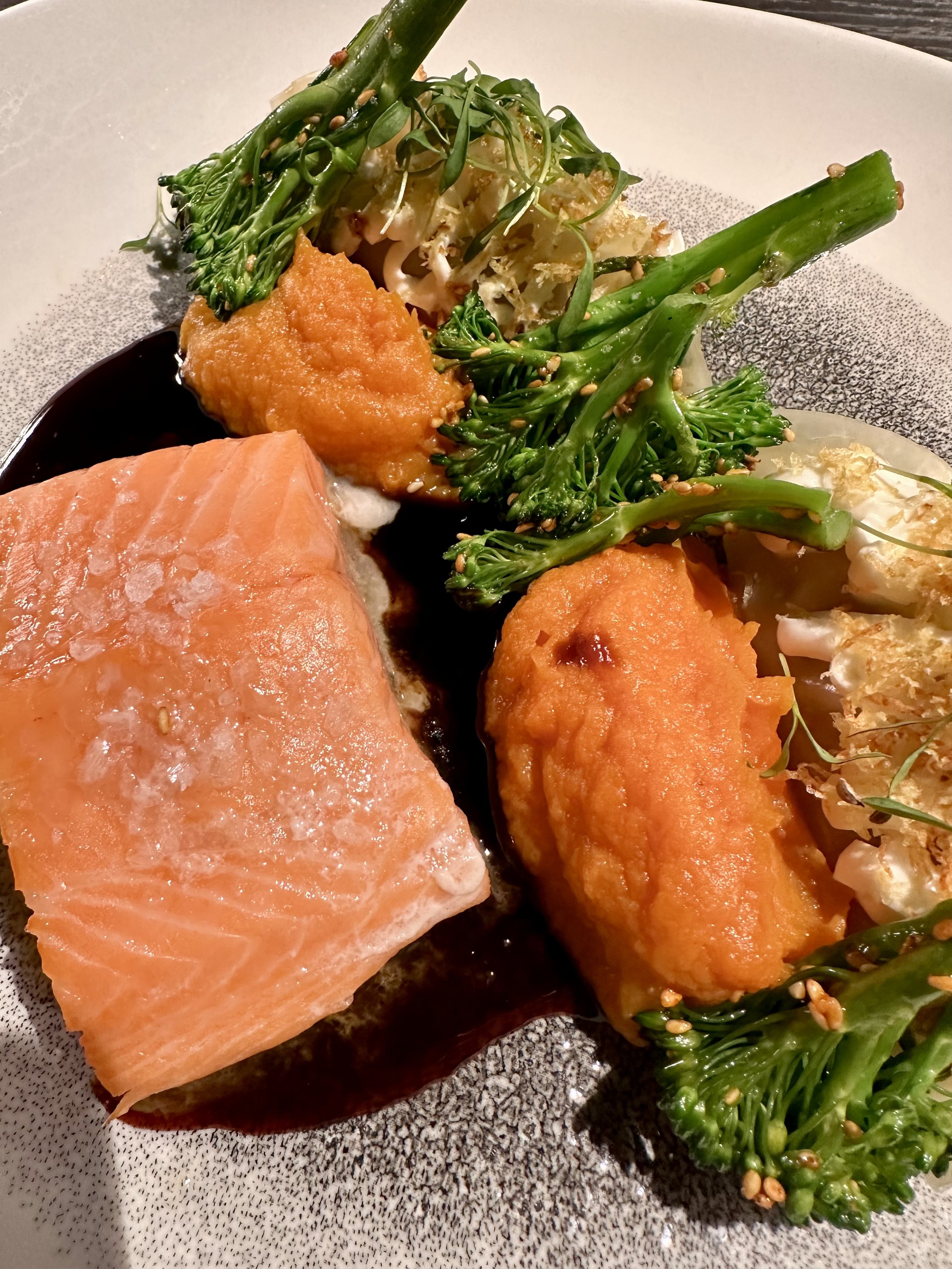
Essigbrätlein is the best restaurant in Nuremberg and one of the best in Germany, holding two Michelin stars. You ring a bell to enter a building that has been a tavern since 1596. Inside, chefs Andree Köthe and Yves Ollech run a vegetable-focused tasting menu that is genuinely unlike anything else in the country. Reserve well in advance and set aside a full evening.
Albrecht-Dürer-Stube is the Franconian classics restaurant you want when you are cold, tired from a long morning of shooting, and need something restorative. Hearty regional food served in a timbered room that looks like it has not changed in two hundred years.
Hausbrauerei Altstadthof brews its own beer in the cellar and serves Nuremberg sausages and Franconian standards in a lively, relaxed setting. This is where you go after the Christmas market. The brewery tour is worth it.
Zeit & Raum takes a more contemporary approach, with seasonal plates and a wine list that makes the room worth lingering in. Good for a dinner that sits somewhere between casual and special occasion.
CôCô Indochine is a Vietnamese-French bistro that offers a welcome change of pace from the Franconian meat-and-potato rotation. Bright flavors, good energy, and genuinely good food.
Coffee
Machhörndl Kaffee is the serious coffee destination in the city. Third-wave roasters with beautiful interiors and espresso that is worth rearranging your morning around.
Kaffe Hörna is a Swedish-style café on a quiet street that rewards finding. Calm, well-lit, good for editing a morning's work.
Café Mainheim is warm and relaxed, ideal for post-shoot editing when you need a flat surface, a cappuccino, and somewhere that is not asking you to leave after an hour.
Altstadt (Old Town)

Photography Gear to Bring to Nuremberg
DSLR and Mirrorless Kit
Nuremberg rewards a versatile setup. The Old Town is intimate enough that you do not need extreme focal lengths, but having range matters when you are on the castle walls looking across rooftops.
Camera bodies: Canon EOS R5 Mark II, Nikon Z8, or Sony A7RV. Any of these handles the low-light requirements of blue hour and the Christmas market without complaint.
Wide angle (16 to 35mm): Essential for the castle courtyard, the Weißgerbergasse, and any interior shooting inside Dürer's House. You will use this more than anything else.
Standard zoom (24 to 70mm): Your all-day workhorse for the market, street scenes, and the Hauptmarkt.
Telephoto (70 to 200mm): Useful for compressing the medieval street layers from the castle and isolating architectural details from a distance.
Tripod: Non-negotiable if you are shooting blue hour at Henkersteg or doing long exposures along the Pegnitz. A travel tripod, like the Peak Design or a Platypod, for surfaces where a tripod is inconvenient.
ND filters (3, 6, and 10 stop): For long exposures on the river and any crowd-clearing shots at the Hauptmarkt.
Extra batteries: Cold winter temperatures drain batteries quickly. Bring a minimum of three for any December visit.
Samsung T7 SSD: Back up every evening.
Drone: Nuremberg falls under EU drone regulations, with restricted zones over the Altstadt and the castle. Do not assume you can fly inside the city. Check the EU Drone Regulation map for open category rules and always verify local restrictions before launching. The rally grounds are more accessible but require the same due diligence.
iPhone Photography in Nuremberg
Weißgerbergasse in Portrait Mode: Switch to Portrait Mode when you are shooting the timber-framed facades on this street. The subject separation against the colorful buildings behind is exactly what Portrait Mode was designed for. Use it at 2x to avoid distortion.
Night Mode at the Christmas market: The lantern light at the Christkindlesmarkt is warm and beautiful, but tricky to expose correctly. Let Night Mode take over, but brace yourself against a wall or railing to avoid camera shake during the longer exposure. The result is far better than what Auto produces.
Ultrawide at the castle courtyard: When you are inside the Kaiserburg walls, looking down toward the city, the iPhone's ultrawide lens captures the full sweep of the rooftop panorama in a way that a standard lens clips. Switch to ultrawide here. At golden hour, the result can be remarkable.
ProRAW for the Pegnitz reflections: If your iPhone supports ProRAW, turn it on for the river shots. The ability to recover highlights in the reflections and pull up shadow detail in the bridges gives you far more to work with in editing than a standard JPEG.
Hauptmarkt at blue hour with the Frauenkirche: The Frauenkirche facade at blue hour, with the square emptying out and the last warm light catching the stone, is one of the best iPhone compositions in the city. Stand back far enough to include the square in the foreground and let the architecture fill the frame.

Photography Spots in Nuremberg
Kaiserburg Castle
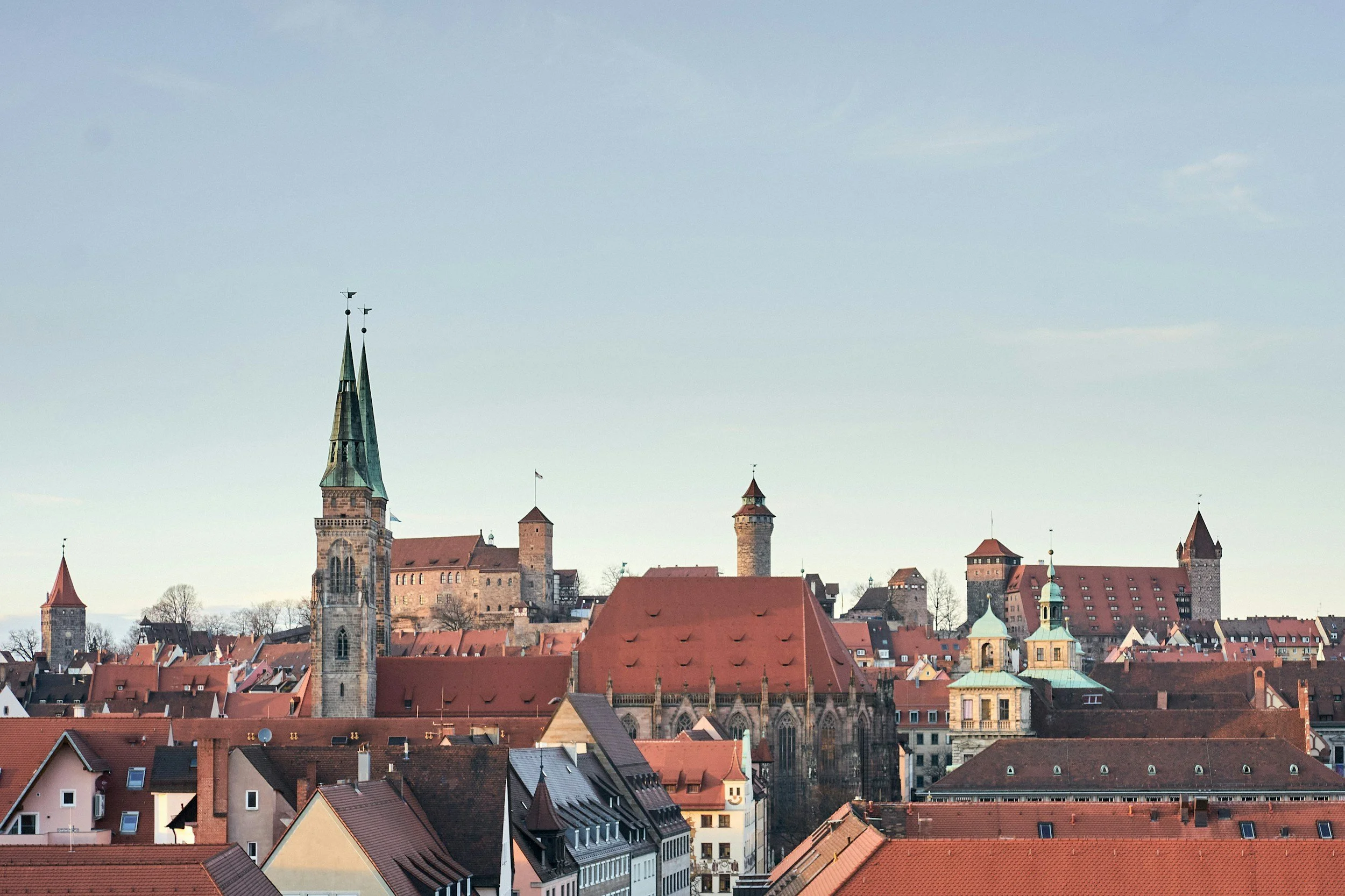
The Imperial Castle sits at the highest point of the Altstadt, and from the walls you have a panoramic view across the red-tiled rooftops of the Old Town with church spires breaking the horizon in every direction. It is the establishing shot of the city and one of the few places in Nuremberg that rewards multiple visits in different light.
The view from the Sinwellturm lookout tower is the obvious composition, but the castle courtyard itself offers strong geometry and angles that most visitors walk past. The stone, the well, the layered walls: there is a lot to work with before you even get to the panorama.
📷 Pro Tip: Arrive before sunrise and position yourself on the castle walls facing southeast. The first light catches the church towers and rooftops below in a way that only lasts about twenty minutes before the scene flattens. Bring a wide-angle lens for the panorama (16 to 24mm) and a standard zoom for picking out individual rooftop details. A tripod is useful in the lower light of early morning. The castle grounds open early; confirm current hours before your visit. In winter, the low sun angle gives you similar quality light at a much more manageable hour.
Best time: Sunrise or golden hour. Access: Paid entry to the inner castle complex; free to walk the outer walls. Walking distance from anywhere in the Altstadt.
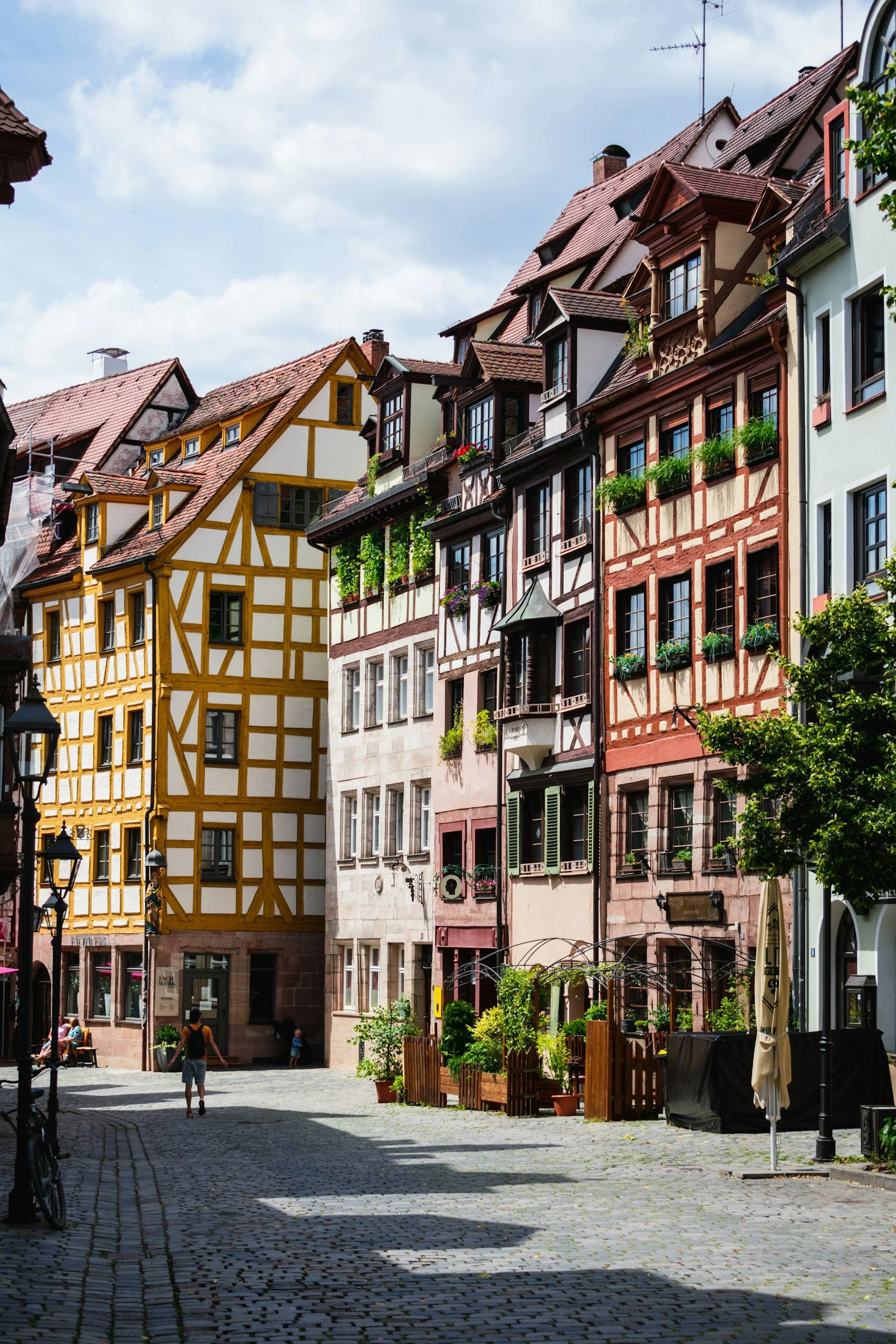
Weißgerbergasse (Tanners' Lane)
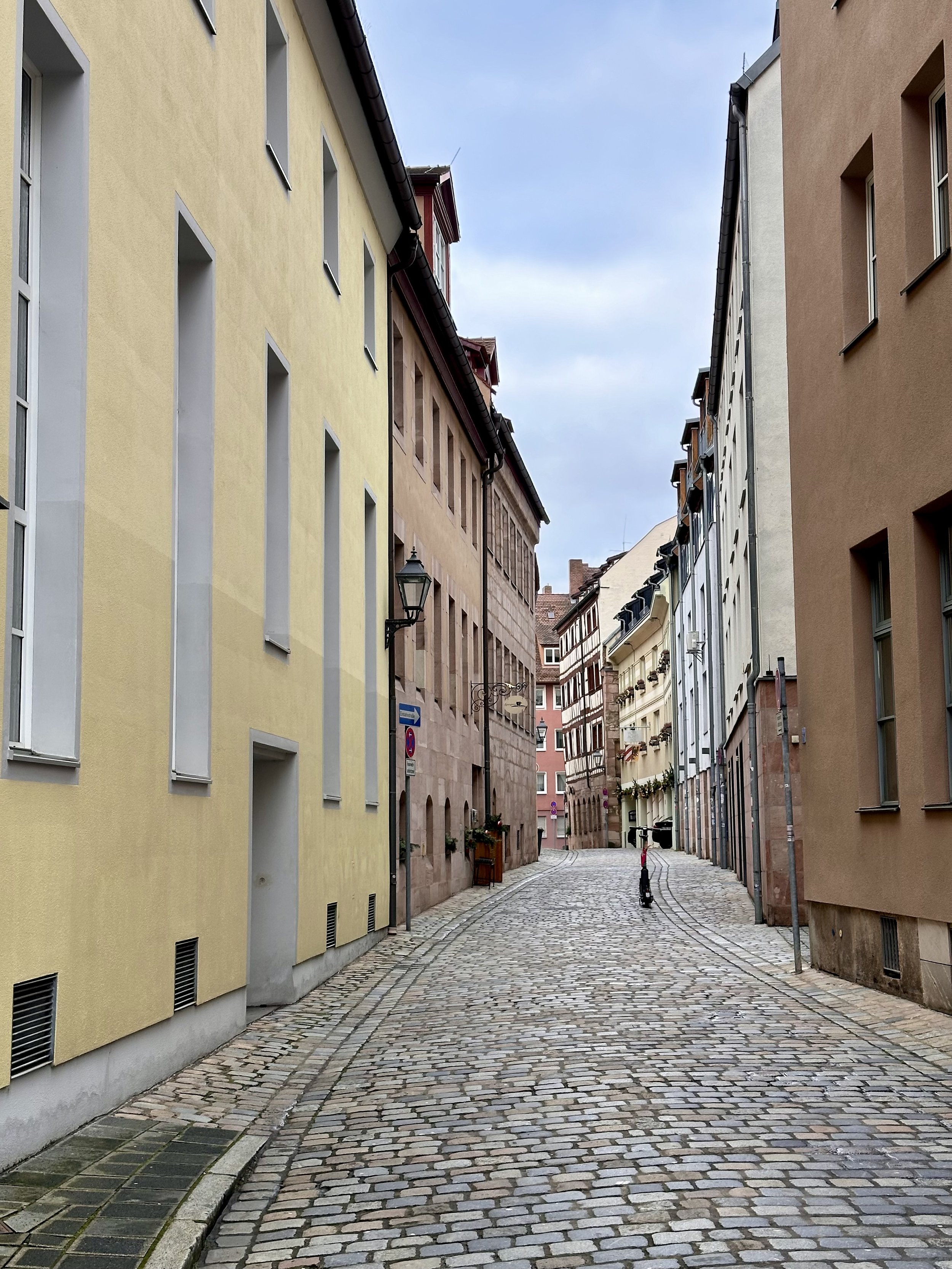
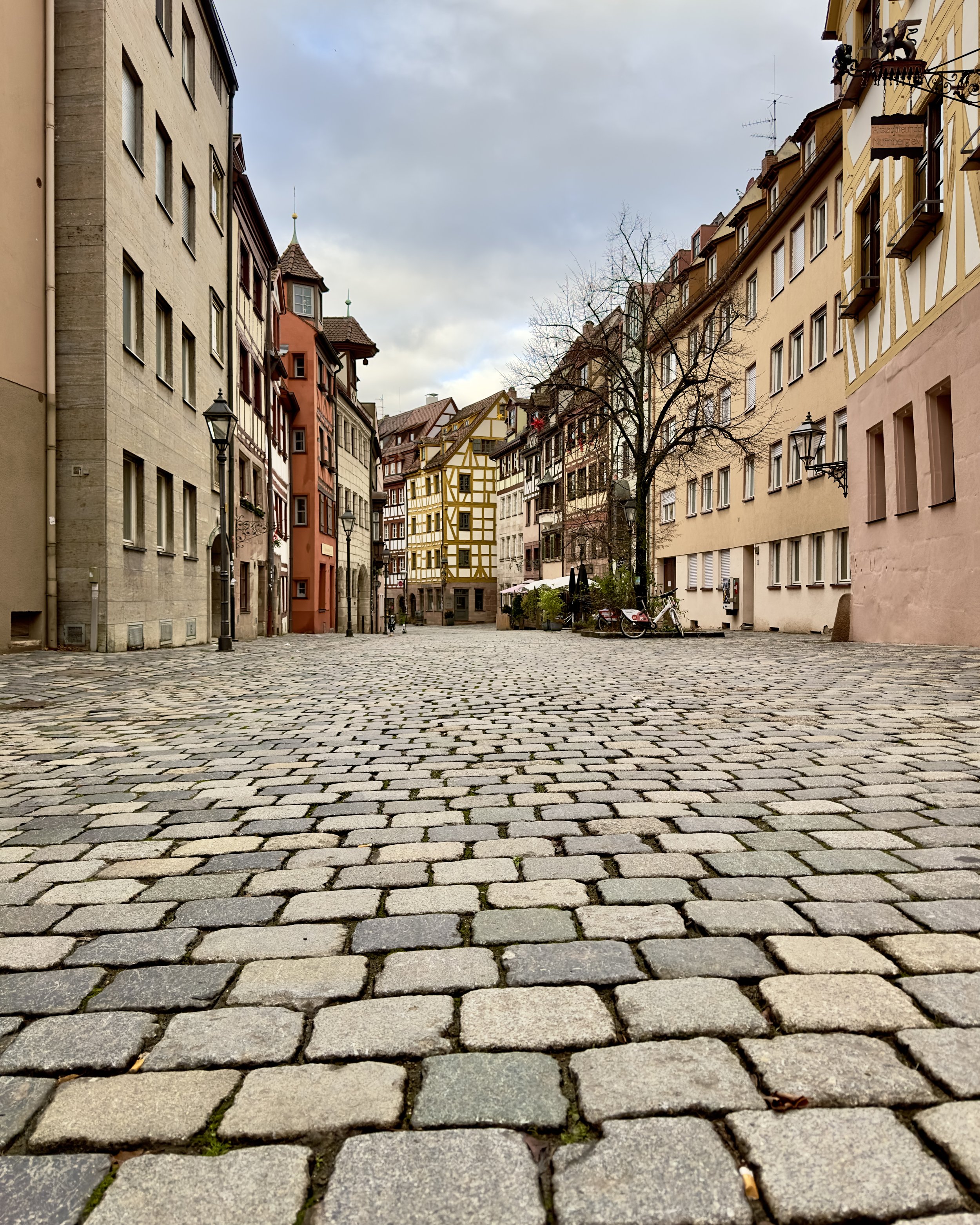
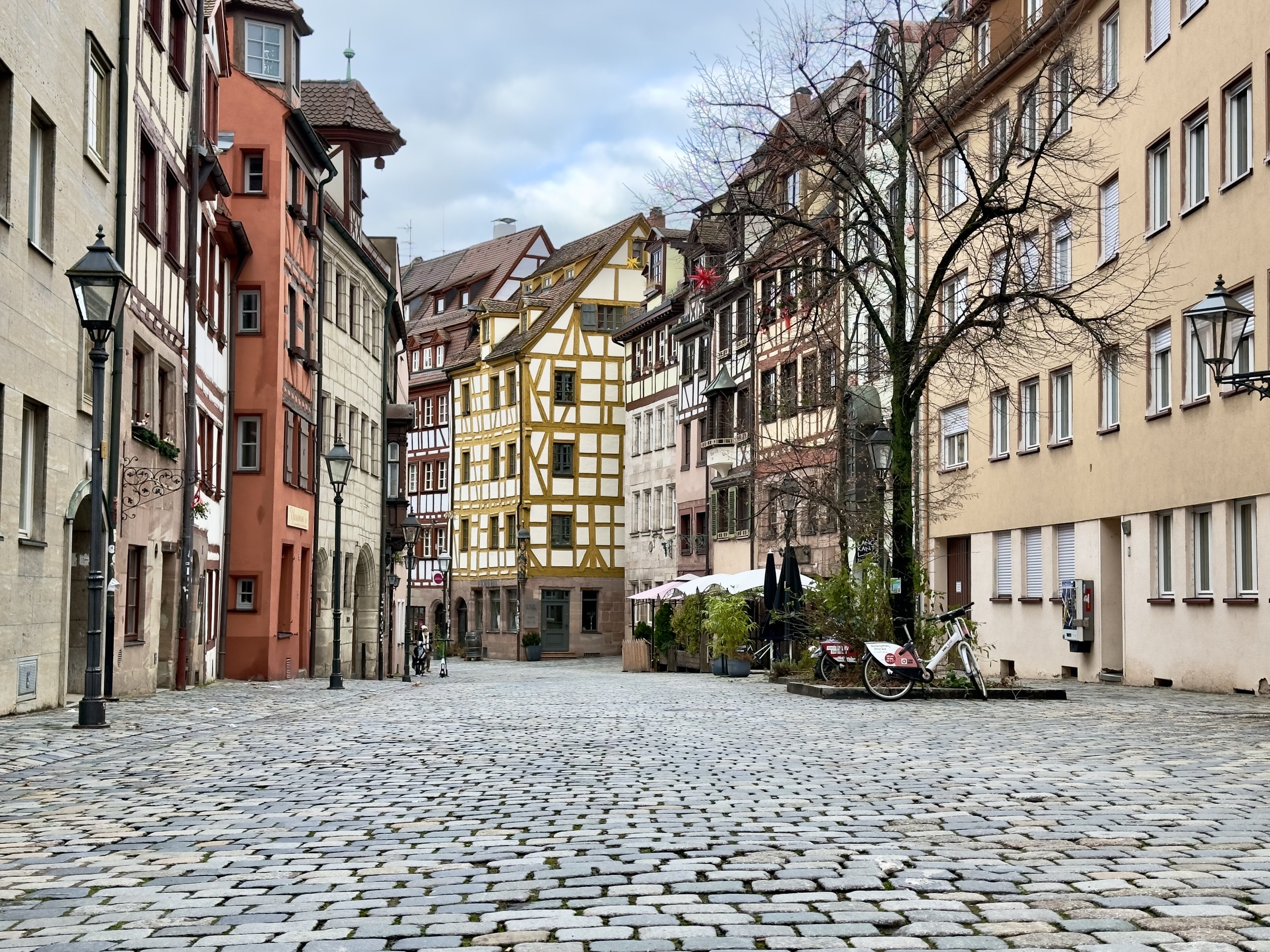
This is the most photogenic single street in Nuremberg. A row of well-preserved, half-timbered houses in warm yellows, reds, and ochres runs the length of the lane, and the perspective down the street at ground level is as good a composition as the city offers. It is not a secret, but most visitors walk through quickly. Stay longer.
The facades change with every shift in light. Early morning is clean and quiet, with soft directional light picking out the texture of the timber frames. Midday is flat and avoidable. Late afternoon, when the warm light rakes across the painted plaster, is when the street earns its reputation.
📷 Pro Tip: Get low. A low-angle wide shot down the lane at around 20 to 24mm, with the perspective lines converging toward the far end, is a stronger composition than standing and shooting straight across. Rain makes the cobblestones reflective and adds another layer to the image; do not leave if it starts to drizzle. The street is short enough to walk end to end several times, so try both directions. Early morning on a weekday is the clearest window before foot traffic picks up.
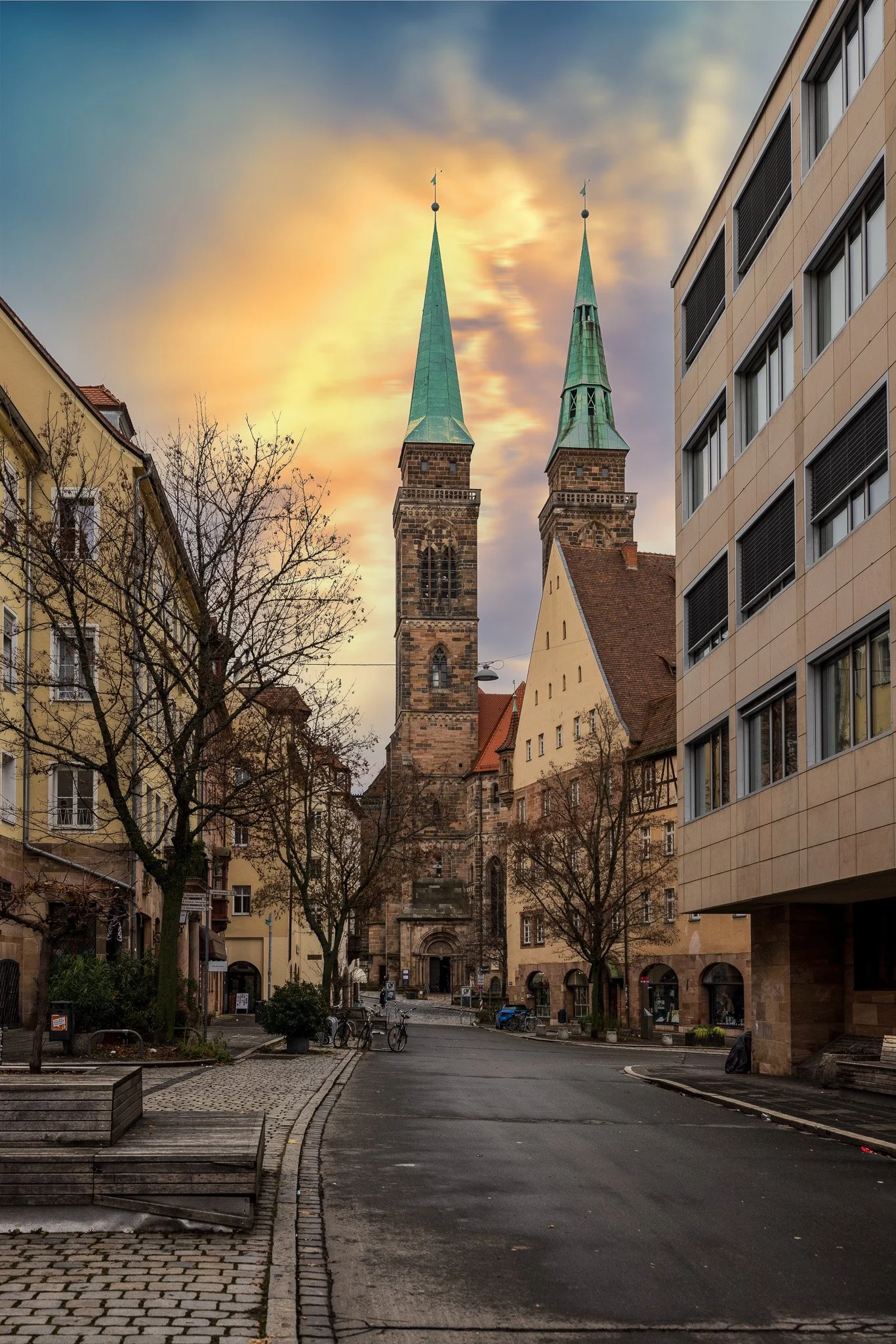
Hauptmarkt and the Frauenkirche
The central market square is Nuremberg's civic heart and one of its most adaptable photography locations. The Frauenkirche's Gothic facade dominates the eastern end; the Beautiful Fountain (Schöner Brunnen), a fourteen-meter Gothic spire, anchors the northwest corner. The square itself changes character completely depending on the time of year and day.
At blue hour, with the Frauenkirche lit and the square emptying out, the scene is remarkably quiet and clean. In December, the Christkindlesmarkt fills every inch of it with stalls, light, and life. At midday in August, it is a tourist transit corridor. The square does not photograph well at its default; you have to choose your moment.
📷 Pro Tip: For the Frauenkirche, position yourself in the center of the square and shoot at 24 to 35mm during the last twenty minutes of blue hour. The church facade glows against a deep blue sky in a way that midday light never produces. For the Beautiful Fountain, get close and shoot upward at around 16 to 20mm to capture the full height of the spire against the sky. Early morning on a Saturday before 7am is the quietest window in warmer months. During the Christmas market, arrive at opening time or in the last hour before it closes for the calmest shooting conditions.
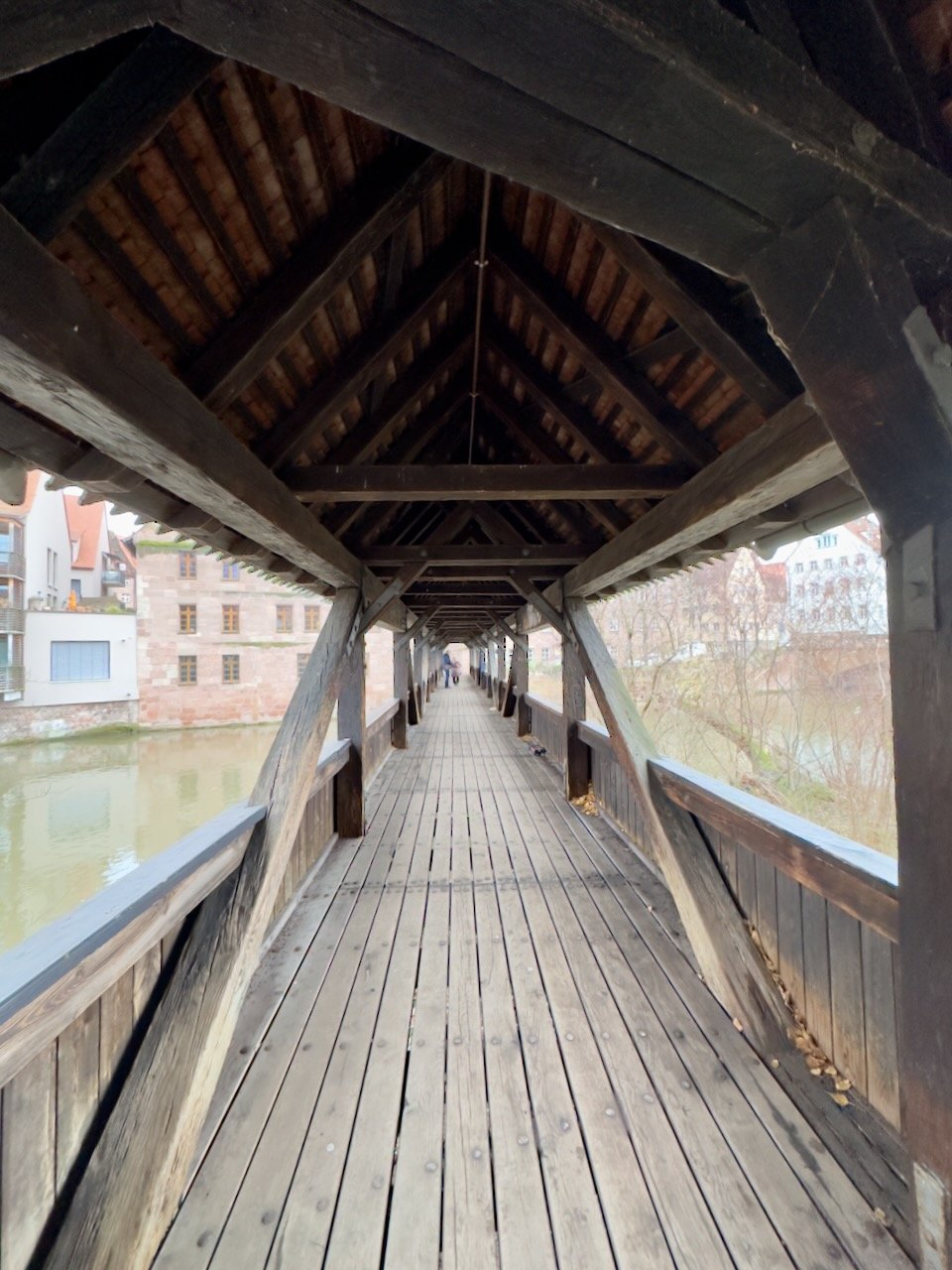
Henkersteg and the Hangman's Bridge
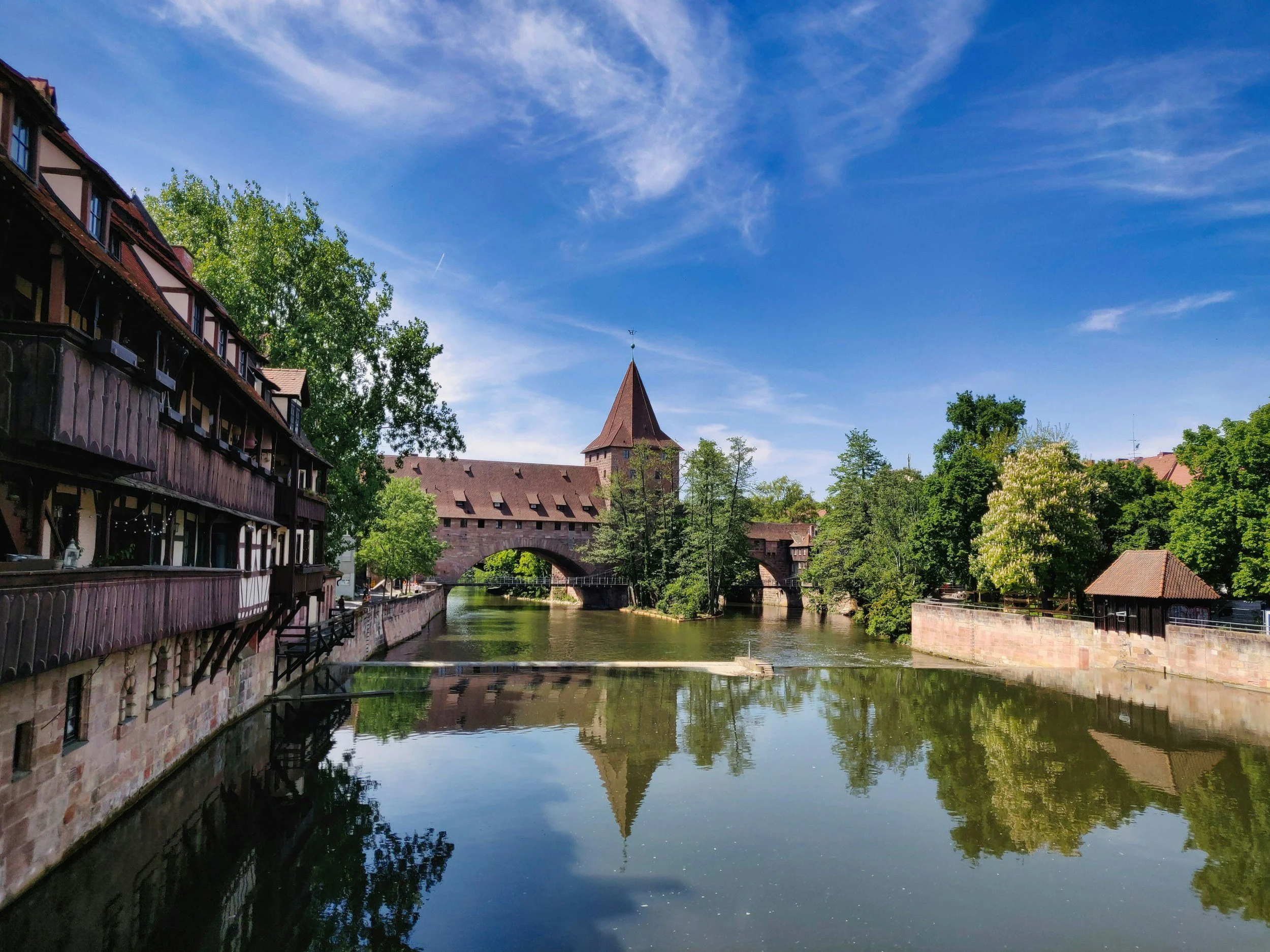
Henkersteg is a small covered wooden bridge spanning the Pegnitz that dates to the fifteenth century, originally connecting the city's prison to the executioner's house. It is one of those places that is almost inherently photogenic: the dark timber structure, the river surface below, and the Old Town rising on both sides create the kind of layered composition that makes Nuremberg worth returning to.
The reflections here are excellent when the water is calm, which it typically is in the early morning and on overcast days. The surrounding area along the Pegnitz is quieter and less visited than the main Altstadt, which means you can often work the scene without interruption.
📷 Pro Tip: The best angle is not from the bridge itself but from the riverbank looking toward it, with the bridge in the mid-ground and the Old Town buildings behind. A 24 to 50mm focal length captures the whole composition without distortion. Late afternoon light in autumn hits the bridge and the water at the same time and is the single best window for this location. Bring an ND filter if you want to do a long exposure on the river to smooth out any ripple. The area around the bridge also has several other minor bridges and water channels that are worth exploring.
Albrecht Dürer's House
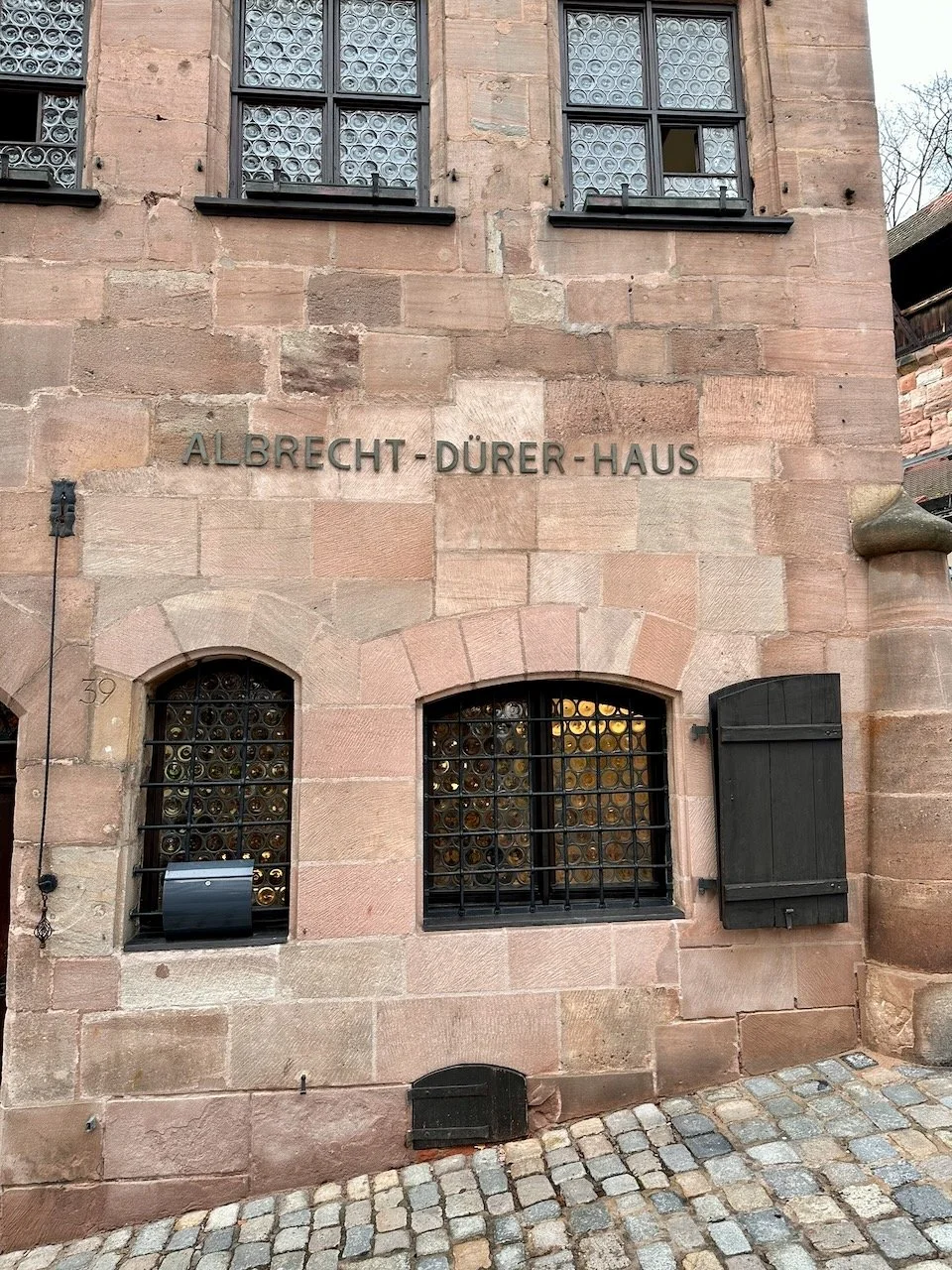
Dürer's House is the birthplace and lifelong home of the artist Albrecht Dürer, arguably the most important German painter of the Renaissance period and Nuremberg's most celebrated son. The building itself is a beautifully preserved late-Gothic structure with a characteristic stepped gable, and it sits in one of the most photogenic corners of the Altstadt near the Tiergärtnertor city gate.
The photography value here is dual: the architecture of the house and its immediate surroundings, and the interior spaces if you pay for entry. The courtyard in front of the house, with the bronze Dürer monument and the castle rising in the background, is one of the most compressed and layered compositions in the city.
📷 Pro Tip: Stand at the far end of the small square in front of the house and shoot at 35 to 50mm with the monument in the foreground and the house behind it. Early morning gives you the cleanest shot without visitors in the frame. The alley to the right of the building leads upward toward the castle walls and opens onto a view of the rooftops that most people miss entirely. If you go inside, the workshop spaces and printing equipment offer close-up detail shots that work well at 50mm or 85mm for compression and subject separation.
Best time: Early morning for the exterior. Interior: any time during opening hours. Access: Free outside; paid entry for the interior museum. U-Bahn to Maxfeld or a ten-minute walk from the castle.
He traveled widely, studied perspective, anatomy, and proportion, and helped raise the status of the artist from craftsman to intellectual.

Printmaking Revolution: Dürer turned woodcuts and engravings into high art. His works were reproduced and distributed across Europe, essentially making him one of the first international art stars. His writings on geometry, perspective, and proportion influenced artists for centuries.
Pieces like The Four Horsemen of the Apocalypse, Melencolia I, and Praying Hands remain iconic, deeply detailed, and widely studied.
Festivals & Events
Christkindlesmarkt (late November to December 24) is the single most photographically rich event in Nuremberg and one of the most famous Christmas markets in the world. The Hauptmarkt fills with red-and-white-striped stalls, the air smells of Lebkuchen and roasted nuts, and the evening light from hundreds of lanterns turns the medieval square into something genuinely beautiful. The market dates to at least the seventeenth century, and the atmosphere reflects that history.
For photographers, the challenge is the crowds. Go early in the morning when the stalls are just opening, and the vendors are setting up. Return in the final hour before closing when the light is warm and the numbers thin slightly. Midday is all but unusable photographically. The market is at its most magical on misty or lightly snowing evenings when the lantern light diffuses into the air.
Blaue Nacht (Blue Night, May) is Nuremberg's annual night-time art and light festival, when the city's monuments, facades, and public spaces are lit with artistic light installations after dark. For photographers, it is a wide-open invitation to shoot familiar locations in entirely unfamiliar light. Plan to be on the streets from dusk until late.
Altstadtfest (Old Town Festival, September) fills the Altstadt with folk music, street food, and Franconian traditions. It is a strong opportunity for street and people photography in a relaxed, celebratory atmosphere.
Noris Force (September) is a motorsport and military vehicle festival held at the Nazi Party Rally Grounds, drawing historic vehicles and a community that takes its history seriously. The visual contrast of historic machinery in that particular space is worth the trip.

It can get very busy
Frequently Asked Questions About Visiting Nuremberg
Is Nuremberg worth visiting, given its history?
Yes, and approaching it honestly is part of what makes it worthwhile. The Documentation Center at the former Nazi Party Rally Grounds addresses this history directly and thoughtfully. The city holds both its medieval beauty and its 20th-century weight at once, and that tension is genuinely part of what makes it meaningful to photograph.
Do you need a car in Nuremberg?
No, the Altstadt is entirely walkable, and nearly every photography location sits within a twenty-minute walk of the center. The U-Bahn covers destinations outside the center, like the rally grounds, efficiently.
Is Nuremberg expensive?
Not particularly, outside of Essigbrätlein, which holds two Michelin stars and prices accordingly. Franconian classics like Albrecht-Dürer-Stube and Hausbrauerei Altstadthof offer excellent value.
What are the best photo spots in Nuremberg?
Weißgerbergasse in late afternoon light, Kaiserburg Castle at sunrise, and Henkersteg at blue hour are three that consistently deliver. The full list with Pro Tips is above.
Can you fly a drone in Nuremberg?
No, not over the Altstadt or the castle without specific authorization. Check the EU Drone Regulation map and current local restrictions before flying; the rally grounds require the same diligence.
What surprised you most about Nuremberg?
The size of the Christmas market. It's unlike anything else in Germany, the Hauptmarkt fills completely, and the scale and atmosphere genuinely earn the market's centuries-long reputation.
How many days do you need in Nuremberg?
Three days for a focused photography visit; five lets you shoot the same locations in different light and add a half-day trip to the Nazi Party Rally Grounds without feeling rushed.
Is Nuremberg worth combining with Munich or Prague?
Yes, both work well. Munich is a two-hour train ride with a completely different Bavarian character. Prague is a short journey across the border and shares Nuremberg's medieval scale, though with a different river and layout.
Final Thoughts
Nuremberg is not a city that tries to impress you quickly. It earns your attention slowly, through mornings on the castle walls and evenings along the river, through the weight of what happened here and the resilience of what remains. For photographers who want more than a backdrop, who want a destination with actual depth, it consistently delivers.
Come back more than once. The Christmas market version of this city and the spring version of this city are genuinely different places, and both reward a camera in your hands.
Want to improve your photography while exploring some incredible destinations? Join me on one of my photography workshops! You can find all the details, including upcoming destinations and dates, through the links below.
Let's Stay Connected!
More Guides in the Region
My Photography & Travel Guide to Munich, Germany is a two-hour train ride from Nuremberg and an entirely different experience: the Marienplatz, the English Garden, the covered market halls, and easy day-trip access to Neuschwanstein and the Bavarian Alps. The two cities together tell the full story of Bavaria.
My Photography & Travel Guide to Prague, Czech Republic is a short journey across the border and one of the most photogenic cities in Central Europe. Prague and Nuremberg share a medieval character and a Central European light quality, but Prague's scale and river views offer something Nuremberg does not.
My Photography & Travel Guide to Vienna, Austria is a longer journey south, but a natural companion for anyone who wants to follow the architectural and cultural thread of Central European history. Where Nuremberg is intimate and layered, Vienna is expansive and imperial.

Are you carrying too much camera equipment, but still coming home disappointed with your travel photographs?
You are not alone. Many photographers fall into the packing trap. They bring too much, plan too little, and spend their trip scrambling to capture photographs instead of enjoying the experience.
Capture the World offers a better approach.
In this practical guide, travel photographer Vito L. Tanzi shares the five step system he uses to plan photography trips, pack with purpose, work with the best light, and return home with stronger images.
Inside, you will learn how to:
• Travel lighter without sacrificing image quality
• Choose destinations that match your photography goals
• Visit at the right time for weather, light, wildlife, festivals, or seasonal conditions
• Build a photography itinerary around sunrise, sunset, blue hour, and changing weather
• Select the equipment you will actually use
• Find promising locations before you arrive
• Avoid the stress and exhaustion that can ruin a photography trip
• Stay flexible when weather, crowds, or travel plans change
This guide includes practical planning advice, useful photography tools, real travel examples, and a complete system you can use again and again.
Whether you are preparing for your first international photography trip or planning a weekend closer to home, Capture the World will help you travel with greater purpose, photograph with more intention, and spend less time worrying about what is inside your camera bag.
Because the best photography trip is not the one where you carry everything.
It is the one where you are ready when the right moment appears.
📸 Format: PDF download
Instant Download
Finally—a beginner-friendly photography guide that makes sense.
If you've ever picked up a camera and thought, "Now what?" this is the book for you.
Photography Made Simple is written for adults who are just starting out and want a clear, encouraging, real-world approach to learning photography. Whether you're using a DSLR, mirrorless, or just your smartphone, this guide walks you through the basics—without the jargon or tech overwhelm.
Inside, you'll learn:
The only camera settings you really need to know to get started
How to shoot sharper, more intentional photos using light and composition
Simple tips for portraits, landscapes, travel, and everyday life
What gear you do (and don’t) need
How to create better photos without upgrading your camera
You’ll also get practical exercises, cheat sheets, and tips for organizing and editing your images—plus the confidence to shoot off Auto Mode for good.
This is not a textbook. It’s a friendly guide to seeing the world with fresh eyes—and finally capturing what you see the way you imagine it.
📸 Format: PDF download
Pages: 100+
Perfect for: Beginners, hobbyists, and anyone ready to take better photos without the stress