Moscow, Russia Travel & Photography Guide: Best Photo Spots, Things to Do & Hidden Gems
My father was giving a series of lectures in Moscow and asked if I wanted to join him. I had never expected to go to Russia, but this was too good an opportunity to pass up.
I went not knowing what to expect, and came home having learned something I think about often. The people we encountered were warm, curious, and genuinely friendly. The food, which I also had no expectations for, was excellent. And the photography was extraordinary, the kind that comes from a city that operates at a scale and a grandeur that most other capitals cannot match.
Moscow does not ease you in. St. Basil's Cathedral in the January snow, lit up against a dark sky in Red Square, is one of the most visually powerful things I have ever stood in front of with a camera. The city speaks in large gestures, wide boulevards, and buildings that were designed to communicate power and permanence. As a photographer, you feel the scale before you feel anything else.
The Moscow Metro is worth the entire trip on its own terms. I will say more about it later, but the short version is: you have never seen a metro system like this, and you will spend as much time in it as you spend on the streets above.
We visited in January 2019. Much has changed since then. This guide is a record of that visit and what it produced. Please check your government's current travel advisory before making any travel plans to Russia.
In this Photography Guide to Moscow, I share the photography locations, the hotels and restaurants from our 2019 visit, the Metro, and what it felt like to discover a city I had never expected to love.

Photographer's Notes
Before you go, here are my own takeaways from this January 2019 visit.
Favorite Season: Spring (for a future visit; we went in winter)
Favorite Location: Red Square
Favorite Restaurant: Café Pushkin
Favorite Lens: 15-35mm f/2.8
Would I Return? I'm glad I went. It's a fascinating city, especially Red Square. But given how things stand now, I'm not sure I'd go back.
Why Should You Visit Moscow?
Moscow isn’t just a city—it’s a living, breathing mosaic of history, culture, and innovation. Whether you’re a history buff, architecture enthusiast, foodie, or photographer, there’s something in Moscow that will leave you spellbound. Here’s why Moscow deserves a spot on everyone’s travel bucket list:
Architectural Masterpieces
Moscow’s skyline is a stunning juxtaposition of past and future. The city is home to some of the world’s most iconic buildings, from the fairy-tale domes of St. Basil’s Cathedral to the modern steel and glass skyscrapers of Moscow City. The Moscow Metro itself is an architectural wonder, with stations that look more like royal ballrooms than transit hubs.

Rich History and Culture
As the epicenter of Russian history, Moscow offers a deep dive into the country’s fascinating past. Explore the grandeur of the Kremlin, visit Lenin’s Mausoleum, and walk through Red Square, where centuries of history converge. The city's museums, like the State Historical Museum and Tretyakov Gallery, house priceless treasures and masterpieces that provide insight into Russia’s artistic and cultural evolution.
Vibrant Arts and Entertainment
Moscow is a cultural powerhouse, offering world-class performances at legendary venues like the Bolshoi Theatre. Whether it’s ballet, opera, or contemporary art exhibitions, the city pulses with creative energy. Street art and galleries in areas like Winzavod showcase Moscow’s modern artistic edge.
Photography
Every corner of Moscow is photogenic. From the ornate ceilings of the Moscow Metro to the reflective facades of Moscow City, there’s no shortage of breathtaking scenes. Sunrise over Red Square and sunset at Sparrow Hills offer unparalleled photo opportunities.
Where to Stay in Moscow, Russia
Important note for 2026 visitors: The major international hotel brands listed in this section were operating in Moscow during our January 2019 visit. Following geopolitical events in 2022, a number of international hospitality brands restructured or ended their Russian operations. Hotel affiliations, brand names, and operating conditions may have changed significantly. Verify current status directly before booking.
The following are the hotels we were aware of during our visit, based in the historic center near Red Square and the Kremlin.

St. Basil’s Cathedral
Luxury Hotels
Ritz-Carlton Moscow — Located steps from Red Square with panoramic views from the rooftop bar, this was one of the most coveted hotel addresses in Moscow. Opulent suites, world-class service, and the most direct access to the Kremlin and Red Square of any hotel in the city. Verify current brand affiliation and operating status before booking.
Ararat Park Hotel Moscow — A landmark property near the Bolshoi Theatre, combining elegant design with exceptional service. The location is excellent for photographers focused on the theater and the Kremlin district. Verify current operating status.
The Legend of Moscow (formerly Four Seasons) — Overlooking Red Square, this property was operating as a Four Seasons affiliate during our visit. It now operates under independent management as The Legend of Moscow. The location directly facing Red Square remains among the finest in the city for photographers: the view from upper-floor rooms across the square to St. Basil's Cathedral is extraordinary.
Mid-Range Options
Hotel Metropol Moscow — A magnificent Art Nouveau building near the Kremlin and Bolshoi Theatre, the Metropol is one of the most architecturally significant hotels in Moscow. The grand interiors, the stained glass, and the historic dining rooms are photography subjects in their own right. A genuinely distinctive mid-range choice.
Mercure Moscow Baumanskaya — A reliable Accor property with easy metro access to major attractions at a practical mid-range price point.
Azimut Hotel Smolenskaya Moscow — A modern high-rise with city views and convenient transport links. A comfortable and accessible base.

St. Basil’s Cathedral
Trip Planning Essentials
Ideal Length of Stay: Spend 5–7 days to explore fully and photograph Moscow’s highlights and lesser-known gems.
Best Time to Visit: Spring and fall showcase Moscow at its finest. The city comes alive with blooming gardens in the spring, while autumn’s golden hues add warmth and depth to its historic landmarks. These seasons also bring mild weather, creating ideal conditions for exploring and photographing the city without the extremes of winter or summer.

Getting Around Moscow, Russia
Moscow’s transportation system is efficient and affordable. The best option is to explore the metro. It is remarkably beautiful with statues, stained glass, and expansive hallways.


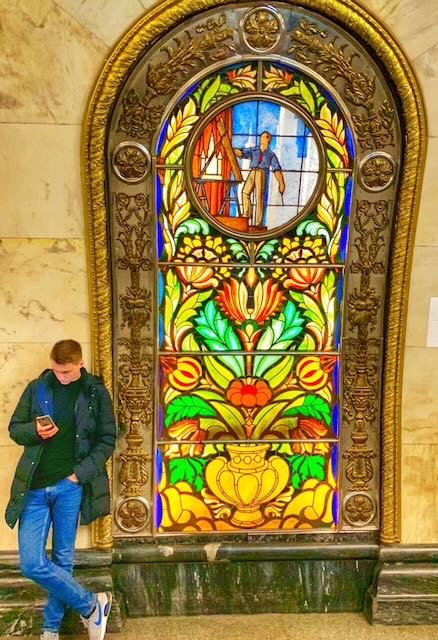


Metro: The Moscow Metro is not only fast but also an architectural marvel, with stations like Mayakovskaya and Komsomolskaya serving as stunning photo spots.

Inside the Metro
Walking: The city center is highly walkable, allowing you to capture candid street scenes and historic architecture.
Ride-Sharing: Apps like Yandex. Taxi and Bolt are reliable options for navigating areas beyond the metro’s reach.

Dining Recommendations in Moscow, Russia
Moscow’s culinary scene is as diverse as its architecture, offering everything from traditional Russian dishes to contemporary cuisine. We were very surprised at how much we enjoyed the food.
Exploring Moscow’s culinary scene is an essential part of the journey. Traditional dishes like borscht, with its vibrant flavors, pelmeni—delicate dumplings often served with sour cream—and blini, thin pancakes paired with various fillings, offer a taste of Russia’s rich culinary heritage.

Where to Eat in Moscow, Russia
We were surprised at every meal. Russian cuisine is nothing like the reputation it carries in Western Europe, at least not in Moscow in 2019. The range was extraordinary and the quality consistent. These are our recommendations from that visit.
Three dishes to know before you sit down: Borscht, the deep red beetroot soup with sour cream, is the one you must try. Pelmeni, small meat dumplings typically served with butter and sour cream, are the Russian equivalent of pierogi and equally excellent. Blini, thin pancakes served with smoked salmon, caviar, or sweet fillings, appear at every meal and reward attention.
Café Pushkin — The most celebrated and most atmospheric restaurant in Moscow, operating inside a mansion designed to evoke 19th-century aristocratic life. The menu serves classical Russian cuisine executed with precision: borscht, game, whole-roasted fish, and a pastry counter that earns its own visit. The ambiance is theatrical in the best sense. The building, the staff in period dress, and the specific quality of the food combine to produce an evening that is genuinely unlike any other in the city. Reserve in advance.
White Rabbit — One of the most acclaimed and most talked-about restaurants in Russia, serving avant-garde Russian cuisine on the 16th floor of a building in central Moscow with 360-degree views over the city. The food draws on Russian ingredients from across the country's vast territory and reinterprets them with genuine creative ambition. Panoramic dining views and serious cooking in the same room.
Dr. Zhivago — A stylish restaurant adjacent to Red Square serving classic Russian flavors with a contemporary sensibility. The location is excellent, and the food captures the traditional Russian kitchen without the museum-piece atmosphere. A strong choice for a dinner close to the photography action.
Strelka Bar — A relaxed waterfront venue on the Moscow River with terrace views and a menu that covers casual European and Russian dishes. After an afternoon of photography along the riverfront, the combination of the view and the easy atmosphere is exactly right.
Coffee Mania — Moscow's most respected café chain, with multiple locations across the city. Artisanal coffee, good food, and the stylish, unhurried atmosphere that makes it the right stop for an editing session between shoots.

Gum Department Store
Photography Gear & Tips for Moscow, Russia
Moscow is a demanding city for photography in the best way. You are shooting wide interiors under chandeliers, vast open squares in winter light, reflective glass towers at blue hour, and dimly lit Metro stations that make most cameras work hard. Bring a body with strong high-ISO performance and you will not be limited by the city.
My recommended kit for Moscow:
Camera Bodies: The Canon EOS R5 Mark II, Sony A7R V, and Nikon Z8 are all exceptional here. The A7R V in particular handles the low-light Metro stations with ease, and the resolution gives you room to crop tightly on architectural detail. The R5 Mark II's autofocus is useful for street work in busy public spaces. Any of the three will produce serious results.
Walk-Around Camera: I travel with the Leica Q3 for street work and candid moments. It is unobtrusive, the 28mm lens is perfect for Red Square and Metro platforms, and the image quality is exceptional.
Lenses:
Wide angle (16 to 35mm): Your most important lens in Moscow. Red Square, the Metro stations, the floating bridge at Zaryadye Park, all reward a wide perspective. You need this.
Standard zoom (24 to 70mm): The all-day workhorse. Architecture at medium distance, food photography, the GUM interior.
Telephoto (70 to 200mm): Excellent for isolating St. Basil's onion domes against the sky, compressing the Kremlin towers, and pulling distant architectural details into a tighter frame.
Fast prime (35mm f/1.4 or 50mm f/1.4): Essential for Metro station photography, where light is controlled and dramatic but not bright. A fast prime lets you shoot handheld without sacrificing shutter speed.
Accessories:
Tripod: Non-negotiable for blue hour at Red Square, long exposures along the Moscow River, and low-light Metro compositions. A travel tripod that fits in your carry-on is enough.
ND Filters: A 6-stop ND is useful along the Moscow River during overcast days to smooth the water and reduce commuter foot traffic in long exposures.
Extra batteries: Cold weather drains batteries faster than you expect. Moscow in winter is genuinely cold. Carry at least two spares and keep one inside your coat.
Memory cards and a Samsung T7 SSD for end-of-day backup. Do not rely on a single card in a city this photogenic.
Cold-weather hand warmers: Not camera gear, but they protect your hands between shots and your shooting efficiency improves dramatically.
Drone Note: Drone regulations in Russia were highly restrictive even before 2022 geopolitical events, with permits required in most urban areas and flying prohibited near government buildings, the Kremlin, and military installations. This essentially means no drone photography in central Moscow. Do not bring a drone expecting to fly it here.
iPhone Photography Tips for Moscow
Moscow rewards strong composition over technical complexity. If you are shooting on an iPhone, the city gives you everything you need to produce outstanding results.
In the Metro: Switch to the ultra-wide lens (0.5x) at Komsomolskaya Station and stand at the center of the platform. The vaulted ceiling, the chandeliers, and the receding arches create one of the strongest symmetrical compositions you will find anywhere in the world. Shoot in ProRAW if your iPhone supports it. The dynamic range between the lit chandeliers and the darker platform is significant, and RAW gives you room to recover shadow detail.
At Red Square in Snow: Night mode is your friend here. The cobblestones absorb and reflect the ambient light from the Cathedral and the Kremlin walls. Lock your exposure manually if your iPhone allows it, set a slower shutter, and brace against a wall or set the phone on a surface. The resulting image at 1 to 3 seconds will show light trails from passing pedestrians against the glowing Cathedral, which is exactly the shot.
Moscow City Towers: The blue hour reflection on the Moskva River from Bagration Bridge is one of the clearest geometry-and-reflection shots in the city. On iPhone, use the standard lens (1x) in the standard photo mode. Portrait mode and its blurred backgrounds do not help you here. You want the full depth and sharpness of the scene. Shoot just after the sun drops below the horizon, when the towers begin to glow and the sky still holds color.
GUM Department Store: The interior arcade with its vaulted glass ceiling is a perfect iPhone subject. The light flooding down through the roof creates natural diffusion. Stand at either end of the main arcade and shoot straight down the axis. Use the grid lines to keep your verticals straight.

Photography Locations in Moscow, Russia
The Kremlin and Red Square are icons of Moscow, and their architectural grandeur alone is worth the visit. These sites are steeped in history and offer countless angles for breathtaking photographs. Whether you’re capturing the intricate details of St. Basil’s Cathedral or the vast openness of Red Square, these locations deliver both inspiration and artistry.
Red Square
Iconic landmarks like St. Basil’s Cathedral and Lenin’s Mausoleum make this a must-visit. If you only have time to photograph one thing in Moscow, this would be it. It’s just incredibly beautiful.
Pro Tip: Arrive thirty minutes before sunrise for the quietest and most photogenic conditions. The cobblestones reflect the cathedral's colors when wet from overnight cleaning. The 16-35mm wide-angle captures St. Basil's full facade from the south end of the square; a 70-200mm lens from the Kremlin Wall side compresses the cathedral against the sky. Return after dark: Red Square lit at night, particularly in snow, is one of the finest winter photography environments in Europe.

When I arrived at St. Basil’s Cathedral just after sunrise, the soft light transformed its vibrant domes into a fairytale-like scene. It was the perfect time to capture its intricate beauty.

I loved photographing Red Square at Night. Everything is lit up, and while we were there, it was snowing.


Zaryadye Park
This urban oasis near the Kremlin offers diverse landscapes and panoramic views from its "floating bridge." Zaryadye Park is divided into four climate zones—forest, steppe, tundra, and wetlands—allowing photographers to capture various natural environments without leaving the park.
The park’s iconic floating bridge, which extends over the Moskva River without any support underneath, is an architectural marvel. You can capture stunning panoramic shots of the Kremlin, St. Basil’s Cathedral, and the Moscow River from here.
Pro Tip: The floating bridge at golden hour gives you the Kremlin, St. Basil's, and the Moscow River in a single wide composition. A 24-70mm handles the full panorama; a 70-200mm pulls the cathedral and Kremlin towers into a tighter compression across the water.

Gorky Park
Gorky Park is one of Moscow's most famous parks, offering a mix of natural beauty and urban life. Its well-maintained gardens, walking paths, and open spaces provide a tranquil yet dynamic environment for photography. The Grand Central Entrance Arch, an iconic structure, is a fantastic subject for architectural and symmetry-focused shots.

Moscow City
What makes Moscow interesting is the contrasting modern and old architecture. On one hand, you have Basil’s Cathedral, and just a few minutes away, you will find futuristic skyscrapers and reflections along the Moskva River.
Pro Tip: The best view of Moscow City's towers from across the Moskva River is from Bagration Bridge, which frames the cluster of glass skyscrapers against the water. At blue hour, the reflections on the river are extraordinary. The contrast between these towers and St. Basil's visible in the opposite direction from the same bridge is the essential Moscow photograph.

Bolshoi Theatre
A world-renowned cultural landmark and an architectural masterpiece. The theatre is one of the most famous opera and ballet venues in the world.

The Pushkin Museum
The museum houses one of Russia's most extensive and diverse collections of fine art, featuring masterpieces from ancient civilizations to modern times. You’ll find works by iconic artists like Rembrandt, Monet, Van Gogh, and Picasso, making it a haven for capturing timeless artistic brilliance.


The Metro System
If you think a metro system is just a functional way to get from Point A to Point B, you’ve never stepped into the Moscow Metro. It’s not just public transport—it’s an underground palace, a living museum, and one of the most photogenic urban experiences you’ll ever have. Trust me, as a photographer who’s been lucky enough to document the world’s wonders, this is a bucket-list photography destination.
Pro Tip: Komsomolskaya Station on the Circle Line is the single most photogenic station: gold mosaics, chandeliers, and vaulted ceilings that look like an imperial ballroom. Arrive during off-peak hours (before 8 a.m. or after 10 p.m.) to minimize commuter traffic. A wide-angle at the platform level creates the leading-line composition along the vaulted ceiling. A 35mm prime captures the human scale against the palatial backdrop. Ask permission before photographing individuals directly.

The Moscow Metro isn’t just about trains—it’s about chandeliers, marble columns, mosaics, and sculptures that look like they belong in a royal residence. Stations like Komsomolskaya, with its golden ceilings and opulent chandeliers, or Mayakovskaya, a masterpiece of Art Deco design, transport you into a bygone era of grandeur. Photographing these stations feels like stepping back in time while capturing something truly unique.

The architecture of the Moscow Metro is a photographer’s dream if you love playing with symmetry and vanishing points. The long platforms framed by arched ceilings and intricate designs create leading lines that guide your viewer’s eye. Stations like Taganskaya or Novoslobodskaya offer perfect examples of balance and perspective.

Festivals & Seasonal Highlights
Moscow operates on a grand scale year-round, and the city's calendar of public celebrations reflects that. These are the events worth planning around if photography is your priority.
Victory Day, May Victory Day is one of the most visually powerful public events in Europe. The military parade through Red Square draws enormous crowds and fills the city with flags, uniforms, veterans wearing their medals, and ceremonies that have a weight and seriousness unlike anything in Western capitals. If you are in Moscow in May, this is extraordinary to photograph. Arrive early to secure a position along the parade route. A telephoto lens in the 100 to 200mm range lets you work the crowd and isolate individual faces and medal ribbons without needing to push to the front.
Moscow City Day, September The city celebrates its founding anniversary each September with concerts, fireworks, street performances, and public installations across the center. The celebrations concentrate around Red Square, Gorky Park, and Tverskaya Street. Blue hour and the fireworks together over the skyline make for strong long-exposure work. A tripod and a 24 to 70mm lens are the right setup.
New Year and Christmas Celebrations, December and January This is when Moscow transforms. The city decorates at a scale that rivals any European capital. Red Square becomes a tented winter market with light installations, ice sculptures, and food stalls. GUM, the department store adjacent to Red Square, puts up one of the most elaborate Christmas light displays in the world. The combination of falling snow, the illuminated Cathedral, and the market stalls in the foreground is the defining winter image of the city. For photographers, this season delivers the most consistently spectacular conditions.
Golden Autumn, September and October Gorky Park and Kolomenskoye turn extraordinary shades in late September and October. The Kolomenskoye estate, a UNESCO World Heritage site on a bluff above the Moscow River, has centuries-old apple orchards that go gold and the wooden Church of the Ascension as a backdrop. A visit during peak color in the last two weeks of September, in morning light, is one of the quieter and more personal photography experiences Moscow offers.
Maslenitsa (Pancake Week), February or March The traditional Slavic festival marking the end of winter involves street fairs, folk dancing, blini (the pancakes that give the week its name), and the ceremonial burning of a straw effigy called Lady Maslenitsa. Gorky Park and outdoor public squares host the main celebrations. The color, the costumes, and the mood are unlike anything else in Moscow's calendar. The date shifts each year based on the Orthodox calendar, so verify timing when planning.

Frequently Asked Questions About Visiting Moscow
Is it safe to travel to Russia right now?
Check your government's current travel advisory before making any plans. This guide documents a January 2019 visit, and conditions have changed significantly since then. Do your own current research rather than relying on this guide for present-day safety guidance.
What are the best photo spots in Moscow?
Red Square at dawn, the Moscow Metro's Komsomolskaya station, and the Bagration Bridge for the Moscow City skyline reflected in the river are three that stood out on this trip. The full list with Pro Tips is above.
Is the Moscow Metro really worth photographing?
Yes, genuinely. Stations like Komsomolskaya and Mayakovskaya look more like imperial ballrooms than transit hubs, gold mosaics, chandeliers, vaulted ceilings. It's one of the most photogenic urban transit systems anywhere in the world.
What surprised you most about photographing Moscow?
How much I enjoyed visiting, and how interesting the city turned out to be, especially Red Square. The food was much better than expected too. That said, I'm not sure I'd go back again given how things have developed since.
Do hotel brands from this guide still operate in Moscow?
Not necessarily. Several international hospitality brands restructured or ended their Russian operations following 2022. Verify current brand affiliation and operating status directly before booking anything referenced in this guide.
Final Thoughts
I still think about Red Square at night in the snow.
We had been out photographing for hours, and the temperature had dropped well below zero. My father had gone back to the hotel. I stayed. At some point around ten o'clock, the square emptied almost completely, the snow was falling steadily, and St. Basil's Cathedral sat there in the dark, lit from below, its domes saturated with color against a sky that had gone nearly black. It was one of those photography moments you do not plan. You just stay when everyone else leaves, and the city gives you something.
That is Moscow's best quality for photographers. It does not hide its drama. It also does not hand it to you immediately. The scale is enormous, and the city can feel formal and even stern at first. Give it time. Walk the Metro platforms slowly. Go to Red Square before sunrise and again after midnight. Stand on the floating bridge at Zaryadye and let the full panorama settle. The city opens up to the photographer who is willing to work in the cold and stay out late.
This was a January 2019 visit, and much has changed since then. Whether and when you travel to Russia is a decision you need to make based on your own assessment of current conditions and your government's travel advisory. What I can say is that Moscow was not what I expected. The people we met were warm and curious. The food surprised us completely. And the Metro, which I will always describe to anyone who will listen, is unlike anything else in the world.
If you would like to join a future photography workshop, visit my Workshops page for current offerings and upcoming dates. You can also connect with me on Instagram (@chasinghippoz) and Facebook, or subscribe to the newsletter for travel photography tips, destination guides, and behind-the-scenes stories from more than 75 countries. I look forward to sharing the journey with you.
If Moscow is eventually on your list, it will earn its place.
My Photography & Travel Guide to Warsaw, Poland Warsaw sits just two hours from Moscow by air and carries its own extraordinary weight of history and resilience. The Old Town is a UNESCO World Heritage Site rebuilt from near-total destruction after World War II. The contrast between Warsaw's rebuilt historic quarter and its Soviet-era architecture is a photographer's essay in European history. If you are planning an Eastern European route, Warsaw belongs on it.
My Photography & Travel Guide to Prague, Czech Republic Prague is the most photographically dense city in Central Europe. The Old Town, the Charles Bridge at dawn, the castle complex above the Vltava River, and the medieval astronomical clock combine to create a city that rewards any time you spend in it. A logical extension of a Moscow visit for anyone drawn to European architecture and history.
My Photography & Travel Guide to Budapest, Hungary. Budapest is one of the great underrated photography destinations in Europe. The Parliament building on the Danube, the thermal bath interiors, the Fisherman's Bastion at sunrise, and the ruin bars of the Jewish Quarter give photographers an almost unreasonable range of subjects in a compact and walkable city. One of my favorites on the continent.

Are you carrying too much camera equipment, but still coming home disappointed with your travel photographs?
You are not alone. Many photographers fall into the packing trap. They bring too much, plan too little, and spend their trip scrambling to capture photographs instead of enjoying the experience.
Capture the World offers a better approach.
In this practical guide, travel photographer Vito L. Tanzi shares the five step system he uses to plan photography trips, pack with purpose, work with the best light, and return home with stronger images.
Inside, you will learn how to:
• Travel lighter without sacrificing image quality
• Choose destinations that match your photography goals
• Visit at the right time for weather, light, wildlife, festivals, or seasonal conditions
• Build a photography itinerary around sunrise, sunset, blue hour, and changing weather
• Select the equipment you will actually use
• Find promising locations before you arrive
• Avoid the stress and exhaustion that can ruin a photography trip
• Stay flexible when weather, crowds, or travel plans change
This guide includes practical planning advice, useful photography tools, real travel examples, and a complete system you can use again and again.
Whether you are preparing for your first international photography trip or planning a weekend closer to home, Capture the World will help you travel with greater purpose, photograph with more intention, and spend less time worrying about what is inside your camera bag.
Because the best photography trip is not the one where you carry everything.
It is the one where you are ready when the right moment appears.
📸 Format: PDF download
Instant Download