Bergen, Norway Travel & Photography Guide: Best Photo Spots, Things to Do & Hidden Gems
Bergen does not ease you in gently. The first time I took the Fløibanen funicular up Mount Fløyen at dusk, I stood at the top and watched the harbor lights begin to flicker on below me, the wooden houses of Bryggen glowing amber against the dark water, seven mountains pressing in from all sides. I had my camera out before I fully understood what I was looking at. That image has stayed with me across every return visit.
I have been to Bergen more than three times now, and the city still surprises me. It sits on Norway's southwestern coast, tucked between the Hardangerfjord and the Sognefjord, surrounded by mountains and perpetually threatened by rain. And here is what no one tells you before you go: the rain is not the problem. The rain is the point. Bergen averages around 240 rainy days a year, and every one of them is a gift for photographers. Wet cobblestones double the color of Bryggen's facades. Low clouds press drama into the fjord valleys. Mist softens the mountain edges into something that looks painted. Bring your rain cover and leave your disappointment at home.

Bergen gives you history, nature, and light in proportions that few cities can match. The Hanseatic wharf at Bryggen has been standing since the 12th century. The Norway in a Nutshell fjord circuit departs right from the city center. And on a clear summer evening, golden hour here lasts until nearly 11 pm. Whether you are shooting with a full mirrorless kit or an iPhone, this city will work with you.
In this Photography Guide to Bergen, Norway, I share the places and experiences that continue to draw me back. You will find my favorite photography locations, guidance on when and where to shoot, practical travel tips, and gear recommendations, along with cultural insights to help you explore and photograph Bergen with confidence, respect, and ease.

Photographer's Notes
Before you go, here are my own takeaways.
Favorite Season: Summer
Favorite Location: Mount Fløyen
Favorite Hotel: Hotel Norge by Scandic
Favorite Restaurant: Bryggeloftet & Stuene
Favorite Café: Kaffemisjonen
Favorite Lens: 16-35mm f/2.8
Would I Return? Yes, definitely.
Where to Stay in Bergen
Best Area: Bryggen and Central Bergen
Stay close to the water. The neighborhoods around Bryggen and the central harbor put you within walking distance of every major photography location in the city, and when the light shifts fast, you will not want to be hunting for a taxi. Most of the hotels below are within a 10 to 15-minute walk of each other, which also makes it easy to explore on foot without burning the morning.
Luxury Hotels in Bergen
Opus XVI | Central Bergen, Vågsallmenningen
This is the most interesting luxury property in Bergen, and one of the few hotels anywhere with a genuine story behind it. Opus XVI is run by descendants of Norwegian composer Edvard Grieg, and the building, a grand 19th-century bank, was originally designed in part by Grieg's own cousin. The central hall still has its original marble columns and polished granite walls, now sitting alongside contemporary Scandinavian design. For photographers, the architecture alone is worth the stay. Request a room on the upper floors for views toward the Fløibanen funicular and the mountainside. The on-site restaurant runs a serious seafood menu anchored in local ingredients.
Hotel Norge by Scandic | Central Bergen, Byparken
Hotel Norge first opened in 1885 and was completely renovated in 2018. It is Bergen's largest and most prominent full-service hotel, and its location next to Byparken puts you a flat 10-minute walk from Bryggen. The property has two restaurants, a full spa, and free bicycle rentals, which matter when you are moving between photography locations across the city. Some rooms face the mountains.
Home Hotel Havnekontoret | Bryggen Wharf
This hotel sits in a Neoclassical 1920s stone building right on the historic Bryggen waterfront, with a free evening meal and harbor views from the rooftop terrace. The photography value here is immediate: you can be shooting Bryggen at blue hour and be back at the hotel bar in four minutes. The rooftop looks directly over the harbor, which makes it a useful spot for scouting compositions before you commit to a full shoot.
Mid-Range Hotels in Bergen
Zander K Hotel | Central Bergen, near Bergen Station
Since opening in 2017, Zander K has established itself as one of the most design-forward hotels in Bergen. The aesthetic is clean, minimalist, and Scandinavian without being cold. The hotel sits 20 meters from Bergen's central train station, useful if you are arriving by train from Oslo or connecting to the Norway in a Nutshell tour. The organic breakfast buffet pulls from locally sourced Western Norway ingredients, and free coffee and tea are available in the lobby throughout the day. Bryggen is about a 15-minute walk.
Magic Hotel Bergen City Center | Central Bergen
The location is excellent: a short walk from the Fish Market, the Fløibanen funicular, and the main sightseeing areas. Rooms are compact but clean, the design is bold and visually energetic, and the price point is one of the better values in central Bergen. The hotel has a rooftop terrace with city views, worth checking out at dusk before you head out to shoot.
Scandic Neptun | Central Bergen
A reliable, no-surprises mid-range option in the center of the city. Clean rooms, consistent service, and easy walking access to the harbor and Bryggen. A solid choice if the other options are fully booked during peak summer months, and Scandic's loyalty program makes it useful for frequent Norway travelers.

By the Historic Fishmarket
How to Get to Bergen
By Air
Bergen Airport Flesland sits about 20 kilometers south of the city center. It is Norway's second-busiest airport with direct flights from many European cities, and connecting service from North America through Oslo, Amsterdam, and Copenhagen.
From the airport, you have two good options. The Bybanen light rail (Line 1) runs directly from the airport terminal to the city center in about 45 minutes. It is the easiest option if you are traveling with a camera bag rather than a loaded suitcase, and the line runs until around midnight. The Flybussen airport express bus (FB50) is faster at around 30 minutes, and drops you at Bergen Bus Station in the city center. If you are arriving with heavy gear, the bus has more luggage space than the tram.
By Train from Oslo
The Bergen Railway offers a spectacular seven-hour journey from Oslo through Norway's mountain landscapes. It is one of the most scenic train rides in Europe and is worth considering as part of the journey rather than just a transfer. Buy tickets through the Vy app or website, and book in advance for the best fares. If you are combining Bergen with Oslo, this is the most photogenic way to connect them.
By Ferry
Fjord Line operates comfortable ferries between Hirtshals in Denmark, Stavanger, and Bergen. The ferry terminal sits within easy walking distance of the city center, which is genuinely useful when you are carrying gear. Hurtigruten and Havila Voyages also run coastal routes from Bergen north to Kirkenes, and both are worth knowing about if you are planning a broader Norway itinerary.
One tip for gear travelers: If you are arriving by light rail from the airport, the Zander K Hotel is literally steps from the Bergen train and tram station, which cuts out a lot of rolling luggage across cobblestones. Worth factoring into your hotel choice if you are carrying a heavy kit.
How Many Days Should I Stay in Bergen
The minimum: three days. The right answer: five.
Three days is enough to cover Bergen's main photography locations without feeling rushed, but it does not leave much room for bad weather, light that does not cooperate, or the kind of unplanned wandering that produces your best images. Five days gives you that room.
Three Days: The Essentials
Day one is for the waterfront. Bryggen at blue hour in the morning, the Fish Market mid-morning, the harbor at golden hour in the evening. You will spend most of this day within a ten-minute walk of your hotel. Day two is for Mount Fløyen. Take the funicular up in the afternoon, stay for sunset, and shoot the harbor lights from above. Day three is for the Old Town and the neighborhoods behind Bryggen, the textures and quieter streets that most visitors never find because they stay on the main drag. Three days get you to the city.
Five Days: The Full Picture
Add a full day for the Norway in a Nutshell fjord circuit. This is a 10 to 12-hour day, and it earns every one of those hours. Add a fifth day as a flex day: a second attempt at a location where the light did not work, a morning shoot in rain you did not get on day one, or time at the KODE art museums if the weather closes in. Five days let Bergen breathe.
For photographers specifically: Build your itinerary around light, not logistics. Bergen's best shooting windows are early morning before 8 am and the long evening from around 8 pm onward in summer. Your midday hours are for eating, editing, and moving between locations. Do not try to shoot everything in one pass; plan to return to your best locations two or three times across the trip. That is how you get the shot you came for.
Bryggen
Best Time to Visit Bergen
The short answer: May through September for most photographers. Late September for the smart ones.
Bergen photographs well in every season, but the conditions change dramatically across the year, and knowing what you are walking into makes a real difference.
May to June: The Sweet Spot
This is the window most photographers should aim for. By June, Bergen is getting nearly 19 hours of daylight, and the long Nordic twilight means golden hour does not end so much as slowly fade. In late June, sunset is not until around 11 pm, which gives you an extraordinary amount of time to work with soft, directional light. Crowds are building but not yet at peak summer levels. The mountains are green, waterfalls are running hard from snowmelt, and the fjords have clarity and color that mid-summer haze can flatten. If you are planning the Norway in a Nutshell day trip, this is the best light you will get for it.
July to August: Peak Season, Peak Crowds
The weather is at its warmest, typically 15 to 19°C, and Bergen is at its busiest. Bryggen in particular gets packed by mid-morning. If you visit in July or August, plan your key shots for before 8 am and after 8 pm. The light is still extraordinary; you just have to work around the people.
September: The Photographer's Secret
September can be spectacular for photography. Crowds drop off sharply after the first week. Autumn colors hit the mountains in late September, and the combination of golden foliage, moody skies, and dramatically shorter days shifts the entire character of the city. The Bergen Matfestival runs in early September, bringing the city's food culture to the waterfront for a few days that are genuinely worth planning around. The rain intensifies in autumn, but as we have already established, rain is not your enemy here.
October: Moody in the Best Way
Golden trees, misty mornings, and darkening evenings create a distinctly Nordic atmosphere. Crowds are gone. The city belongs to you and the locals. This is when Bergen starts to feel like it belongs in a painting.
Winter (November to March): For the Committed
Bergen's coldest month is January, and daylight drops to around six hours near the solstice. That said, snow on the Bryggen rooftops and blue-hour light at 3 pm create images you simply cannot make any other time of year. Come prepared and come with purpose.
One practical note for all seasons: Bergen's weather can shift four times in a single afternoon. Check the forecast the night before every shoot, but do not cancel a session because rain is predicted. Overcast and wet is often the best possible condition for the colored facades of Bryggen. Bring your rain cover regardless.

On the Harbor
Getting Around Bergen
The best news for photographers: Bergen is remarkably walkable. The historic center, Bryggen, the Fish Market, Mount Fløyen, and most of the photo locations in this guide are within a 20-minute walk of each other. If you are staying near the harbor, you may not need any transport at all for the first two days.
On Foot
Walking is genuinely the best way to work in Bergen. The city is compact, the streets are interesting at ground level, and some of the best compositions reveal themselves when you slow down and wander. The terrain has hills, especially once you move away from the waterfront, so wear real shoes. Cobblestones and light rain are a combination that will find your weak footwear quickly.
The Bybanen Light Rail
Bergen's light rail system, the Bybanen, is clean, reliable, and runs directly from the airport to the city center. It is the single most useful piece of public transport for photographers arriving with gear. The Byparken stop drops you in the heart of the city. Tickets cost around 51 NOK for a single adult fare and can be paid by card at the platform machines. If you are staying for several days, the Bergen Card covers unlimited Bybanen and bus travel and is worth buying on arrival.
Buses
The Skyss bus network fills in the gaps the light rail does not cover. You will not need it much if you are focused on the central photography locations, but it is useful for reaching the Old Bergen Museum or getting out toward Nordnes. Download the Skyss app before you arrive to buy tickets and check routes.
Taxis
Bergen Taxi is the largest operator in the city, with over 200 drivers. You can book through their app (07000) or by phone at +47 07000. There are taxi ranks on Bryggen and behind Hotel Norge by Scandic. Taxis in Norway are regulated but not cheap. A typical 5-kilometer ride runs around 135 NOK. Use them for early morning airport runs or when you are carrying heavy gear in the rain.
Uber and Bolt
Both Uber and Bolt operate in Bergen, though Uber's availability can be unreliable with relatively few drivers in the city. Bolt tends to be the more consistent choice. That said, downloading the Taxifix app before you arrive is worth doing. It connects to Bergen Taxi and other established Norwegian operators through a single interface and shows you a binding maximum price before you confirm the ride. It works in situations where Uber and Bolt come up empty.
A note on driving: You do not need a car in central Bergen. Parking is expensive, and the cobblestone streets in the historic district are not designed for it. If you are planning a day trip to the fjords independently rather than on an organized tour, then a rental car makes sense. Otherwise, leave the driving to someone else and focus on shooting.

The Freshest Fish
Where to Eat in Bergen
Bergen is the seafood capital of Norway. If you are going to spend money here, spend it on fish. The quality of what comes out of these waters is exceptional, and the local chefs know exactly what to do with it. Norway is not a cheap place to eat, and Bergen reflects that reality across the board. Budget accordingly, and do not let sticker shock push you toward the obvious tourist traps along the waterfront. The restaurants below are worth every krone.
Bryggeloftet & Stuene | Bryggen 11, harborfront
This restaurant has been running at Bryggen since 1910 and has been in the same family ever since. That kind of continuity is rare anywhere, and it has made Bryggeloftet & Stuene the definitive address for traditional Norwegian cooking in Bergen. The Bergen fish soup is their most popular dish, made the traditional Bergen way, and many regulars come back specifically for it. The grilled reindeer fillet with game sauce, juniper, and lingonberries is the other dish worth ordering. Sit upstairs on the first floor for harbor views. Book ahead in summer; this place fills up fast and deservedly so.
Lysverket | Rasmus Meyers Allé, KODE 4 Art Museum
Set inside the KODE 4 art museum with views over the lake Lille Lungegårdsvannet, Lysverket holds a Michelin star and is run by chef-owner Christopher Haatuft, who shapes the menu around Norwegian produce, always with scallops from a local fisherman collaborator on it. The restaurant was featured in the New York Times as redefining Nordic cuisine, and the 10-course tasting menu can be paired with wine, an alcohol-free pairing, or a bottle from the wine list. This is Bergen's most serious dining room. Book weeks ahead, dress for the occasion, and plan nothing important for the rest of the evening.
Cornelius Seafood Restaurant | Holmen island, 20-minute boat from Bryggen
Cornelius sits on a small island just outside Bergen, and you arrive by boat from Bryggen. The menu changes with the weather and the season, a concept they call the Meteorological Menu. On warm summer days the doors slide open and tables go out on the quay. When the weather turns, the fire goes on and the food gets richer. This is one of the most genuinely unique dining experiences in Norway, not just Bergen. Reserve well in advance, confirm boat departure times when you book, and bring a camera. The boat ride through the archipelago alone is worth it.
Pingvinen | Vaskerelven, central Bergen
Pingvinen has been a tradition-bearer for Norwegian food in Bergen for over 15 years. Walking in feels like entering your grandmother's living room, and the menu delivers exactly that kind of comfort: fish pie, meatballs, meat stew, and classic Norwegian home cooking done with real care. On Thursdays, potato dumplings are the dish of the day, a Bergen tradition that locals take seriously. This is the most honest value-for-money restaurant on this list, and it stays open until 3am, which is useful information after a long evening shoot.
Bare Vestland | Central Bergen
Bare Vestland focuses on locally sourced, rustic Western Norwegian ingredients in a relaxed setting that feels more neighborhood than tourist. The menu is seasonal and shorter than you might expect, which is always a good sign. This is where you go when you want good food without the theater of a tasting menu or the noise of the harbor restaurants.
Enhjørningen Fiskerestaurant | Bryggen district
Set inside one of the historic, slanted Bryggen buildings, the atmosphere here is genuinely memorable. One of the oldest seafood restaurants in Bergen, it leans into its history without becoming a museum piece. The fish and shellfish menu is strong, and the location inside Bryggen means you are essentially eating inside a UNESCO World Heritage site. Go for dinner, not lunch, when the crowds thin and the place finds its character.
Coffee in Bergen
Bergen's coffee culture is serious. The city has an excellent café scene, and Norwegians take the quality of what is in the cup genuinely seriously, with independent specialty cafés sourcing beans from single-origin farms and rotating their offerings seasonally.
Kaffemisjonen | City center, near Torgallmenningen
Kaffemisjonen is probably the best-known specialty coffee shop in Bergen and a must-visit for serious coffee lovers. Located right in the city center, this small café has built a reputation for expertly brewed coffee using beans from top Norwegian and Scandinavian roasters. Minimalist interior, no fuss, outstanding cup. This is your pre-shoot morning stop.
Det Lille Kaffekompaniet | Near the Fløibanen funicular
Bergen's smallest and oldest coffee shop, tucked down a narrow side street with both indoor and outdoor seating. It is a particularly good stop before heading up to Mount Fløyen, and the carrot cake is genuinely one of the better versions you will find. Tables go fast on weekends. Get there early or be prepared to take your coffee to go.
Dromedar Kaffebar | Multiple central locations
A reliable, cozy chain with a genuine commitment to quality. The atmosphere is inviting and unpretentious, with good WiFi and enough seating to sit down and edit for an hour without anyone hovering. The best option in Bergen when you need a longer edit session over a good cup.

Photography Gear: What to Bring to Bergen
Bergen will test your gear in ways a lot of cities won't. Rain is a near-constant companion, the light shifts fast between seasons, and you will be shooting everything from tight alleyway compositions at Bryggen to sweeping fjord landscapes from a moving boat. Versatility and weather protection are the two things to build your kit around.

Bergen will test your gear in ways a lot of cities won't. Rain is a near-constant companion, the light shifts fast between seasons, and you will be shooting everything from tight alleyway compositions at Bryggen to sweeping fjord landscapes from a moving boat. Versatility and weather protection are the two things to build your kit around.
Camera Bodies
Any modern full-frame mirrorless body performs well here. The Canon EOS R5 Mark II, Nikon Z8, and Sony A7R V are all strong choices and handle low light well, which matters given Bergen's overcast skies and long blue-hour windows. If you shoot Leica, the Q3 is an excellent single-body option for street work and the narrow Bryggen alleys. Whatever body you bring, confirm it has at least some weather sealing. Bergen will find the gaps.
Bring two bodies if you can. Switching lenses in the rain on a narrow harbor walkway is how filters end up in the water.
Lenses
Your wide angle (15 to 35mm) is the most important lens in Bergen. The colored facades of Bryggen, the harbor panoramas from the opposite waterfront, and the fjord landscapes from Mount Fløyen all reward a wide field of view. A 16-35mm f/2.8 earns its weight on every day of a Bergen trip.
Your standard zoom (24-70mm) is your workaround lens for the Fish Market, street work in the Old Town, and the Norway in a Nutshell boat cruise. It is the lens that stays on the camera when you do not know what is coming next, which in Bergen is most of the time.
A telephoto (70-200mm) earns its place on the fjord day trip. From the boat deck on the Nærøyfjord, you will want reach for the waterfalls dropping off the cliff walls and the tiny villages on the opposite shore. It is also useful for compressing the layers of mountains behind Bergen from the Fløyen viewpoint.
Tripod
Non-negotiable. Bergen's best light comes at blue hour, and the long exposure shot of Bryggen's reflections from across the harbor is one of the defining images of the city. A compact travel tripod works for most locations. If you travel with a Platypod, it is genuinely useful for low-angle harbor shots where you cannot set up full legs.
ND Filters
Bring a 6-stop and a 10-stop. The Norway in a Nutshell waterfalls are one obvious use case, but you will also want them on overcast days at the harbor when the water is choppy and you want to smooth it out into a long exposure. A circular polarizer is worth packing too; it cuts the glare off the wet cobblestones at Bryggen and deepens the color of the fjord water on the cruise.
Rain Protection
This is not optional in Bergen. A quality rain cover for your camera and bag is as essential as the tripod. If you do not already own one, buy it before you leave. Shooting in light rain here is normal and often produces the most atmospheric images. You should be able to keep working in it without thinking about your gear.
Backup and Power
Bring at least two extra batteries per body. Cold Norwegian air drains batteries faster than you expect, and if you are doing a full Norway in a Nutshell day with early morning and late evening shooting, one battery will not get you through. Carry a Samsung T7 SSD for end-of-day backups. Memory cards fail faster than you think, and losing a day of Nærøyfjord images is not a story you want to tell.
Drone
Norway operates under the EU's EASA drone framework and allows recreational flying in the Open category, but Bergen's compact urban setting and busy maritime airspace require careful planning. Register through flydrone.no before your trip and check the SafeToFly or Ninox apps for no-fly zones around Bryggen and the harbor before any flight. The Nærøyfjord is a UNESCO site with restrictions. Always check local signage on location. The fjords outside the city, including certain open stretches on the Norway in a Nutshell route, offer legitimate aerial opportunities for registered operators.
iPhone Photography in Bergen
Bergen is genuinely one of the best cities in Europe for iPhone photography, and not just because the subjects are easy. The soft, diffused light from overcast skies is almost always flattering on a phone sensor, and the compact size of the Bryggen alleys makes a wide-angle phone lens the ideal tool.
Use the ultrawide for Bryggen. The narrow passages between the Hanseatic buildings are too tight for even a 16mm lens on a mirrorless. Your iPhone's ultrawide (roughly 13mm equivalent) fits them perfectly. Shoot in the rain when the wood facades are dark and saturated, and look for the reflections pooling on the stone ground.
Use Night Mode for harbor long exposures. From the opposite waterfront after sunset, prop your iPhone on a wall or low surface and let Night Mode run a full 10-second exposure on the Bryggen lights reflecting in the water. The results will surprise you. Use a small travel tripod or GorillaPod for this if you have one; even minor movement ruins the reflection.
Use Portrait Mode at the Fish Market. The vendors and their stalls are natural portrait subjects. Portrait Mode on a face with the stall and harbor as background gives you subject separation that isolates the human element cleanly. Get close, make eye contact first, and shoot wide.
Best Photography Locations in Bergen
Bryggen
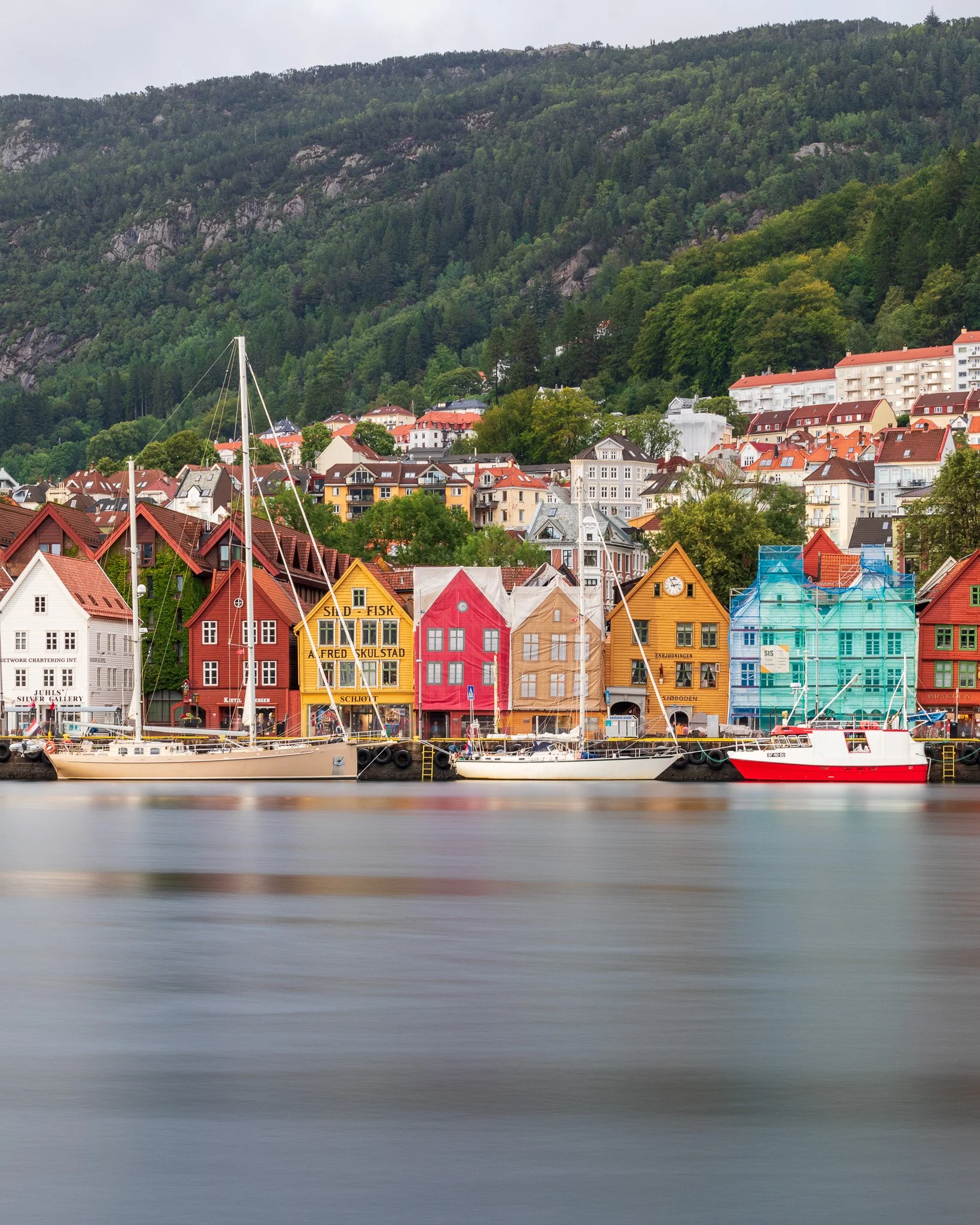
Bergen's most photographed subject is also its most forgiving. The row of colorful Hanseatic wooden buildings along the Vågen harbor has been standing since the 14th century, and the colors, ochre, rust, deep red, and white, photograph well in almost any light. What most visitors miss is that the best image of Bryggen is not taken from the front.
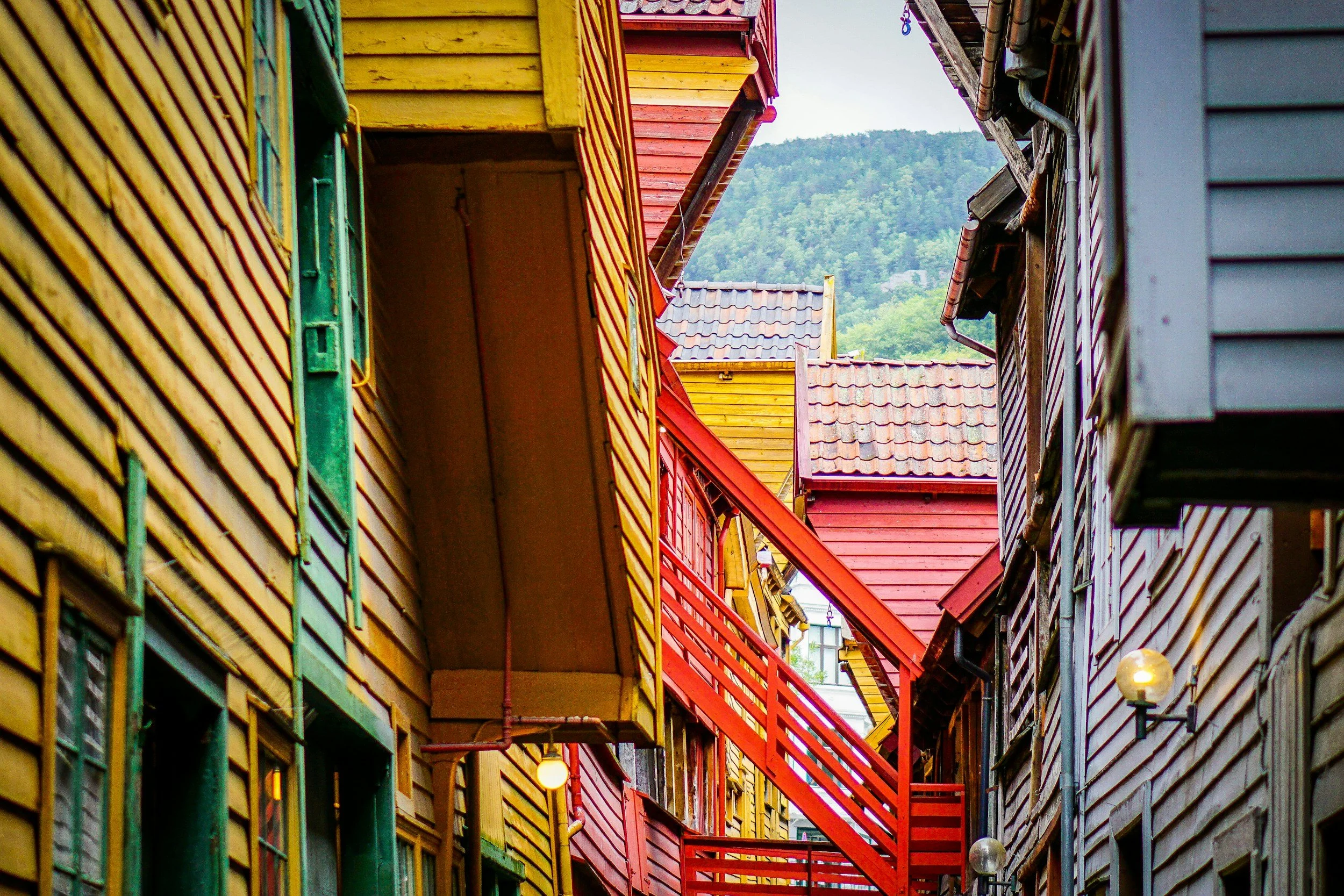
Position yourself on the opposite side of the harbor and shoot across the water for the classic reflection composition. Early morning, before the tour boats arrive, gives you a still harbor surface. Rain helps; wet water doubles the color saturation in the reflection and adds a mood that the midday sun cannot match. The narrow alleys behind the facades are the other discovery. These passages are too tight for most zoom lenses and perfect for a 24mm or 35mm prime. The lean of the centuries-old timber frames, the worn stone underfoot, and the gap of sky overhead make compositions that have nothing to do with the postcard version of Bryggen.
📷 Pro Tip: For the harbor reflection shot, position yourself at the far end of the Bryggen pier where the water opens up and the full row of buildings lines the frame. Shoot with a 24-70mm lens around 35mm for a natural perspective. Arrive before 7am in summer to beat the foot traffic. The light hits the facades directly in late afternoon from the west; use this for saturated color on the buildings themselves rather than reflections. In the rain, switch to the alleys and shoot tight with a 24mm or 35mm prime. Look up occasionally as well as forward; the gap between the leaning rooflines against the sky is one of Bergen's best and least-photographed compositions. Tripod is useful for the harbor reflection at blue hour.
Best time: Blue hour morning for reflections; late afternoon for direct facade light; any time in the alleys. Access: Free, open always. A two-minute walk from any central Bergen hotel.

One of the best views is from the opposite side of the harbor where you can take a long exposure shot with a tripod.

The Old Hanseatic Wood Houses
The area immediately behind the Bryggen facade and the streets of the Old Town running south from it are where Bergen reveals its texture. Most visitors photograph the harbor front and move on. The people who wander into the back alleys and uphill streets come back with the images that actually look like Bergen rather than a postcard of it.
The Hanseatic alleyways behind the wharf buildings are narrow, dark, and full of structural character. Timber frames lean at angles accumulated over centuries. Stone and worn wood sit side by side. The light that gets in through the gaps is directional and dramatic. Further into the Old Town, wooden houses in similar ochre and rust tones line the streets, with the mountains as a backdrop and small details, a painted door, a weathered sign, a bicycle leaning against a fence, around every corner.
📷 Pro Tip: This is your 35mm prime location. Leave the zoom behind and work with a single focal length that forces you to move. The alleys behind Bryggen are tight enough that anything longer than 35mm makes framing difficult. Shoot in the middle of the day here when the sun is high and throws sharp shadows down into the passages; this is one of the few Bergen locations where midday light works in your favor rather than against you. For the Old Town streets, early morning before 8am gives you empty lanes and soft directional light. Look for leading lines, the line of a fence, a row of windows, a narrow street disappearing uphill, and use the mountain backdrop whenever you can include it without forcing the composition.
Best time: Alleys: midday for contrast. Old Town streets: early morning. Access: Free, always open. The alleyways begin immediately behind the Bryggen facade buildings.

As Bergen served as a German trading center in the past, you can still find many German surnames among the city’s residents. Some of the most common family names are Friele, Mowinckel and Mohn.


Bergen Fish Market (Fisketorget)
Fishermen have sold their daily catch at Torget since the 12th century, and the market still runs on the waterfront next to Bryggen at the edge of the Vågen harbor. The outdoor market runs May through September with 15 to 20 colorful tented stalls arranged in two rows, creating a central walking corridor of fresh seafood, prepared food, and Norwegian specialty products. The indoor Mathallen hall operates year-round for off-season visits.
For photographers, this is a people and detail location, not a landscape one. The vendors, the textures of the fish, the steam rising from the soup pots, and the interaction between sellers and buyers are the story here. It rewards patience and a short lens over a wide establishing shot.
📷 Pro Tip: Get there at opening, around 9am, before the cruise ship crowds arrive. The light is soft and raking across the stalls in the morning, which gives you texture on the fish displays and rim light on the vendors' faces. Use a 70-200mm from a distance to shoot candid vendor activity without disrupting the flow of the market. If you want environmental portraits, make eye contact first and mime your camera before raising it. Most vendors are accustomed to being photographed and respond well to a direct, respectful approach. For detail shots of fish displays, oysters, and arranged catches, get low and shoot at stall level rather than standing over the subject. A 24-70mm around 50mm works well for this. Ask permission before photographing vendors or customers closely. Machu Picchu Gateway
Best time: 9 am to 11 am for light and manageable crowds. Access: Free. Outdoor market open May to September, 9am to 9:30pm. Indoor Mathallen year-round. Located at Torget, the harbor end of the city center.


Mount Fløyen
The Fløibanen funicular whisks you from the harbor to the summit in minutes, where you are met with one of Norway's most famous views: the city's red-tiled rooftops cascading toward the water, framed by peaks and forest. This is the shot I keep coming back to. Standing at the main viewing platform at the top as the city lights come on below and the harbor starts to glow is one of those moments that makes you understand exactly why you carry a camera everywhere. Life in Norway
The platform faces directly down over Bergen's rooftops toward the harbor and the open water beyond. In summer, you have enormous flexibility with timing because sunset pushes past 10pm. In autumn, the surrounding forest turns and the mountain viewpoint becomes a completely different image.
📷 Pro Tip: Go up in the late afternoon and stay for blue hour. The transition from golden light on the rooftops to the city lights coming on against a deep blue sky is the window you are waiting for, and it happens fast. Set up on the main viewing platform and use a 24-70mm around 24 to 28mm to get the full sweep of the city and harbor in a single frame. Bring your tripod for the blue-hour exposure; handheld will not give you the sharpness the image deserves. If you want a slightly different angle than the standard platform view, walk two minutes further up the trail to the left to a bench that overlooks the platform itself, giving you a compressed view with the city beyond. Check the funicular's last departure time before you lose track of the hour. In summer it runs late, but confirm on the day. Go Fjords
Best time: Late afternoon through blue hour. Funicular departs from Vetrlidsallmenningen, a five-minute walk from Bryggen. Access: Funicular ticket required, around 100 NOK return for adults. Verify current pricing on arrival.

Stroll Through the Old Town: Øvregaten and the Lanes Around Domkirken
Most visitors to Bergen never make it past the Bryggen waterfront. That is their loss, and quietly, your gain. The streets that climb the hillside above the harbor, especially Øvregaten and the narrow lanes winding up around the Domkirken cathedral, are where Bergen stops performing for tourists and just gets on with being itself.
I came through here early one morning, before the city had fully woken up, and the streets were almost entirely empty. What stopped me, repeatedly, were the doors. Painted in deep greens, reds, and blues, each one worn and slightly different from its neighbor, framed by timber facades that lean with the casual confidence of buildings that have been standing for centuries. Throw in a piece of graffiti on a stone wall, a crooked window box, a bicycle leaning against a painted gate, and you have a street that gives you something new every twenty meters.
The hill itself is part of the composition. As you climb, the rooftops of the lower city start to stack below you, and the mountains appear at the end of streets. It is the kind of neighborhood that rewards slow walking and a short lens.
📷 Pro Tip: Arrive before 8 am. The streets are empty, the light is soft and directional, and you will not be dodging other people in your frames. A 35mm prime is the ideal lens here. It is wide enough to include the full facade of a house with its door and some street context, but tight enough to isolate a single painted door or a detail on a window frame. For the graffiti, get close and look for pieces where the painted wall sits against old timber or stone; the contrast between the contemporary mark and the centuries-old surface is the image. Walk up Øvregaten first, then work your way through the smaller lanes toward Domkirken. Do not rush this section. The best finds are the ones you nearly walk past.
Best time: Early morning, any season. Access: Free, always open. A 10-minute walk uphill from Bryggen.


A Fjord Day-Trip - The Norway in a Nutshell Experience
The Norway in a Nutshell day trip from Bergen is a 10 to 12-hour circuit that takes you through some of the most dramatic fjord landscapes in Europe. It combines train, bus, and boat. The Nærøyfjord cruise is the centerpiece.
Sailing through the Nærøyfjord means moving between towering cliff walls with waterfalls dropping off the edges and tiny coastal villages appearing around each bend. The fjord is a UNESCO World Heritage site in its own right, and on clear days, the light on the water and the scale of the surrounding terrain are almost impossible to process in real time. This was my best single photography moment of the entire trip. The cliffs are close enough that you feel them pressing in from both sides, and the reflection of the mountains in the calm water between turns the cruise into something that feels genuinely surreal.
📷 Pro Tip: Position yourself on the outer deck as early as possible after boarding and stay there. The best compositions come from low and close to the water, not from standing at the railing. Bring your 70-200mm for the waterfalls and the distant villages on the far shore; a wide-angle captures the scale, but the telephoto captures the detail and the drama. The light in the fjord varies dramatically depending on cloud cover and time of day; overcast gives you even, shadowless color on the water and cliff faces, while direct sun creates high contrast that is beautiful but harder to expose for. Shoot in RAW and bracket your exposures on the high-contrast scenes. The weather shapes everything on this cruise; calm days give mirror reflections in the water, rougher days give movement and atmosphere. Both are worth photographing. Bring your rain cover regardless of the forecast.
Best time: May to September for full green mountain coverage and running waterfalls; any conditions produce strong images. Book the Norway in a Nutshell tour in advance through the official site. Full day commitment.

The Fjord Cruise Ship
Key Stops for Photography

Flåm Railway:
The Flåm Railway is one of the steepest standard-gauge railways in the world, climbing from sea level to 866 meters through narrow valleys, alongside waterfalls, and past mountain farms in under an hour. The train makes one photography stop at the Kjosfossen waterfall, where passengers have around ten minutes to shoot before reboarding.
This is one of the most compressed photography opportunities you will encounter anywhere: a powerful waterfall, a theatrical mist, and a Norwegian folk legend performed at the base of the falls, all in ten minutes. Have your camera out, settings dialed in, and your position chosen before the train stops.
📷 Pro Tip: Set up your exposure before the train pulls in; you do not have time to experiment once you are standing there. A 6 or 10-stop ND filter gives you the silky waterfall effect that makes the image. Use a shutter speed of one to four seconds depending on water volume and the look you want. Position yourself slightly to the side rather than dead center to create a diagonal lead-in with the cascade. The performance at the base of the falls is theatrical and adds a human element if you want it; use a 70-200mm for a tight crop that puts the figure against the white water. The mist from the falls will coat your front element within two minutes; bring a lens cloth and wipe before each shot. Ten minutes goes faster than you think.
Best time: The railway runs year-round; spring and early summer bring the heaviest water flow. The photography stop at Kjosfossen is included in every standard run. Access: Included in the Norway in a Nutshell ticket.

The Flåm Railway has been voted one of the most beautiful train journeys in the world. The railway climbs from sea level to 860 metres above sea level through the Flåm Railway, and the scenery is incredible.

The railway makes one photo stop by a waterfall and a woman comes out and sings by the waterfalls.

Once you arrive in Gudvangen, you will take the scenic fjord cruise to Flåm.

Nærøyfjord:
The fjord cruise from Flåm to Gudvangen is pure magic.

You’ll sail between towering cliffs and tiny coastal villages, with plenty of spots to snap dramatic fjord landscapes.

The landscapes through the Fjords are amazing.

If you are lucky the sun will peak through or you might even be super lucky and have a sunny day.

You will pass through so many tiny villlages along the way.

Each village is more beautiful that the last

Stegastein Viewpoint
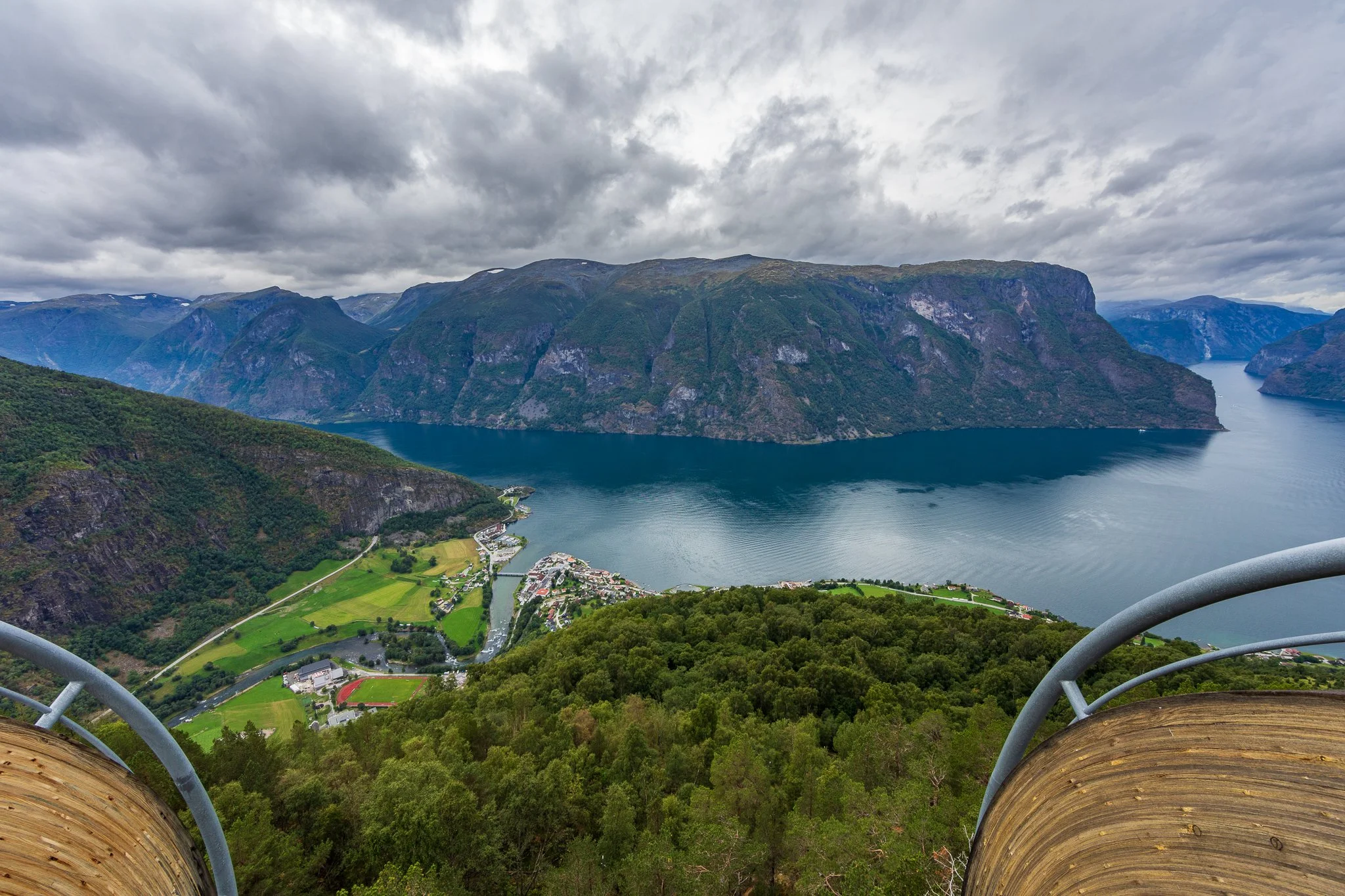
Stegastein sits perched high above the Aurlandsfjord and offers sweeping, wide-angle views in every direction, including the fjord cruise ships moving far below. Getting there requires renting a car or taking a local taxi from Flåm during your two-hour window before the fjord cruise departs, but it is worth organizing. I rented a small electric car and drove up; the road is steep and dramatic in its own right.
The viewpoint itself is a cantilevered wooden platform that extends out over the valley, giving you a clean foreground drop and an unobstructed view across the Aurlandsfjord. On clear days, this is one of the best wide-angle landscape shots in the entire Norway in a Nutshell circuit.
📷 Pro Tip: The viewpoint platform is narrow and shared, so work quickly and be considerate of other visitors. A 16-35mm at the widest end is the right tool here; you need width to capture the full scale of the fjord, the mountains, and the valley floor simultaneously. Shoot toward the fjord for the water reflection if conditions allow; shoot back toward the mountains for the layered ridge lines that stack beautifully at this elevation. In summer, with the long light, the golden hour view from here is exceptional, but you need your own transport and careful timing to make it work alongside the cruise departure. Confirm your boat time before you commit to the drive.
Best time: Clear days for fjord views; golden hour in summer if timing allows. Access: Requires independent transport from Flåm. Free to visit the viewpoint itself. Allow 30 to 45 minutes for the round trip from Flåm.

The views in all directions are stunning.

From the top you can see the Fjord cruise ships below.
Special Events and Festivals
Bergen punches well above its size as a festival city. Several events are exceptional for photographers, not just as attendees but as subjects.
Bergen International Festival (Festspillene i Bergen) | Late May through early June
This is one of the most prestigious performing arts festivals in Scandinavia, running across two weeks in late spring with concerts, theater, dance, and exhibitions spread across the city's cultural venues. For photographers, the combination of outdoor performances, dressed audiences, and Bergen's late evening light creates an atmosphere unlike anything the city offers the rest of the year. The main stages are open-air in parts, and the crowd scenes around the harbor and city squares during performance evenings are worth shooting even if you cannot attend the events themselves. Arrive in the evening when the light is still long and the city fills with people dressed for the occasion.
Bergen Matfestival (Bergen Food Festival) | Early September
Bergen's largest food festival takes over Festplassen and the city center waterfront for several days in early September, bringing together regional producers, chefs, and food artisans in a tented market that is genuinely photogenic. The stalls are colorful, the vendors are engaged and proud of what they are selling, and the combination of seafood displays, open-fire cooking, and the Bryggen backdrop makes this one of the best people and food photography opportunities in the region. Shoot in the morning when the light is still raking and the crowds are manageable. Get close to the producers and ask before you shoot; most are delighted to have someone take their craft seriously.
Nattjazz | Late May
One of the world's longest-running jazz festivals, Nattjazz takes over venues across Bergen for around 10 days in late May. The festival is known for its late-night programming, which means you are shooting musicians in low light, often with dramatic stage lighting that rewards a fast prime and a body that performs well at high ISO. The Bergen Light Rail stations and streets around the venues fill with music fans in the late evening. Shoot the energy of the crowd as much as the stage.
Bergenfest | Late June
An outdoor music festival held over several days in Bergen, Bergenfest draws a mix of international headliners and Norwegian acts to stages around the city. The late June light in Bergen, still golden at 10pm, makes the outdoor stages and crowd scenes unusually beautiful for a music festival. A 70-200mm is your tool for stage shots from a distance; a 35mm prime handles the crowd atmosphere.
Bergen International Film Festival (BIFF) | October
Held each October across Bergen's cinemas and cultural spaces, BIFF is one of the largest film festivals in Norway. For photographers, the appeal is less about the screenings and more about the energy the festival brings to the city during what is otherwise the quietest month of the tourist calendar. Evening crowds in the October light, the lit-up facades of the city's cultural quarter, and the generally atmospheric October conditions in Bergen make the festival period a strong time to be working in the streets.
Bergen Pride | August
Bergen Pride fills the city center with color, community, and energy over several days in summer. The parade itself moves through the main streets and past the waterfront, and the combination of vibrant crowds, color, and Bergen's summer light makes it one of the most photographically rewarding events on the calendar. A wide angle for the crowd scenes, a 70-200mm for portraits and compressed parade shots, and patience with the timing are your tools.
Frequently Asked Questions About Visiting Bergen
Does the rain in Bergen ruin your photos?
No, it's actually the opposite. Bergen averages around 240 rainy days a year, and every one is a gift for photographers. Wet cobblestones double the color saturation of Bryggen's facades, low clouds add drama to the fjord valleys, and mist softens the mountains into something that looks painted. Bring a rain cover and lean into it rather than waiting for it to clear.
Is Bergen expensive?
Yes, Norway is expensive across the board. Dinner for two at a mid-range restaurant runs 800-1,200 NOK without wine, and fine dining pushes past 2,000 NOK per person. Budget accordingly, but the seafood is genuinely exceptional and worth spending on.
Do you need a car in Bergen?
No, not for the city itself. Bergen is remarkably walkable, and the Bybanen light rail covers everything else. A car only makes sense if you're doing an independent fjord day trip rather than the organized Norway in a Nutshell tour.
What are the best photo spots in Bergen?
Bryggen's harbor reflection at blue hour, Mount Fløyen at sunset, and the alleys behind Bryggen at midday for the dramatic light coming through the gaps are three that consistently deliver. The full list with Pro Tips is above.
Can you fly a drone in Bergen?
Check current Norwegian drone regulations before flying, particularly around Bryggen's UNESCO World Heritage designation and the harbor area, which likely carry restrictions.
What surprised you most about Bergen?
That rain is not the problem, it's the point. I came in expecting to work around Bergen's weather and left understanding that the weather is what makes the photography here distinctive. The images that surprised me most on every trip were the ones I made when I stopped waiting for the sun.
How many days do you need in Bergen?
Three days minimum for the essentials; five is the right answer if you want to add the Norway in a Nutshell fjord day trip and a flex day for weather or a second attempt at a location.
Is the Norway in a Nutshell fjord tour worth the full day?
Yes, without question. The Nærøyfjord cruise, sailing between towering cliff walls with waterfalls dropping off the edges, was the best single photography moment of an entire Bergen trip. Book it in advance through the official site.
Final Thoughts
Bergen will get under your skin in a way that cleaner, sunnier cities rarely do. There is something about a place that asks you to earn it: to show up in the rain, to stay out past midnight in summer light that refuses to quit, to climb a mountain before breakfast and stand above the clouds while the harbor glows below. Bergen asks all of that, and it gives back more than you put in.
I have been here more than three times now, and I still find new images on every visit. The alleyways behind Bryggen look different in October than they do in June. Mount Fløyen in the rain is a different photograph from Mount Fløyen at golden hour. The Nærøyfjord in cloud shadow is not the same image as one made on a calm, mirror-flat morning. This is a city that rewards return visits, and it rewards photographers who slow down enough to notice what changes.
If you take one thing from this guide, let it be this: do not fight Bergen's weather. Lean into it. The images that surprised me most on every trip were the ones I made when I stopped waiting for the sun and started working with whatever the sky was doing. That is the Bergen mindset, and once you find it, the city opens up.
Bergen is compact enough that you can cover its best locations in a few days, but rich enough that you will wish you had a few more. Give it five days if you can. Do the fjord day trip. Stay for blue hour at least twice. Eat the fish soup at Bryggeloftet. Stand at the top of Fløyen after dark and watch the harbor lights come on.
You will come back.
Want to improve your photography while exploring some incredible destinations? Join me on one of my photography workshops! You can find all the details, including upcoming destinations and dates, through the links below.
Let's Stay Connected!
More Norway and Scandinavia Guides from Chasing Hippoz:
My Photography & Travel Guide to the Lofoten Islands, Norway The most dramatic archipelago in Norway, and one of the most photographed places in all of Scandinavia. If Bergen gives you fjords and history, Lofoten gives you peaks dropping straight into the sea, tiny red fishing villages, and light that defies description. The two destinations together make for one of the great photography trips in Europe.
My Photography & Travel Guide to Oslo, Norway Bergen is the soul of Norway; Oslo is its modern face. The Vigeland Sculpture Park, the Aker Brygge waterfront, and the new Munch Museum give photographers a completely different country to work with. A six-hour train ride connects the two cities through mountain landscape that is worth photographing on its own.
My Photography & Travel Guide to Reykjavik, Iceland and the Golden Circle From Bergen, Iceland is a short flight and a completely different world. Geysers, black sand beaches, waterfalls, and the midnight sun. If Norway's fjords have your attention, Iceland's elemental landscapes are the logical next chapter.
Are you carrying too much camera equipment, but still coming home disappointed with your travel photographs?
You are not alone. Many photographers fall into the packing trap. They bring too much, plan too little, and spend their trip scrambling to capture photographs instead of enjoying the experience.
Capture the World offers a better approach.
In this practical guide, travel photographer Vito L. Tanzi shares the five step system he uses to plan photography trips, pack with purpose, work with the best light, and return home with stronger images.
Inside, you will learn how to:
• Travel lighter without sacrificing image quality
• Choose destinations that match your photography goals
• Visit at the right time for weather, light, wildlife, festivals, or seasonal conditions
• Build a photography itinerary around sunrise, sunset, blue hour, and changing weather
• Select the equipment you will actually use
• Find promising locations before you arrive
• Avoid the stress and exhaustion that can ruin a photography trip
• Stay flexible when weather, crowds, or travel plans change
This guide includes practical planning advice, useful photography tools, real travel examples, and a complete system you can use again and again.
Whether you are preparing for your first international photography trip or planning a weekend closer to home, Capture the World will help you travel with greater purpose, photograph with more intention, and spend less time worrying about what is inside your camera bag.
Because the best photography trip is not the one where you carry everything.
It is the one where you are ready when the right moment appears.
📸 Format: PDF download
Instant Download