Athens, Greece Travel & Photography Guide: Best Photo Spots, Things to Do & Hidden Gems
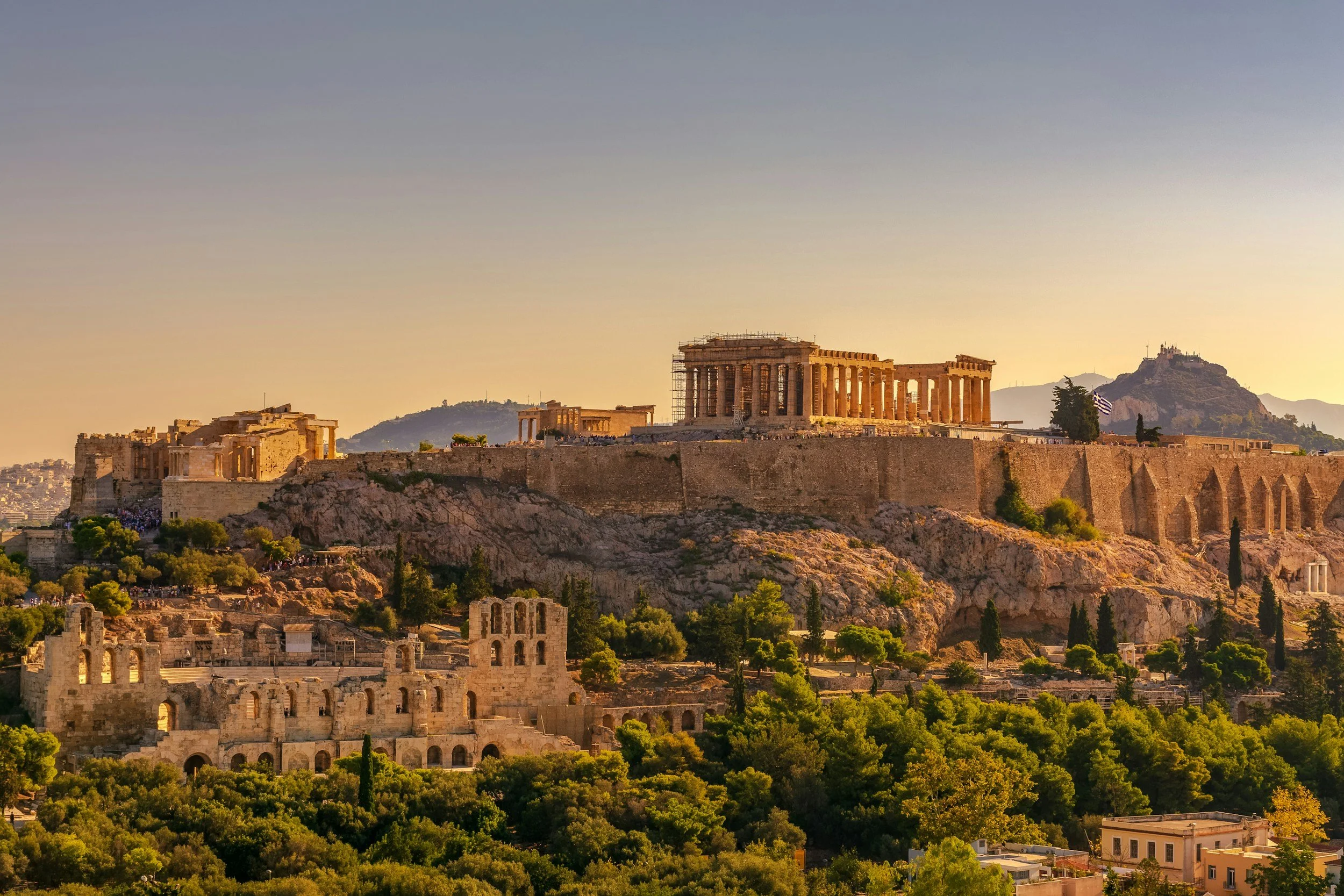
I was standing on Areopagus Hill in the dark, camera on a tripod, when the Parthenon slowly emerged from the predawn black. The marble turned violet, then warm gold, then white as the sun climbed behind Lycabettus Hill and the city began to exhale. In 25 years of photographing places on every continent, that morning ranks among the most quietly breathtaking I have ever had.
That is Athens.
Most travelers treat it as a layover, a quick stamp on the way to Santorini or Mykonos. That is a serious mistake. Athens is not a gateway. It is a destination. It is one of the oldest continuously inhabited cities on the planet, and you feel that weight the moment you step into it. Ancient ruins, Byzantine churches, Ottoman markets, neoclassical architecture, and one of the most energetic street scenes in Europe all exist within walking distance of each other. The contrasts are constant, and they are extraordinary.
For photographers, Athens is close to perfect. The Mediterranean light is exceptional year-round. Your subjects range from world-class archaeological landmarks to narrow whitewashed alleys, from rooftop bars at blue hour to morning markets bursting with color. You can spend an entire day shooting without ever getting in a car. For travelers who slow down and let the city reveal itself one street at a time, Athens delivers something most European capitals no longer can: genuine, living history that you walk through, not around.

In this Photography Guide to Athens, I share the places and experiences that continue to draw me back. You will find my favorite photography locations, guidance on when and where to shoot, practical travel tips, and gear recommendations, along with cultural insights to help you explore and photograph Athens with confidence, respect, and ease.

Photographer's Notes
Before you go, here are my own takeaways.
Favorite Season: Spring
Favorite Location: Areopagus Hill
Favorite Hotel: AthensWas Design Hotel
Favorite Restaurant: Karamanlidika tou Fani
Favorite Café: Taf Coffee
Favorite Lens: 24-105mm
Would I Return? Yes, definitely. Athens is like Rome, there's so much to see.
Best Time to Visit Athens for Photography
Athens can be photographed year-round, but some seasons reward photographers more than others.
Spring (March to May) is my favorite time to visit. Temperatures are comfortable, wildflowers begin to appear on the hills, and the softer light is ideal for photography. Crowds are also significantly smaller than in summer. The golden hour light in April and May is long and warm, which suits the pale marble of the ancient sites perfectly.
Summer (June to August) brings long days and high energy, but also intense heat and large crowds at every major site. If you visit during this period, plan all photography sessions around sunrise and sunset. Midday in July and August is brutal, both for you and for the flat, shadowless light.
Fall (September to November) is the other strong season. Temperatures drop to a comfortable range, tourist numbers fall sharply, and the golden light of late afternoon stretches well into the evening. September in particular is excellent: warm enough to be comfortable, cool enough to shoot at any hour.
Winter (December to February) is consistently overlooked. Cooler temperatures, far fewer visitors, and a quieter city that feels more like the Athens locals actually live in. Photographing the Acropolis in winter light, especially on a clear morning with low sun, is a completely different and equally compelling experience.
Where to Stay in Athens
For photographers, neighborhood matters more than almost anything else in Athens. Staying within walking distance of the Acropolis means you can reach the city's best shooting locations before the crowds arrive, and get back for a quick battery swap without losing the light. The Plaka and Dionysiou Areopagitou corridor gives you that access better than anywhere else in the city.
Luxury Options in Athens
AthensWas Design Hotel Dionysiou Areopagitou Street, steps from the Acropolis Museum
I have stayed here twice, and both times the location alone justified the choice. AthensWas sits on one of the most beautiful pedestrian streets in Athens, the tree-lined Dionysiou Areopagitou, which runs directly below the south slope of the Acropolis. The Acropolis Museum is across the street. Areopagus Hill is a five-minute walk. Plaka is right there.
The 21 rooms and suites blend warm timber tones with dark marble bathrooms and bold, color-block textiles. The design feels modern without feeling cold. But the rooftop is the reason to come. Upper-floor suites have expansive balconies, and the rooftop restaurant at sunset delivers one of the most extraordinary views in all of Athens: the Parthenon glowing above you, the city spreading out in every direction, the sky turning colors you will want to photograph immediately. If you are optimizing purely for a photography-focused trip, this is where you stay. You can be at every major shooting location before the tour buses arrive.
Hotel Grande Bretagne Syntagma Square, Athens City Center
There are newer hotels in Athens. There are more fashionable ones. There is no more iconic one. The Grande Bretagne has anchored Syntagma Square since 1874, and from the moment you walk through the door into its gilded salons and marble staircases, you understand exactly why. This is the kind of hotel that has hosted heads of state, royalty, and artists for 150 years, and it carries that history in every detail.
The rooftop GB Roof Garden restaurant delivers one of the finest views of the Acropolis in the city. Book a table at dusk and watch the Parthenon turn gold. For photographers, the location is exceptional: Plaka, Monastiraki, Areopagus Hill, and the Acropolis are all within a 15-minute walk. The hotel also connects directly to the metro, which makes early morning shoots and late-night returns easy.
The Dolli at Acropolis Mitropoleos Street, Plaka
The Dolli is one of the most talked-about boutique hotels in Athens right now, and with good reason. Housed in a meticulously restored 1925 neoclassical mansion in the heart of Plaka, this Grecotel property offers 46 high-ceilinged suites furnished with a mix of original art, antiques, and contemporary pieces that feels genuinely curated. The rooftop infinity pool with direct views of the Parthenon is one of the most photogenic hotel spaces I have seen anywhere. Le Bar Secret on the ground floor is the kind of place you stumble into for one drink and leave two hours later. If you want a luxury stay that doubles as a photography location without leaving the property, this is it.
Mid-Range Options in Athens
Ava Hotel & Suites Plaka Spacious suites with kitchenettes in the heart of Plaka, ideal for longer stays. Smart, comfortable, and well-positioned for early morning Acropolis access. A strong value pick for photographers who want to keep their focus on the work and not the commute.
Herodion Hotel Near the Acropolis Museum Stylish and well-run, just a short walk from the Acropolis Museum. The rooftop terrace has solid Acropolis sightlines and is a fine spot for evening drinks after a long day of shooting. The staff here are genuinely helpful about early-morning logistics.
Plaka Hotel Plaka neighborhood Clean, well-located rooms in the heart of Plaka. Nothing flashy, but the position is excellent, the price is right, and you are steps from some of the best street photography in the city.

How Many Days to Spend in Athens
Three days is the minimum for a photography-focused trip. Five days is better. With three days, you can cover the major landmarks, explore Plaka and the ancient sites, and catch golden hour from at least two good vantage points. With five days, you have room to slow down, revisit locations in different light, take a day trip to the Temple of Poseidon at Sounion, and spend an evening simply sitting on a rooftop without a camera in your hand.
A rough outline:
Day 1: Arrive, walk Plaka and Anafiotika in the afternoon, sunset from Areopagus Hill.
Day 2: Acropolis at opening (8 am), then the Acropolis Museum, afternoon in Monastiraki, rooftop blue hour.
Day 3: Ancient Agora in the morning, Panathenaic Stadium, Syntagma Square for the changing of the guard, Lycabettus Hill at sunset.
Day 4 (optional): Day trip to the Temple of Poseidon at Sounion, or explore Psiri and the Central Market for street photography.
Day 5 (optional): Philopappos Hill at sunrise, the Roman Agora and Temple of Olympian Zeus, slow morning coffee in Plaka.
Getting Around Athens
Athens is best explored on foot, especially in the historic center. Most of the photography locations in this guide are within a 20-minute walk of each other, and that walk is often part of the experience.
For longer distances, the metro is clean, efficient, and worth using. Some stations contain actual archaeological displays in the platforms, found during construction, which makes the metro itself worth photographing. Line 3 connects the airport to Syntagma Square.
Uber and Beat are both available for taxis and rideshares. Beat is the local app and tends to be more reliable in the city center. Avoid renting a car: traffic is dense, parking is difficult, and you will not need one for any photography location in this guide.
If you plan to reach the coast for the Athens Riviera, trams run from the city center to Glyfada and beyond, and they are a pleasant, scenic option.

Where to Eat in Athens
Some of my best memories from Athens have nothing to do with a camera. They involve a table outside in the warm night air, a plate of grilled octopus, a carafe of local wine, and the Acropolis glowing above the rooftops. Athens is a city where meals become events. Give them the time they deserve.
Here is where I eat.
Karamanlidika tou Fani:
Walk past the hanging cured meats and the hand-labeled jars of local cheese on your way in, and you have already understood what this place is. Karamanlidika is equal parts charcuterie, fromagerie, and traditional taverna, all in one narrow space near the central market. The menu is rooted in the culinary traditions of Asia Minor Greeks: aged pastirma, hand-made sujuk, sharp regional cheeses, and warm, fresh-baked bread from a stone oven. Order a selection of meze and cold cuts, ask for whatever sausage they are featuring that day, and take your time. Every dish is cooked to order, and the flavors are serious. It is the kind of lunch that earns its own afternoon. Go early or expect to wait. Worth it.
Ergon House
Ergon House is one of the most interesting dining concepts in Athens: a boutique hotel, a food market stocked with Greek producers, and a restaurant all under one roof. The breakfast here is outstanding, and the space itself, bright, open, and lined with jars of honey, olive oil, and dried herbs, is one of the most photogenic dining environments in the city. Come for breakfast before a morning shoot and browse the market shelves while you wait for your coffee. Opens at 7am, which makes it ideal for photographers heading to the Acropolis at opening.
Hytra
For a special evening, Hytra is the answer. The kitchen works with exceptional Greek ingredients and the tasting menu changes with the seasons, each course a precise, confident piece of work that shows you what modern Greek cuisine actually looks like at its best. The design of the space is clean and contemporary, with city views that reward a window table. Book ahead. This is not a walk-in restaurant.
A for Athens Rooftop Bar
A for Athens is technically a rooftop bar, not a restaurant. The food menu is light. But for photographers, the view of the illuminated Acropolis from this terrace at blue hour is one of the best in the city. Arrive 30 minutes before sunset, order a drink, and stay through the blue hour transition. The light on the Parthenon at dusk is something you will not forget.
Foods You Should Try in Greece
Moussaka: An eggplant and ground meat casserole topped with a thick, creamy layer of bechamel. Sometimes made with potato or zucchini instead of eggplant.
Fava: Not made of fava beans, despite the name. Fava is made of split yellow peas and resembles a bright yellow hummus. Served with lemon, onions, olive oil, and parsley.
Saganaki: If you like cheese, you are going to fall hard for saganaki. We ended up ordering it as a starter before almost every meal.
Tzatziki: A creamy, tangy cucumber dip made with Greek yogurt that accompanies souvlaki, pita bread, dolmades, and just about everything else.
Dolmades: Stuffed grape leaves, usually made with rice and aromatic herbs. One of the most genuinely delicious things on any Greek table.
Greek Salad (Horiatiki): You have had a Greek salad before, but probably not prepared the way the Greeks actually do it. A traditional Horiatiki includes tomato, cucumber, green pepper, red onion, Kalamata olives, and a full brick of feta cheese. No shredded lettuce, no dressing beyond olive oil.
Souvlaki: Chunks of lamb or pork marinated in lemon and olive oil, grilled with onions, served with pita and a Greek salad alongside.
Coffee
A 5 am Acropolis session means you need coffee before the city wakes up. These three deliver:
Taf Coffee: One of the most respected specialty roasters in Greece. Rotating seasonal beans, serious baristas, and a quiet space that works well for editing between shoots.
Dope Roasting Co.: Hip industrial space with excellent espresso and pour-overs. Good light for a mid-morning break.
Little Tree Books & Coffee: Books, relaxed outdoor seating, and good coffee near the Acropolis. A fine place to decompress after a morning shoot.

The Agora from the Acropolis
Photography Gear to Bring for Athens
You will shoot wide-angle architecture at the ancient sites, mid-range street photography in Plaka and Monastiraki, and telephoto compression from the hilltop viewpoints. Bring more than one focal length.
Camera bodies: The Canon EOS R5 Mark II, Sony A7R V, and Nikon Z8 are all excellent choices for Athens. The high resolution pays off when you are capturing the detail in ancient stonework or compressing a layered cityscape from Lycabettus. The Leica Q3 is a superb walk-around body for Plaka and street work.
Lenses:
Wide-angle (15-35mm): Essential for the Acropolis, the Agora, and the Panathenaic Stadium. Use it for scale and context.
Standard zoom (24-105mm): Your most-used lens in Athens. Handles everything from street scenes to architectural details.
Telephoto (70-200mm): Critical from the hilltops. Use it to compress the relationship between the Parthenon and the city below, and for the changing of the guard at Syntagma.
35mm or 50mm prime: Ideal for Plaka, Anafiotika, and the markets. Lightweight and fast in lower light.
Accessories:
Lightweight travel tripod: Essential for Areopagus Hill and Lycabettus at blue hour and for long exposures of the illuminated Acropolis.
ND filters (3, 6, and 10 stops): Useful for long exposures in busy areas like Monastiraki Square and for smoothing water if you venture to the coast.
Extra batteries and cards: The cold in winter and the heat in summer both drain batteries faster than expected.
Samsung T7 SSD: Back up your cards every evening.
Drone restrictions: Drones are prohibited at and around all archaeological sites in Athens, including the Acropolis, the Ancient Agora, and the Temple of Olympian Zeus. Flying near these sites without authorization can result in serious fines and confiscation of equipment. Always check the current Greek civil aviation authority regulations before flying anywhere in the city.
iPhone Photography Tips for Athens
Athens is an outstanding destination for iPhone photographers. The whitewashed walls, strong directional light, and constant visual contrast between ancient and modern make it one of the most naturally photogenic cities you will find.
At the Acropolis and ancient sites: Use your ultrawide lens to capture the full scale of the ruins and the columns. Switch to Portrait Mode for isolating individual architectural details, a single column capital, a carved relief, against the sky. The depth separation is strong in open light.
In Plaka and Anafiotika, The narrow alleys and white walls work beautifully with the standard lens. Avoid the ultrawide here: it distorts the walls and removes the sense of enclosure that makes these streets feel so compelling. Shoot in the first two hours after sunrise when the light is soft and directional.
At the hilltop viewpoints (Areopagus, Lycabettus, Philopappos): Use Night Mode on a tripod for blue hour and post-sunset shots of the illuminated Acropolis. The iPhone handles this scene well if the camera is stable. Use ProRAW if your device supports it: you will have far more flexibility in editing the sky and the lit monument in the same frame.
At the markets and in Monastiraki: Turn off portrait mode and shoot candid street scenes in the standard lens. Use the volume button as a shutter release to keep the phone steady. The morning market light in Monastiraki is warm and soft, which the iPhone handles naturally.
Photography Locations in Athens
There are so many beautiful locations to photograph in Athens. Here is a list of some of the best locations:
Acropolis and Parthenon
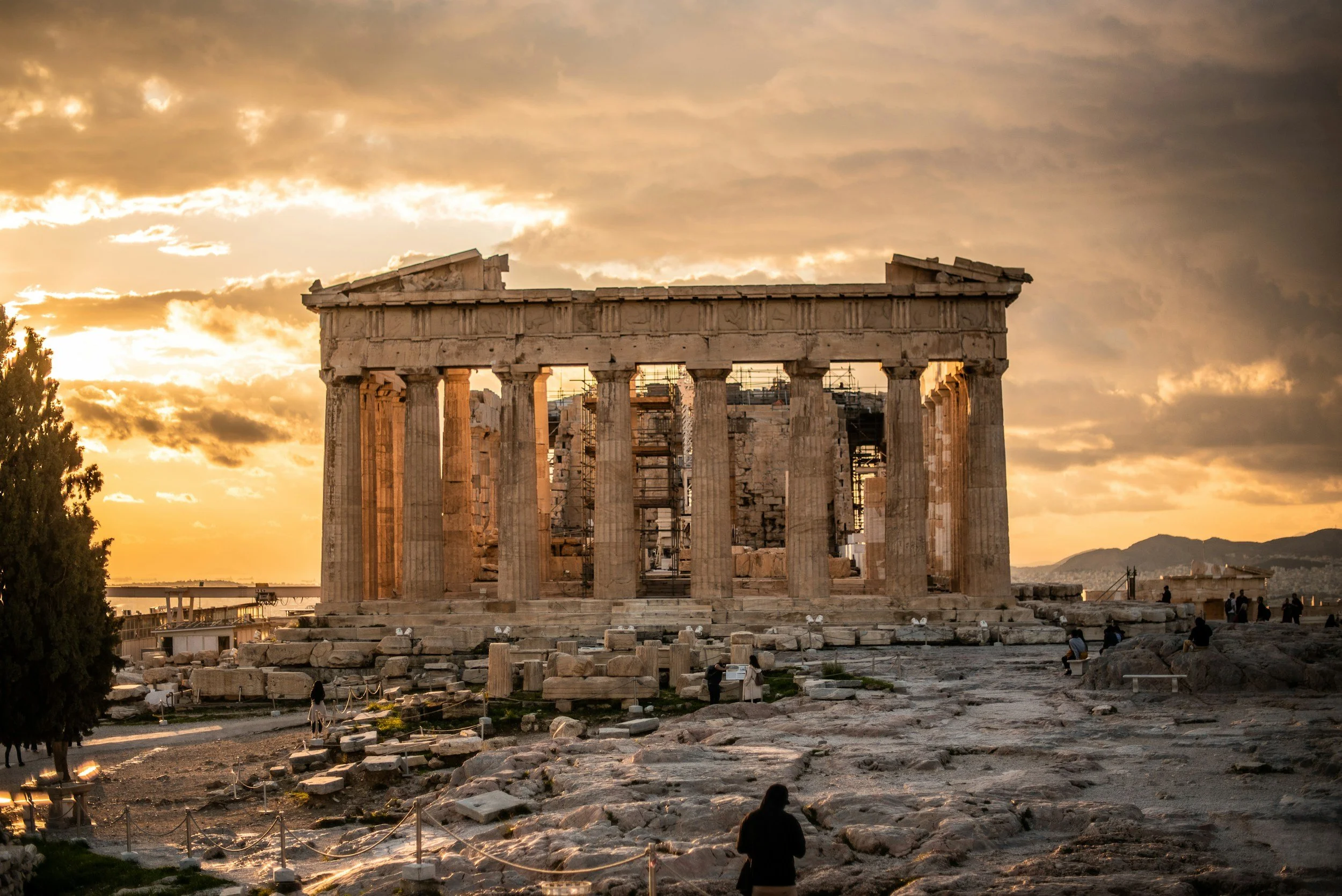
The Acropolis is not one building. It is an entire fortified citadel: the Parthenon, the Propylaea, the Temple of Athena Nike, the Erechtheion, and more, all perched on a rocky hill above the city with views in every direction. This is a site with more than 3,000 years of history, the most significant in Greece, and it deserves more than a rushed hour between tour groups.
Buy your ticket in advance. Crowds begin building by 9 am. If you are there at 8 am when the gates open, you can often have major areas nearly to yourself for the first 45 minutes, which makes an enormous difference both photographically and experientially.
📷 Pro Tip: Wide angles (16-24mm) work beautifully for conveying the scale of the ruins, but do not ignore your mid-range zoom (70-105mm) for isolating individual columns, details in the frieze, and the relationship between ancient stone and sky. Shoot the Parthenon from the northeast corner for a composition that shows both the long colonnade and the city below. Late afternoon light from the west gives the marble a warm, almost amber glow that no filter can replicate. Avoid midday in summer: the light is flat, and the crowds are at their worst.
Best time: Opening (8 am) or late afternoon. Access: Admission required; book online in advance. The Acropolis combination ticket covers six additional sites and is worth buying.

The Athenian Acropolis has over 3,000 years of history, making it arguably the most historically significant site in Greece. You could easily spend a few hours walking around and taking photos.


Propylaea
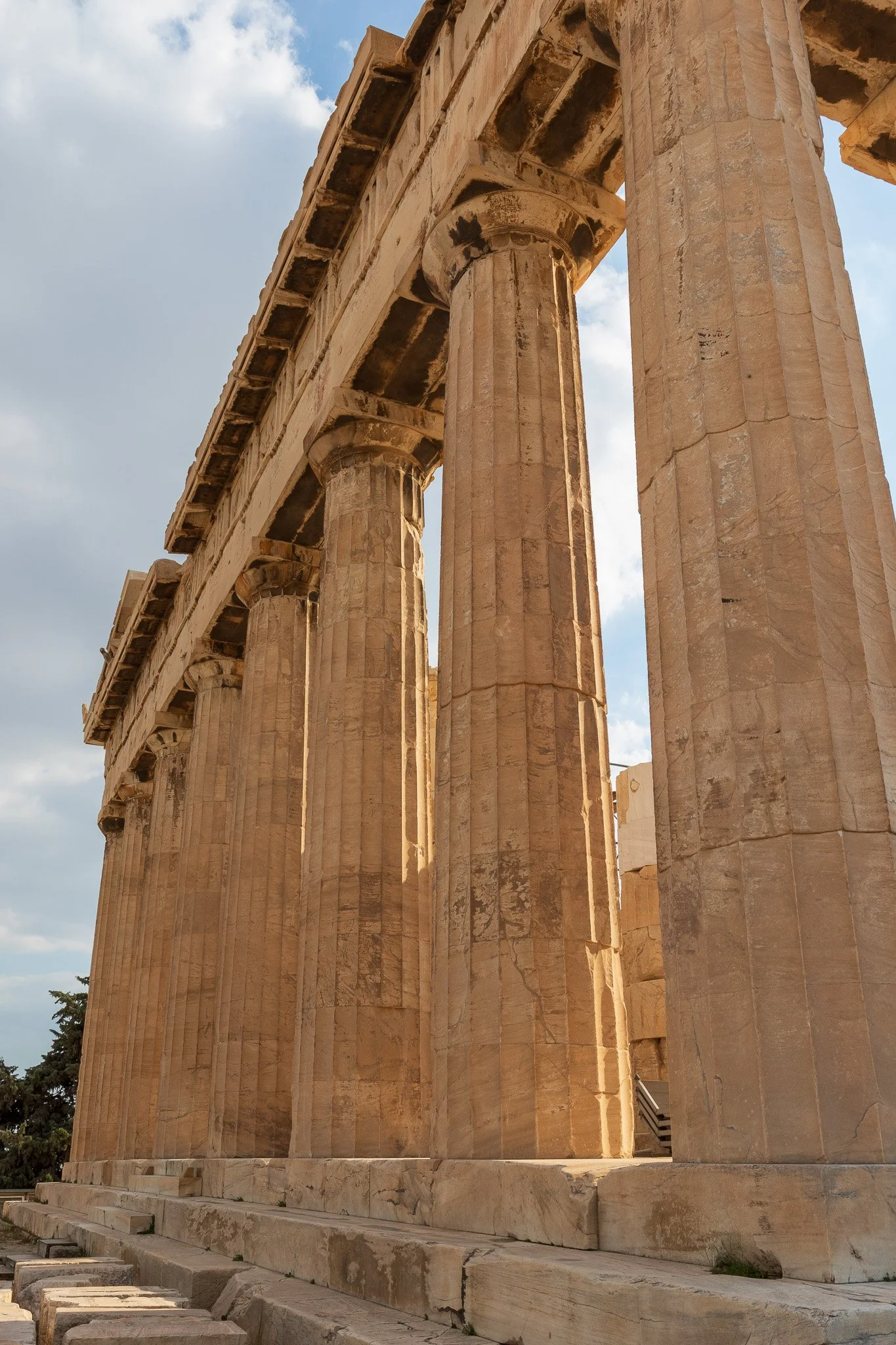
The Propylaea is a gateway - forming the main entrance to the Acropolis. It was built in the 430s BC.
It was supposed to be the gates to the Acropolis, but it was never completely finished. You will find the Temple of Athena Nike to the right of the Propylaea. This temple was dedicated to the goddesses Athena and Nike and was where ancient Athenians would worship for victory in war.


Areopagus Hill
This rocky outcrop directly below the Acropolis is one of my absolute favorite spots in Athens. No admission fee, no crowds before sunrise, and a direct sightline to the Parthenon at eye level. Standing here at first light while the city sleeps below you is one of those travel moments that stays with you for years. I have been here twice and would come back for this view alone.
The Areopagus has an extraordinary history. In ancient Athens, it was the seat of the city's highest judicial council. In Christian history, it is where Paul delivered one of his most famous sermons, recorded in Acts 17. The flat rock at the top is marked with a plaque in modern Greek noting that speech.
📷 Pro Tip: This is your best wide-angle Acropolis shot from ground level. Position yourself on the rock face facing northeast and shoot at 16-24mm with the Parthenon centered above and the city stretching to the horizon. At blue hour, when the city lights come up and the Acropolis is fully illuminated, the contrast between the glowing monument and the dark city below is extraordinary. Bring your tripod. The rock surface is uneven and slippery after rain, so wear shoes with grip and set up carefully.
Best time: Sunrise or blue hour. Access: Free, open 24 hours.

Mount Lycabettus
Athens' highest point at 277 meters, Lycabettus offers a 360-degree panorama that puts the entire city in frame: the Acropolis, the port of Piraeus, the Saronic Gulf, and the mountains of Attica stretching to the horizon. This is the shot that shows you the full scale of Athens and everything it sits within.
You can hike up in about 30 minutes through pine trees, or take the funicular from Kolonaki if your legs have already done enough for the day.
📷 Pro Tip: Arrive 45 minutes before sunset for the light and the position. The view west toward the Acropolis is your primary composition, but do not ignore the 180-degree turn toward Piraeus and the sea, especially if there is cloud cover giving you drama in the sky. A 24-70mm lens handles both the wide panorama and tighter shots of the city grid below. At night, the city lights reward a long-exposure shot on a tripod. There is a small chapel at the summit that photographs beautifully in the last light of day.
Best time: Sunset or blue hour. Access: Free to hike. Funicular departs from Plutarchou Street, Kolonaki.

Plaka and Anafiotika
Plaka is the oldest continuously inhabited neighborhood in Athens, a maze of narrow cobblestone streets, neoclassical facades, and bougainvillea-draped walls sitting at the foot of the Acropolis. Wander without a plan. Every alley offers something.
Inside Plaka, tucked against the north face of the Acropolis rock, is Anafiotika: a tiny cluster of whitewashed houses and blue-painted doors that look transplanted directly from the Cycladic islands. Built in the 19th century by workers from the island of Anafi who came to help construct the new Greek capital, it remains one of the most photogenic and least-visited pockets in all of Athens.
📷 Pro Tip: For Anafiotika, go early. By 9 am, there are already tour groups. At 7 am, it is quiet, the light is soft and directional, and the white walls glow. Shoot tight with a 35-50mm for the doors, the textures, the potted plants, and the cats that seem to own the place. In Plaka, the main street, Adrianou, is lively and full of color, but the small cross-streets are where the real character lives. Look up as much as you look forward: the Acropolis keeps appearing above the rooftops in ways that stop you mid-step.
Best time: Early morning, before 9 am. Access: Free.

The charming old neighborhood has narrow streets, colorful houses, and vibrant street life. Plaka is one of Athens's oldest and most picturesque neighborhoods.

Church of Agia Ekaterini
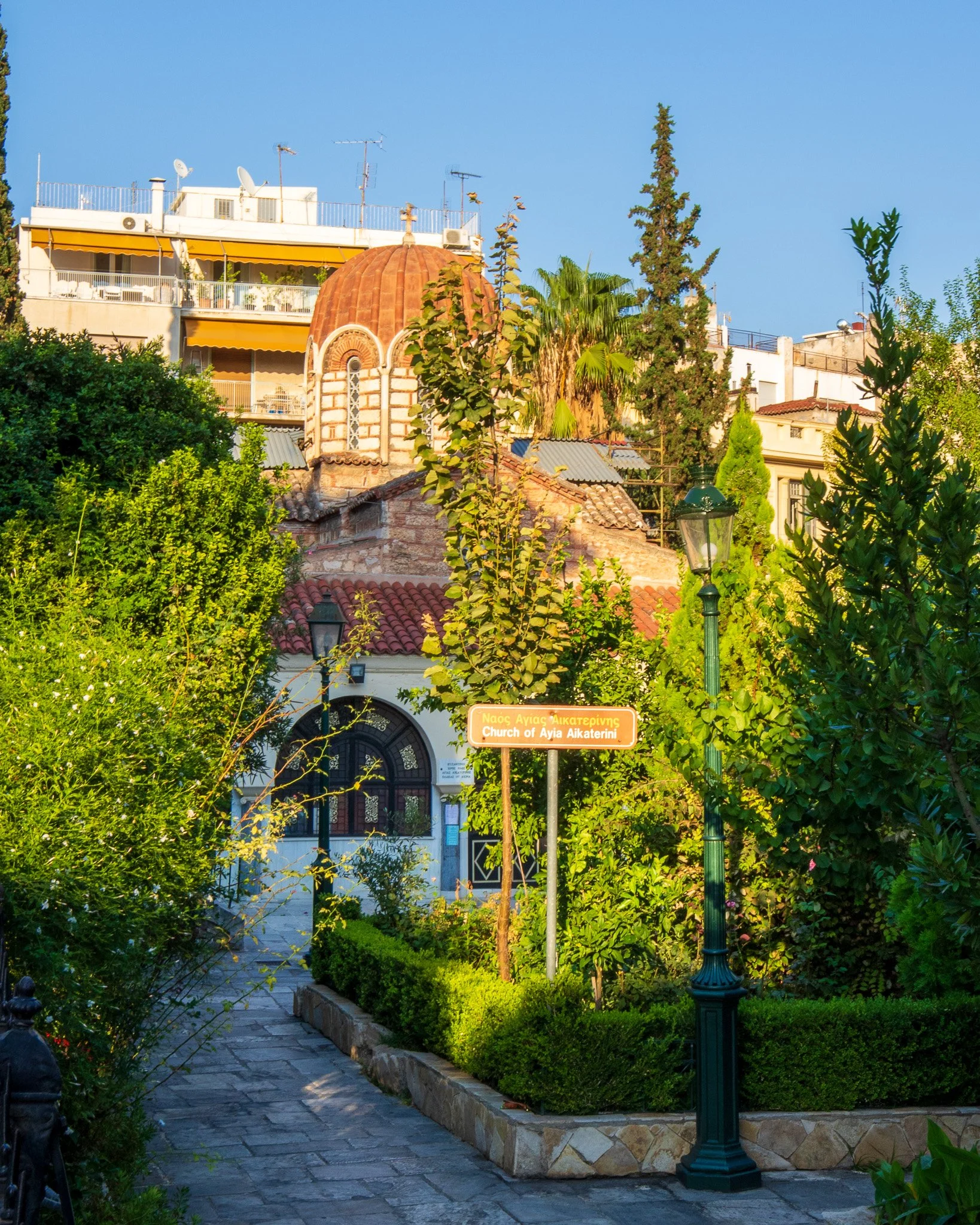
The Church of Agia Ekaterini (Saint Catherine) is a beautiful historic church located in the Plaka neighborhood.
The Acropolis Museum
If you enjoy history, you’ll love the Acropolis Museum, which opened in June 2009. The museum contains all sorts of artifacts, statues, and artwork found at the Acropolis’ excavation site. The museum houses over 4,000 artifacts from the Acropolis site, spanning the Archaic, Classical, and Roman periods


The Holy Church of Saint Sophia
This is a beautiful, small Greek Orthodox church located in Plaka on Dionysiou Areopagitou Street. "Sophia" means "wisdom" in Greek, symbolizing divine wisdom.

Arch of Hadrian (Hadrian's Gate)
The Arch of Hadrian is located on Amalias Avenue, near the Temple of Olympian Zeus entrance. It was constructed in honor of the Roman Emperor Hadrian, who ruled from 117 to 138 AD.

Ancient Agora of Athens
The word agora means marketplace and public gathering place. The Ancient Agora was the heart of classical Athens: where merchants sold goods, philosophers debated, and citizens voted. Socrates walked here. So did Plato. Founded in the 6th century BC, this is one of the most historically rich archaeological sites in Greece, and it is far less crowded than the Acropolis.
Do not miss the Church of the Holy Apostles inside the site, a beautiful 11th-century Byzantine church with original frescoes on the ceiling. And spend time at the Stoa of Attalos, the beautifully reconstructed portico that now houses the Agora Museum.
📷 Pro Tip: The Stoa of Attalos, with its long colonnaded walkway, makes a compelling architectural image at any time of day. Use the columns as leading lines drawing the eye down the length of the building. In the early morning, the light comes from the east and gives the stone a warm glow. The view back toward the Acropolis from inside the Agora, with the Hephaestion temple in the foreground, is one of the most layered and satisfying compositions in Athens: ancient over ancient, with the city rising behind it all.
Best time: Morning. Access: Included in the Acropolis combination ticket. Opens at 8 am.

Do not miss the Church of the Holy Apostles inside the site, a beautiful 11th-century Byzantine church with original frescoes on the ceiling. And spend time at the Stoa of Attalos, the beautifully reconstructed portico that now houses the Agora Museum.

📷 Pro Tip: The Stoa of Attalos, with its long colonnaded walkway, makes a compelling architectural image at any time of day. Use the columns as leading lines, drawing the eye down the length of the building. In the early morning, the light comes from the east and gives the stone a warm glow. The view back toward the Acropolis from inside the Agora, with the Hephaestion temple in the foreground, is one of the most layered compositions in Athens.
Best time: Morning. Opens at 8 am. Admission: Included in the €30 Acropolis combination ticket.


Roman Forum of Athens (Roman Agora)
The Roman Forum of Athens, also known as the Roman Agora, is another important archaeological site located in the heart of Athens. It was a central area of the city during the Roman period, in the 1st century BC, and served as a marketplace and administrative center.
The Roman Agora is similar to the Ancient Agora in that it was considered the central market of the town. However, the Roman Agora was the central public area during the Roman-controlled era of Athens.

The Panathenaic Stadium
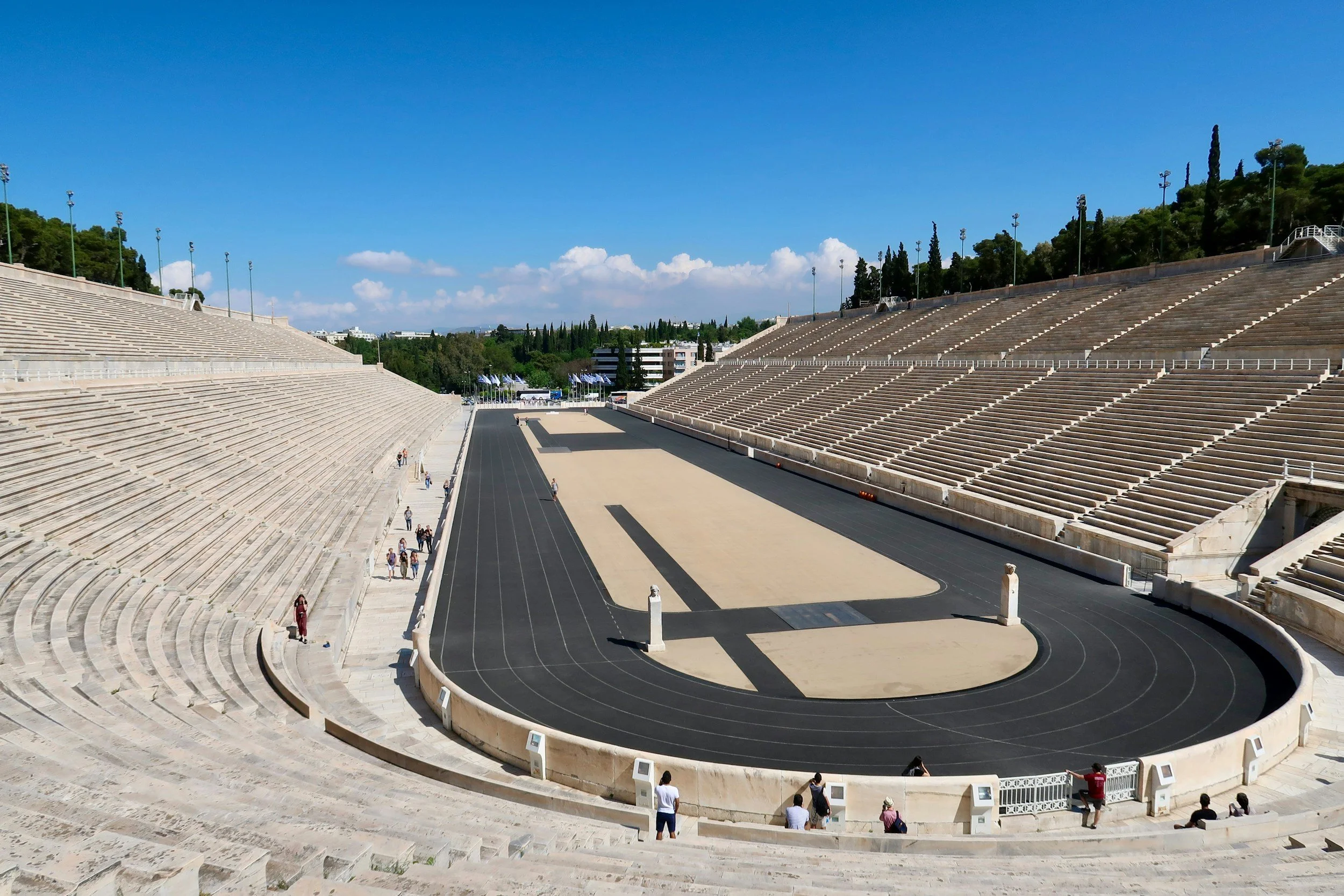
This is the only stadium in the world built entirely of white Pentelic marble, the same marble used for the Parthenon. It dates to the 4th century BC and was rebuilt for the first modern Olympic Games in 1896. Standing on the track, surrounded by 50 tiers of glowing white marble rising around you, is one of the most quietly powerful experiences Athens offers.
Admission includes a free audio guide in 11 languages. You can actually run a lap on the original Olympic track. Behind the stadium, through the athletes' tunnel, is a small underground museum containing every Olympic torch from 1936 to the present.
📷 Pro Tip: The best photograph in the stadium is from the top tier of Section 21. From there, you can frame the Acropolis, Philopappos Hill, the Temple of Olympian Zeus, the National Garden, and Lycabettus Hill all in a single wide-angle composition. Late afternoon is the best time for photography, when the sun illuminates the marble from the west and the white stone turns the color of warm honey. Avoid midday in summer: the marble radiates heat and the light is completely flat.
Best time: Late afternoon. Access: Paid admission, includes audio guide. Opens daily at 8am.
Psiri Neighborhood (Street Art and Street Photography)
Psiri, just north of Monastiraki, is where Athens gets loud and contemporary. The neighborhood is a collage of street art murals, independent bars, small restaurants, and the kind of urban texture that rewards photographers who like to wander. It is particularly active on weekend evenings, when the streets fill with locals moving between venues.
📷 Pro Tip: Come during the day for street art, which covers entire building facades throughout the neighborhood. A 24–50mm handles the murals while keeping context. Return in the evening for street photography: the mix of neon signs, warm restaurant light spilling onto the pavement, and the energy of people moving through the neighborhood makes for strong candid images. Ask before photographing individuals.
Best time: Daytime for murals, evening for street photography.
Olympic Station
The Olympic Station in Athens, known as "Olympiakó Stádio", is a major sports complex that was a central venue during the 2004 Summer Olympics.

Anafiotika -
This is a picturesque, charming area on the slopes of the Acropolis with whitewashed houses. Anafiotika. It is known for its island-like atmosphere, narrow streets, and quaint, whitewashed houses.

Temple of Olympian Zeus
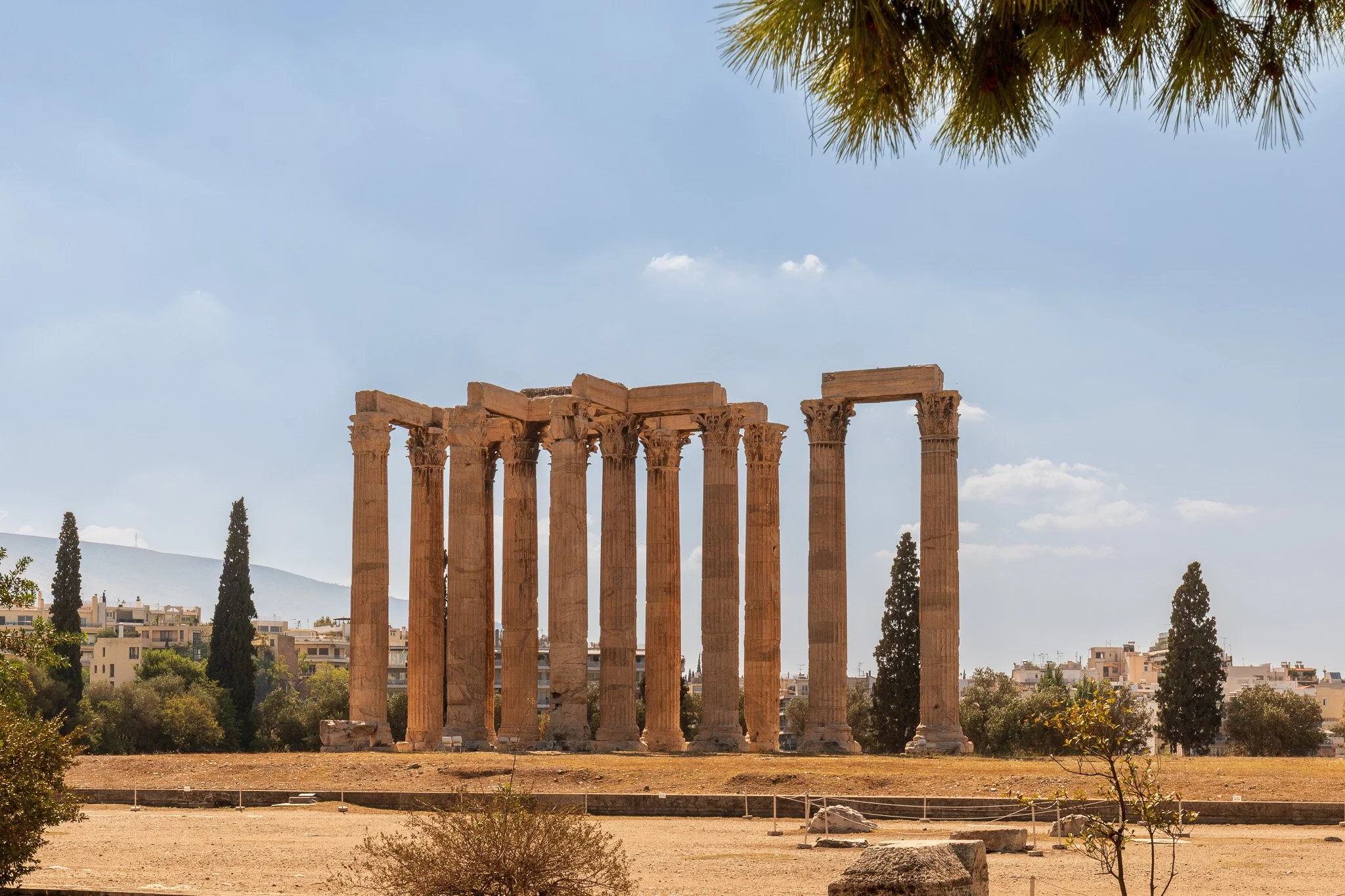
The Temple of Olympian Zeus took over 600 years to complete, from the 6th century BC through 131 AD, making it one of the longest construction projects in ancient history. Of the original 104 Corinthian columns, only 16 remain standing. At 17 meters high each, the scale is staggering. One column lies on its side exactly where it fell, still in the outline of its collapse.
Just outside the site entrance stands Hadrian's Arch, the elegant stone gateway built in 132 AD to mark the boundary between ancient Athens and the Roman city beyond.
📷 Pro Tip: The fallen column lying on its side inside the site is one of the most compelling subjects in Athens. Shoot it with the standing columns behind and a wide angle to emphasize its scale against what once stood around it. Hadrian's Arch is best photographed from the east in the early morning, with the sun behind you and the Acropolis visible through the arch. A 35-50mm works well here. The arch and the Parthenon in a single frame is one of the signature compositions of Athens.
Best time: Morning light for Hadrian's Arch. Golden hour for the standing columns. Access: Included in the Acropolis combination ticket.
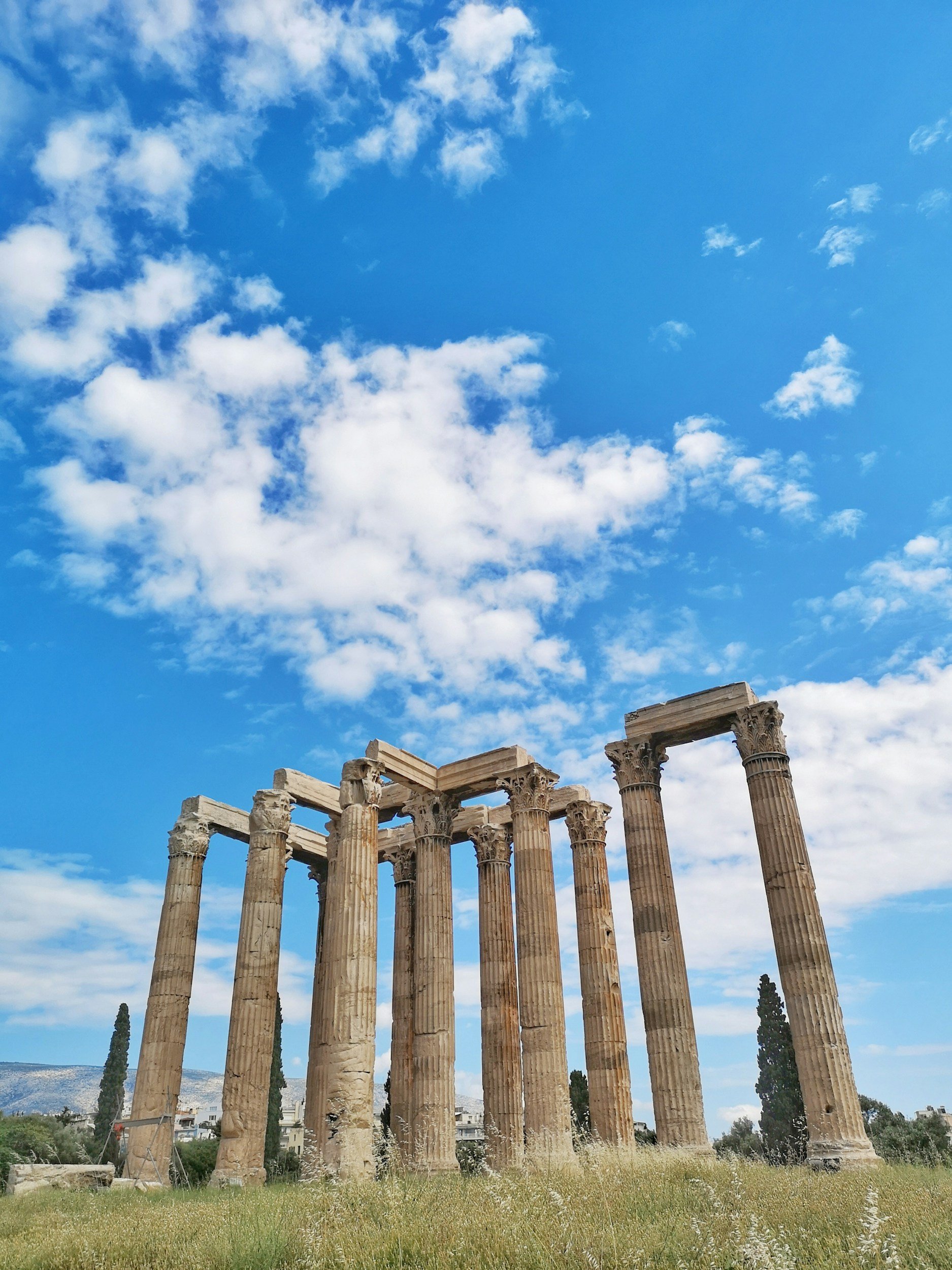
Definitely take your time walking around the Temple
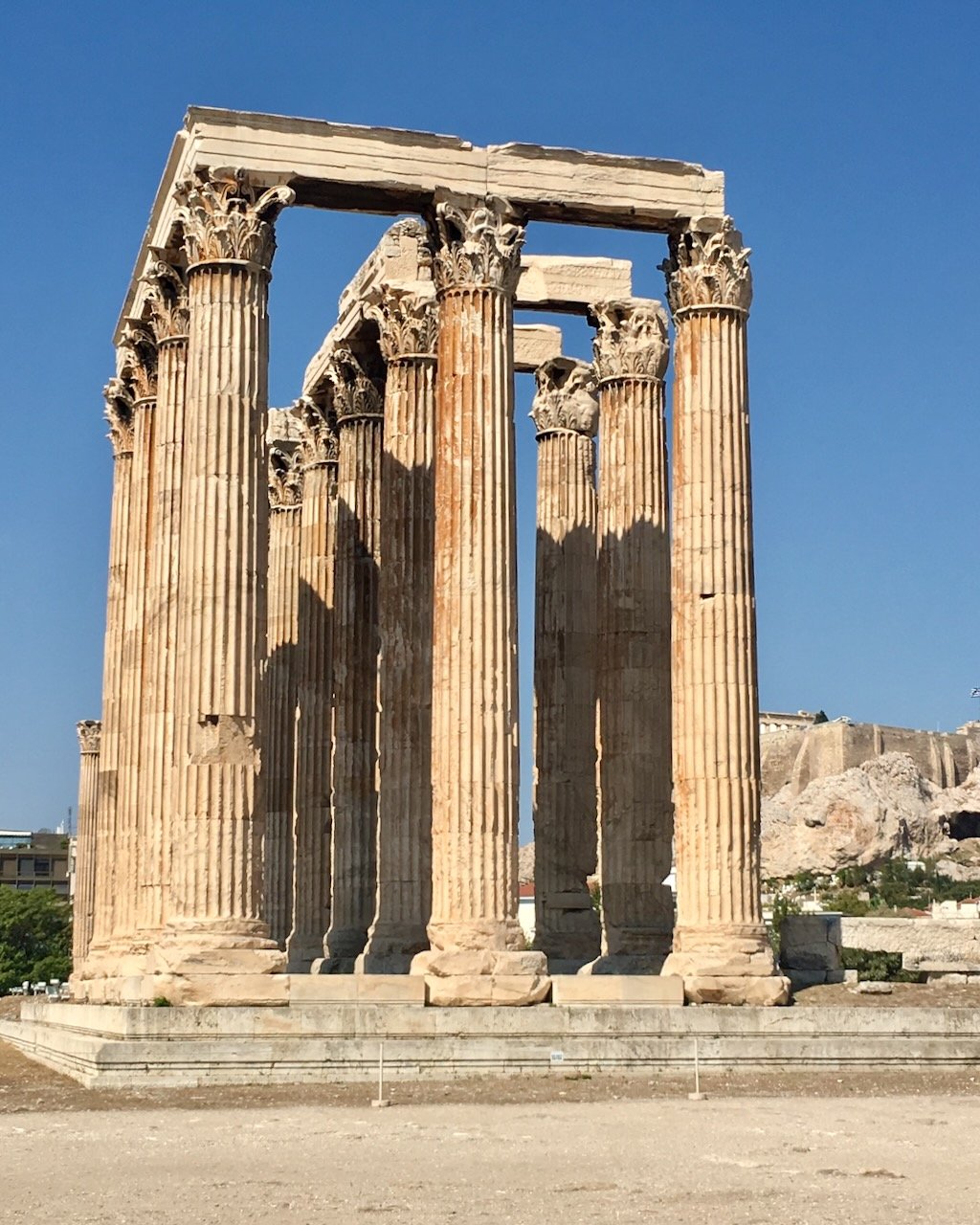
The ruins are simply stunning.


Syntagma Square -
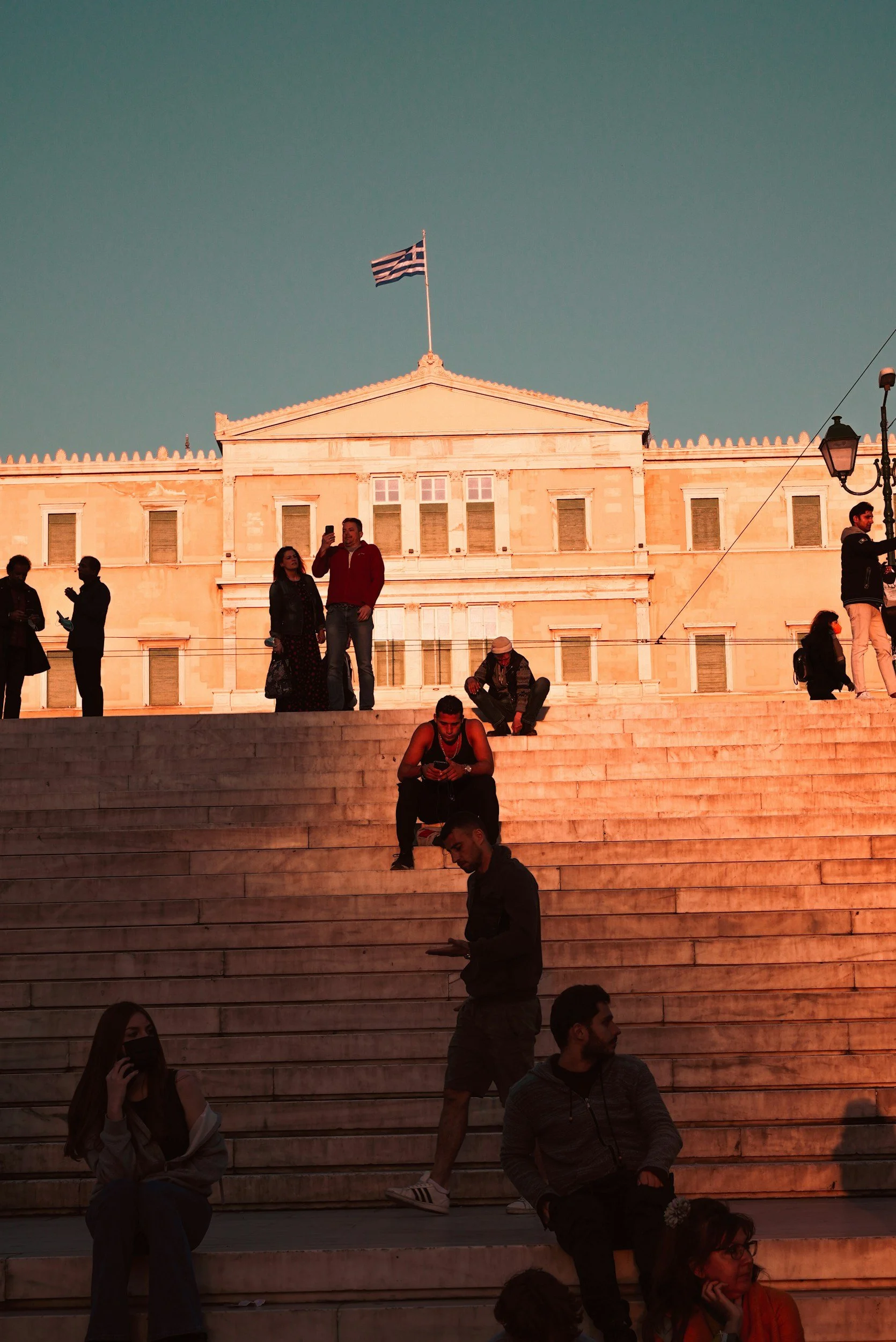
Syntagma (Constitution) Square is the political center of Athens, flanked by the Greek Parliament building and the Hotel Grande Bretagne. Every hour, the Evzone guards perform the ceremonial changing of the guard at the Tomb of the Unknown Soldier, a highly photogenic ritual in traditional uniform.
📷 Pro Tip: Position yourself to the right side of the Parliament steps with the guards walking toward you from left to right. A 70-200mm lens lets you isolate individual guards without fighting through the crowd. The synchronized foot movements and traditional costume make strong close-up images. Sunday mornings at 11 am feature an extended full ceremonial change with the complete guard complement: this is the one to photograph.
Best time: Any hour on the hour. Sunday morning at 11 am for the full ceremony. Access: Free.
Monastiraki Square
Monastiraki is the beating commercial heart of central Athens: a mosaic of street vendors, antique dealers, cafes, and Byzantine fragments all compressed into a few chaotic, photogenic blocks. The square itself is anchored by the Monastiraki Mosque and framed by the Acropolis above, which means almost any wide-angle shot from here includes ancient and modern Athens in the same frame.
Sunday morning is when the flea market fully comes alive, with vendors selling everything from old coins and vintage cameras to Soviet-era memorabilia and hand-embroidered textiles.
📷 Pro Tip: Sunday morning before 10am is your window for authentic market photography. Come with a 35mm or 50mm and photograph the vendors setting up, the textures of the market tables, and the faces of the regulars. The contrast between the stalls in the foreground and the Acropolis above the rooftops in the background is one of the most layered compositions in Athens: it tells the full story of the city in a single frame. Any evening works for street photography as the square fills with locals and the restaurants spill out onto the pavement.
Best time: Sunday morning for the flea market. Any evening for street photography. Access: Free.

Odeon of Herodes Atticus
Built in 161 AD by the Roman aristocrat Herodes Atticus in memory of his wife, the Odeon is a perfectly preserved ancient theater on the south slope of the Acropolis. It still functions as a performance venue during the Athens Festival each summer, hosting everything from classical drama to opera and jazz. Maria Callas, Luciano Pavarotti, and Frank Sinatra have all performed here.
You cannot enter the Odeon except during performances, but the exterior, especially the arched facade lit at night, is extraordinary from the adjacent Dionysiou Areopagitou promenade.
📷 Pro Tip: The best exterior shot is from the pedestrian promenade to the south, looking north with the facade and the Acropolis rising above it in the same frame. Shoot at blue hour when the Odeon is illuminated and the sky still holds color. A 70-105mm focal length compresses the relationship between the theater and the Parthenon behind it beautifully. If you can get tickets to a performance, bring a fast prime (85mm f/1.4 or 50mm f/1.2) and shoot during the show: the combination of ancient stone, stage lighting, and a live audience is unlike anything else in the city.
Best time: Blue hour for exterior photography. Check the Athens Festival schedule for performance dates.

📷 Pro Tip: The best exterior shot is from the pedestrian promenade to the south, looking north with the facade and the Acropolis rising above it in the same frame. Shoot at blue hour when the Odeon is illuminated and the sky still holds color. A 70–105mm focal length compresses the relationship between the theater and the Parthenon behind it beautifully.

You cannot enter the Odeon except during performances, but the exterior, especially the arched facade lit at night, is extraordinary from the adjacent Dionysiou Areopagitou promenade.

Best time: Blue hour for exterior photography. Check the Athens Festival schedule at aefestival.gr for performance dates.

Festivals and Holidays
Greek Independence Day (March 25): Military parades, national pride, and the kind of street atmosphere that makes for strong documentary images. The mood is celebratory and accessible.
Easter (March or April): The most important holiday in the Greek Orthodox calendar, and one of the most photographically powerful events in the country. The candlelit midnight service on Holy Saturday, when thousands of people hold lit candles in the streets, is extraordinary. Respectful attendance and quiet photography are appropriate.
Athens and Epidaurus Festival (June to August): Theater, music, and dance performances at ancient venues including the Odeon of Herodes Atticus. Photographically exceptional: the combination of live performance and ancient stone under warm summer light is unlike anything else.
Athens Technopolis Jazz Festival (May): Held at the Gazi Technopolis, a converted 19th-century gasworks complex that is itself worth photographing. Live music, engaged crowds, and strong industrial architecture make it a full photography session on its own.
Monastiraki Flea Market (Sundays year-round): Not a festival, but treat it like one. Sunday mornings in Monastiraki are among the most consistently photogenic recurring events in Athens.
Frequently Asked Questions About Visiting Athens
Is Athens worth more than a quick stopover before the islands?
Yes, without question. Most travelers treat it as a layover on the way to Santorini or Mykonos, which is a real mistake. Athens is a destination in its own right, one of the oldest continuously inhabited cities on the planet, and it deserves at least three days.
Is Athens safe?
Yes, it's one of the safer major European capitals to walk, including Plaka and the historic center at night. Normal city awareness in crowded tourist areas like Monastiraki covers most of what you need to know.
Do you need a car in Athens?
No, and it's actively discouraged. Traffic is dense and parking is difficult. Most photography locations sit within a 20-minute walk of each other, and the metro efficiently covers longer distances.
What are the best photo spots in Athens?
The Acropolis at opening before the crowds, Areopagus Hill at sunrise, and Anafiotika before 9am are three that consistently deliver. The full list with Pro Tips is above.
Can you fly a drone in Athens?
No, not around the Acropolis, the Ancient Agora, or the Temple of Olympian Zeus. Drones are prohibited at and around all archaeological sites, and flying without authorization can mean serious fines and confiscated equipment.
What surprised you most about Athens?
It reminded me of the beauty of Rome, all that historic architecture existing not behind glass but genuinely alive, walked through rather than around. That living quality is something surprisingly few European capitals still have.
How many days do you need in Athens?
Three days is the minimum for a photography-focused trip; five is better, giving you room to slow down, revisit locations in different light, and take a day trip to the Temple of Poseidon at Sounion.
Is Athens worth combining with Crete or Cyprus?
Yes, both are natural extensions, a short flight or ferry away, and together they tell a fuller story of Greece and the eastern Mediterranean.
Final Thoughts
Athens stays with you because it is alive. The Parthenon is not behind glass. The Agora is not preserved under a climate-controlled dome. You walk through it, stand inside it, and feel the same marble under your feet that has been worn smooth by 2,500 years of human traffic. That is not something you find everywhere.
I have been here twice, and both times Athens has given me something I did not expect. The first morning on Areopagus Hill changed how I think about early starts. The rooftop at AthensWas, with the Parthenon filling the frame above the city at golden hour, a view I am not done photographing. I will be back.
Give Athens more than two days. Climb the hills. Eat slowly. Sit on a rooftop and watch the Parthenon light up at night, the marble going from honey gold to white with the city spreading out beneath you in every direction. You will not regret staying longer.
Want to improve your photography while exploring some incredible destinations? Join me on one of my photography workshops! You can find all the details, including upcoming destinations and dates, through the links below.
Let's Stay Connected!
If you are traveling in the region,
My Photography & Travel Guide to Creteis the natural next chapter. It is a short flight or ferry from Athens, and the two destinations together tell the full story of Greece.
My Photography & Travel Guide to Cyprus is also worth the short flight east: sea cliffs, ancient mosaics, and a cultural identity unlike anywhere else in the eastern Mediterranean. And if you are heading into Italy,
My Photography & Travel Guide to Romecovers a city that shares Athens' weight of history and its ability to make ancient stone feel completely present.
Finally—a beginner-friendly photography guide that makes sense.
If you've ever picked up a camera and thought, "Now what?" this is the book for you.
Photography Made Simple is written for adults who are just starting out and want a clear, encouraging, real-world approach to learning photography. Whether you're using a DSLR, mirrorless, or just your smartphone, this guide walks you through the basics—without the jargon or tech overwhelm.
Inside, you'll learn:
The only camera settings you really need to know to get started
How to shoot sharper, more intentional photos using light and composition
Simple tips for portraits, landscapes, travel, and everyday life
What gear you do (and don’t) need
How to create better photos without upgrading your camera
You’ll also get practical exercises, cheat sheets, and tips for organizing and editing your images—plus the confidence to shoot off Auto Mode for good.
This is not a textbook. It’s a friendly guide to seeing the world with fresh eyes—and finally capturing what you see the way you imagine it.
📸 Format: PDF download
Pages: 100+
Perfect for: Beginners, hobbyists, and anyone ready to take better photos without the stress

Are you carrying too much camera equipment, but still coming home disappointed with your travel photographs?
You are not alone. Many photographers fall into the packing trap. They bring too much, plan too little, and spend their trip scrambling to capture photographs instead of enjoying the experience.
Capture the World offers a better approach.
In this practical guide, travel photographer Vito L. Tanzi shares the five step system he uses to plan photography trips, pack with purpose, work with the best light, and return home with stronger images.
Inside, you will learn how to:
• Travel lighter without sacrificing image quality
• Choose destinations that match your photography goals
• Visit at the right time for weather, light, wildlife, festivals, or seasonal conditions
• Build a photography itinerary around sunrise, sunset, blue hour, and changing weather
• Select the equipment you will actually use
• Find promising locations before you arrive
• Avoid the stress and exhaustion that can ruin a photography trip
• Stay flexible when weather, crowds, or travel plans change
This guide includes practical planning advice, useful photography tools, real travel examples, and a complete system you can use again and again.
Whether you are preparing for your first international photography trip or planning a weekend closer to home, Capture the World will help you travel with greater purpose, photograph with more intention, and spend less time worrying about what is inside your camera bag.
Because the best photography trip is not the one where you carry everything.
It is the one where you are ready when the right moment appears.
📸 Format: PDF download
Instant Download