Colmar, France Travel & Photography Guide: Best Photo Spots, Things to Do & Hidden Gems
Colmar had been on my photography list for years, and when we finally arrived in December for the Christmas markets, it was everything I had hoped for and then some.
The town is small. You can cover it on foot in the morning and still feel like you are missing corners worth finding. But the scale is part of what makes it work so well. Every street in the Old Town is walkable, every canal is within a short turn, and every morning before the visitors arrive, you can have the pastel timber-framed houses and the reflections in the canals almost entirely to yourself. Go early. Colmar rewards the early riser in the way that all beautiful small towns do: you get the light and the quiet at the same time.
We walked through the Christmas markets at dusk and again the next morning, photographed Little Venice at sunrise with the mist still on the water, sat in cafes for coffee and lunch when the cold needed somewhere warm to go, and felt throughout that we had been saving this trip for the right moment, and the right moment had finally arrived.
Colmar sits in the Alsace region of northeastern France, near the German border, and the architecture reflects centuries of that dual identity: French wine culture and German timber framing, combined into something that belongs entirely to this specific valley. The Christmas market tradition here is among the finest in Europe. The vineyards are a fifteen-minute drive in any direction. And Little Venice, the canal quarter at the southern end of the Old Town, is one of the most photogenic short stretches of any French city.
You can visit Colmar as a day trip from Strasbourg or Basel, both less than an hour by train. Two nights give you two mornings of golden hour and two evenings at the markets, which is the right amount of time to photograph it properly.
In this Photography Guide to Colmar, I share the places and experiences that continue to draw me back. You will find my favorite photography locations, guidance on when and where to shoot, practical travel tips, and gear recommendations, along with cultural insights to help you explore and photograph Colmar with confidence, respect, and ease.

The Classic View
Photographer's Notes
Before you go, here are my own takeaways.
Favorite Season: Fall, for photography, though December's Christmas markets are unforgettable in their own right
Favorite Location: Little Venice
Favorite Hotel: La Maison des Têtes
Favorite Restaurant: Wistub de la Petite Venise
Favorite Café: L'Atelier de Yann
Would I Return? This is a beautiful town, absolutely worth visiting.
Where to Stay in Colmar
Stay in the Old Town. There is no reason to stay anywhere else. You will be within walking distance of every photography location, and you can be at Little Venice before sunrise without calling a taxi.
Luxury Hotels in Colmar
La Maison des Têtes — The finest address in Colmar. A 17th-century mansion on Rue des Têtes, named for the 111 sculpted heads covering the facade, is one of the most architecturally distinctive buildings in the Old Town. The interior has been converted into a five-star hotel with genuinely beautiful rooms, and the Michelin-starred restaurant beneath the same roof is one of the best in Alsace. A serious luxury choice if the budget extends to it.
L'Esquisse Hotel & Spa Colmar, MGallery — A polished MGallery property on the edge of the historic district, combining contemporary design with excellent spa facilities. A strong choice for travelers who want modern comfort alongside access to the Old Town. The spa makes it a good base for a longer stay.
James Boutique Hotel — A boutique hotel with refined interiors and good walkability inside the Old Town. Smaller and more personal than the MGallery. Well-regarded for service and its proximity to the key photography locations.
Mid-Range Hotels in Colmar
Hotel Le Colombier — Steps from Little Venice, with canal views from some rooms and the rustic-modern Alsatian character that makes small regional hotels worth choosing over chains. The position is ideal for photographers: you can be at the waterfront before sunrise without a taxi.
Hotel Saint-Martin — A charming stay inside a traditional Alsatian building in the historic center. Full of character without the full luxury pricing. The kind of hotel that feels genuinely local rather than designed for tourists.
Hotel Turenne — Clean, reliable, and well-located, a short walk from the historic center. The most accessible price point among the Old Town options. Good value for a two-night photography stay.

Best Time to Visit Colmar
The three best seasons are late spring, autumn, and December.
Late Spring (May to June): The flower boxes overflow with color. The light is soft and long. Crowds are present but manageable. Golden hour arrives early and stays late. This is the most flattering season for the pastel facades.
Autumn (September to October): The vineyards surrounding the town turn red and orange, and the morning mist on the canals is thicker and more photogenic. Crowds thin out noticeably after mid-September. The overcast light that Alsace produces in autumn suits the architecture better than hard summer sun.
December (Christmas Markets): The most photographed season for a reason. The markets run from late November through Christmas, and the town is transformed by lights, lanterns, and wooden stalls. The canal reflections at dusk during the market period are some of the finest photography conditions you will find anywhere in France. Go early, before the day visitors arrive; the first hour of morning belongs entirely to photographers.
Summer (July to August) is crowded and the light is harsh in the narrow streets. It is the one season I would skip.

How Many Days to Spend in Colmar?
Two nights is the right amount. It gives you two golden hours in the morning, two evenings at the markets, and enough time in between to slow down and photograph properly rather than running from one location to the next.
One night is possible, especially as an add-on to Strasbourg or Basel, but you will leave feeling like you needed more time. Three nights allow you to make day trips to the nearby villages of Eguisheim and Riquewihr, both worth the drive for their own photography value.
A two-night stay might look like this: arrive in the late afternoon, walk the Old Town as the evening market lights come on, and photograph Little Venice at dusk. Day two: up before sunrise for the canal at golden hour, then the Covered Market in the morning, then Rue des Marchands and the Koïfhus in the afternoon light. Third morning: Unterlinden Museum courtyard before the crowds, coffee, train to your next destination.

Getting Around Colmar
Colmar is made for walking. The Old Town is compact and flat, and nearly every photo-worthy corner is reachable on foot. If you are staying in the historic center, you will not need any other transport during your stay.
For day trips to the nearby villages, Eguisheim is a ten-minute drive, and Riquewihr is about twenty minutes. A rental car is the most practical option for the Alsace Wine Route villages. Taxis are available but not always immediately. Uber and Bolt operate here, but coverage is inconsistent, especially early in the morning when you want to be shooting.
Trains connect Colmar to Strasbourg (roughly 30 minutes) and Basel (roughly 45 minutes) easily, making both strong home bases if you are combining the region into a longer trip.

A Santa Letter Box
Restaurants in Colmar
Colmar's food scene is defined by Alsatian cooking: tarte flambée, choucroute garnie, spätzle, Munster cheese, and the local Riesling and Gewurztraminer that go with all of it. The restaurants here are not trying to be something they are not, which is the right instinct in a town this good at what it does.
Wistub de la Petite Venise — The most atmospheric restaurant in Colmar and the right choice for a long Alsatian lunch. Traditional tarte flambée, choucroute garnie, and Alsatian wines in a room that is cozy in the way that old stone, low ceilings, and good food in cold weather always produce. Photogenic from every angle and full of locals who know what they are eating.
JY's — Two Michelin stars by the canal. Chef Jean-Yves Schillinger's kitchen draws on Alsatian ingredients with a creative contemporary technique that earns the stars consistently. The canal position adds a view to match the food. Reserve well in advance.
Brasserie Schwendi — The honest, unpretentious option for Alsatian classics: tarte flambée with crème fraîche and lardons, choucroute with sausages and potatoes, Alsatian beer on tap. Full of atmosphere and the specific warmth of a brasserie that has been feeding the town for a long time.
La Soï — Small, casual, and well-regarded for its spätzle, the Alsatian egg noodles that are the region's most comforting cold-weather food. A good lunch stop when the Christmas market has reminded you how cold December in Alsace can be.
Zum Pflanzstecker — A local favorite in the Old Town for traditional Alsatian cooking with none of the tourist-facing presentation. Order the baeckeoffe if it is on the menu, a slow-cooked meat and potato casserole that is the kind of food you eat sitting next to a window with wine and no agenda.
Wistub de la Petite Venise — The most atmospheric restaurant in Colmar and the right choice for a long Alsatian lunch. Traditional tarte flambée, choucroute garnie, and Alsatian wines in a room that is cozy in the way that old stone and low ceilings and good food in cold weather always produce. Photogenic from every angle and full of locals who know what they are eating.
JY's — Two Michelin stars by the canal, the finest restaurant in Colmar. Chef Jean-Yves Schillinger's kitchen draws on Alsatian ingredients with a creative contemporary technique that earns the stars consistently. The canal position adds a view to match the food. Reserve in advance.
Brasserie Schwendi — The honest, unpretentious option for Alsatian classics: tarte flambée with crème fraîche and lardons, choucroute with sausages and potatoes, Alsatian beer on tap. Full of atmosphere, fair prices, and the specific warmth of a brasserie that has been feeding the town for a long time.
La Soï — Small, casual, and well-regarded for its spätzle, the Alsatian egg noodles that are the region's most comforting cold-weather food. A good lunch stop when the Christmas market has reminded you how cold December in Alsace can be.


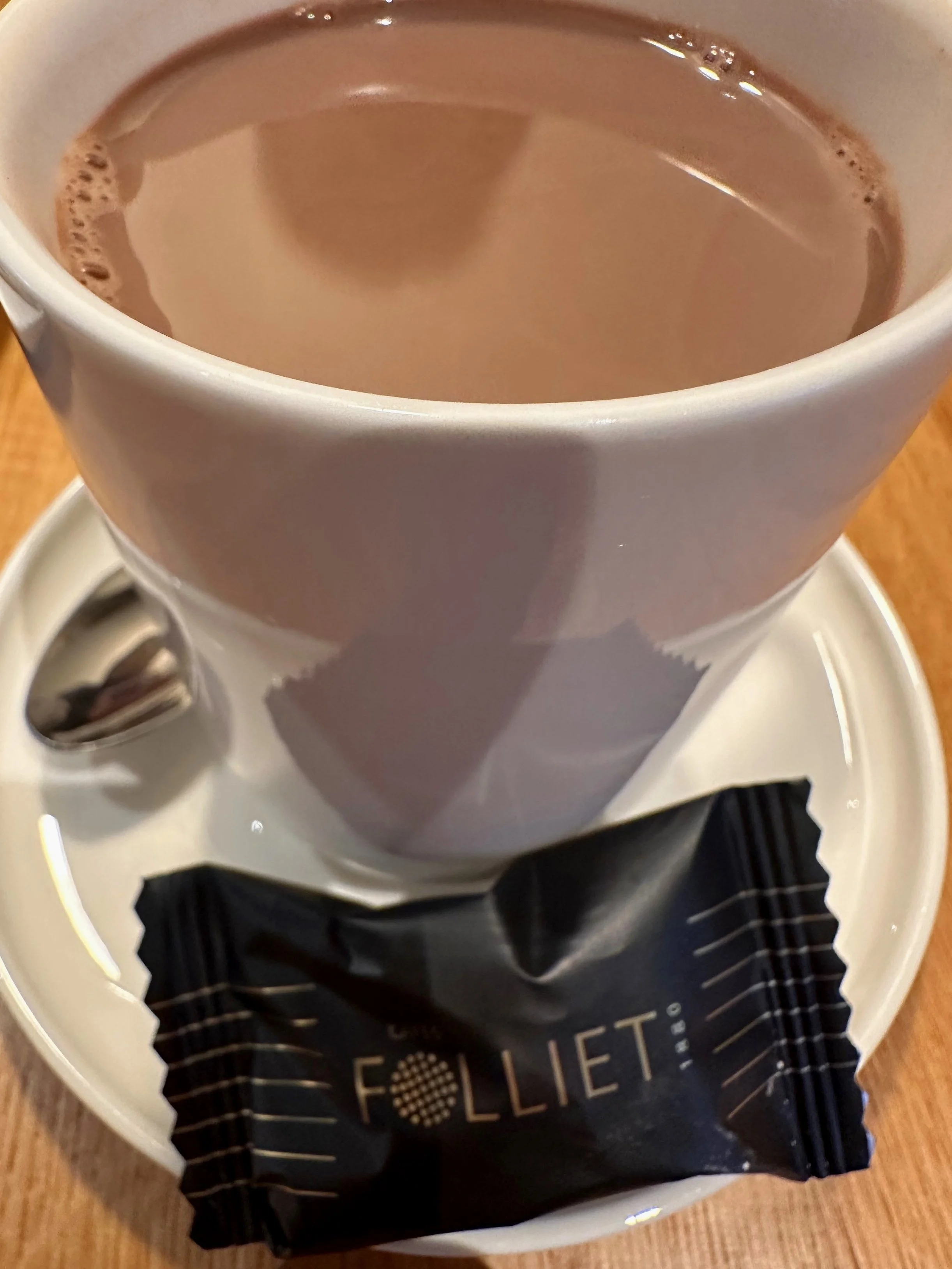


Coffee in Colmar
L'Atelier de Yann — The best pastries in Colmar, excellent espresso, and good natural light through the windows. This is the place to edit photos over a second coffee after the morning shoot.
Café Rapp — Stylish, central, and cozy. A good mid-morning stop between photography locations, with the kind of atmosphere that earns a second cup.
Café de la Rue des Marchands — Old-world character and reliable espresso on one of the most photogenic streets in the Old Town. Sit by the window and watch the morning light move across the timber-framed facades opposite.

Photography Gear for Colmar
Colmar is an architectural and canal photography destination. The focal lengths that matter most here are wide and standard zoom.
Camera bodies: The Canon EOS R5 Mark II, Sony A7R V, and Nikon Z8 all perform well here. I used the Leica Q3 as my walk-around body throughout the Christmas market visit, and the fixed 28mm focal length suited the narrow streets and canal compositions better than anything I expected. For the canals and architecture, any of these bodies gives you the resolution to capture fine detail in the timber framing.
Lenses: A 16–35mm wide-angle handles the canal quarter, the interior of the Covered Market, and the full-length compositions on Rue des Marchands. A 24–70mm standard zoom covers everything else. A 70–200mm telephoto is worth bringing for compressing the canal facades from a distance and for isolating architectural details on the Koïfhus and Maison Pfister. I used the 70–200mm for the polychrome roof tiles, and the compression was exactly right.
Tripod: Essential for blue-hour canal shots and Christmas market long exposures. A lightweight travel tripod is enough given the flat, accessible shooting positions. You will not be scrambling onto anything uneven.
Filters: A circular polarizer reduces glare on the canal water and deepens the color saturation in the facade reflections. A 6-stop ND filter extends exposures at the canal in full daylight. A 3-stop ND for early morning long exposures when there is just enough light to create motion blur.
Drone: Drone flights in Colmar's Old Town are restricted under French urban aviation regulations. Check current rules at the official French civil aviation authority site before bringing one. The canal quarter and Christmas market area will be restricted. Plan accordingly and do not fly without confirmation of current permissions.
Extras: Samsung T7 SSD for daily backups. Extra batteries, especially in December: cold temperatures drain batteries faster than you expect, and the light in December is short enough that you cannot afford to miss it because of a dead battery.
iPhone Photography in Colmar
Colmar is one of the best destinations for iPhone photography in France. The scale is small, the subjects are close, and the color palette of the facades reads beautifully on a phone screen.
At Little Venice: Use the 0.5x ultrawide lens from the western bank at sunrise to capture the full curve of the canal houses and their reflections in a single frame. The phone's ultrawide handles the canal geometry better than you expect at that focal length. Shoot in ProRAW if your iPhone supports it; the shadow detail in the reflection will thank you in post.
On Rue des Marchands: Switch to the 1x standard lens and use the phone's Portrait Mode on individual building details, the painted facade of Maison Pfister in particular. The subject separation from the background is stronger than you would expect from a building this close.
At the Christmas Markets: Night Mode is your primary tool after the market lights come on. Hold the phone steady or prop it against a surface; a two-to-three second Night Mode exposure on the canal at dusk will render the colored light reflections better than a rushed handheld shot. The HDR capability handles the contrast between the lit market stalls and the dark canal water well. Shoot multiple exposures and choose the sharpest.
In the Covered Market: Use the 1x lens at stall level and let the natural light from the high iron-framed windows do the work. The phone's computational HDR handles the contrast between the bright windows and the market floor better than a camera set to auto in the same conditions.
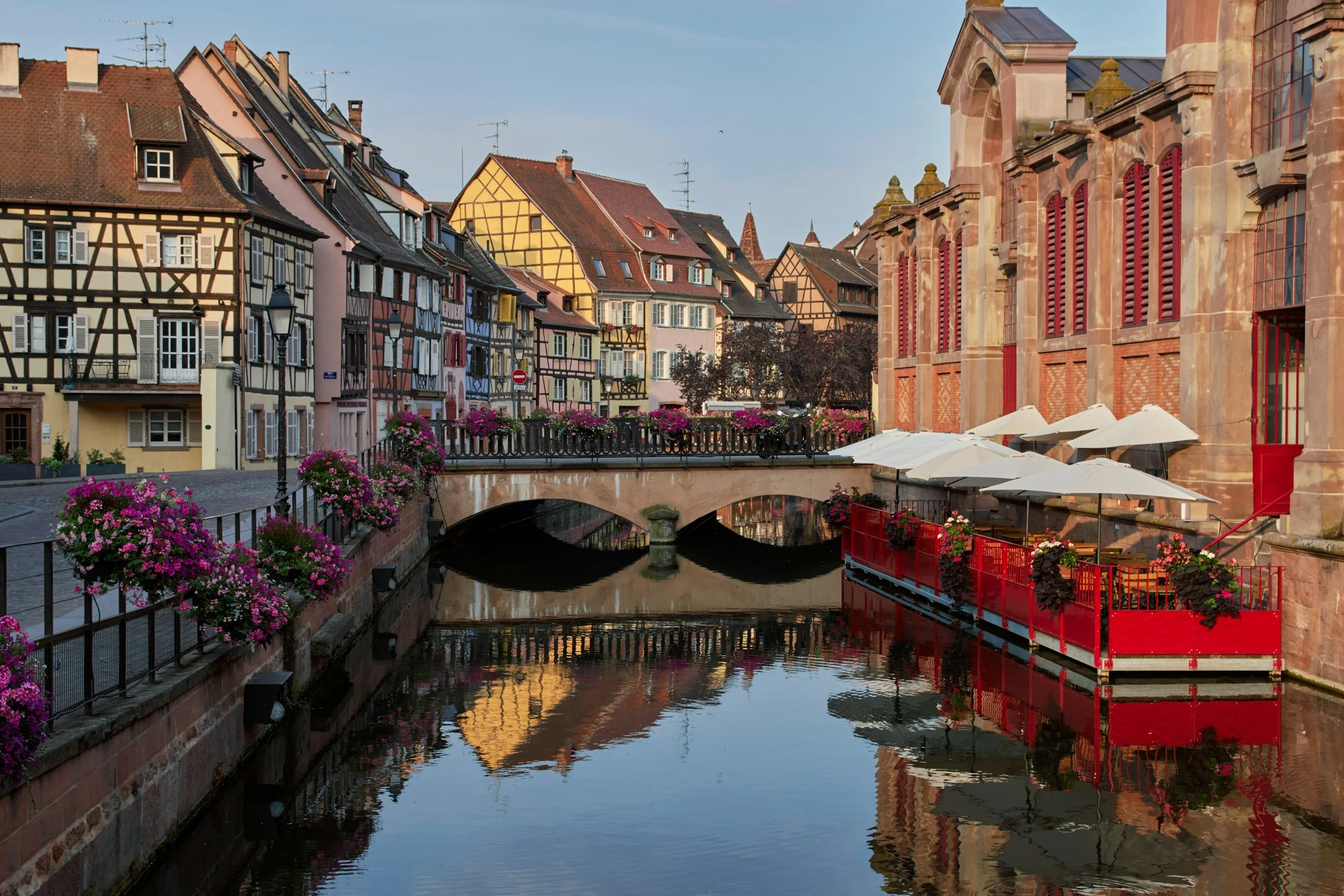
Photography Spots in Colmar
Petite Venise (Little Venice)
The defining image of Colmar. The canal quarter at the southern end of the Old Town, where flower-draped half-timbered houses reflect in still water and a footbridge crosses at a gentle curve. The most recognized composition in Colmar and the most crowded location by mid-morning. The canal is mirror-still in the first hour of daylight, and during the Christmas market period, the colored lights from the surrounding stalls and lampposts reflect in the water at dusk in a way that makes you stop what you are doing.
The reflections are better than the lights themselves. Every photographer who was there with us at dusk stopped talking when the canal turned gold and green and red below us. For about five minutes, nobody moved.
📷 Pro Tip: Arrive before sunrise. The canal is mirror-still in the early morning and you will have the reflections without the boat traffic or foot traffic that disrupts the water by 9 a.m. Position yourself on the western bank for the classic wide composition. A 16–35mm captures the full curve of the canal houses in a single frame. A 70–200mm compresses the facades from the footbridge and isolates individual window boxes and architectural details. Return at blue hour after the Christmas market lights come on: the colored reflections on the water at dusk are the finest light of the day in Colmar. During the Christmas market season, blue hour runs approximately 30 to 45 minutes after sunset; check the specific time for your visit date and be in position 15 minutes early.
Best time: Sunrise and blue hour. Access: Free, public. Getting there: On foot from any Old Town hotel, typically 5 to 10 minutes.
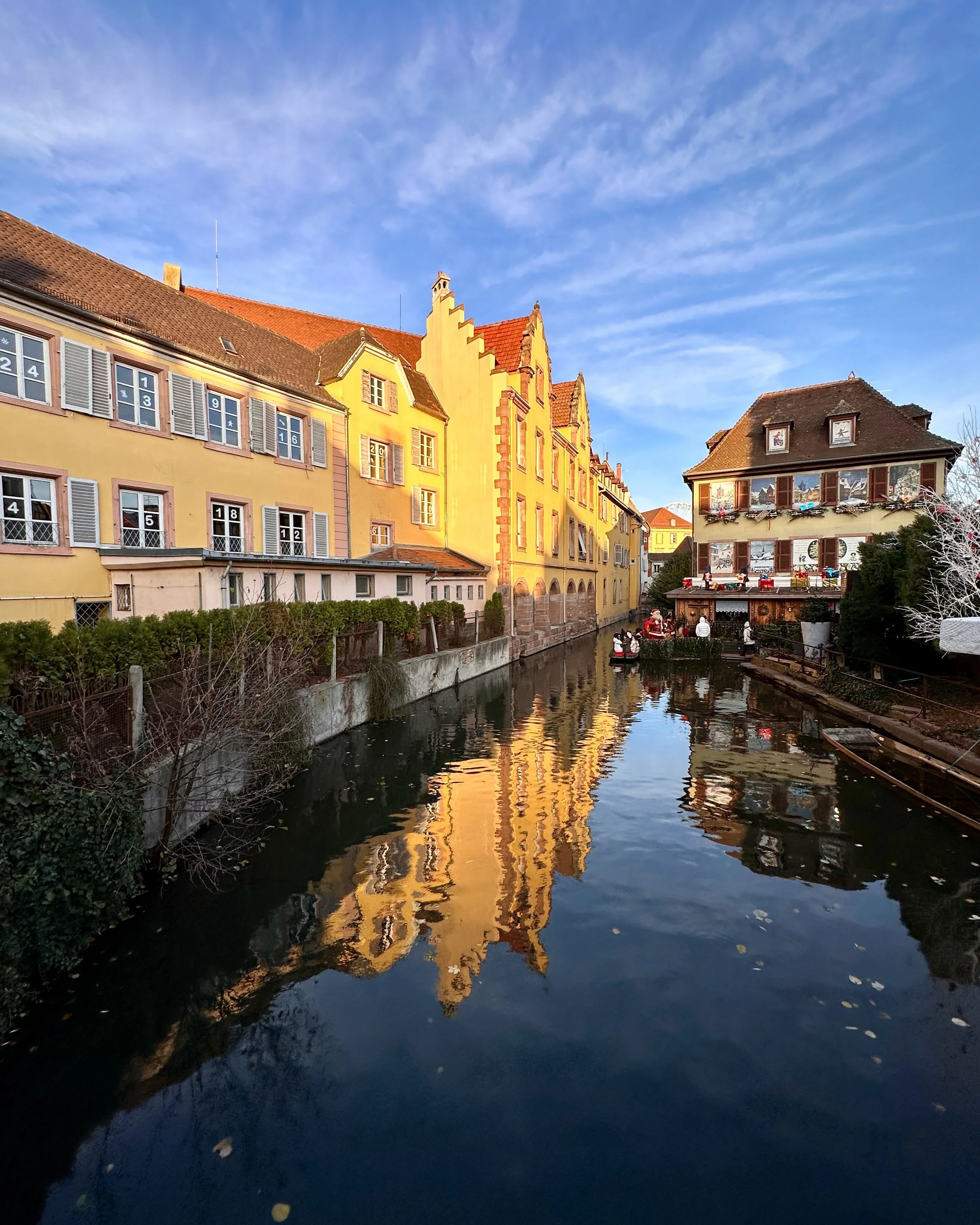
Rue des Marchands
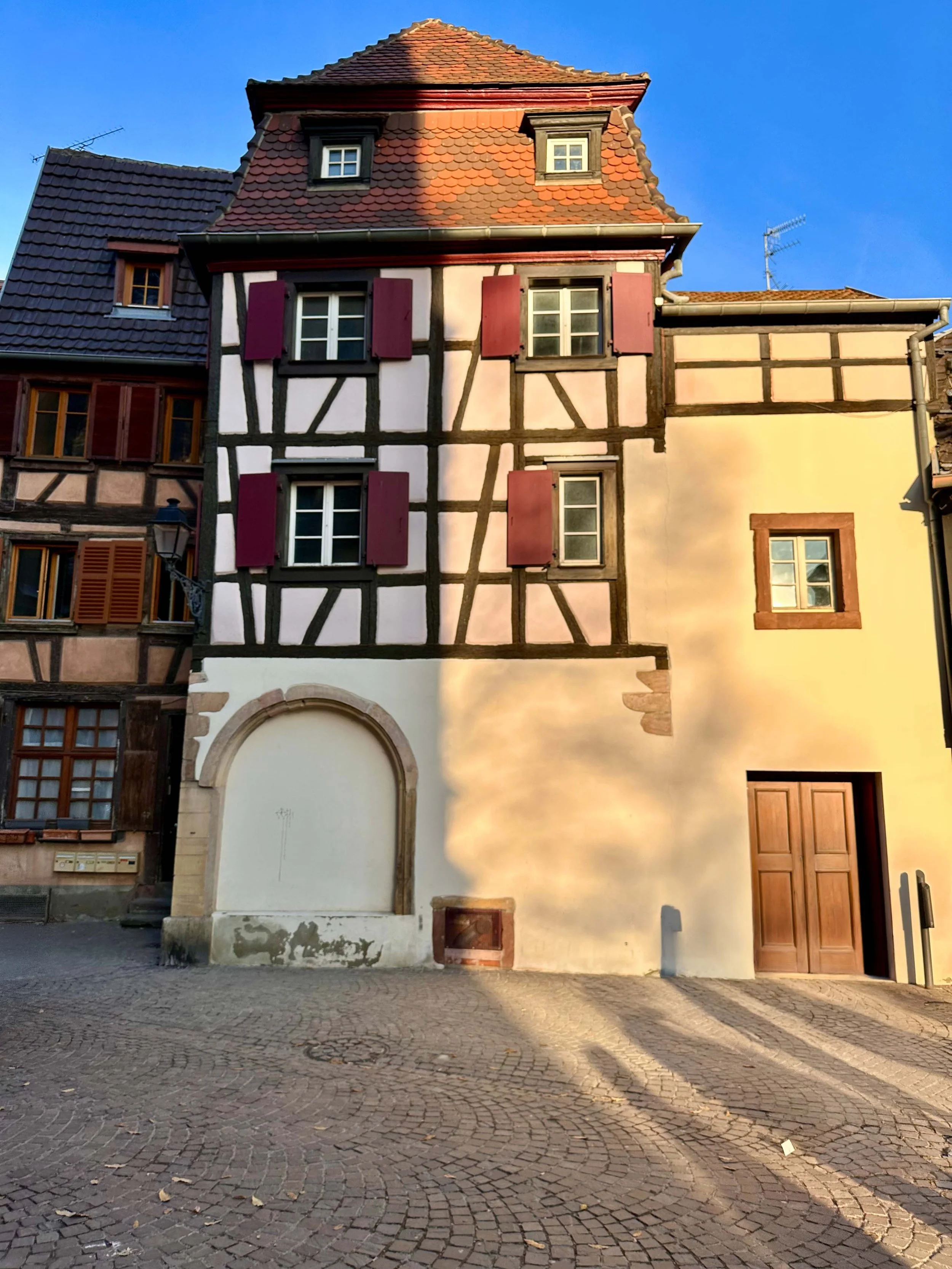
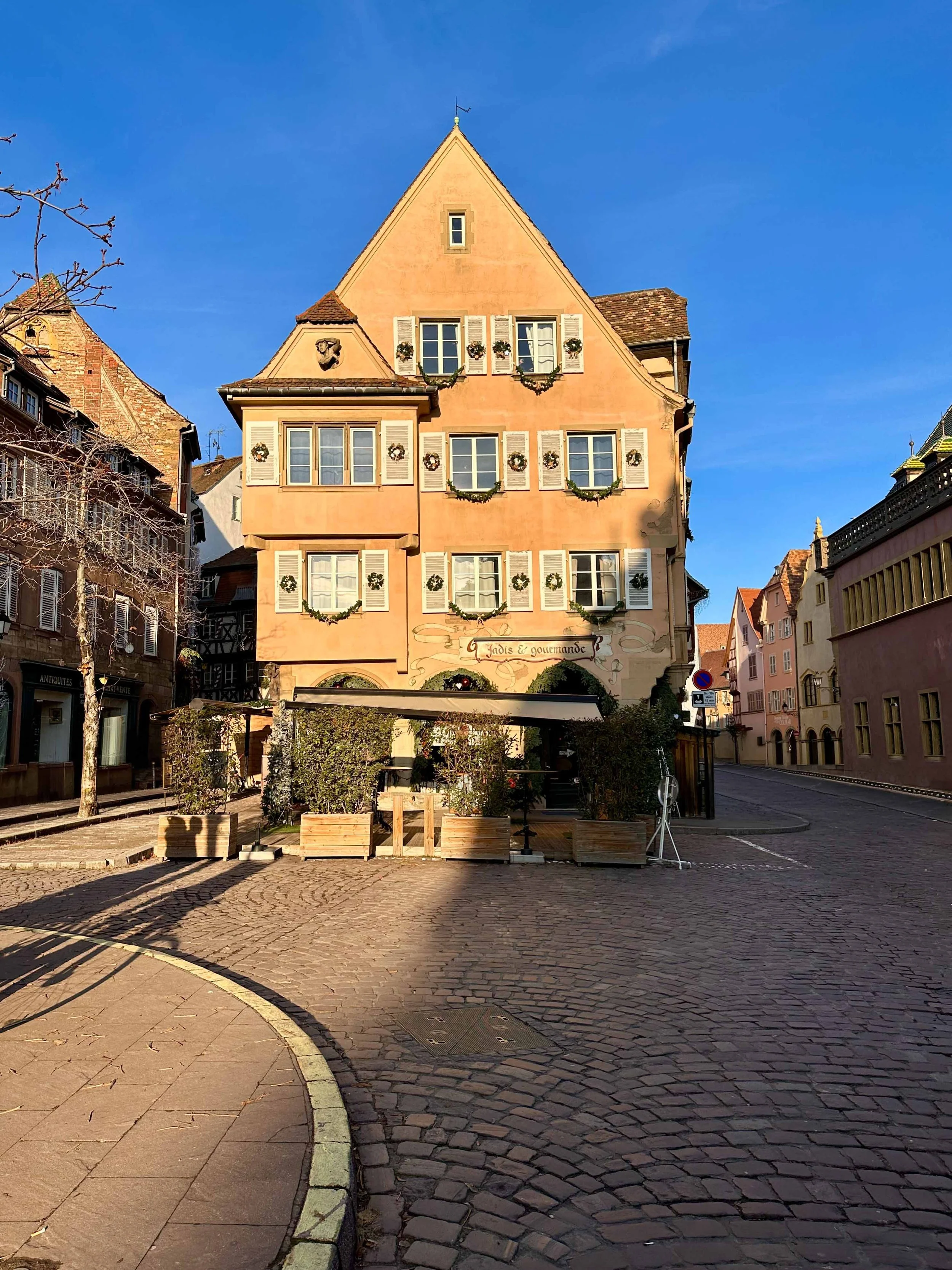
The main street of the Old Town, lined with half-timbered houses in varying heights and a palette of yellow, pink, green, and ochre that looks most saturated in overcast light. The Maison Pfister at number 11, with its 16th-century painted facade and corner oriel, is the street's most distinctive building and one of the finest examples of secular Renaissance architecture in Alsace.
Overcast days are better here than direct sunlight. Hard sun creates harsh shadows between the buildings and loses the color saturation that makes the street worth photographing. On a grey December morning, the colors are more vivid than in July.
📷 Pro Tip: Walk the full length of the street in both directions before committing to a composition. The perspective changes significantly depending on which end you shoot from. A 24–70mm standard zoom handles the street perspective well from the southern end looking north toward Maison Pfister. A 70–200mm isolates specific facade details, the oriel window, the painted panels, the roofline, from the far end of the street without distortion. In the Christmas market season, the street is decorated with overhead ornaments that add a layer of color and context above the architecture. Shoot early, before 8 a.m., when the market vendors are setting up but the crowd has not yet arrived.
Best time: Early morning, overcast light. Access: Free, public. Getting there: On foot, central Old Town.
Covered Market (Marché Couvert)
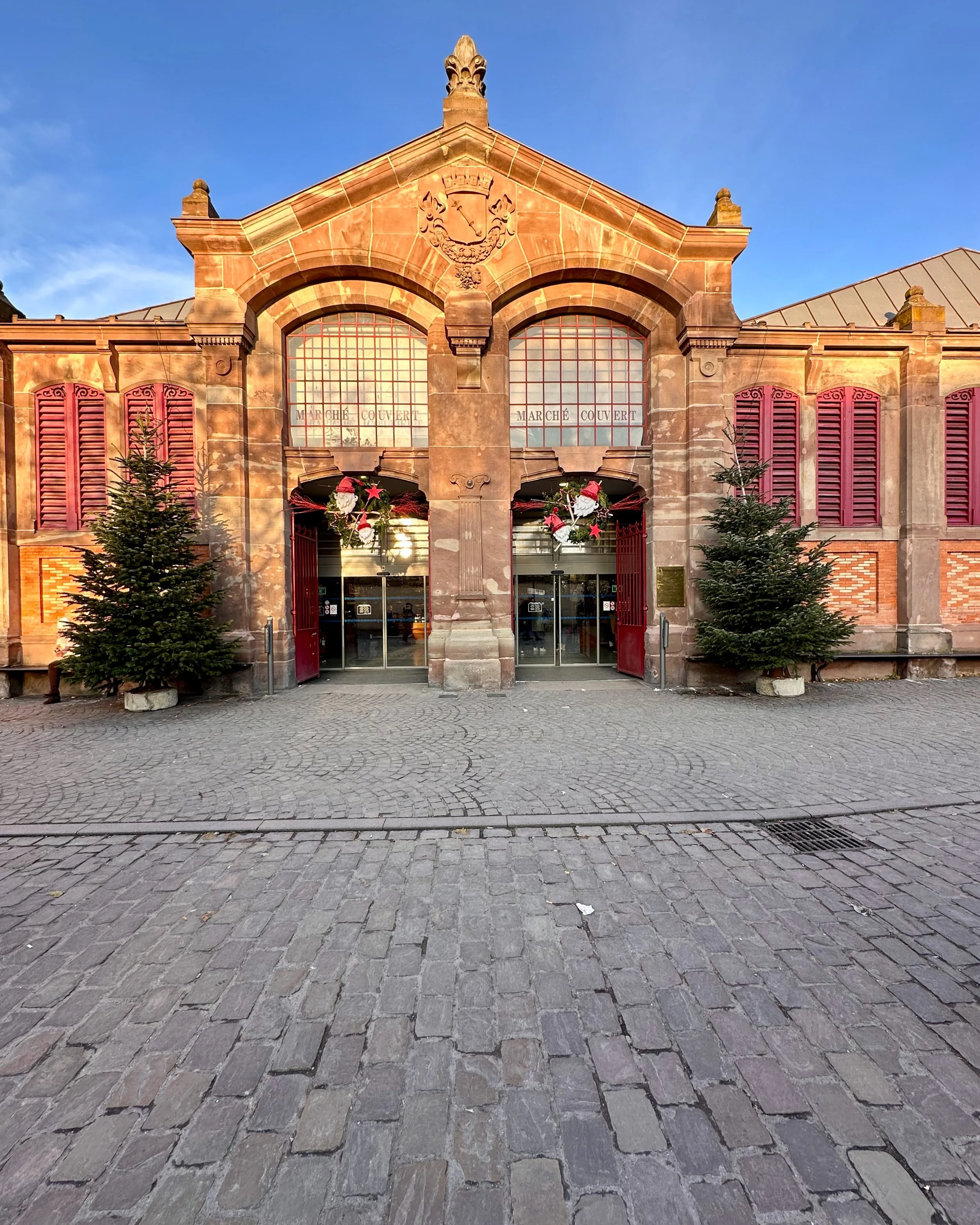
The 1865 iron-framed covered market is Colmar's finest interior photography environment: good natural light from the high windows, colorful produce and cheese vendors, Alsatian sausages and wines, and the specific energy of a market that serves residents rather than tourists. The roof structure itself is worth photographing separately from the stalls below.
Saturday morning is the best time to be here. The market is at full capacity, the vendors are in full display, and the light from the upper windows comes down at an angle that makes the produce and charcuterie stalls glow.
📷 Pro Tip: Visit on Saturday morning before 10 a.m. A 35mm prime keeps you compact and unobtrusive in the narrow stall passages. The best compositions are at two levels: shoot upward toward the iron roof structure from the center of the market floor, and shoot at stall level, low and close, for the cheese and charcuterie displays in the window light. The vendors here are used to photographers and are generally receptive; a nod and a smile before pointing the camera goes a long way. The light is best in the 8 to 10 a.m. window before the overhead light flattens and the crowd thickens.
Best time: Saturday morning, 8 to 10 a.m. Access: Free. Getting there: On foot, central Old Town.
Koïfhus (Old Customs House)
The 15th-century customs house at the center of the Old Town has an arcaded ground floor, a loggia on the upper floor, and a roofline of polychrome glazed tiles in geometric patterns. One of the most architecturally detailed buildings in Colmar, and consistently underrepresented in most photography guides. The glazed roof tiles are the detail most worth isolating.
📷 Pro Tip: Photograph from the square to the south in the morning when the light hits the facade directly. The polychrome tile roof requires a 70–200mm focal length to isolate the color pattern against the sky from street level; a wide-angle from close range does not capture the tile detail effectively. The arcades at ground level create strong geometric shadow patterns in afternoon light. Come back in the late afternoon for the arcade shadows if you were here in the morning for the facade. During the Christmas market, the wooden market stalls are set up in the square in front of the Koïfhus; include them in the foreground for context and depth.
Best time: Morning for facade light, afternoon for arcade shadows. Access: Free, exterior. Getting there: On foot, central Old Town Square.
Dominican Church
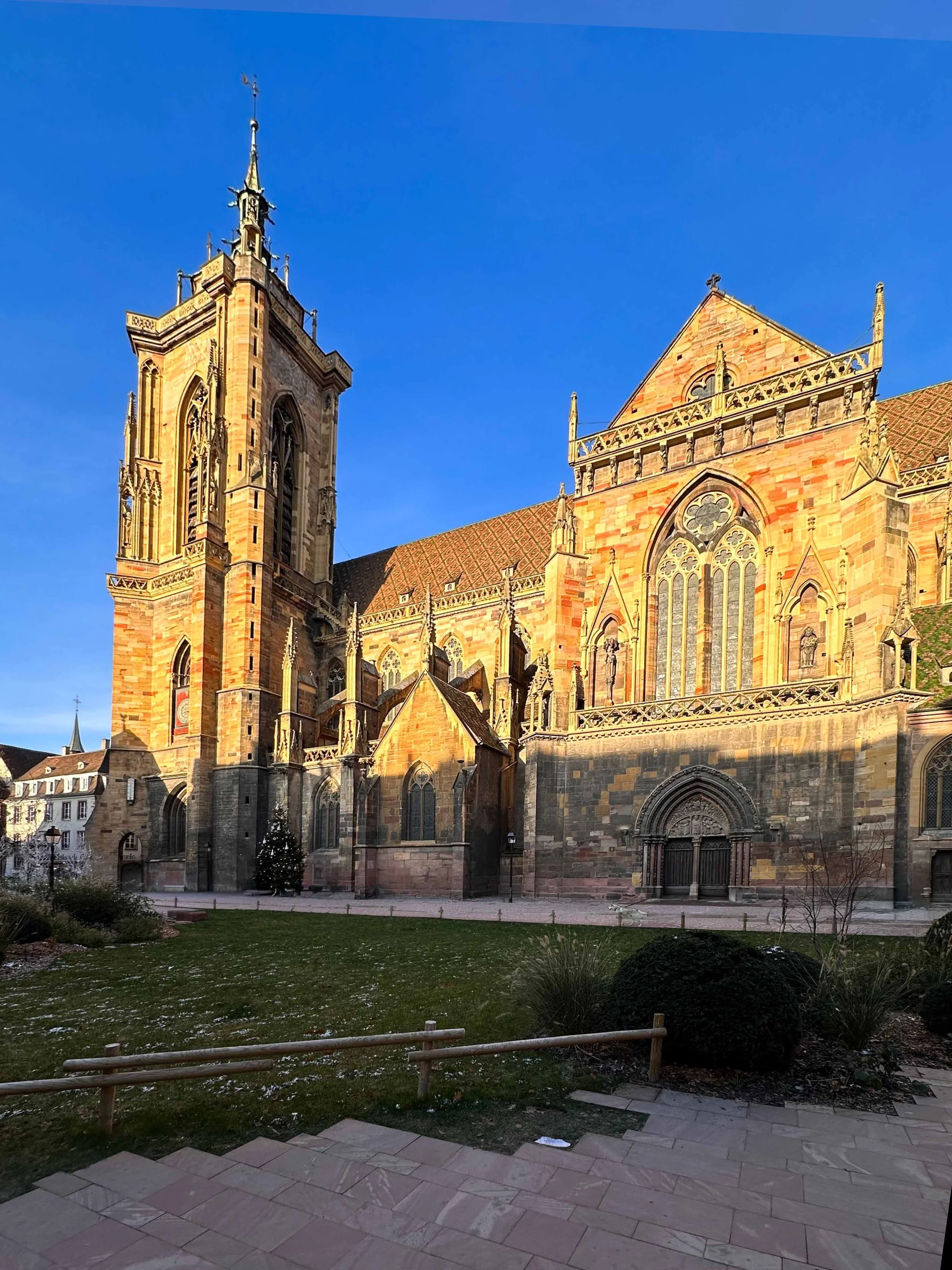
A 13th-century Gothic church that contains Martin Schongauer's altarpiece "Madonna of the Rose Bower" (1473), one of the most significant paintings in Alsace. The exterior at golden hour, when the late light catches the stone facade from the west, is the strongest architectural photography subject in the church district. The interior is quieter and cooler than the streets outside, and worth entering for the altarpiece alone regardless of whether you are there to photograph.
📷 Pro Tip: The exterior is best photographed from the square to the west in the late afternoon, when the warm light hits the Gothic stonework directly. Interior photography is permitted; the altarpiece is small and positioned at the far end of the nave, so a 70–200mm from the back of the church is more effective than trying to photograph it from close range with a wide lens. Attend an evening service during the Christmas market period if you have the chance: the church lit with candles and the organ playing is a specifically Colmar experience that goes beyond photography.
Best time: Late afternoon for exterior, early morning for empty interior. Access: Small entry fee for the altarpiece room; exterior free. Getting there: On foot, Old Town church district.
Unterlinden Museum Courtyard
A 13th-century Dominican convent courtyard, now the entrance to the finest art museum in Alsace, which houses the Isenheim Altarpiece by Matthias Grünewald (1512–1516), one of the most powerful paintings in European art. The courtyard is all cloister arches, stone columns, and morning light at a low angle across the flagstones. Worth visiting even if the museum is not your priority.
📷 Pro Tip: The courtyard is most photogenic in the morning when the light comes at a low angle across the cloister arches from the east. Position yourself at the far end of the courtyard and use a 16–35mm wide-angle to capture the full run of arches with the courtyard garden in the foreground. Photography is permitted throughout the permanent collection. The Isenheim Altarpiece is extraordinary and should not be skipped even on a photography-focused visit. Some things are worth putting the camera down for. This is one of them.
Best time: Morning for courtyard light. Access: Paid museum entry. Getting there: On foot, short walk from the Old Town center.


Festivals & Events in Colmar
Colmar Christmas Markets (Late November through December): One of the finest Christmas market experiences in Europe. Five separate markets spread across the Old Town, each with a slightly different character: the main market at the Koïfhus square, the Alsatian market near the Covered Market, and the children's market near Rue des Marchands. The town is lit with lanterns, garlands, and warm light that transforms every canal and alley into a photography subject. Go early and stay late. The best photography happens before 9 a.m. and again at blue hour.
Festival of Alsatian Culture (July): Folk costumes, traditional music, and regional food in the Old Town streets. One of the few times you will see locals in traditional Alsatian dress outside of private occasions. Worth photographing for the color and the people, though the summer crowds are at their highest during this period.
Alsace Wine Fair (August): Held in nearby Colmar and surrounding towns, with wine producers from across the region presenting their vintages. The fair itself is as much a cultural event as a wine event, and the combination of Alsatian food, music, and the vineyard landscape makes it a strong photography subject if you are in the region during August.
Sunday Markets (Year-round): The weekly market around the Covered Market and the Dominican church square is worth building your Sunday morning around. Produce, cheese, charcuterie, and flowers, with the Old Town architecture as a backdrop. Less crowded than the Christmas market and more accessible for candid photography.
Frequently Asked Questions About Visiting Colmar
Is Colmar worth visiting outside of the Christmas season?
Yes, absolutely. Spring brings flower boxes overflowing with color, and fall turns the surrounding vineyards and trees deep red and orange. December is genuinely special for the Christmas markets, but it's far from the only reason to come.
Do you need a car in Colmar?
No, the Old Town is compact, flat, and entirely walkable. A car becomes useful only for day trips to nearby villages like Eguisheim or Riquewihr, or the Alsace vineyards.
Is Colmar worth visiting as a day trip from Strasbourg or Basel?
Yes, both are under an hour away by train, making a day trip realistic. That said, two nights gives you two mornings of golden hour and two evenings at the markets or canals, which is genuinely the right amount of time to photograph it properly.
What are the best photo spots in Colmar?
Little Venice before sunrise for the mirror-still canal reflections, Rue des Marchands on an overcast day for saturated color, and the Covered Market on a Saturday morning are three that consistently deliver. The full list with Pro Tips is above.
Can you fly a drone in Colmar?
Check current French regulations before flying; urban drone flights are restricted, and the historic Old Town likely falls under additional limitations given its architecture and crowds.
What surprised you most about Colmar?
The beauty of the canals in the city. Little Venice isn't just a photogenic postcard corner, it genuinely earns the comparison, flower-draped houses reflected in still water, quiet enough in the early morning that it feels entirely yours.
How many days do you need in Colmar?
One to two days. That's enough time to wander the streets at different hours for varied light, and still have room to explore a nearby village like Eguisheim or Riquewihr.
Is Colmar worth combining with Paris or Étretat?
Yes, though it's a bigger trip, Colmar sits in Alsace, several hours from both. If you're doing a broader France circuit, it's one of the most photogenic towns in the country and a strong addition to a longer itinerary.
Final Thoughts
The Christmas market lights came on while we were at Little Venice, and the canal turned gold and green and red below us. Every other photographer who was there stopped talking. The reflections were better than the lights themselves. For about five minutes, nobody moved.
That is Colmar in December: small enough to feel yours entirely when the morning is quiet, beautiful enough to stop you mid-conversation when the light changes. The kind of place you save up for years and then find yourself wondering why it took so long.
Go early. The first hour before the markets open and the tour groups arrive belongs to photographers. The Old Town at seven in the morning in December, with frost on the cobblestones and the Christmas lights still on above Rue des Marchands, is one of the finest photography walks in France. Sit in a cafe when the cold arrives. Stay for lunch. Come back in the afternoon for the markets in the fading light. Two nights are better than one.
Want to improve your photography while exploring some incredible destinations? Join me on one of my photography workshops! You can find all the details, including upcoming destinations and dates, through the links below.
Let's Stay Connected!
If you enjoyed this Photography and Travel Guide to Colmar, here are three companion guides for the region that pair naturally with a visit.
My Photography & Travel Guide to Paris — Two and a half hours by train from Colmar, and the obvious extension of any Alsace trip. Paris and Colmar share the same love of light, good food, and architectural detail, scaled entirely differently. The guide covers all my favorite photography locations across the city, from Montmartre at dawn to the Seine at blue hour.
My Photography & Travel Guide to Provence, France — Provence is the other end of the French photography spectrum from Alsace: lavender fields, ochre cliffs, and Roman ruins instead of canal houses and Christmas markets. If Colmar is the north of France at its most intimate, Provence is the south at its most expansive. The light in both regions is worth a dedicated trip.
My Photography & Travel Guide to Mont-Saint-Michel, France — One of the most recognizable silhouettes in Europe, rising from a tidal flat off the Normandy coast. As architecturally extraordinary as Colmar in its own way, and as rewarding to photograph at golden hour. A natural addition to any France itinerary that takes Colmar seriously.
Finally—a beginner-friendly photography guide that makes sense.
If you've ever picked up a camera and thought, "Now what?" this is the book for you.
Photography Made Simple is written for adults who are just starting out and want a clear, encouraging, real-world approach to learning photography. Whether you're using a DSLR, mirrorless, or just your smartphone, this guide walks you through the basics—without the jargon or tech overwhelm.
Inside, you'll learn:
The only camera settings you really need to know to get started
How to shoot sharper, more intentional photos using light and composition
Simple tips for portraits, landscapes, travel, and everyday life
What gear you do (and don’t) need
How to create better photos without upgrading your camera
You’ll also get practical exercises, cheat sheets, and tips for organizing and editing your images—plus the confidence to shoot off Auto Mode for good.
This is not a textbook. It’s a friendly guide to seeing the world with fresh eyes—and finally capturing what you see the way you imagine it.
📸 Format: PDF download
Pages: 100+
Perfect for: Beginners, hobbyists, and anyone ready to take better photos without the stress