Tallinn, Estonia Travel & Photography Guide: Best Photo Spots, Things to Do & Hidden Gems
Russia gave us a 72-hour visa. That was not enough time for what we had planned, so we pivoted to Tallinn instead. It turned out to be one of the best accidental travel decisions of our lives.
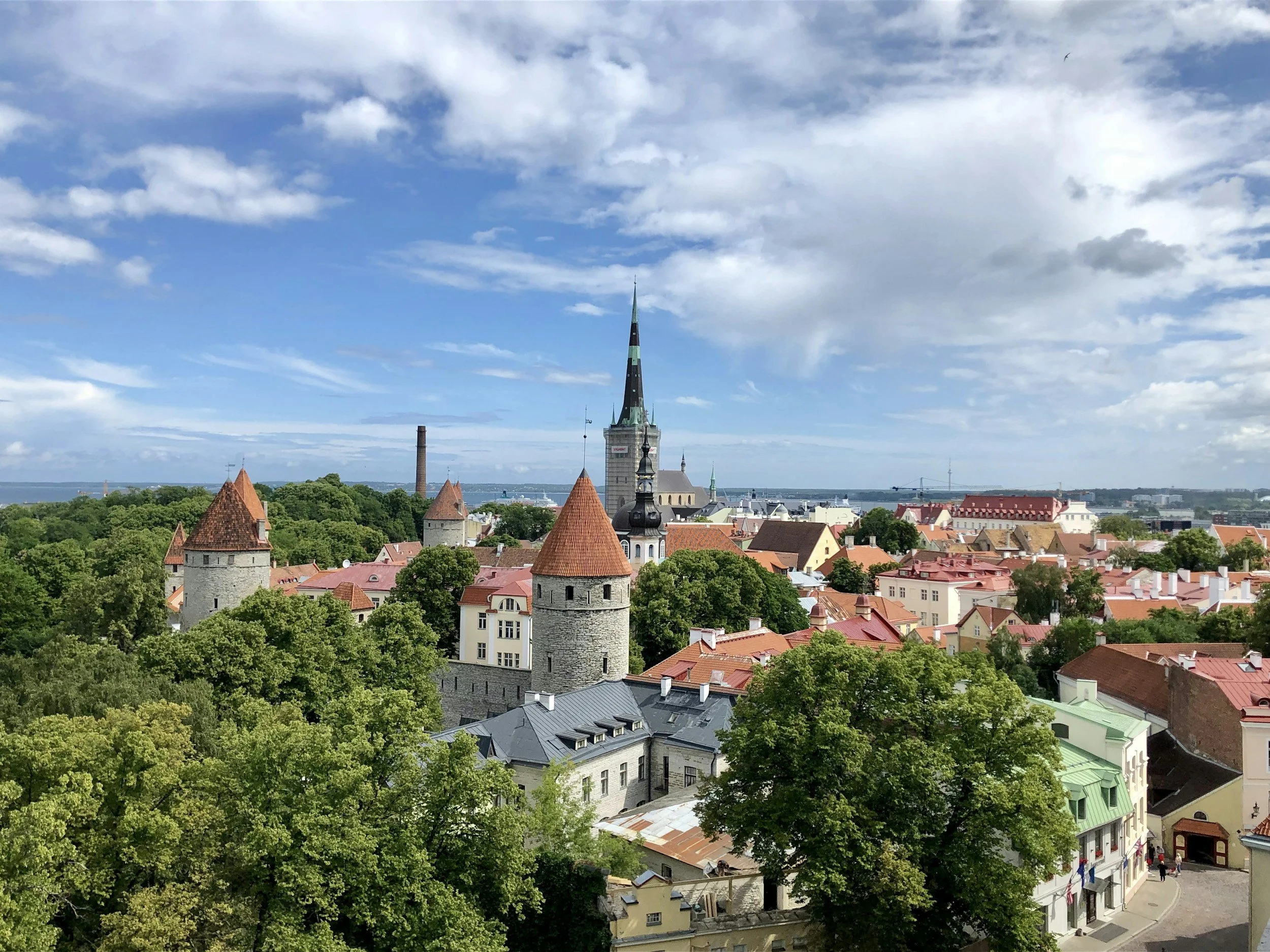
Tallinn is one of the most completely preserved medieval cities in Europe, and for photographers, that is not a small thing. Walking through the Old Town, you genuinely feel that nothing has changed in five hundred years. The towers, the cobblestone alleys, the colored merchant houses, the Gothic Town Hall anchoring the central square. The city is clean, compact, and completely unlike the polished tourist corridors of more heavily visited European capitals. It reminded me of Prague, but smaller, quieter, and, if anything, better preserved. Less choreographed.
Photographically, Tallinn rewards patience and early alarm clocks. The viewing platforms above the Lower Town produce sweeping panoramas of terracotta rooftops and church spires that glow at sunrise. The narrow lanes of the Old Town generate directional light and leading lines that work at any focal length. The color palette, muted stone walls, rust-red roofs, and the deep blue of the Baltic sky in winter, is subtle and consistent, which means the images have a coherence that's hard to achieve in louder, more chaotic cities. We visited in January. The cold kept the streets empty until mid-morning, and the low winter sun gave us golden light for two hours every day without competition from crowds.
In this Photography Guide to Tallinn, I share the places and experiences that continue to draw me back. You will find my favorite photography locations, guidance on when and where to shoot, practical travel tips, and gear recommendations, along with cultural insights to help you explore and photograph Tallinn with confidence, respect, and ease.
Photographer's Notes
Before you go, here are my own takeaways.
Favorite Location: Kohtuotsa Viewing Platform
Favorite Hotel: Schlossle Hotel
Favorite Restaurant: Rataskaevu 16
Favorite Café: Maiasmokk
Would I Return? I loved the city and would come back in spring or fall.
Best Time to Visit Tallinn
Summer (May to August) is the most popular window. The weather is warm, the days are long, and the city comes alive with outdoor dining and the Old Town Days festival in June. Golden hour in June stretches past 10 pm, which is extraordinary for photography. The downside is crowds. The Old Town gets busy, especially on weekends, and the viewing platforms can be packed by mid-morning.
Shoulder season (April and September) is the smart photographer's window. Crowds thin significantly, prices drop, the light is lower and more directional, and the Old Town looks its most atmospheric in the morning mist that settles in September.
Winter (November to February) is when we visited, and I would go back in a heartbeat. The low Baltic sun sits at a permanent golden angle for the two to three hours it is above the horizon. The streets are empty at dawn. The Christmas market in December transforms Town Hall Square into one of the finest seasonal photography subjects in northern Europe. Bring extra batteries. Cold temperatures drain camera power significantly faster than normal operating conditions.

Where to Stay in Tallinn
Stay inside the Old Town or immediately adjacent to it. The medieval core is compact and photogenic, and proximity means you can be at the viewing platforms before sunrise and back for coffee without a taxi. Every property listed below puts you within walking distance of the best photography locations.
Luxury in Tallinn
Schlossle Hotel This is where we stayed, and it was the right choice. The Schlossle occupies a 14th-century building on Pühavaimu Street, one of the most atmospheric addresses in the Old Town. The 23 rooms are designed with a historic restraint that feels genuinely connected to the building's age. The restaurant is excellent, the service is warm and personal in the way that small hotels in old buildings tend to be, and Town Hall Square is a two-minute walk from the front door. For photographers, the location is unbeatable.
Hotel Telegraaf, a beautifully converted Art Nouveau building on Vene Street in the heart of the Old Town. The original telegraph exchange architecture is preserved in the lobby and common areas, and the 86 rooms are contemporary against the historic shell. The Tchaikovsky Restaurant, one of the finest in the Old Town, operates within the hotel. An excellent choice for travelers who want luxury with history built in.
Hotel Viru is the most historically distinctive hotel in Estonia and possibly the most interesting in the Baltic states. The Hotel Viru was built in 1972 during the Soviet era as one of the first Western-style hotels in the USSR, and the 23rd floor was operated by the KGB for surveillance of guests and staff until Estonian independence in 1991. That floor is now the KGB Museum, open for guided tours, with original surveillance equipment, listening devices, and documentation still in place. Staying at the Viru means staying inside Cold War history. Book the museum tour when you check in. It is one of the most fascinating ninety minutes in Tallinn.
Mid-Range in Tallinn
L'Ermitage Hotel A well-run boutique property in a beautifully restored historic building near the Old Town walls. Personal service and thoughtfully decorated rooms at a price point below the full luxury properties. A reliable and comfortable base.
The Bern Hotel A small, well-positioned boutique hotel within the Old Town, close to Toompea Hill and the viewing platforms. Good value for photographers focused on the upper town at sunrise.
Go Hotel Schnelli, located just outside the Old Town walls near the train station, offers clean, modern rooms at a sensible price point with easy access to the medieval core on foot. A solid option if the Old Town properties are full.
Getting Around Tallinn
The Old Town is small enough that walking is the right approach. From any hotel within the medieval walls, every major photography location is within a fifteen-minute walk. That compact scale is one of Tallinn's greatest advantages for photographers: you can cover all the key locations in a day and return to your favorites at different light without a single taxi.
Trams and buses cover the areas beyond the Old Town efficiently. The same ticketing system applies across all public transport. A 24-hour or 48-hour pass makes sense if you plan to venture beyond the walls.
Bolt, the European rideshare app founded in Estonia, is the dominant option and generally faster in this market than Uber. Download it before you arrive. Both operate in Tallinn, but Bolt is home here.
For the airport transfer, Bolt and taxis are both reliable. The city center is roughly 15 to 20 minutes from the airport.
How Many Days Should I Visit Tallinn
Three days is the right minimum for photographers. Two days is what we had, and we ran out of time before we ran out of subjects. Three days lets you cover the key photography locations at multiple times of day, spend a morning shooting the Christmas market or the Old Town Days, and still have an afternoon for the KGB Museum and a long dinner.
Five days is the ideal pace if you want to shoot at sunrise and blue hour without feeling rushed, and add day trips to places like Lahemaa National Park or the Patarei Sea Fortress.
A rough outline for a three-day photography visit:
Day 1: Arrive, walk the Old Town in the afternoon, shoot the Christmas market or the lower town streets at blue hour
Day 2: Kohtuotsa and Patkuli viewing platforms at sunrise, Old Town streets mid-morning, Alexander Nevsky Cathedral and Toompea Hill in the afternoon, Town Hall Square at sunset
Day 3: St. Catherine's Passage and City Walls in the morning, KGB Museum, Fotografiska Tallinn for lunch, final golden hour at the viewing platforms before departure
Where to Eat in Tallinn?
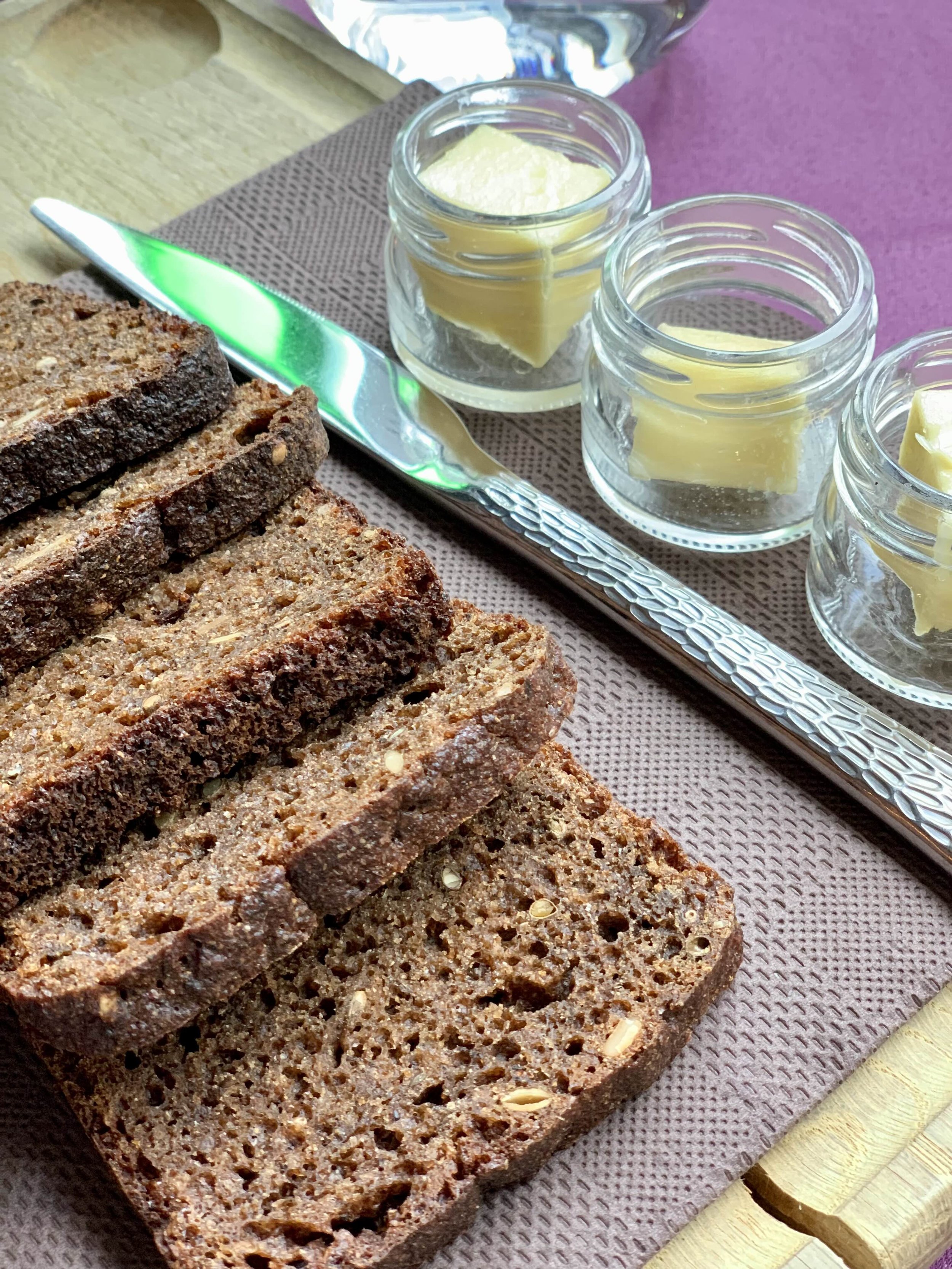
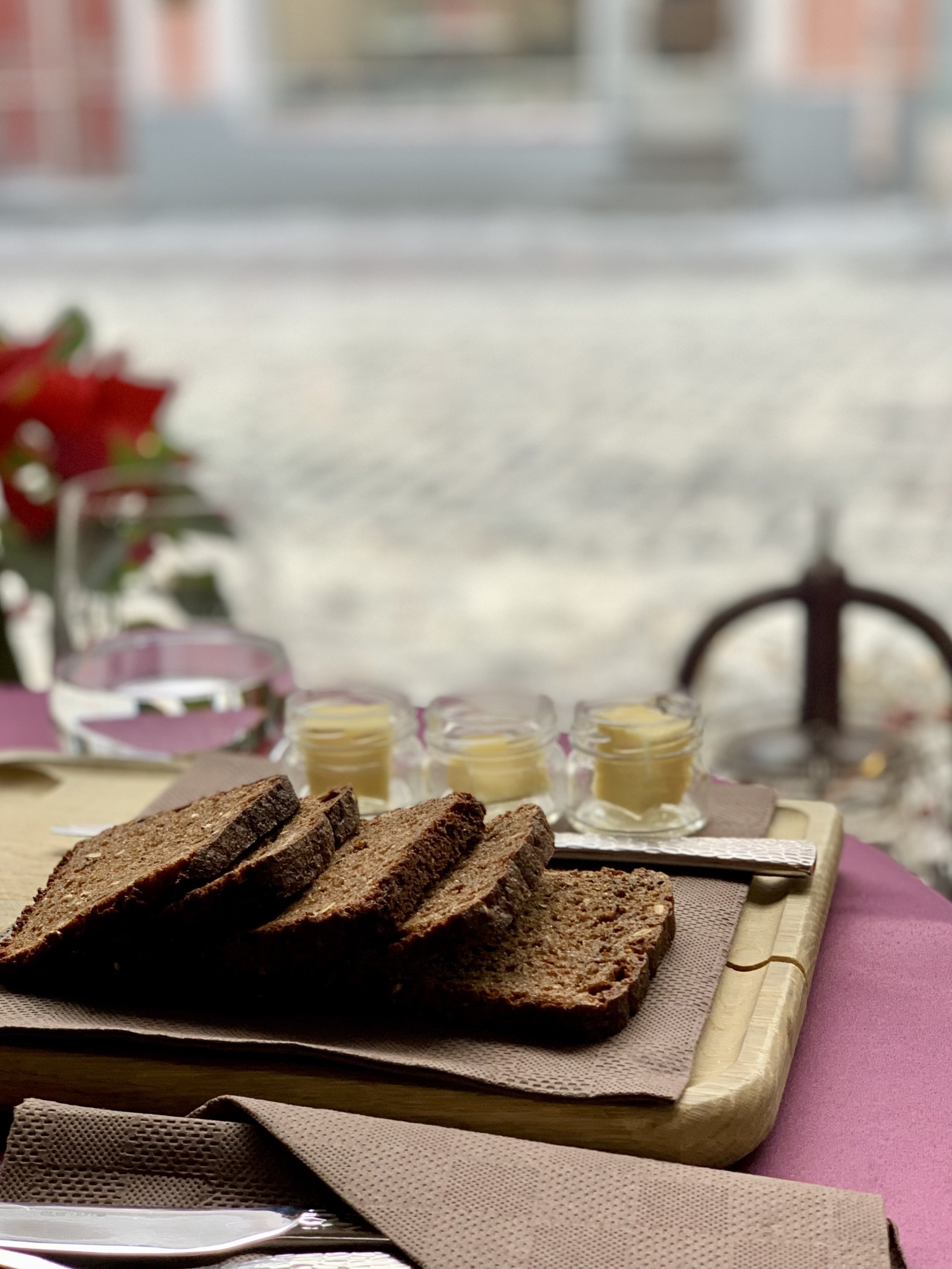
Tallinn's food scene is a genuine and underrated pleasure. The cooking draws on Estonian ingredients: dark rye bread, forest mushrooms, river fish, smoked meats, and the dairy products of a country that takes its farm tradition seriously. The Old Town is full of restaurants, from atmospheric medieval cellar dining to bright contemporary spaces. And the number of excellent vegetarian options is extraordinary for a city this size.
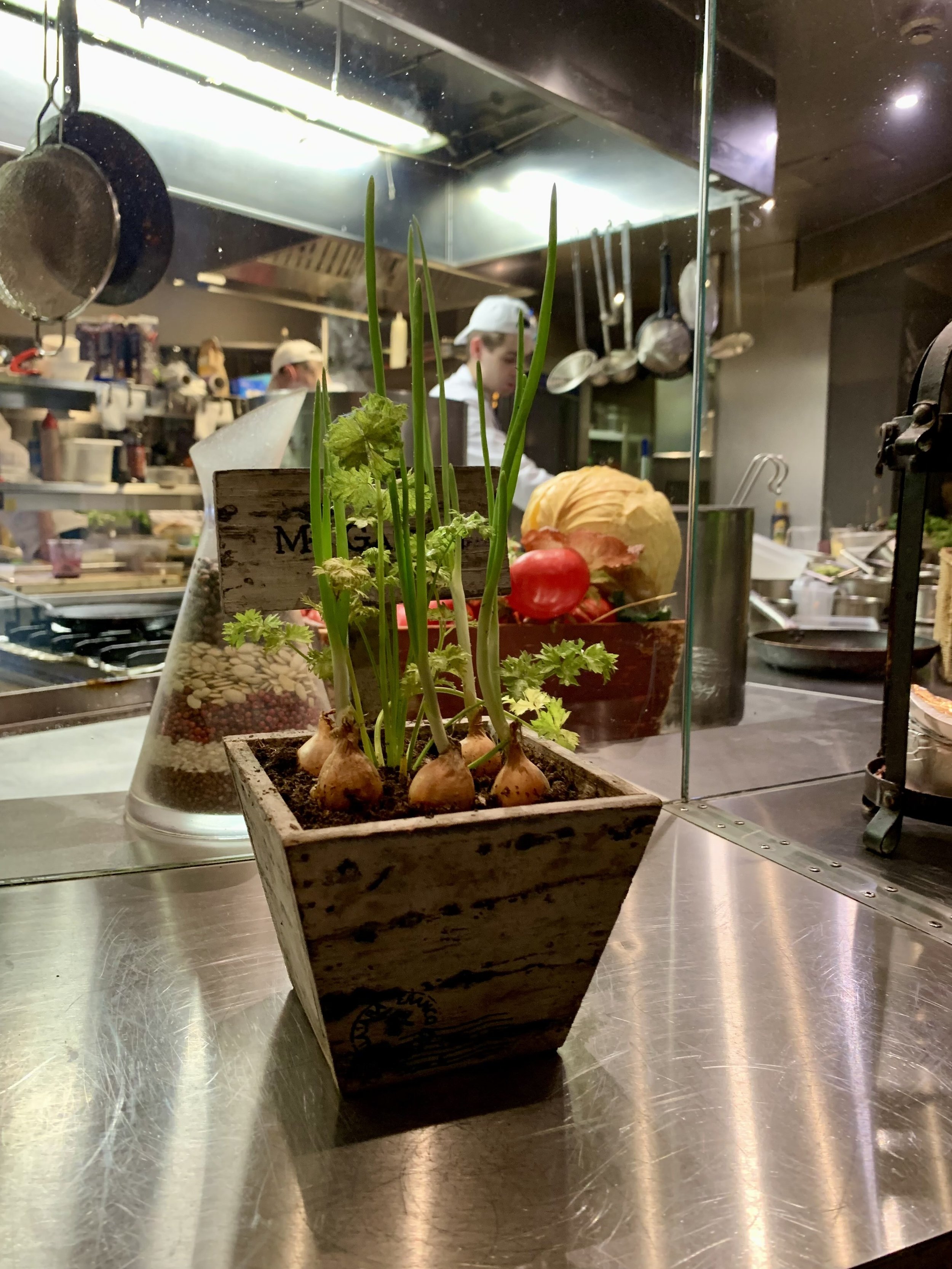
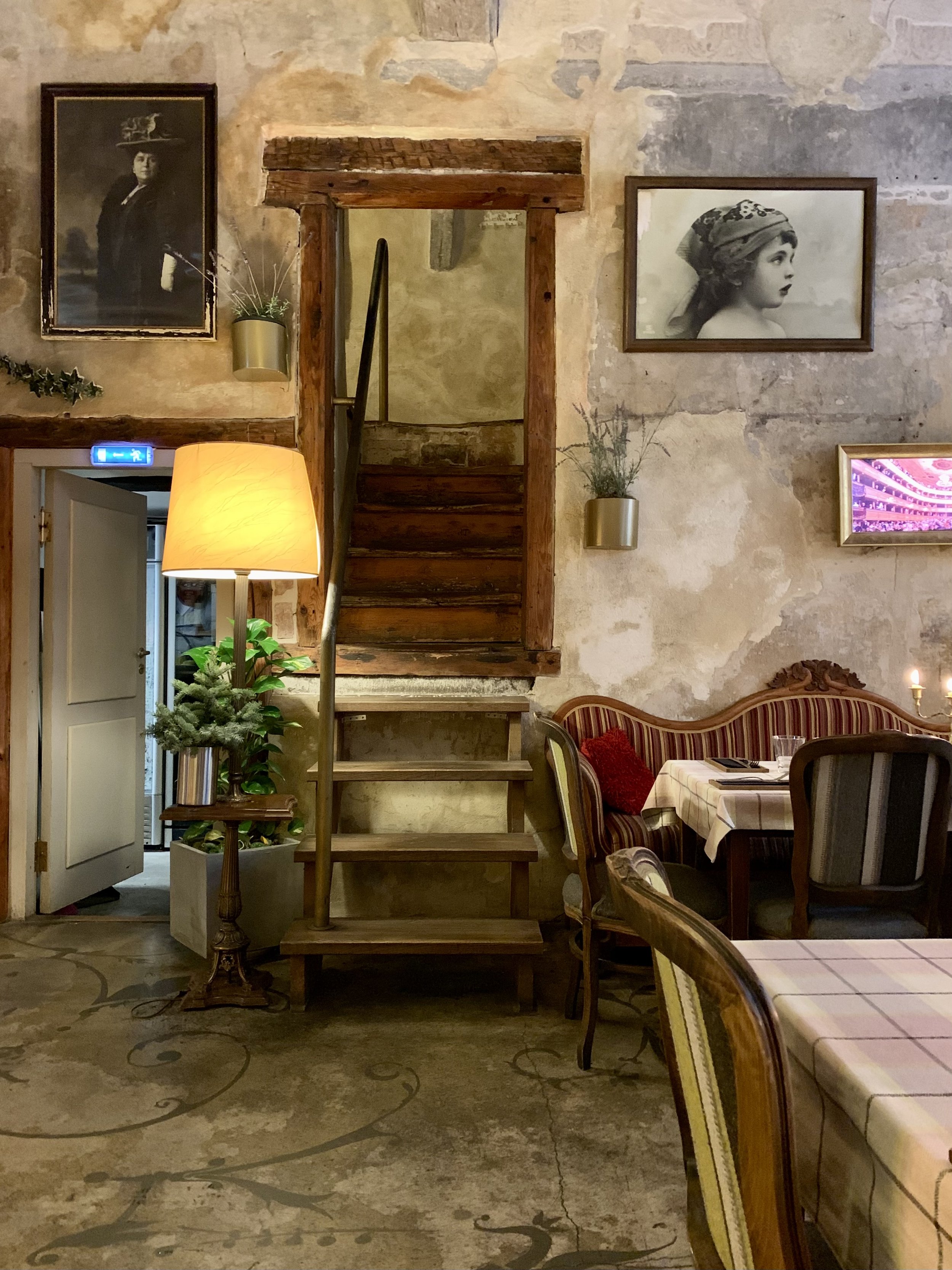
Rataskaevu 16 — The most popular restaurant in the Old Town and the right introduction to Estonian cooking. The kitchen uses traditional Baltic ingredients, including dark bread, game, mushrooms, and cured meats, in a warm, stone-walled space that is always full and always worth the wait. The elk stew and the wild boar dishes are the things to order. Book ahead.
Leib Resto ja Aed — "Leib" means bread in Estonian, and the restaurant earns its name. Set in a garden courtyard behind the Old Town walls, Leib serves creative Estonian cuisine with a genuine commitment to local and seasonal produce. The bread basket alone is worth a visit. The garden in summer is one of the most pleasant outdoor dining settings in the city.
Fotografiska Tallinn — The Tallinn outpost of the Swedish photography museum is worth visiting for the exhibitions alone, but the restaurant is genuinely excellent and naturally appeals to photographers. The menu is predominantly plant-based and creative, the space is beautifully designed, and the combination of contemporary art and good food makes it the most distinctive lunch stop in the city. Walk through the exhibitions before eating.
Vegan Restoran V — The finest fully vegetarian restaurant in Tallinn and one of the best in the Baltic states. Creative, seasonal, and completely satisfying regardless of your usual dietary preferences. If you have been traveling through meat-heavy northern European cooking, V is the reset.
Von Krahli Aed — A garden restaurant in the Old Town connected to the Von Krahli Theatre, with an eclectic menu that reflects the creative energy of the theater community around it. Relaxed, interesting, good for a long lunch.
Coffee and Desserts Tallinn
Maiasmokk — The oldest café in Estonia, established in 1864, on Pikk Street in the Old Town. The marzipan, which Tallinn has been producing for centuries, is made in-house and sold in the adjoining confectionery shop. The interior is Art Nouveau and completely unchanged. Order coffee, marzipan, and stay for an hour. One of the most atmospheric cafés in the Baltic.
Kehrwieder — A well-regarded specialty coffee shop in the Old Town with excellent single-origin espresso and genuinely good cakes and pastries. The interior is warm and the coffee is serious. A reliable editing stop between shoots.
Kalev Marzipan Shop — Attached to the Kalev Marzipan Museum Room in the Photography Locations section, the shop sells handmade marzipan figures that are specific to Tallinn and one of the finest edible souvenirs in any city we have visited.
Photography Gear for Tallinn
Tallinn's narrow medieval streets, wide viewing platform panoramas, and the high dynamic range of Baltic winter light all require a versatile kit.
Camera bodies: The Canon EOS R5 Mark II, Sony A7R V, or Nikon Z8 all handle the dynamic range challenges of the viewing platform compositions and the low interior light of the churches and cafés. Any of the three will produce excellent results.
Lenses: A 16-35mm wide-angle is essential. The narrow passages of Saiakang, St. Catherine's Passage, and the church interiors demand it. A 24-70mm standard zoom handles Town Hall Square and general street work. A 70-200mm telephoto compresses the rooftop layers from the viewing platforms into layered compositions with genuine depth. A 35mm or 50mm prime is the best street photography lens in the Old Town; compact and unobtrusive in tight alleys.
Tripod: Essential for the viewing platforms at blue hour and long exposures on the City Walls. The early morning light at Kohtuotsa in winter requires a stable base. A Platypod works well on ledge walls.
Extra batteries: Cold temperatures drain camera batteries significantly faster than normal. Bring at least two spares and keep them in a jacket pocket between uses. This is not optional in winter.
ND filters: Useful on the City Walls for long-exposure work during the day. A 6-stop or 10-stop ND opens up creative options even in low winter light.
Samsung T7 SSD: Back up every evening. Old Town cafés are warm and reliable for this.
Drone restrictions: Drone use in Tallinn's Old Town is heavily restricted. The entire UNESCO-listed medieval core is a no-fly zone. Check current ECAA regulations before you arrive and plan drone work outside the protected area.
iPhone Photography in Tallinn
Tallinn is one of the best cities in Europe for iPhone photographers. The Old Town's high-contrast lanes, the muted color palette, and the clear geometry of the towers all translate exceptionally well to a phone camera.
Use ProRAW mode at the viewing platforms at sunrise. The dynamic range between the bright sky and the darker rooftops benefits from the extra latitude ProRAW gives you in post.
For St. Catherine's Passage and Saiakang, shoot with the ultrawide lens from a low position and frame the lane so the cobblestones create a leading line toward the far end. The geometry does most of the work.
At Town Hall Square, use Portrait mode on street details: the painted merchant house facades, the iron lanterns, the signage above café doorways. The subject separation isolates the detail against the blur of the medieval background in a way that is very effective on a phone.
In winter, shoot the viewing platforms in Night mode at blue hour rather than waiting for full darkness. The balance between the residual sky color and the warm city lights produces the most compelling results. On iPhone 15 Pro and later, the 5x telephoto is strong enough to compress the rooftop layers from Kohtuotsa without a long lens.
Best Photography Locations in Tallinn
Tallinn is a fantastic city for photography. The old town is quite small, but its countless alleys and streets make for great images. If you’re looking for an iconic photo of the city, there are 2 great locations that are within a 10-minute walk of the hotel I recommended above.
Kohtuotsa Viewing Platform
This is the most photographed viewpoint in Tallinn, and the reputation is earned. Standing at the Kohtuotsa platform on Toompea Hill, you look out over the terracotta rooftops of the Lower Town, the medieval towers and spires, and on a clear day, the Gulf of Finland on the horizon. The "Times We Had" quote on the wall beside the platform has become a secondary subject in itself, a foreground element that reads well against the city panorama behind it.
📷 Pro Tip: Arrive thirty minutes before sunrise and face east. The light comes up behind you and illuminates the terracotta rooftops from the front, with clean shadows defining the tower edges. Use the 70-200mm to compress the rooftop layers into a dense, textured panorama. Use the 16-35mm for the full sweep including the "Times We Had" quote. Stay through the first fifteen minutes of golden hour. That is when the color is warmest and the light is most directional. The platform is free and open around the clock.
Best time: Sunrise and blue hour. Access: Free, open 24 hours. Walking distance: 10 minutes from the Schlossle Hotel uphill through the Old Town.

The walk up to the viewing platform
The composition changes with every season and every hour of light. In winter, the sunrise silhouettes the spires against a pale pink sky. In summer, the warm evening light holds until late and the shadow patterns on the rooftops become graphic and abstract.

Toompea Castle
This Baroque castle sits atop a 9th-century citadel, with the first wooden fortification believed to date to the 10th or 11th century. Since Estonian independence in 1918, it has housed the nation's parliament, the Riigikogu, giving it genuine political as well as historical weight.
📷 Pro Tip: Shoot the exterior in the golden hour before sunset, when warm light catches the pale pink facade against the sky. A 24-70mm lens handles the full building from the courtyard approach; a 16-35mm lens works if you want to include more of the surrounding walls and towers. This pairs naturally with a visit to the nearby Kohtuotsa Viewing Platform, just a short walk away.
Best time: Golden hour. Access: Free exterior viewing; grounds accessible during standard hours.

Raekoja Plats (Town Hall Square)
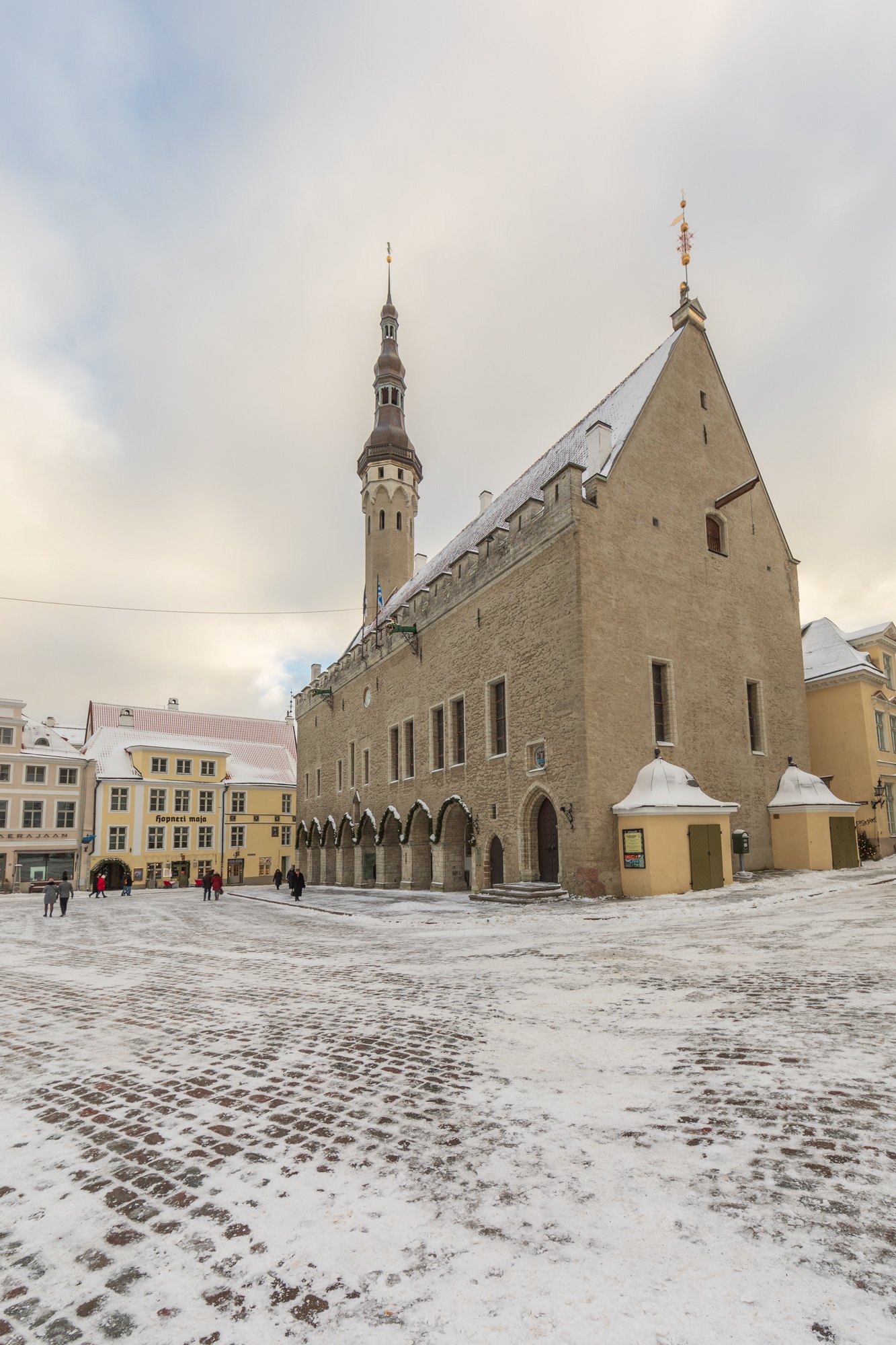
Town Hall Square is the civic center of Tallinn and one of the finest medieval squares in northern Europe. The Gothic Town Hall anchors the east end of the square, flanked by the painted facades of the guild houses. The square shifts character through the day: empty and geometric in the early morning, café tables spilling out by mid-morning, market stalls in the afternoon, warmly lit and social in the evening.
The Christmas market, which runs from late November through December, transforms the square into one of the most atmospheric seasonal photography subjects in the Baltic. The market lights, the decorated stalls, the Gothic spire rising behind, and the falling snow on a good night produce images that look like they belong on a magazine cover.
📷 Pro Tip: Position yourself at the northwest corner of the square in the first hour after sunrise, before the café tables are installed and the tourist groups arrive. This angle frames the colored guild house facades against the Gothic Town Hall spire with clean cobblestone foreground. Use a 24-70mm at the wider end for the full composition. For Christmas market work, return at blue hour when the stall lights are on against a still-luminous sky. The 35mm prime is ideal for people and market detail in the evening light.
Best time: First hour after sunrise; blue hour during Christmas market. Access: Free and public. Location: Center of the Old Town, a 2-minute walk from the Schlossle Hotel.

You can take pictures in various picturesque corners but our favorite spot is between three/four coloured houses with the Troika restaurant in the centre.

Saiakang
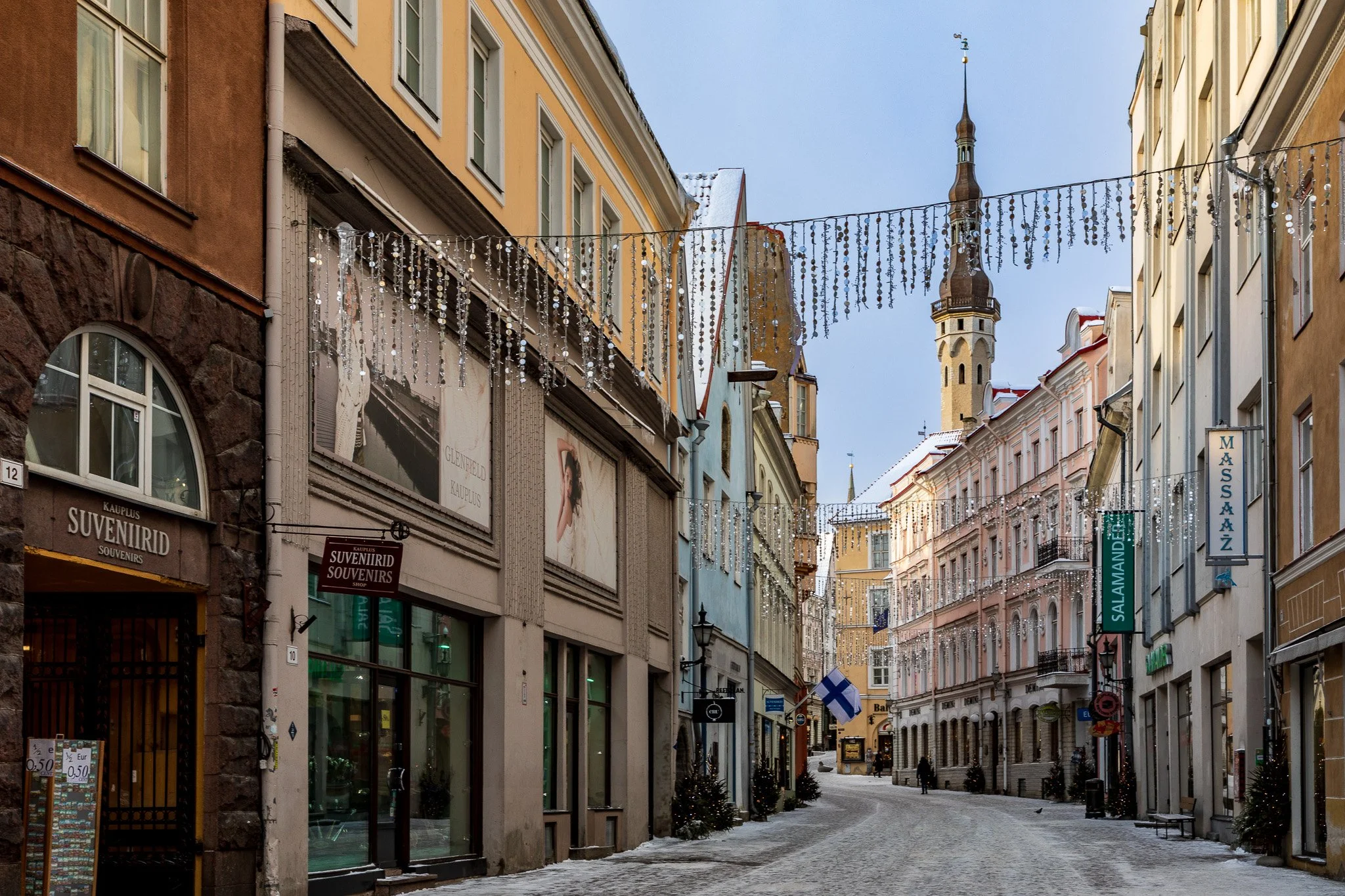
Saiakang, which translates roughly as "white bread," is one of the narrowest and most photographed lanes in the Old Town. The name comes from the bakeries that once lined the street. Today it is a short connecting alley between Town Hall Square and the streets to the north, but the compressed perspective, medieval facades, and the warm tones of the painted buildings make it one of the most immediately photogenic streets in Tallinn.
📷 Pro Tip: Stand at the Town Hall Square entrance and shoot toward the far end with the 16-35mm. The narrowness creates a strong tunnel composition. In the morning, the light comes in from the east and illuminates the left wall while the right stays in shadow, giving you directional contrast that emphasizes the depth of the lane. Return at blue hour when the street lanterns are lit and the lane goes warm against a cooler sky.
Best time: First hour of morning light; blue hour. Access: Free and public. Location: Runs north from Town Hall Square; entrance on the northeast corner of the square.

City Hall of Tallinn
The Gothic Town Hall anchors Old Town Square and is one of the best-preserved medieval town halls in northern Europe, its stepped facade and spire visible from throughout the lower Old Town.
📷 Pro Tip: Shoot from the northwest corner of the square for the classic composition, colored guild houses in the foreground with the Town Hall spire rising behind. A 24-70mm covers this well. Blue hour adds real drama once the building is illuminated against the darkening sky.
Best time: Blue hour. Access: Free exterior viewing; interior access varies by season.
Kalev Marzipan Museum Room
Just steps from Old Town Square, this small museum showcases Tallinn's centuries-old marzipan tradition, hand-crafted figures, and confectionery history in a compact, characterful space.
📷 Pro Tip: This is a quick cultural stop rather than a dedicated photography session. A 35-50mm lens handles the interior displays well in the available light. Pair it naturally with a visit to the Maiasmokk café nearby, both showcase the same marzipan tradition from different angles.
Best time: Any time during opening hours. Access: Free or small admission, check current hours.

Holy Spirit Church (Püha Vaimu kirik)
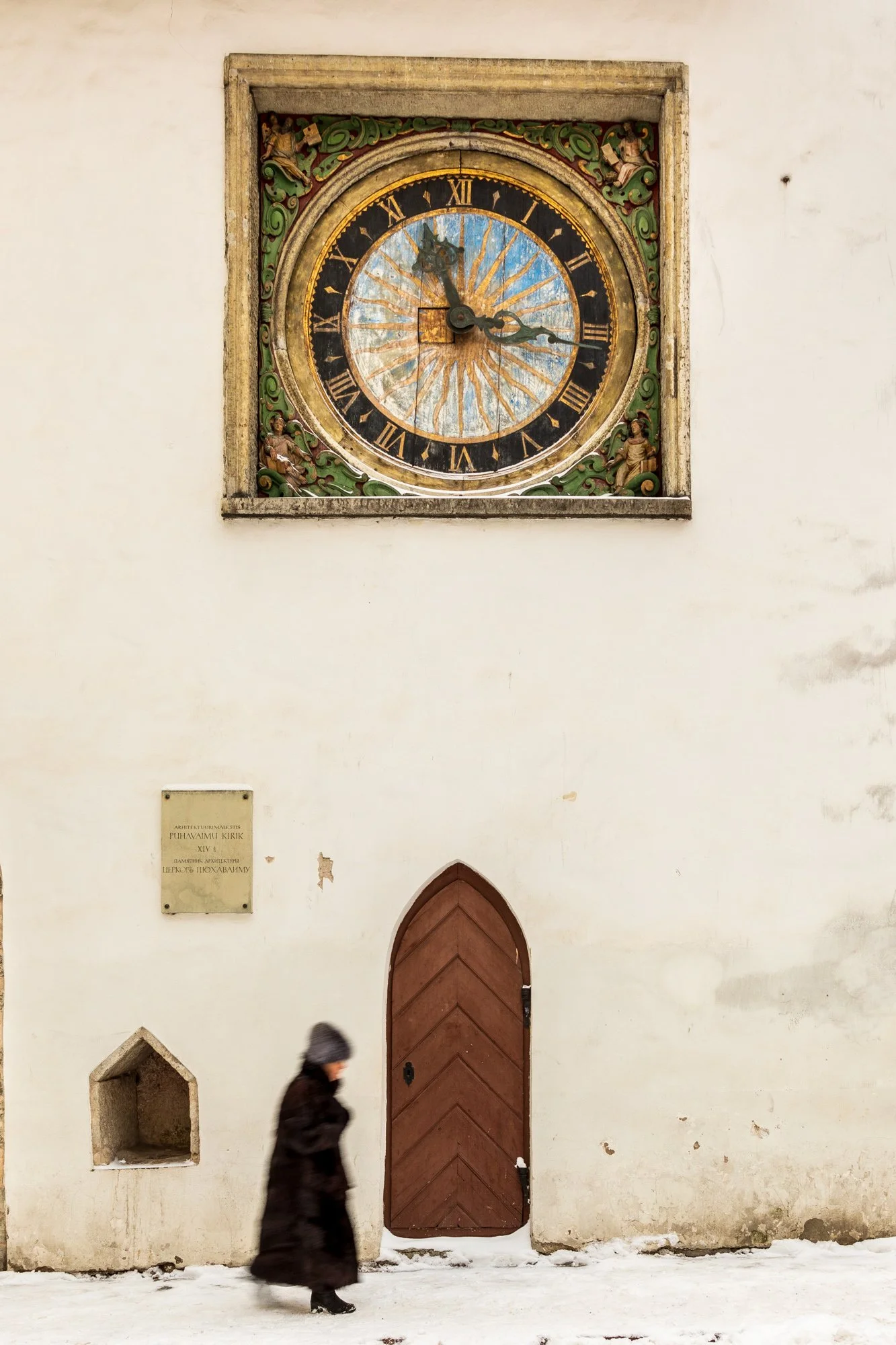
The Church of the Holy Spirit is a medieval Lutheran church tucked behind Town Hall Square, with a distinctive white exterior and a large mounted clock on the facade that is one of the oldest public clocks in Estonia. The interior is remarkable, with a 16th-century baroque altarpiece and centuries-old wooden carvings. The exterior facade, particularly the clock and the carved wooden door, is a strong foreground subject with the Old Town lane as the context.
📷 Pro Tip: The exterior clock and door are best photographed with a 50mm or 85mm to isolate the facade detail. Shoot in the morning when the white exterior is in full front light. For interior work, ask permission at the entrance and shoot with a wide prime at ISO 3200 or higher. The altarpiece is the dominant subject inside; position yourself in the central nave and use the wooden pew rows as a leading line toward the altar.
Best time: Morning for the exterior; midday for interior light. Access: Small entry fee for the interior; exterior free. Location: Pühavaimu Street, immediately behind Town Hall Square.
House of the Brotherhood of Black Heads or Mustpeade Maja
Tallinn is full of remarkable doors, locals and visitors alike treat photographing them almost as a scavenger hunt, but if you only have time for one, the entrance to the House of the Brotherhood of Blackheads is the one to prioritize, ornate, historic, and genuinely striking up close.
📷 Pro Tip: Get close and shoot the door itself as the subject, a 35-50mm at a tighter frame isolates the carved and painted details without unnecessary context around it. Morning light works best, avoiding the shadow that falls across the narrow street later in the day.
Best time: Morning. Access: Free, public street-level viewing.
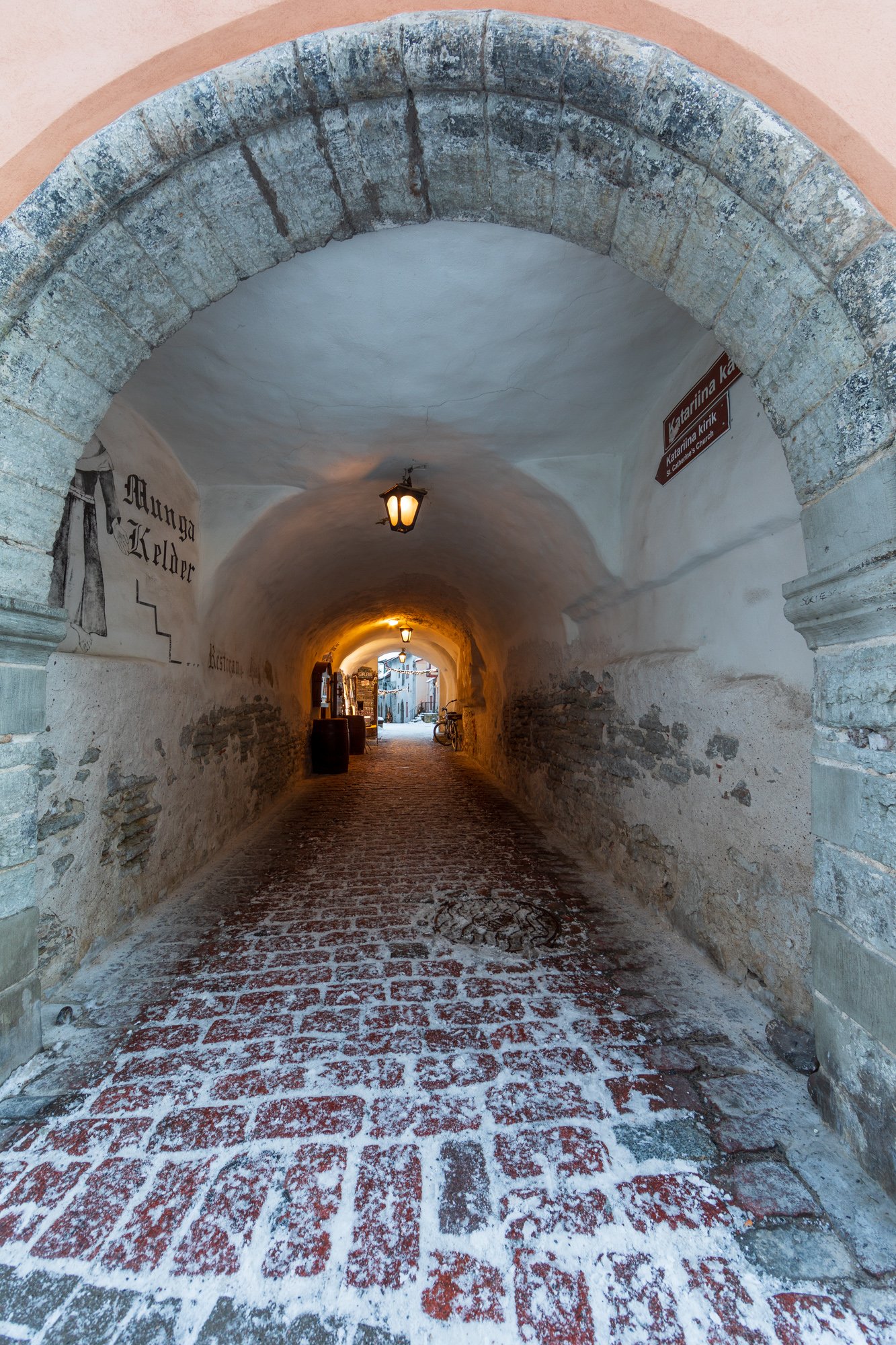
St. Catherine's Passage (Katariina käik)
St. Catherine's Passage is a narrow medieval lane running parallel to the southern edge of the Old Town, tucked beside the old city walls. It is not on the main tourist route, which is exactly why it is worth finding. The walls on both sides are medieval stone. The lane is cobblestone. The medieval artisan workshops that line the passage produce glasswork, ceramics, and textiles, and the working studios add life and texture to the photographs.
The passage is best in the morning when the narrow slit of sky above produces a shaft of directional light that runs along the cobblestones and illuminates the far end. In winter, the quality of that light is exceptional.
📷 Pro Tip: Enter from the Vene Street end and position yourself at the midpoint of the passage with a low shooting position. The 16-35mm at the wide end creates a strong leading line along the cobblestones toward the arch at the far end. Shoot in the first hour after sunrise when the light angle is lowest and most directional. The medieval stonework on the left wall shows texture best in the raking light of the early morning. The artisan workshops open during business hours and are themselves worth photographing: get permission before pointing a lens inside.
Best time: First two hours after sunrise. Access: Free, open daily. Location: Off Vene Street, between Müürivahe Street and the old city walls.
The City Walls and Towers
Tallinn's medieval defense walls are among the best-preserved urban fortifications in Europe. The walls run for nearly two kilometers around the Old Town, with twenty-six towers, fourteen of which are still standing. The towers are round, tapering, and distinctive against the sky. Walking the section of wall between the Kiek in de Kök tower and the Fat Margaret tower gives you the most photogenic stretches, with views both outward over the surrounding streets and inward over the Old Town rooftops.
📷 Pro Tip: The best compositions come from photographing the towers from the street below rather than from the wall itself. On Müürivahe Street, the tower facades rise directly above the lane and can be framed with the 24-70mm at the longer end. For long exposures of the walls at blue hour, set up on a tripod on Nunne Street where the wall is most intact and the towers are backlit by the city glow. The towers are open for climbing at Kiek in de Kök, which also offers a museum of Tallinn's medieval defensive history. Entry fee applies.
Best time: Blue hour and early morning. Access: The walls are free to walk along; tower entry paid. Location: Perimeter of the Old Town; Müürivahe Street runs parallel to the eastern section.

St. Olaf’s Church
Believed to date to the 12th century, St. Olaf's was historically the center of Tallinn's Scandinavian community before Denmark's conquest in 1219, and its tower was once among the tallest structures in the world.
📷 Pro Tip: Shoot the tower from a distance with a 70-200mm to compress it against the sky or the surrounding rooftops; up close, a 16-35mm captures the full height of the facade. The tower is climbable for a panoramic view over the Old Town, worth the effort if you want a different vantage point from the standard viewing platforms.
Best time: Golden hour for the exterior. Access: Free exterior; paid tower climb.

Patkuli Viewing Platform
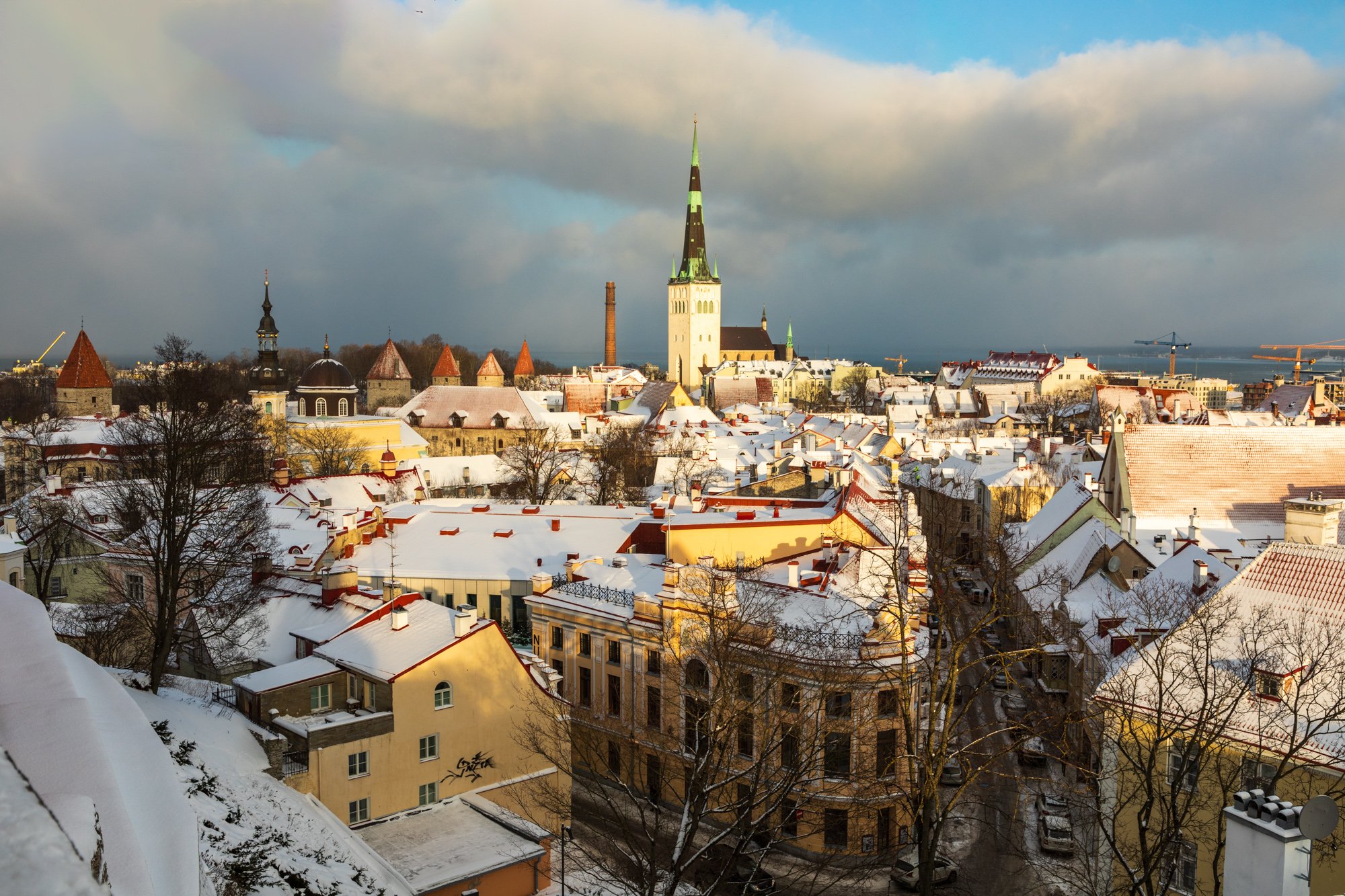
Two minutes on foot from Kohtuotsa, Patkuli offers a completely different perspective on the same skyline. Where Kohtuotsa looks east over the rooftops, Patkuli faces north and west, showing the medieval defense towers of the Lower Town with the City Walls visible in the foreground. The two platforms together give you a full 180-degree composition of the medieval core at sunrise, and covering both in a single golden hour session is straightforward.
📷 Pro Tip: Walk from Kohtuotsa to Patkuli immediately after shooting the sunrise from the first platform. The Patkuli angle works best with the 70-200mm, isolating individual towers against the sky. In winter, the bare trees along the platform's edge can serve as framing elements on either side of the composition. The platform stairs descend toward the Lower Town and make a good secondary composition in the early morning light.
Best time: Sunrise, same session as Kohtuotsa. Access: Free, open 24 hours. Location: 2-minute walk west from Kohtuotsa along the Toompea escarpment path.
Rataskaevu Street
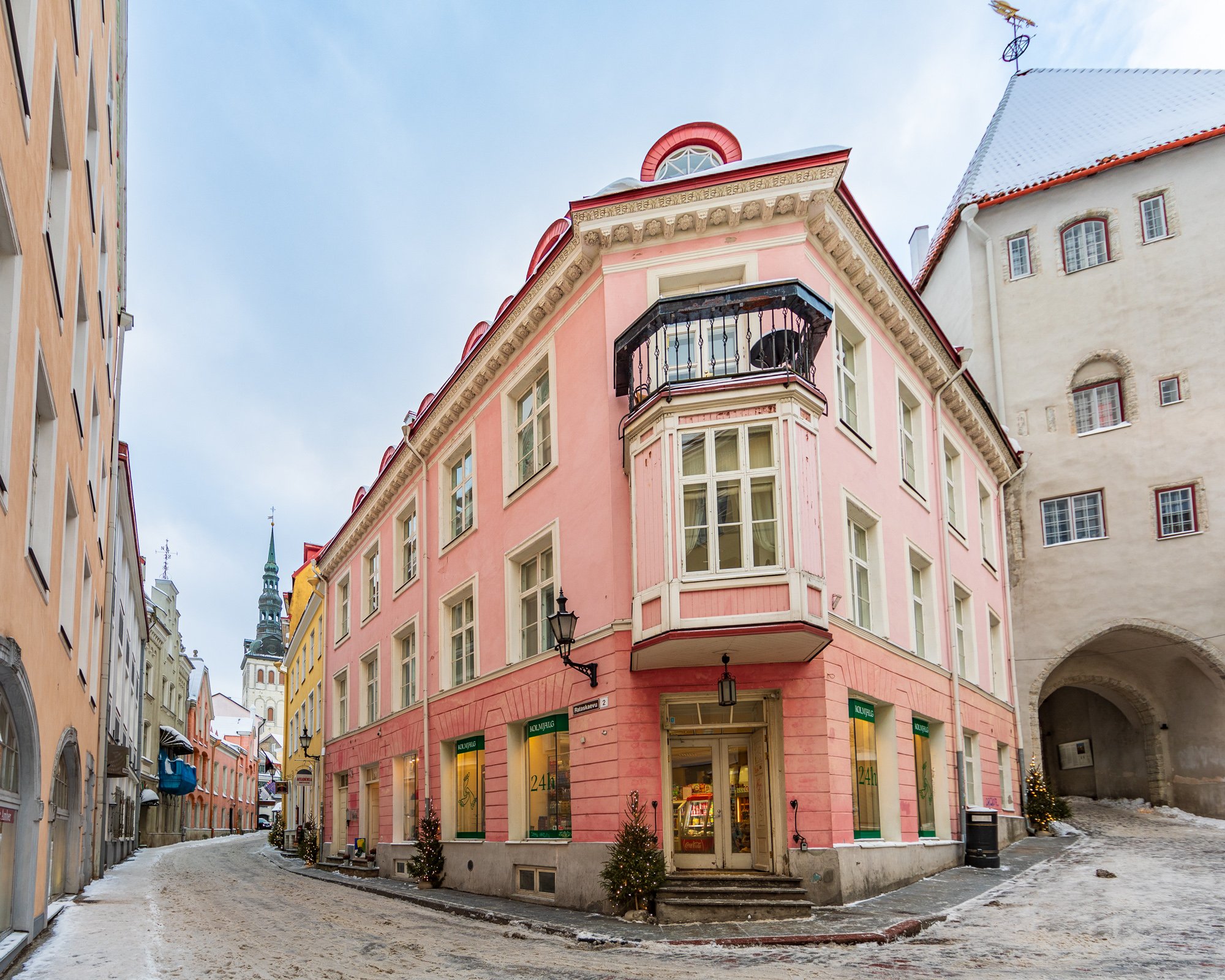
One of several picturesque, colorful streets threading through the Old Town alongside Mündi, St. Catherine's Passage, Saiakang, and Pikk, Rataskaevu is lined with shops and cafés and rewards unhurried wandering.
📷 Pro Tip: Walk it slowly in the early morning for an empty street and soft light on the colored facades. A 35mm prime suits the intimate scale well, capturing both the street and individual shopfronts without distortion.
Best time: Early morning. Access: Free, public street.
Alexander Nevsky Cathedral
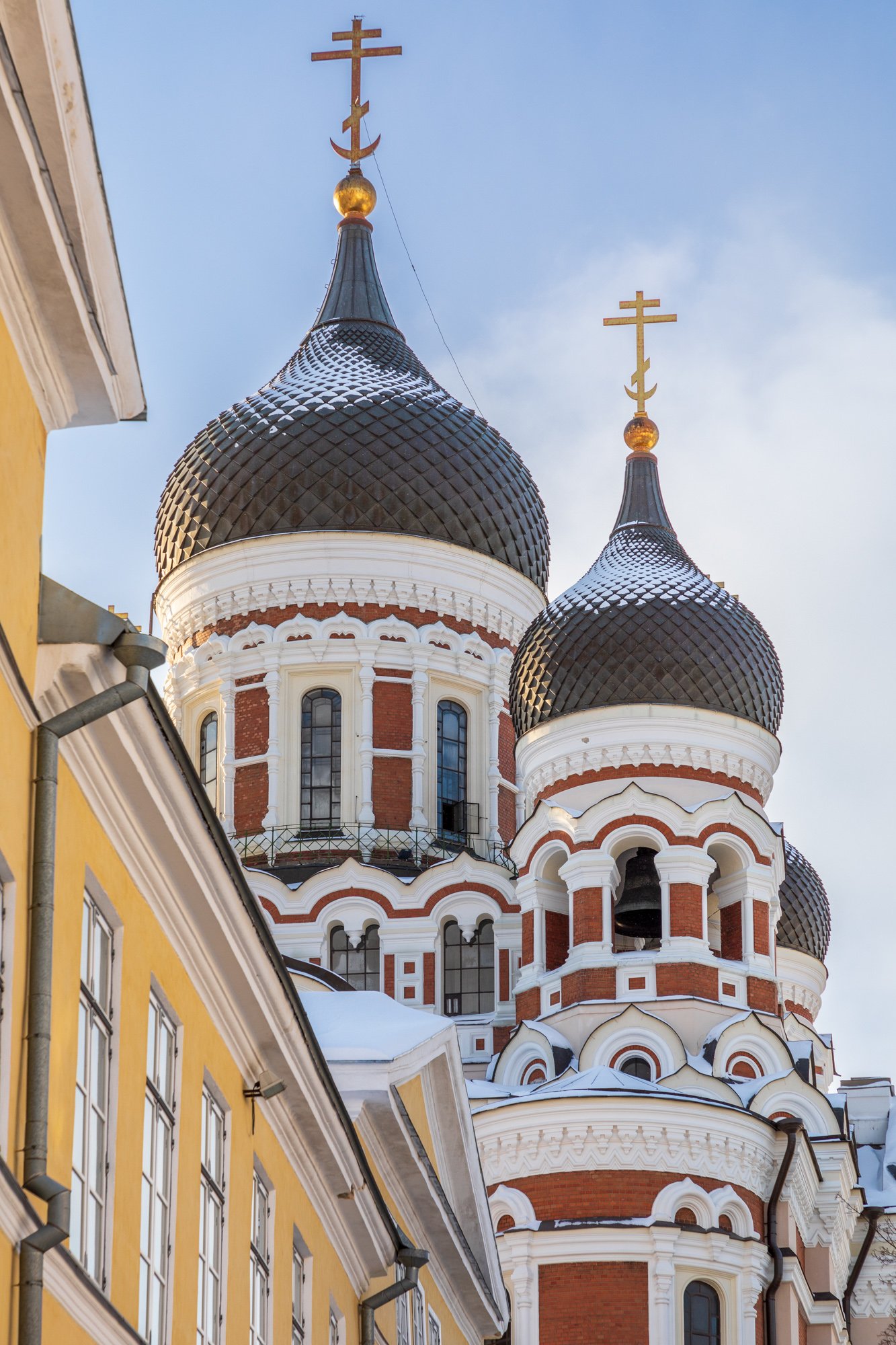
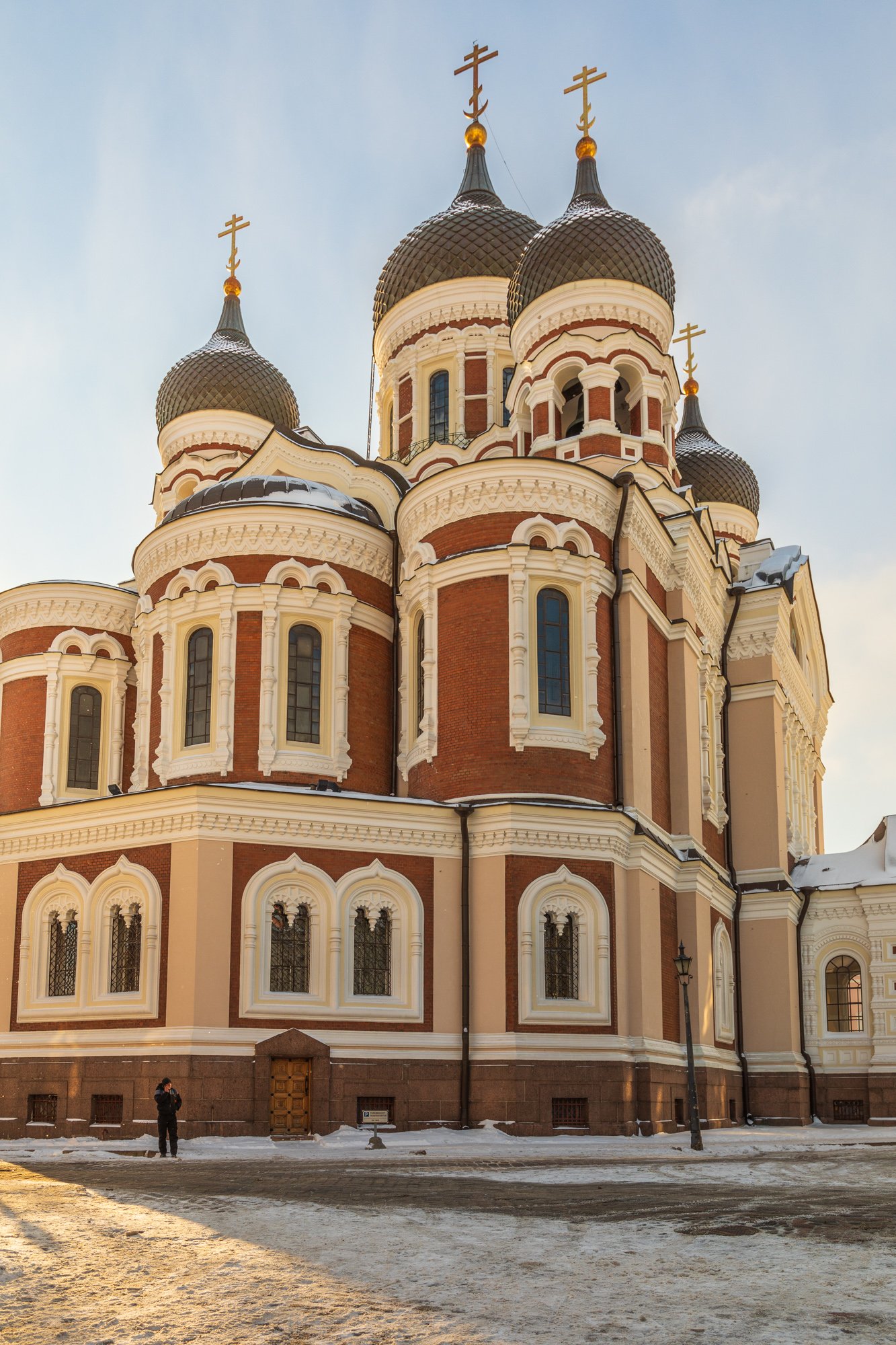
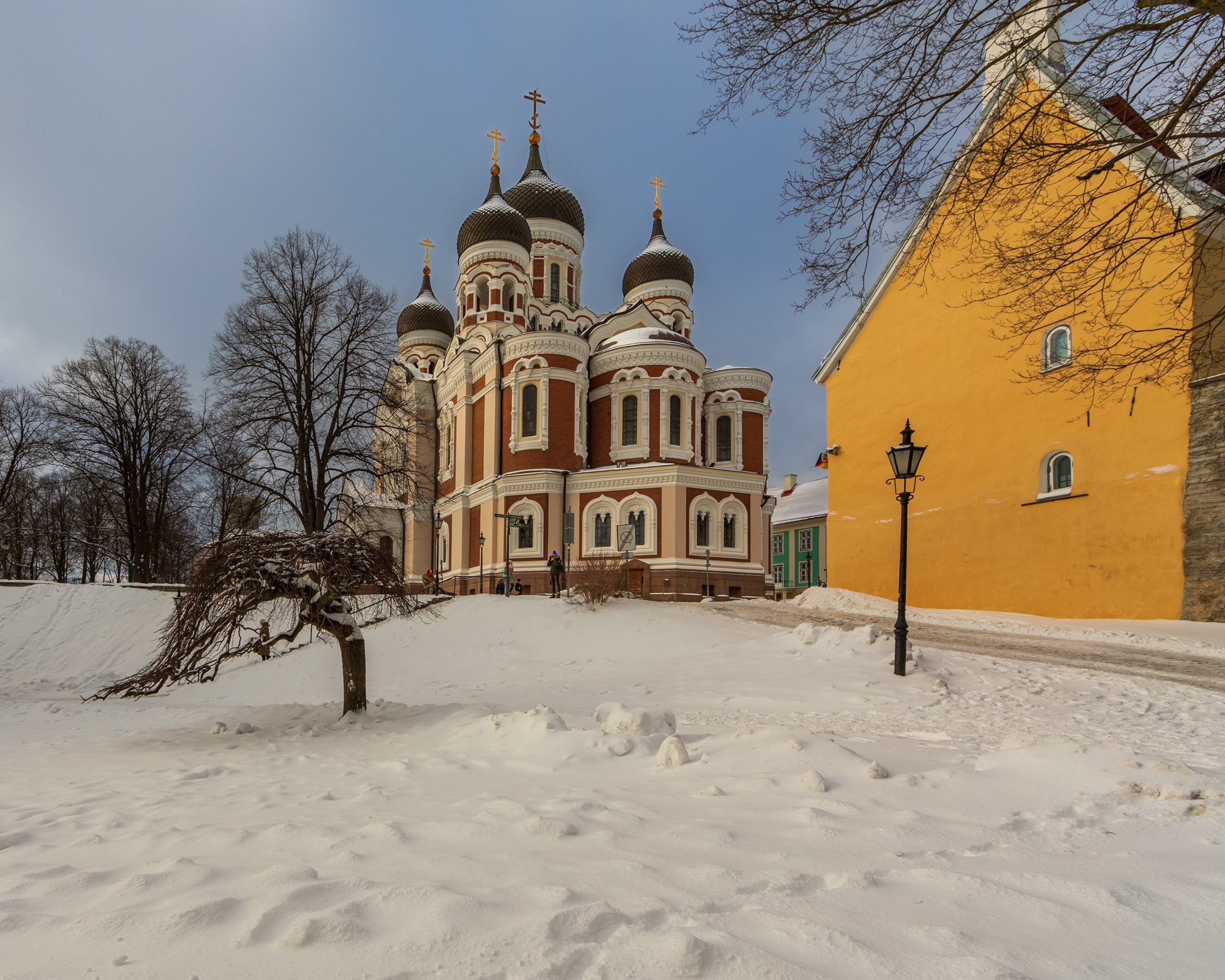
The Alexander Nevsky Cathedral is an Orthodox church built in 1894–1900 on Toompea Hill, directly across the square from Toompea Castle. It was commissioned by Tsar Alexander III during the Russian imperial period, and the onion-domed silhouette stands in deliberate and visible contrast to the Lutheran spires of the Lower Town. The exterior is ornate and photogenic from any angle. The interior is covered in mosaics and icons and is one of the most elaborately decorated spaces in Tallinn.
📷 Pro Tip: The most effective exterior compositions come from the square directly in front of the cathedral, using a 24-70mm to frame the full facade with the onion domes centered above the entrance arch. For a different perspective, walk around to the north side of Toompea Hill and photograph the cathedral domes rising above the medieval town below at the 70-200mm. Interior photography is permitted but a tripod is generally not allowed; push your ISO to at least 3200 and use image stabilization to work handheld in the low light. Visit between services for better access and less crowd pressure.
Best time: Morning light hits the facade directly; interiors work best at midday when light enters through the upper windows. Access: Free, open daily; confirm service times. Location: Lossi Plats, Toompea Hill.
Festivals and Events in Tallinn
Old Town Days (Vanalinna Päevad) — June The most atmospheric photography event in Tallinn's annual calendar. The entire Old Town fills with medieval markets, costumed performers, jousting demonstrations, and craftspeople working in period techniques. The combination of medieval costume against medieval architecture in the best light of the year, with long June evenings that push golden hour past 10 pm, produces extraordinary images. One of the finest photography festivals in northern Europe.
Tallinn Music Week — March or April An international music festival spread across venues throughout the city, including outdoor performances in the Old Town. Strong street photography and live music opportunities. The festival draws an eclectic international crowd and the venues are often smaller and more accessible than comparable events in larger cities.
Christmas Market on Town Hall Square — Late November through December Consistently rated among the finest Christmas markets in Europe. Town Hall Square transforms into a warmly lit medieval market with handmade crafts, Estonian food, and mulled wine. Visit in the early morning before the crowds arrive, or at blue hour when the market lights come on against the darkening sky. In the best years, snow falls during market hours. Plan around it if you can.
Jaanipäev (St. John's Day, Midsummer) — Late June Estonia's most significant national celebration, marked by bonfires, singing, and gatherings across the country. The city empties slightly as Estonians head to the countryside for the holiday, creating unusually quiet Old Town streets for photography. The evening before Jaanipäev, bonfires are lit in parks and on the beach at Pirita, which is a strong photographic subject in its own right.
Tallinn Black Nights Film Festival (PÖFF) — November One of the most significant film festivals in northern Europe, running across multiple venues in Tallinn for two weeks in November. The film screenings draw audiences from across the Baltic and northern Europe and the festival atmosphere adds energy to the city during what is otherwise a quiet shoulder month. Strong people photography around the festival venues.
Frequently Asked Questions About Visiting Tallinn
Is Tallinn worth visiting?
Yes, and it's genuinely underrated. It's one of the most remarkably preserved medieval cities in Europe, compact, colorful, and less crowded than comparable Old Towns like Prague.
Do you need a car in Tallinn?
No, and it's actively unnecessary. The Old Town is small enough to walk end to end in fifteen minutes, and every photography location worth visiting sits within that compact medieval footprint.
Is Tallinn expensive?
No, it's genuinely affordable for a European capital, both for hotels and dining, with real quality at every price point.
What are the best photo spots in Tallinn?
Kohtuotsa Viewing Platform at sunrise, Old Town Square in the first hour after sunrise, and St. Catherine's Passage for directional morning light are three that consistently deliver. The full list is above.
Can you fly a drone in Tallinn?
Check current Estonian and EU drone regulations before flying, particularly around the Old Town's UNESCO-protected medieval core, which likely carries restrictions.
What surprised you most about Tallinn?
The food scene. We didn't expect it going in, and it turned out to be one of the best parts of the trip, the black rye bread alone was worth it, alongside genuinely strong coffee culture and more vegetarian options than almost anywhere else we've traveled.
How many days do you need in Tallinn?
Two to three days. The Old Town is compact enough to cover all the major locations in a day and return to your favorites at different hours without ever needing to drive.
Is Tallinn worth combining with Helsinki or Copenhagen?
Yes, both work well. Helsinki is a short ferry ride across the Gulf of Finland; Copenhagen makes a natural extension for a broader Baltic and Scandinavian photography trip.
Final Thoughts on Tallinn
Tallinn is the kind of city that does not need much explaining once you are standing in it. The Old Town makes the case for itself in the first fifteen minutes. The medieval core is so intact, so cohesive, and so compact that the city functions almost like a large outdoor museum, except it is alive. People live here, work here, and eat dinner here, which is what gives the photography its life.
What stayed with me after that January visit was the quiet. Early morning in a medieval city with empty streets and soft winter light, and a camera in hand, is close to a perfect experience for a photographer. Tallinn gives you that without planning for it. You just have to show up before the rest of the world wakes up.
Go. Go in winter if you can handle the cold. Go for the Christmas market if you can time it right. Go in summer for the long evenings and the Old Town Days. But go. The accidental detour became one of my favorite cities in Europe, and it will earn a place in yours.
Want to improve your photography while exploring some incredible destinations? Join me on one of my photography workshops! You can find all the details, including upcoming destinations and dates, through the links below.
Let's Stay Connected!
If you enjoyed this Photography and Travel Guide to Tallinn, you might also enjoy these companion guides for northern and central Europe:
My Photography and Travel Guide to Helsinki, Finland — A short ferry crossing from Tallinn across the Gulf of Finland, Helsinki is a natural extension of any Baltic trip. The Art Nouveau architecture of Kallio, the covered market hall, and the wild coast of Suomenlinna Fortress give you a completely different photographic experience within two hours of Tallinn.
My Photography and Travel Guide to Copenhagen, Denmark — The design-forward capital of Scandinavia and one of the most photographically coherent cities in Europe. The colorful harbor facades of Nyhavn, the symmetry of Amalienborg, and the cycling culture of the streets all reward a camera. A logical next stop after the Baltic.
My Photography and Travel Guide to Prague, Czech Republic — The closest comparison to Tallinn in Europe for medieval preservation and photographic density. Prague is larger, richer, and more visited, but the two cities share a sensibility: old stone, colored facades, and towers that read beautifully at blue hour. If Tallinn left you wanting more of this kind of city, Prague is the next one.
Finally—a beginner-friendly photography guide that makes sense.
If you've ever picked up a camera and thought, "Now what?" this is the book for you.
Photography Made Simple is written for adults who are just starting out and want a clear, encouraging, real-world approach to learning photography. Whether you're using a DSLR, mirrorless, or just your smartphone, this guide walks you through the basics—without the jargon or tech overwhelm.
Inside, you'll learn:
The only camera settings you really need to know to get started
How to shoot sharper, more intentional photos using light and composition
Simple tips for portraits, landscapes, travel, and everyday life
What gear you do (and don’t) need
How to create better photos without upgrading your camera
You’ll also get practical exercises, cheat sheets, and tips for organizing and editing your images—plus the confidence to shoot off Auto Mode for good.
This is not a textbook. It’s a friendly guide to seeing the world with fresh eyes—and finally capturing what you see the way you imagine it.
📸 Format: PDF download
Pages: 100+
Perfect for: Beginners, hobbyists, and anyone ready to take better photos without the stress
✈️ Travel Photography Planning Sessions
One-on-One Trip Planning with a Professional Travel Photographer
Don’t miss the shot. Let me help you plan for it.
Overview
Planning a photography-focused trip can be overwhelming. From figuring out the best places to shoot, to when the light is just right, to knowing which lens to pack — there are a lot of decisions to make.
This one-on-one Zoom session is your chance to get personalized travel photography advice from someone who’s spent the past 25 years exploring cities, coastlines, and wild places around the world — camera in hand.
Whether you're headed to Paris, Patagonia, Tokyo, or Tuscany, I’ll help you make sure your photography trip is well-planned and creatively inspired, so you come home with the images you dreamed of (and then some).
What’s Included
✅ Photography Location Planning
I’ll help you create a customized itinerary of the best photo spots, including off-the-beaten-path gems and iconic views.
✅ Best Times to Shoot
Get expert advice on lighting, golden hour, blue hour, and seasonal conditions for each location.
✅ Gear Recommendations
Not sure whether to bring the telephoto or the prime? We’ll walk through your gear and make sure you’re bringing the right tools for your destination and style.
✅ Hotel and Base Recommendations
Stay where it’s convenient for sunrise shoots and late-night strolls with your camera. I’ll recommend hotels that are photographer-friendly and well-located.
✅ Custom Travel Tips
From sunrise entry times to tripod rules at major landmarks, you’ll get insider tips to save time, avoid tourist traps, and make the most of your trip.
Who It’s For
This service is for anyone who:
Is planning a trip and wants to prioritize photography
Wants expert insight on the best places to shoot and how to get there
Is tired of missing the shot because of poor planning or bad timing
Is a beginner, enthusiast, or professional photographer looking for guidance before a trip
How It Works
Book a Session
Choose a time that works for you and tell me where you're headed.Share Your Plans
You’ll fill out a quick questionnaire so I know your travel dates, interests, and photography style.One-on-One Zoom Call (60 minutes)
We’ll meet via Zoom and walk through your trip together — from location ideas to gear and timing. You'll leave with a custom PDF full of notes and suggestions.Follow-Up Support
Get one round of email Q&A after your session to clarify anything as your plans evolve.
Why Work With Me?
I’ve spent the last 25 years photographing the world — from major cities to remote islands. I know what it’s like to travel and shoot under pressure, and I love helping people get the most out of their trips. This is not just about hitting “popular spots” — it’s about crafting a creative and efficient plan tailored to your trip, your gear, and your goals.
Pricing
$125 / Session
Includes:
60-minute Zoom call
Custom PDF summary with photography spots, gear tips, and travel recommendations
One follow-up email with additional Q&A
Introductory rate available through September 2025
Ready to Plan Your Trip?
Let’s make sure you’re ready — so when the light is perfect, you’re in the right place with the right gear.
Questions?
Please email me at vito@chasinghippoz.com if you're not sure whether this is right for you. I'm happy to chat.