Washington, DC Travel & Photography Guide: Best Monuments, Photo Spots & Hidden Gems
Washington, DC is my favorite city in the United States. I am, of course, biased, as I was born and raised here so I've had a lifetime to figure out why.
Some of my best mornings as a photographer have happened before most of the city woke up. Standing at the Lincoln Memorial before the tour buses arrive. Walking the Georgetown canal at night when the only sound is water and my own footsteps. Setting an alarm for the Tidal Basin during cherry blossom season, when the only other people there are the handful of us who also know it's worth losing sleep over. What keeps this city interesting for me after all these years is the sheer range of monuments packed into one walkable stretch. From the Lincoln to the FDR Memorial, each one is unique to Washington and its history, and most of them sit within a mile or two of each other around the National Mall. You could spend a week just there and never run out of things to shoot.

A Map of Washington DC
Most people only think of politics when they think of DC, and I get it, that's the export everyone knows. But for photographers, the real range extends well past the monuments. Incredible graffiti, quiet parks, dense street photography, and neighborhoods like Georgetown and Old Town Alexandria that most visitors never make time for. The dining scene deserves its own mention too.
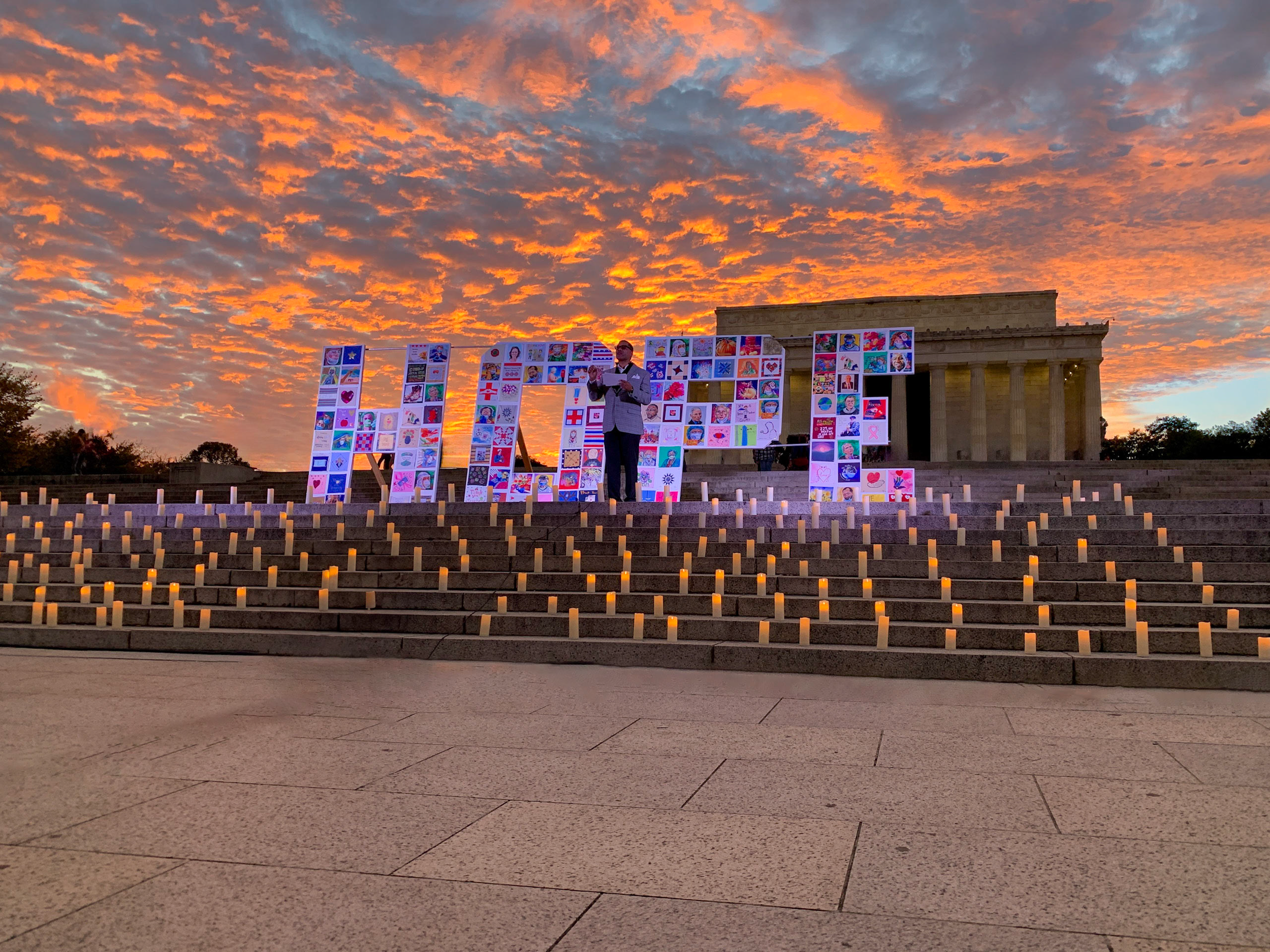
The Lincoln Memorial at sunset in Washington, DC.
Because DC is home to nearly every embassy in the world, the restaurant scene here has a variety you don't find in most American cities, real Ethiopian, Peruvian, Lebanese, and dozens of other cuisines sitting a few blocks from each other. History, museums that are free (every single Smithsonian, no exceptions), and more street photography per square mile than almost anywhere else in the country.

A reflection of the Washington Monument and the US Capitol at Sunset
The city has something for everyone: history, monuments, museums, parks, murals, world-class dining, and more street photography per square mile than almost any American city. And unlike most capital cities, all the Smithsonian Museums are free. Every single one.
In this Photography Guide to Washington DC, I share the places and experiences that continue to draw me back after a lifetime here. You'll find my favorite photography locations, guidance on when and where to shoot, practical travel tips, gear recommendations, and the kind of local knowledge that only comes from spending years in a place with a camera in hand.
Photographer's Notes
Before you go, here are my own takeaways.
Favorite Season: Fall
Favorite Sunrise Location: Netherlands Carillon
Favorite Sunset Location: Lincoln Memorial
Favorite Neighborhood: Georgetown
Favorite Hotel: Rosewood Washington DC, Georgetown
Favorite Café: Baked & Wired in Georgetown
Favorite Lens: 15-35mm f/2.8
Why I Keep Coming Back: Absolutely, since I live here. This is home.
Best Time to Visit Washington DC
Washington, DC has very photogenic seasons. If I had to choose my favorite times of year it would be Spring time for the Cherry Blossoms and the Fall colors in Autumn.
Spring (March–May):
Cherry blossoms steal the show from late March to early April. Mornings are best. Use a zoom or telephoto to compress those fluffy pink canopies. Best for: Tidal Basin, Capitol Hill gardens, soft golden morning light.Summer (June–August):
Long days, intense light. Get out early or late. Use ND filters to tame highlights. Smartphone Night Mode works well in steamy, neon-lit evenings. Best for: Waterfront scenes, street photography, and festival coverage.Fall (September–November):
The light turns gold, and DC’s many trees put on a show. Foggy mornings are magical.
Best for: Rock Creek Park, Dumbarton Oaks, and Moody Monument reflections.Winter (December–February):
Bare trees give strong silhouettes. Sunrise colors feel sharper in the cold. Occasional snow makes for postcard scenes.
Best for: Capitol dome in snow, moody black-and-white architecture shots.

Cherry blossoms framing the monuments around Washington, DC’s Tidal Basin during peak bloom.
Where to Stay in Washington DC
Washington is one of the most walkable cities in the country, and where you base yourself shapes your whole shooting day. These neighborhoods give you the right combination of access, atmosphere, and that crucial walkable-at-6am quality that matters when you are chasing early light.
Luxury Hotels in Washington DC
Four Seasons Hotel Washington, DC (Georgetown / Pennsylvania Avenue) The only Forbes Five-Star, AAA Five-Diamond hotel in the city, and the standard against which every other DC luxury hotel is measured. The hotel occupies a landmark position at the edge of Georgetown and Rock Creek Parkway, with 222 rooms in two wings connected by a glass-enclosed garden walkway. The Canal Room and the indoor pool area are exceptional interior photography subjects. If you want to shoot the C&O Canal at first light and return to a hotel that genuinely earns the word luxury, this is it. Rated 9.4 on Trip.com's 2026 Global 100.
Waldorf Astoria Washington DC (The Mall / Pennsylvania Avenue) The former Old Post Office building on Pennsylvania Avenue, one of the most architecturally significant addresses in the city, is now one of the best hotels in the country. The soaring atrium, the stone arches, the clock tower, and the warm interior light make the hotel itself a legitimate photography subject before you even step outside. The location, directly between the White House and the Capitol, is ideal for anyone focused on the monumental core. Consistently rated among the top properties in DC and nationally for 2025 and 2026.
Rosewood Washington DC (Georgetown / C&O Canal) Set directly on the historic Chesapeake and Ohio Canal, the Rosewood is the most photogenic luxury option in Georgetown. The canal is one of the great early-morning locations in the city, and staying here means you are shooting reflections at dawn and back for breakfast before most visitors have arrived. Boutique scale, exceptional service, and a neighborhood that rewards slow, camera-in-hand mornings. CUT by Wolfgang Puck is the in-house restaurant and a strong dinner option in its own right..

The Lincoln Memorial at Sunset with a very long exposure
Mid-Range & Boutique in Washington DC
Riggs Washington DC (Penn Quarter / Pennsylvania Avenue) The former headquarters of Riggs National Bank, known as the Bank of Presidents, converted into one of the most visually compelling hotels in DC. The original banking hall, now a spectacular atrium bar and restaurant, is one of the most photographed interior spaces in the city. Marble columns, vaulted ceilings, and the original vault doors repurposed throughout the property give you legitimate architectural subjects without leaving the building. The Silver Lyan Bar, housed in the original bank vault, is worth photographing after dinner. Midway between the White House and the Capitol.
Hotel AKA Washington Circle (Foggy Bottom / West End) ⚠️ Note: As of June 23, 2026, this property transitions to One Washington Circle DC under Tapestry Collection by Hilton. Current bookings through June 22 are confirmed; book future stays under the new name. Quality and location remain unchanged. Directly on Washington Circle at the Foggy Bottom Metro station, steps from Georgetown, the Kennedy Center, and the National Mall. Spacious suites, many with terraces and full kitchens, make this an excellent base for longer stays or photographers who want the flexibility of cooking between shoots. Refined without being stiff, and genuinely well-located.
The LINE DC (Adams Morgan) A converted neoclassical church with a 60-foot vaulted ceiling, this is the most architecturally distinctive hotel in DC. Adams Morgan is a neighborhood most visitors skip entirely, which is exactly why photographers should stay here. The murals on 18th Street, the Sunday morning market energy, the proximity to Meridian Hill Park, and the access to the 14th Street corridor's best restaurants give you subjects and dining that the monument crowd never reaches. The hotel's interior, especially the former nave, is a genuine photography subject.
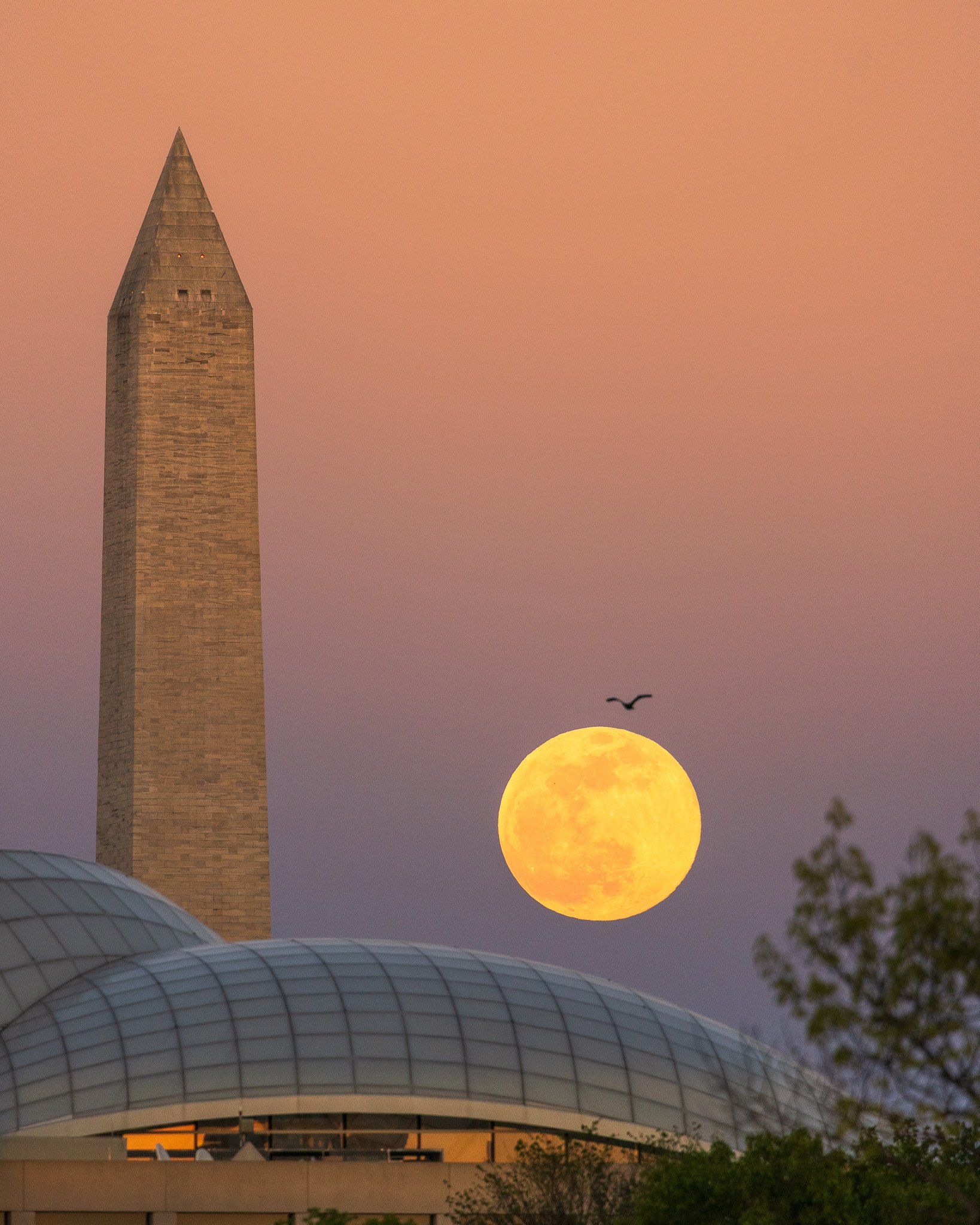
The United States Institute of Peace with the Washington Monument with a Full Moon
Ideal Duration of Stay — 4-Day Itinerary
If you're coming for photography, give yourself at least 4 full days. Here’s a relaxed itinerary with golden light, classic sights, and a few curveballs:
Day 1: Monuments at Sunrise
Start at the Lincoln Memorial by 6 am. Then walk the Reflecting Pool toward the WWII Memorial and up to the Washington Monument. iPhones excel here with wide lenses and clean symmetry. Afternoon: wander The Wharf. Blue hour here is lovely.
Day 2: Neighborhoods & Cafés
Shoot rowhouses and murals in Shaw and Logan Circle. Grab lunch at Le Diplomate (fantastic for people-watching). Sunset from Meridian Hill Park gives you layered city views with music drifting in the background.
Day 3: Museums & Architecture
Photograph inside the National Gallery of Art or the Hirshhorn (both allow non-flash photography). Late afternoon? Head to Union Market for urban art and food trucks. Night shots from H Street’s vintage neon are perfect for phone photographers.
Day 4: Georgetown + Waterfront
Early morning in Georgetown for canal reflections and narrow alleys. Midday café photos and boutique storefronts. Sunset: cross Key Bridge to shoot back at the city skyline.
Getting Around Washington DC
DC is extremely walkable, and the Metro is efficient — but with gear, here’s what you need to know:
Metro: Most major photo spots are within a few stops. But be aware: some stations have long escalators and no elevators.
Walking: Flat and safe. Bring a cross-body bag or backpack — I use a lightweight sling when shooting with both camera and phone.
Biking/Scooters: Great for covering ground quickly, especially from monuments to neighborhoods.
Uber/Lyft: Easy but not always faster during rush hour.
Pro Tip: Use the SmarTrip card for Metro. Load it at any station kiosk or through the SmarTrip app on your phone. It works across Metro, buses, and most regional transit services.
Restaurants, Cafes, & Bakeries in Washington DC
Washington has become one of the serious dining cities in America. The combination of a deeply international resident population and a generation of ambitious chefs has produced a restaurant scene that competes with any city in the country. Michelin covers DC and the city currently holds 26 starred restaurants. You will not eat badly here.
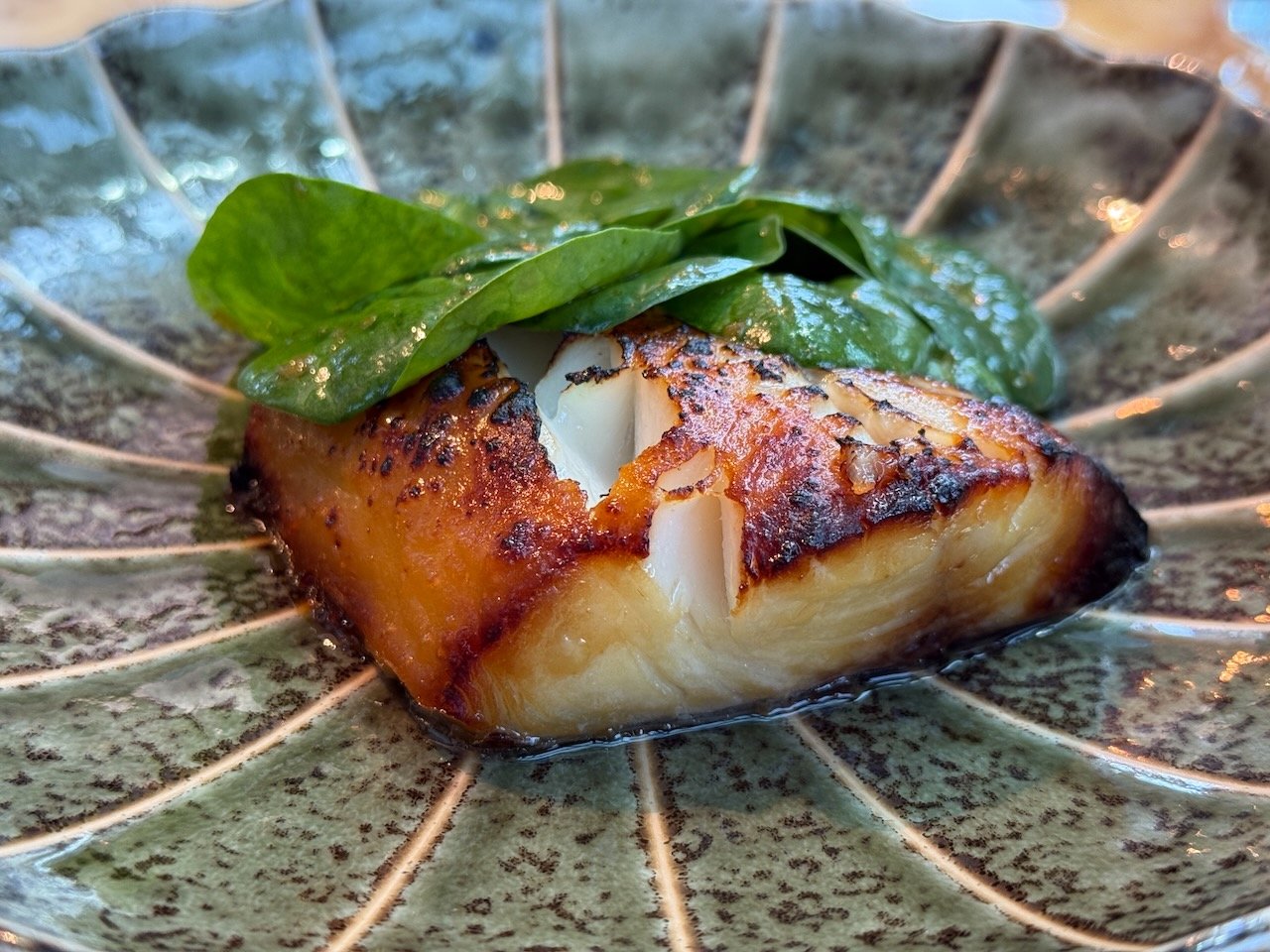
My Little Chamomile
Restaurants in Washington DC
Old Ebbitt Grill (Downtown / near the White House) The most iconic restaurant in Washington and somehow still one of the best. Operating in various forms since 1856, Old Ebbitt has been feeding presidents, journalists, lobbyists, and tourists longer than almost any other institution in the city. The Victorian interior — dark wood, brass fixtures, mounted wildlife, and a long marble bar — is one of the great restaurant rooms in America. For photographers, the dining room at golden hour, when warm light plays off the wood and glass, is extraordinary. The oysters are exceptional. Go for dinner, stay at the bar. Featured on the 2026 Global 100 Must-Visit Restaurants list.
Albi (Navy Yard) DC's top restaurant for the second consecutive year, per Washingtonian's 2026 rankings. The first back-to-back winner in over a decade. Chef Michael Rafidi won the 2024 James Beard Outstanding Chef Award and earned a Michelin star for his live-fire Levantine and Afro-Middle Eastern cooking: wood-roasted whole chicken with pomegranate glaze, handmade flatbreads from the wood oven, smoked eggplant with charred peppers. Book well in advance.
Yellow (Georgetown, Navy Yard, Union Market): Also from Michael Rafidi, Yellow is a Levantine-inspired café that earned a Michelin recommendation and made the New York Times' list of the 22 best pizzerias in the US. The wood-fired pita sandwiches, mezze, and creative pastry program make it one of the best casual meals in the city. The Georgetown location on Wisconsin Avenue is the most convenient for tourists. Currently open all day Tuesday through Saturday.
The Dabney (Blagden's Alley, Shaw): Mid-Atlantic cuisine at its most thoughtful. Chef Jeremiah Langhorne works almost exclusively with Chesapeake watershed ingredients: Virginia trout, Maryland crab, Shenandoah Valley lamb, foraged mushrooms. The open hearth anchors the room. The Dabney is physically next to the Blagden's Alley photography location in this guide, making dinner here a natural end to an afternoon of shooting the alley's murals. Multiple James Beard Award winner, including Outstanding Restaurant. One Michelin star.
Rose's Luxury (Capitol Hill): One of the great dining experiences in DC. The menu changes frequently and is built around unexpected combinations that land. The room is intimate and unfussy, the wine list adventurous. Rose's does not take traditional reservations: show up early, add your name to the list, and it is worth the wait. One Michelin star.
Osteria Mozza (Georgetown) Nancy Silverton brought her celebrated mozzarella bar and Italian cooking from Los Angeles to the former Dean & DeLuca space in Georgetown in 2024, in partnership with restaurateur Stephen Starr. Named one of DC's best new restaurants in Washingtonian's 2025 reader poll. The mozzarella bar, the famed desserts, and the Georgetown setting make it one of the most reliably pleasurable meals in the city.
Oyster Oyster (Shaw): Chef Rob Rubba's plant-based tasting menu holds one Michelin star and one Michelin Green Star for sustainability. Open Tuesday through Saturday for dinner only (5:30–8:30 pm). One of the most distinctive and genuinely compelling meals in DC: seasonal, local, creative without being performative. Book ahead.
Rasika West End (West End): One of the most respected Indian restaurants in the country and a DC institution. Chef Vikram Sunderam's modern Indian cooking, anchored by dishes like the palak chaat (crispy spinach with yogurt and tamarind), has earned consistent national recognition and a near-permanent place on every serious DC dining list. The West End location is slightly calmer than the Penn Quarter original. Reservations strongly recommended.
Love, Makoto (Downtown) A Japanese food hall concept unlike anything else in DC. The long red hallway, inspired by Kyoto's torii gates, leads through four distinct outposts: Dear Sushi (omakase), a Korean BBQ counter, an izakaya, and a ramen shop. Named one of Yelp's Top 25 Best New Restaurants of 2024. Chef Makoto Okuwa, known internationally, brings serious Japanese technique in an accessible, social format. One of the most photogenic dining spaces in the city.
Izakaya Seki (Columbia Heights) DC's most authentic izakaya, consistently ranked at the top of every Japanese dining list in the city. Yakitori, grilled offal, house-made tofu, seasonal specials. Small, intimate, and worth finding. The kind of place regulars protect and visitors discover by accident. Book ahead: it fills quickly.
Kyojin DC (Union Market) A newer entry to DC's Japanese dining scene that has earned quick and deserved attention for its omakase and à la carte sushi. Strong sourcing, skilled execution, and a room that photographs well. A natural pairing with an afternoon at Union Market.
My Little Chamomile (Georgetown) A Turkish and Mediterranean newcomer tucked into a cobblestone alley in Georgetown, and one of the most talked-about openings of 2025. Named to Washingtonian's 100 Very Best Restaurants for 2026. Sesame-seeded bread, girit ezmesi (feta, labneh, and goat cheese), baby artichokes, beef manti. The "From Mom's Kitchen" section is where to focus. Entrance is from the Cherry Hill Lane alley off Grace Street NW. Small and worth the effort to find.
Chai Pani (Union Market) The DC outpost of the James Beard Award-winning Asheville original. Indian street food with visual energy to match: crunchy chaat, uttapam, sigri-grilled dishes, pav sandwiches. Washingtonian readers voted it one of DC's best new restaurants in 2025. The interior is awash in color, the food is made to be shared, and the Union Market setting pairs naturally with a morning of photography at the food hall.
CUT by Wolfgang Puck (Georgetown / Rosewood) Wolfgang Puck's celebrated steakhouse concept, located inside the Rosewood Washington DC. Modern design, refined service, exceptional beef, and a vegetable and seafood-forward menu that transcends the traditional steakhouse format. One of the most polished dinner experiences in the city, and a 2026 RAMMY Award nominee for Wine Program of the Year. Ideal if you are staying at the Rosewood or ending a Georgetown photography day.
Joe's Seafood, Prime Steak & Stone Crab (Downtown) The DC outpost of the legendary Miami original. Stone crab claws, exceptional prime beef, and the kind of room that feels like an institution the moment you walk in. Named a finalist for the 2026 RAMMY Award for Service Program of the Year. A reliable special-occasion option and a strong choice for anyone who wants a classic, serious meal.
Le Diplomate (Logan Circle) Still one of the most photographed and best-loved restaurants in the city after more than a decade. The French brasserie interior, the colorful pastry case, the outdoor terrace on 14th Street, and the beautifully plated food make this as good for a camera as it is for an appetite. Brunch here in the late morning light is worth planning your Saturday around. Reservations essential.
Tapori (H Street NE) Winner of the 2025 Eater DC Best New Restaurant Award and a 2026 James Beard finalist for Best Chef Mid-Atlantic. Chef Suresh Sundas brings South Asian street food culture to H Street: dosas, biryanis, fried plates that arrive crackling, and creative cocktails. Lively atmosphere, photogenic food, and an H Street location that pairs naturally with an evening of shooting the corridor's neon.
2 Amy's: A certified D.O.C. pizzeria using traditional Neapolitan ingredients and a wood-burning oven. Located at 3715 Macomb St NW, open weeknights from 5 pm and weekends from 11 am. No online reservations.
ilili DC: At 100 District Square SW in the Wharf neighborhood. Lebanese, Mediterranean, and Middle Eastern cuisine with an extensive mezze selection.
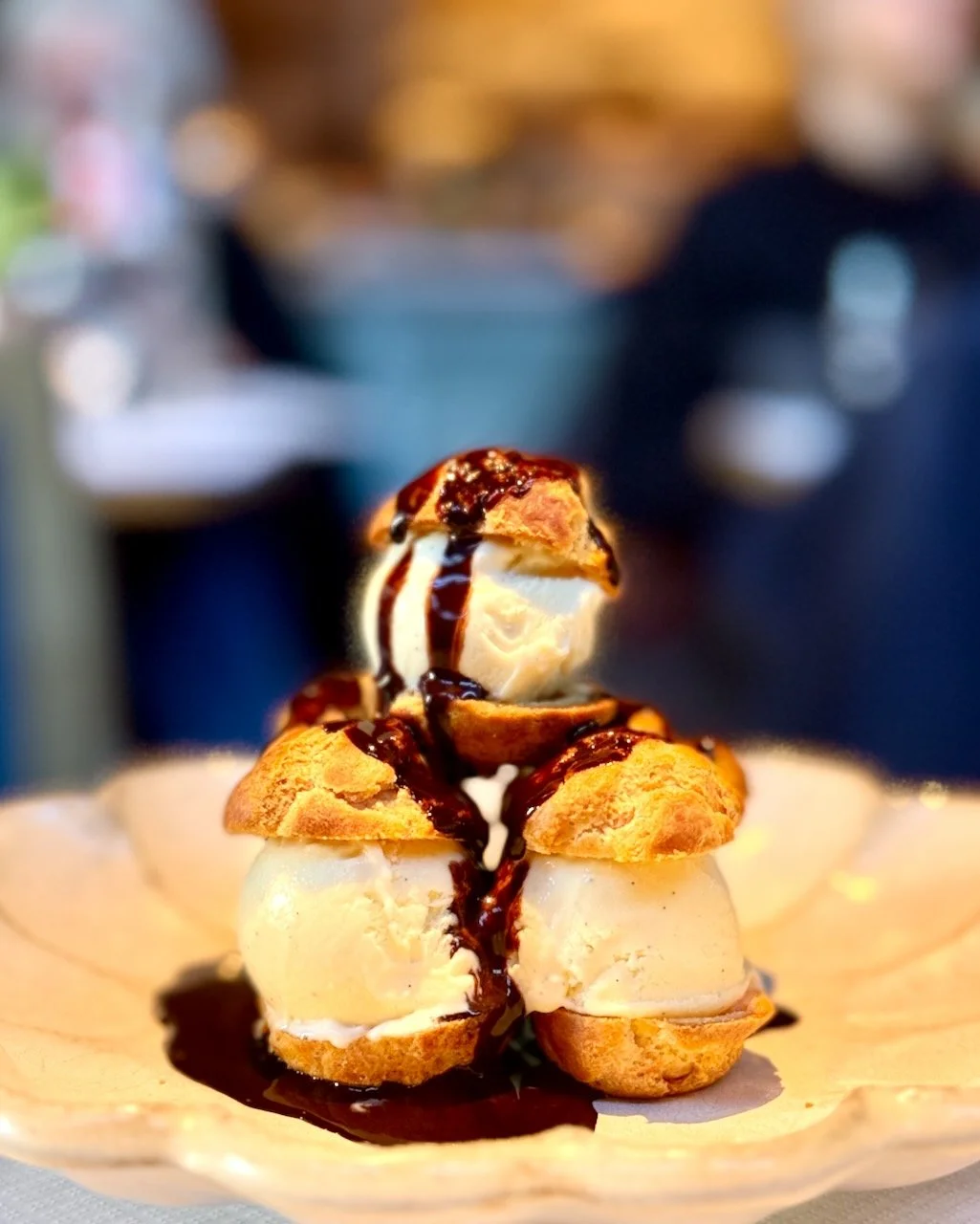
Le Diplomate
Food Hall & Bakery Picks in Washington
Union Market (NoMa) DC's best food hall, and one of the most reliably photogenic spaces in the city. High ceilings, generous light, rotating vendors, graffiti murals on the exterior walls. Chai Pani, Kyojin, and Yellow all have presences here. Good for phone photographers: the light is open, the subjects are colorful, and nobody notices a camera. Plan for at least two hours.
Manifest Bread (Riverdale Park, MD) ⚠️ Located just outside DC in Riverdale Park, MD — about 20 minutes by car. One of the most celebrated bakeries in the greater DC area, with a cult following and prominent placement on the menus of the city's best restaurants. Owner-baker Rick Cook's loaves are exceptional. Worth the trip if you have a car and are serious about bread. The Adams Morgan pop-up, "Out of Office," offers coffee and pastries inside a converted space at 1807 Florida Ave NW if you want the Manifest experience without leaving the city.
Pluma by Bluebird Bakery (Union Market District / 391 Morse St NE): From pastry chefs Camila Arango and Tom Wellings, Pluma sits in the Edison building just steps from Union Market and is one of the finest bakeries in the city. Colombian-blue tiles, marble counters, and gold mid-century fixtures make it one of the most photogenic café interiors in DC. The pistachio croissant and cardamom morning bun are the go-to orders. The sourdough, baguettes, and Roman-style pizza loaves are exceptional. Open Tuesday through Sunday. A natural stop before or after a Union Market photography session. Named to Washingtonian's Best of DC 2026.
Bread Alley (Union Market District / 418 Morse St NE) Tucked into the alley between 4th and 5th Streets NE near Union Market, Bread Alley is one of those places that rewards people who look for it. It supplies bread to the Stephen Starr restaurant empire, including Le Diplomate, and has quietly become one of the most respected bread programs in the city. The cranberry walnut sourdough is the signature, but the baguettes and country loaves are equally serious. No indoor seating: you come, you buy a loaf, you take it with you. Open daily 9am until sold out. Worth the short walk from Union Market or Pluma.
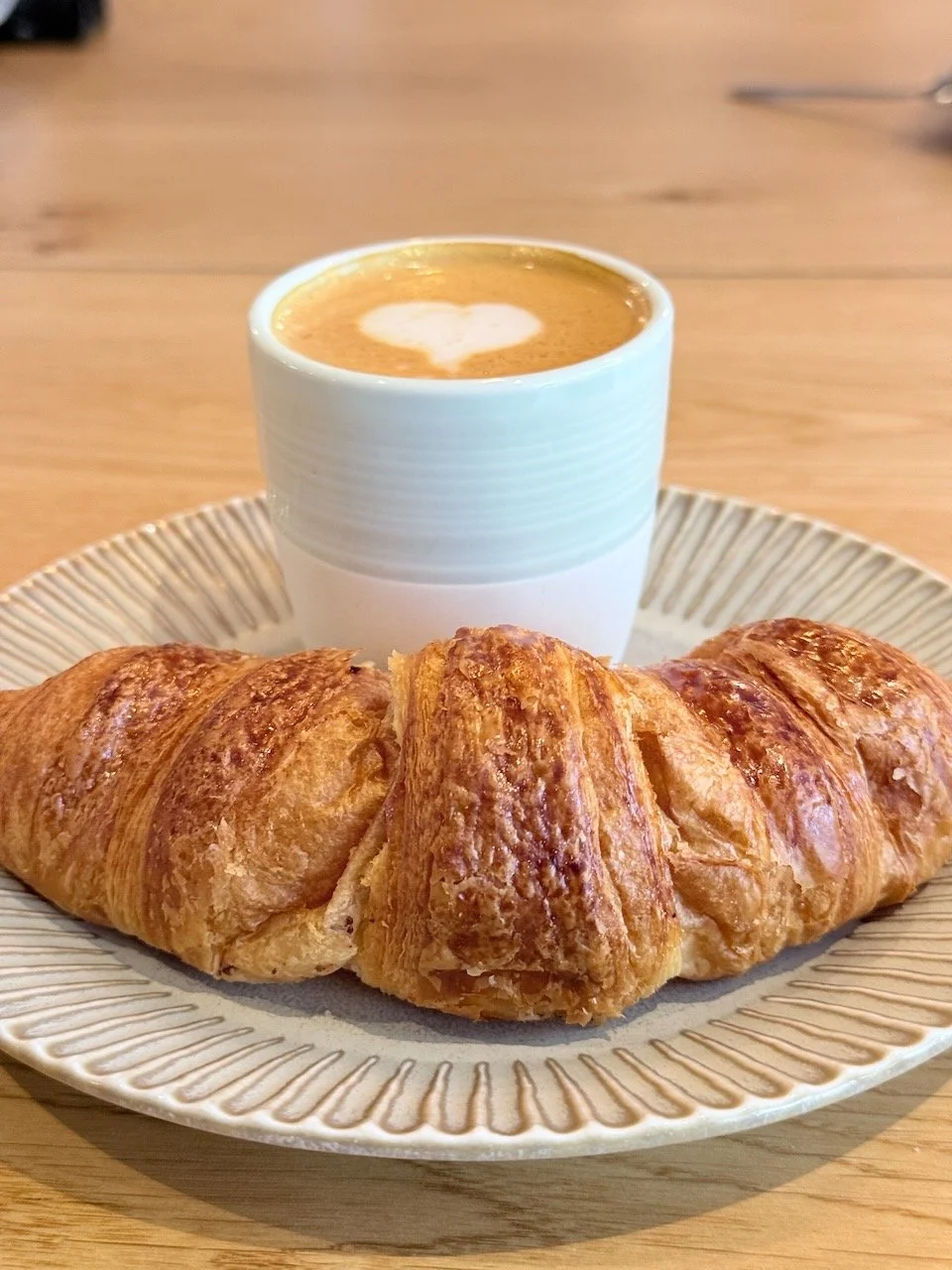
TCB
Coffee Shops in Washington DC
The Coffee Bar (TCB) (Shaw / 1201 S St NW, and Downtown / 1200 17th St NW) A DC institution since 2012, founded by Cait Lowry with a simple and lasting idea: serve great coffee in a space that actually feels like a neighborhood. TCB is one of the few genuine multi-roaster shops in the city, rotating seasonal coffees from Ceremony Coffee Roasters and Onyx Coffee Lab, among others. The Shaw location, in a historic 1880 building, is open seven days a week and is the warmer, more atmospheric of the two. The Downtown location on 17th Street is weekdays only but ideally placed for a mid-morning break between White House and Dupont Circle photography sessions. No grande. Good people.
Slipstream (Logan Circle / Downtown) One of DC's most interesting coffee experiences: a specialty pour-over café by day and cocktail bar by night. The Logan Circle original and the Downtown location both draw a loyal following of remote workers and creatives. Pour-over coffee is excellent, the food holds up, and the weekend tasting experiences (90 minutes, four coffees, flavor-forward) are worth booking for anyone who cares about what they are drinking. Highly rated on Yelp's best work-friendly coffee lists for 2025 and 2026.
Bluestone Lane (23rd & L Street NW): The Australian café brand with genuine coffee credentials. The 23rd and L location is a clean, well-designed space in the West End, walking distance from the Kennedy Center, the Four Seasons, and the AKA/One Washington Circle. Flat whites are consistently strong, the all-day food is solid, and the light in the space works well for an editing session between shoots.
Baked & Wired (Georgetown / 1052 Thomas Jefferson St NW) This is one of my own regular stops in Georgetown, and it earns the trip on its own, no photography excuse needed. The cupcake case alone is worth the walk, along with cookies, bars, and a rotating lineup of other treats, and the coffee is genuinely excellent, not an afterthought next to the baked goods. Small space, a few tables, steps from the canal if you want to walk it off. A natural stop before or after shooting the C&O Canal reflections at dawn.

At the Coffee Bar
Photography Tips, Gear & Advice
My Essential Camera Kit:
I shoot DC with my Canon EOS R5 Mark II as my primary body, and I always have the Leica Q3 on me as a walk around camera for the days I don't want to carry a full bag through the Metro. The Sony A7R V and Nikon Z8 are both excellent choices too if that's what you already shoot.
15 to 35mm f/2.8 for the wide interior shots, the Lincoln's columns, the Library of Congress Great Hall, and anywhere you're standing closer than you'd like to a monument
70 to 200mm f/2.8 for compression. This is the lens that turns the two mile stretch between the Lincoln and the Capitol into what looks like a few hundred feet, and it's the one I reach for at the Netherlands Carillon and for cherry blossoms against the Jefferson dome
A fast prime, 35mm or 50mm, for the Einstein Memorial and interior museum work where you need speed in lower light without a flash
Tripod, lightweight enough to carry on a full day of walking. Non-negotiable for blue hour at the Lincoln and any of the fountain long exposures at the WWII or FDR Memorials
Kase ND filters. I use these constantly on the fountains at the WWII Memorial and FDR Memorial to get that soft, moving water look during the day, and for the Tidal Basin when the light gets harsh
Extra batteries and memory cards. DC's a full day city between sunrise monuments and blue hour, and cold weather in winter drains batteries fast
Samsung T7 SSD for backing up in the field, especially useful if you're shooting multiple sessions a day during Cherry Blossom season when card space fills up quickly
I carry everything in a NYA-EVO Fjord 60L when I'm doing a full sunrise to blue hour day. Overkill for a single Georgetown coffee walk, but if you're covering monuments and museums in one push, having everything on your back beats swapping bags at the hotel
📱 Smartphone Tip Box:
Use Night Mode at the Korean War Veterans Memorial after dark. The uplighting on the statues is dramatic, but your phone needs the extra exposure time to pull detail out of the shadows between the figures
Switch to your wide lens at the Tidal Basin during cherry blossom season so you can get the full loop of blossoms and water in frame, then switch back to the main lens for a tighter shot on the Jefferson dome
Portrait Mode works well on the Einstein Memorial statue itself. Get low, shoot up at his face, and let the background blur separate him from the trees behind
For the Lincoln Memorial at blue hour, brace your phone against one of the columns instead of handholding. The interior light is dim enough that even Night Mode needs a steady base to avoid blur
Edit in Lightroom Mobile or Snapseed. Both handle the contrast between the Vietnam Memorial's black granite and daylight sky better than in-camera processing does
A battery pack is genuinely non-negotiable here. Between Night Mode, Portrait Mode, and constant screen use for navigation, DC will drain your phone by mid-afternoon
Drone restrictions for DC are significant enough that they get their own section below. Read that before you pack one.

Reflection of a man crossing the road by a firestation
Night Photography In Washington DC
DC is one of those cities that is really good for night photography. So, make sure to bring a Tripod and ND filters. Most of the monuments are well lit, so you can get incredible reflections during the blue hour or later.

Blue Hour at the Reflecting Pool
During the holidays, you can even get reflections with a Christmas Tree.

The Reflecting Pool in front of the US Capitol with the US Capitol

Sunrise with the US Capitol and Washingon Monument
The Best Places to Photograph In Washington DC
Lincoln Memorial and the Reflecting Pool
The Lincoln Memorial is the anchor shot of any DC monuments walk, and for good reason. The scale of the columns and the seated statue give you a subject that photographs well from almost every angle, whether you're shooting wide from the steps or tight on the details of the marble.
The light inside the chamber is warm with the sun beams in the morning light, which creates a strong contrast against the cool blue tone outside during blue hour. That contrast is the shot.

The Lincoln Memorial glowing in the quiet early morning light before the crowds arrive.
📷 Pro Tip: Shoot from the base of the steps looking up with a 24mm to 35mm lens to get the full column height without distortion creeping in too much. Arrive right at blue hour, about 20 to 30 minutes after sunset, when the interior lights are on and the sky still holds color. For a different angle, walk around to the back of the memorial and shoot through the columns toward the Reflecting Pool. Bring a tripod. The interior light is dim enough that you'll want a longer exposure even at a wider aperture.
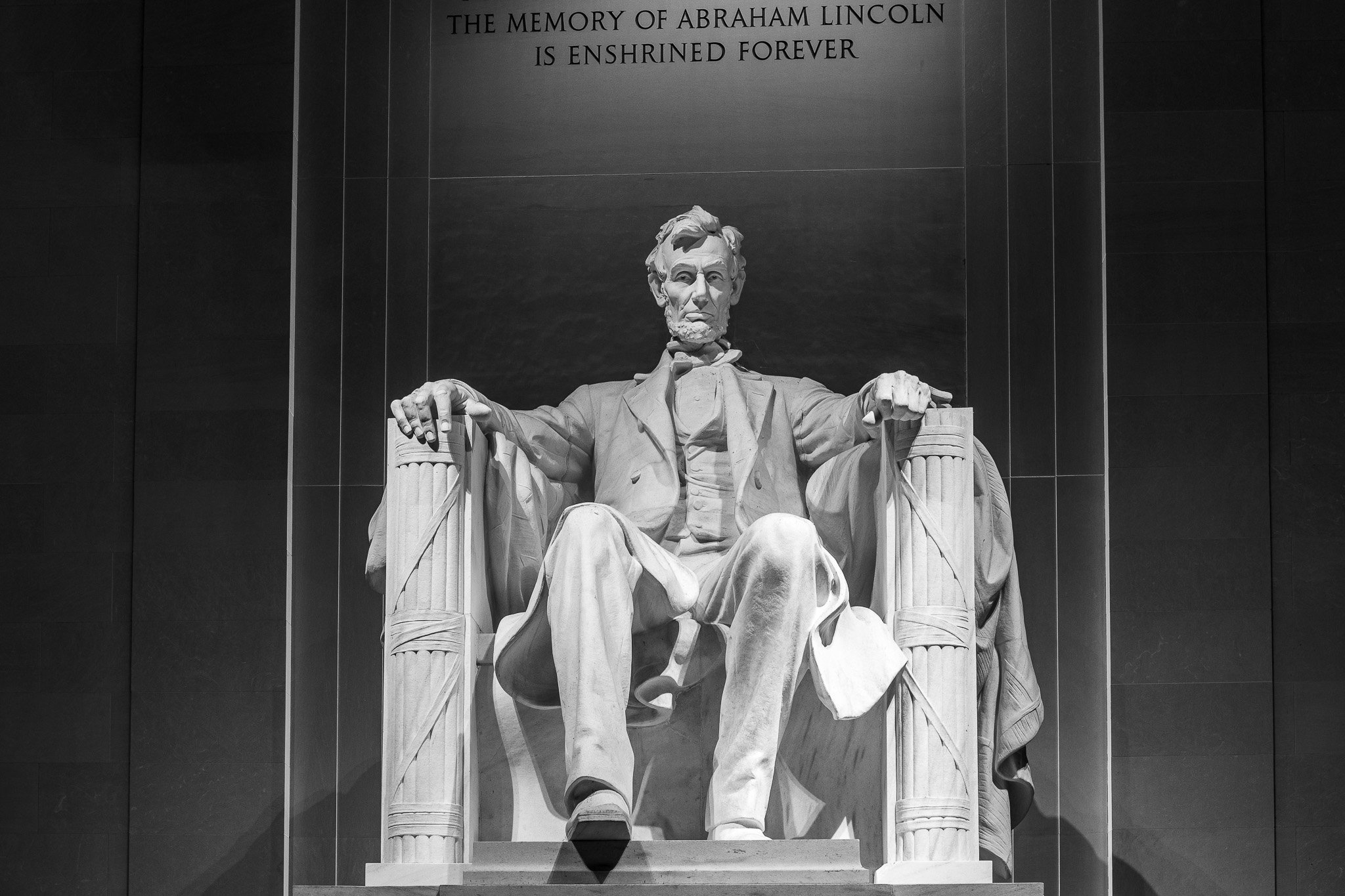
The Lincoln Memorial at Sunrise in Black & White
The best time to visit is sunrise since there are way fewer people and you can usually use a Tripod. Sunset also has great light but lots and lots of tourists. Pro Tip: Try to find the engraving on the stairs where Martin Luther King gave his "I Have a Dream" speech. Most tourists (99.9%) walk over it without noticing.
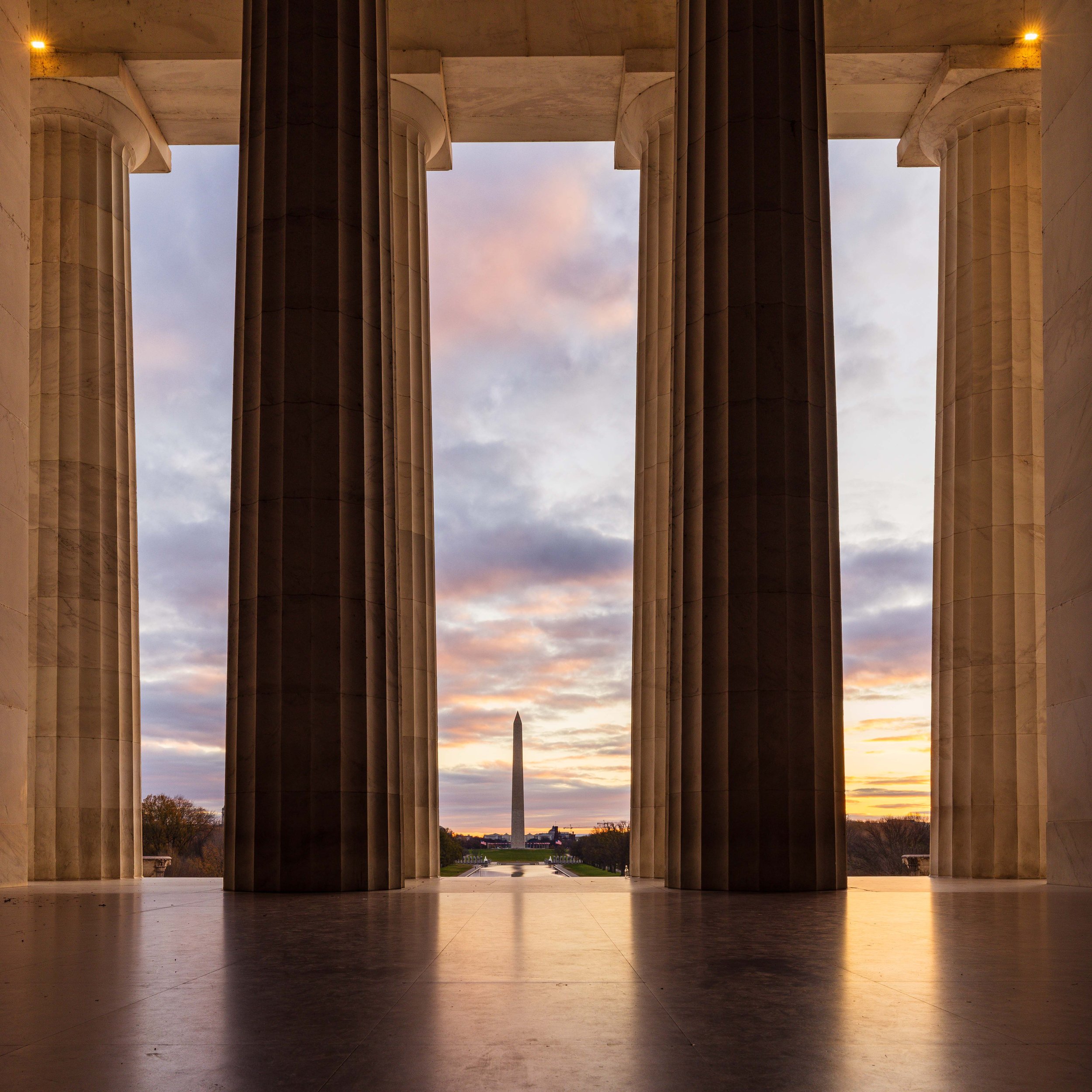
Looking through the columns of the Lincoln Memorial toward the Washington Monument.
There are so many great angles to photograph. I love the reflections of the Lincoln in the reflecting pool but also taking photos from inside the Lincoln outward is fantastic.
Keep in mind that the Lincoln, Vietnam Memorial, Korean Memorial, and WWII Memorial are right next to each other, so you can easily photograph all of them in one morning.
The Lincoln Memorial reflected across the Reflecting Pool on the National Mall.
District of Columbia War Memorial
This one gets skipped by most visitors, which makes it one of the quietest spots on the entire Mall for photography. It's a small, open-air domed structure honoring DC residents who served in World War I, set back in the trees just south of the main path between the Lincoln Memorial and the Washington Monument.
The columns and dome create clean, repeating lines, and because it sits in a grove of trees, you get dappled light filtering through in a way none of the bigger monuments offer.
📷 Pro Tip: Shoot through the columns from an angle rather than straight on to get depth and repetition in the frame, a 24mm to 35mm lens works well for this. Late afternoon light filtering through the surrounding trees adds a softness you won't find at the more open memorials nearby. Because it's so overlooked, this is a reliable spot to get a clean, people-free shot even during peak tourist season.
Best time: Late afternoon. Access: Free, open 24 hours. A short walk south of the main Mall path, between the Lincoln Memorial and the Washington Monument.

The circular marble columns of the District of Columbia War Memorial on the National Mall.
Albert Einstein Memorial
Tucked on the grounds of the National Academy of Sciences, this one is easy to miss if you're only working off the standard Mall route, which is exactly why it's worth the detour. The bronze statue shows Einstein seated, casual, papers in hand, and it invites a much more playful approach than the formal memorials nearby.
Kids climb into his lap constantly, and honestly, that's part of the shot. This is one of the few spots on this list where a candid, human moment beats a clean architectural frame.
📷 Pro Tip: Get low and shoot up at the statue's face with a 35mm to 50mm lens rather than shooting from standing height, it reads as a much more intimate portrait that way. Soft, overcast light works better here than harsh sun, since the bronze can blow out and lose detail in direct midday light. If you want the statue without people in the frame, go early on a weekday morning.
Best time: Overcast mornings, or early weekday hours to avoid crowds. Access: Free, on the grounds of the National Academy of Sciences at 2101 Constitution Ave NW. About a 10 minute walk from the Lincoln Memorial.

The Albert Einstein Memorial along Constitution Avenue, one of Washington’s more playful monuments to photograph.
The Vietnam Memorial
This one photographs completely differently from the rest of the monuments on the Mall. It's low, black, reflective granite cut into the earth rather than rising above it, and that changes how you have to think about the shot.
Look for reflections. The polished granite mirrors the sky, the trees, and the visitors walking past, which is what gives this memorial its emotional weight in photos.

The polished black granite of the Vietnam Veterans Memorial reflecting visitors and the Washington Monument.
The names of the soldiers who died in Vietnam are engraved on the wall of the memorial. You will often see families leaving flowers, wreaths, and notes next to the names of their loved ones.

Thousands of names engraved into the Vietnam Veterans Memorial in Washington, DC.
📷 Pro Tip: Shoot low and close to the wall with a 35mm to 50mm lens to capture the reflection of the sky or the Washington Monument in the granite. Midday sun is harsh here, so early morning or late afternoon works best for soft reflections without blown highlights. Be respectful with your camera. This is a memorial people visit to grieve, not a backdrop. Keep some distance if anyone is present at the wall.
Best time: Early morning or late afternoon. Access: Free, open 24 hours. Walking distance from the Lincoln Memorial, along the path toward the Korean War Veterans Memorial.
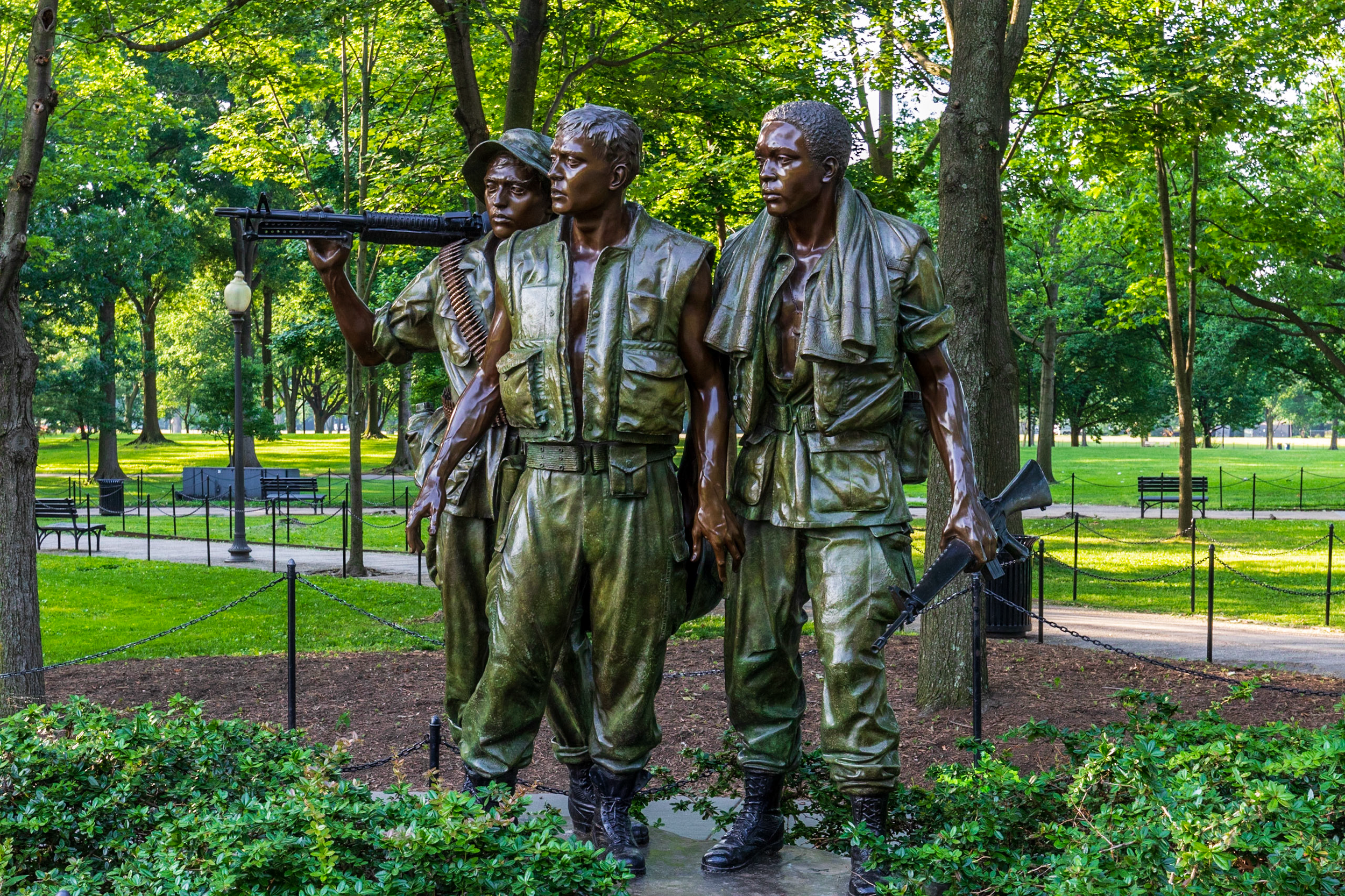
Soft morning light across the Vietnam Veterans Memorial before the National Mall becomes crowded.
Korean War Veterans Memorial
The statues here, a squad of soldiers moving through the field in ponchos, are some of the most photogenic figures on the Mall, especially at night when they're lit from below.
At night, the lighting creates dramatic shadows across the statues' faces and gear, which gives the scene a completely different mood than during the day.
📷 Pro Tip: Come after dark for this one specifically. The uplighting on the statues creates strong shadow and texture that you lose entirely in daylight. Use a 24mm to 70mm lens and get low, shooting up at the statues to emphasize their scale against the sky. A tripod is close to mandatory here since you're working in low light.
Best time: After dark. Access: Free, open 24 hours. Adjacent to the Lincoln Memorial, on the opposite side from the Vietnam Veterans Memorial.
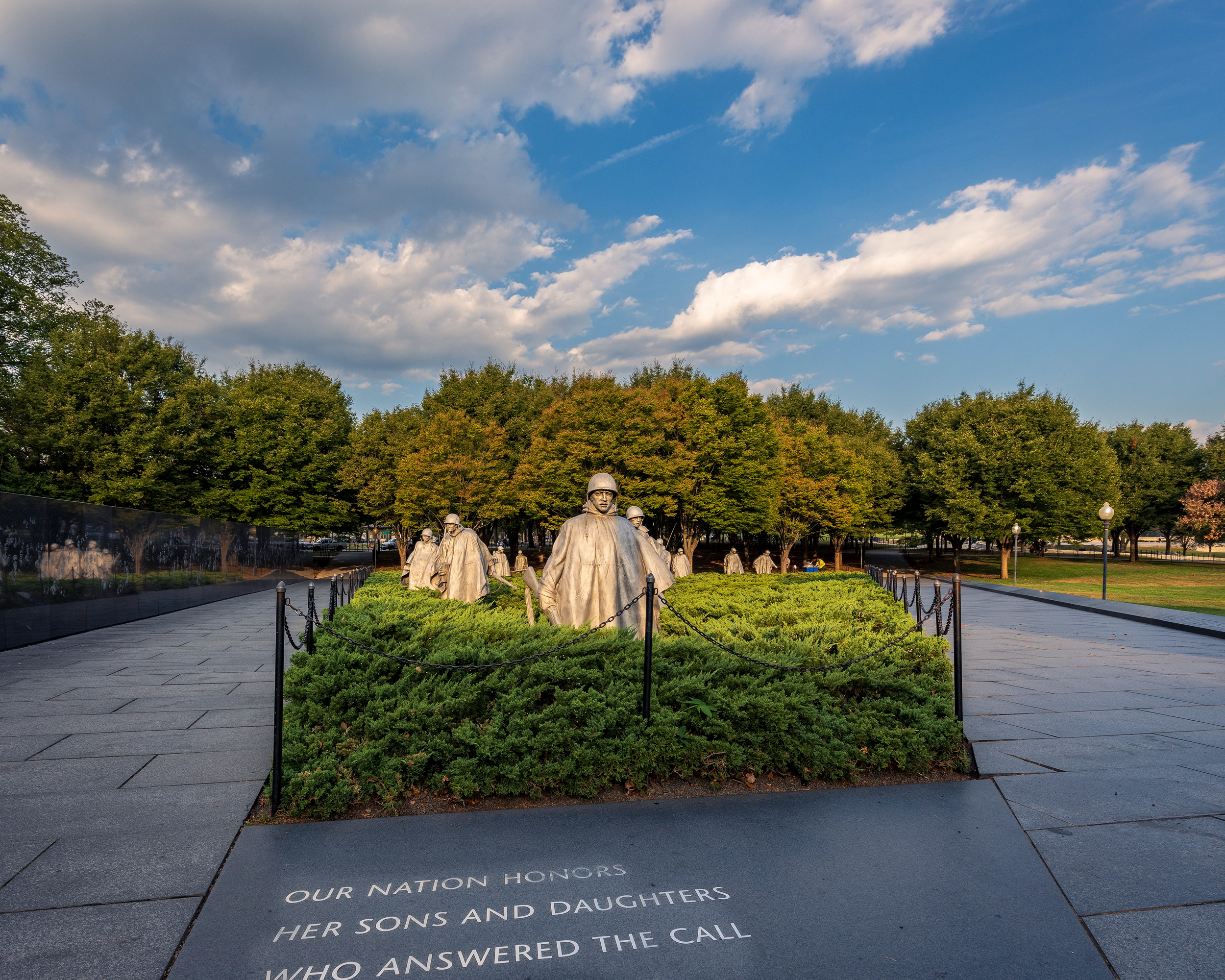
The stainless steel soldiers of the Korean War Veterans Memorial moving through a field beside the Lincoln Memorial.
World War II Memorial
The WWII Memorial is built around a central fountain and plaza, which means water is almost always part of the composition here. It's also one of the more symmetrical monuments on the Mall, which rewards a centered composition.
The fountains create movement and, depending on wind and light, a bit of mist that catches the late afternoon sun.
📷 Pro Tip: Use a 16mm to 35mm lens and center yourself on the plaza's main axis for a symmetrical shot with the Washington Monument in the background. If you want to slow the fountain water into a soft blur, bring an ND filter and shoot a half-second to one-second exposure on a tripod. Late afternoon light works well here because it catches the fountain spray.
Best time: Late afternoon or blue hour. Access: Free, open 24 hours. Roughly a 10-minute walk from the Lincoln Memorial along the Reflecting Pool.
The fountains and stone pillars of the World War II Memorial at the eastern end of the Reflecting Pool.
Since the Lincoln, Vietnam, and Korean Memories are just a few steps away, do not miss photographing the WWII memorial in the morning as well.

The World War II Memorial framed by the Washington Monument on the National Mall.
The Washington Monument
The obelisk works as both a foreground and background element. Up close, it's a study in scale and geometry. From a distance, at the Tidal Basin or the WWII Memorial, it becomes the anchor point that ties the whole Mall together.
At blue hour, the monument's lighting turns it into a clean, glowing vertical line against a darkening sky, which is the shot most people are after.
📷 Pro Tip: For the classic shot, position yourself at the Tidal Basin or near the WWII Memorial reflecting pool so you get the monument mirrored in the water. Use a 24mm to 70mm lens for that composition, or go wider if you're shooting from directly below to emphasize height. Blue hour, 20 to 30 minutes after sunset, is when the monument lighting balances best against the sky.
Best time: Blue hour. Access: Free. Grounds open 24 hours; interior observation deck requires a timed entry ticket.

Sunset and Sunrise are Perfect times to take photos of the Washington Monument
The nice thing about the Washington Memorial is the tidal basin and the reflecting pool in front of the Lincoln Memorial, which provide an excellent opportunity to take photos with reflections.

A calm reflection of the Washington Monument in the waters of the Tidal Basin.
You can also get some great photos from the opposite side of the Washington Monument closer to the US Capitol.

The Washington Monument rising above the open lawns of the National Mall.
Since the memorial is open 24 hours a day, it is wonderful to photograph at sunrise, sunset, and at night.

The Washington Monument illuminated against the evening sky in Washington, DC.
Martin Luther King, Jr. Memorial
The Stone of Hope, the massive granite figure of Dr. King emerging from the split boulder, is one of the most sculpturally dramatic pieces on the entire Tidal Basin. Unlike the classical columns and domes elsewhere on this list, this memorial is all rough-cut stone and negative space, which gives you a completely different set of compositions to work with.
The inscription wall stretches out behind the statue, and the way the light rakes across the carved text in the early morning is worth building a shot around on its own.
📷 Pro Tip: Shoot from below and slightly to the side with a 24mm to 35mm lens to emphasize the statue's scale against the sky, rather than shooting straight on. Early morning side light rakes across the granite texture and brings out the carving in a way flat midday light flattens out. Walk the full length of the inscription wall behind the statue too, a 35mm to 50mm lens tight on individual quotes makes for a strong detail shot to pair with the wide one.
Best time: Early morning. Access: Free, open 24 hours. On the Tidal Basin, between the Franklin Delano Roosevelt Memorial and the Jefferson Memorial.

The Martin Luther King Jr. Memorial overlooking the Tidal Basin in Washington, DC.
The MLK Jr. Memorial in D.C. symbolizes his legacy and vision of equality and freedom. It is a powerful memorial for a man who had an incredible impact on civil rights.

The Stone of Hope at the Martin Luther King Jr. Memorial, honoring one of America’s most important civil rights leaders.
The National Mall
The Mall itself, the long open lawn running between the Capitol and the Lincoln Memorial, is worth treating as its own subject and not just the ground you walk between monuments. It is one of the widest, most deliberately open stretches of green space in any American city, and that openness is the entire point.
Walk the gravel paths at either edge rather than the center lawn, and you get a completely different photograph than the postcard shots of any single monument. Kite flyers, joggers, tourists laid out on blankets, the Smithsonian museums lining both sides. The Mall photographs as a place people actually use, not just a backdrop.
📷 Pro Tip: For the classic compressed sightline, shoot from the Capitol steps or the Lincoln Memorial steps with a 70mm to 200mm lens looking straight down the length of the Mall. Early morning gives you long shadows raking across the grass and far fewer people in frame. If you want the human element, a 24mm to 70mm lens closer to ground level on the lawn itself catches the kite flyers and picnickers with the museums as a backdrop. Fall and winter light, lower in the sky, rakes across the open lawn in a way summer's high sun does not.
Best time: Early morning or golden hour. Access: Free, open 24 hours. Runs the length between the Capitol and the Lincoln Memorial, with every Metro stop along the Mall (Smithsonian, Federal Triangle, Archives) putting you within a short walk.

A classic view across the National Mall toward the Washington Monument.
Tidal Basin & Cherry Blossoms
The Tidal Basin itself, separate from any single monument, is worth treating as its own location. The water gives you reflections of the Jefferson Memorial, the Washington Monument, and the cherry trees all in one loop.
Walking the full loop gives you shifting angles on the same monuments throughout the morning, and the light changes fast as the sun clears the tree line.
📷 Pro Tip: Walk the full loop rather than shooting from one spot. The angle on the Jefferson Memorial changes completely as you move around the water, and you'll find reflection opportunities that aren't visible from the main viewing points. Bring a polarizing filter to control glare on the water when the sun is higher.
Best time: Sunrise through mid-morning. Access: Free, open 24 hours. Paddle boat parking lot near Maine Ave is a good starting point.

Cherry blossoms surrounding the Tidal Basin during Washington, DC’s famous spring peak bloom.
I included a map below because there are many things to see in the Tidal Basin: 1) the Japanese Lantern, 2) the FDR Memorial, 3) the Japanese Pagoda, 4) The MLK Memorial, and 5) the Jefferson Memorial, among a few.

During the Cherry Blossom season, it is essential to arrive very early. The park police will close the streets around the area, so it is nearly almost impossible to find parking. Walking or cycling to the area is easier.
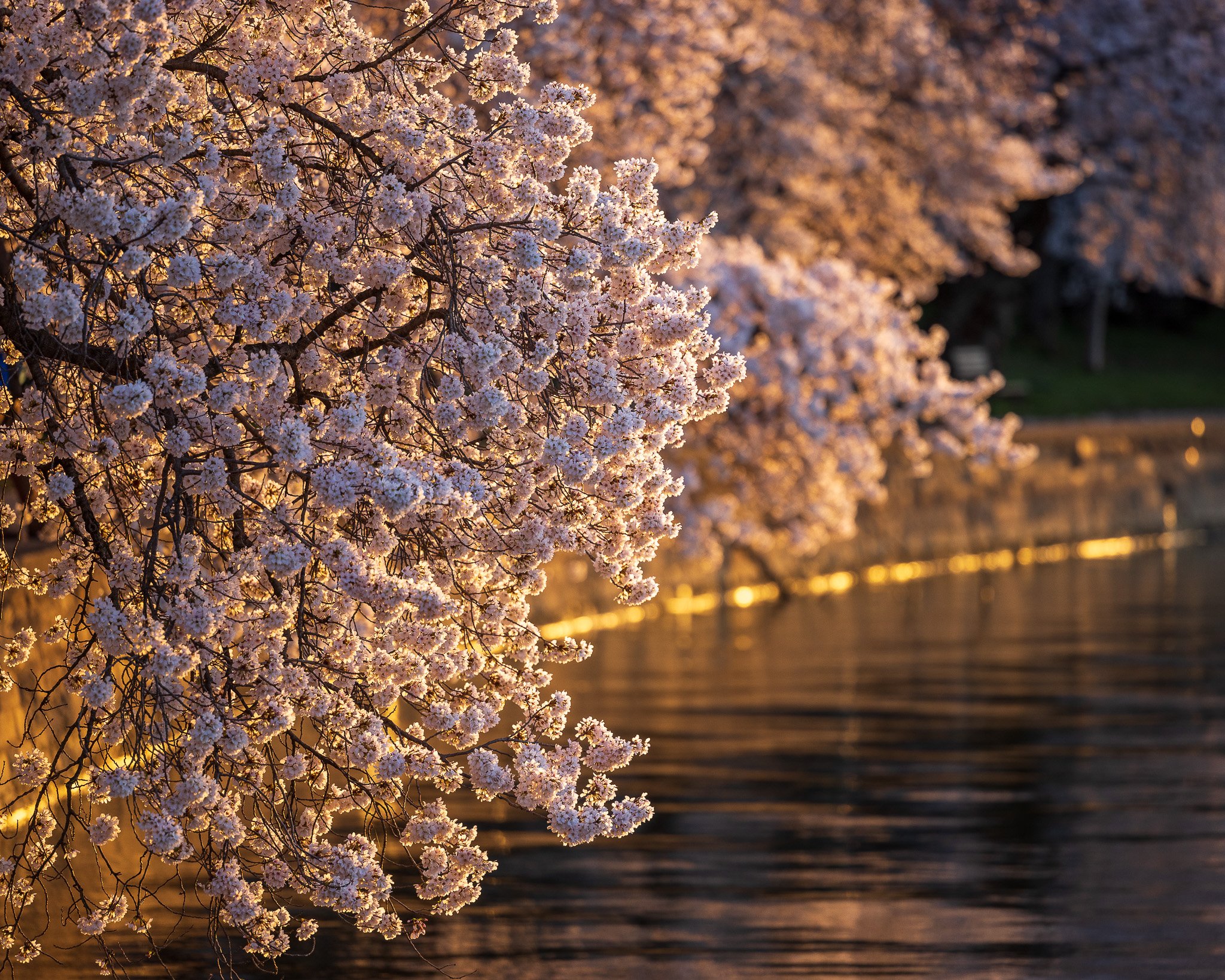
Soft pink cherry blossoms reflected in the calm waters of the Tidal Basin.
Watching the reaction of visitors to the Cherry Blossoms and Magnolias always makes me happy

Visitors enjoying the cherry blossoms and spring magnolias around Washington, DC.
It is usually difficult to predict precisely when you will see the Cherry Blossoms. Once the Cherry Blossoms peak, you will have about one week to see them.

A classic view across the National Mall toward the Washington Monument.
Thomas Jefferson Memorial
The Jefferson Memorial sits across the Tidal Basin, and that distance is actually your best asset. Rather than treating it like an up-close subject, treat it as the centerpiece of a wider composition with the water in the foreground.
The dome reflects beautifully in the Tidal Basin when the water is calm, and during cherry blossom season the pink trees framing the shot make this one of the most photographed spots in the city.
📷 Pro Tip: Shoot from the Tidal Basin's west side in early morning for the best reflection and the fewest people in your frame. A 24mm to 70mm lens covers you for both the wide reflection shot and a tighter crop on the dome. If you're there for cherry blossoms, go at sunrise. By 8am the paths fill up fast.
Best time: Sunrise, especially during cherry blossom season in late March to early April. Access: Free, open 24 hours. A 15 to 20 minute walk around the Tidal Basin from the Lincoln Memorial area.
The Thomas Jefferson Memorial overlooks the Tidal Basin in Washington, DC.

The quiet interior of the Thomas Jefferson Memorial early in the morning.
Another excellent time to photograph the Jefferson is during the Cherry Blossom Season.
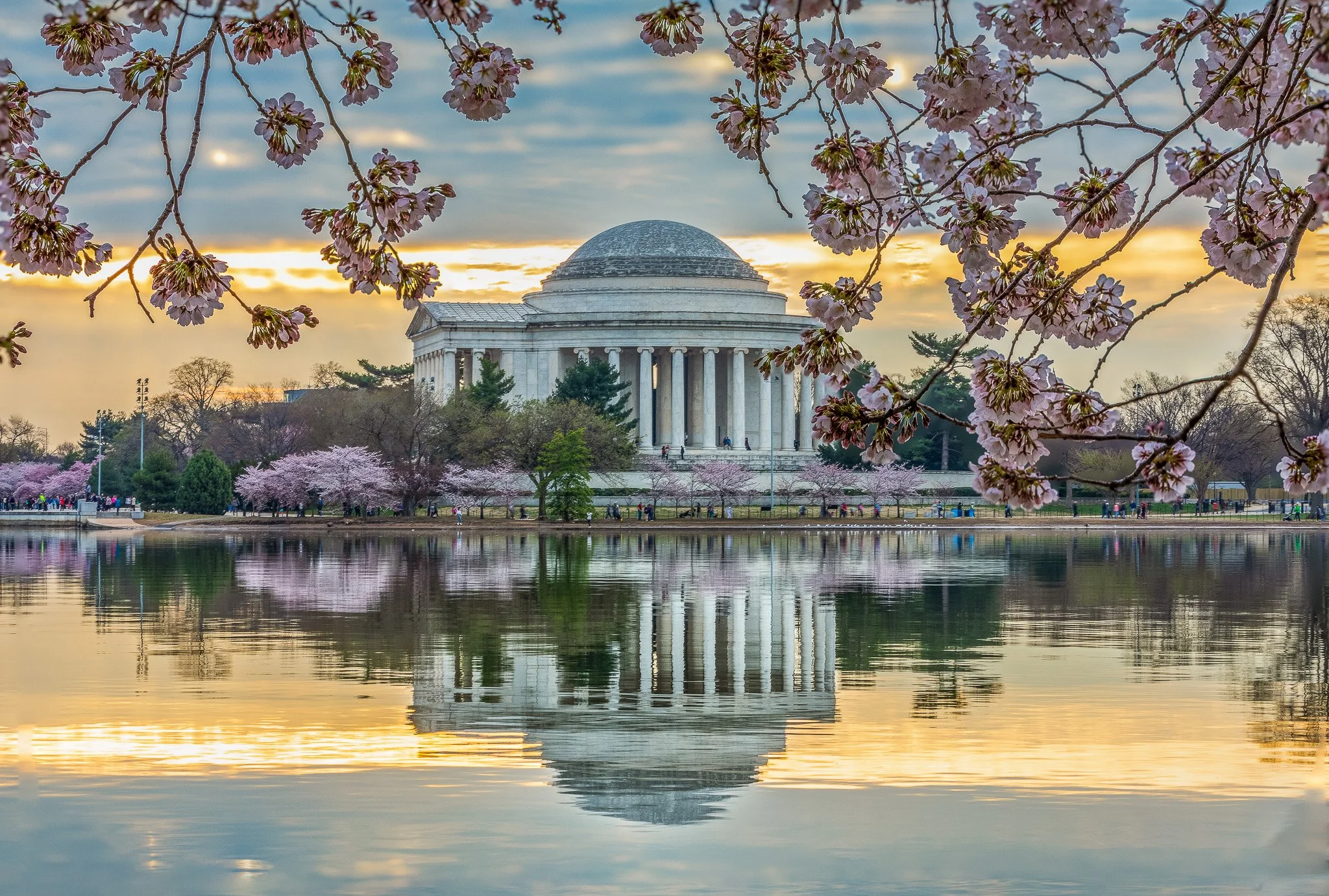
The Jefferson Memorial framed by Washington’s famous cherry blossoms during peak bloom.
Franklin Delano Roosevelt Memorial
This is the most sprawling memorial on the Tidal Basin, four outdoor rooms laid out chronologically across FDR's four terms, connected by waterfalls, quotes carved into stone, and bronze sculptures you can walk right up to. It rewards slowing down more than any other stop on this list.
Each room has its own water feature, and the sound and movement of the falls give you a different mood in every section, from the quiet reflecting pools of the early rooms to the dramatic cascade in the room representing the war years.
📷 Pro Tip: Treat each of the four rooms as a separate shoot rather than rushing through the whole memorial in one pass. Use a 16mm to 35mm lens for the wider room compositions with the waterfalls, and switch to 50mm or longer for the bronze figures, including the breadline sculpture, which photographs best up close. If you want silky water in the falls, bring an ND filter and shoot a half-second to one-second exposure on a tripod during the quieter early morning hours.
Best time: Early morning. Access: Free, open 24 hours. On the Tidal Basin, between the Martin Luther King Jr. Memorial and the Jefferson Memorial.

A quiet section of the FDR Memorial along the Tidal Basin.
““Freedom of Speech, Freedom of Worship, Freedom from Want, Freedom from Fear...””
Twenty-two quotations from Roosevelt's presidency are engraved on the granite walls of the memorial. The quotes are not only thought-provoking but so forward-thinking.

A Sculpture of Franklin Delano Roosevelt Memorial
It’s a wonderful place to stroll through. There are also a lot of benches to sit on.

Powerful sculptures inside the Franklin Delano Roosevelt Memorial tell the story of America during the Great Depression and World War II.
The other good tip for this area is that they have good bathrooms, which might be needed after walking around the tidal basin.

Stone walls, waterfalls, and engraved quotations inside the Franklin Delano Roosevelt Memorial.
The White House
You won't get inside without advance planning, but the exterior views are still some of the most recognizable shots in American photography, and DC visitors expect to see this one covered. The North Lawn view from Lafayette Square is the classic postcard angle, while the South Lawn view from the Ellipse gives you the more famous curved portico.
Security fencing and Secret Service presence are part of the reality here, so the shot is less about creative freedom and more about working within a fixed, well-guarded frame.
📷 Pro Tip: For the South Lawn view, shoot from the Ellipse with a 70mm to 200mm lens to compress the distance and fill the frame, since you'll be standing well back from the fence line. Golden hour lights the building's face beautifully from this angle. From Lafayette Square on the north side, a 24mm to 70mm lens covers the wider view with the fountain in the foreground. Expect security personnel nearby and keep tripods compact, some spots restrict full-size setups.
Best time: Golden hour. Access: Free to view from public areas; interior tours require advance request through your member of Congress or embassy. Ellipse side is a short walk south of the White House grounds; Lafayette Square sits directly north.

The White House photographed from Pennsylvania Avenue in Washington, DC.
The US Capitol
The Capitol anchors the entire Mall sightline, and its dome is arguably the single most recognizable silhouette in the city. Whether you're shooting it up close from the East Front plaza or from two miles away down the length of the Mall, it holds up as a subject at every distance.
The dome's white stone catches light differently depending on the hour, flat and bright at midday, warm and almost glowing at golden hour, and lit dramatically from below after dark.
📷 Pro Tip: For the classic straight-on shot, position yourself on the West Front lawn facing the dome and use a 24mm to 35mm lens to include the terraces in the frame. If you want the compressed Mall shot with the Capitol as the endpoint, head to the Lincoln Memorial steps or further and shoot with a 200mm or longer lens, this is the shot that makes the two miles between them look like a few hundred feet. After dark, the dome is lit and photographs beautifully from the West Front reflecting pool with a tripod and a few second exposure.
Best time: Golden hour or after dark. Access: Free to view exterior grounds 24 hours; interior tours require advance reservation through your member of Congress or the Capitol Visitor Center. East and West Front plazas are both a short walk from the Mall's eastern end.

The US Capitol at sunset with a leading line
The US Capitol is a beautiful location at sunset and at night.

The US Capitol at Sunset from the Stairs
I usually shoot the area behind the US Capitol at Sunset, then walk to the front and take photos with the reflecting pool. But the reflecting pool is also a great location for sunrise.
If you are lucky, you can take photos of the US Capitol with amazing colors. At night, you can get a beautiful reflection on the reflecting pool.
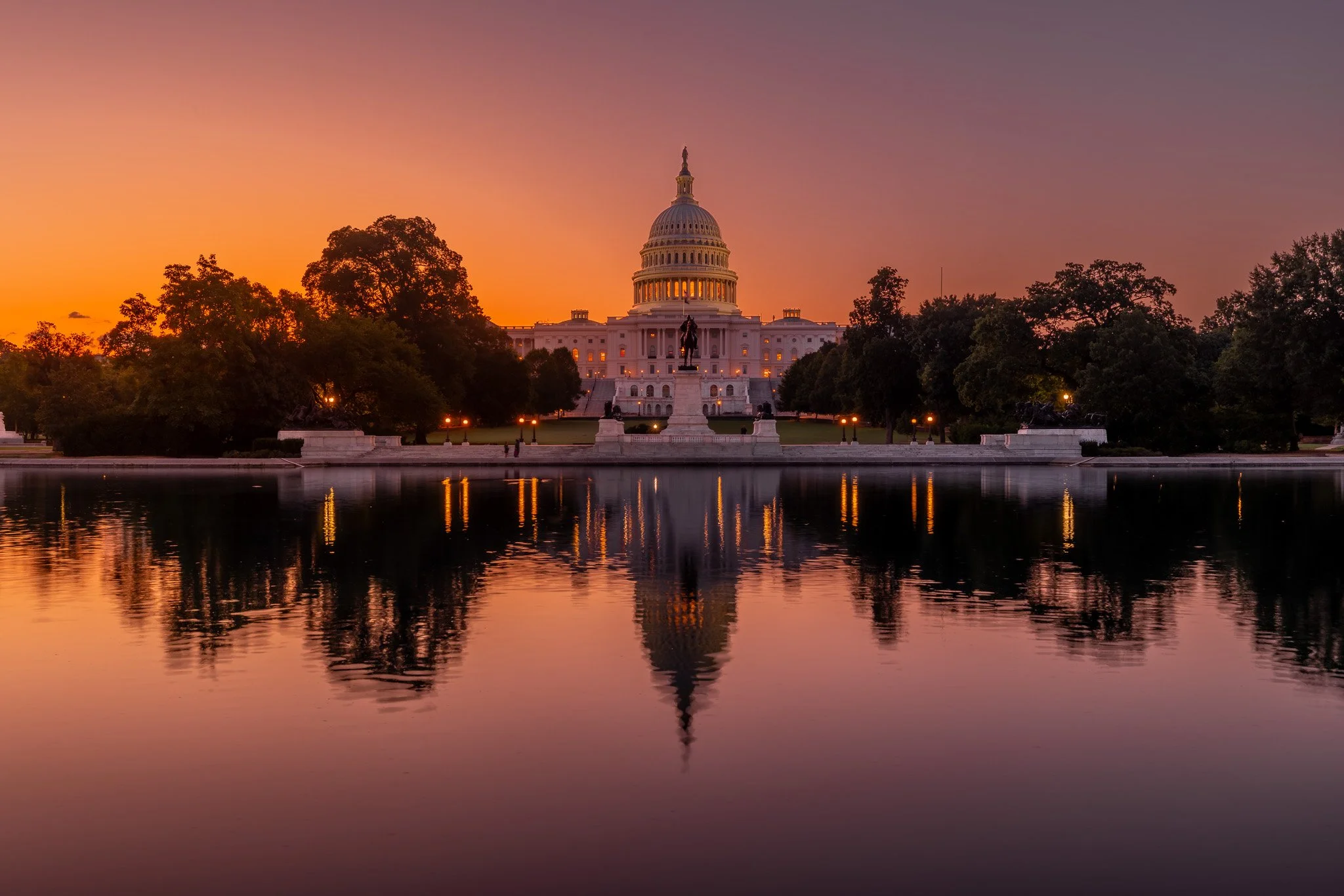
Sunrise at the US Capitol with a reflection
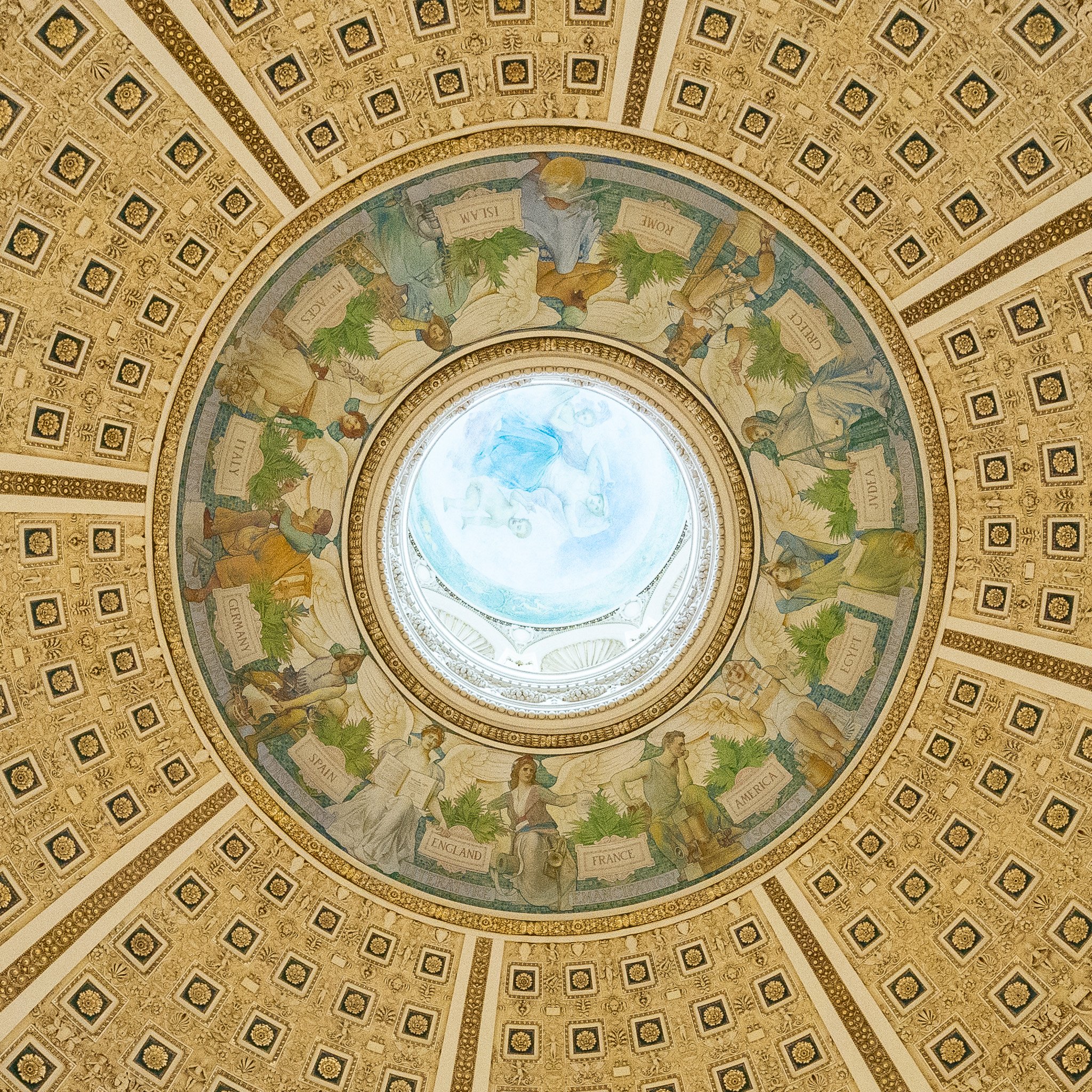
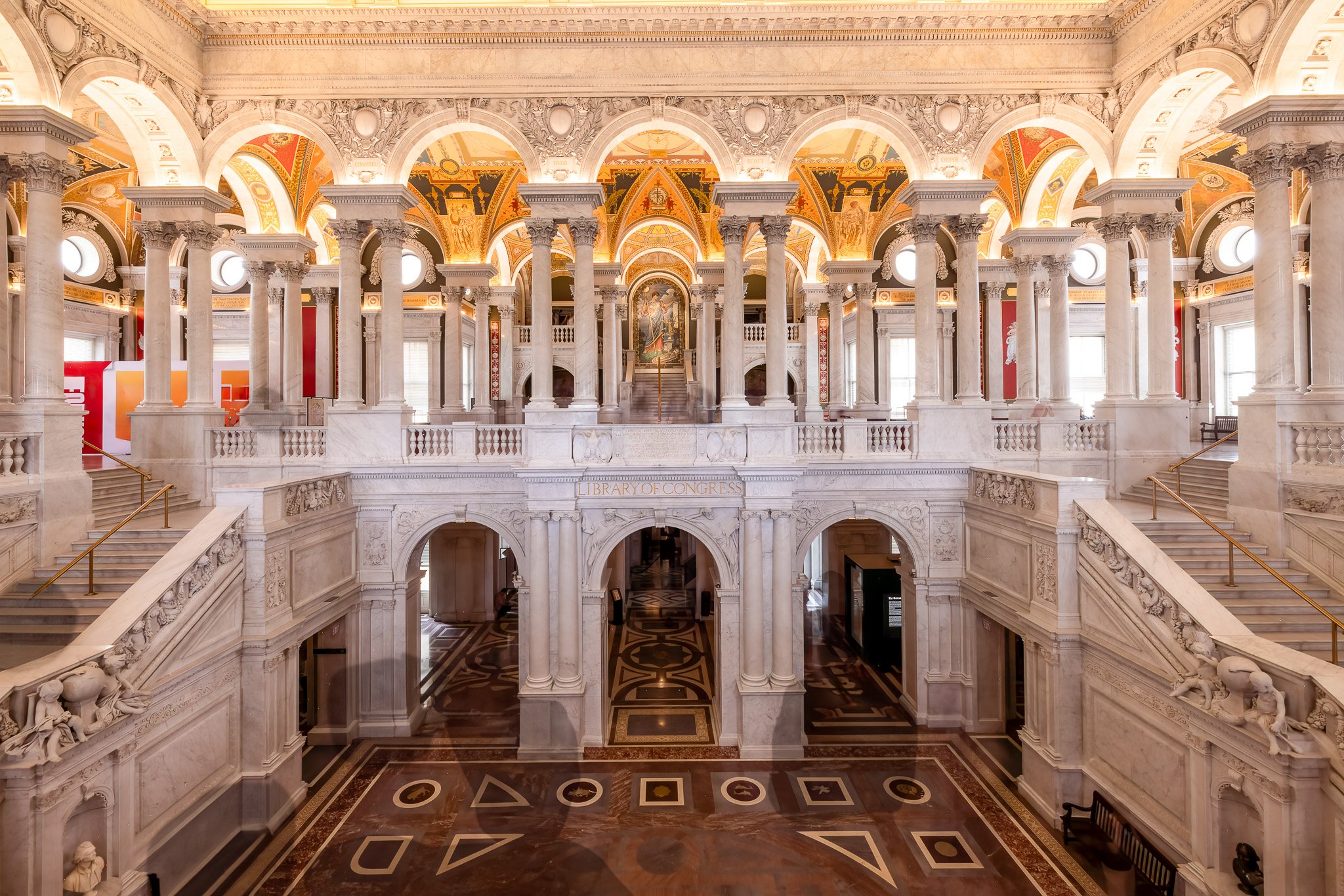
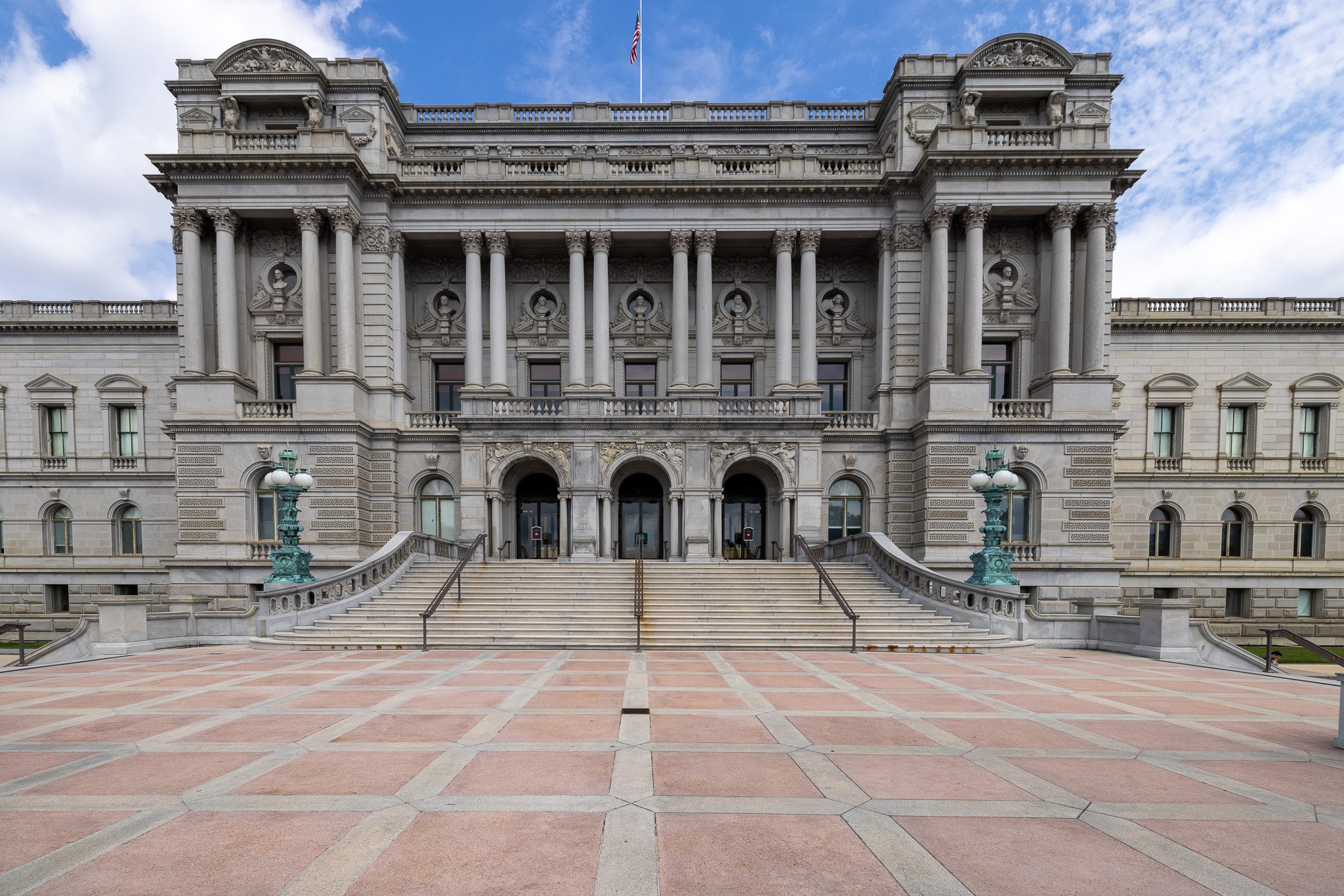
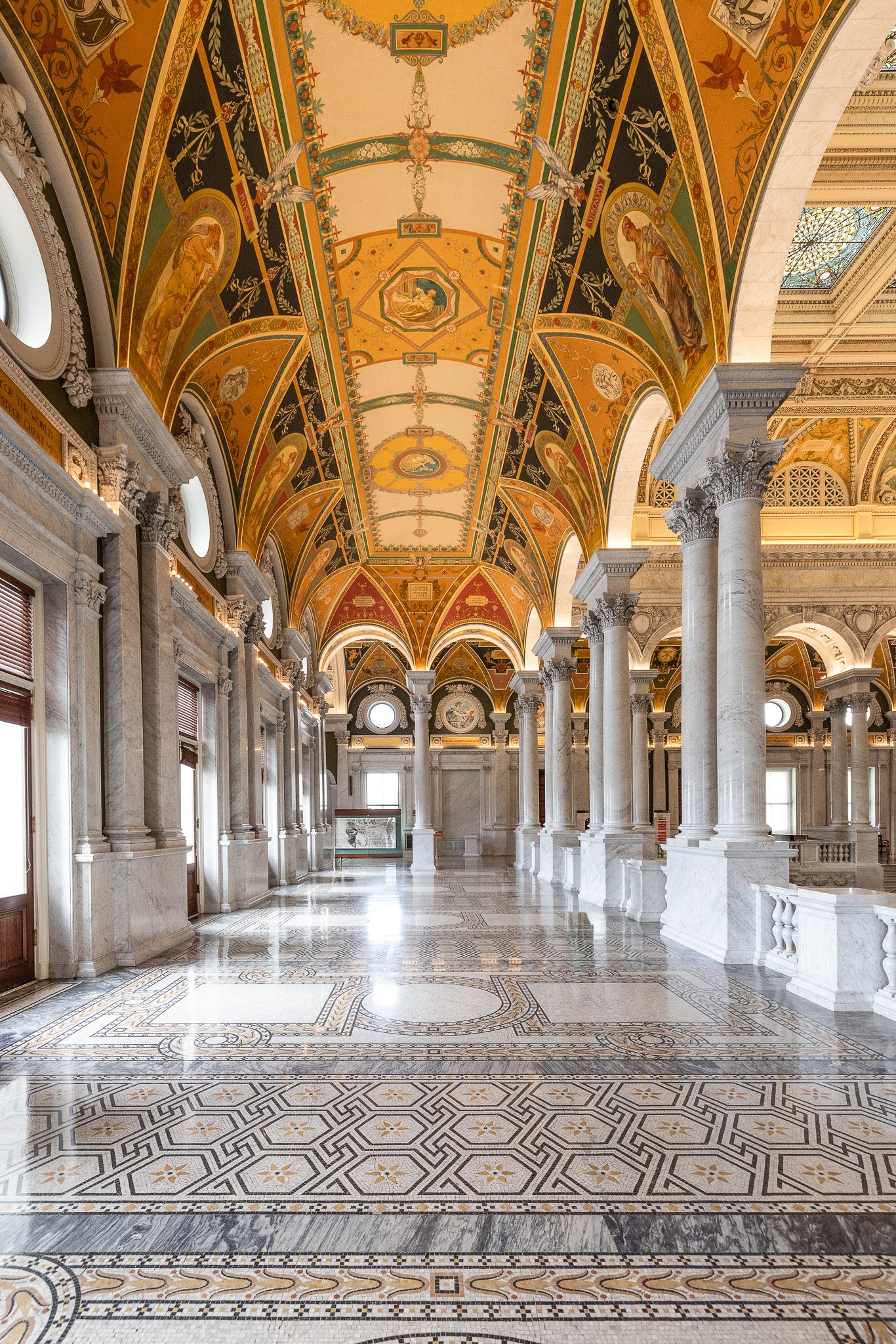
The Library of Congress
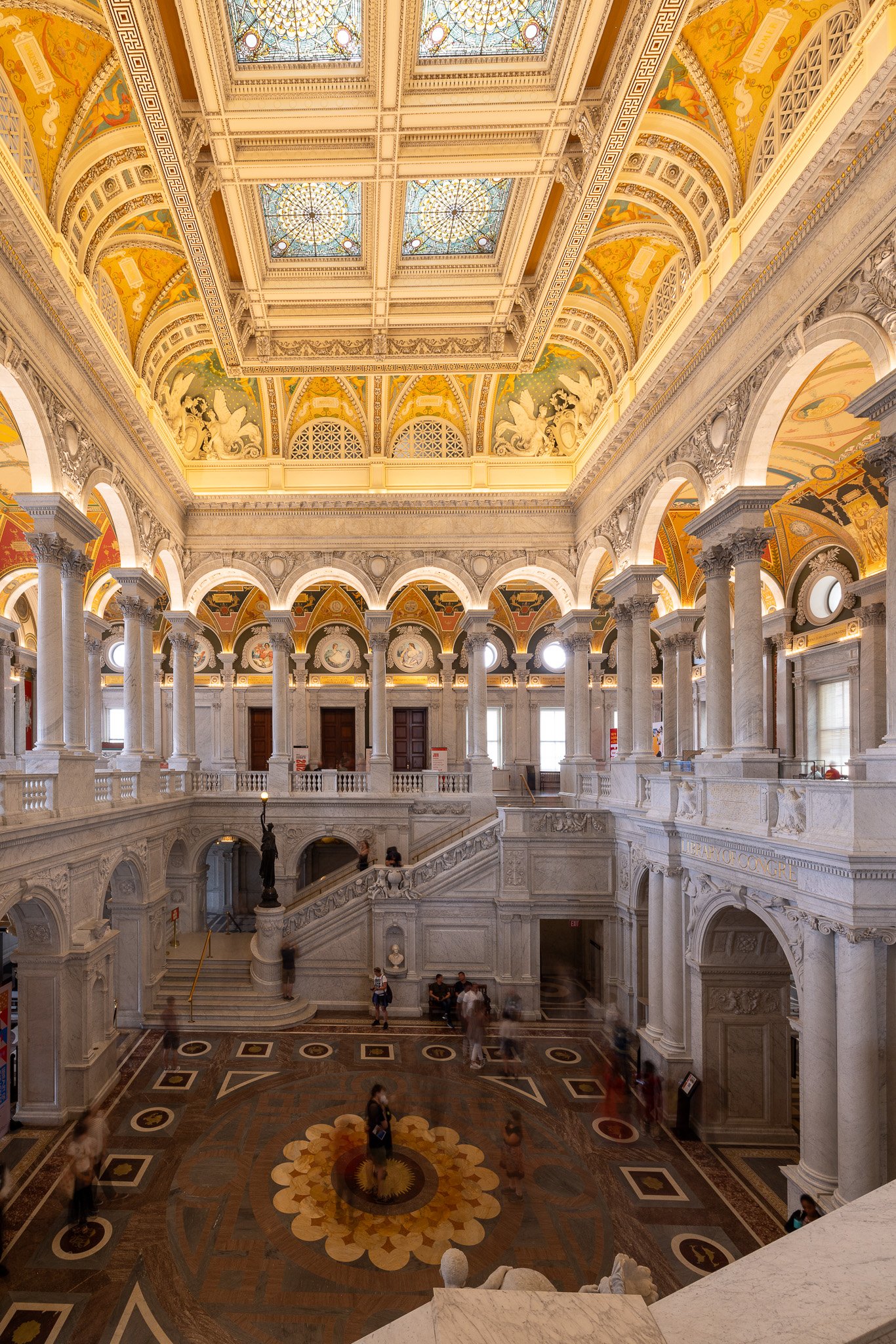
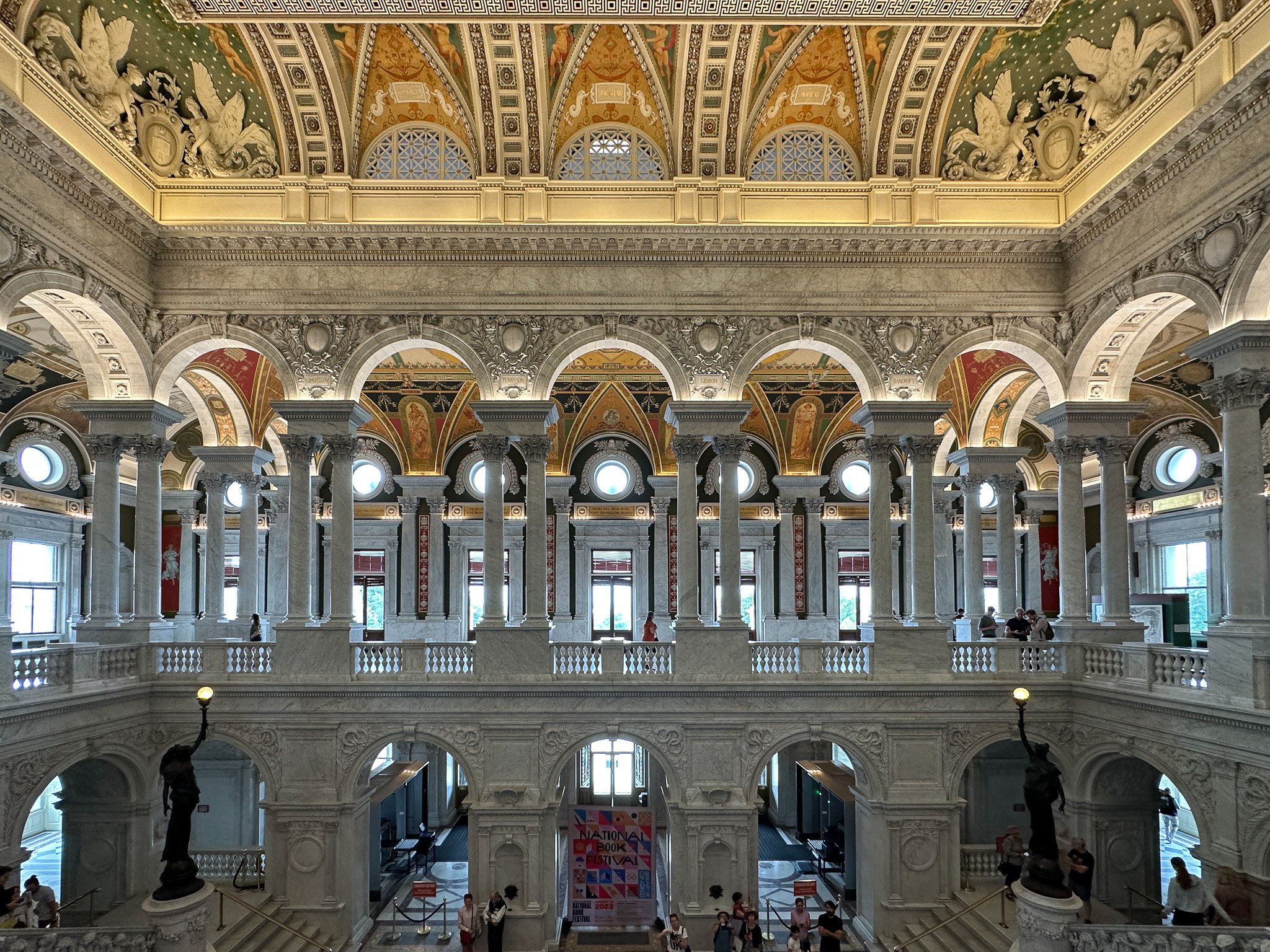
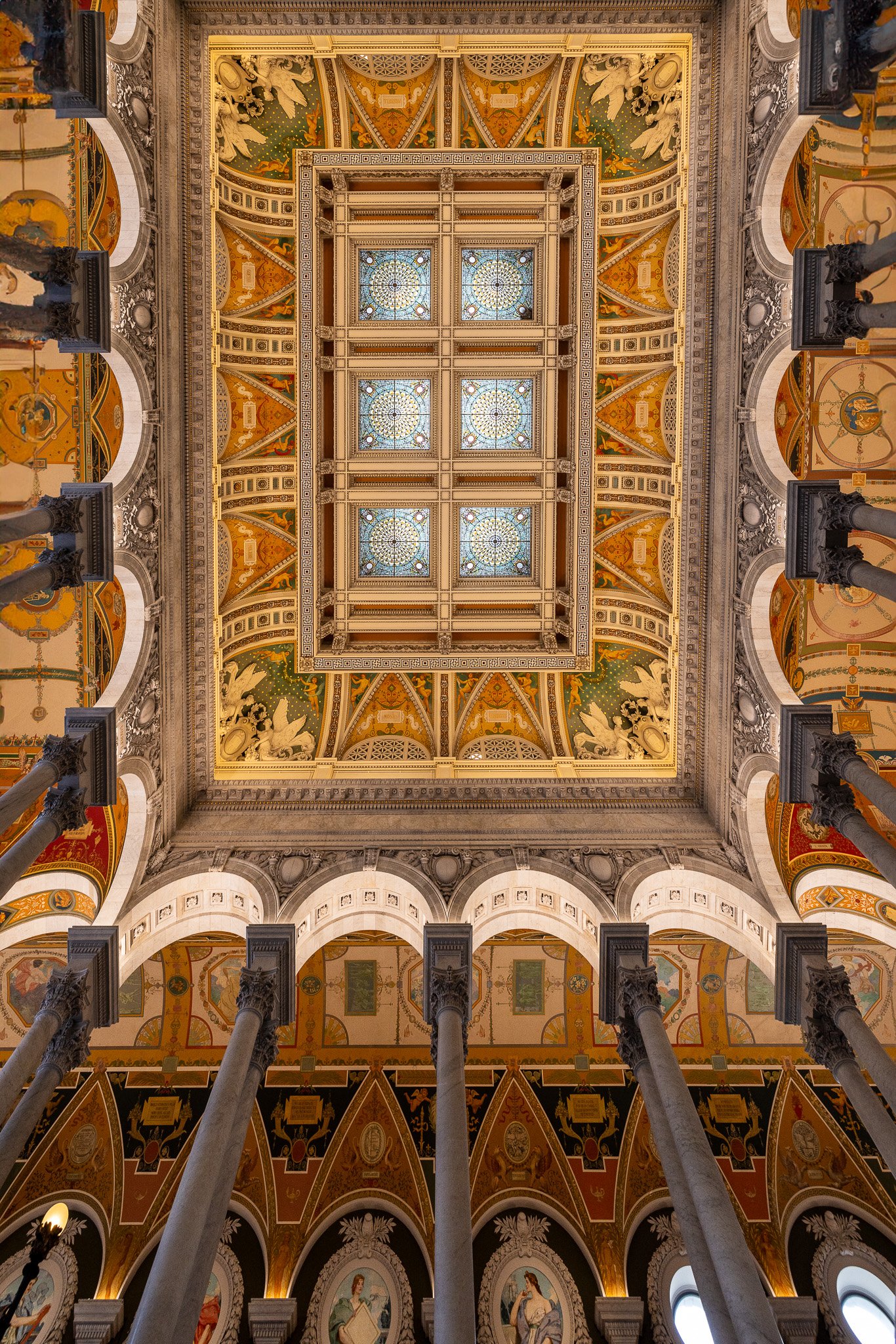
The Great Hall inside the Thomas Jefferson Building is one of the most ornate interior spaces in DC, all marble, mosaic, and gold leaf under a stained-glass ceiling. It photographs like a European cathedral more than a government building.
📷 Pro Tip: Use a 15 mm to 24mm lens to capture the full height of the Great Hall's ceiling and staircases. Bring a small tripod if allowed; interior light is warm but dim, and a wide aperture alone will leave you with noise.
Best time: Late morning, when light through the skylights is strongest. Access: Free, timed entry may apply. On Capitol Hill, across from the Capitol's east side.
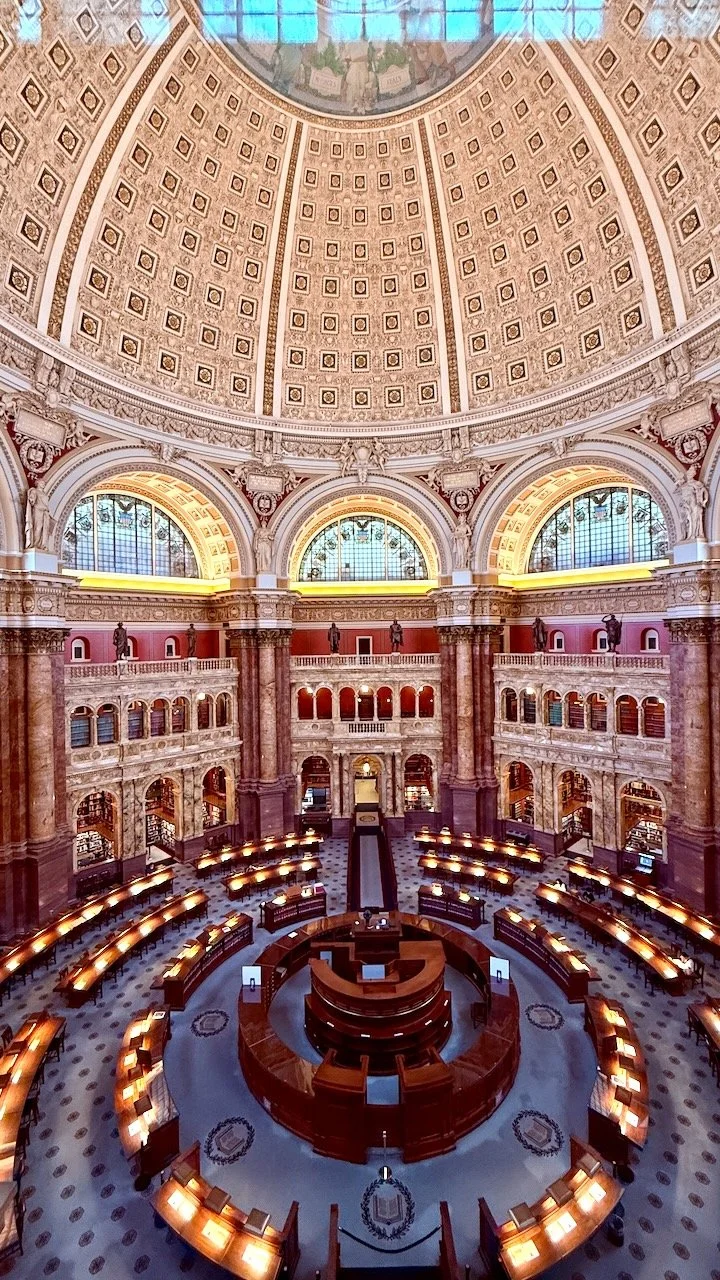
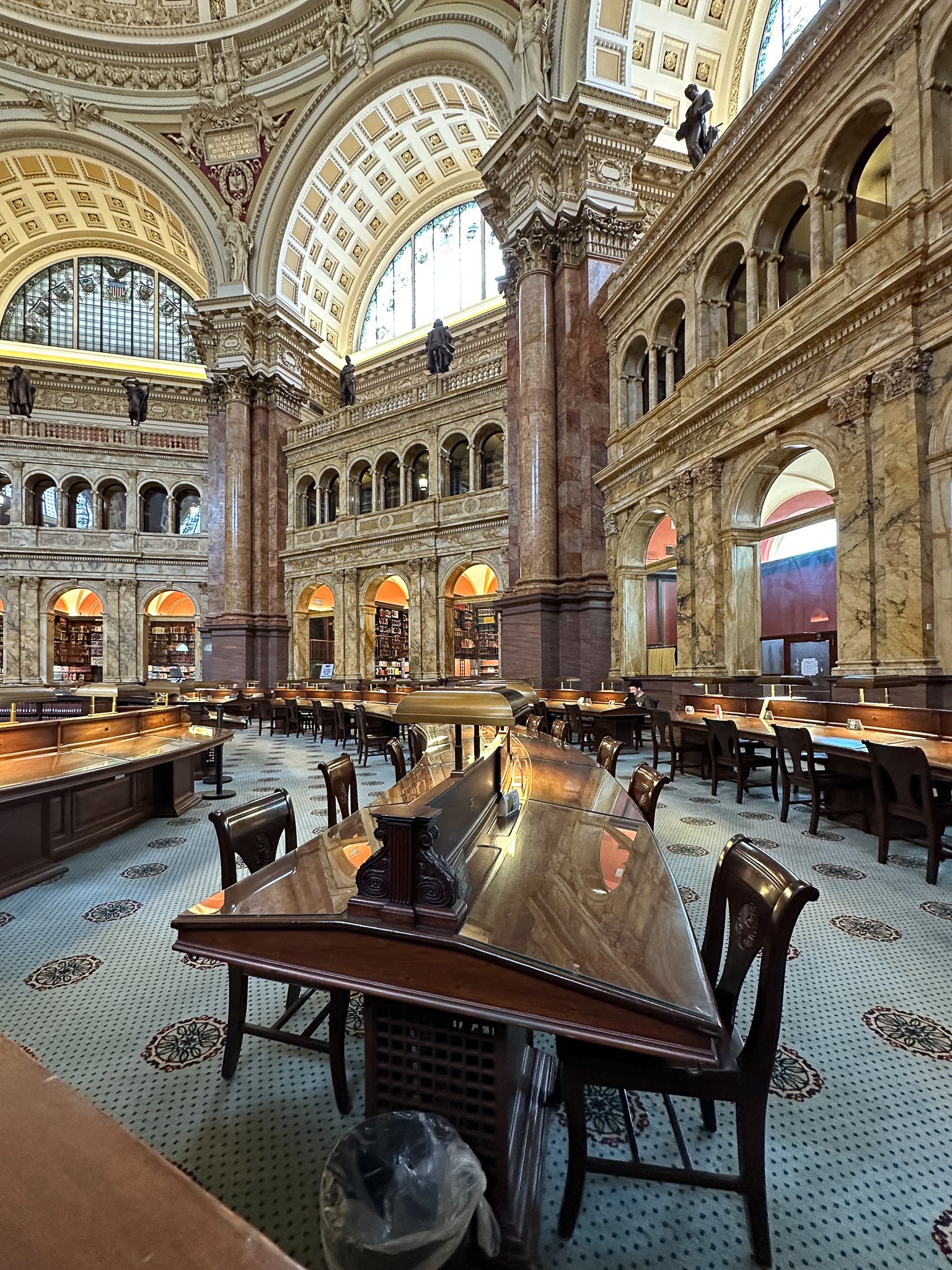
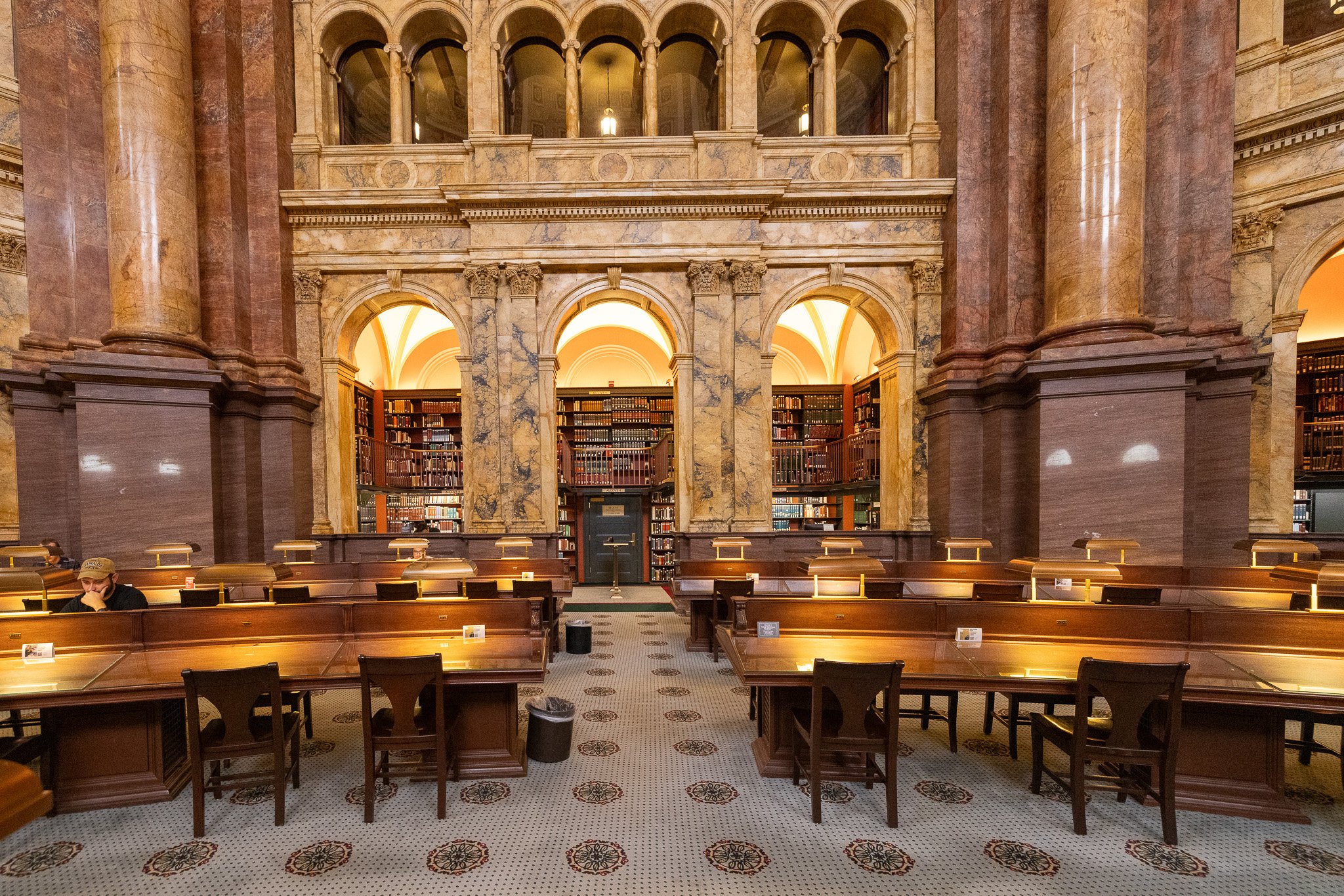
The Chamber of the Library of Congress
You can easily spend a few hours in the Library of Congress photographing the main chamber, the hallways, and the exterior of the building.
Arlington Cemetery
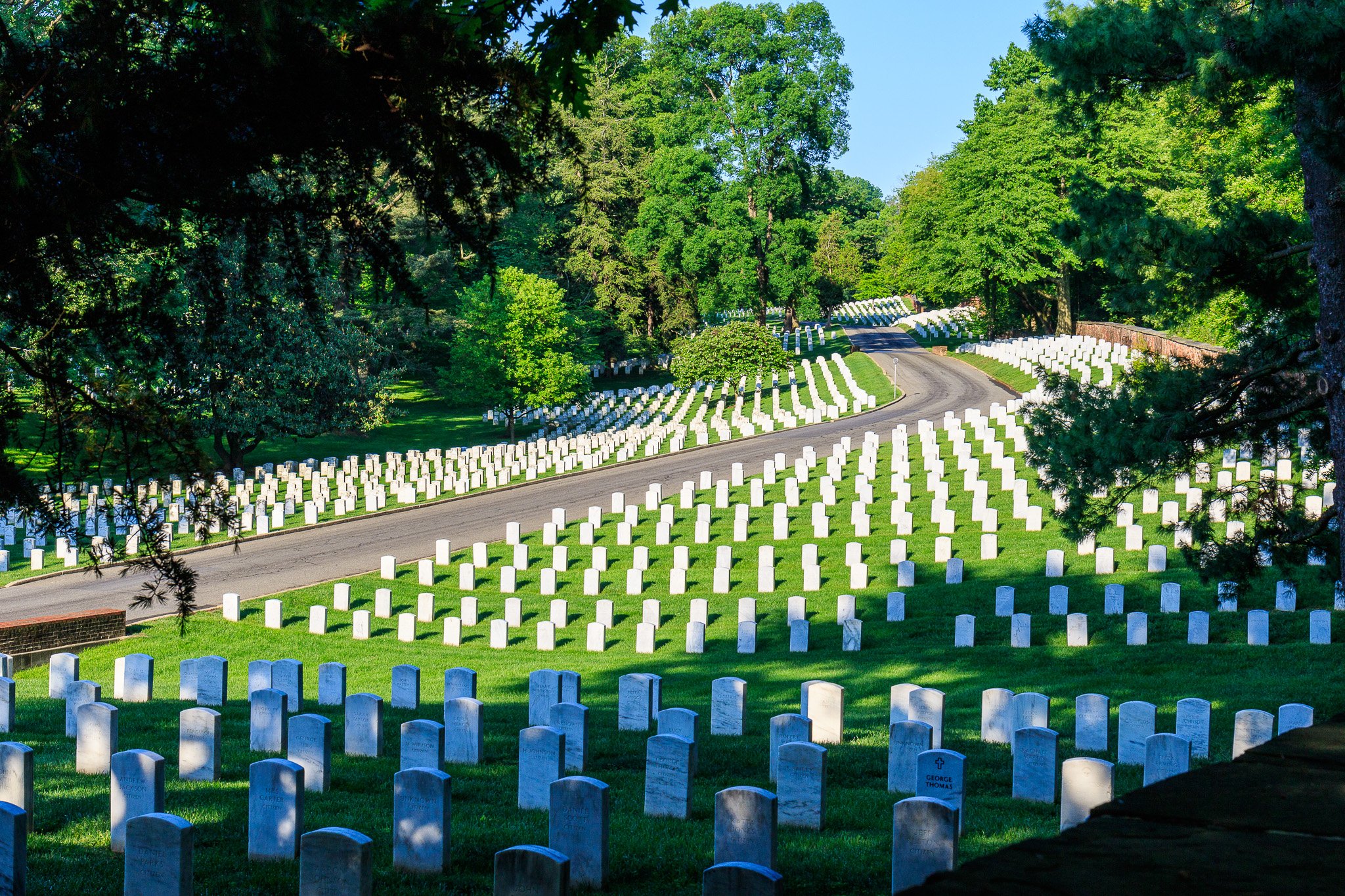
Arlington Cemetery, the 639-acre grounds, honors those who have served our nation. It is a beautiful, serene location with its rolling green hills and trees. The impressive landscape serves as a tribute to the service and sacrifice of every individual laid to rest within these hallowed grounds.
The rows of white headstones against the green hills create a graphic, repeating pattern that photographs differently depending on the angle. Straight down a row, they line up into a single vanishing point. From an angle, they read as texture across the whole hillside.
📷 Pro Tip: Shoot along the rows at a low angle with a 70mm to 200mm lens to compress the headstones into that dense, layered look. Early morning fog and low sun rake across the hills and add real atmosphere, but be conscious of visitors and services in progress. This is one of the most solemn locations in this guide. Keep a respectful distance, use a long lens rather than walking close, and never photograph a funeral or a family at a graveside.
Best time: Early morning. Access: Free, open daily with posted hours. Its own Metro stop on the Blue and Silver lines, directly across the river from the Lincoln Memorial.
Arlington Cemetery at Sunrise
The National Museum of African American History
The building's bronze corona facade is a striking subject on its own, and the way it catches late afternoon light against the sky makes the exterior worth shooting before you even go inside.
📷 Pro Tip: Shoot the exterior corona from across the street at the Washington Monument grounds with a 24mm to 70mm lens during golden hour, when the bronze lattice glows. Interior photography is allowed in most public areas, a fast prime lens helps in the lower-lit historical galleries.
Best time: Golden hour for the exterior. Access: Free, timed entry pass required, reserve online in advance. On the National Mall near 15th Street.
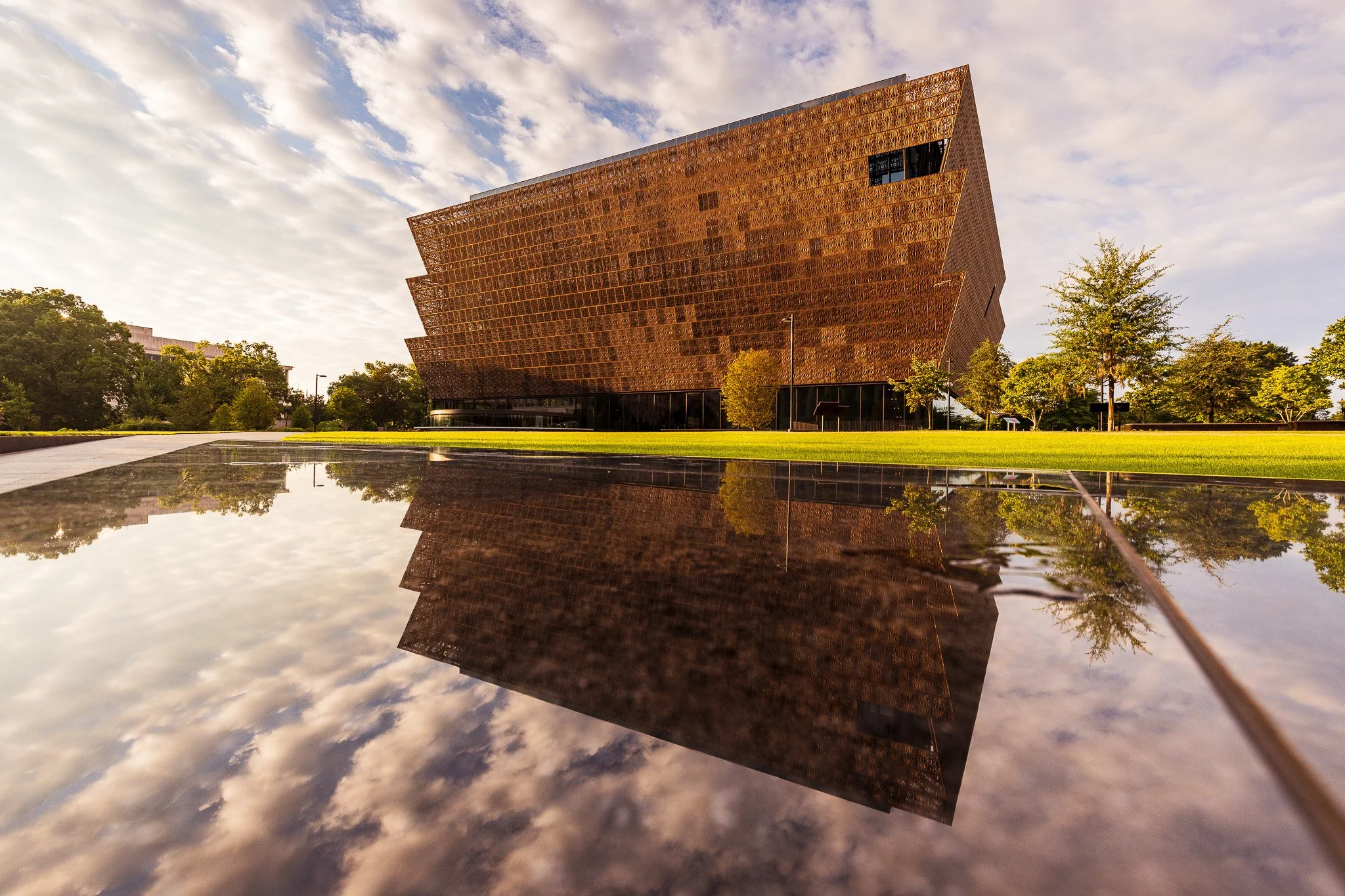
The distinctive bronze colored façade of the National Museum of African American History and Culture on the National Mall.
The National Museum of African American History and Culture is the only national museum dedicated to documenting African American life, history, and culture.

The National Museum of African American History and Culture illuminated during the 20th anniversary commemoration of September 11.
The Netherlands Carillon
Just across the river in Arlington, Virginia, this bell tower sits on a rise with one of the best unobstructed views of the DC skyline anywhere in the area, especially at sunset with cherry blossoms in bloom nearby in spring.
📷 Pro Tip: Use a 70mm to 200mm lens to compress the DC skyline behind the tower, especially effective at sunset. In late March to early April, the surrounding cherry trees frame the shot. Note this location is in Arlington, not DC proper, worth flagging for readers planning a walking day.
Best time: Sunset. Access: Free, open daily. Near Arlington National Cemetery, a short drive or rideshare from the Mall.

The Lincoln Memorial, Washington Monument, and U.S. Capitol compressed into one frame from the Netherlands Carillon in Arlington, Virginia.
It is one of the few places where you can take a photo of the Lincoln, Washington Monument, and US Capitol all in a line. With a long lens, the compression will make the monuments appear closer than they actually are. You will need to be at least 200 mm from this location.
It is also the best location to photograph the Fourth of July Fireworks.

The Washington, DC skyline from the Netherlands Carillon, one of my favorite locations for photographing the Fourth of July fireworks.
The Iwo Jima Memorial
Also across the river in Arlington, this bronze sculpture of the Marine Corps flag raising is monumental in scale and photographs dramatically against a sunset or blue hour sky.
📷 Pro Tip: Shoot from below with a 16mm to 24mm lens to emphasize the statue's height and drama against the sky. Blue hour brings out the memorial's uplighting well. Like the Carillon nearby, this is technically Arlington, Virginia, not DC, so note that for readers.
Best time: Blue hour. Access: Free, open 24 hours. Near Arlington National Cemetery, a short drive or rideshare from the Mall.
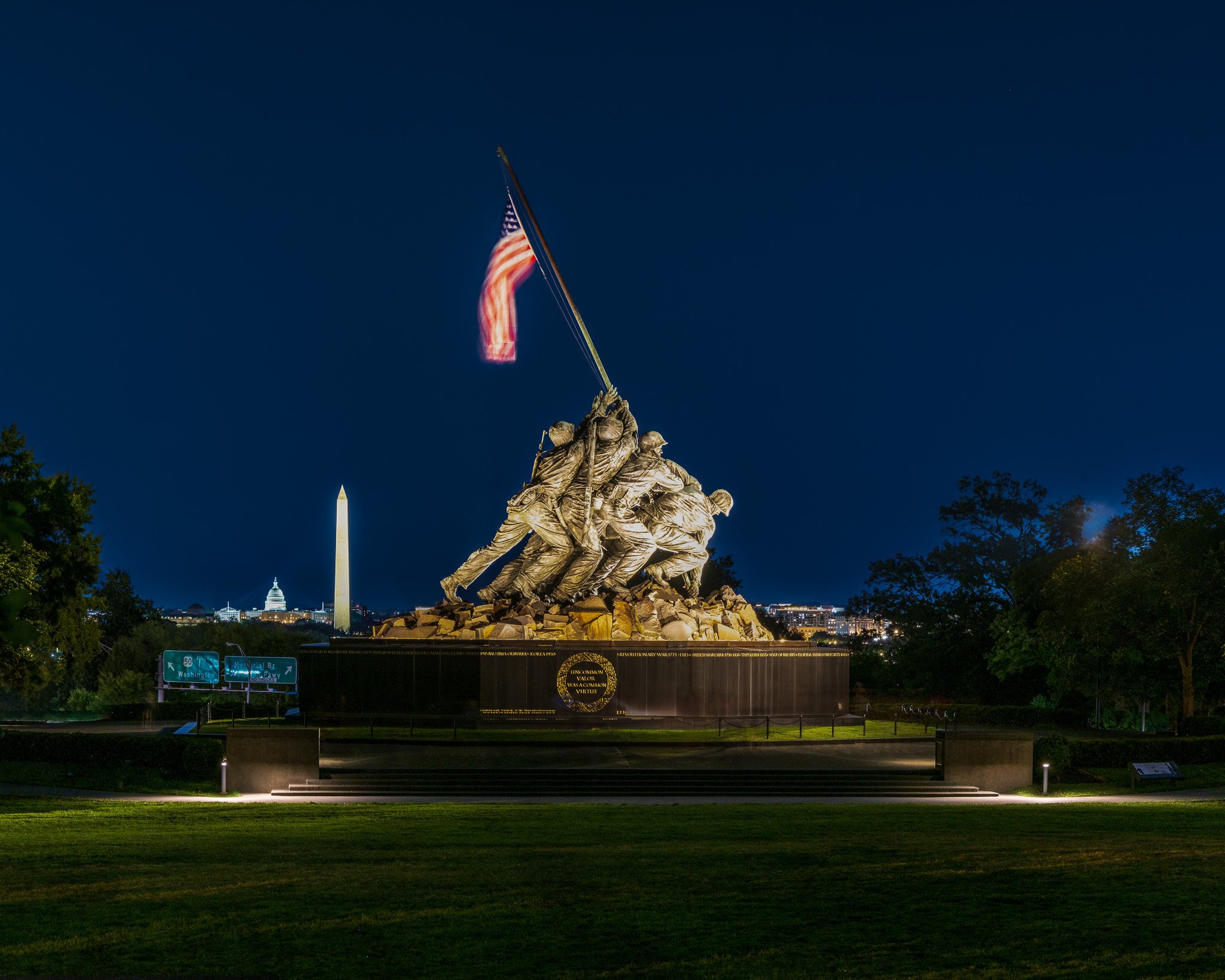
The U.S. Marine Corps War Memorial silhouetted against the early morning sky in Arlington, Virginia.
US Supreme Court
The Court's neoclassical facade, with its massive columns and the inscription "Equal Justice Under Law," is a clean, formal subject that photographs well in strong, direct light.
📷 Pro Tip: Shoot straight on from across First Street with a 24mm to 35mm lens to capture the full facade and steps symmetrically. Midday sun works better here than most Mall locations since the white marble handles harsh light well.
Best time: Midday. Access: Free to view exterior; interior tours limited. On Capitol Hill, directly across from the Capitol.

The classical marble façade of the United States Supreme Court across from the U.S. Capitol.
Washington National Cathedral
The Gothic architecture here, flying buttresses, gargoyles, and stained glass, gives you a completely different photographic language than anywhere else on this list. It's the closest DC gets to European cathedral photography.
📷 Pro Tip: Use a 16mm to 35mm lens for the exterior facade and a fast prime for the stained glass interior shots, light through the windows shifts dramatically through the day. Exterior gargoyle detail shots work best with a mid telephoto, 70mm to 100mm, from the grounds below.
Best time: Mid-morning for interior light. Access: Ticketed for some areas, free grounds access. In upper northwest DC, a drive or rideshare from downtown.

The Gothic architecture of Washington National Cathedral rises above northwest Washington, DC.
Do not miss Bishop Gardens in the back of the Cathedral. These gardens are just beautiful. A perfect place to visit for an afternoon walk.
The Friendship Arch in Chinatown
This ornate arch spanning H Street is one of the largest single-span Chinese arches outside China, and it's especially photogenic at night when fully lit.
📷 Pro Tip: Shoot straight down H Street with a 24mm to 35mm lens after dark to capture the arch fully lit against the city backdrop. A tripod helps for a longer exposure that lets the colors read cleanly.
Best time: After dark. Access: Free, public street. Downtown, near Gallery Place-Chinatown Metro.

The colorful Friendship Archway marking the entrance to Washington, DC’s Chinatown.
One of the most interesting things to photograph in the Arboretum is the original US Capitol columns.
Union Station
The Beaux-Arts main hall, with its barrel-vaulted ceiling and grand columns, is one of the most impressive interior spaces in the city and often overlooked since it's a functioning train station.
📷 Pro Tip: Use a 16mm to 24mm lens from the balcony level to capture the full scale of the main hall ceiling. Morning light through the skylights is strongest before midday crowds fill the concourse.
Best time: Early morning on weekdays. Access: Free to enter as a public building. Near Capitol Hill, its own Metro stop.

The grand Beaux Arts interior of Washington Union Station.
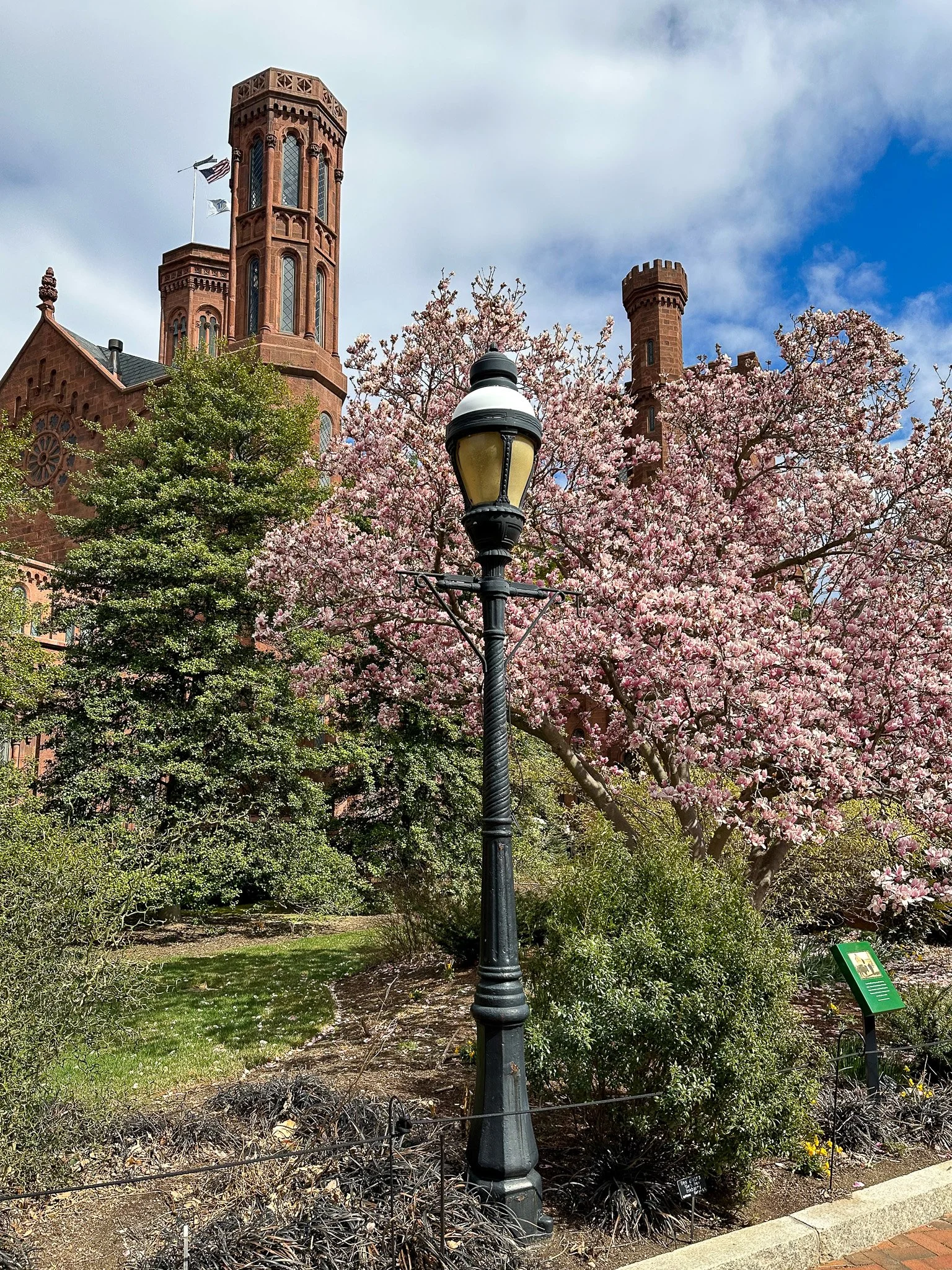
Smithsonian Castle & Enid A. Haupt Garden
The red sandstone Smithsonian Castle looks like something out of a fairy tale against the Mall's classical white marble, and the adjacent Haupt Garden gives you a formal, seasonal garden shot right next door.
📷 Pro Tip: Shoot the Castle's towers and turrets with a 24mm to 70mm lens from the garden side, where flowering beds add color and depth to the foreground. Late afternoon light warms the red stone nicely.
Best time: Late afternoon. Access: Free. On the National Mall near 10th Street.

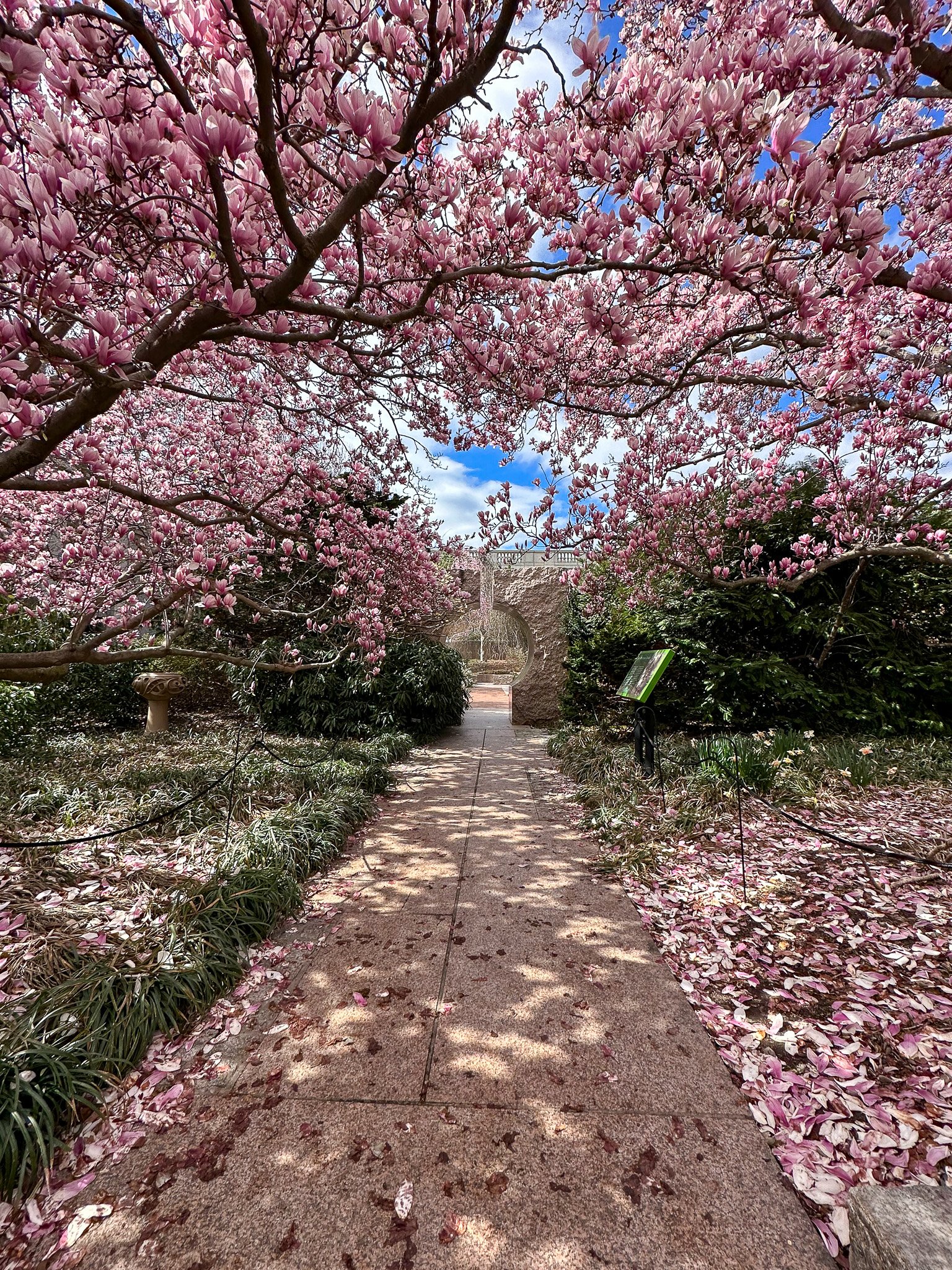
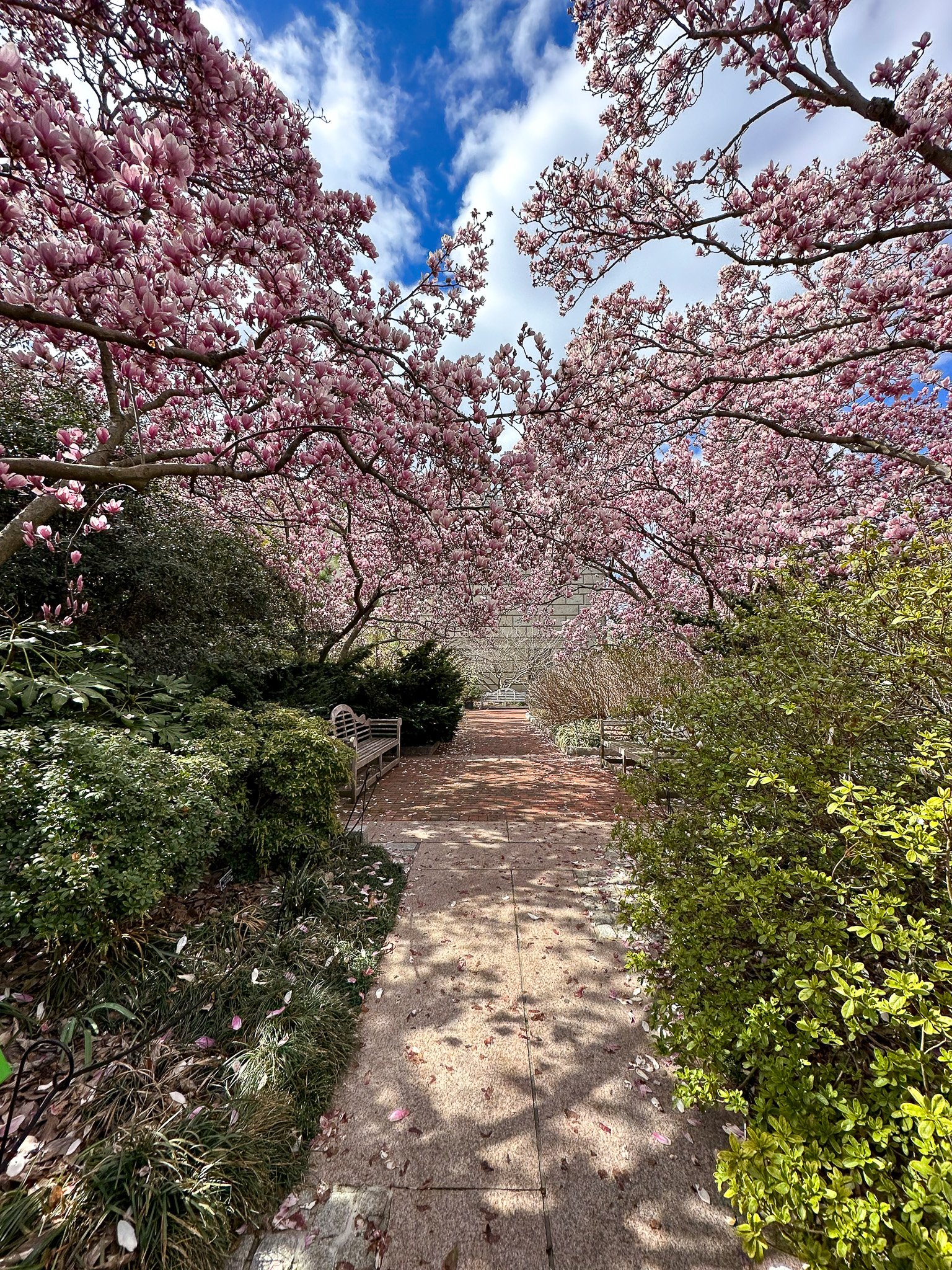
Magnolia Flowers by Enid Haupt Garden
The area is very popular with local photographers. You will often see couples taking engagement photos.
James Madison Memorial Building
This is the Library of Congress's more modern, less-visited building, and its scale and stark architecture offer a strong contrast to the ornate Jefferson Building nearby.
The James Madison Memorial Building is one of three United States Capitol Complex buildings that house the Library of Congress. The building was constructed from 1971 to 1976, and serves as the official memorial to United States Founding Father and President James Madison.
📷 Pro Tip: Shoot the exterior's clean geometric lines with a 24mm to 35mm lens in overcast light, which suits the building's minimalist concrete facade better than harsh sun.
Best time: Overcast days. Access: Free to enter as a public building. On Capitol Hill, near the Library of Congress's main building.
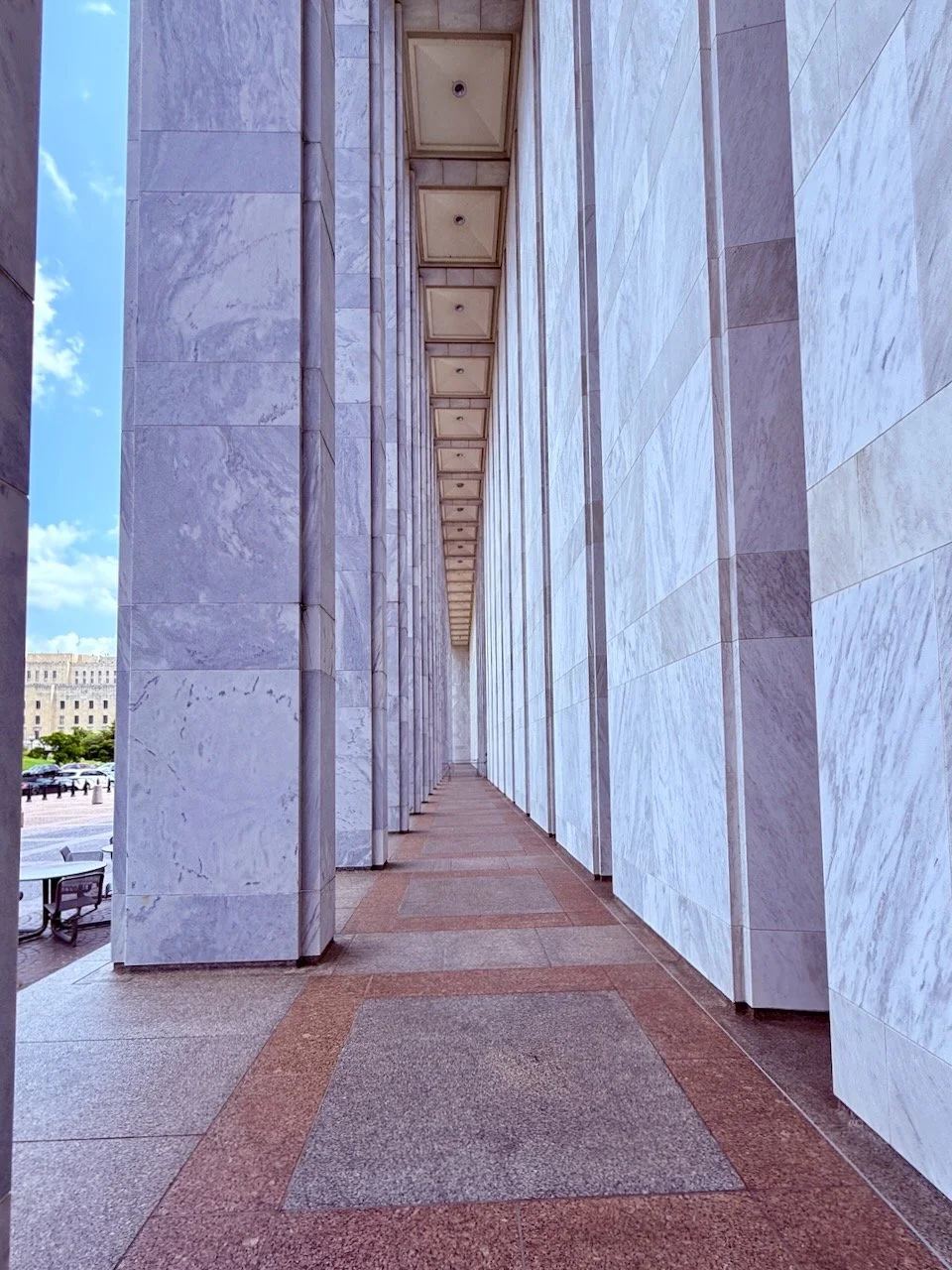
Repeating columns and strong geometric lines outside the James Madison Memorial Building near the U.S. Capitol.
The National Gallery of Art
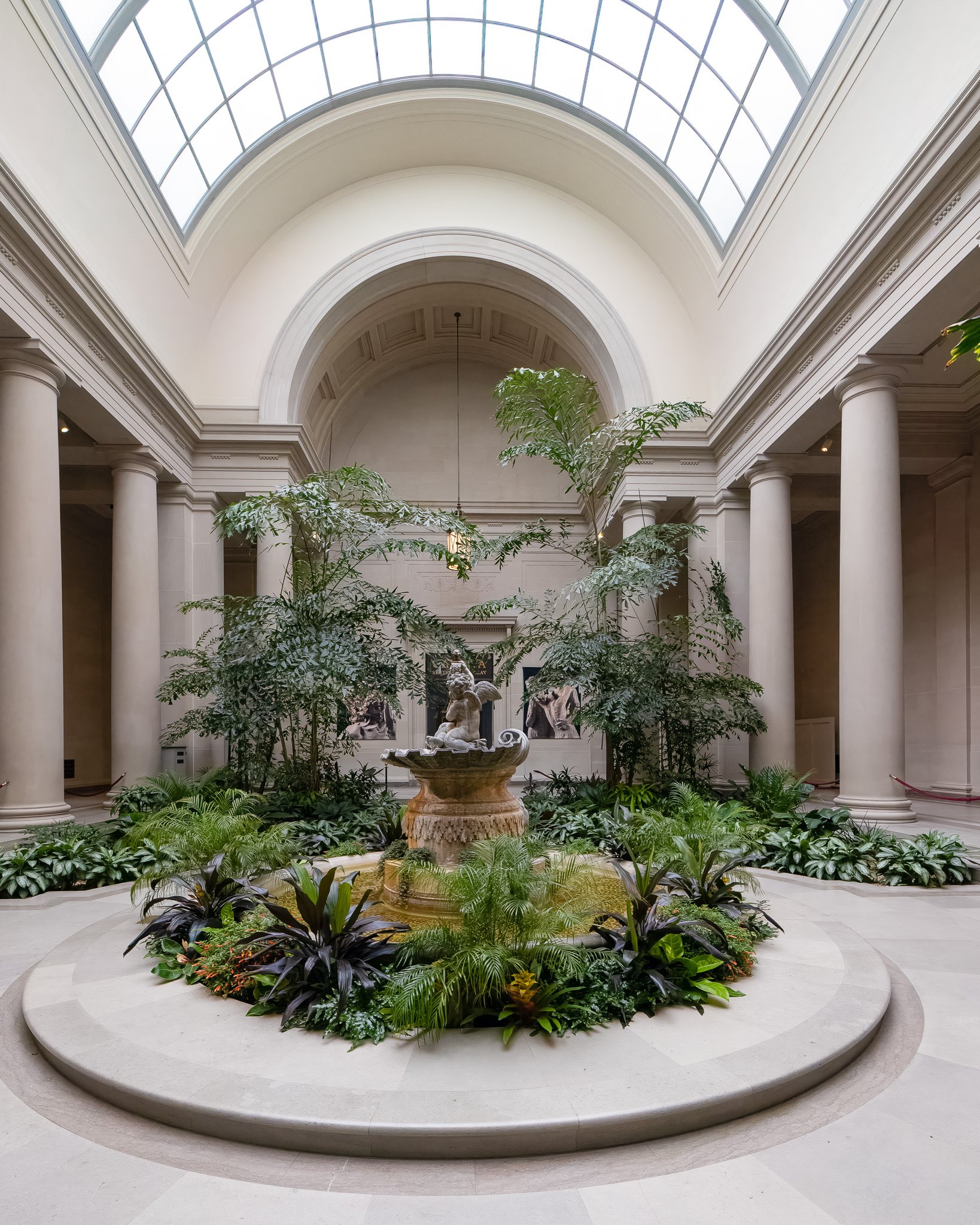
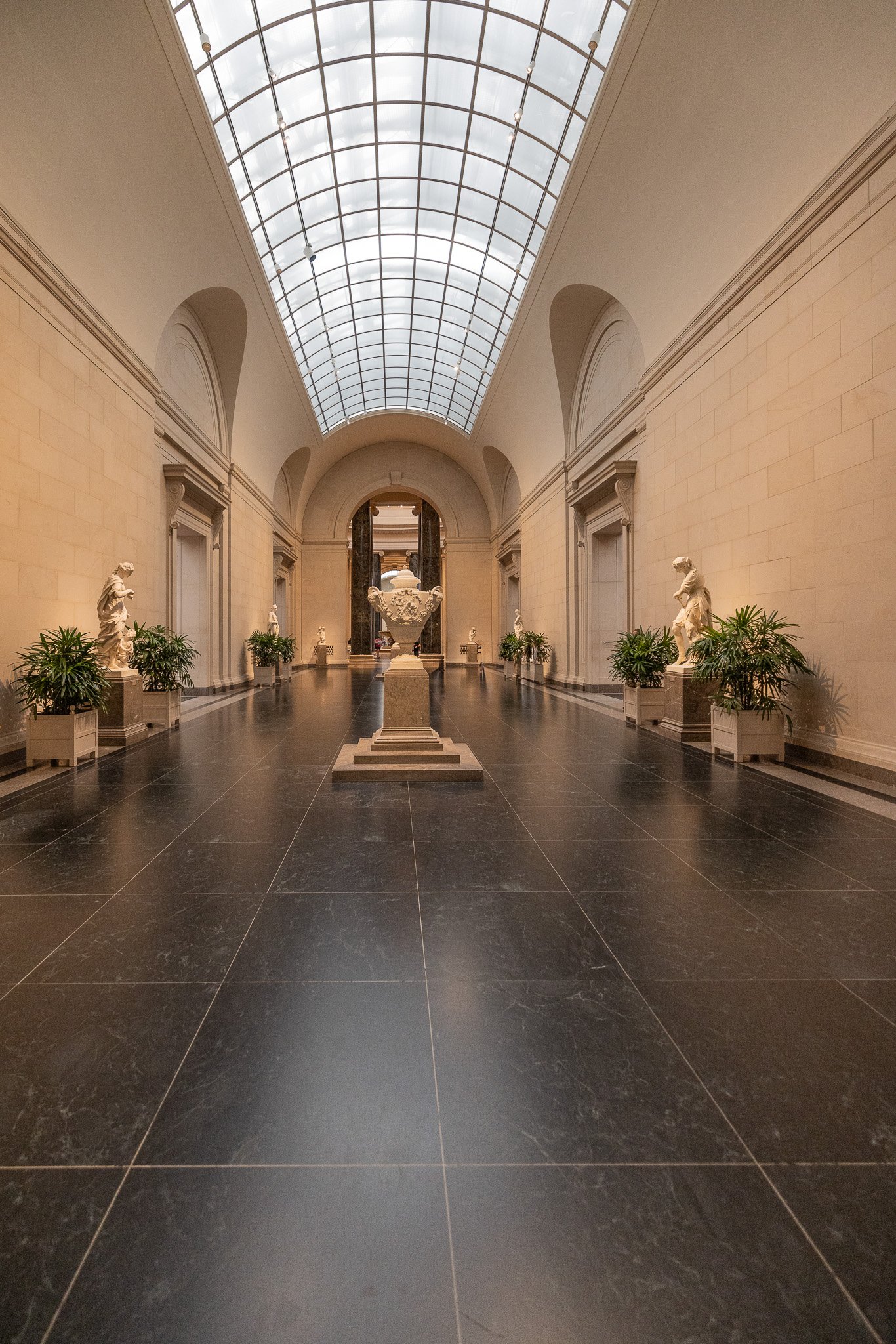
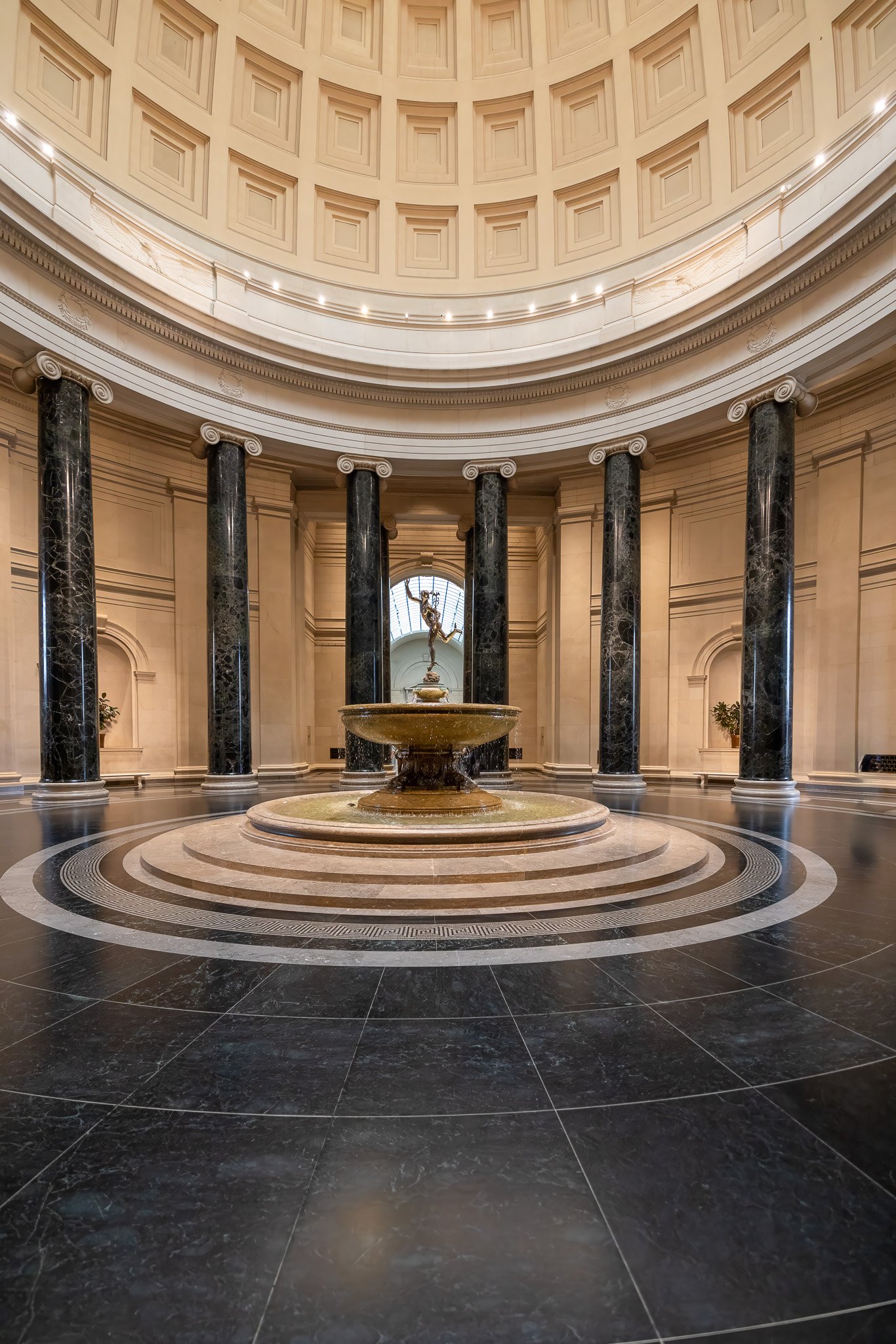
Between the East and West Buildings, you get both a striking I.M. Pei glass pyramid atrium and classical rotunda architecture, plus one of the best art collections in the country as a bonus.
📷 Pro Tip: In the East Building, shoot the angular glass atrium with a 16mm to 24mm lens to capture the geometric ceiling. In the West Building's rotunda, a wider lens captures the domed ceiling and central fountain symmetrically.
Best time: Late morning for interior light. Access: Free. On the National Mall, between 3rd and 7th Street.

The Center area of the National Gallery of Art
There are lots of fantastic architectural spots to shoot inside the National Gallery.
Culture House (formerly Blind Whino)
This former church turned arts space is covered in a vivid, colorful mural on its exterior, making it one of the most vibrant single-building photo subjects in the city, a strong contrast to the Mall's white marble.
📷 Pro Tip: Shoot straight on with a 24mm to 35mm lens in soft, even light, overcast days or shade prevent harsh shadows from breaking up the mural's color and detail.
Best time: Overcast or shaded midday. Access: Free to photograph exterior. Southwest DC.
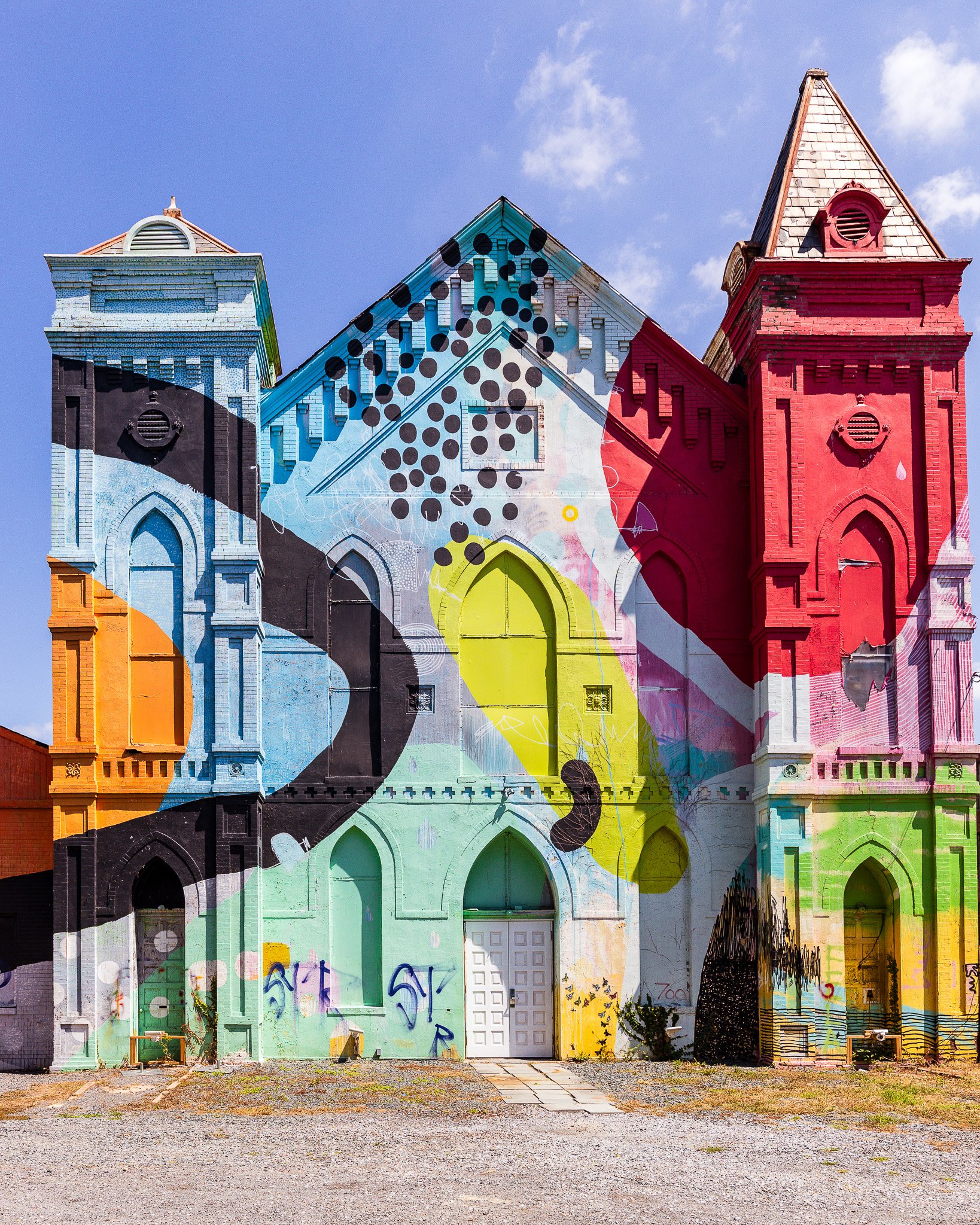
The Blind Whino Church with Graffiti
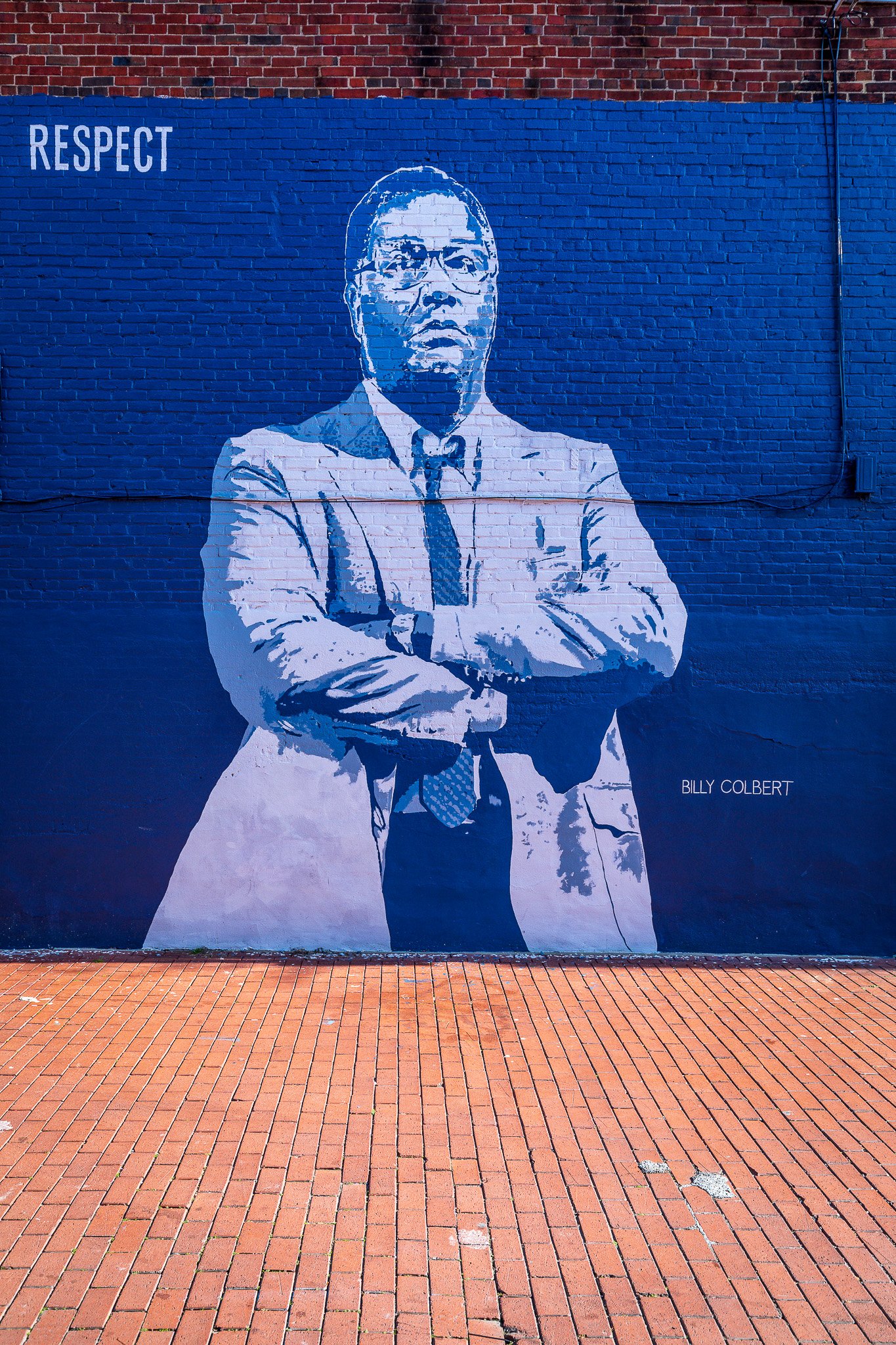
Street Art & Murals
DC Graffiti & Murals -There are so many amazing Murals in Washington, DC. My newest book on DC Murals and Graffiti can be found on Amazon.
The city has definitely embraced the artist and has created a website where you can find more information on the Murals and the Artists. More and more murals are popping up, and not all of the murals are found on the DC Website. So I have created my own Google Map with all the murals I have found so far. I am always searching for new pieces, and the list keeps growing.
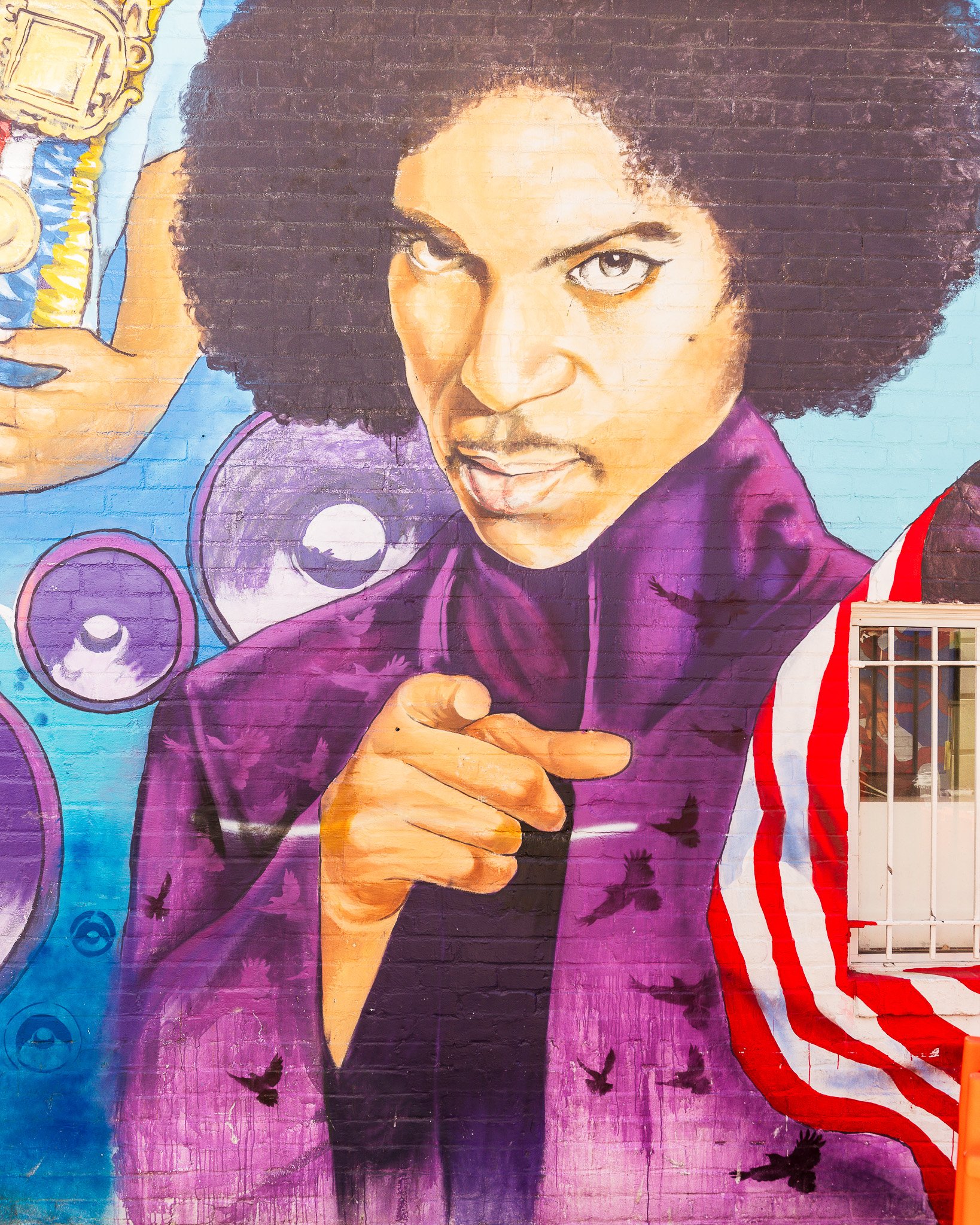
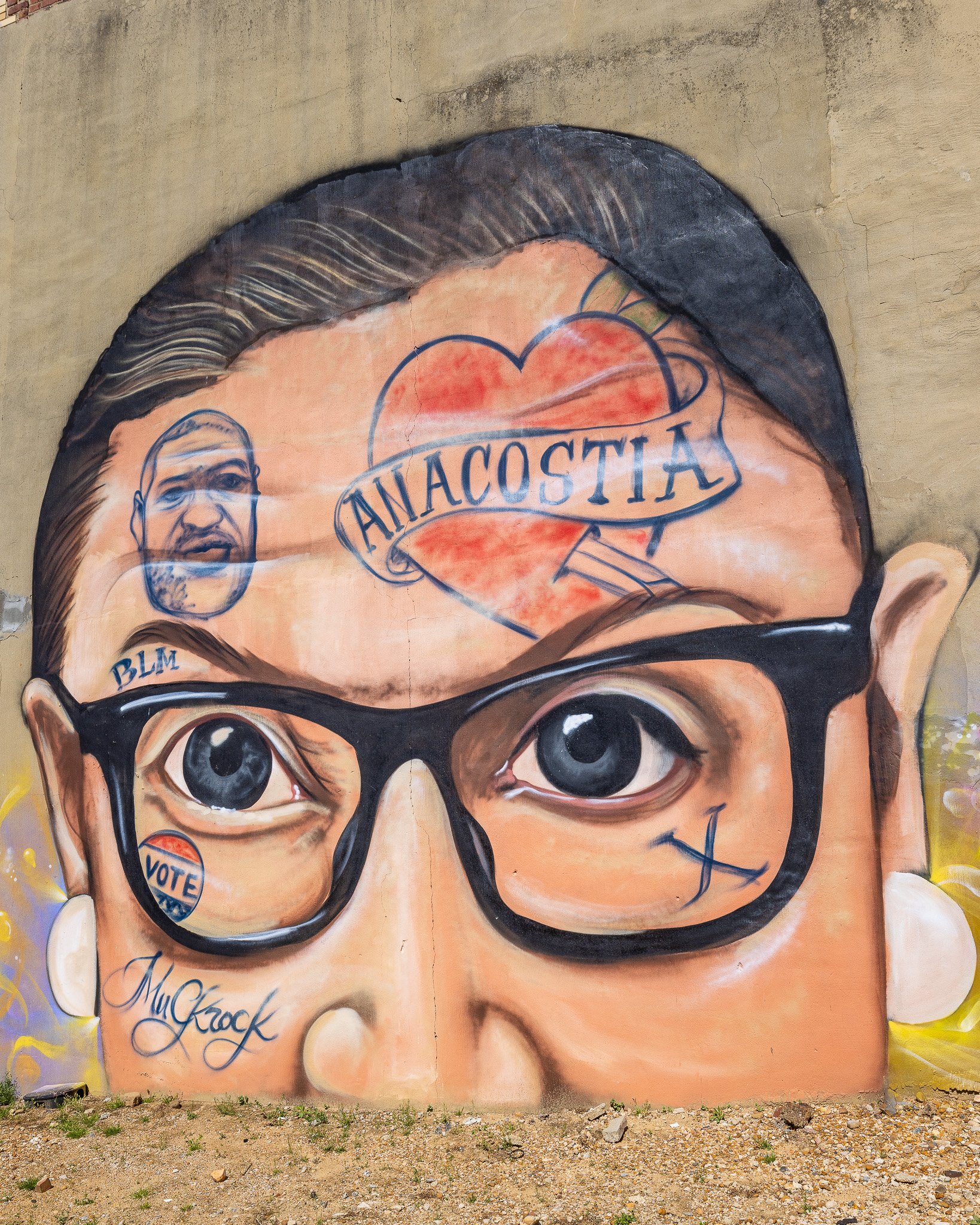
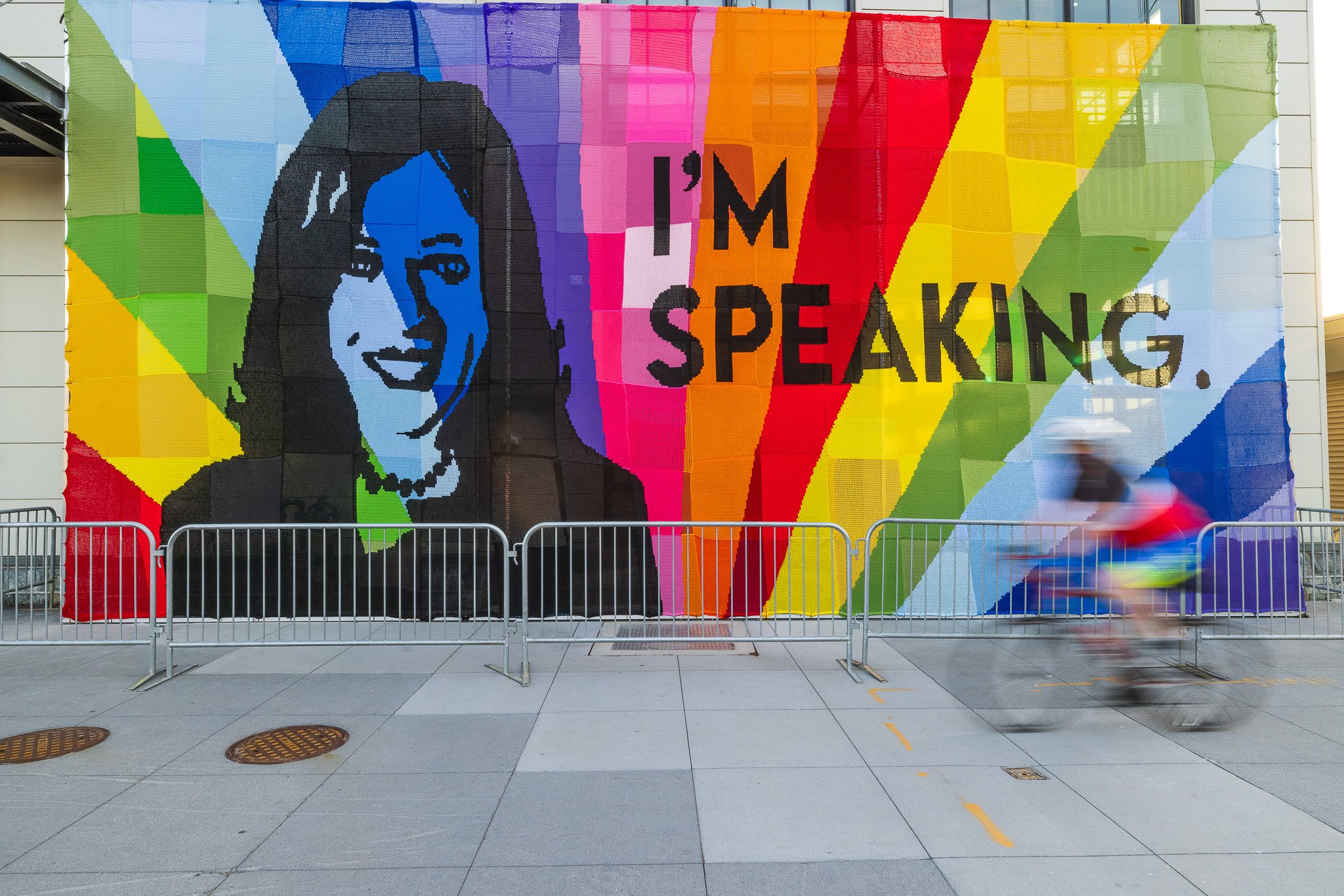
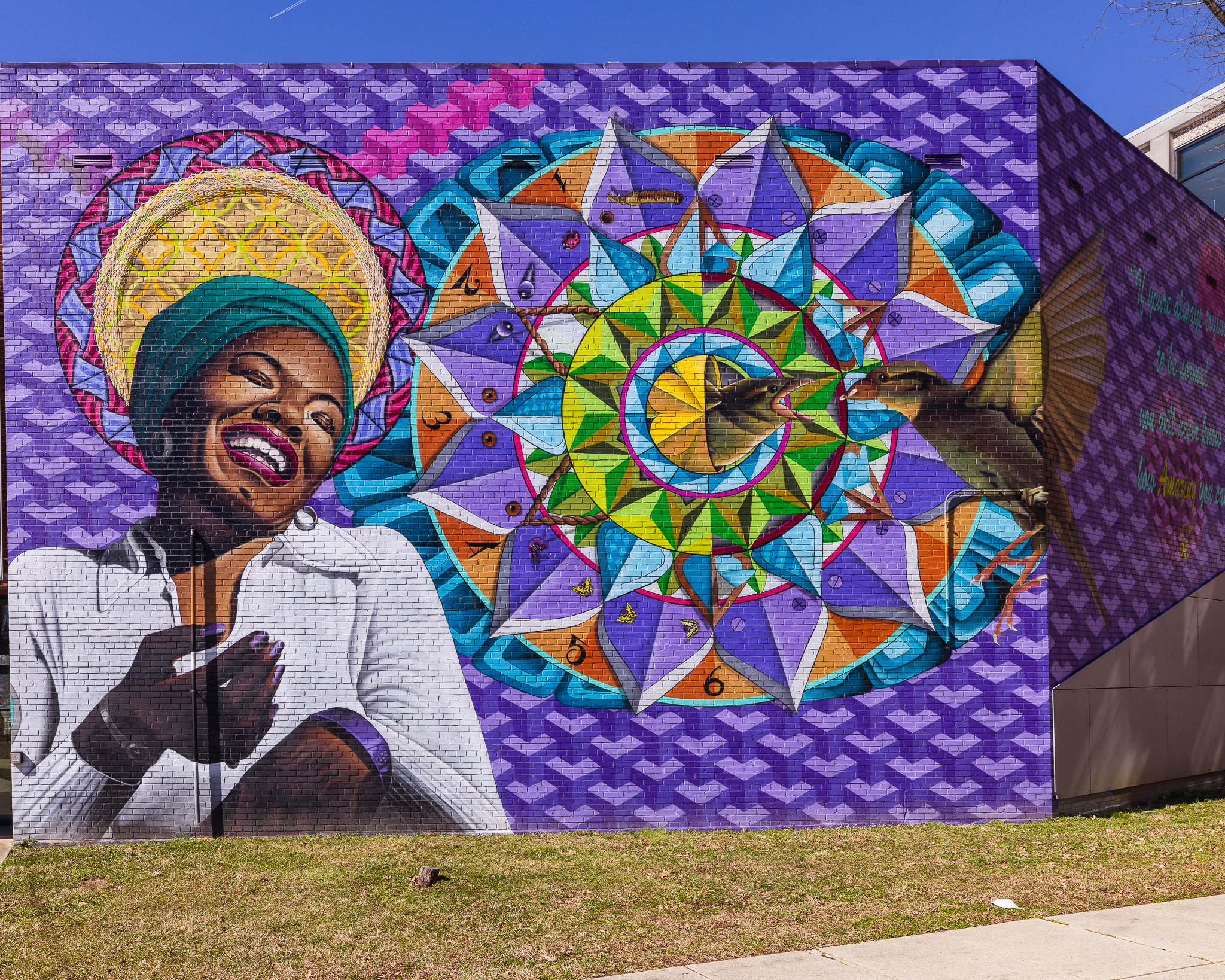
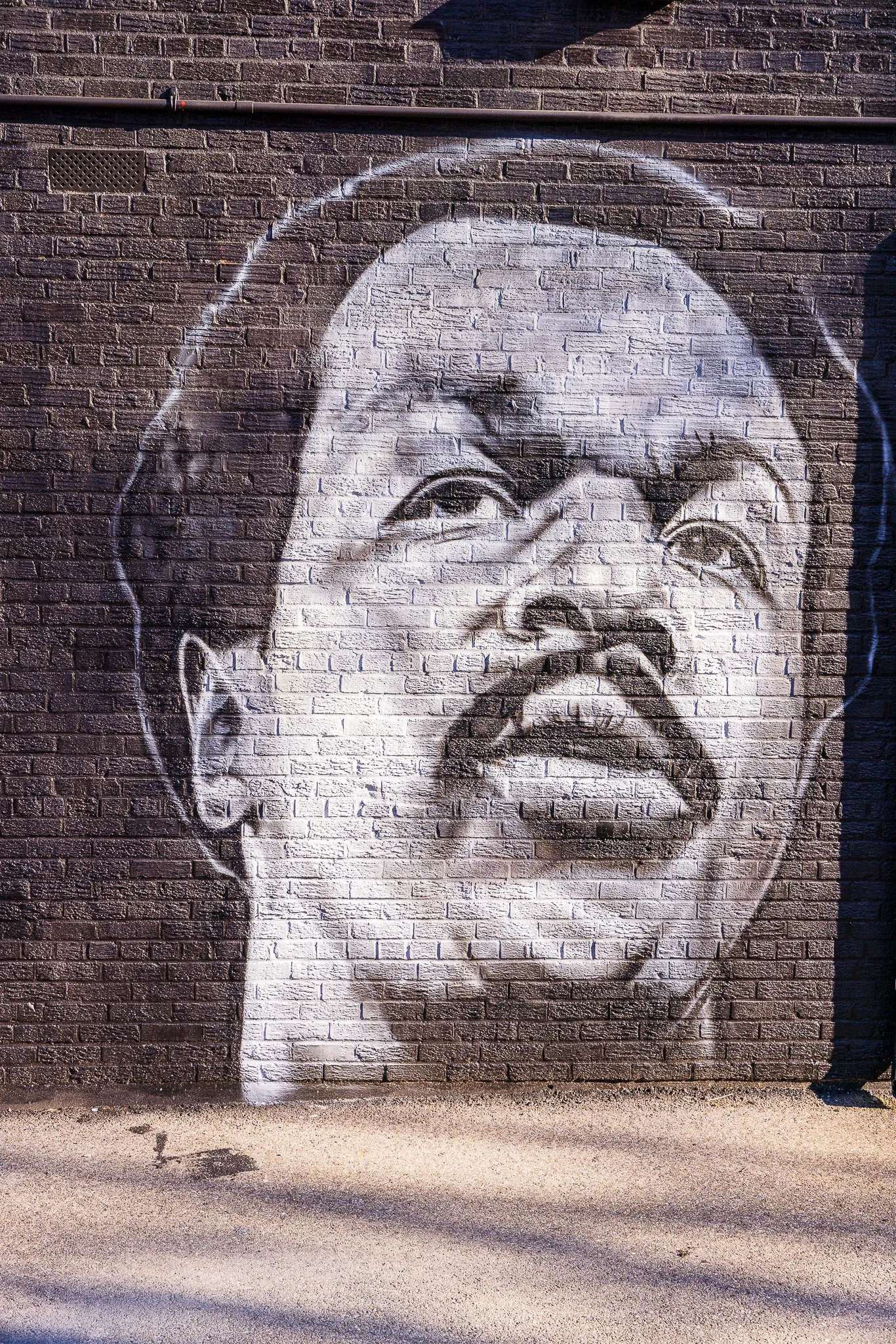
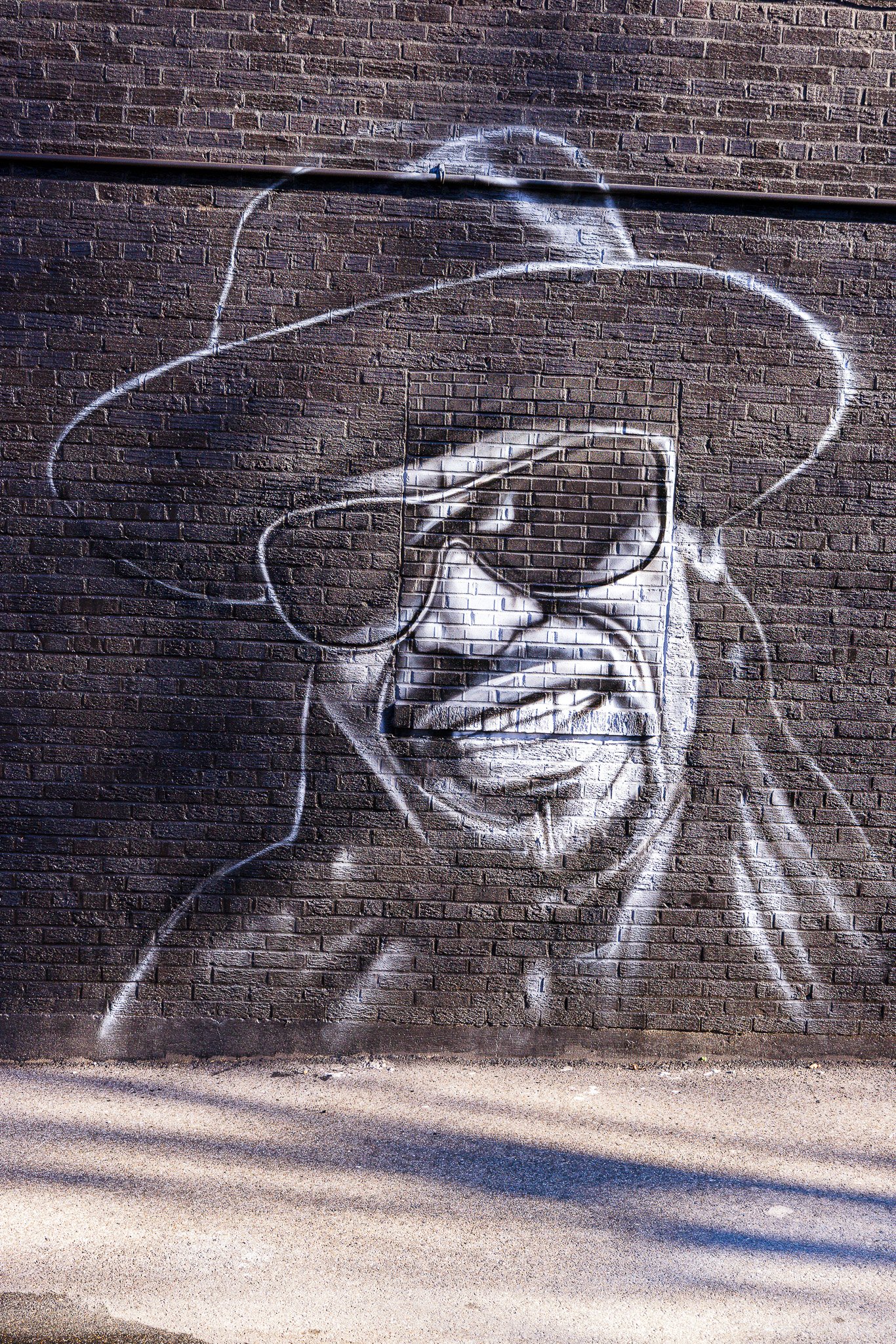

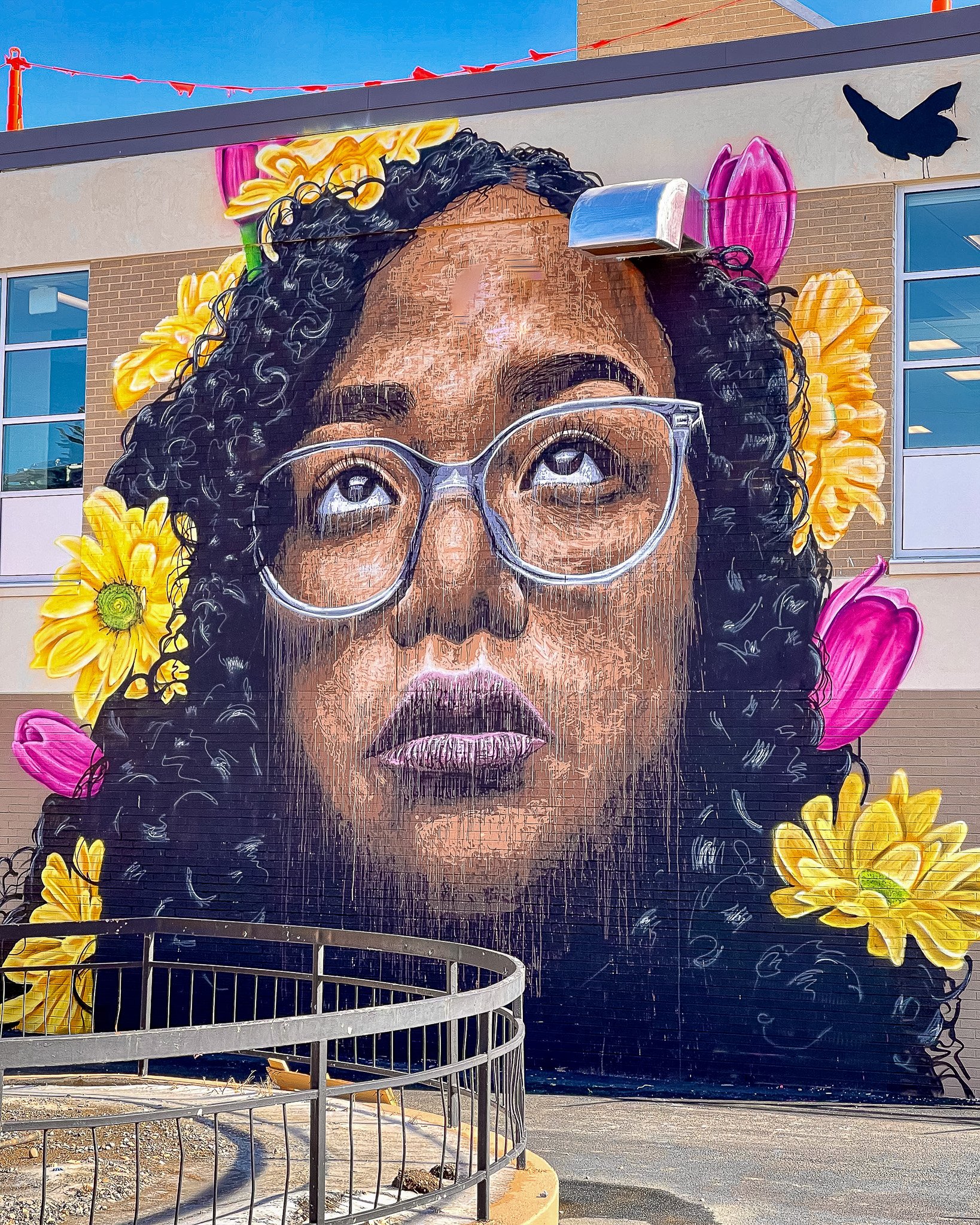
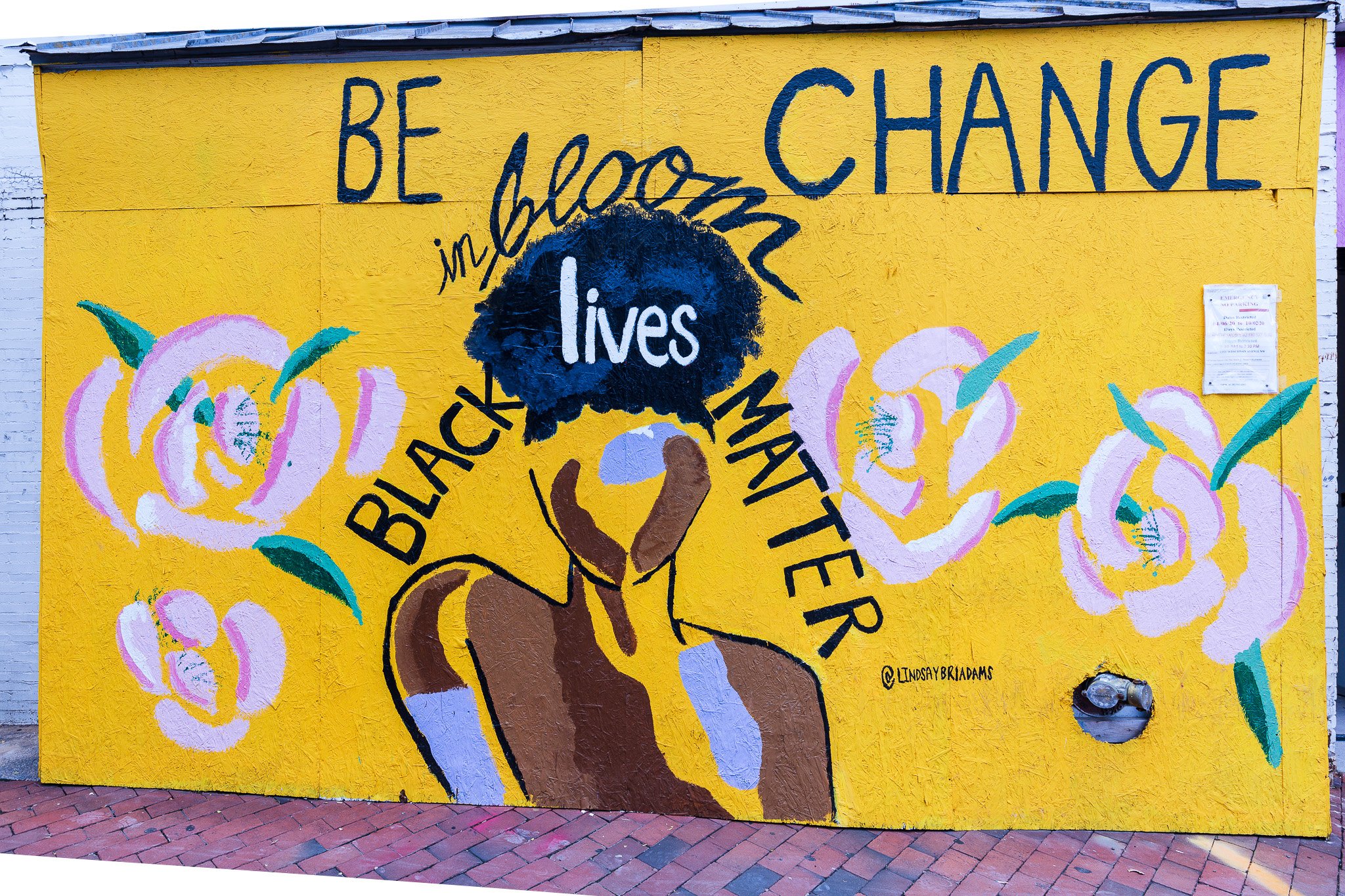
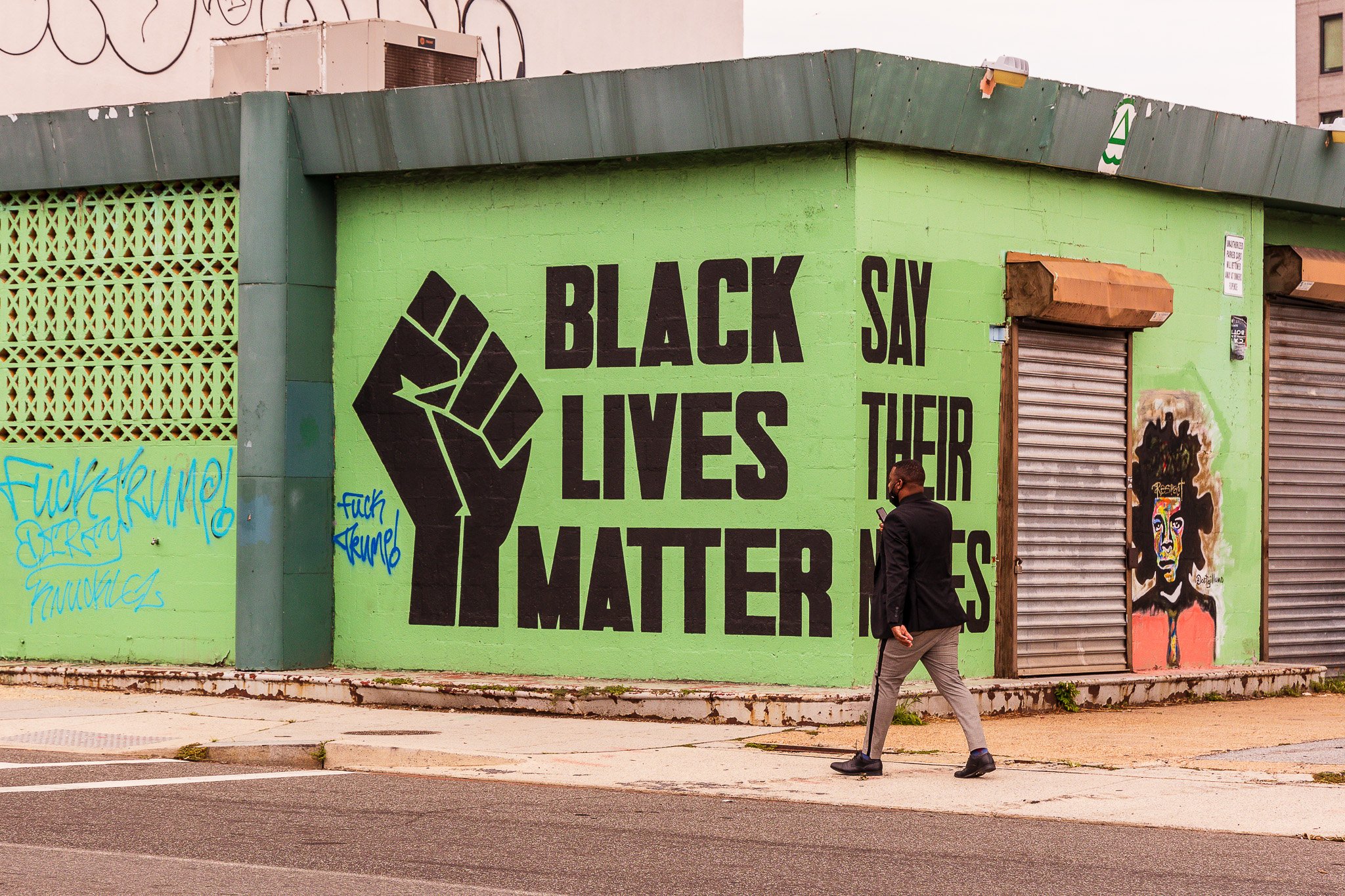
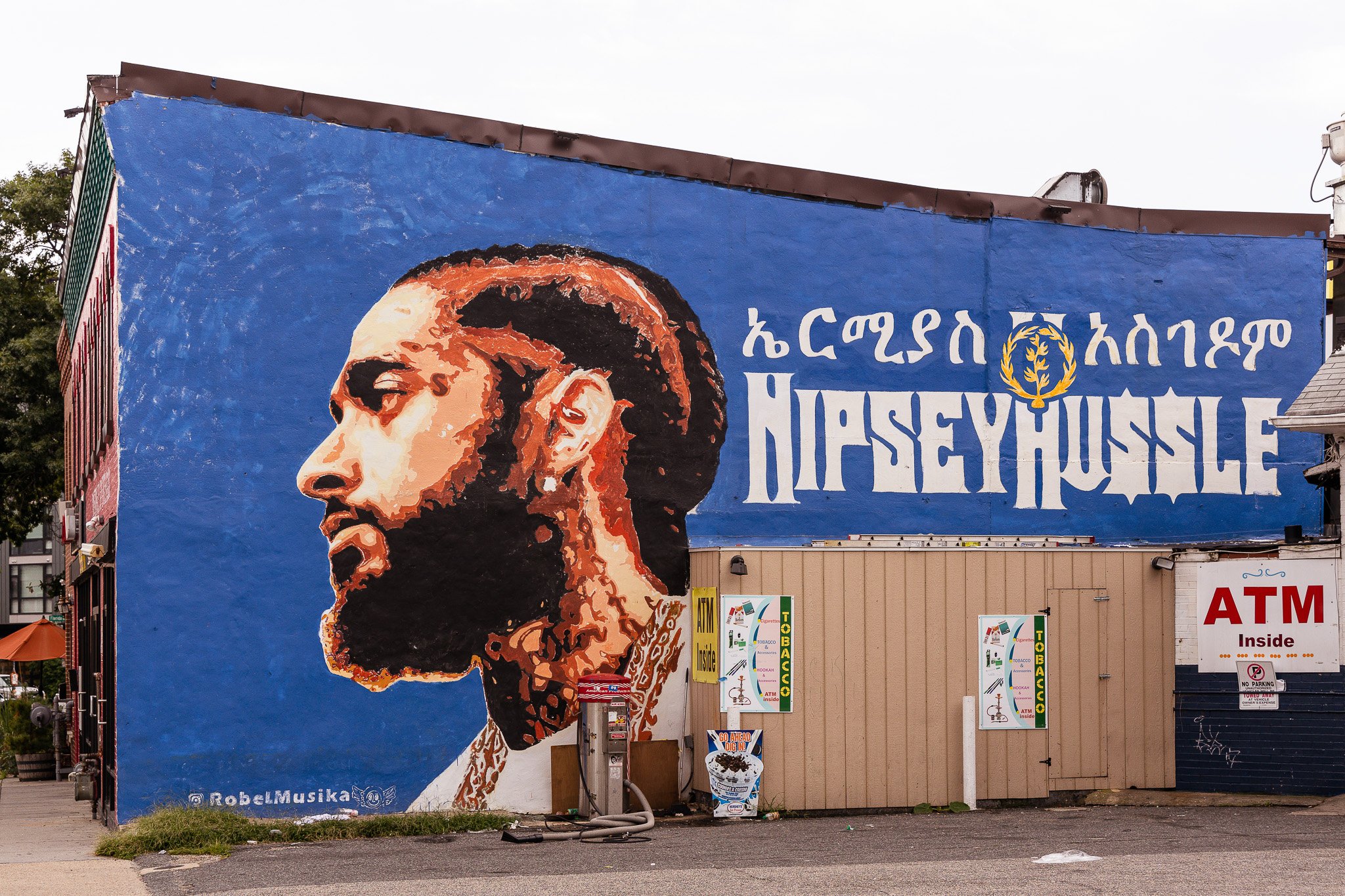
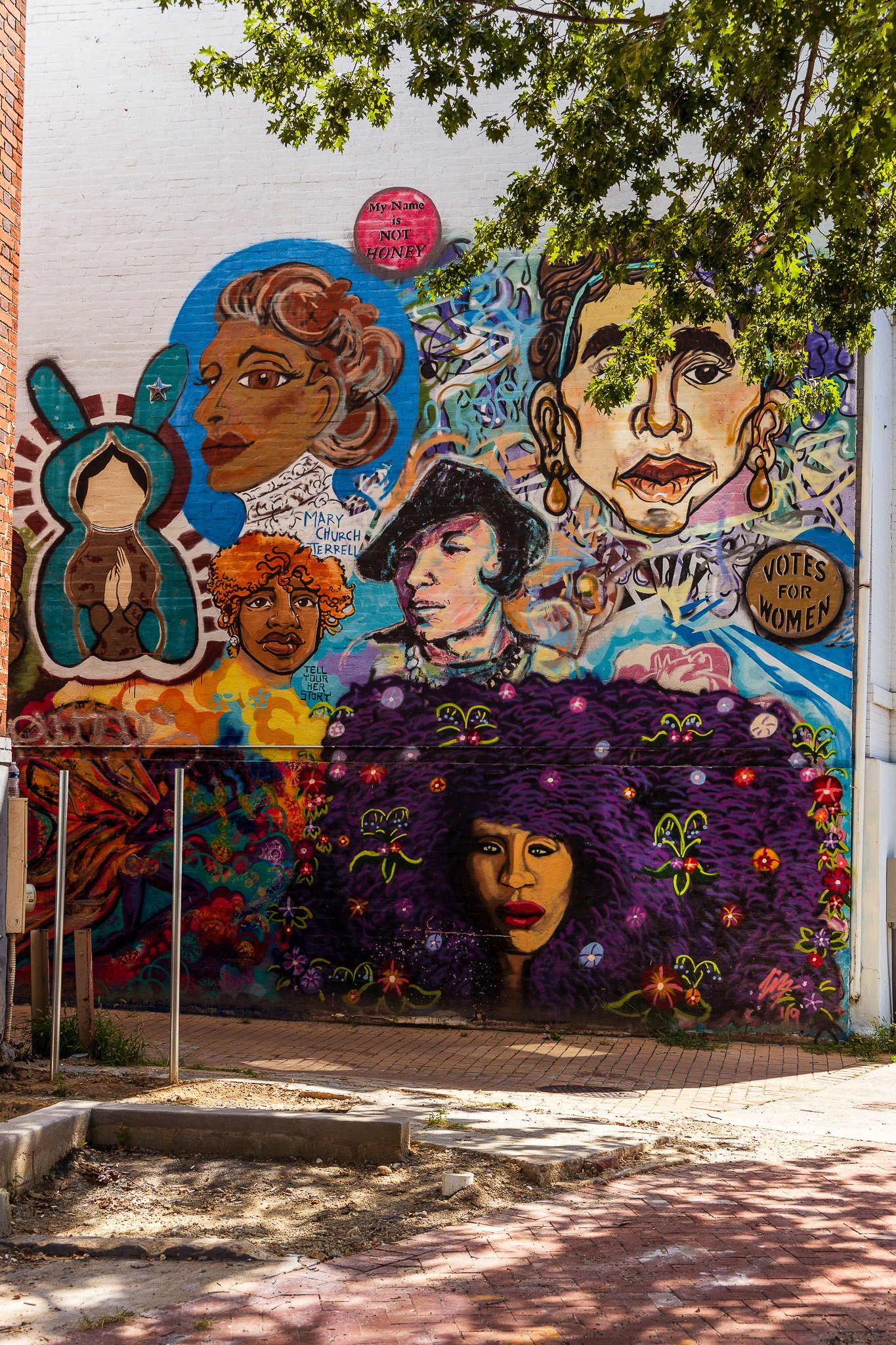
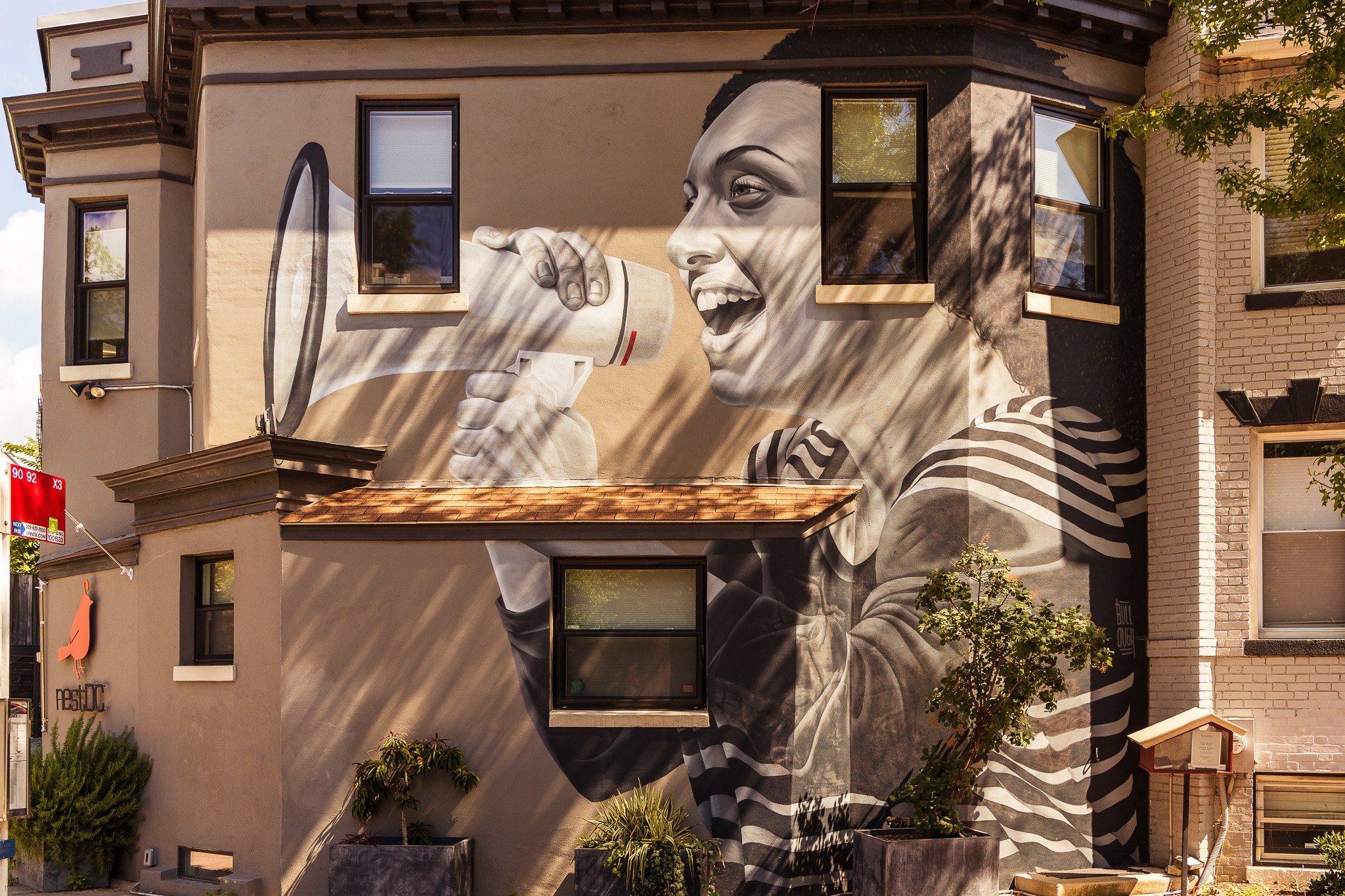
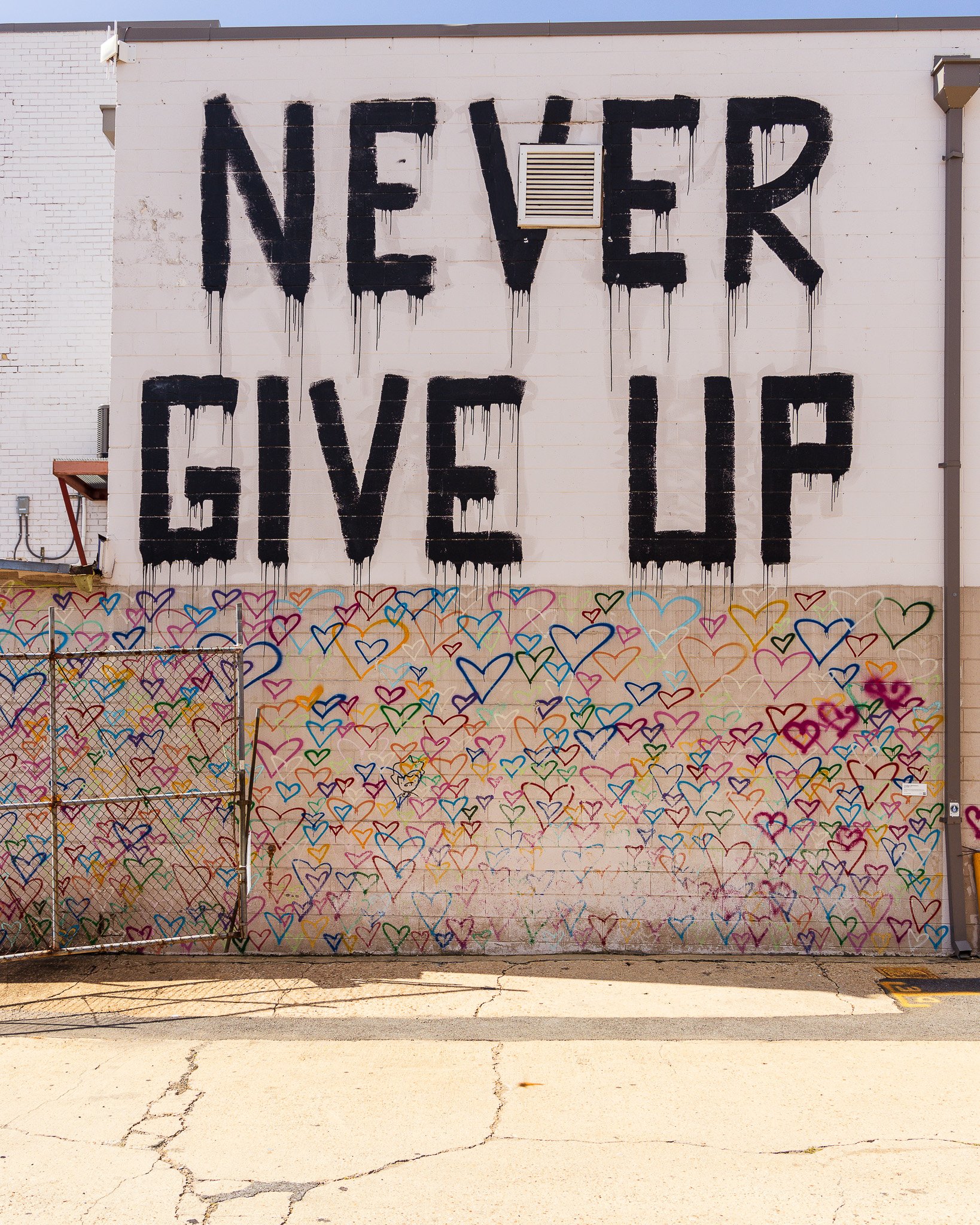
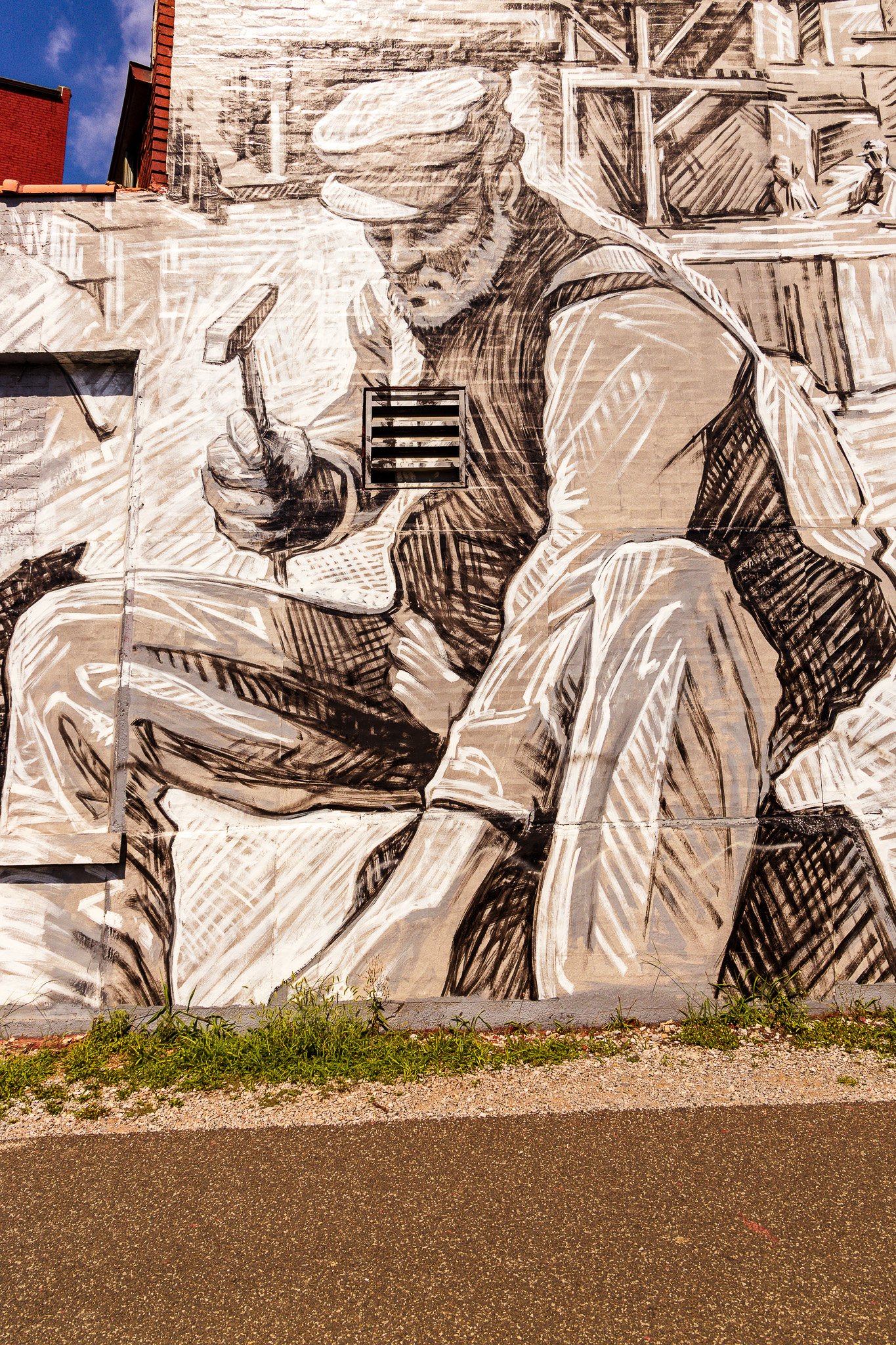
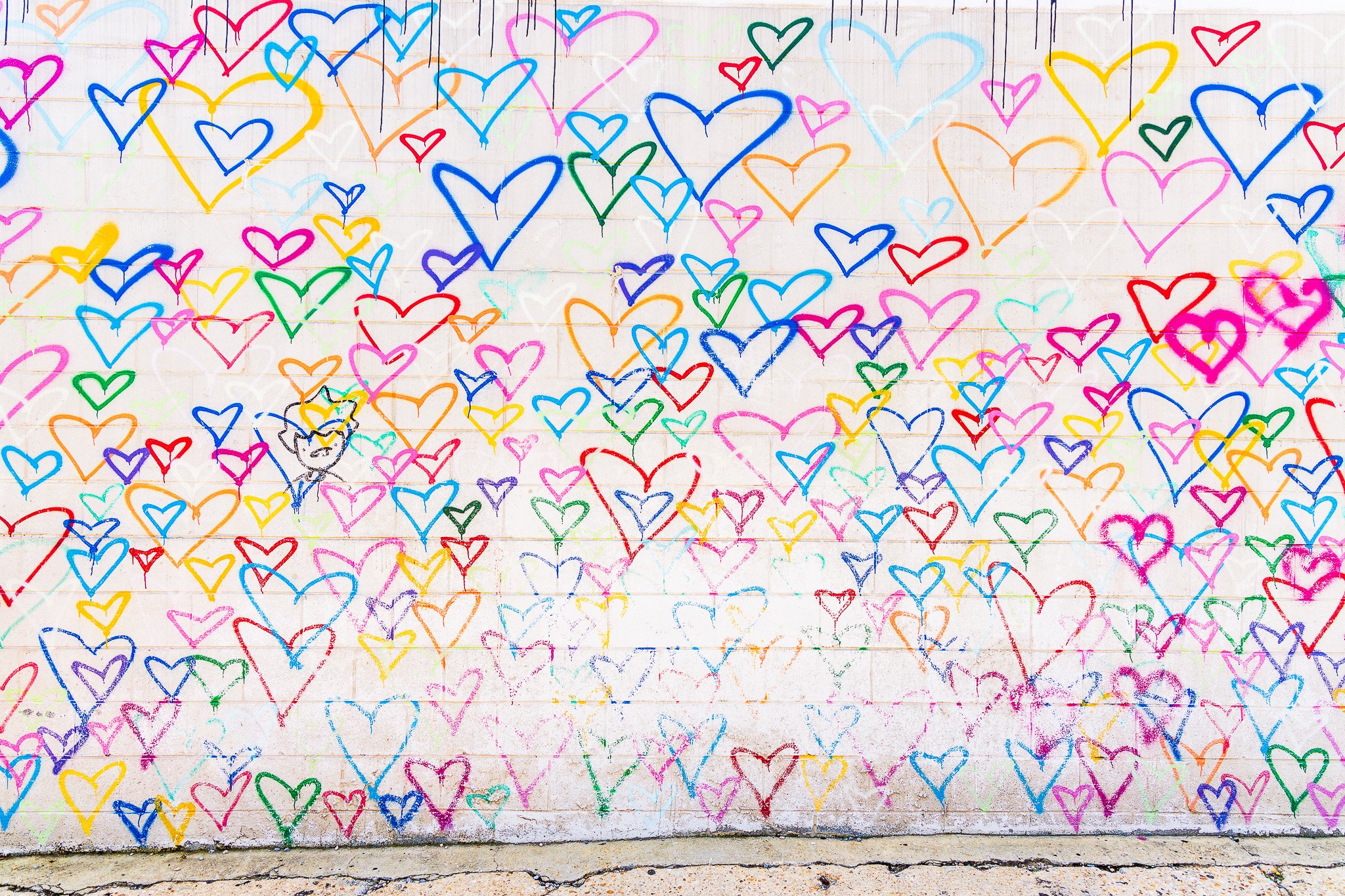
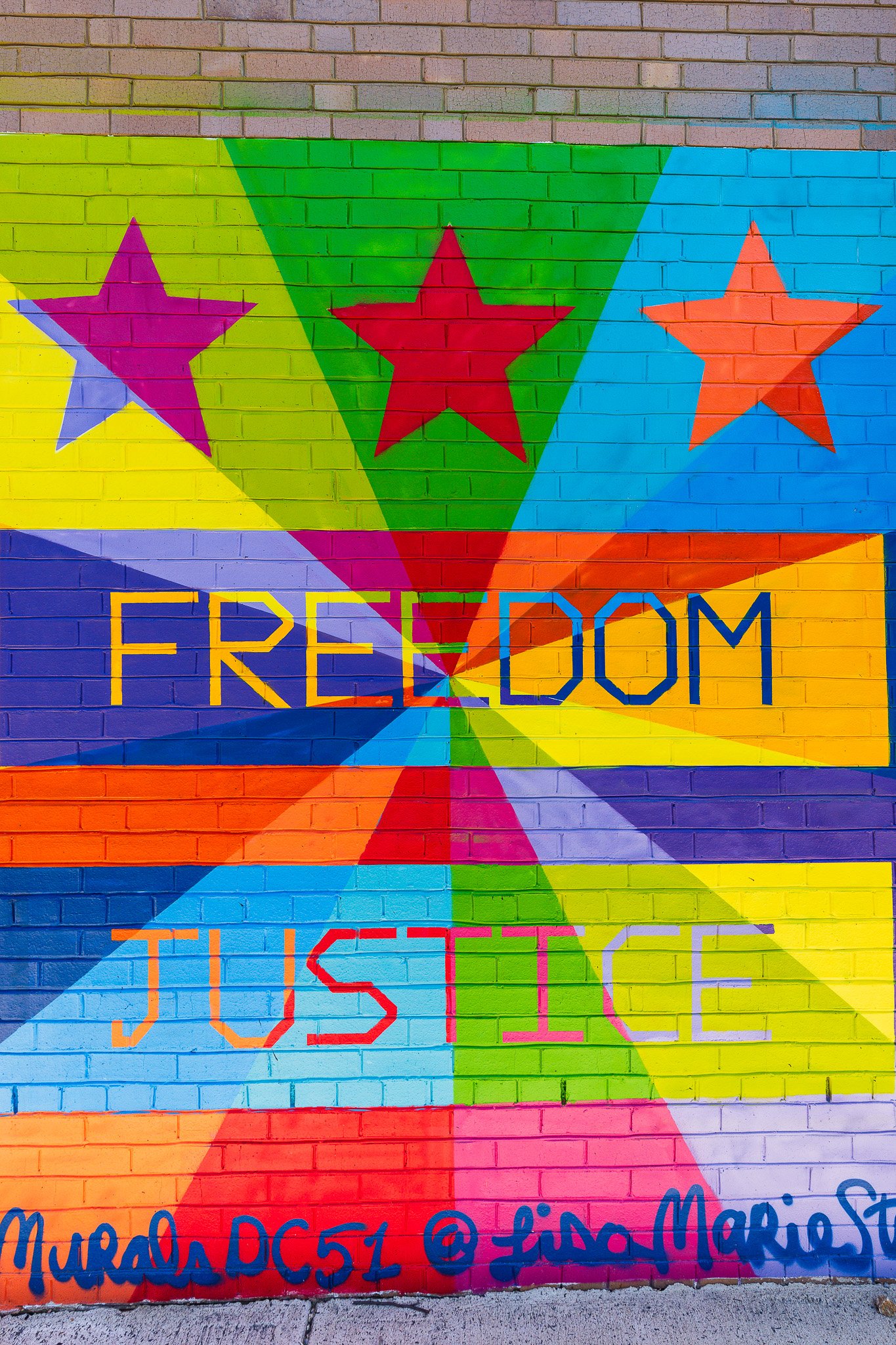
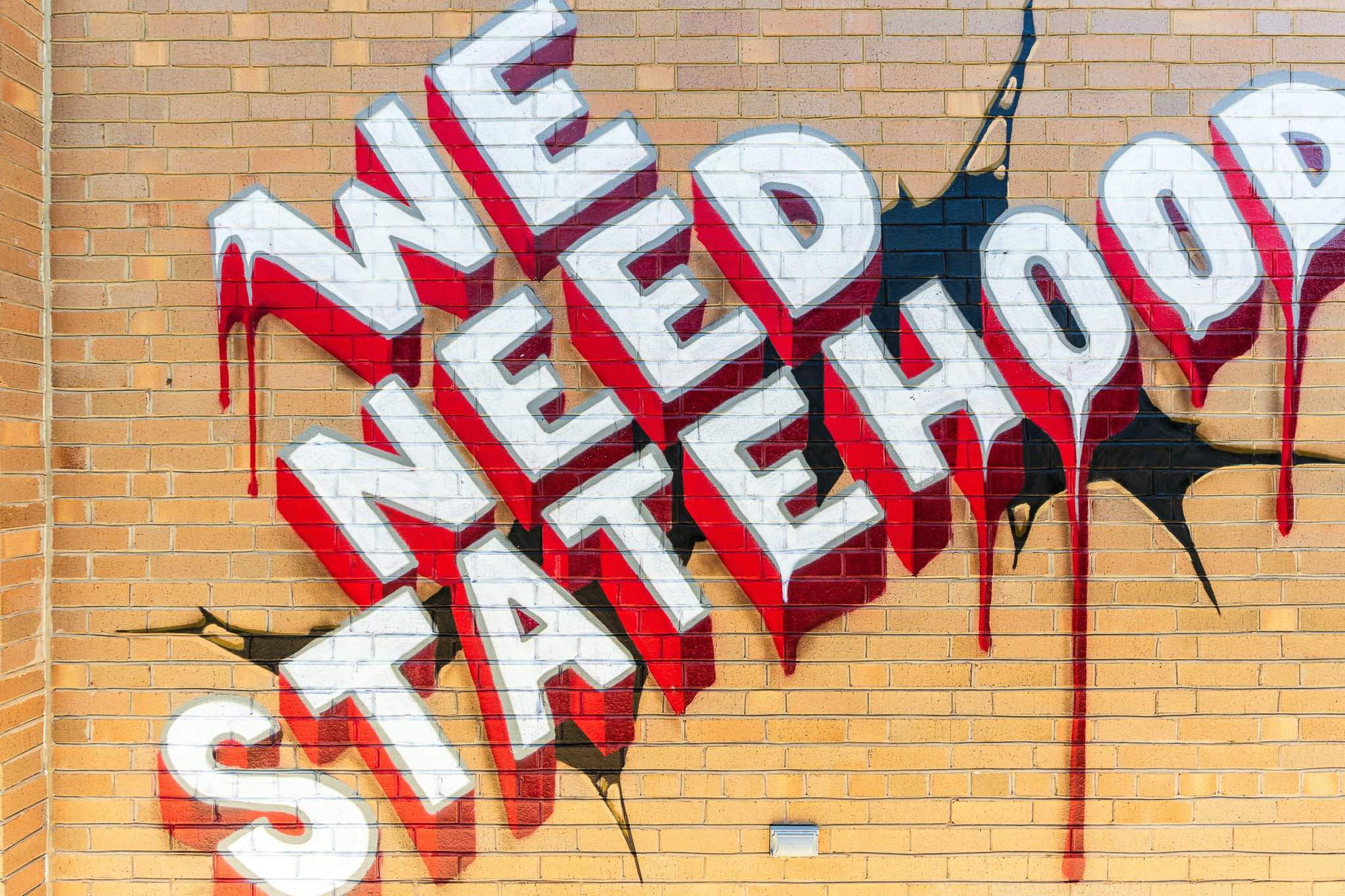
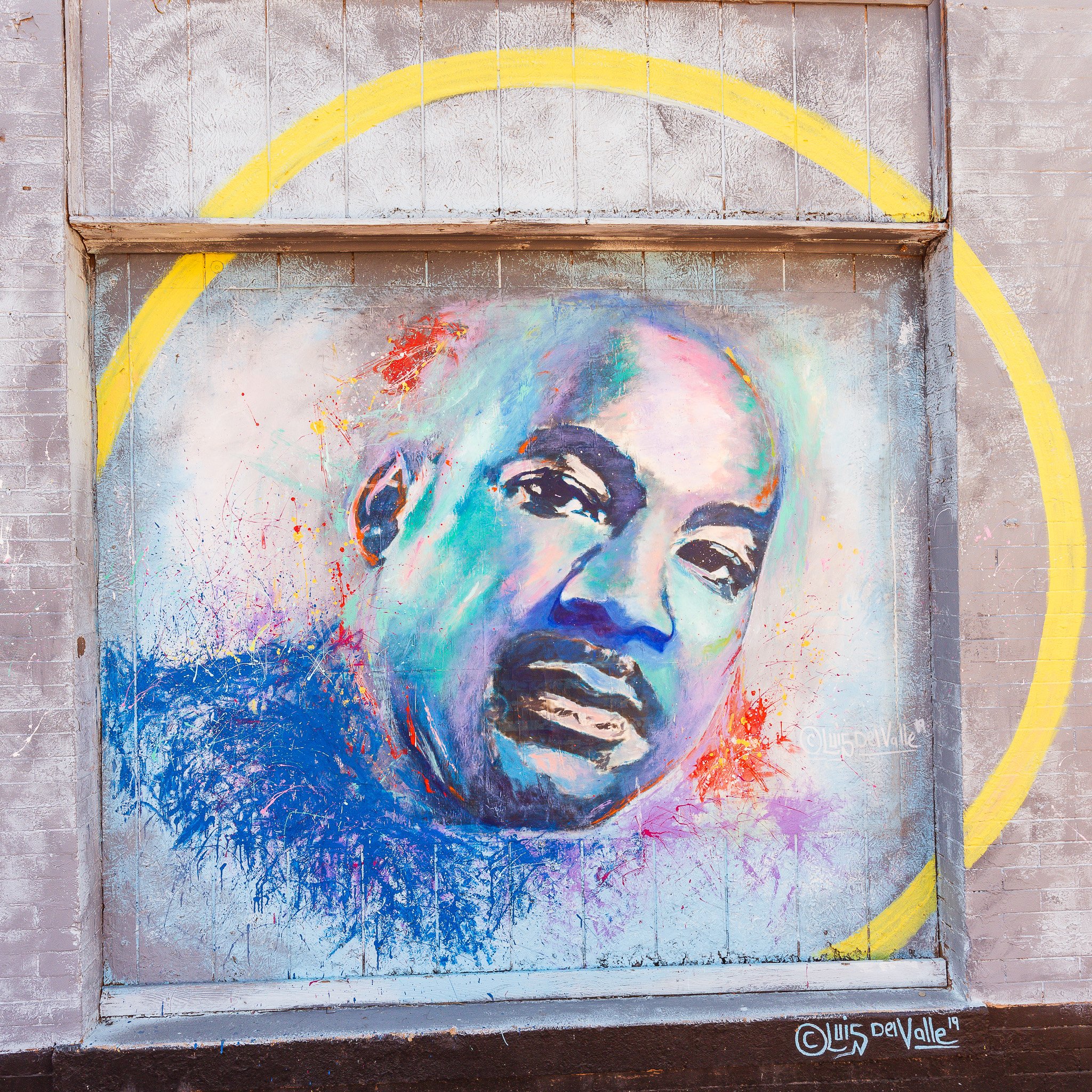
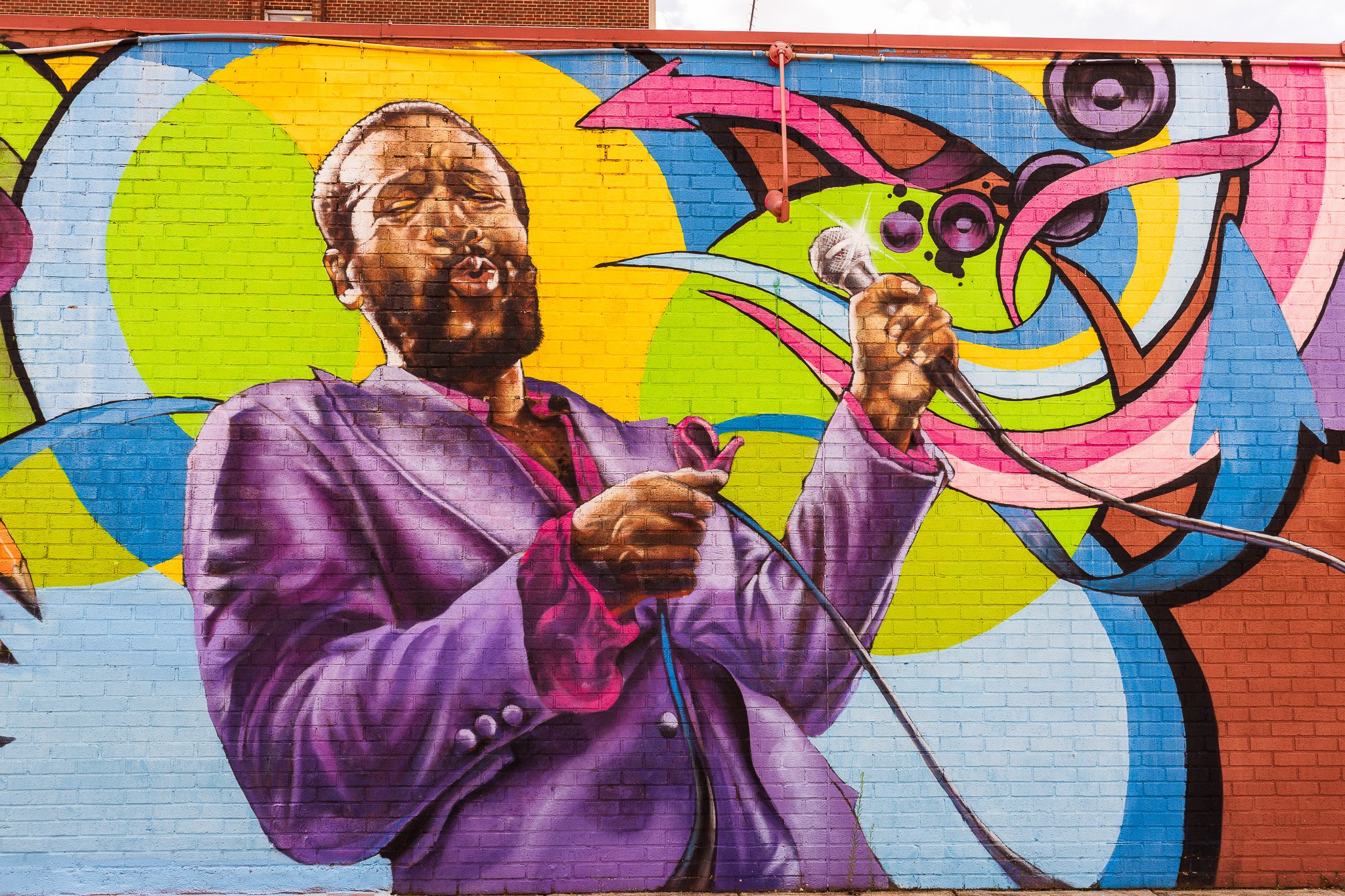
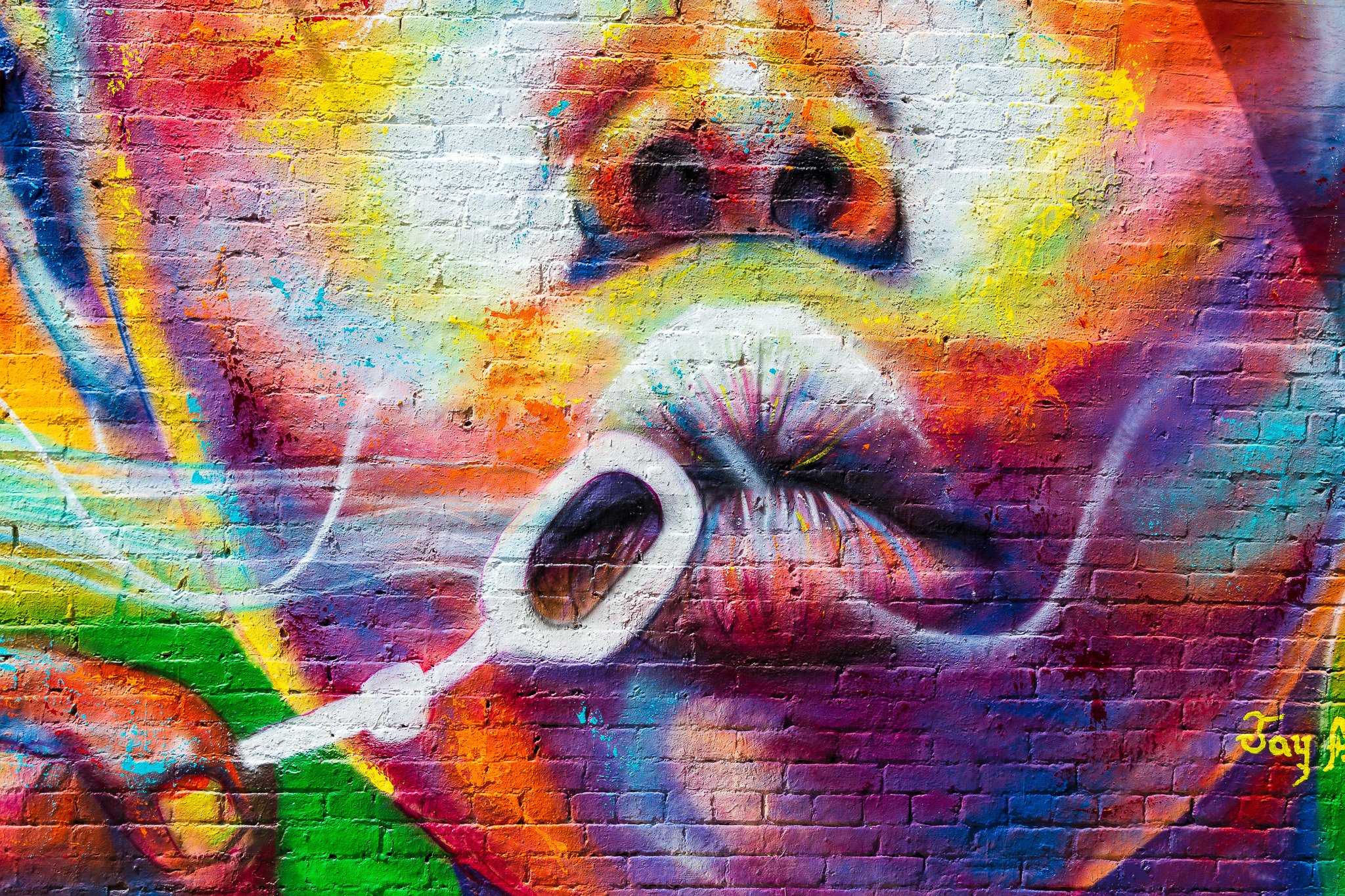
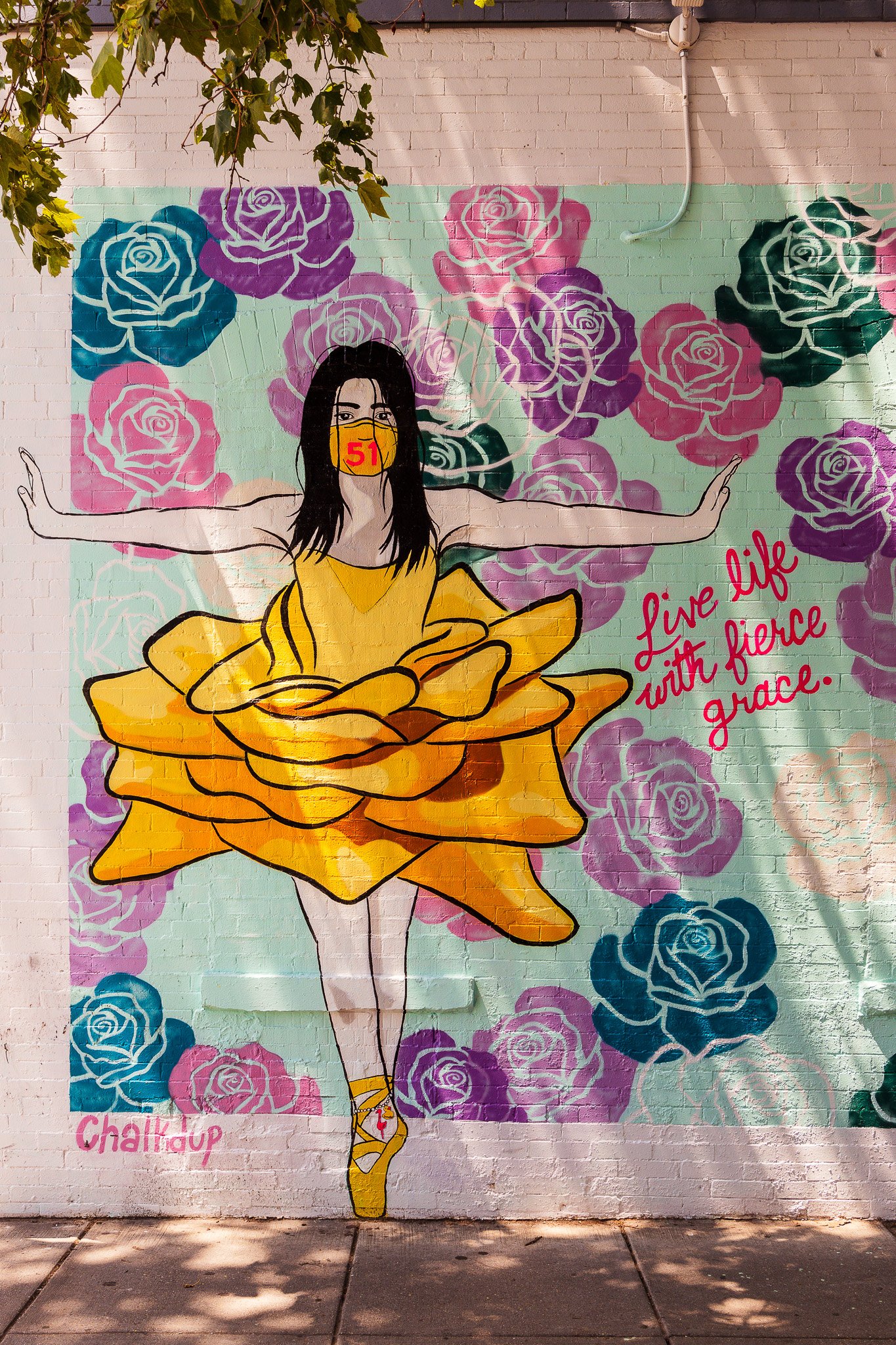
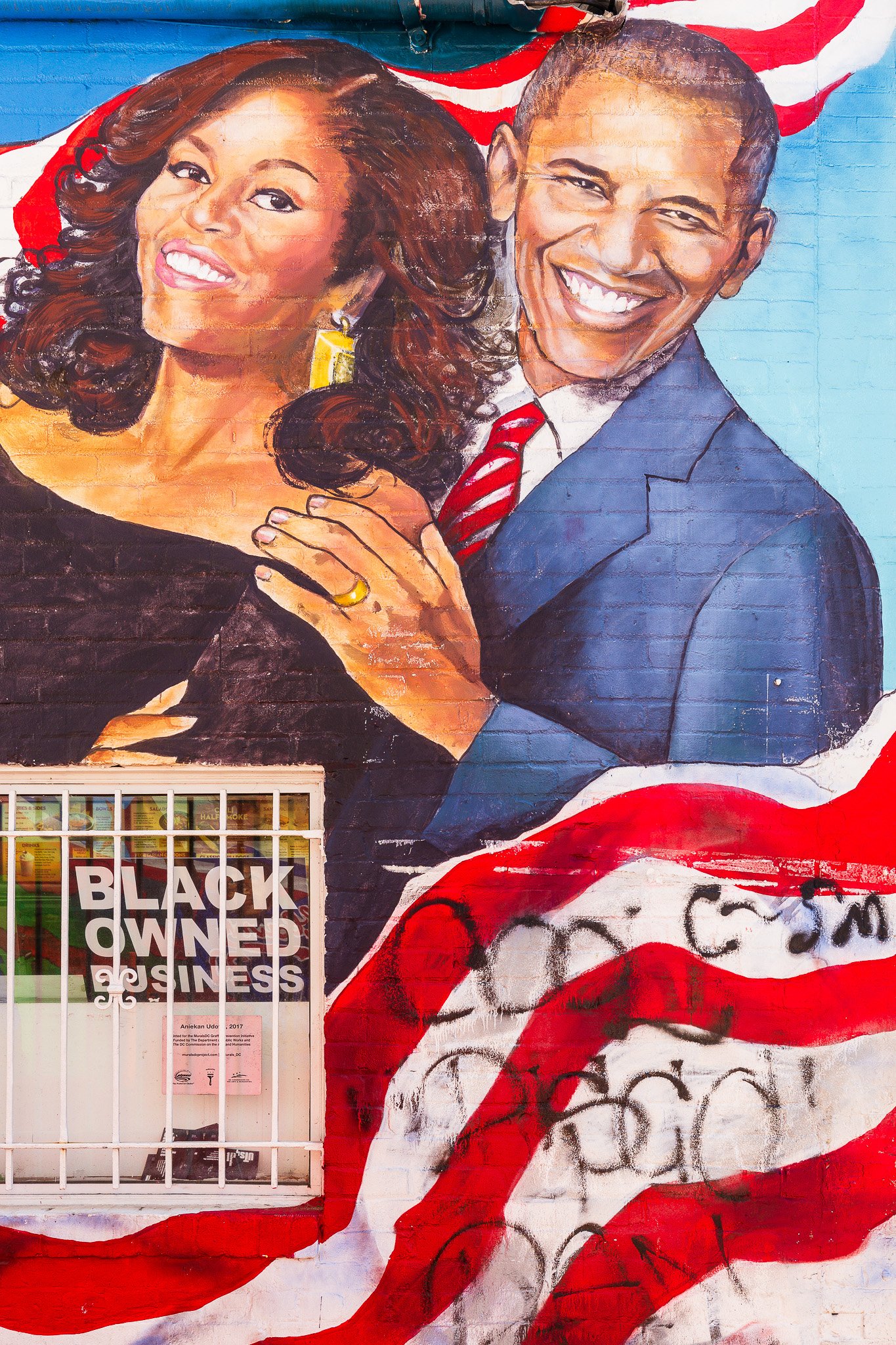
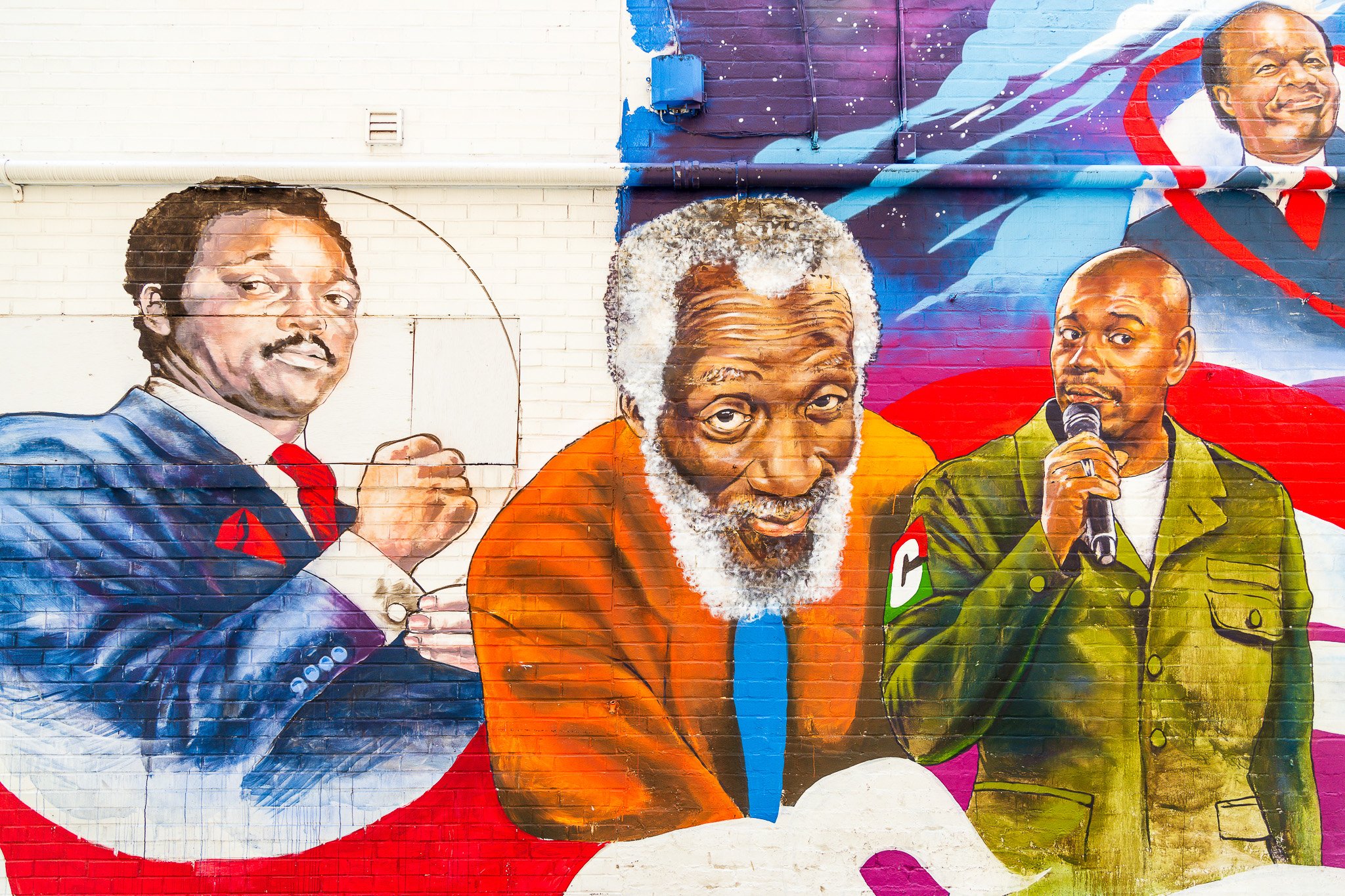
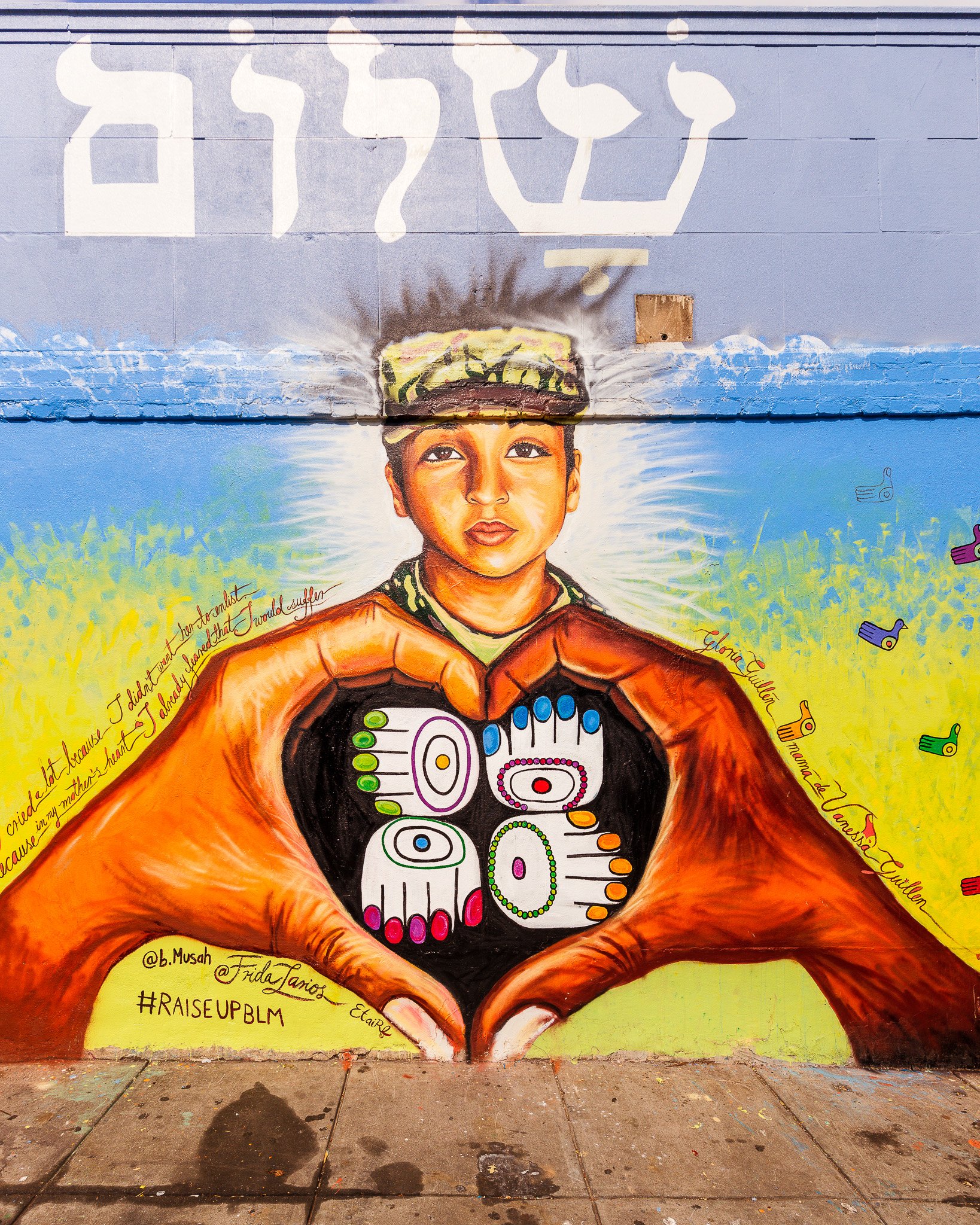
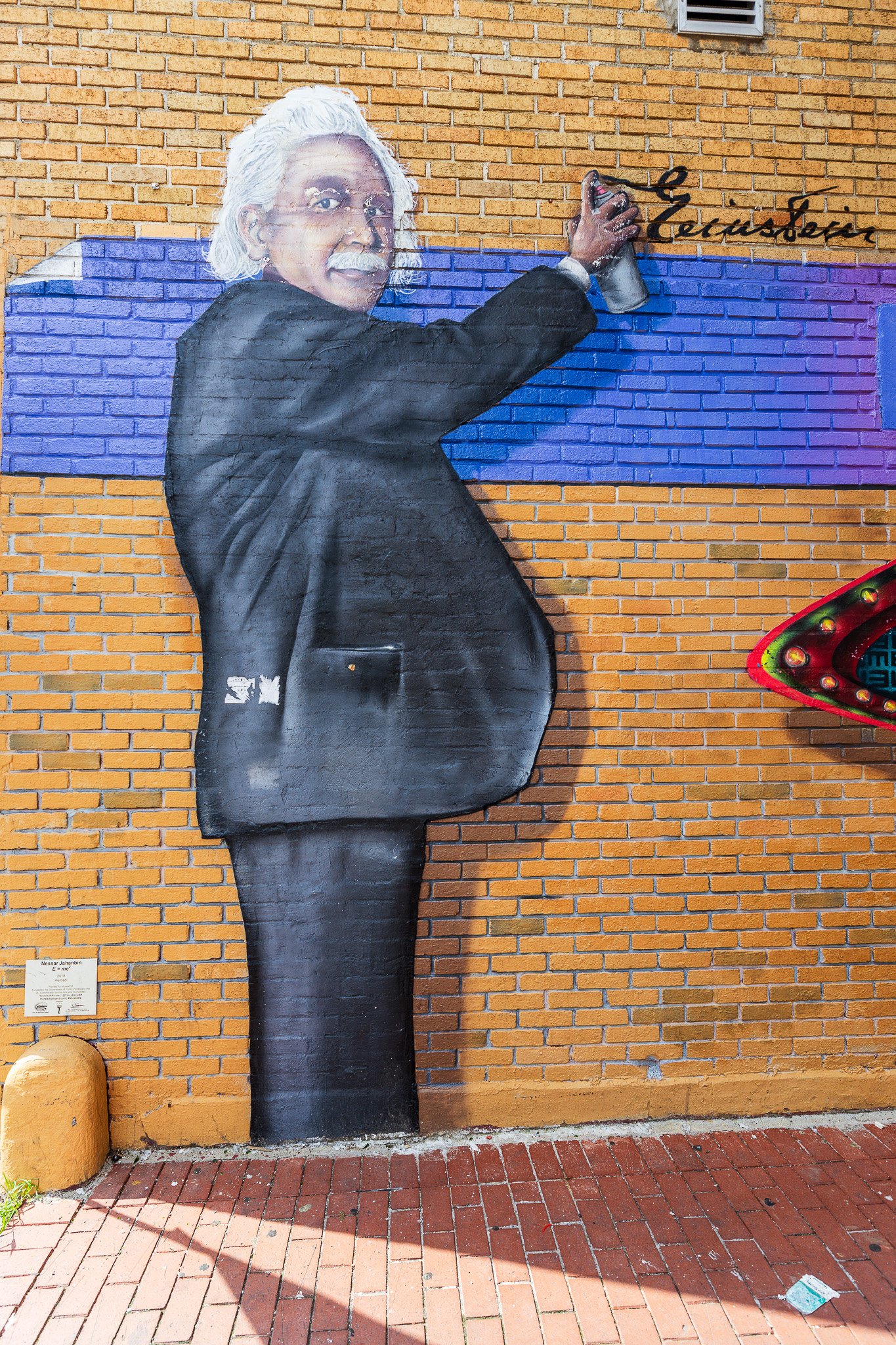
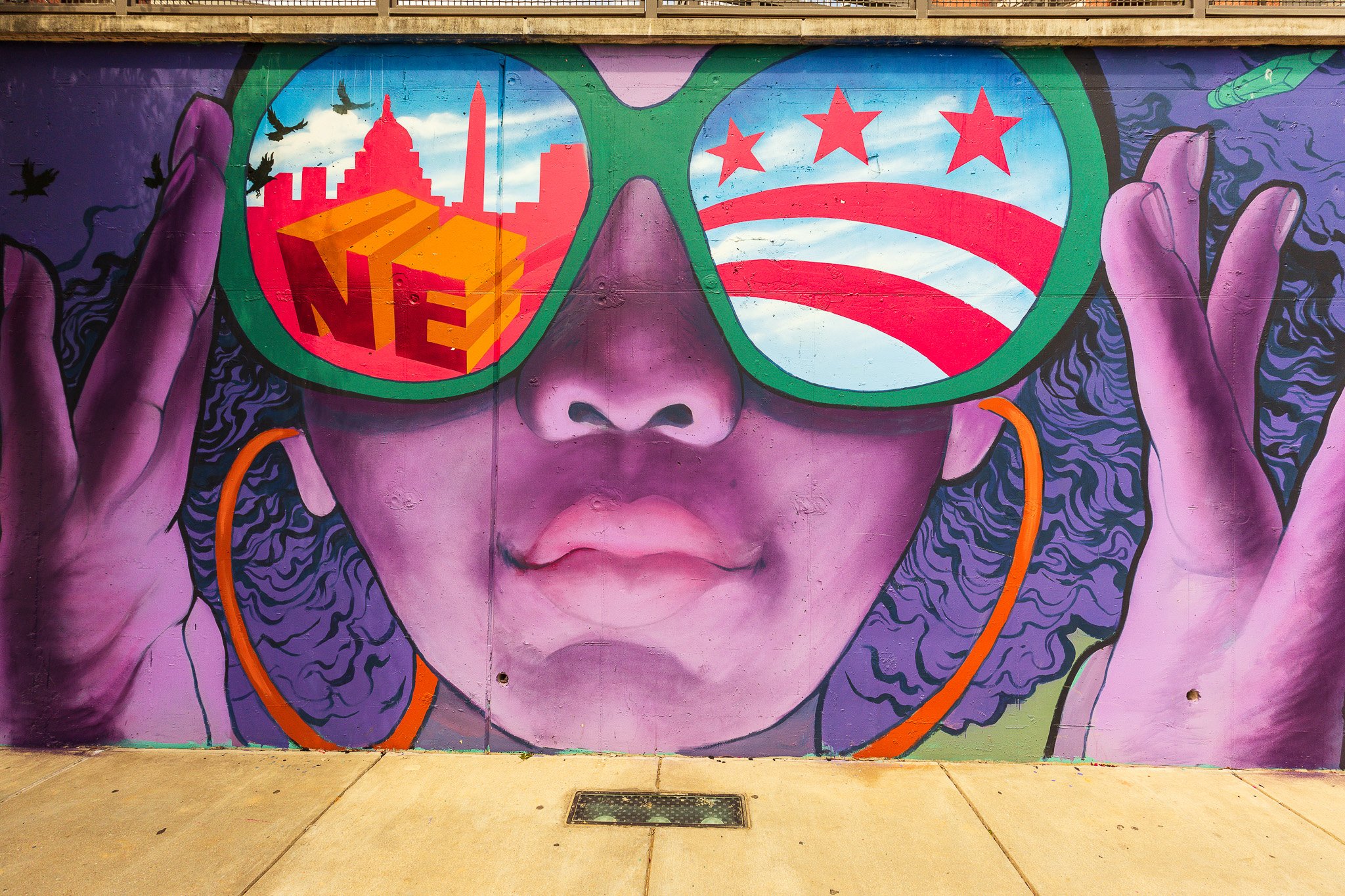
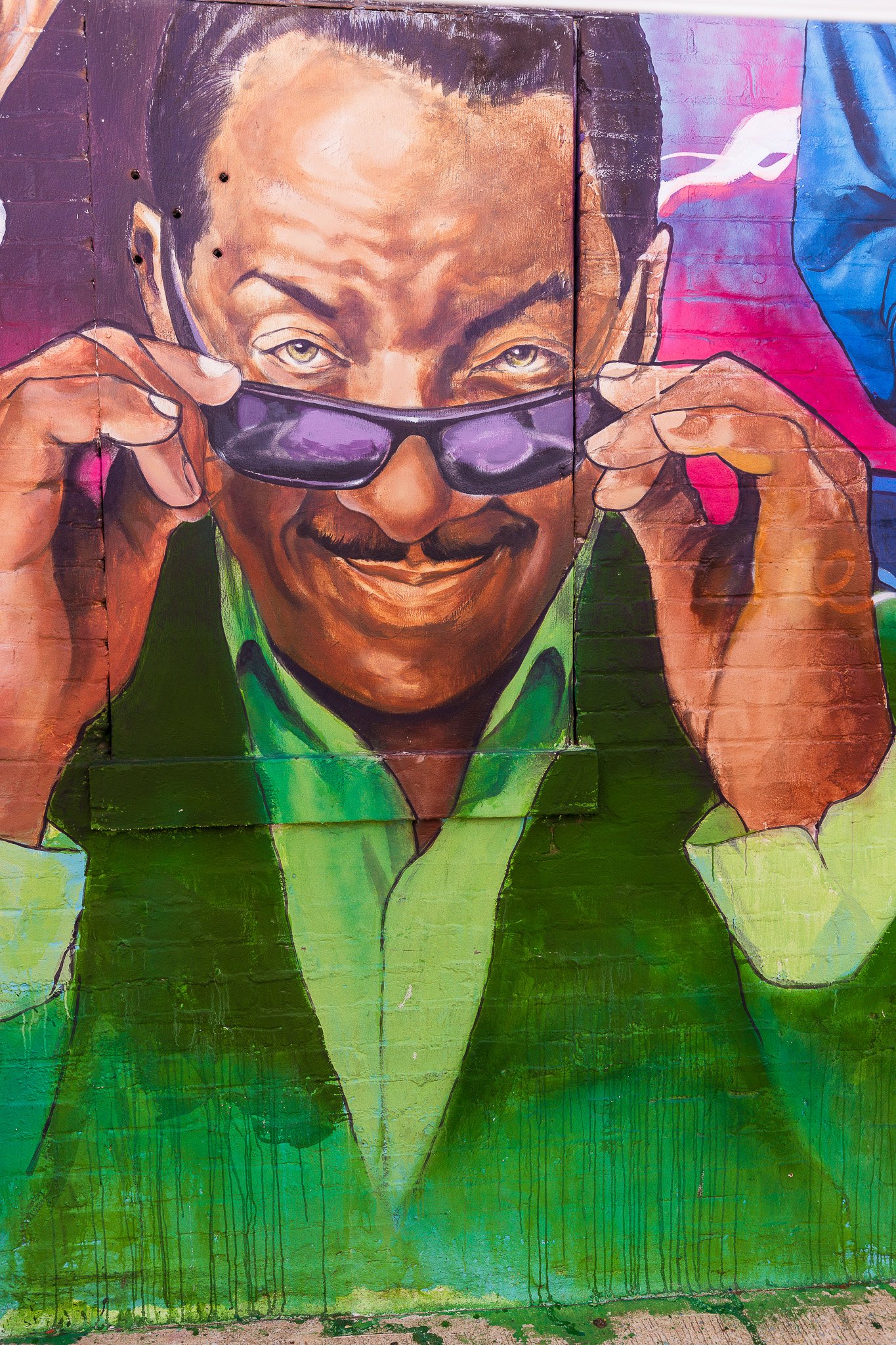
It has become a scavenger hunt to find the murals all over the city. There are always new ones popping up. But it’s a fun to look down alley-ways and discover a beautiful new mural each time I search a new neighborhood.
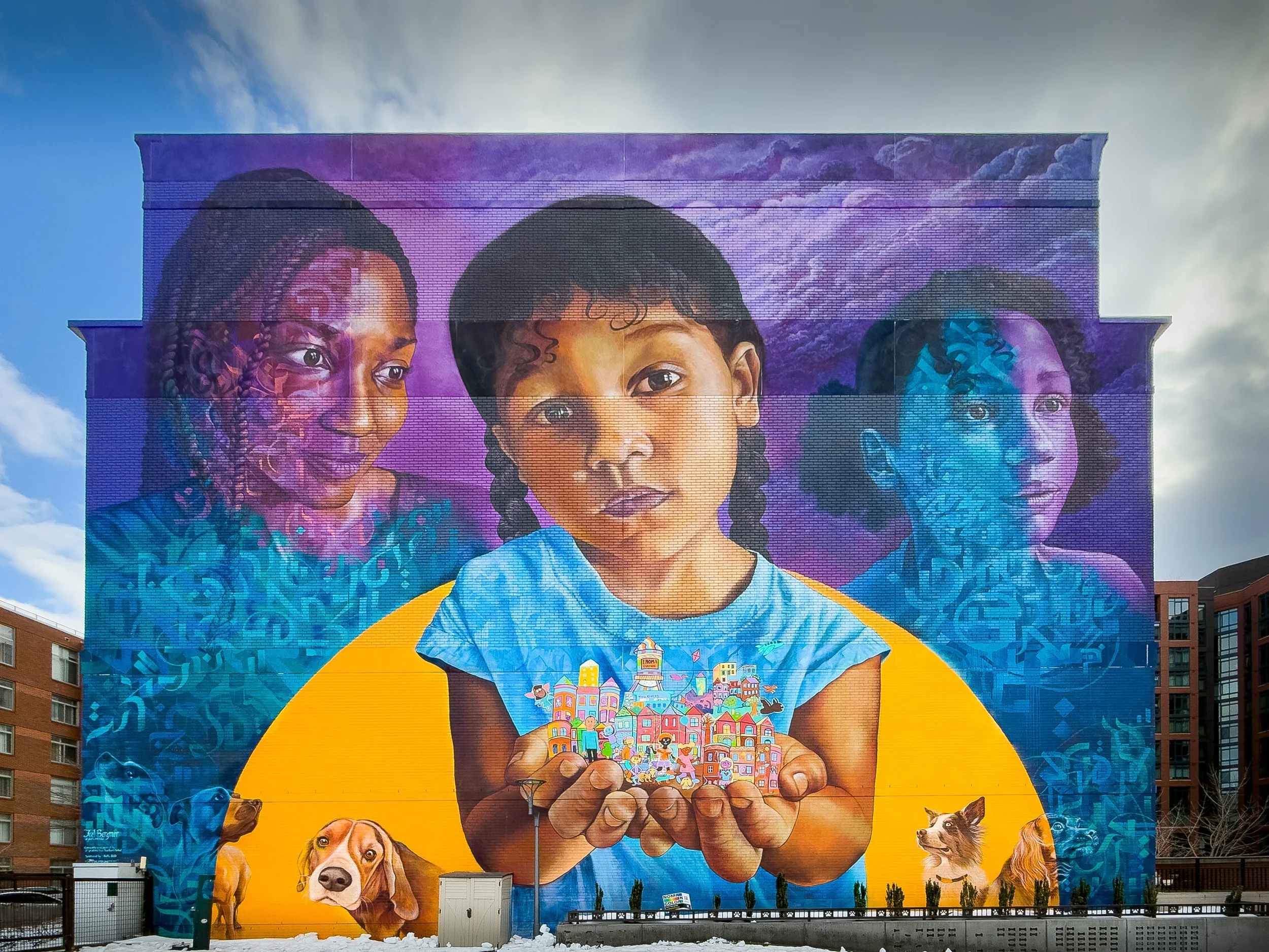
An Incredible mural by Union Station
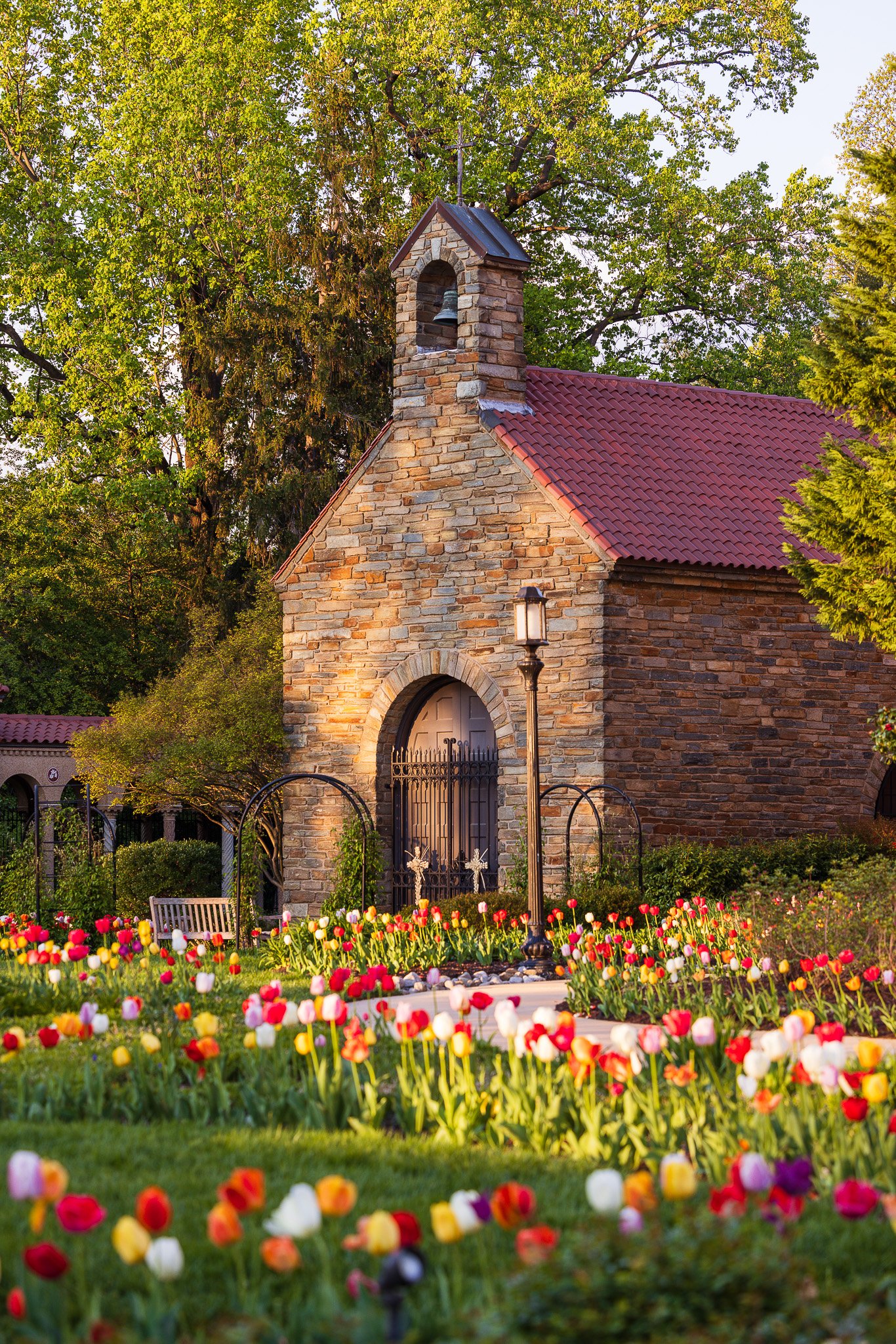
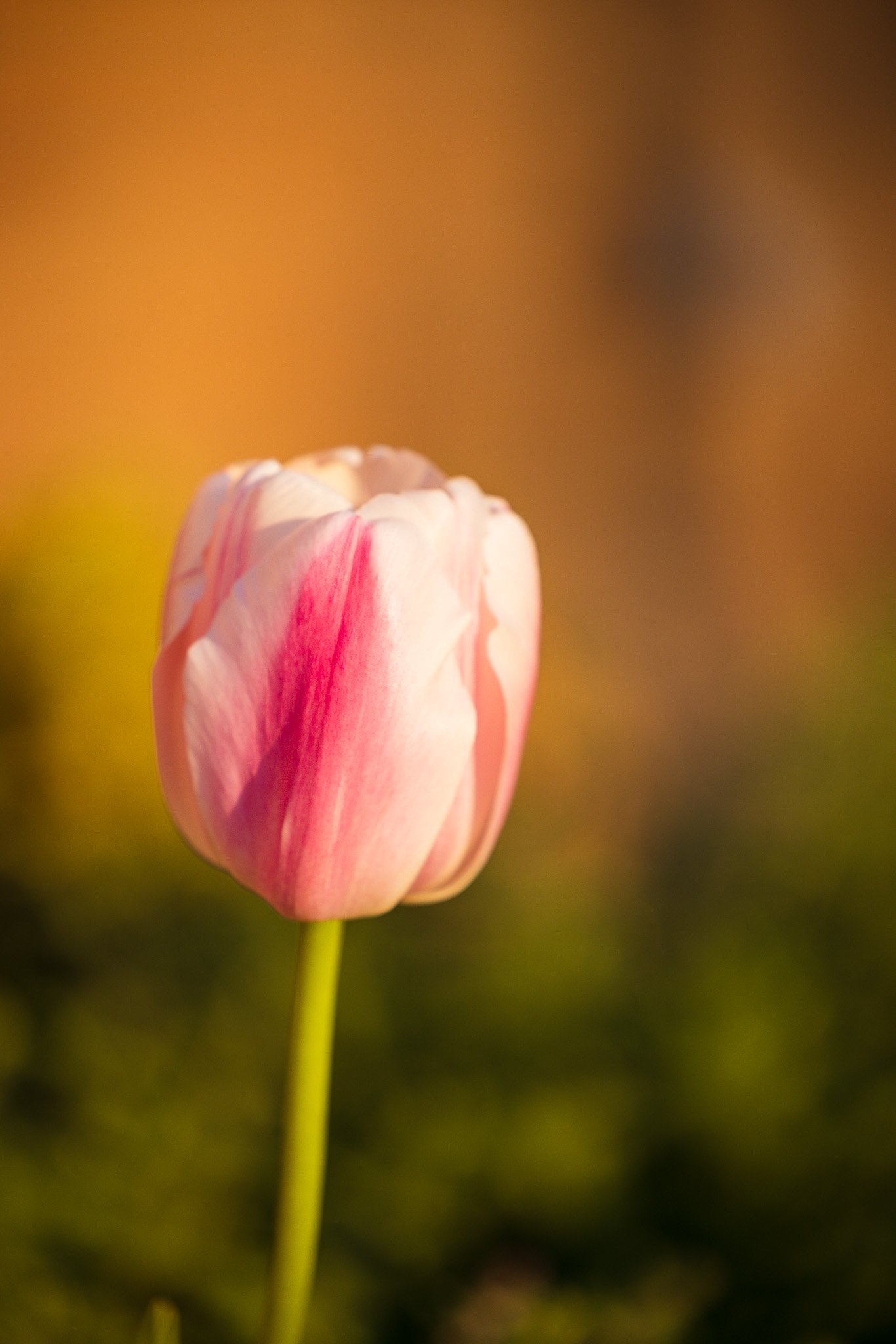
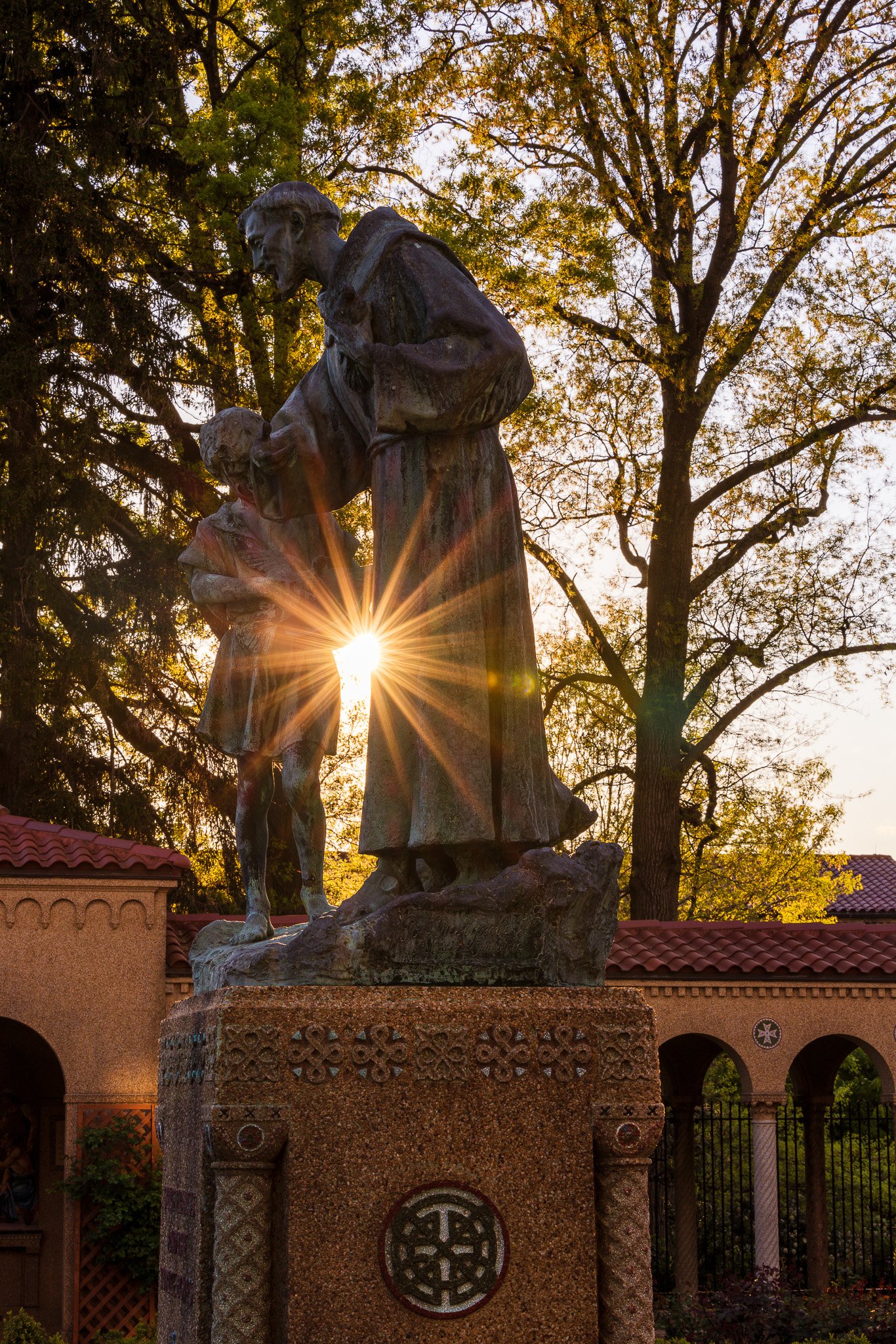
The Gardens of the Franciscan Monastery of the Holy Land in America
A quiet, little-known spot with formal rose gardens, replica shrines, and peaceful courtyards, this feels worlds away from the busy Mall despite being inside city limits.
📷 Pro Tip: Shoot the rose garden with a 50mm to 100mm lens for tight floral detail work, or wider for the replica catacombs and shrine architecture. Morning light is soft and diffused through the surrounding trees.
Best time: Morning. Access: Free, open daily. Northeast DC, best reached by car.
Any Metro Station
DC's Metro stations, particularly the older Brutalist stations like Dupont Circle, Woodley Park, and Cleveland Park, have a distinctive coffered concrete ceiling that's become an iconic DC photo subject in its own right.
📷 Pro Tip: Shoot straight down the platform with a wide lens, 16mm to 24mm, to emphasize the repeating ceiling pattern and create a sense of infinite depth. Slower shutter speeds during off-peak hours let you capture a train's light trail moving through frame.
Best time: Off-peak hours for fewer people on the platform. Access: Requires a SmarTrip fare card to enter. Stations throughout the city.

The Metro Station at Dupont Circle
Roosevelt Island
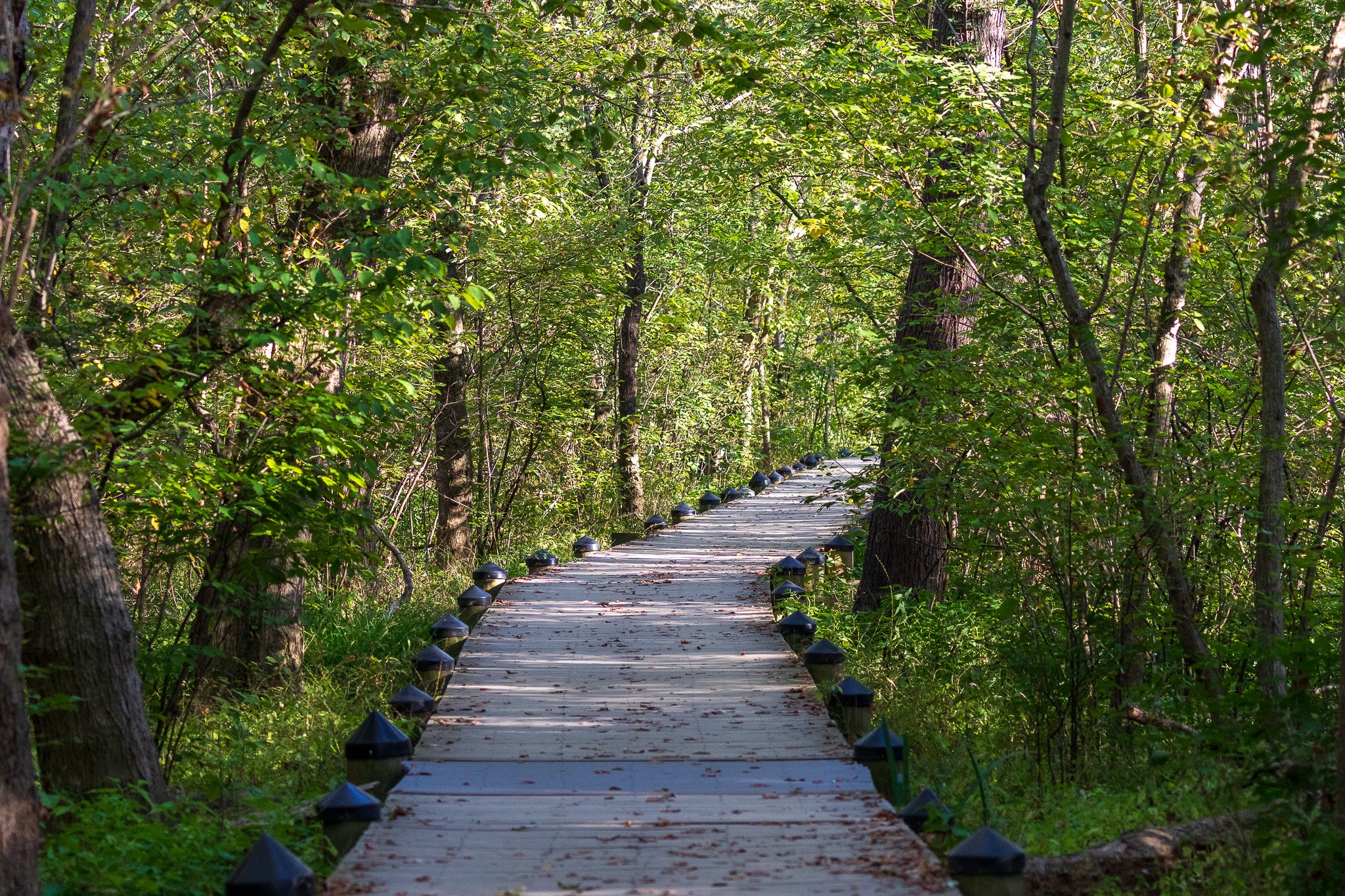
This wooded island park in the middle of the Potomac feels completely removed from the city despite being minutes from downtown, with a memorial clearing, forest trails, and marshland boardwalks.
📷 Pro Tip: Use a 24mm to 70mm lens in the memorial clearing for the statue and fountains, and switch to wider for the boardwalk trails through the marsh, where morning fog often sits low over the water.
Best time: Early morning. Access: Free, accessible only by footbridge from the Virginia side, no direct road access. Near Rosslyn.
Kenilworth Gardens
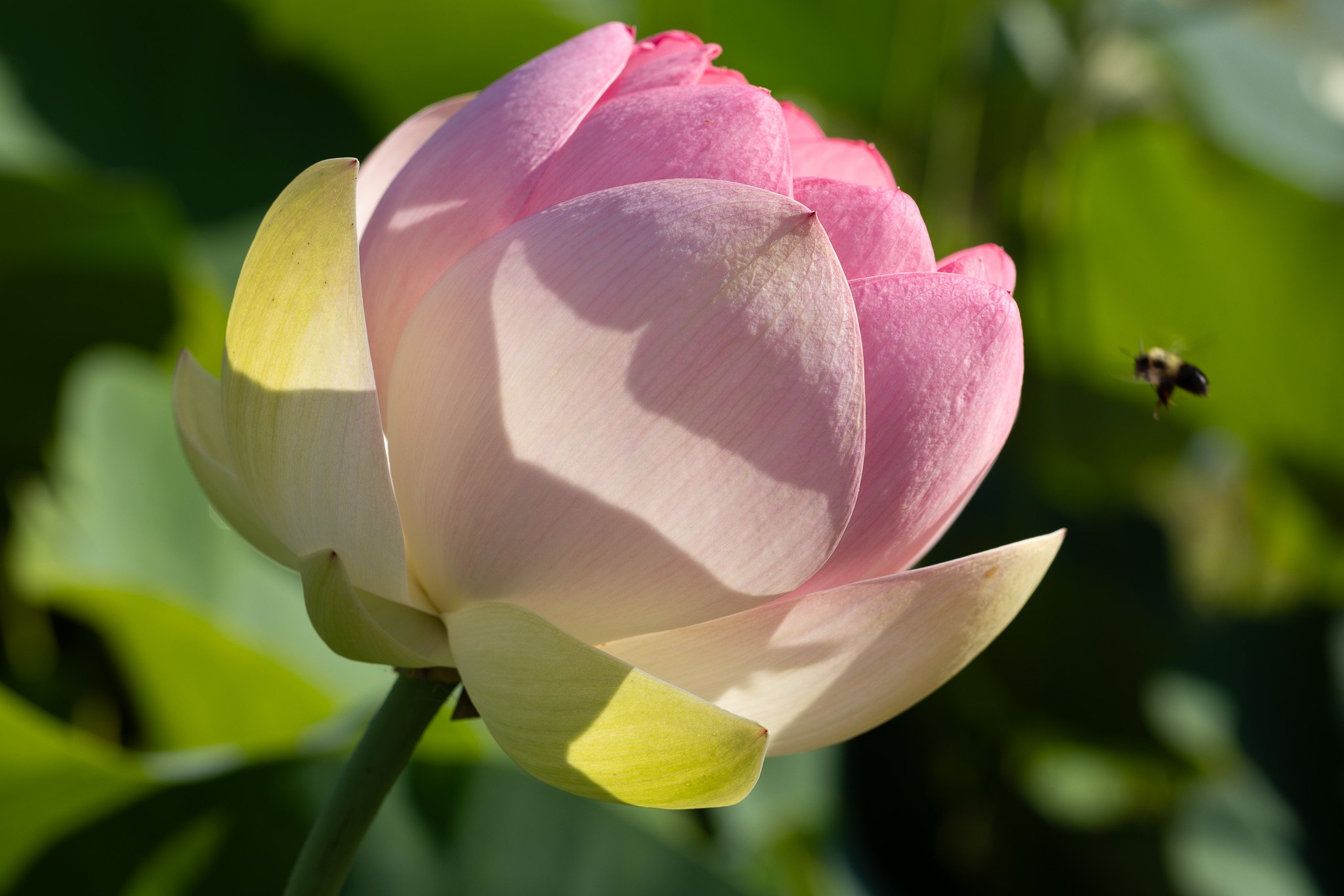
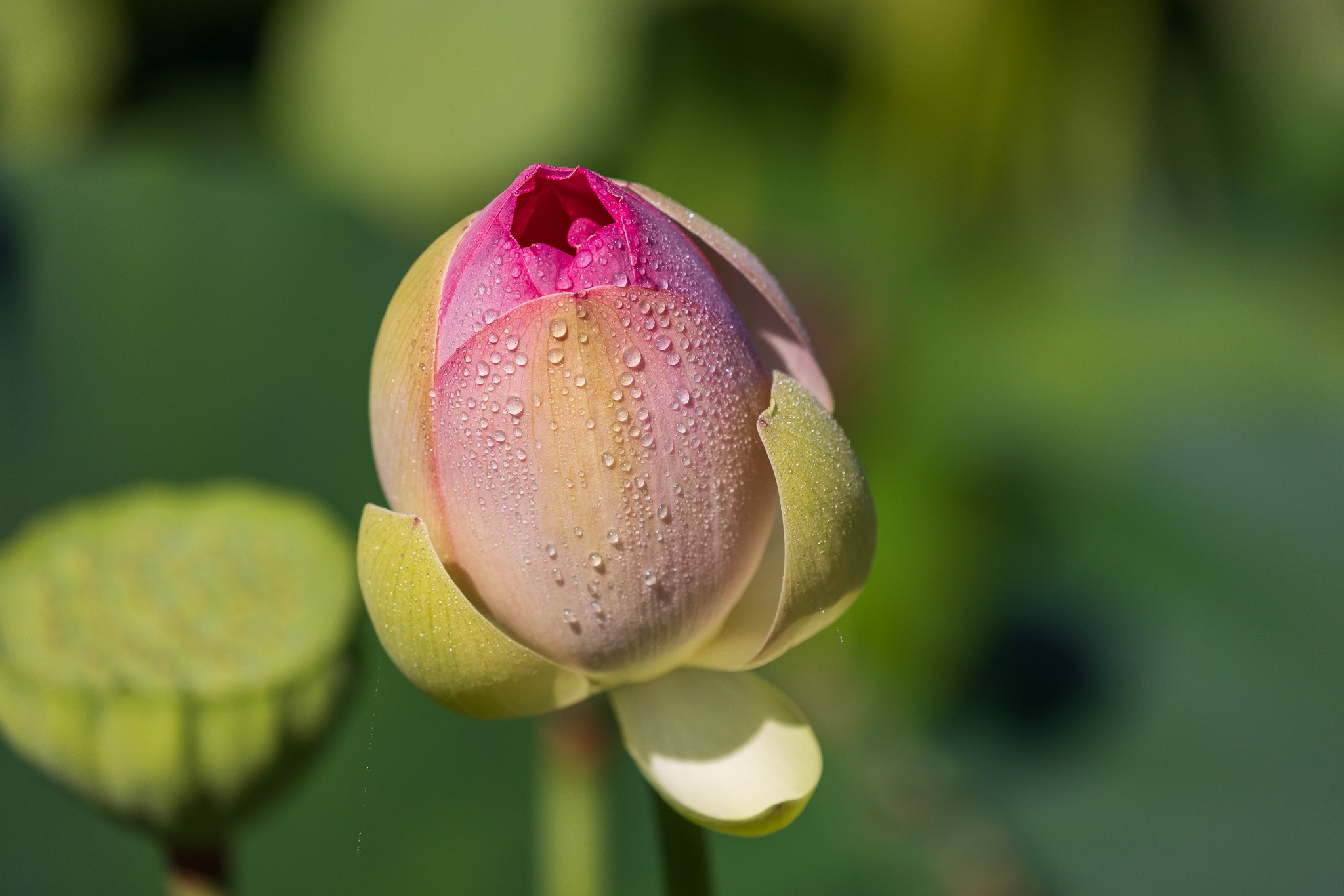
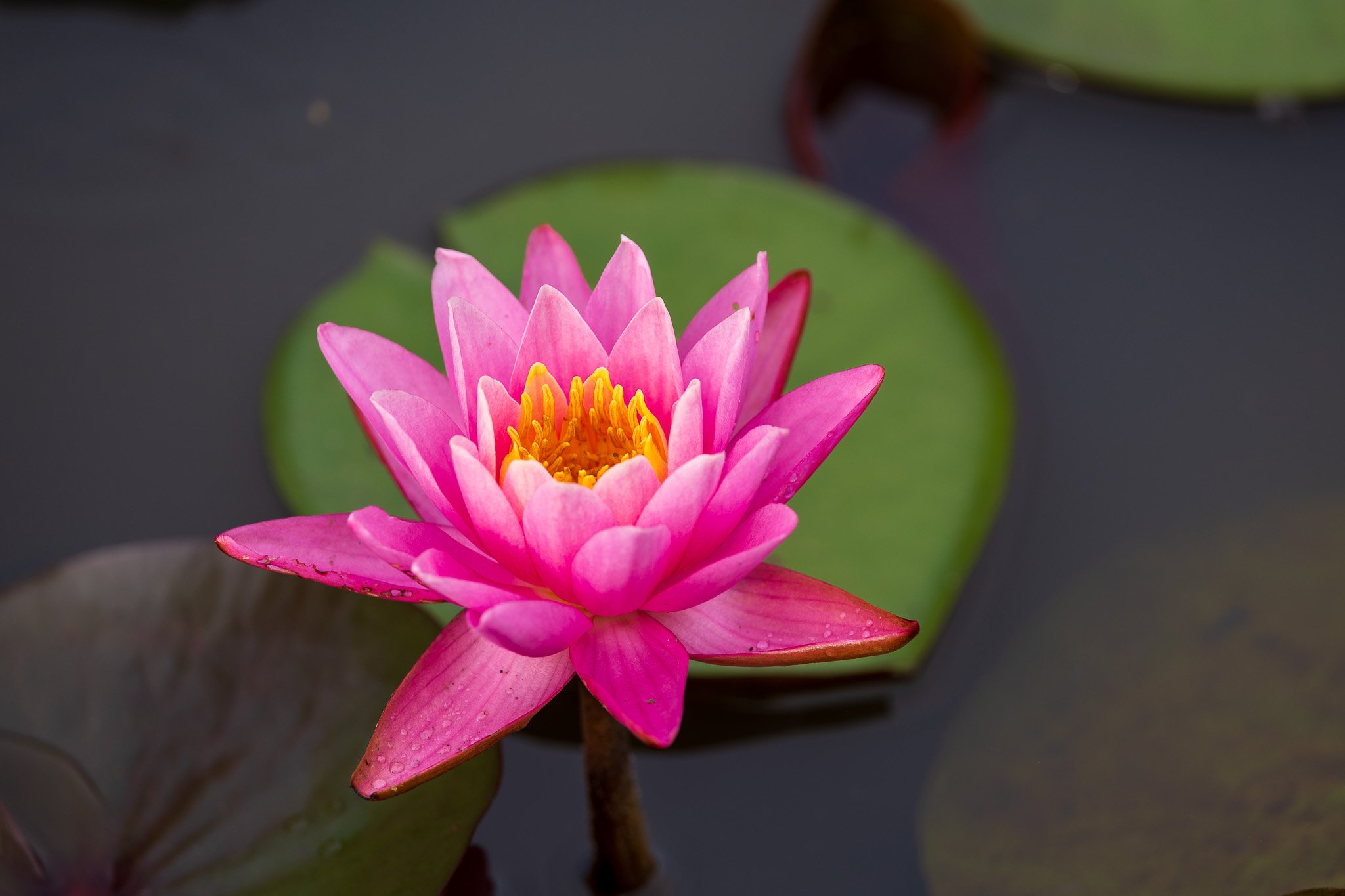
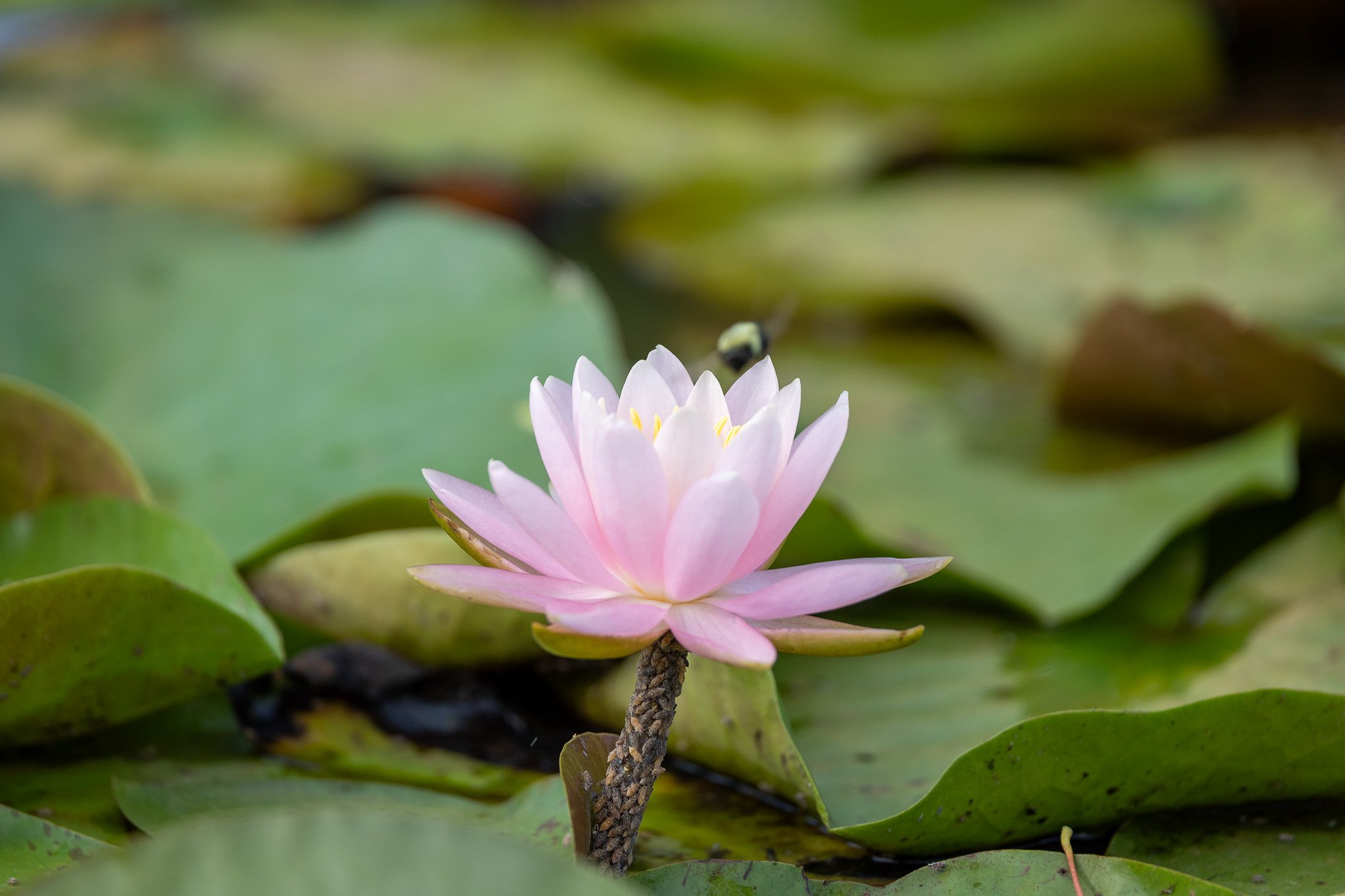
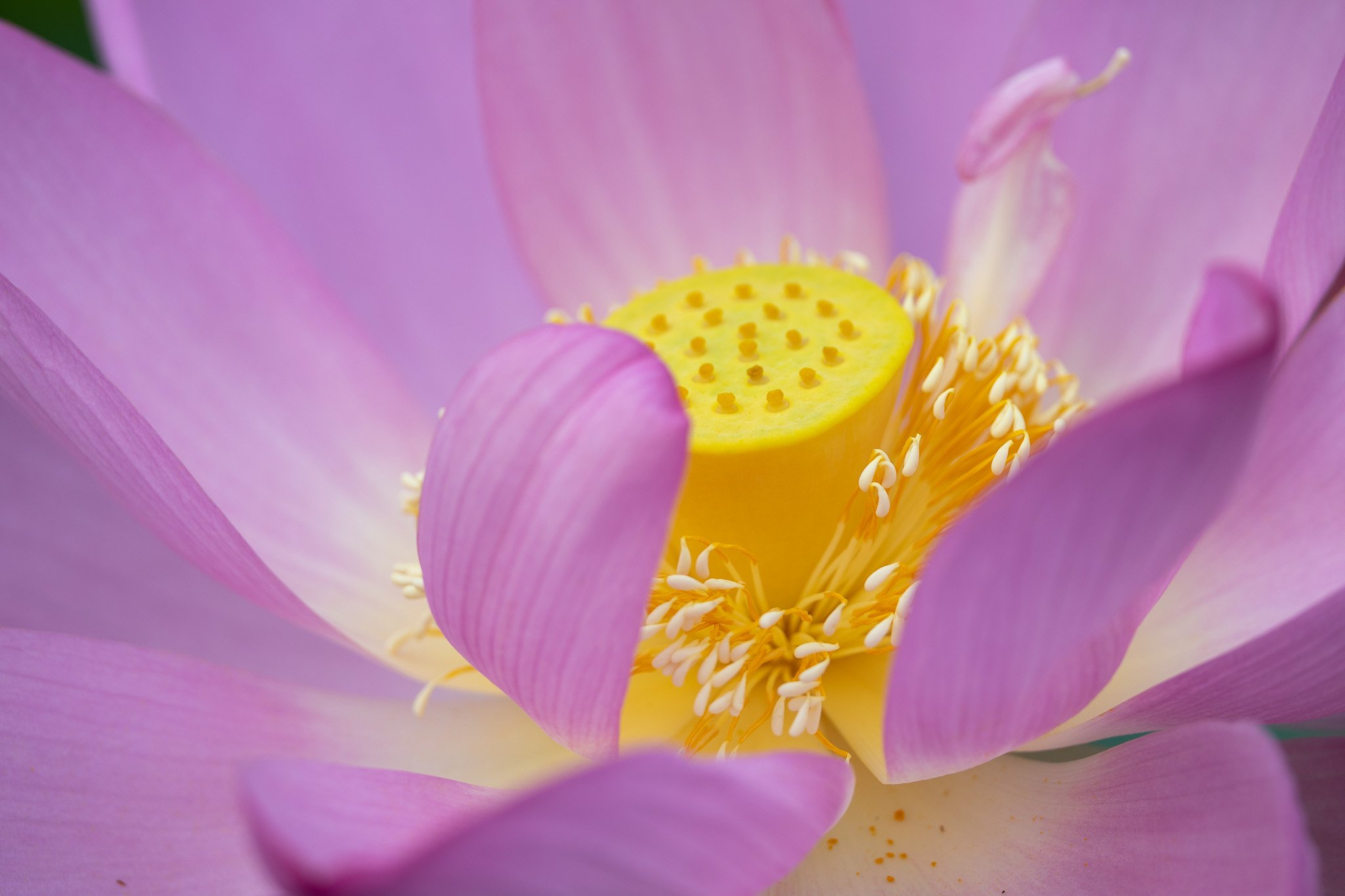
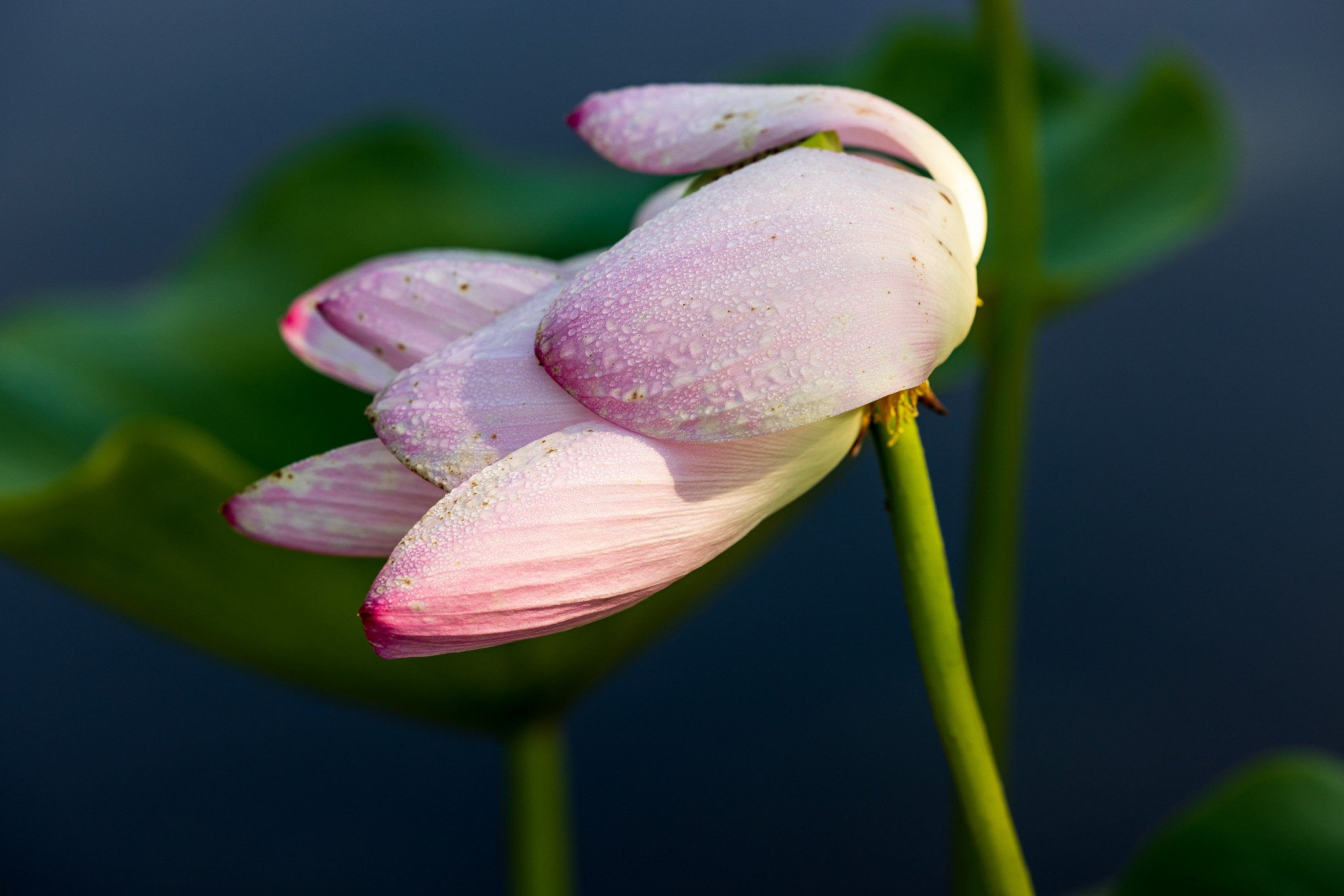
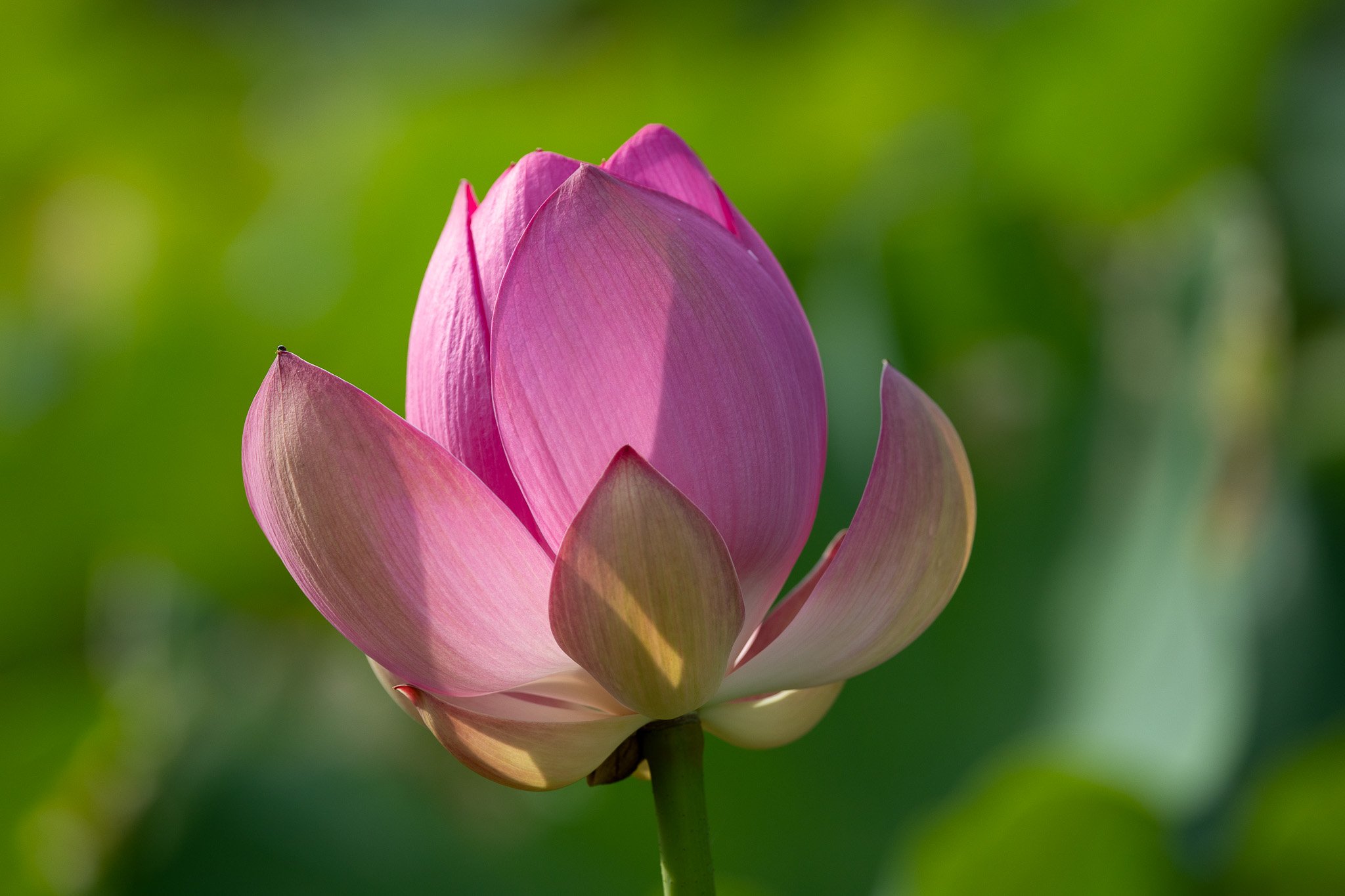
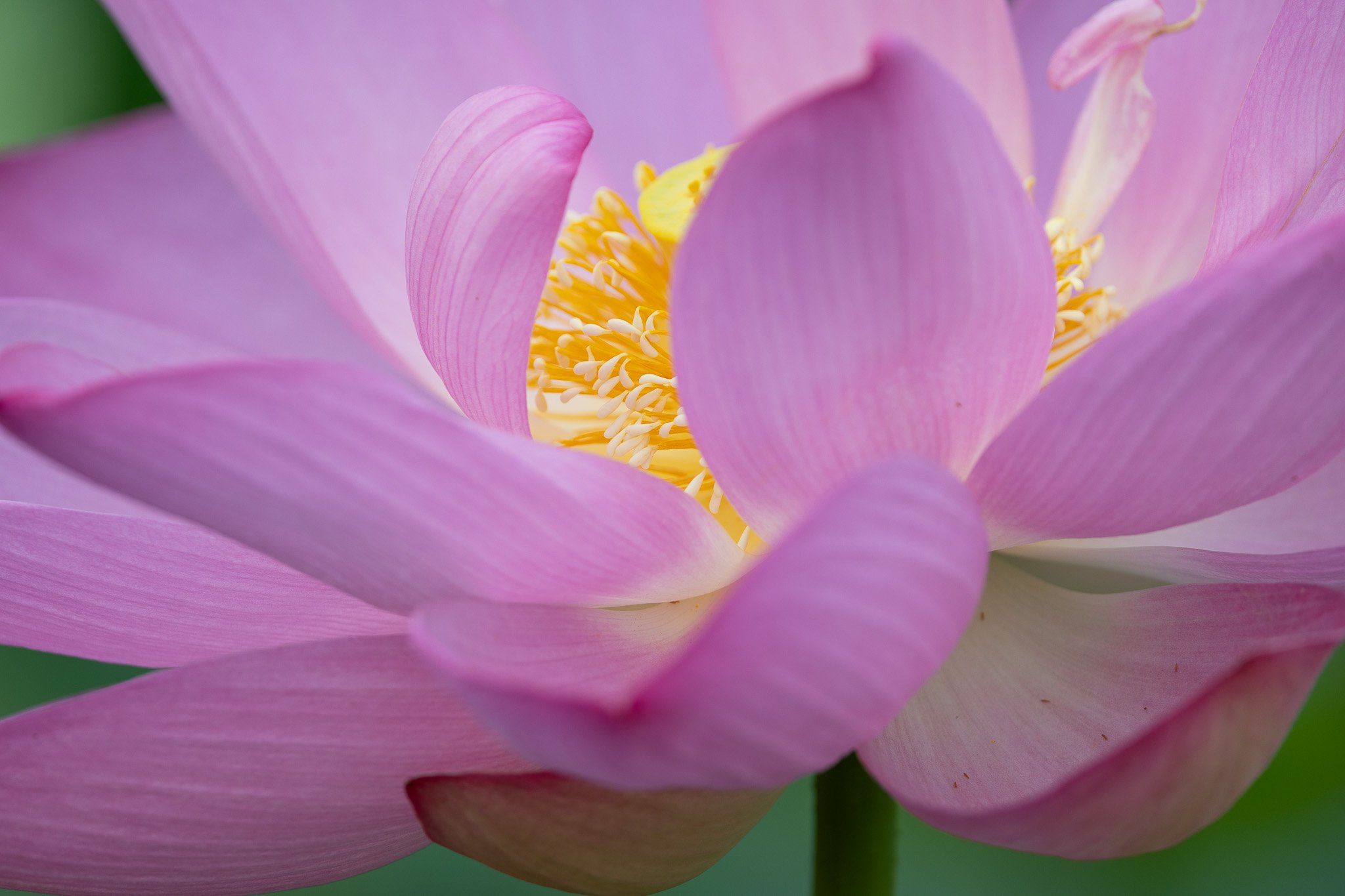
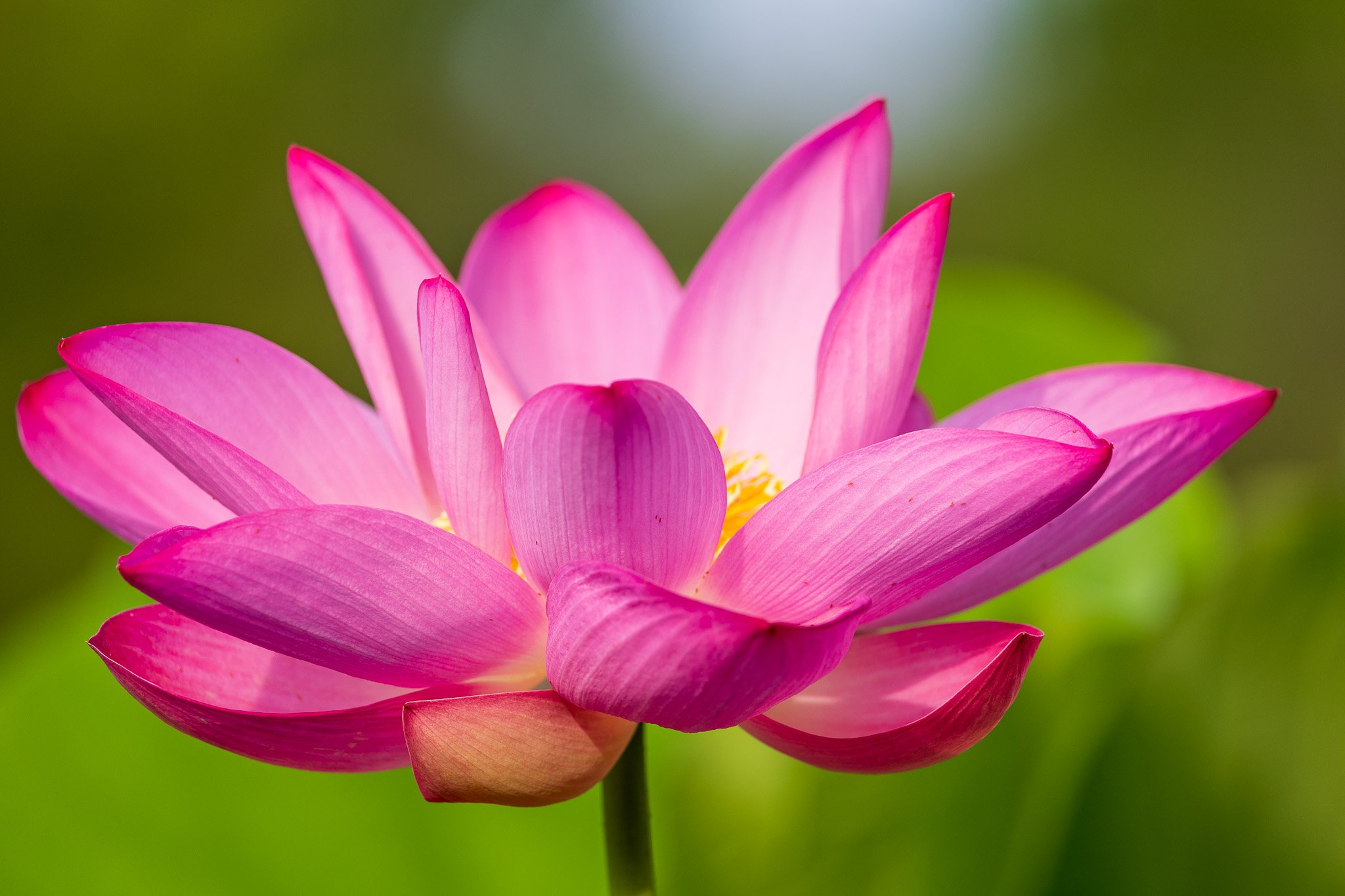
DC's only National Park Service site dedicated to water gardens, this spot bursts with lotus and water lily blooms in summer, a completely different palette from anything else on this list.
📷 Pro Tip: Bring a macro lens for close-up flower detail, and a wider lens, 24mm to 35mm, for the ponds themselves reflecting the sky. Blooms are best in the early morning before they close in the afternoon heat.
Best time: Early morning, July through August for peak bloom. Access: Free. Northeast DC, best reached by car.
National Portrait Gallery -Kogod Courtyard
The glass canopy over this courtyard creates a striking undulating ceiling of light, and the space functions as both an architectural subject and a public gathering spot.
📷 Pro Tip: Shoot straight up with a 16mm to 24mm lens to capture the full wave pattern of the glass canopy. Midday brings strong shadow patterns onto the courtyard floor that add graphic interest to wider shots.
Best time: Midday for strongest shadow patterns. Access: Free. Downtown, near Gallery Place-Chinatown Metro.

Courtyard of the National Portrait Gallery
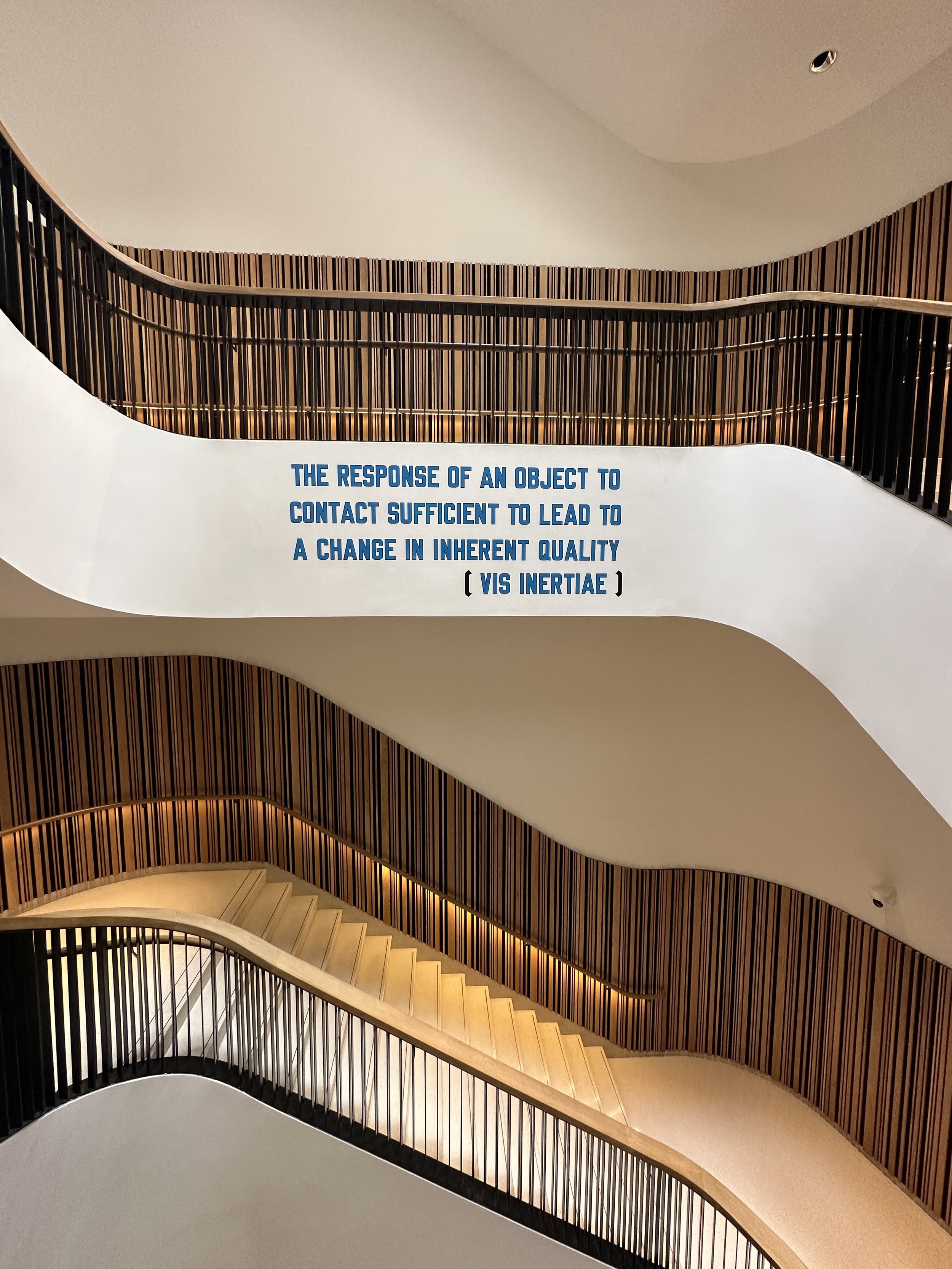
The MLK Library
DC's central library underwent a major modern renovation, and its bright, open interior with a rooftop terrace offers a skyline view that's not widely photographed compared to the Mall's usual vantage points.
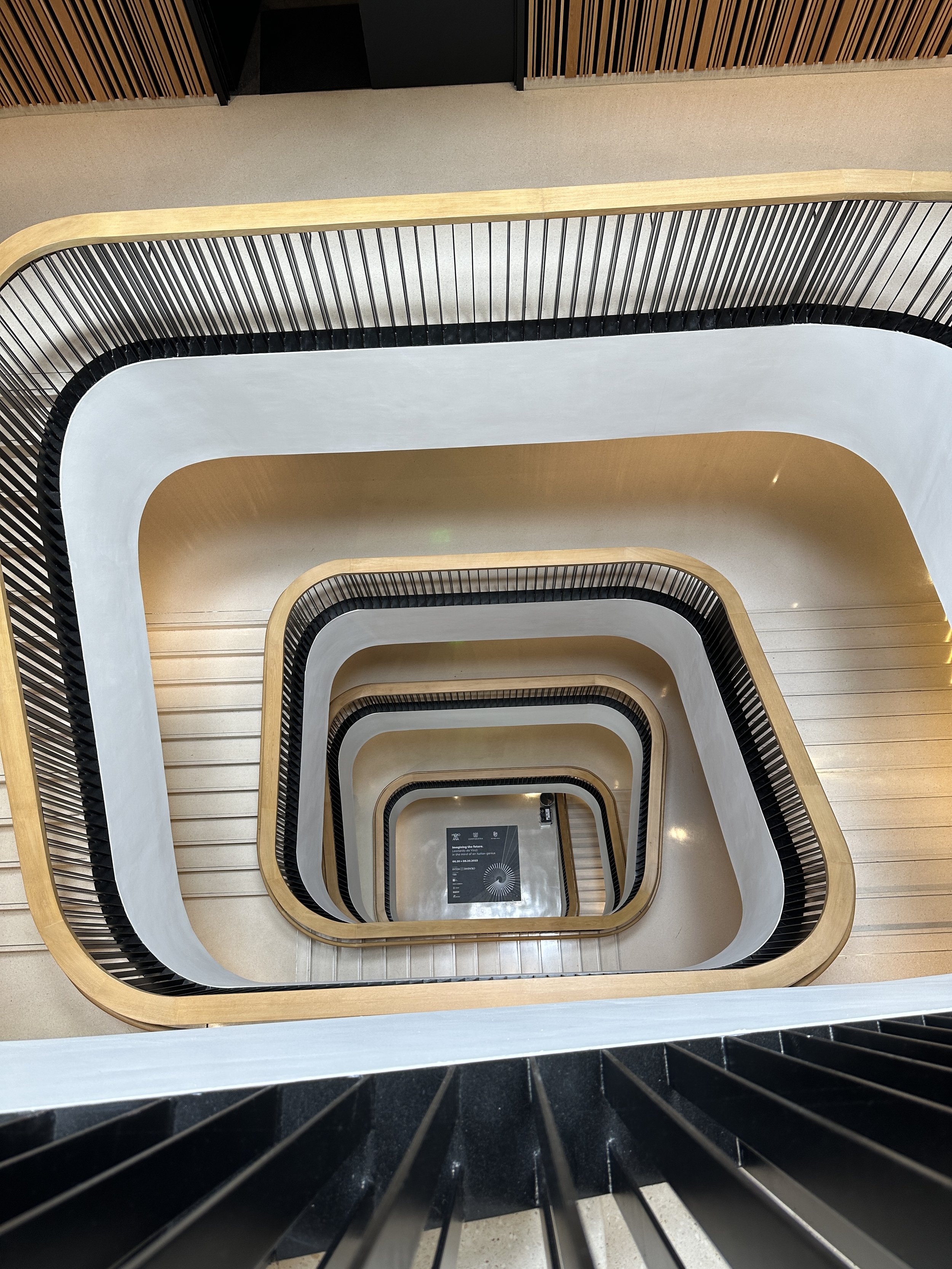
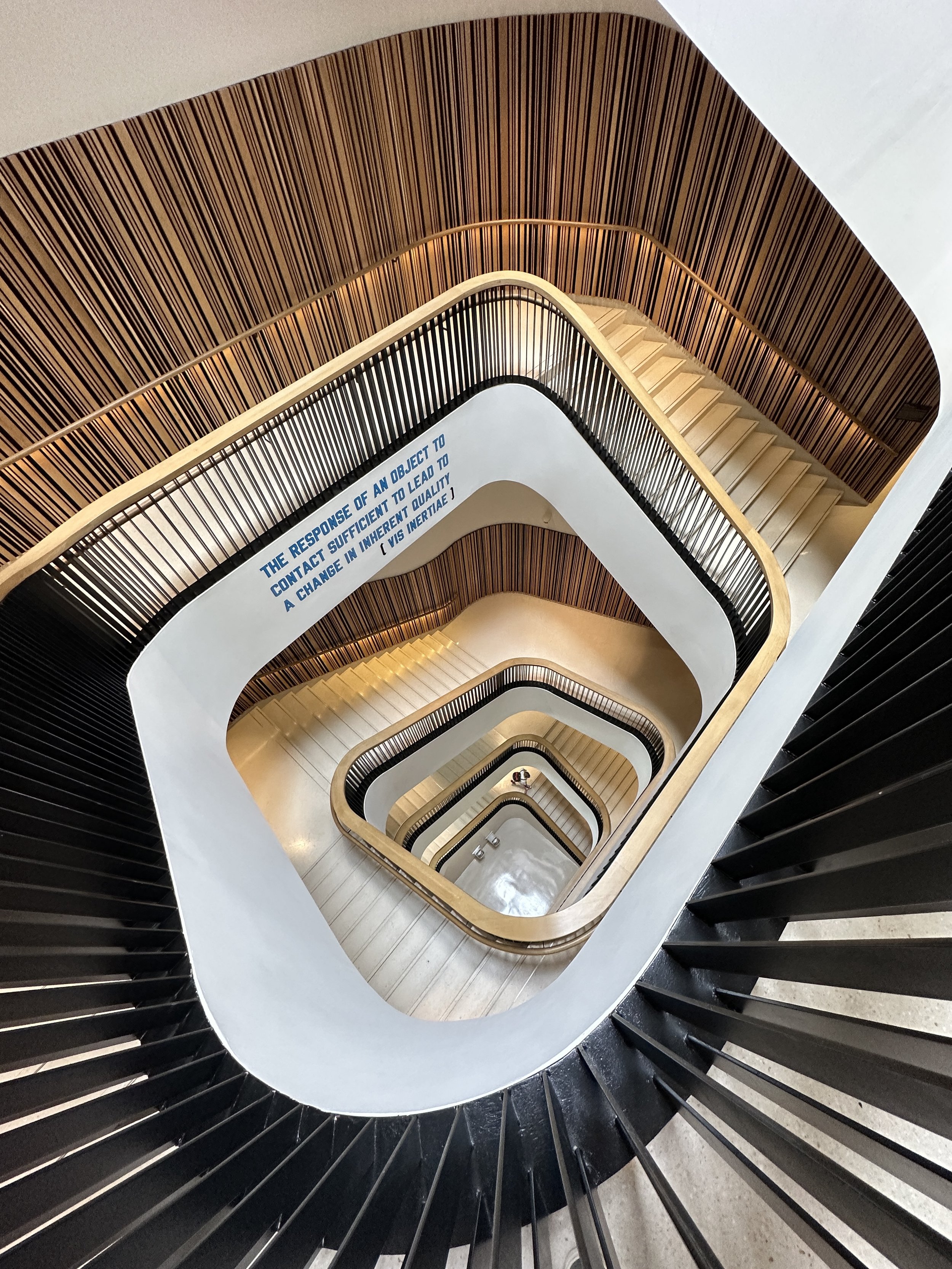
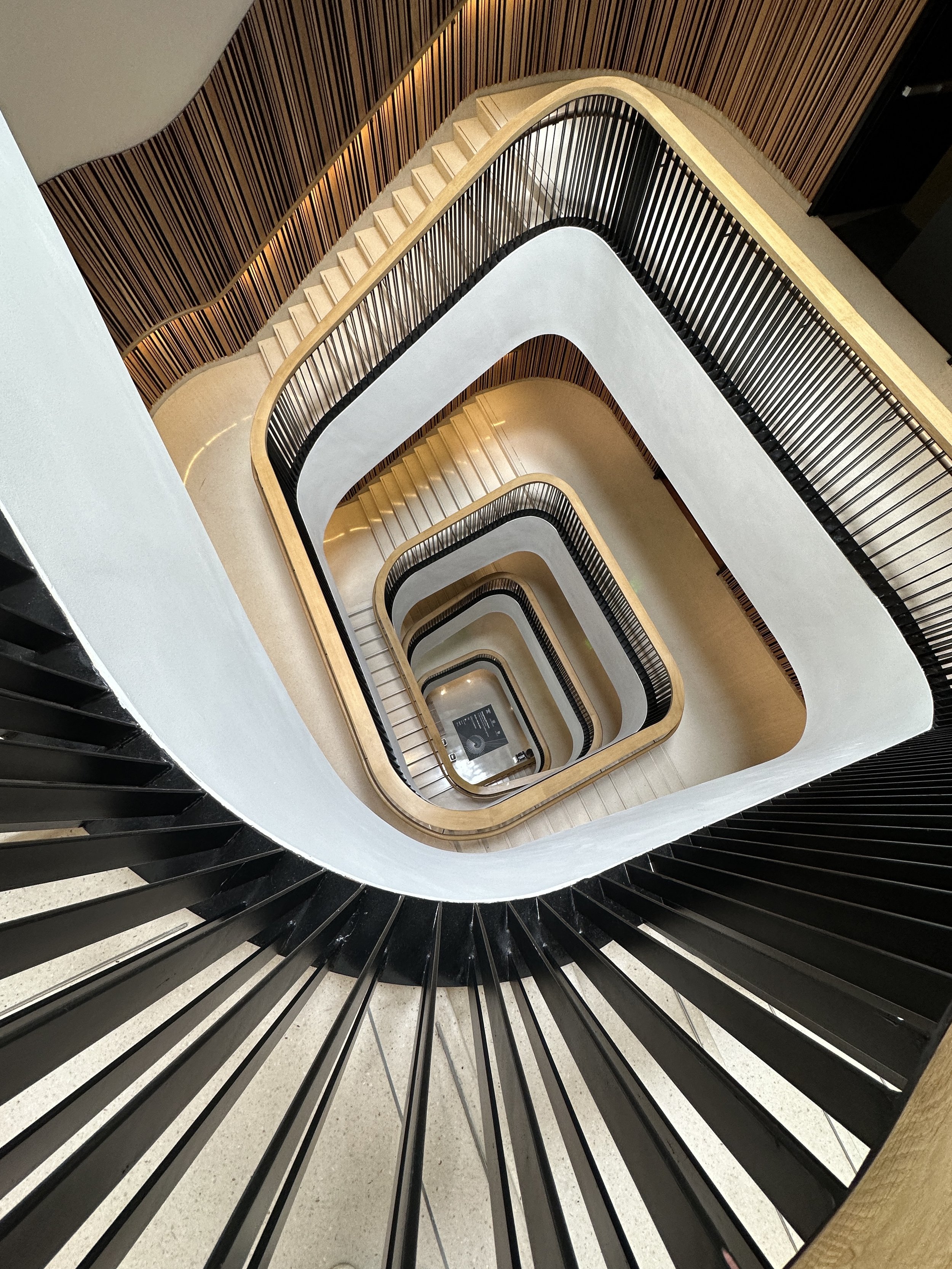
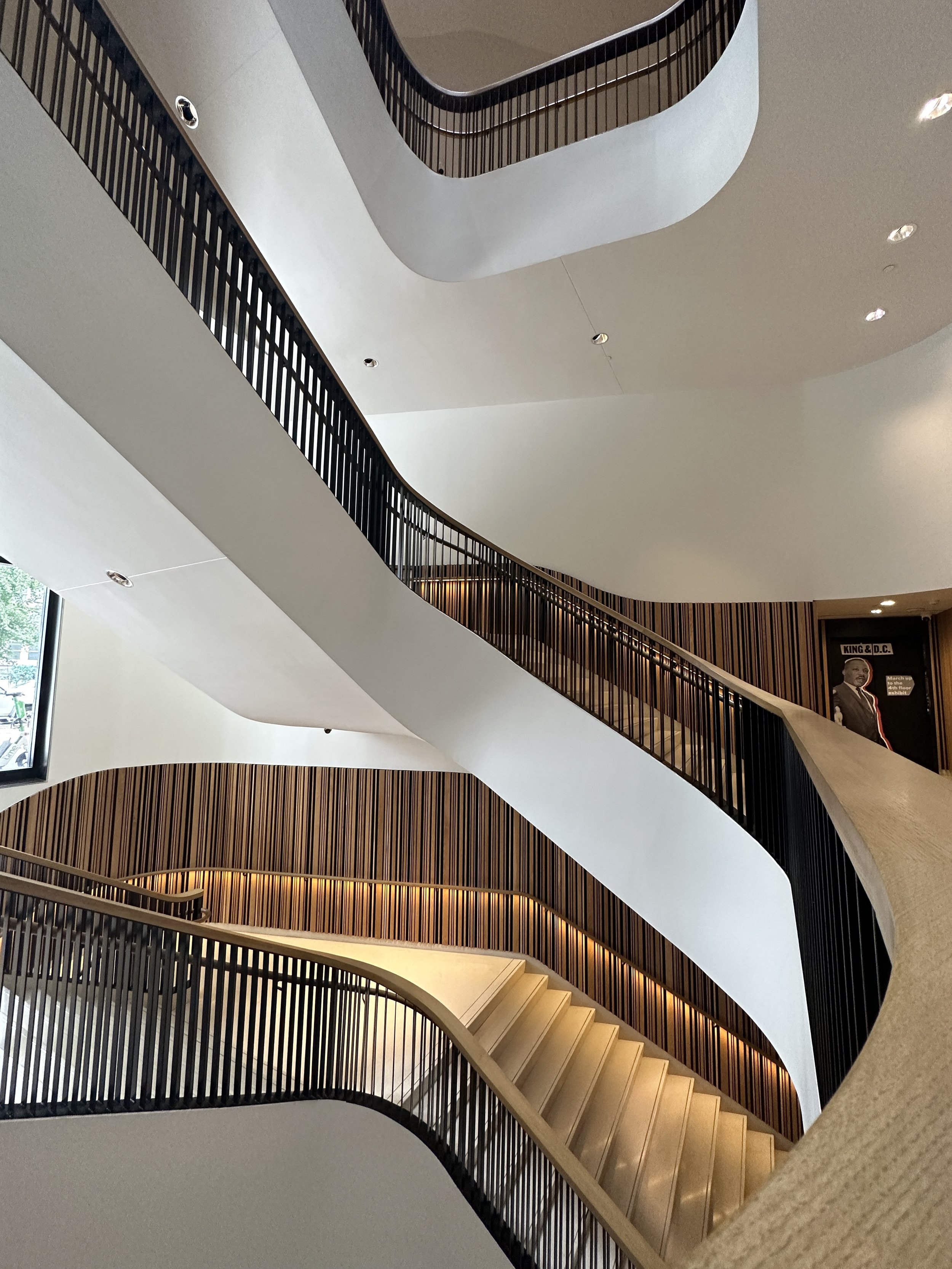
📷 Pro Tip: Head to the rooftop terrace for a 24mm to 70mm skyline shot, especially at golden hour. Inside, the open atrium works well with a wide lens to capture the building's modern lines.
Best time: Golden hour on the rooftop. Access: Free, public library hours apply. Downtown, near Gallery Place-Chinatown Metro.
Georgetown
Georgetown is a town within a town. It was founded in 1751 and is the beginning point of the historic C&O Canal, a national park that runs 184.5 miles into Cumberland, MD. Georgetown is a historic area with cobblestone streets, Georgetown University, shops, cafes, and restaurants. It is a charming area to explore.
Murals here tend to show up in smaller pockets than Shaw or Union Market, tucked alongside streets and loading areas rather than covering full building facades, which rewards slower, more deliberate wandering over a planned mural route.
📷 Pro Tip: Work the side streets off M Street and Wisconsin Avenue rather than the main commercial strips; that's where most of the mural work turns up. A 24mm to 35mm lens handles most wall pieces at close range. Late afternoon light on the cobblestone streets themselves is worth building into the same walk; it hits the brick and stone at a low angle that flatters the whole neighborhood.
Best time: Late afternoon. Access: Free, public streets. Walking distance from the Georgetown waterfront or a short ride from the Foggy Bottom Metro station.
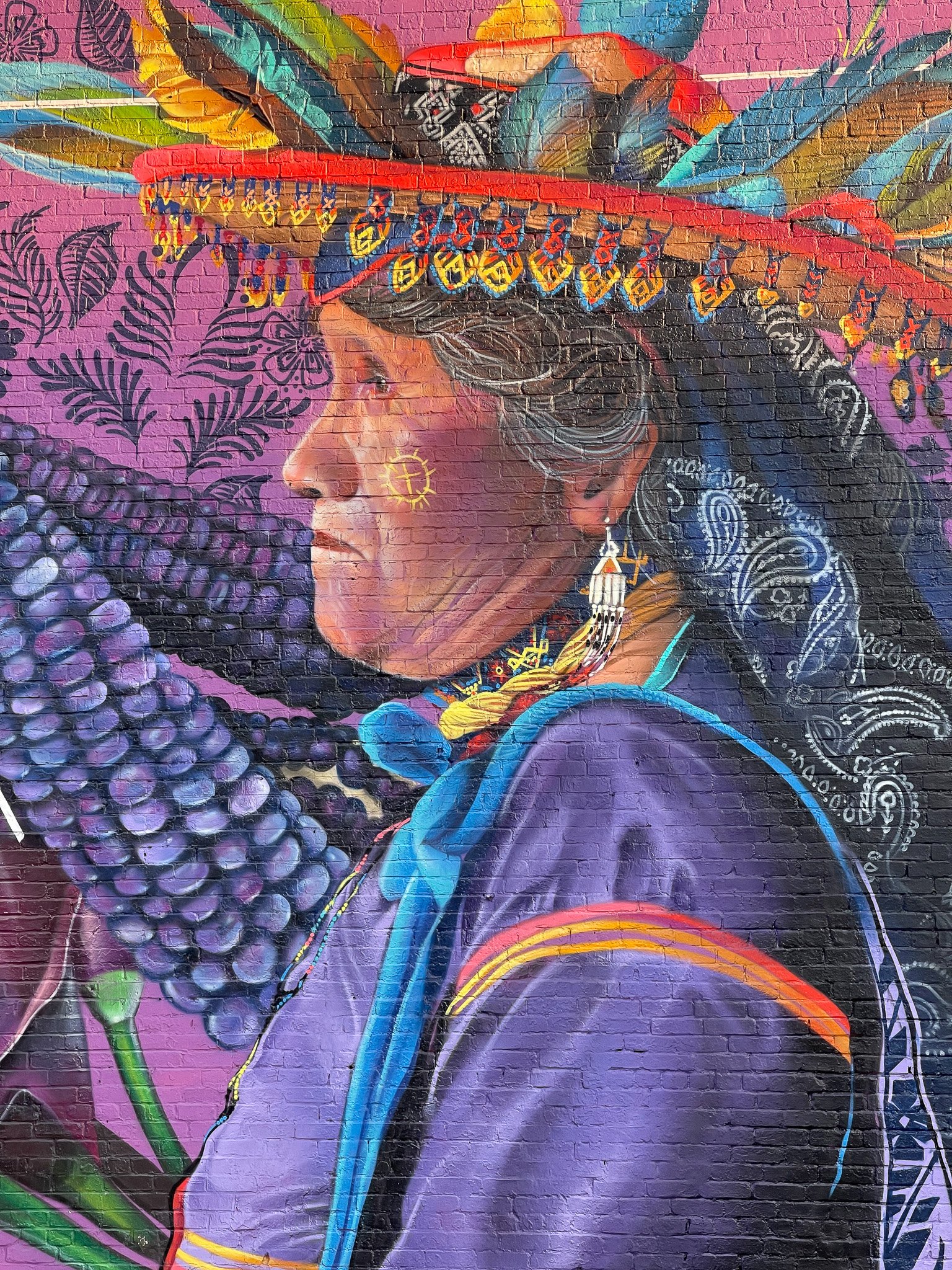
One of my favorite DC Murals
There are plenty of beautiful homes on cobblestone streets that are wonderful to photograph in Georgetown.
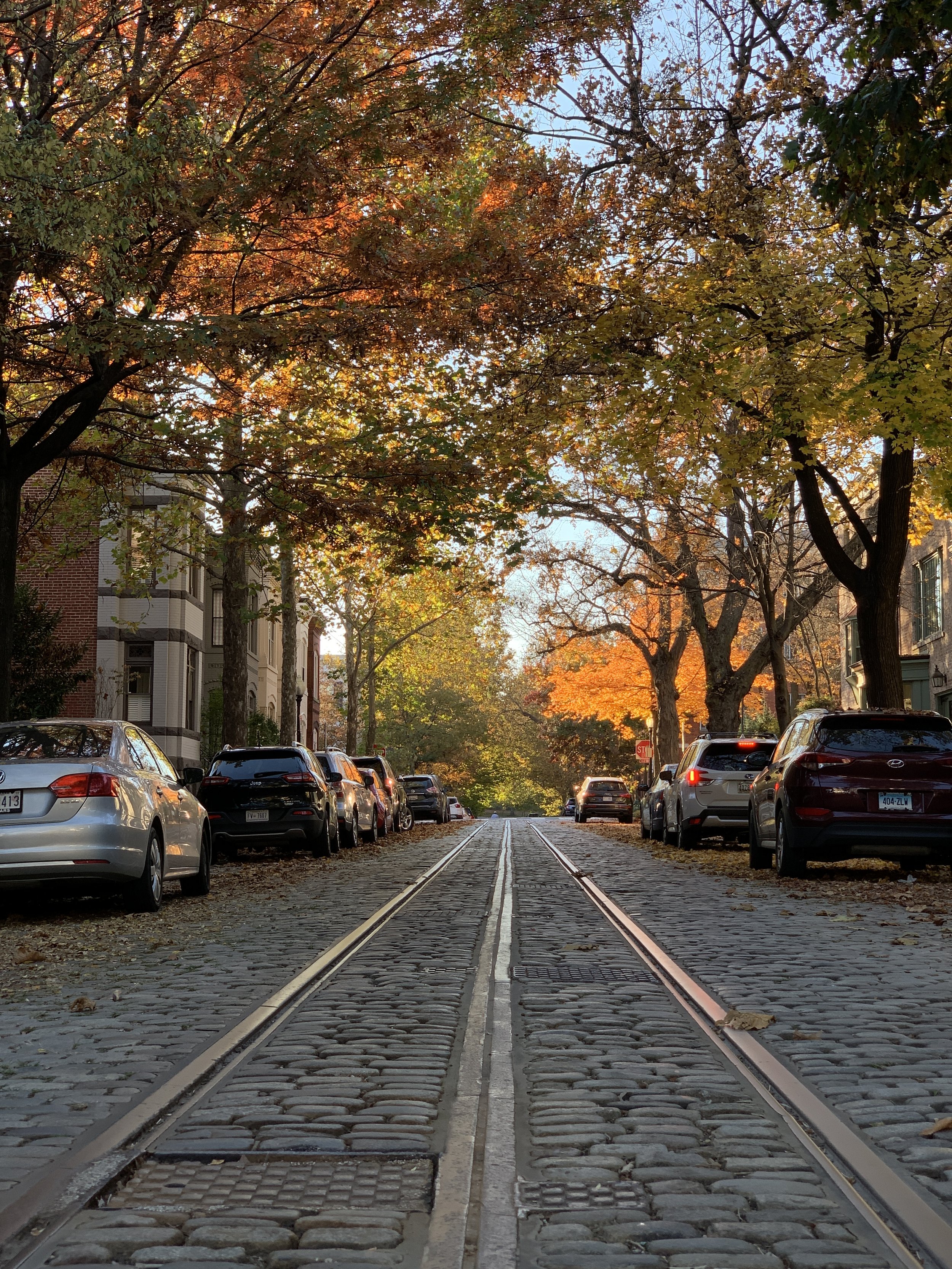
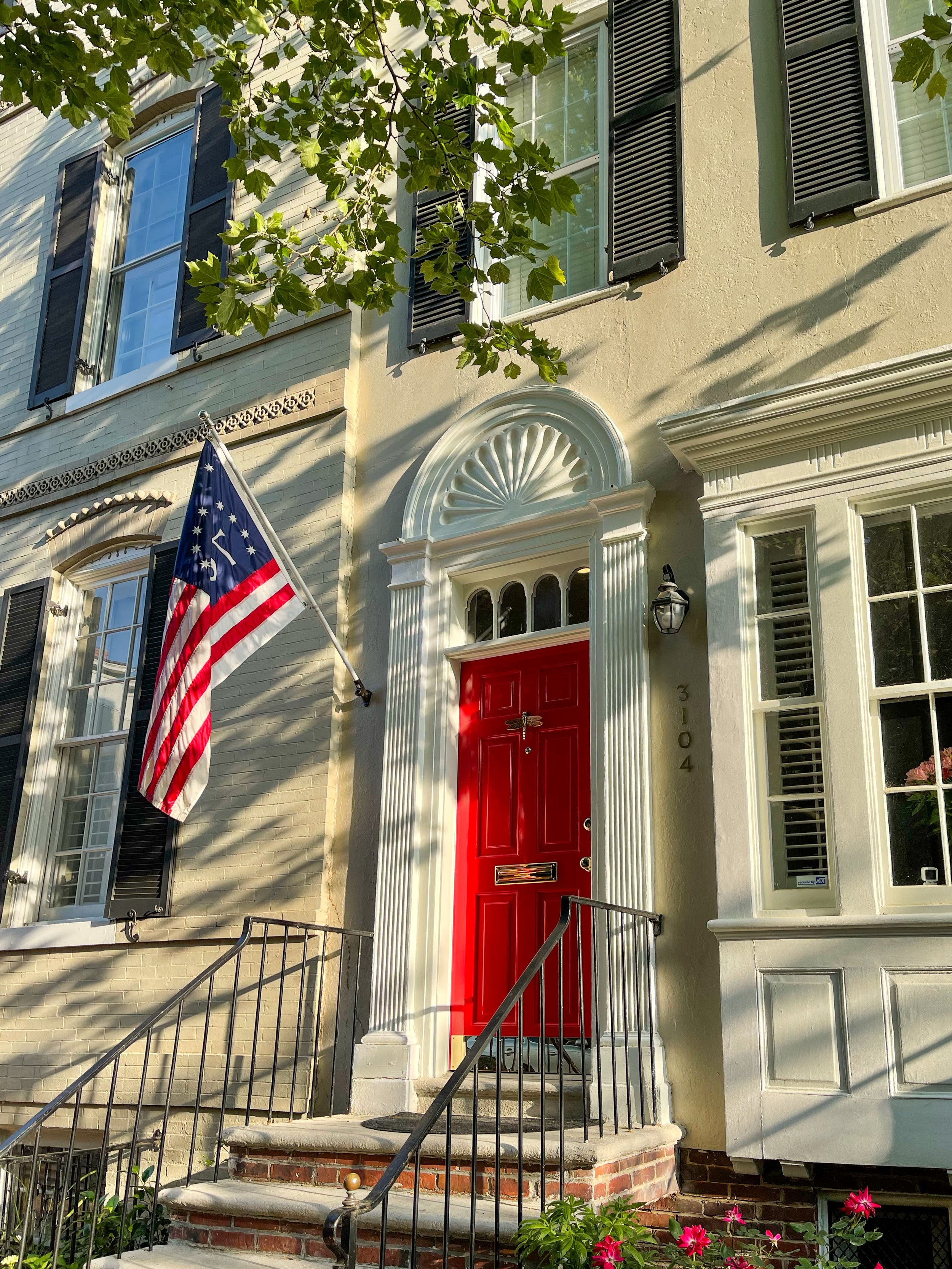
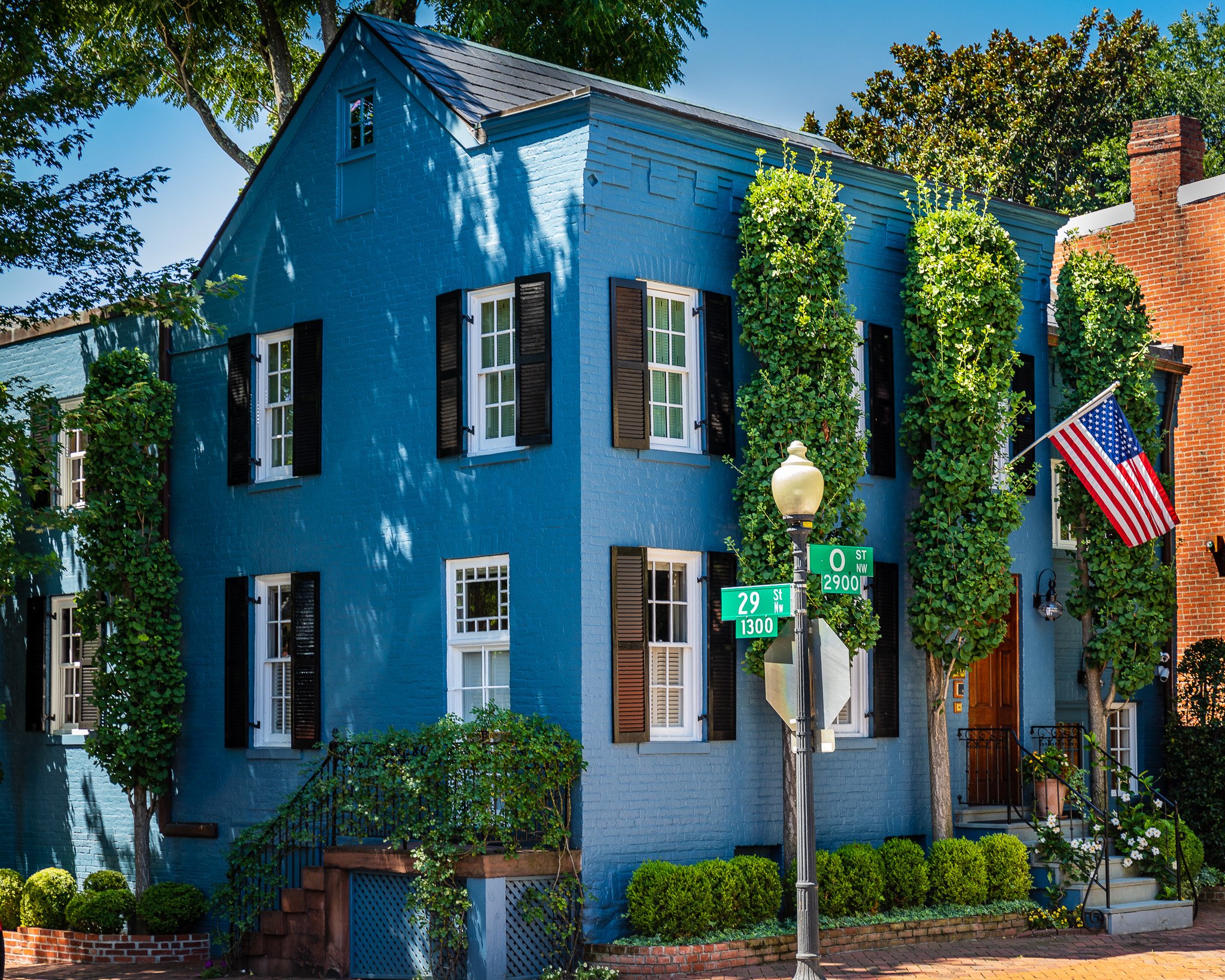
I especially like the way the light hits the buildings during the late afternoon.
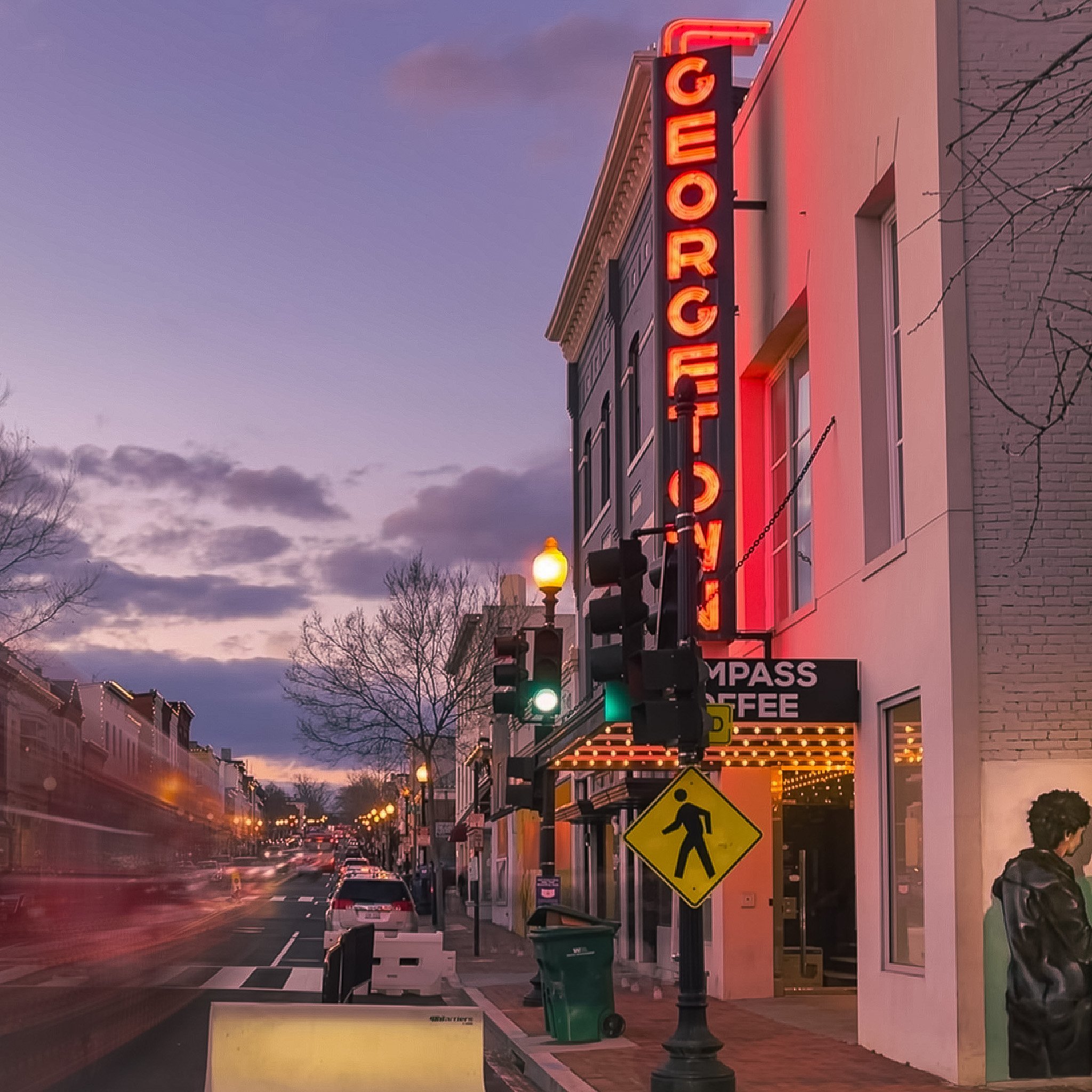
The waterfront along the Potomac River, is also a beautiful area to stroll and enjoy a dinner, and take photos of the Kennedy Center.
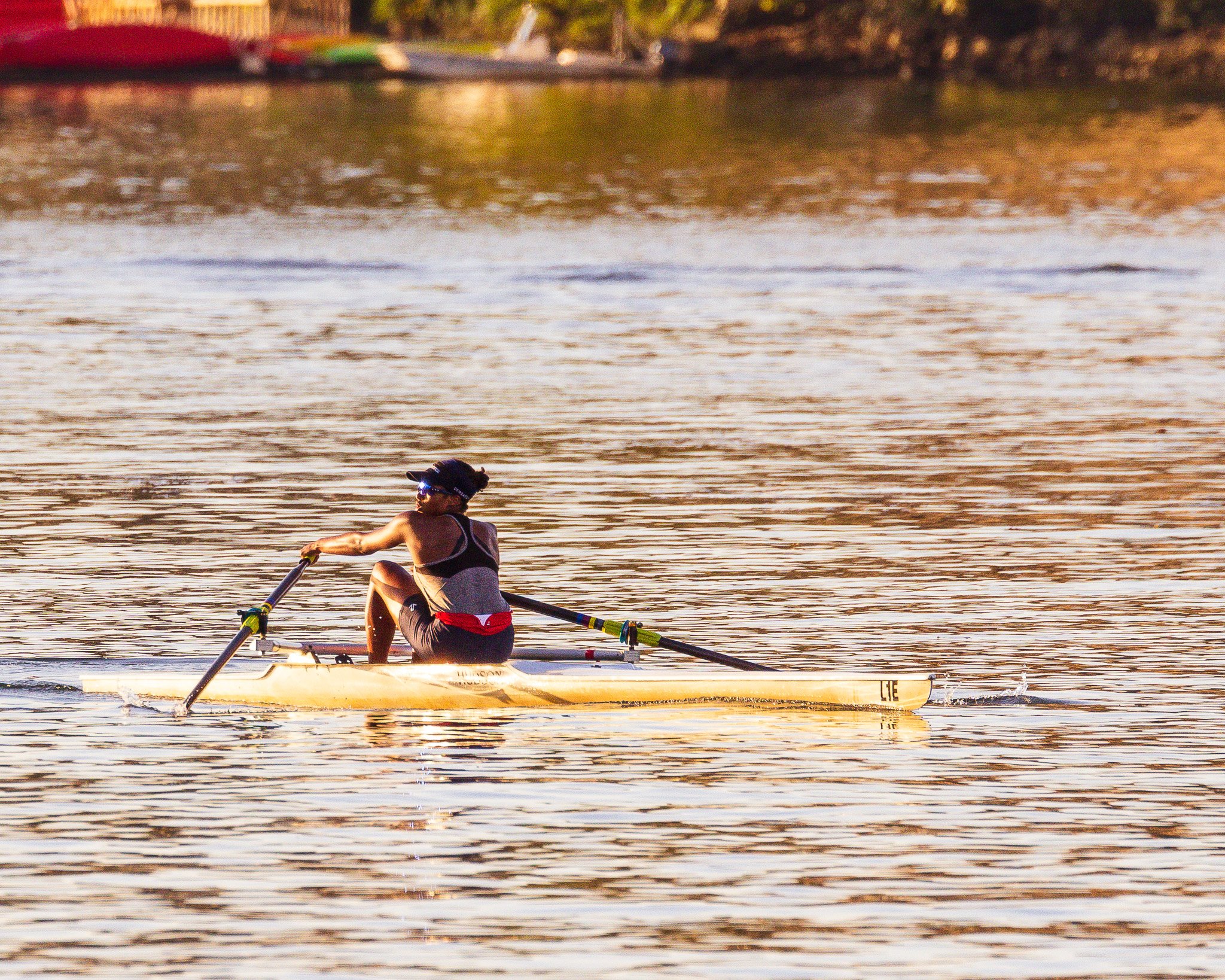
The Crew Teams on the Potomac
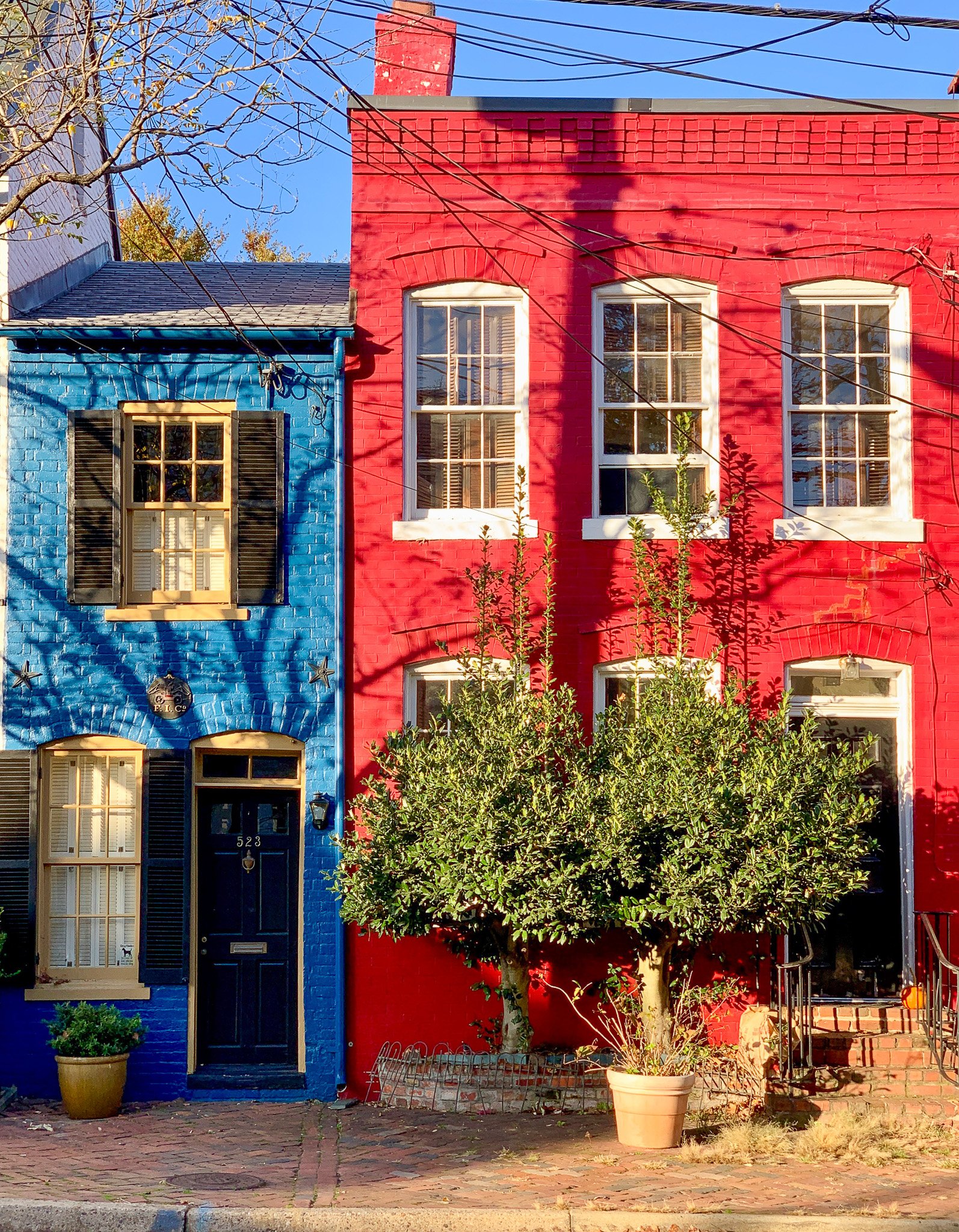
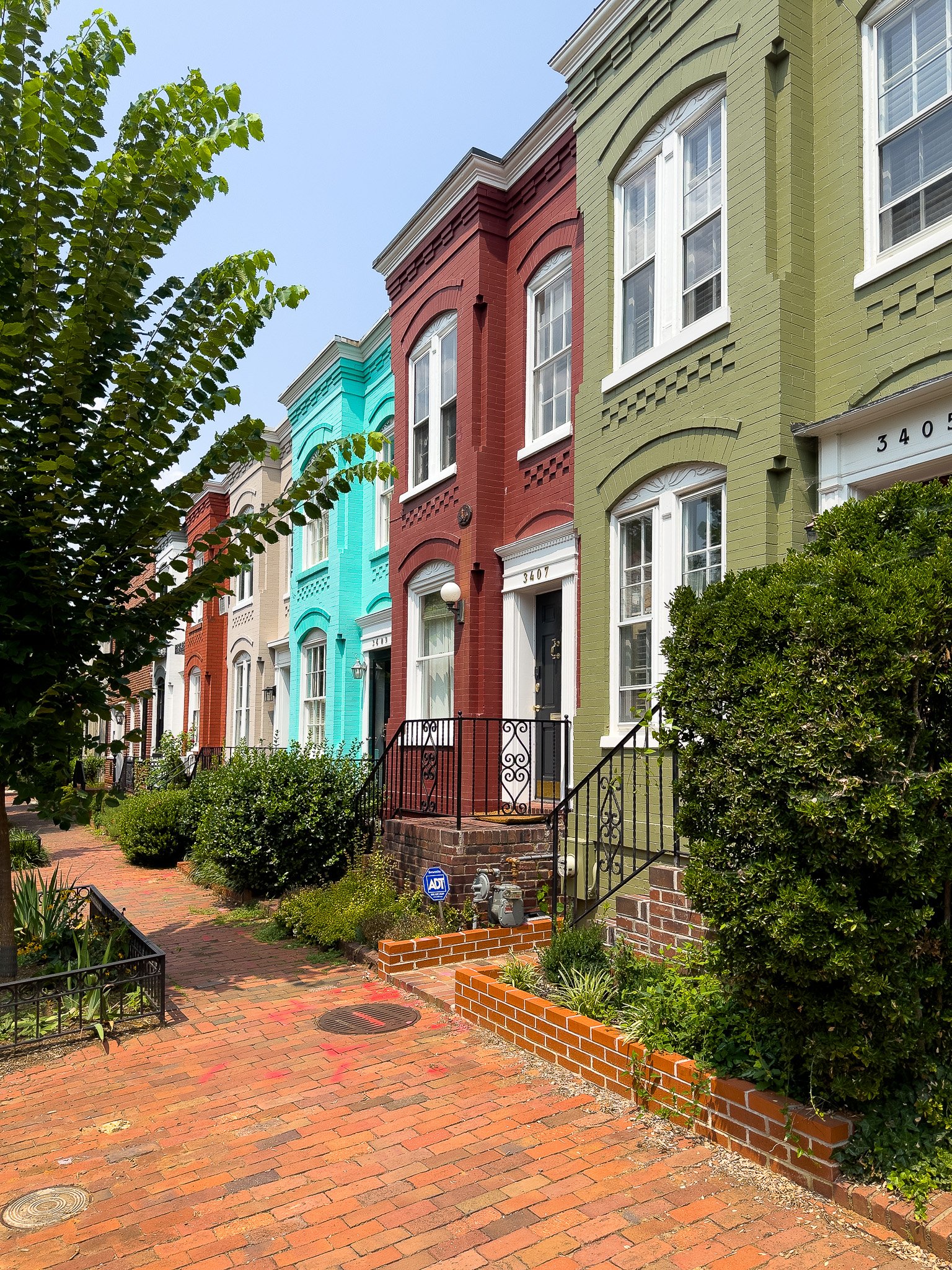
Row Houses in Georgetown, Capitol Hill, and Old Town Alexandria
The quiet, tree lined streets north of M Street on either side of Wisconsin Avenue are filled with homes dating back as early as the 18th century, ranging from modest row houses to large estates. You will also find beautiful row houses in Alexandria, VA, and around Capitol Hill.
The repetition of facades, doors, and stoops along a single block is the real subject here, more than any one house. Each neighborhood has its own color palette and architectural period, so the same composition style reads differently in Georgetown versus Capitol Hill versus Alexandria.
📷 Pro Tip: Walk the block rather than shooting from one spot, and use a 35mm to 50mm lens to isolate a run of two or three facades at a time without distortion. Late afternoon side light brings out the texture in brick and painted wood that flat midday light loses. Capitol Hill's rows tend to have more color variation than Georgetown's, worth covering both if you have the time.
Best time: Late afternoon. Access: Free, public streets. Georgetown rows cluster north of M Street; Capitol Hill rows sit within walking distance of the Eastern Market Metro station; Old Town Alexandria requires a short Metro or drive south.
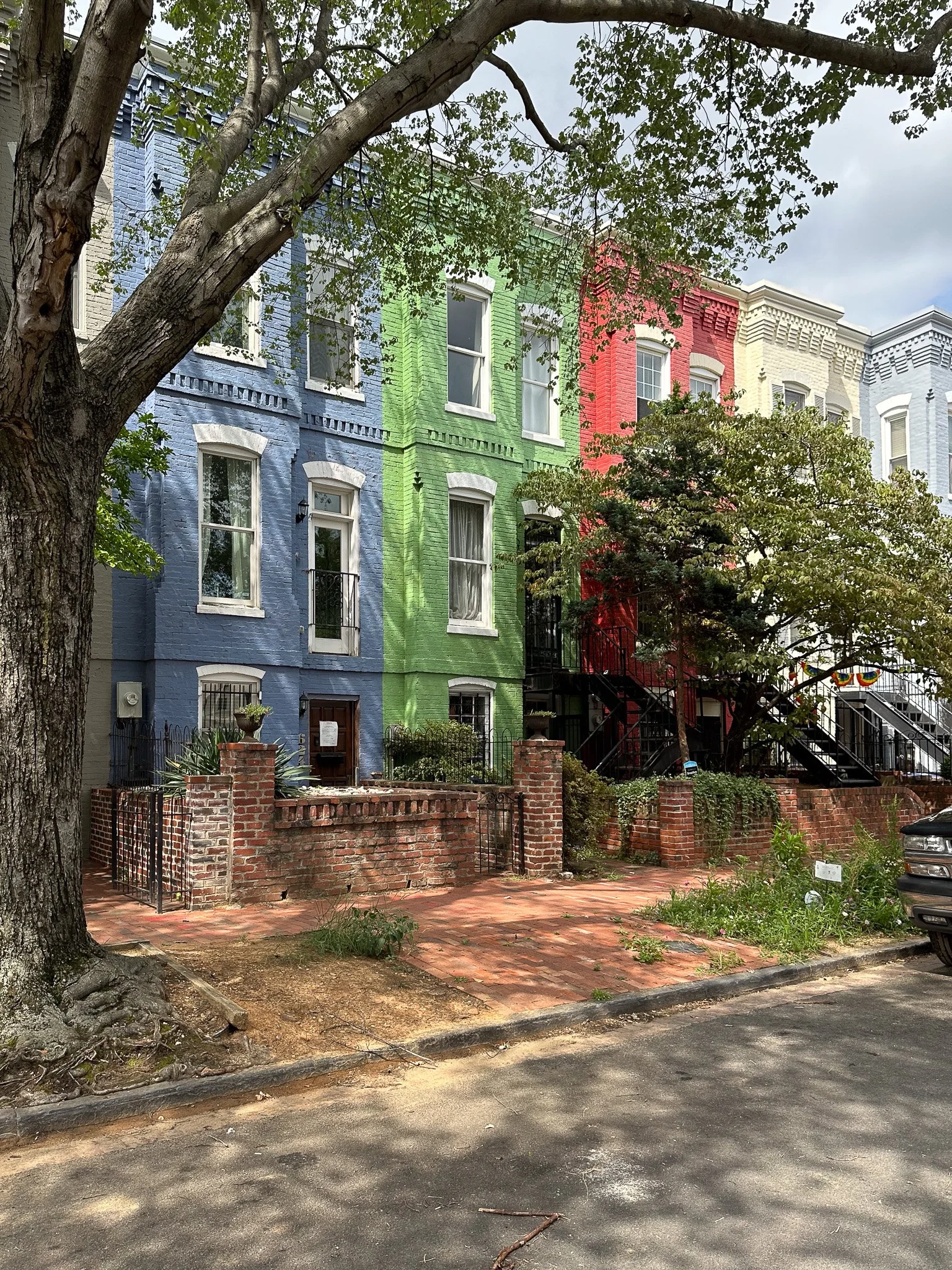
Dupont Circle
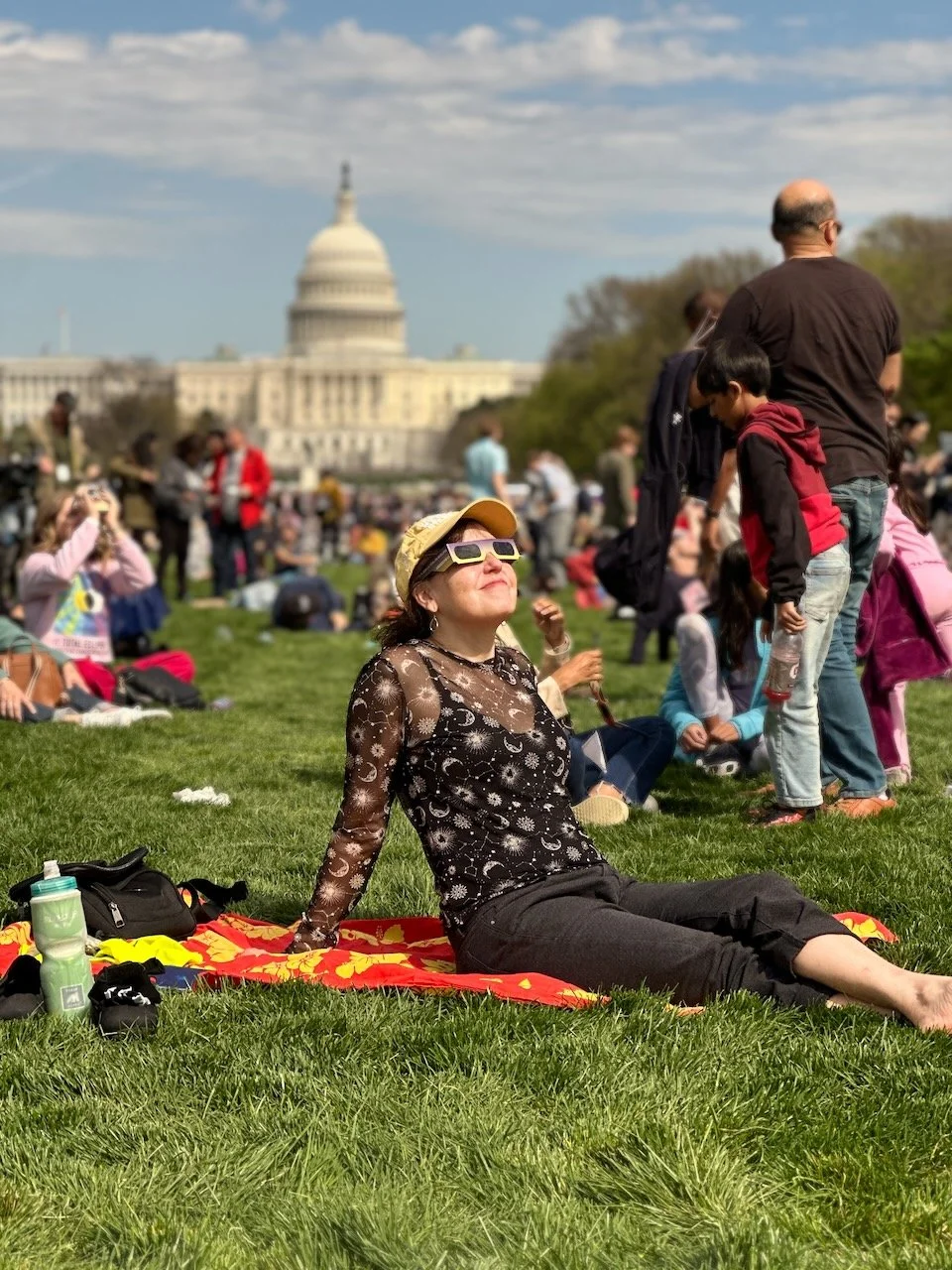
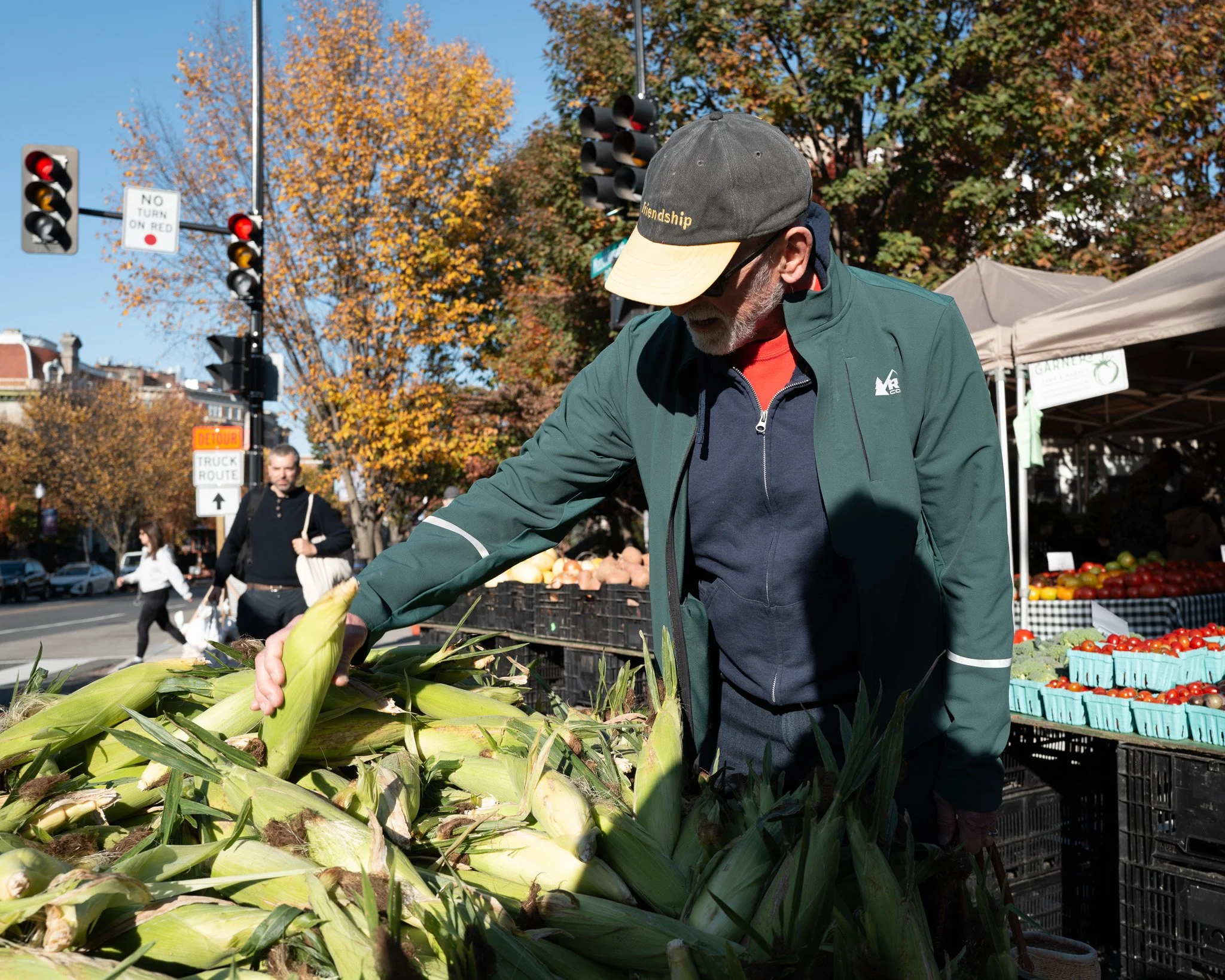
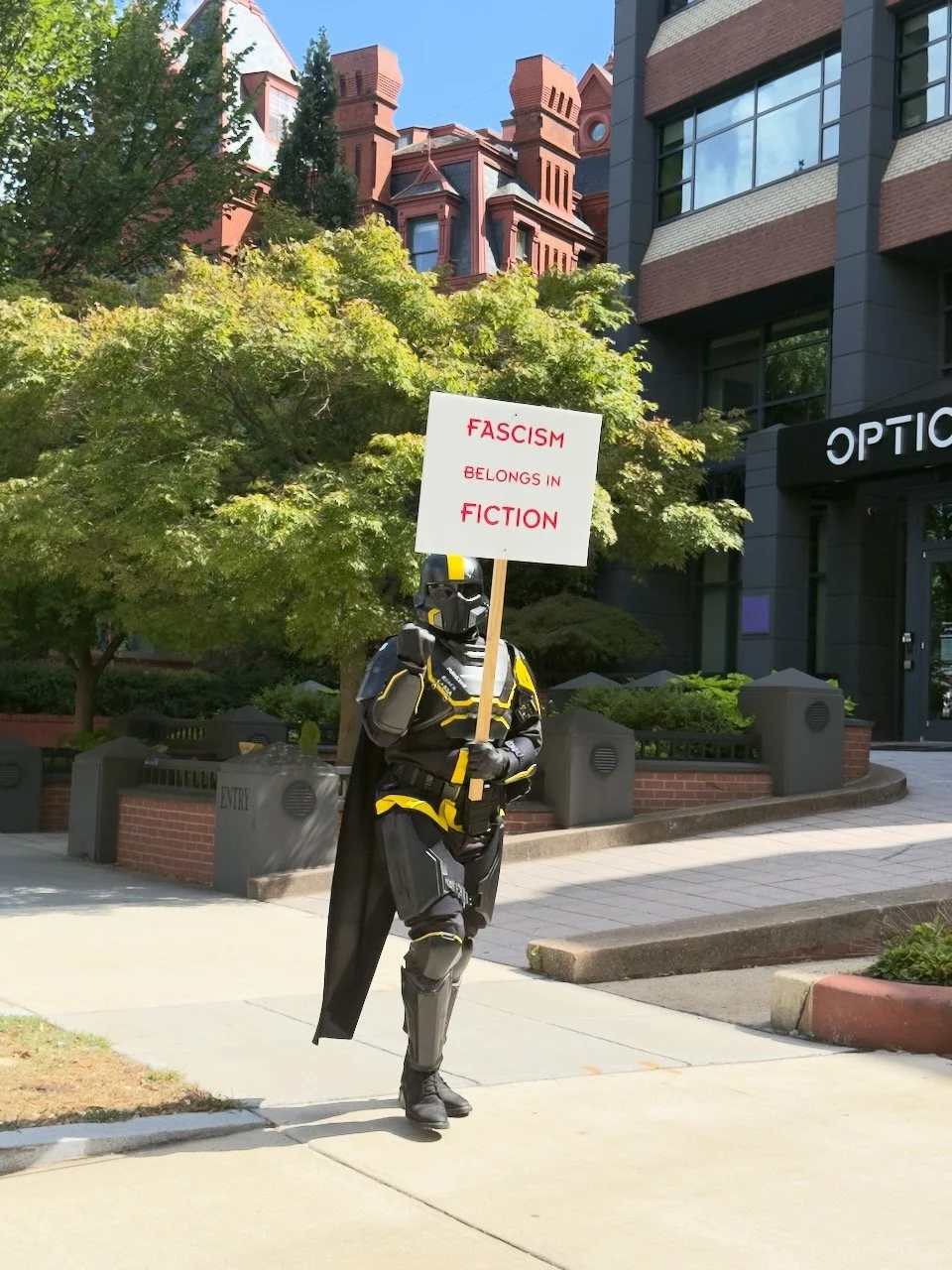
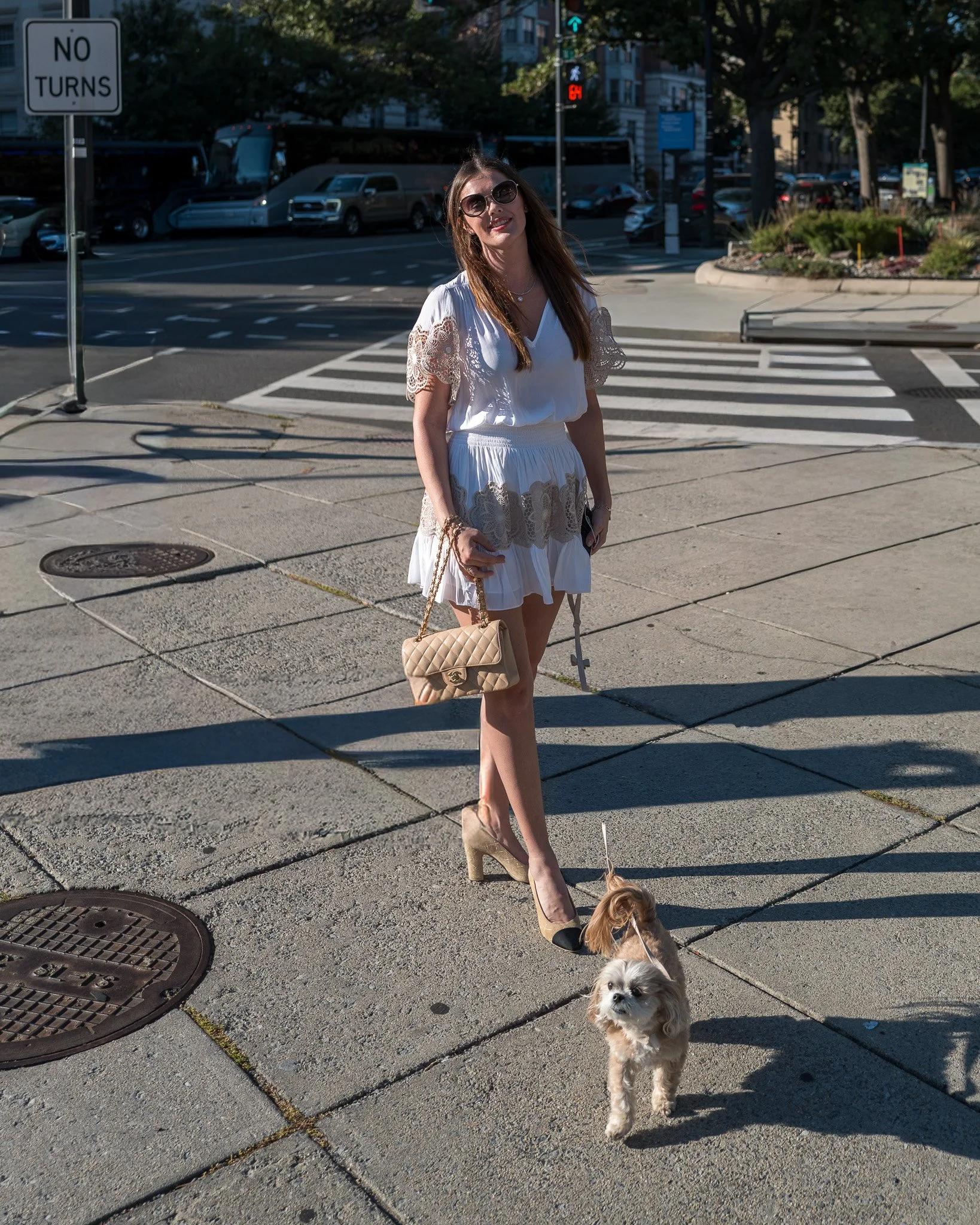
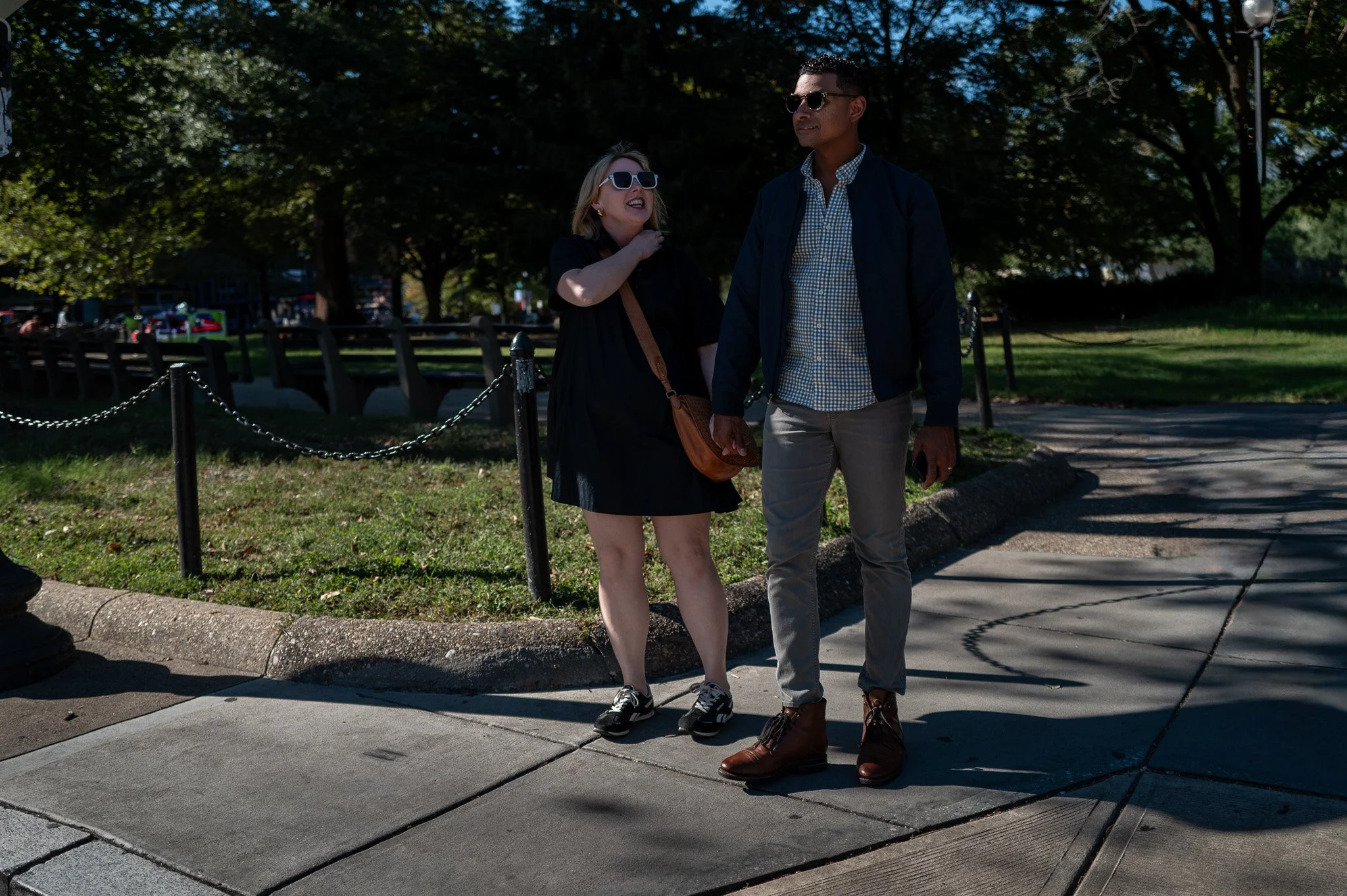
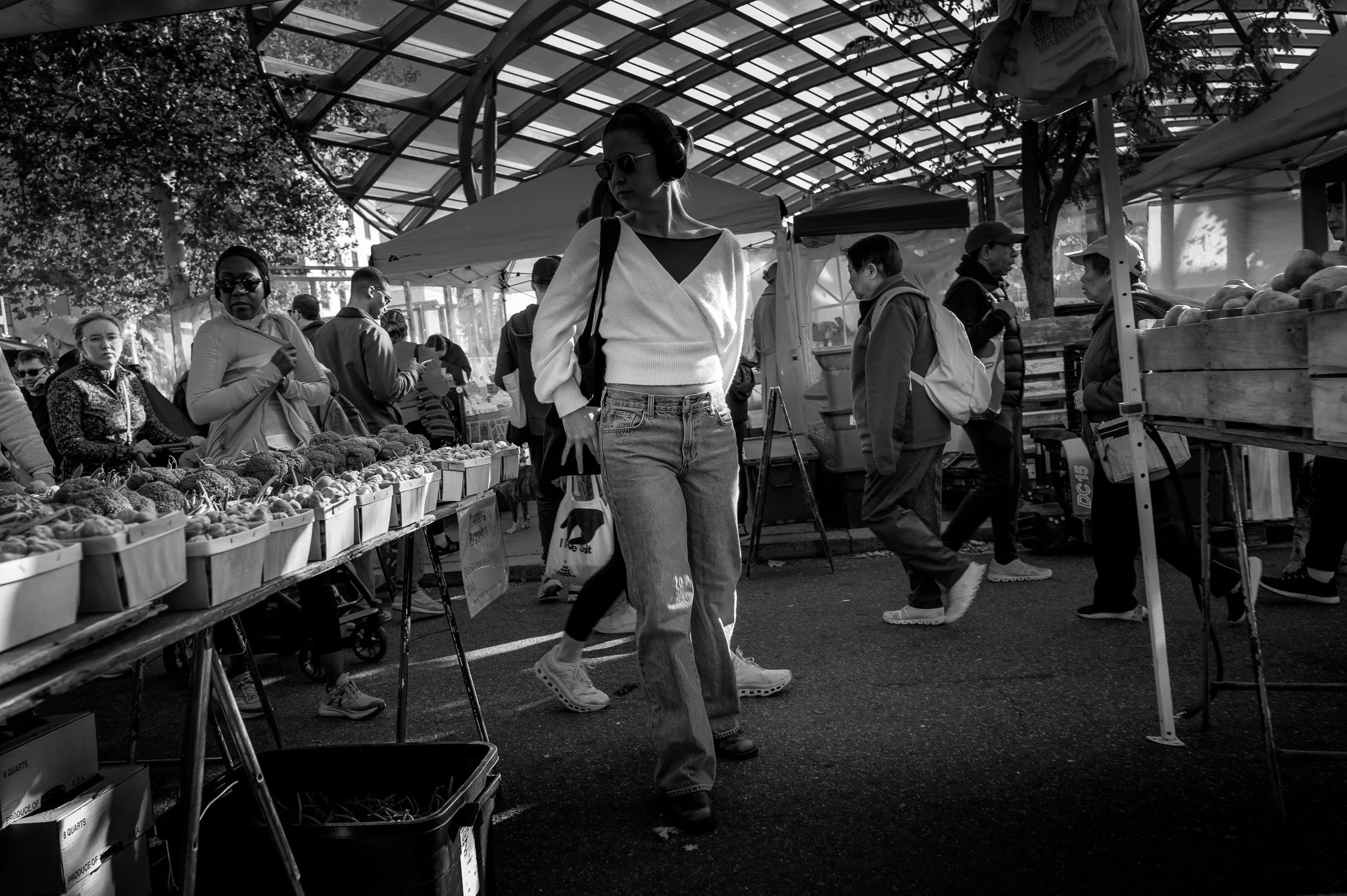
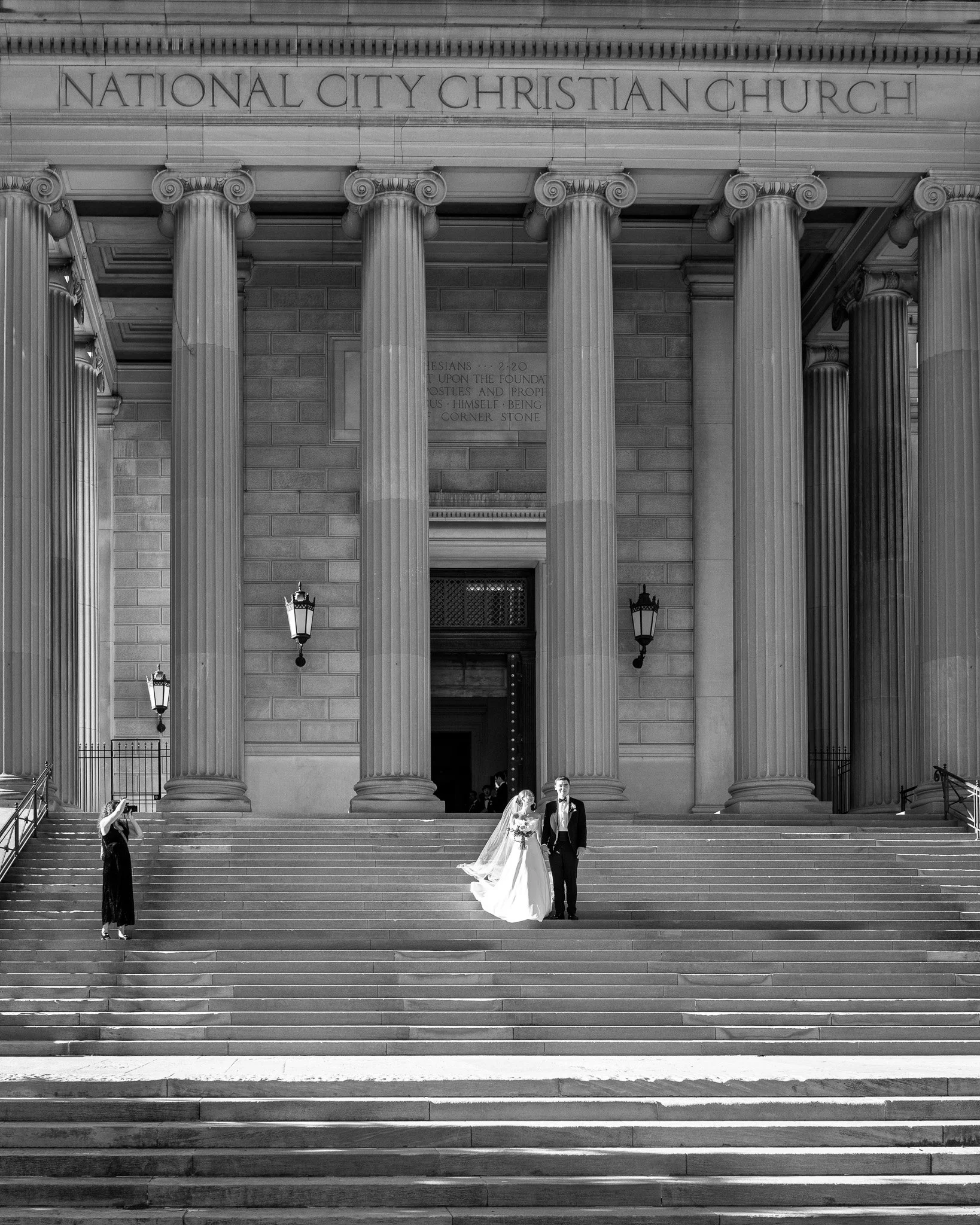
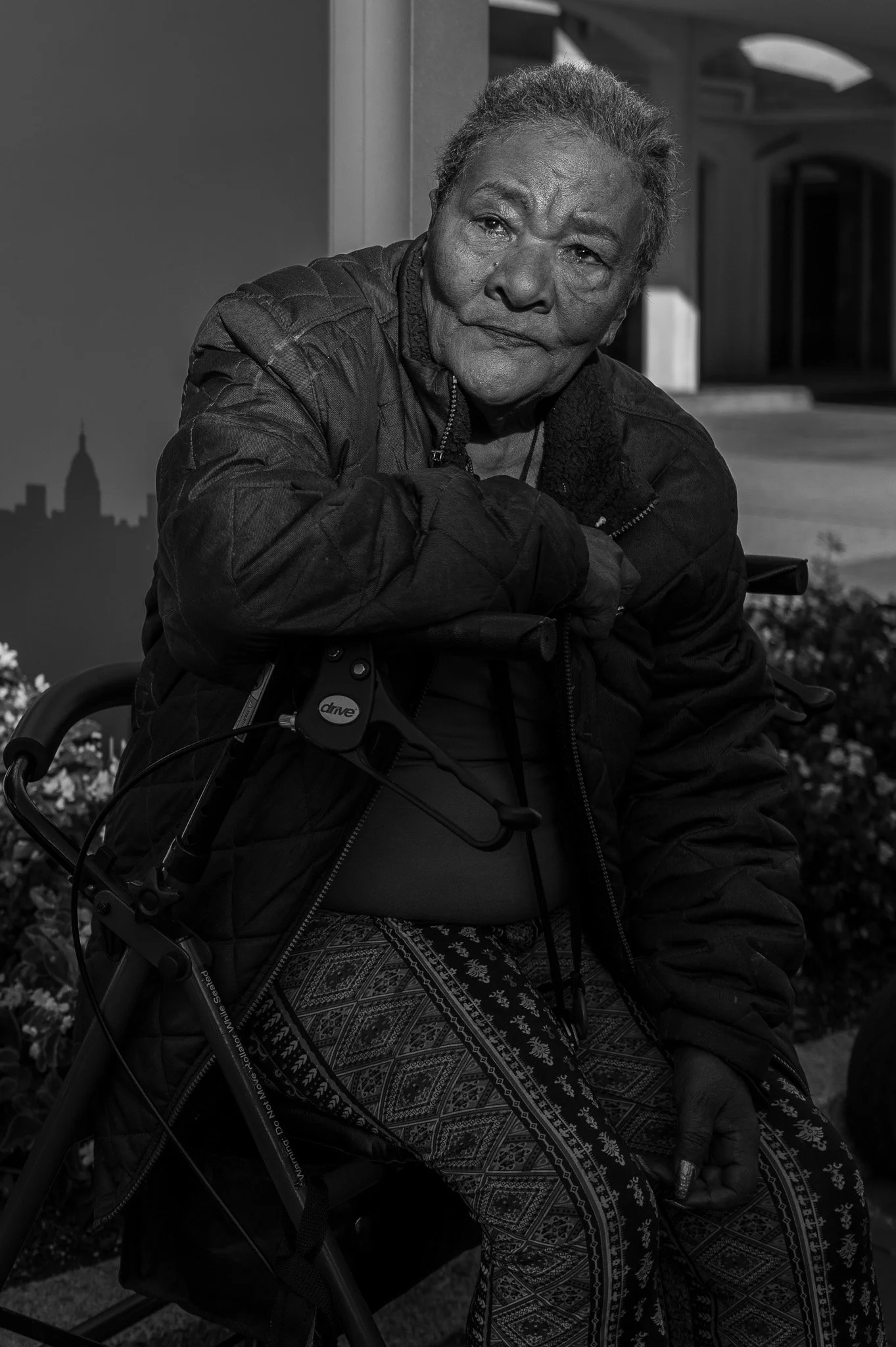
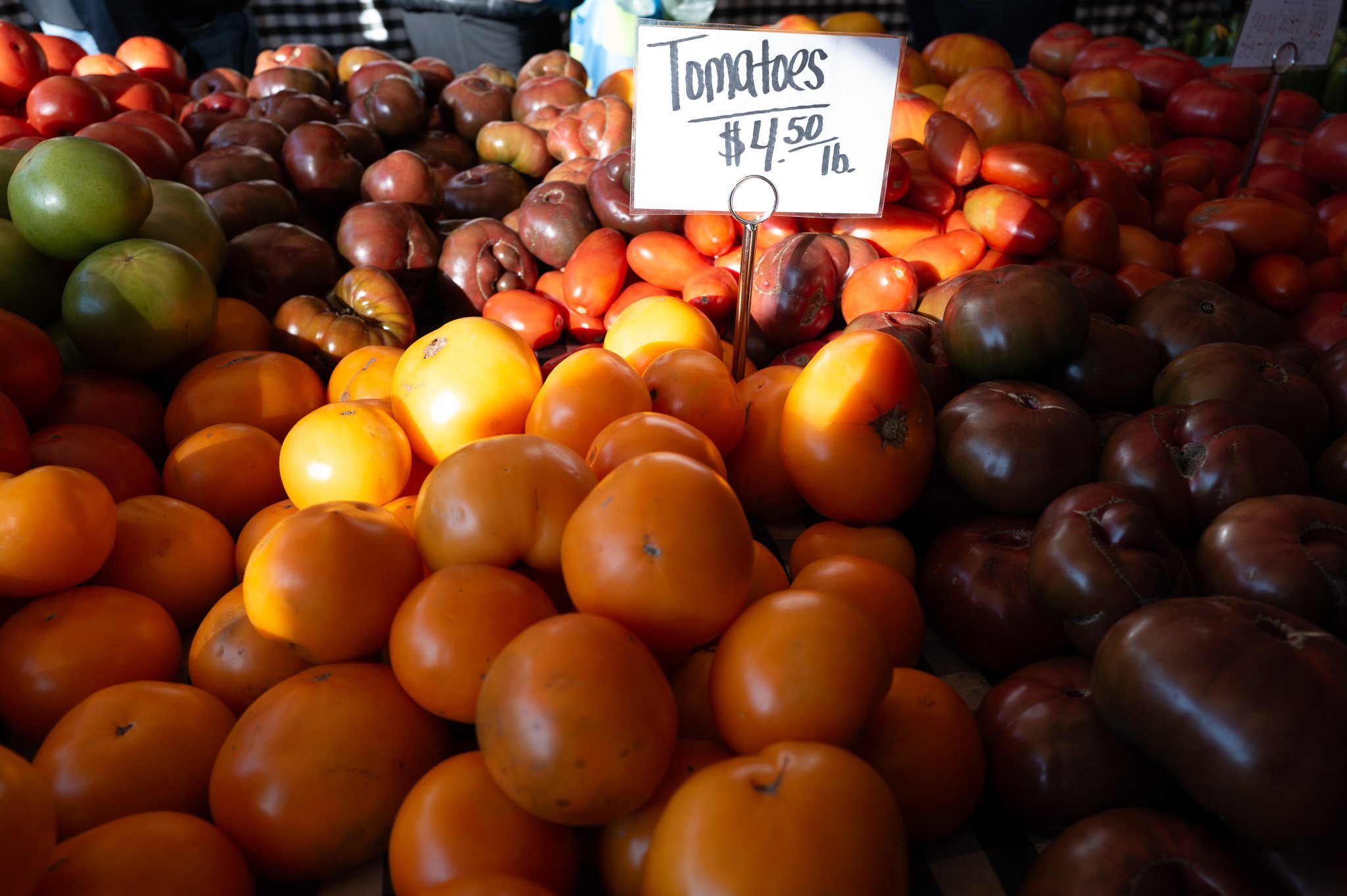
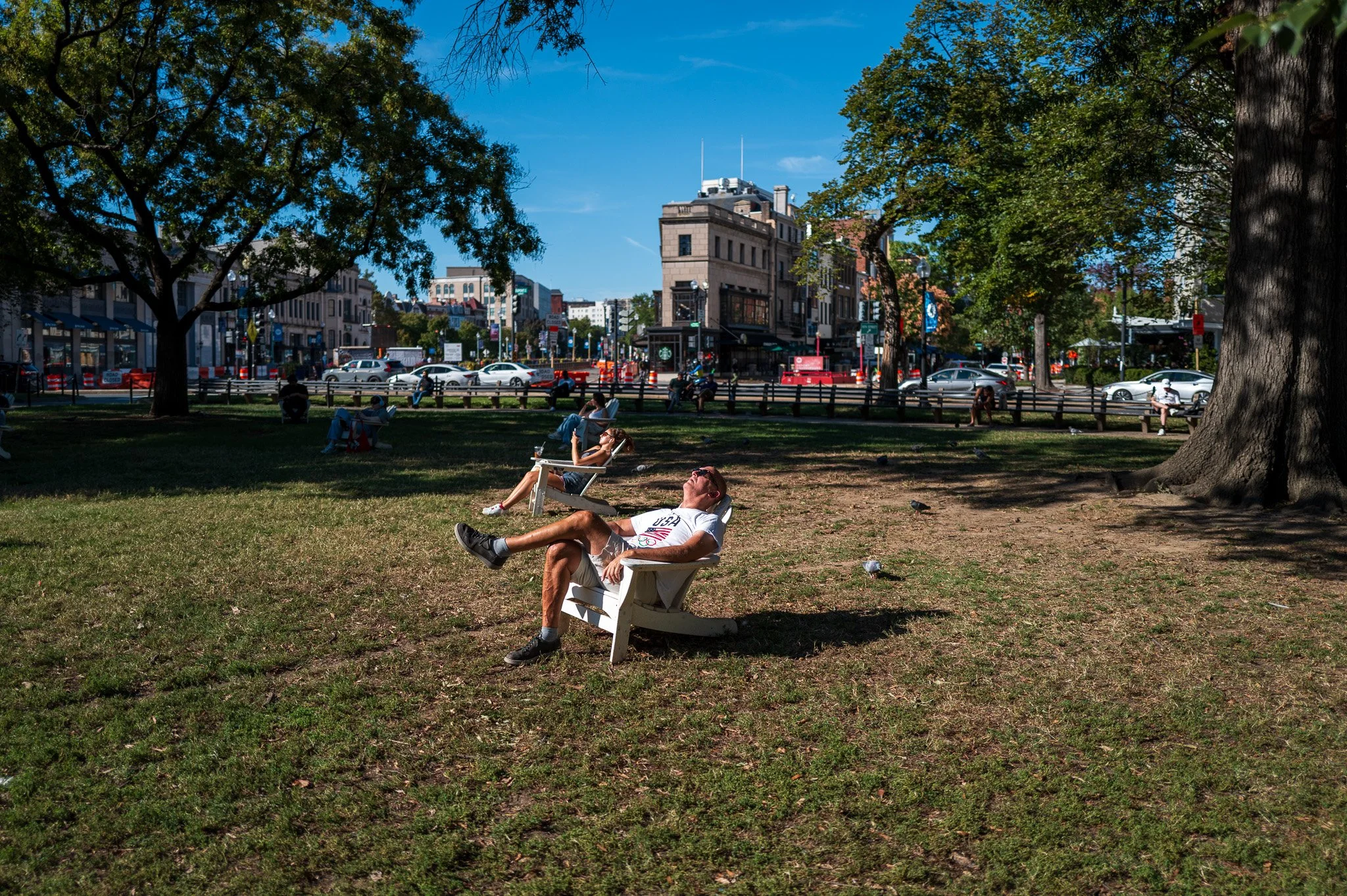
Dupont Circle is the place to go for street photography, and it works because it's one of the only spots in DC where people actually linger instead of moving through on their way to a monument. The fountain at the center of the traffic circle acts as a natural gathering point that draws a crowd all day long: chess players hunched over boards, dog walkers making laps, office workers eating lunch on the fountain's edge, tourists stopped to check a map.
The neighborhood's mix of embassy row architecture, bookshops, and outdoor cafe seating gives you a wider range of faces and moments than the monument core, where most people are moving through rather than lingering.
📷 Pro Tip: Post up near the fountain itself with a 35mm to 50mm lens and let the scene come to you rather than chasing shots. Weekday late afternoon brings out the mix of office workers, students, and neighborhood regulars that makes this spot work for street photography. The Dupont Circle Metro entrance, with its long escalator, is also worth a frame on its own with a wide lens from the bottom looking up.
Best time: Late afternoon on weekdays. Access: Free, public space. Directly on the Red Line at the Dupont Circle Metro station.

What makes this different from shooting the Mall is pace. At the Lincoln or the Capitol, you're working with architecture and light on a schedule. At Dupont, you're working with people on their own time, which means patience matters more than timing. The best shots here come from staying in one spot and letting a scene develop rather than chasing something across the circle.
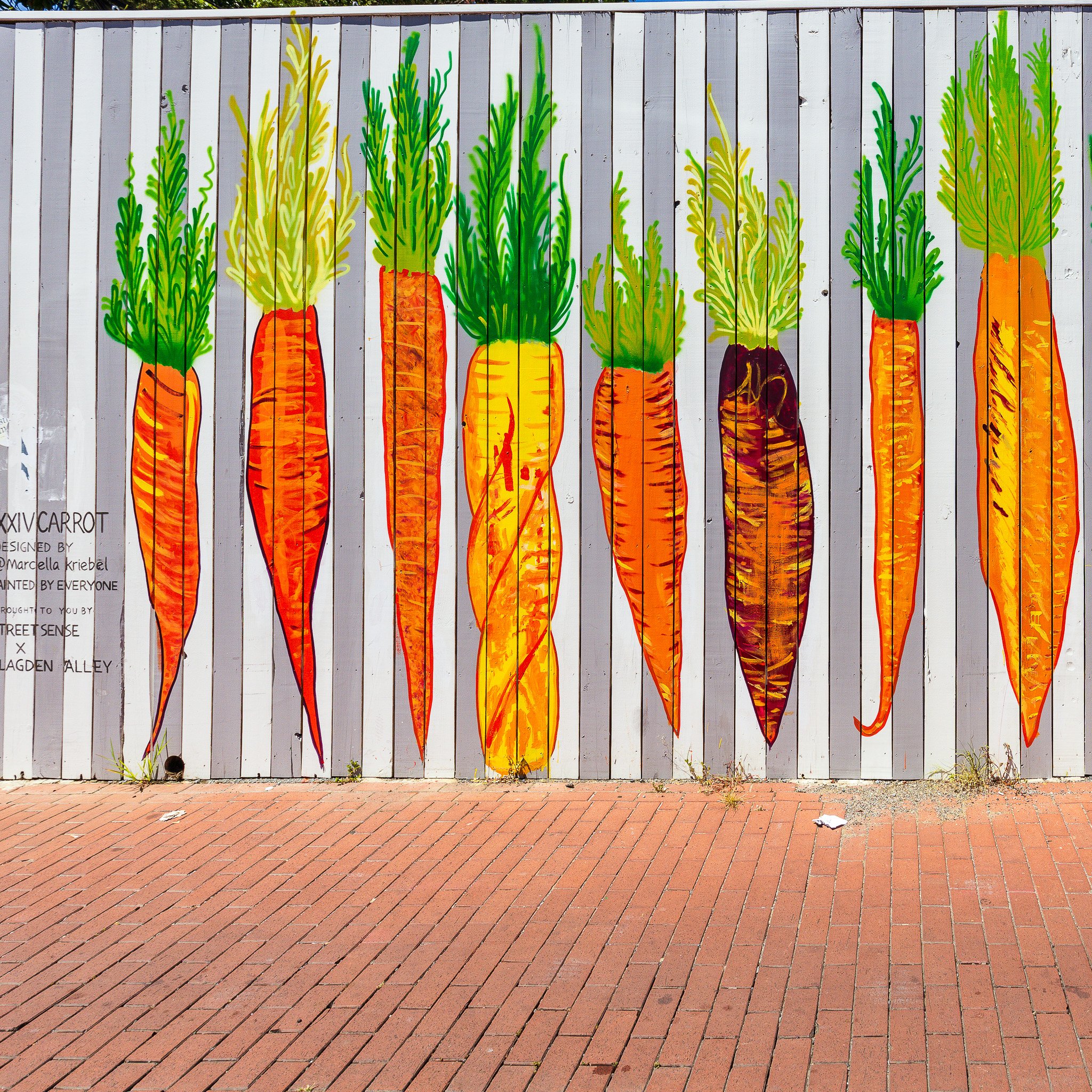
Blagden's Alley
Another fun location is Blagden's Alley. Here, you can not only have a fantastic coffee drink at La Colombe or Seylou Bakery, but there is also some beautiful graffiti. Blagden Alley and Naylor Court are considered so notable that the National Park Service designated them as a historic district.
The alley's narrow brick walls and garage doors are covered in rotating murals, which means the exact composition changes over time even if the location stays the same. Morning light drops straight down between the buildings rather than raking across them, giving flatter, more even light than the open Mall locations.
📷 Pro Tip: Shoot straight down the alley with a 24mm to 35mm lens to capture the full run of murals on both sides. Late morning gives you the most even light without harsh shadows breaking up the wall art. Since the murals rotate, check what's currently up before building a shot list around a specific piece you saw in an older photo.
Best time: Late morning. Access: Free, public alley. In Shaw, a short walk from the Mt Vernon Square or Shaw-Howard University Metro stations.
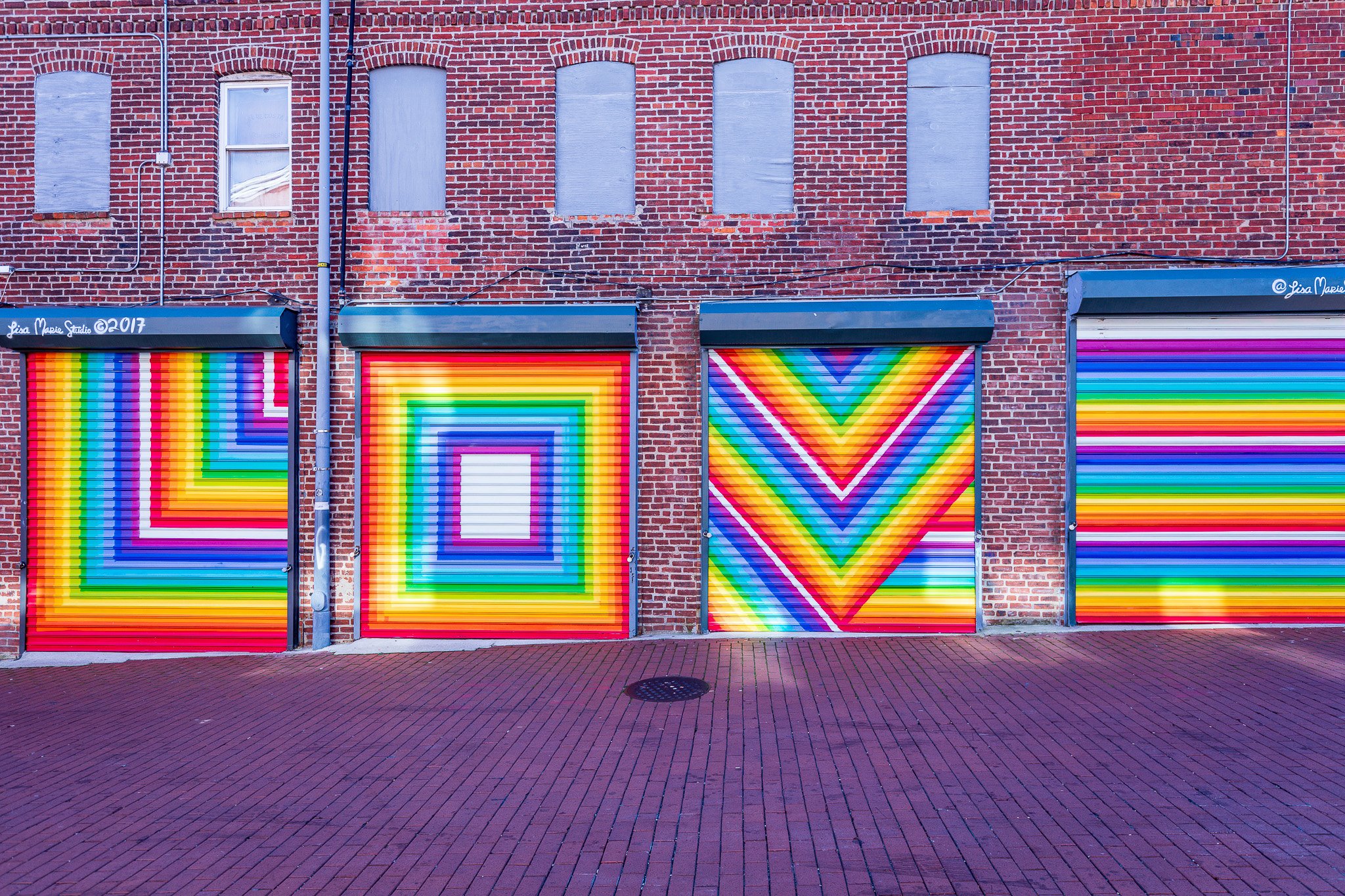
The famous Love Mural
There are lots of murals in Blagdens's Alley.
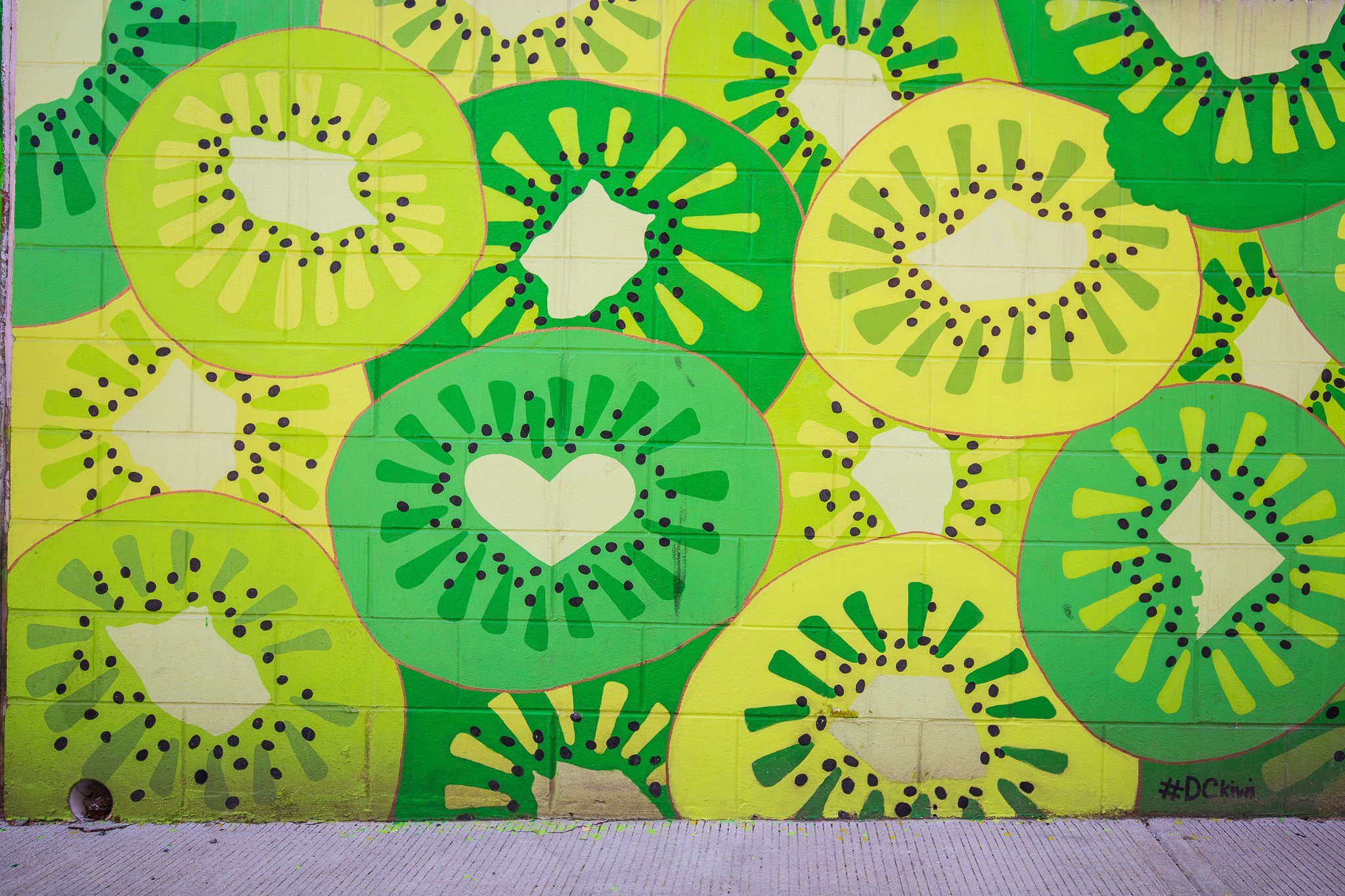
John F. Kennedy Center for the Performing Arts
The Kennedy Center's riverside terrace gives you sweeping Potomac views along with striking modern architecture, especially the newer REACH expansion's sculptural white forms.
📷 Pro Tip: Shoot the terrace and river view at sunset with a 24mm to 70mm lens, when the water and sky both pick up warm color. The REACH pavilions photograph well in harsh midday light thanks to their strong geometric shadows.
Best time: Sunset. Access: Free to visit public areas. Foggy Bottom, along the Potomac.

The Kennedy Center at Night with a reflection
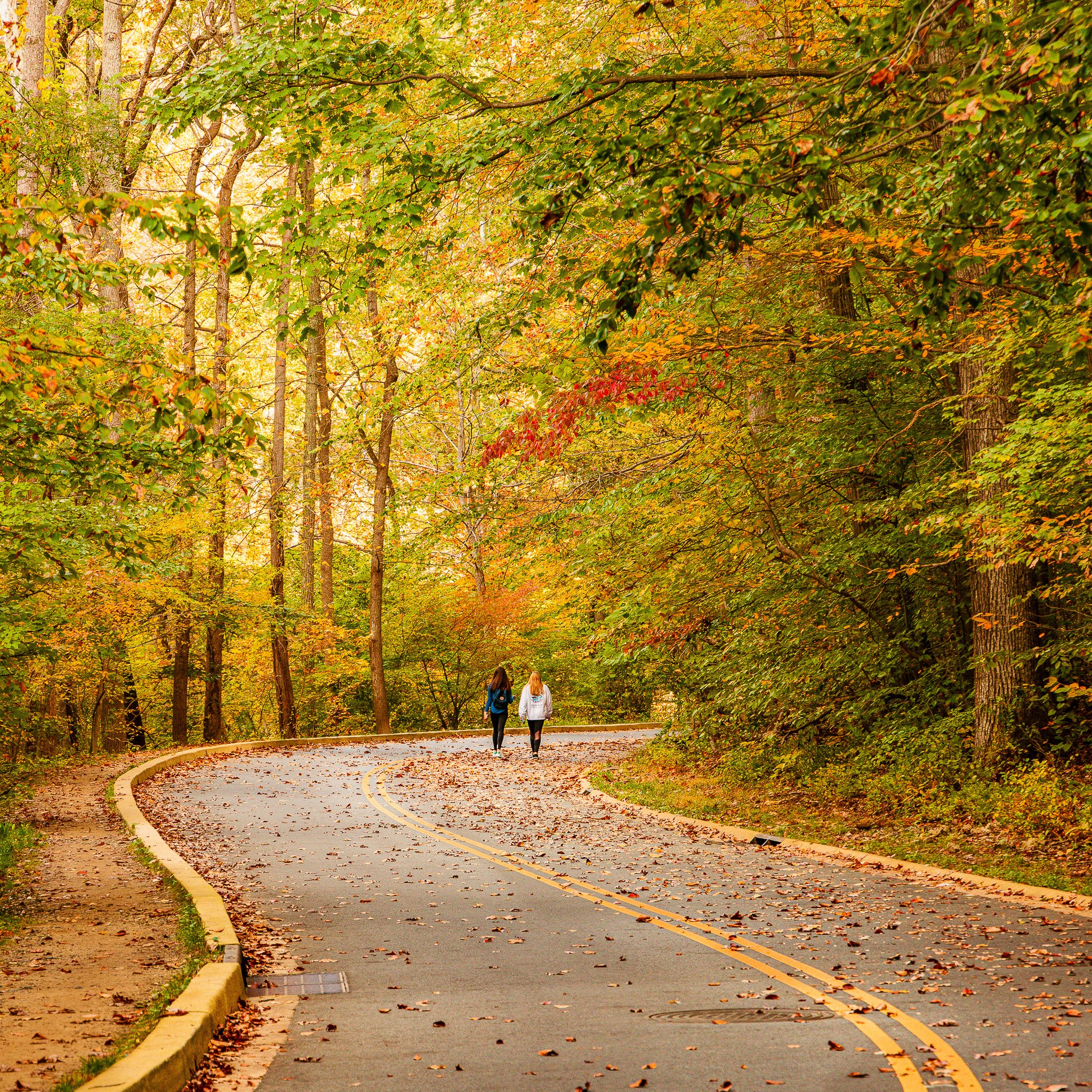
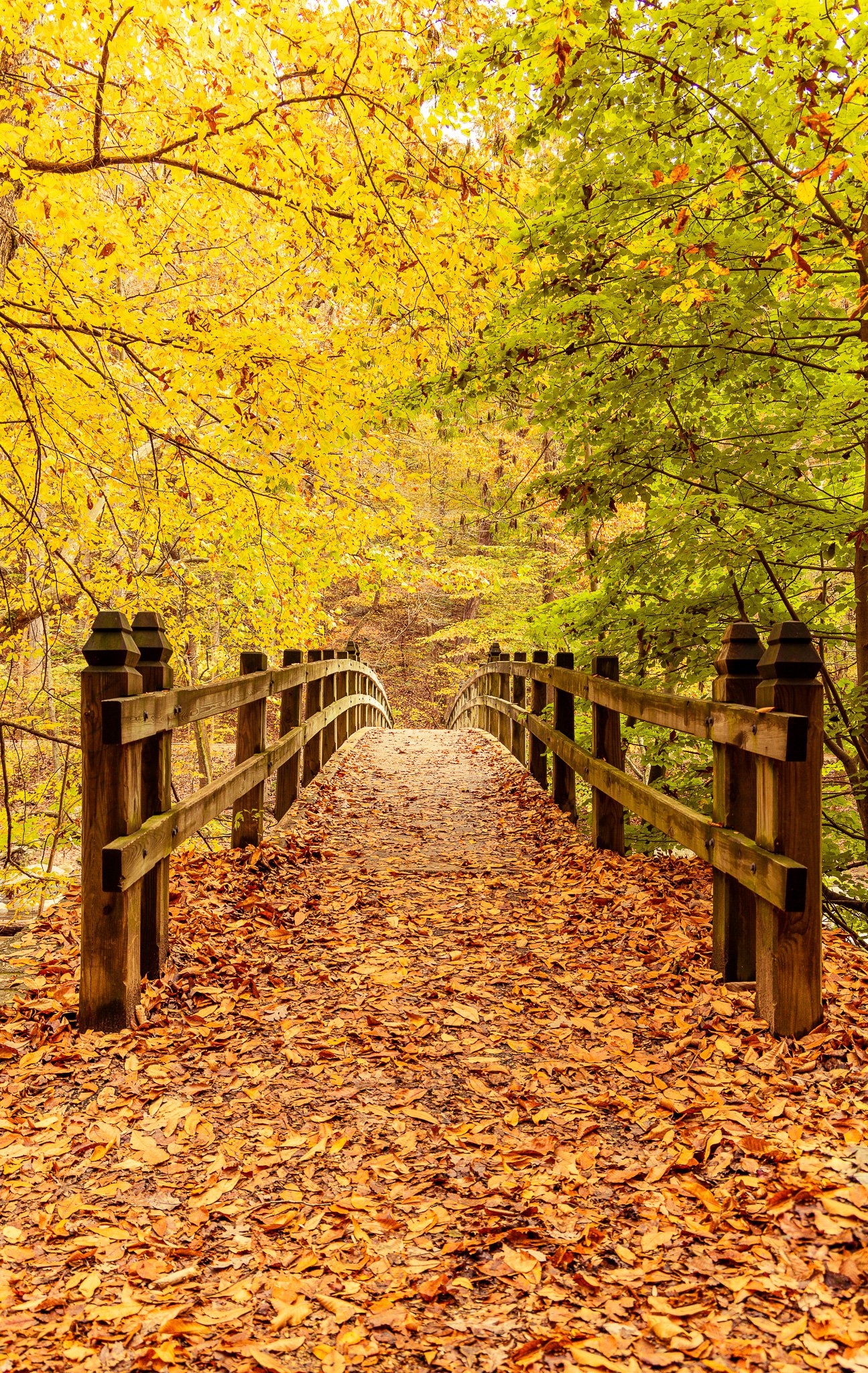
Rock Creek Park
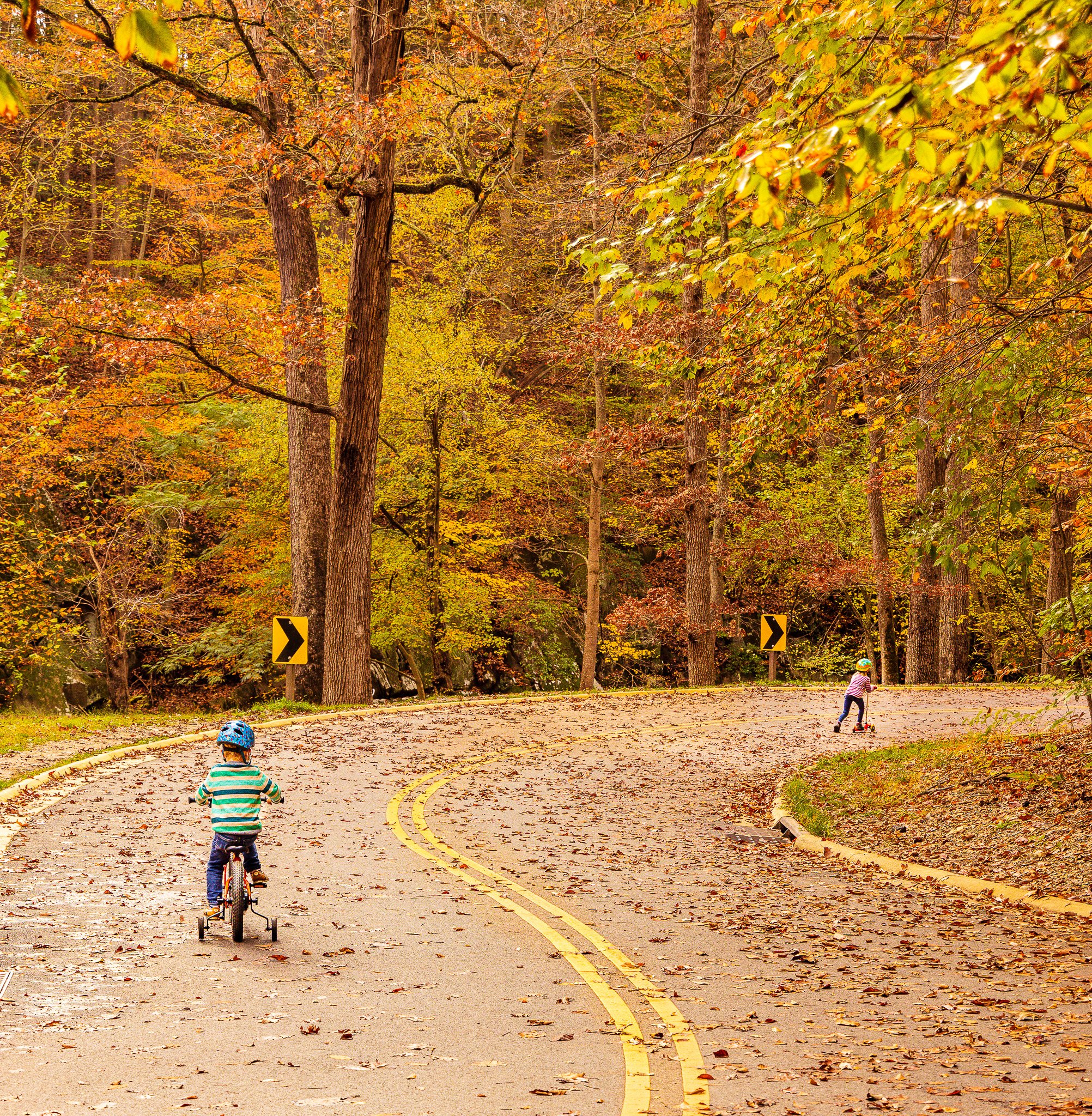
This forested park cutting through the city gives you genuine nature photography without leaving DC, waterfalls, wildlife, and dense tree canopy that changes dramatically with the seasons.
📷 Pro Tip: Bring a 70mm to 200mm lens for wildlife, deer are common along the trails, and a wider lens for the Peirce Mill waterfall area. Fall foliage, typically late October, is the strongest seasonal draw here.
Best time: Late October for fall color. Access: Free, trails throughout. Spans much of northwest DC.
Arlington Memorial Bridge
This bridge connecting the Lincoln Memorial to Arlington National Cemetery offers one of the most symmetrical, iconic sightlines in DC, with the Lincoln Memorial framed at one end.
📷 Pro Tip: Shoot from the bridge's pedestrian path with a 24mm to 35mm lens looking back toward the Lincoln Memorial, especially at sunset when the memorial catches warm light. A longer lens from the Virginia side compresses the whole scene into a classic postcard composition.
Best time: Sunset. Access: Free, pedestrian and vehicle access. Connects the Lincoln Memorial to Arlington, Virginia.

A Long Exposure with Red Lights on Memorial Bridge
Celebration & Events
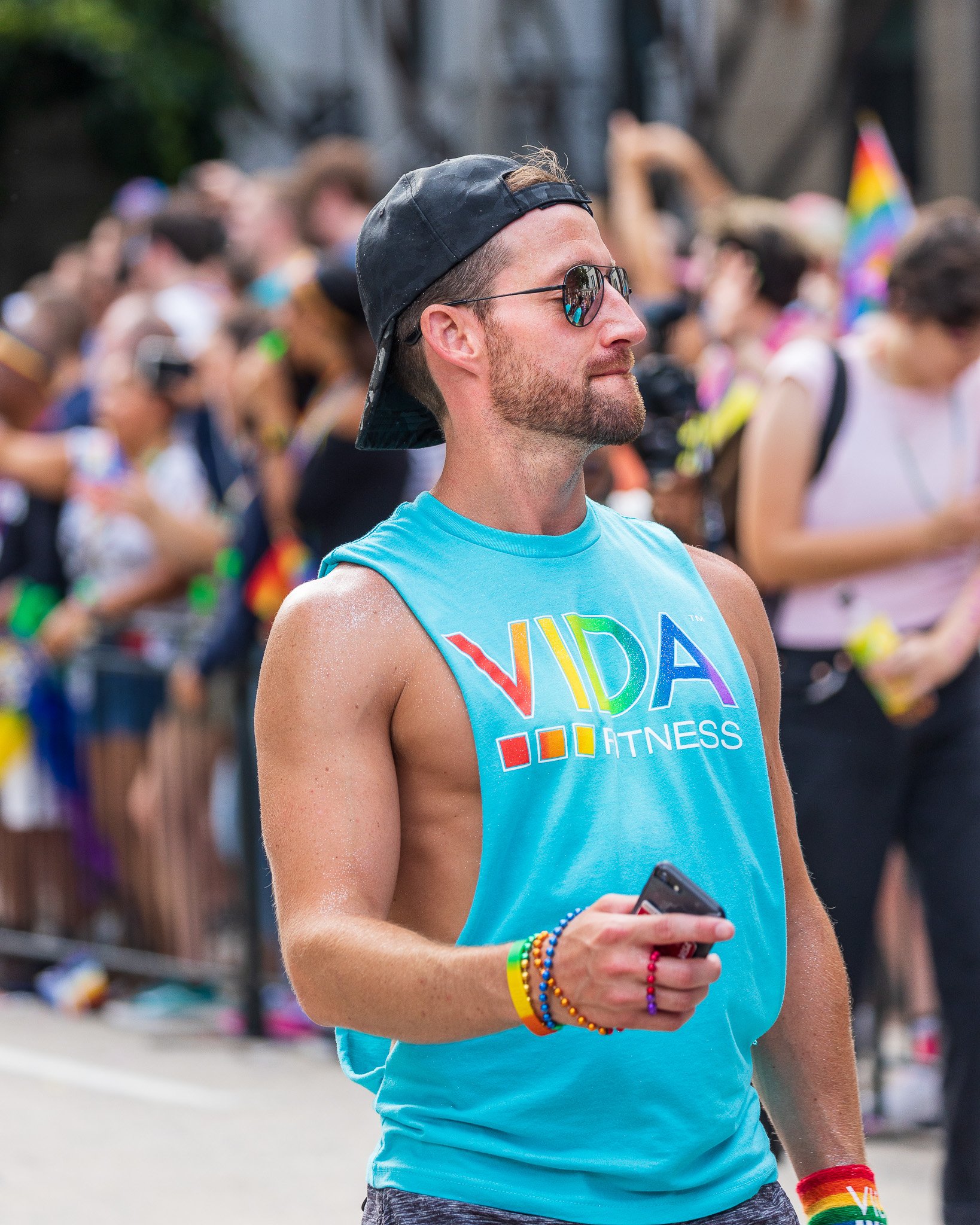
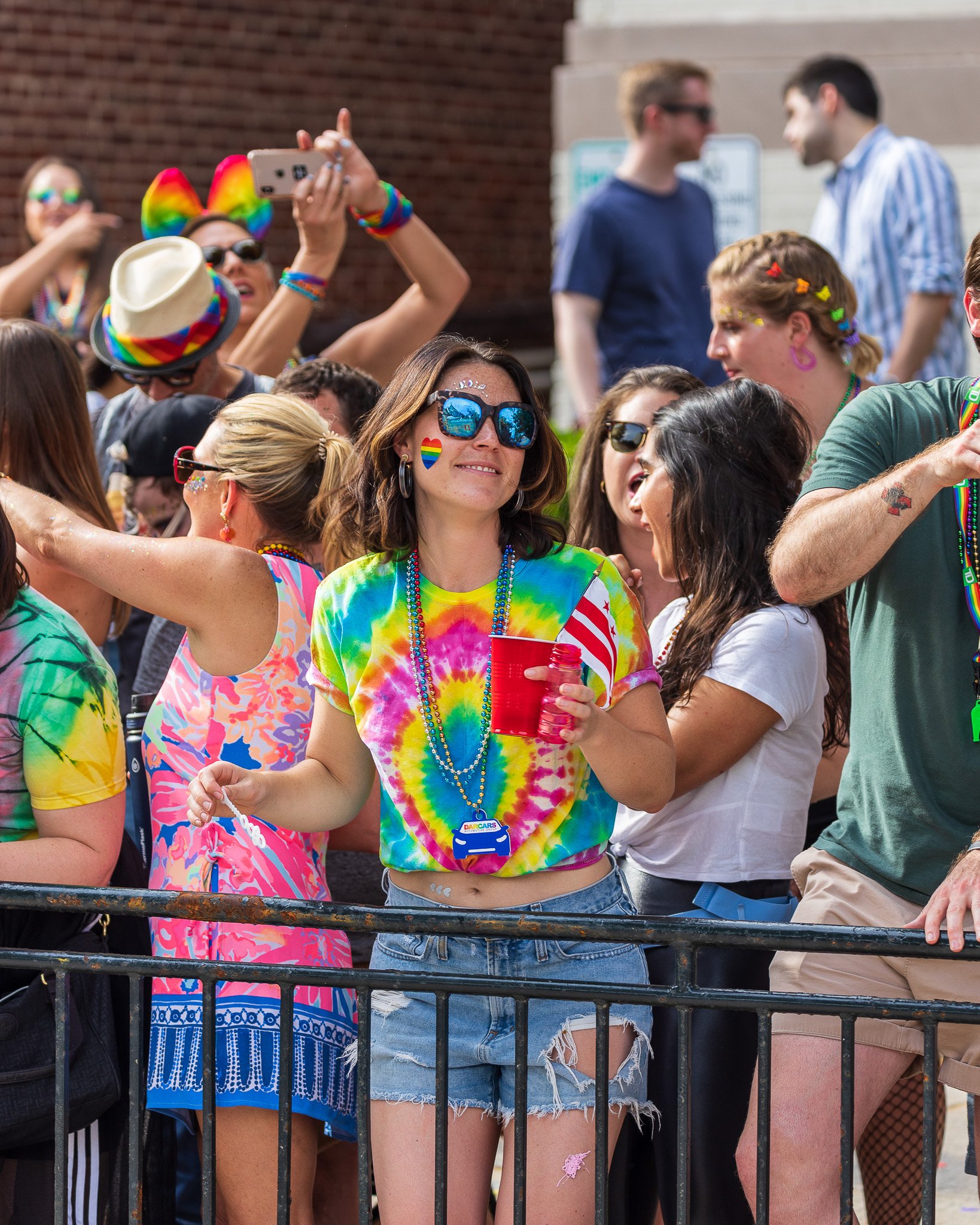
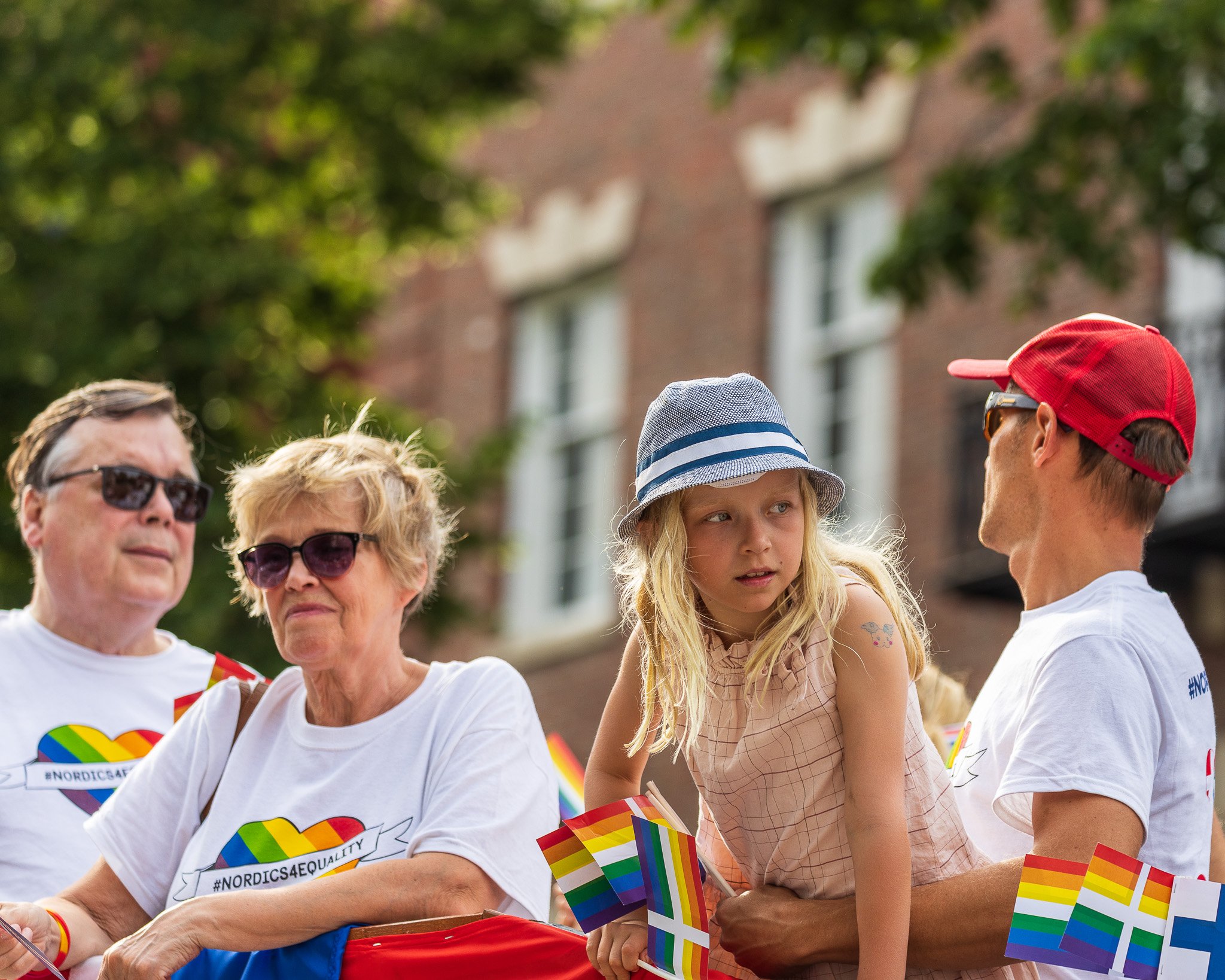
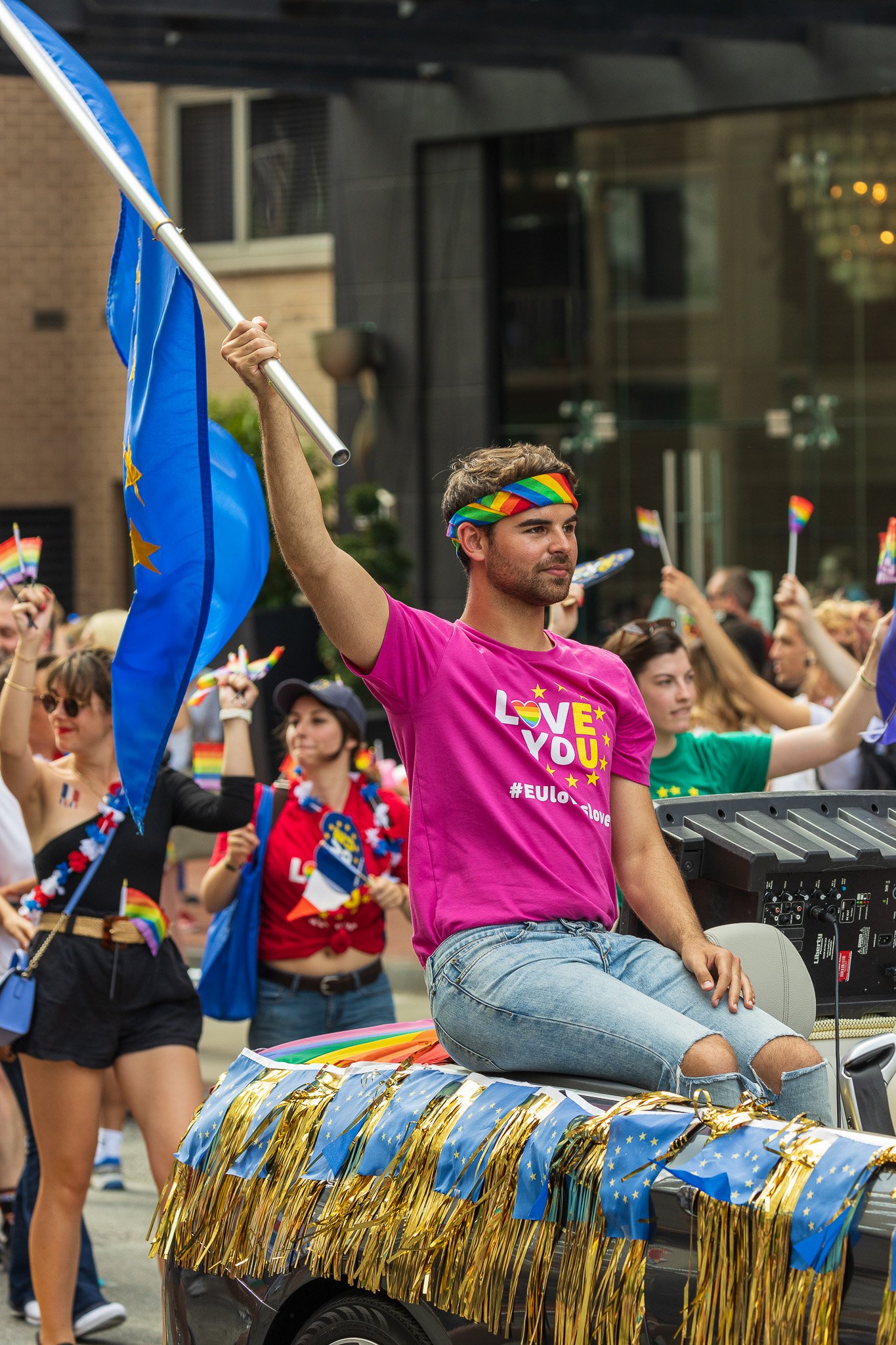
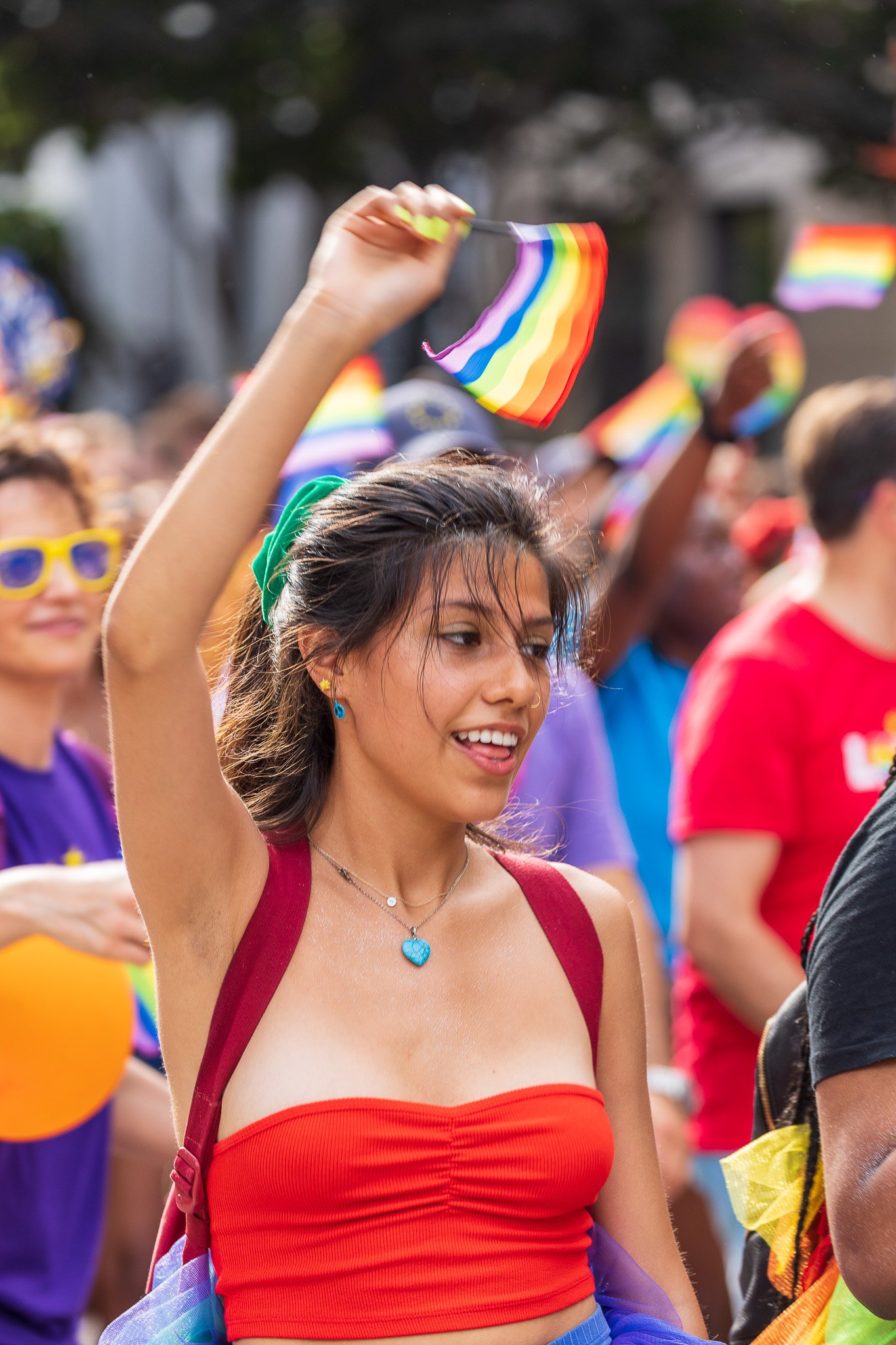
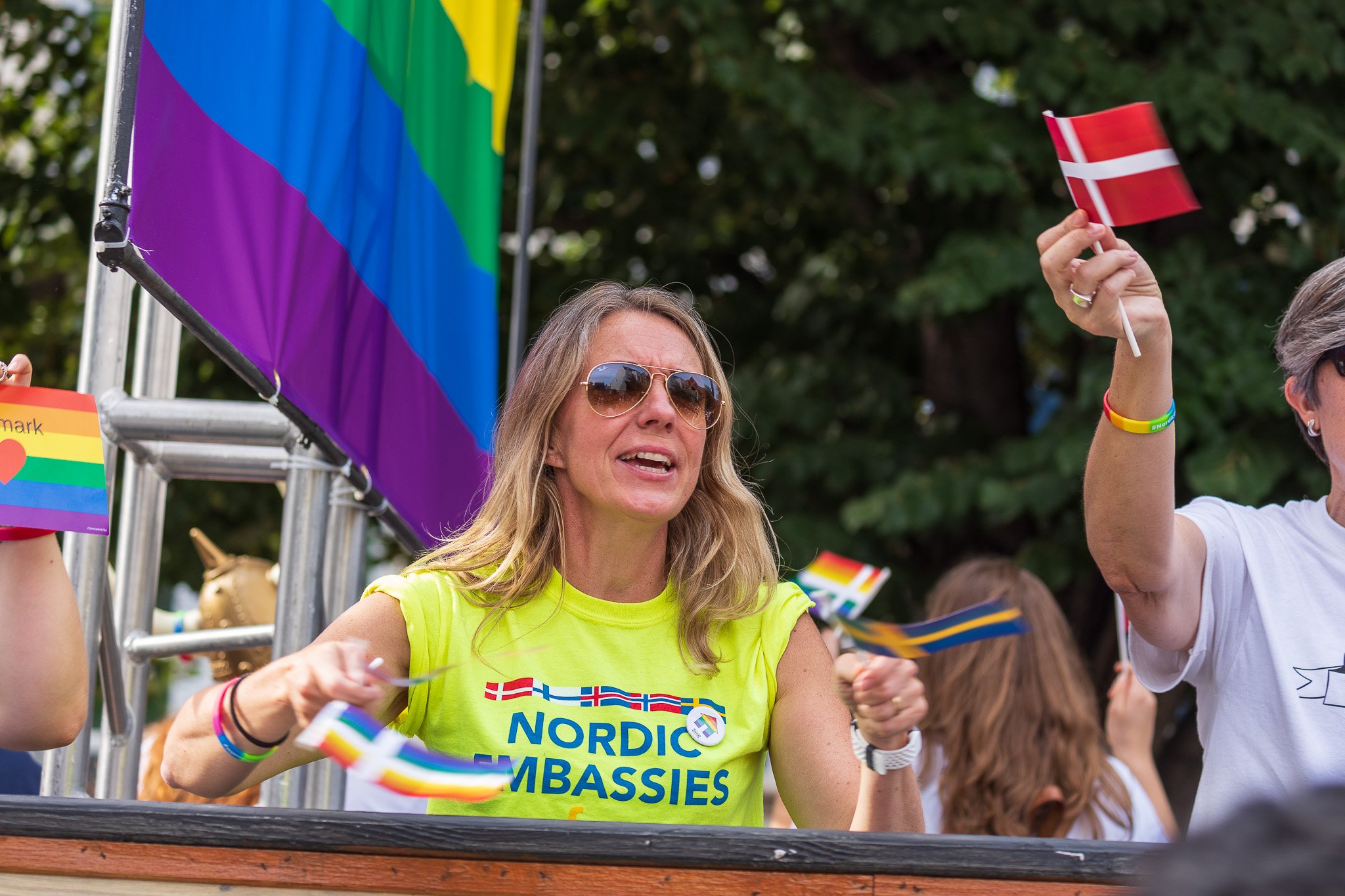
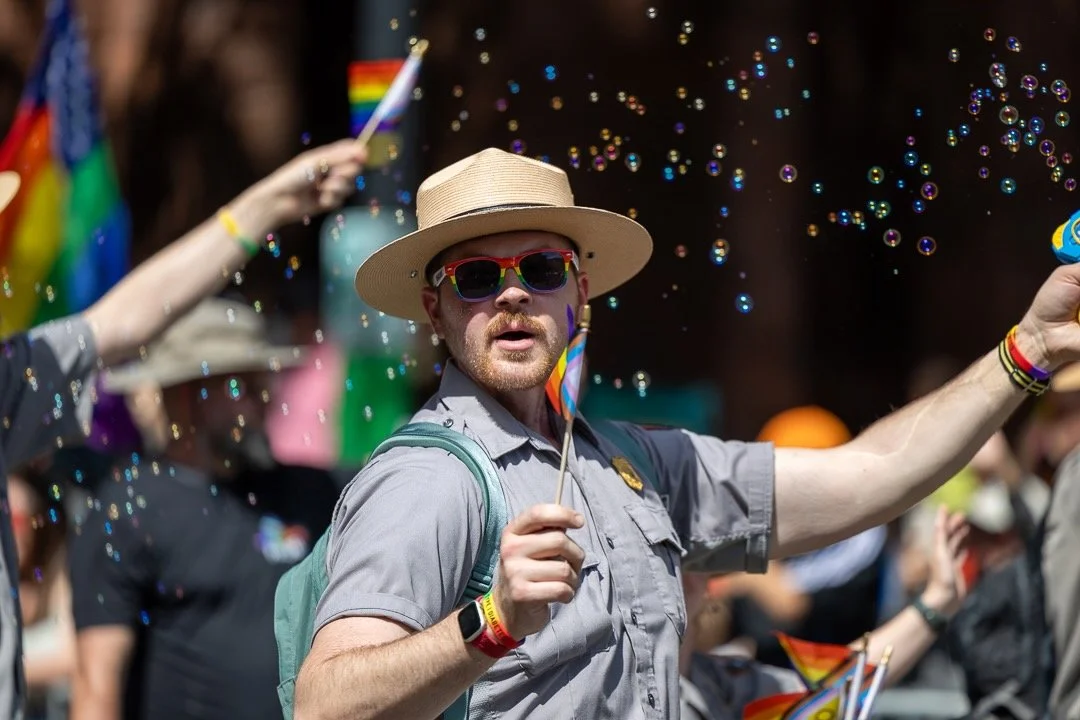
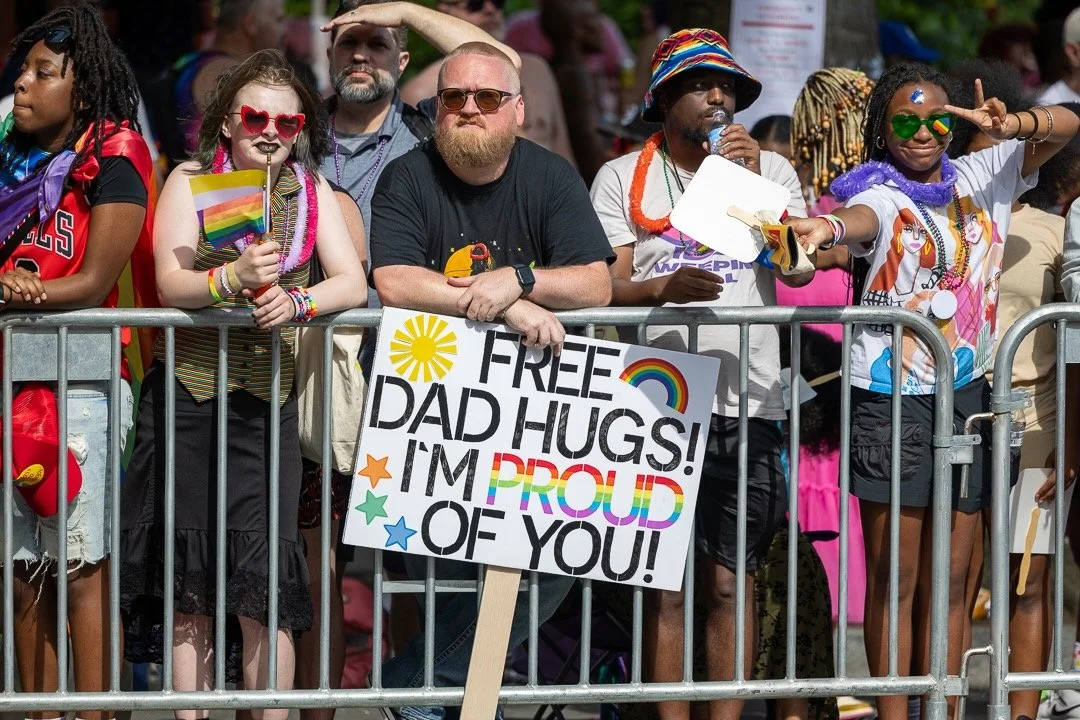
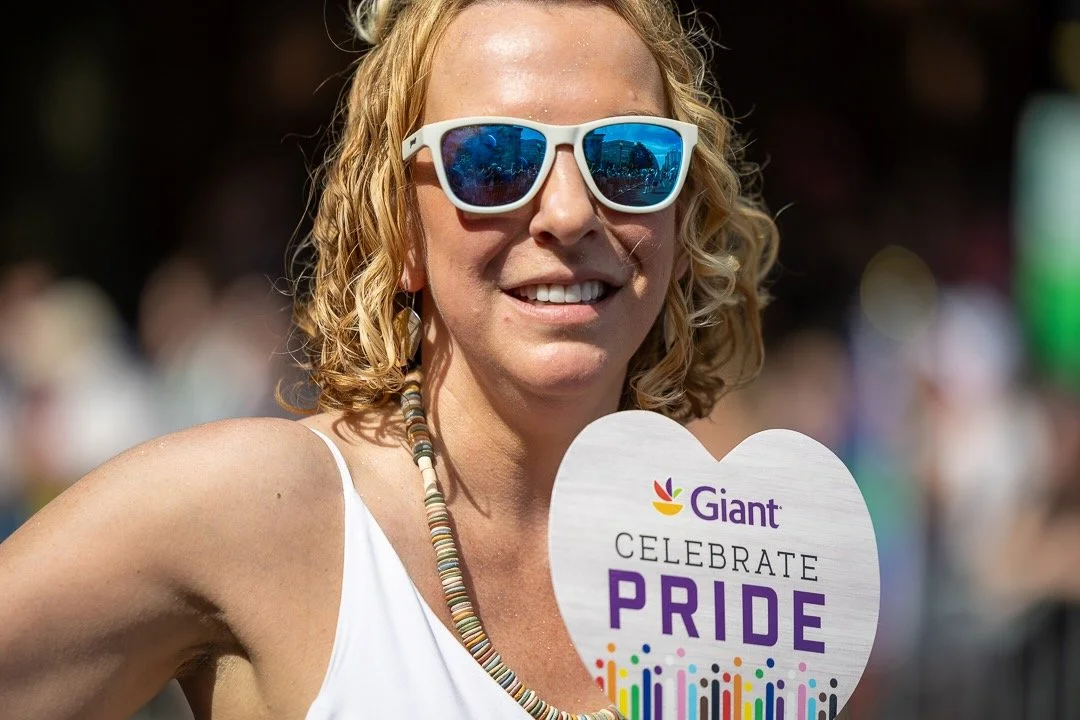
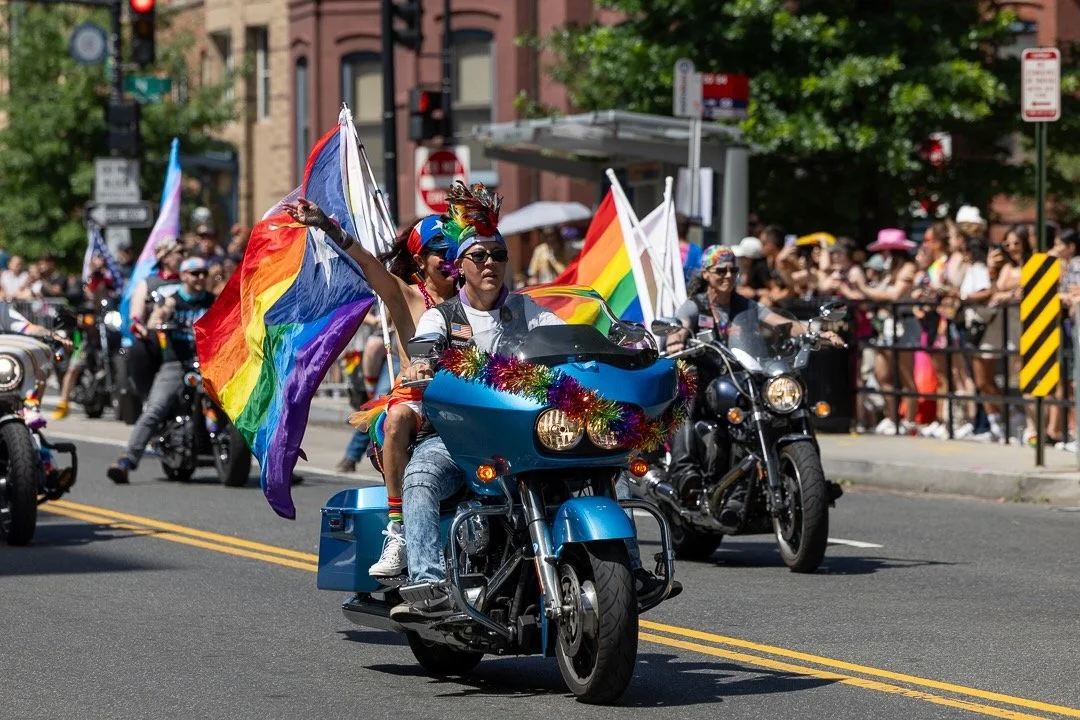
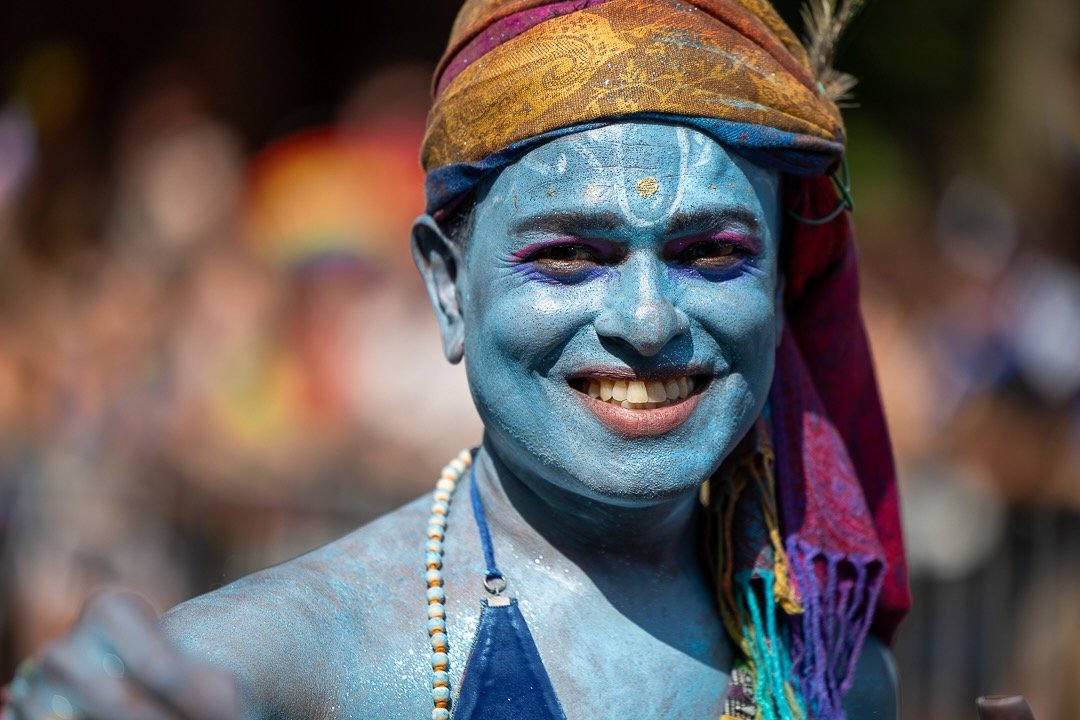
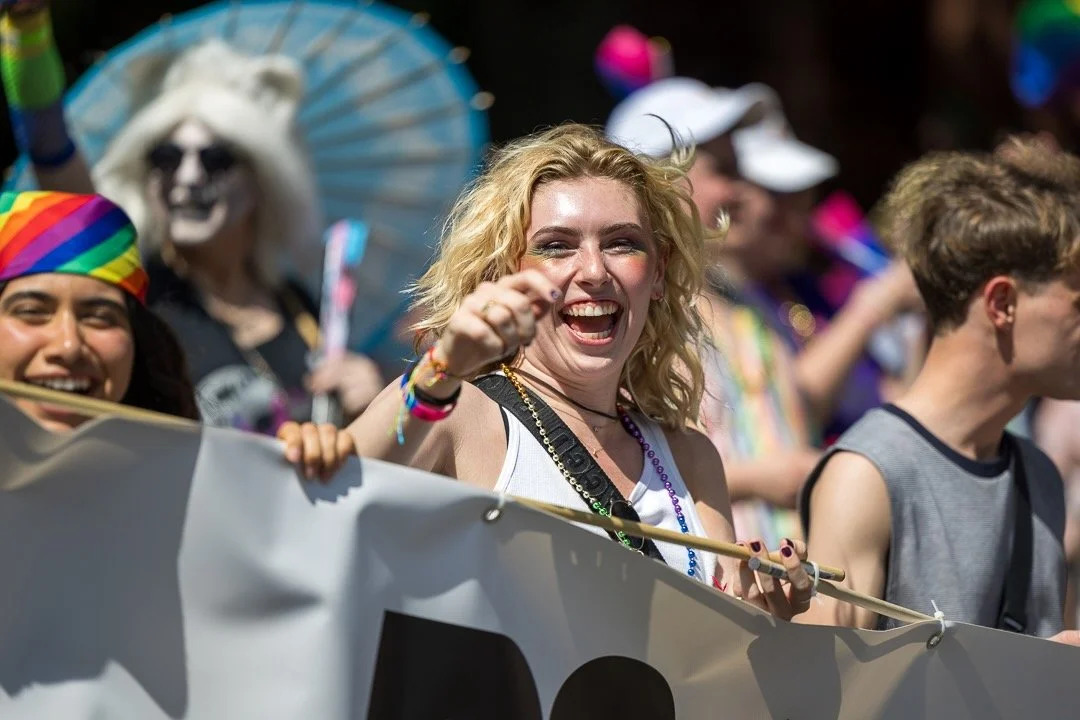
DC's Pride celebration is one of the most colorful and genuinely joyful events on the city's calendar, and it photographs like nothing else on this list. The parade route winds through Dupont Circle and down 14th Street, packed with elaborate floats, drag performers, community groups, and crowds in every color you can imagine. The energy is loud, warm, and entirely different from the quiet reverence of the monuments most visitors associate with DC.
The Capital Pride Festival, held on Pennsylvania Avenue near the Capitol, runs alongside the parade with stages, vendors, and a street festival atmosphere that gives you hours of candid portrait opportunities. Faces mid laugh, elaborate costumes, couples dancing, strangers hugging. This is street photography at its most alive.
📷 Photography Note: Bring a 35mm to 50mm lens for the parade itself so you can move through the crowd and get close without losing context. A longer 70 to 200mm lens works well from a fixed spot along the route for compressed shots of the floats approaching. Golden hour toward the end of the parade route gives you the best light of the day. As with the Folklife Festival, this is a crowd that wants to be photographed. Engage, ask, and shoot.
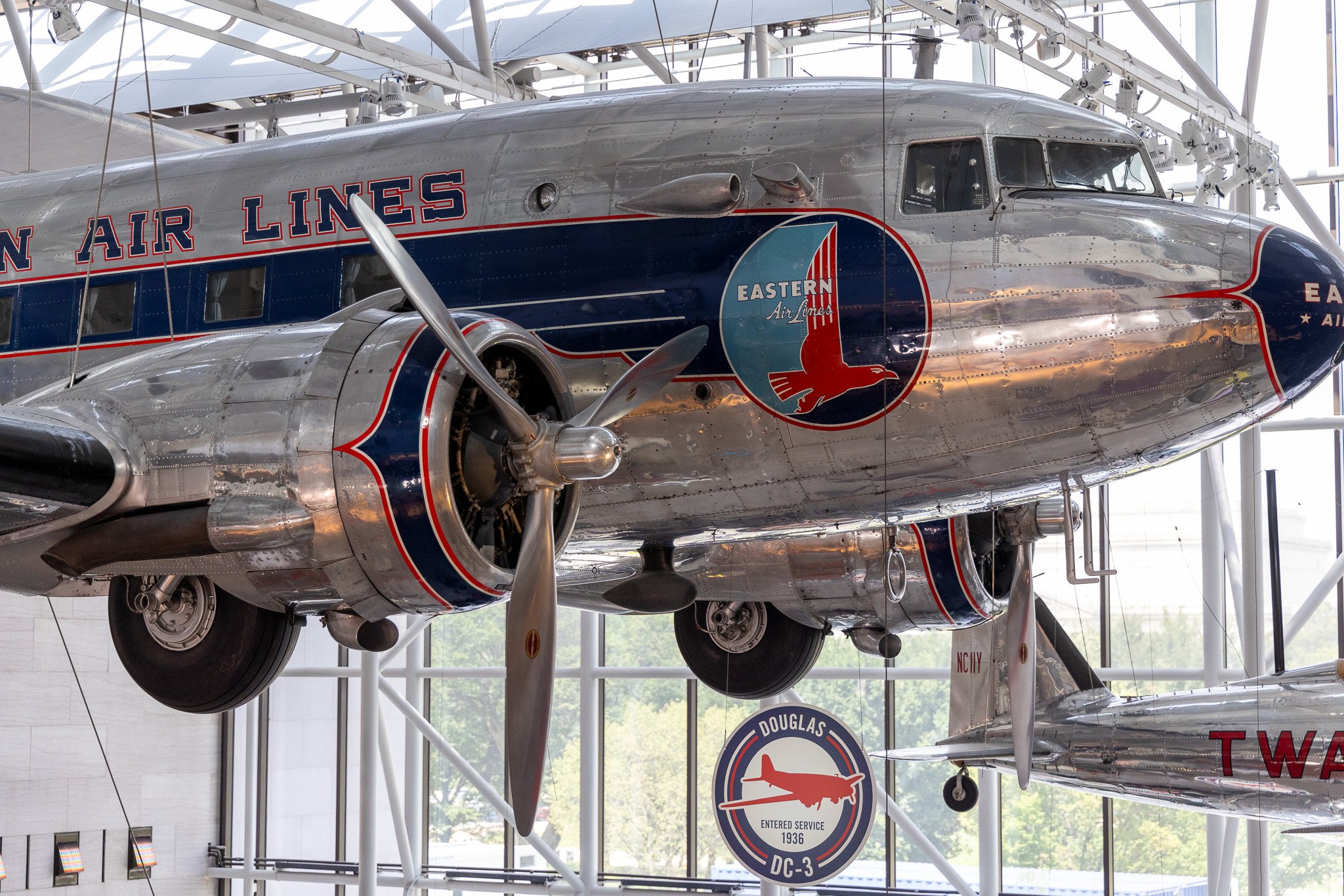
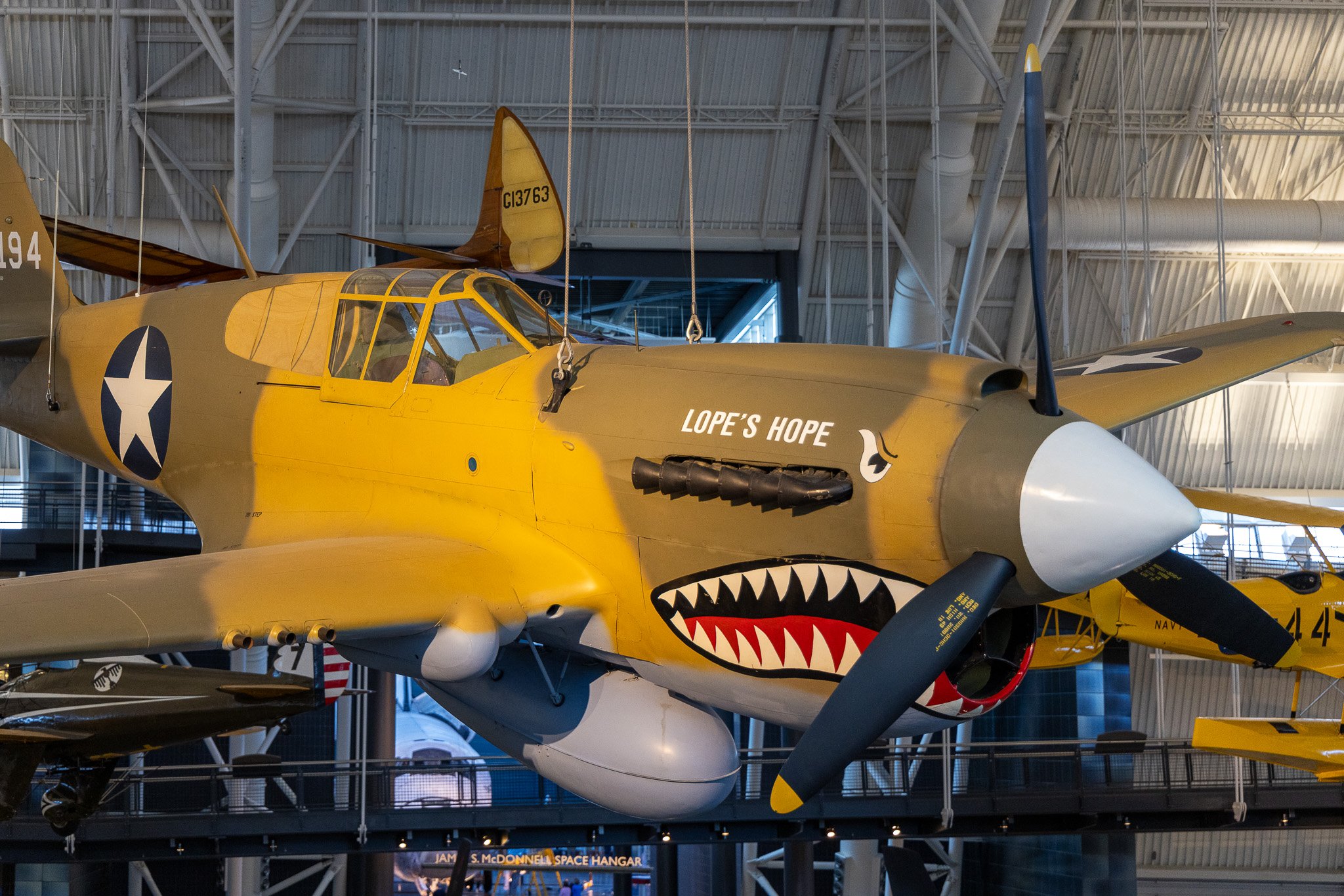
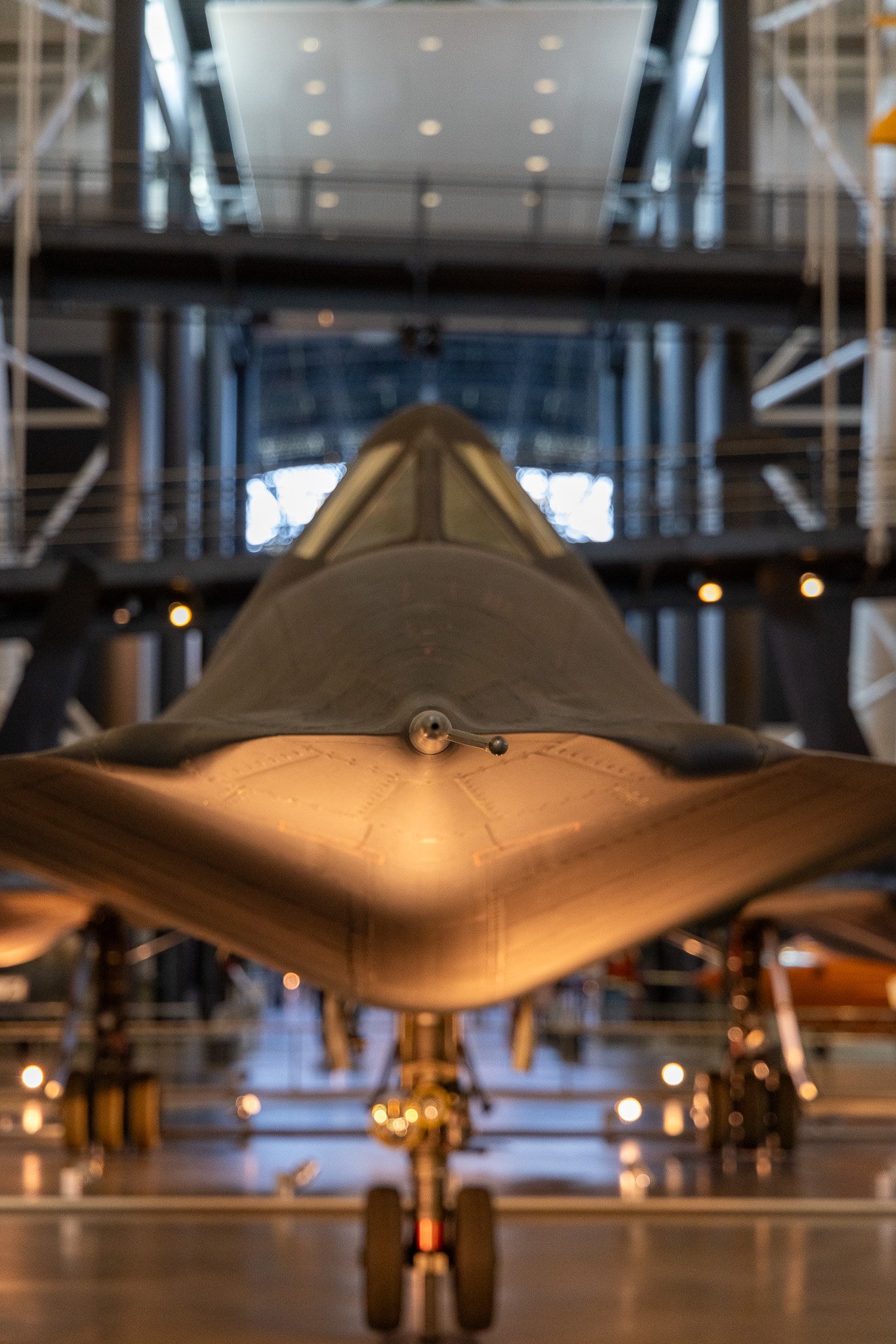
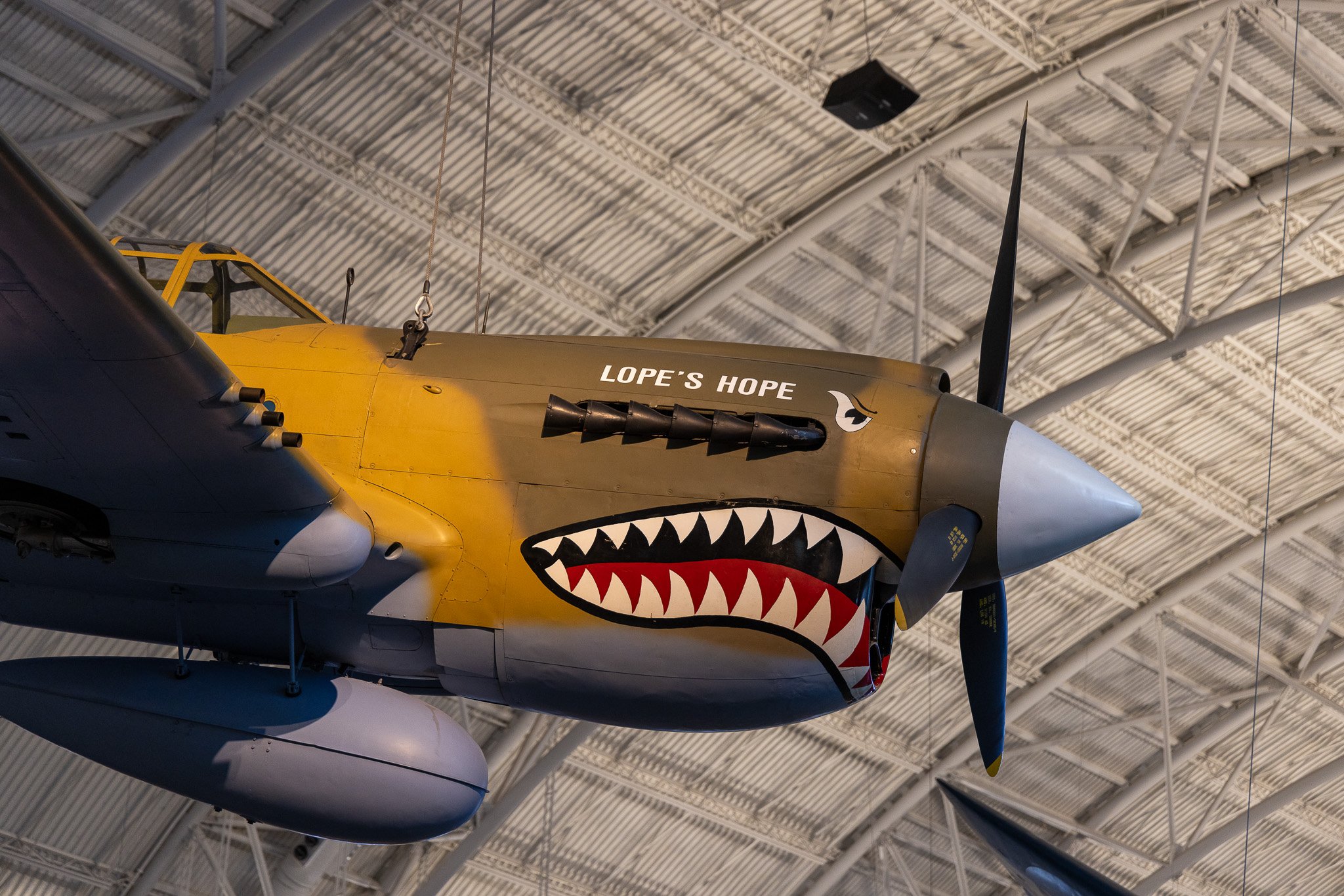
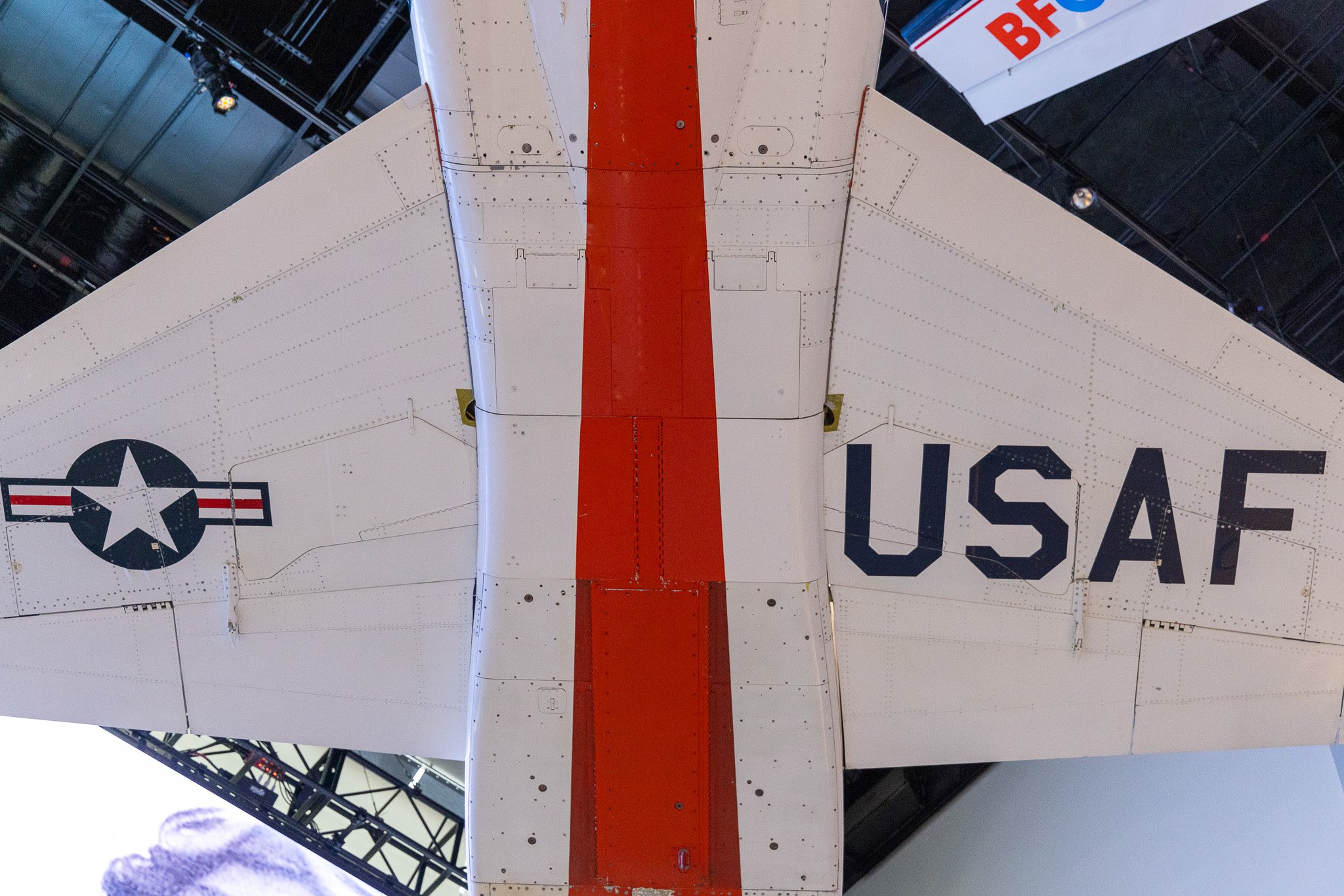
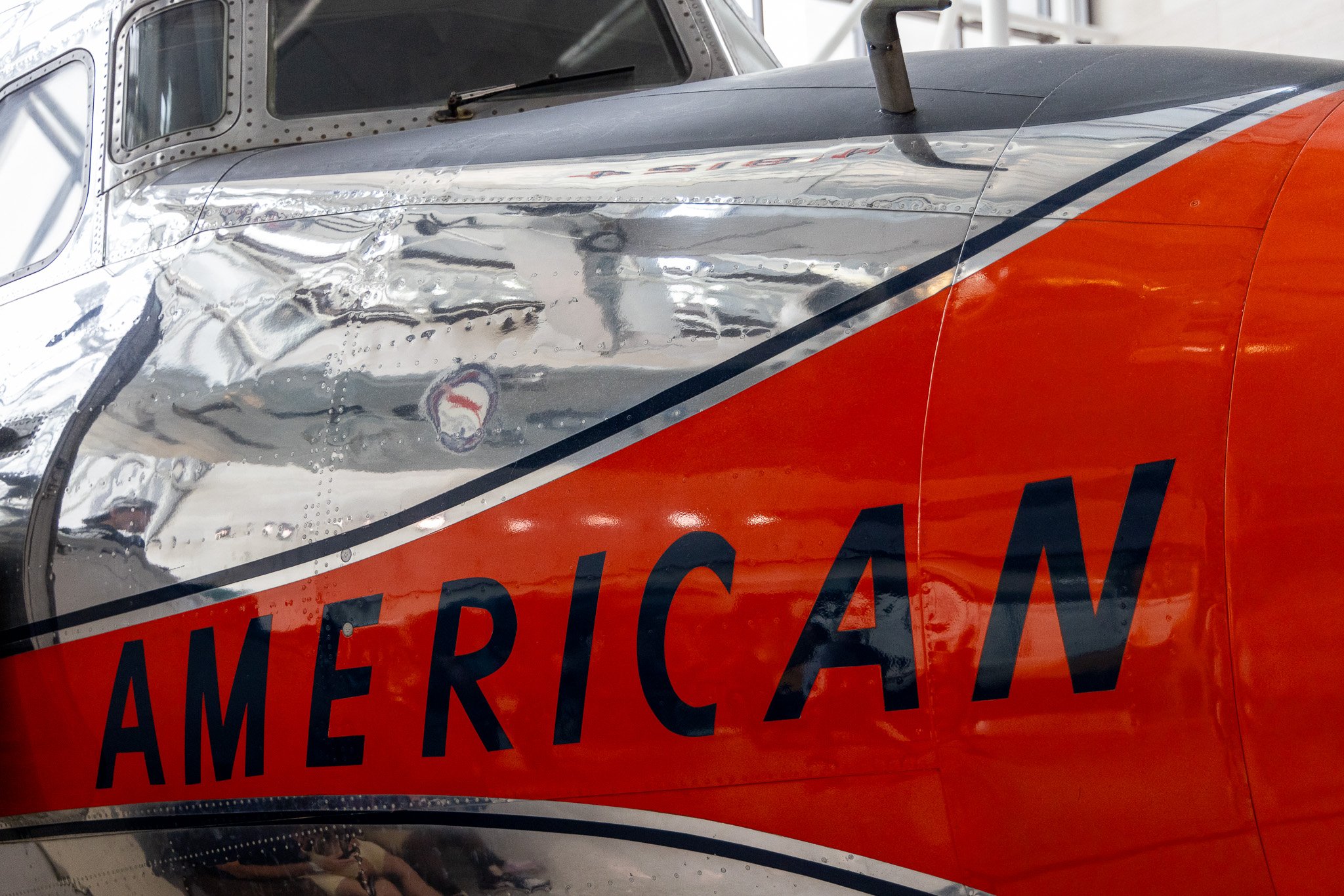
The National Air and Space Museum (Udvar-Hazy Center in Virginia)
Worth noting up front, this location is in Chantilly, Virginia, not DC, a real drive from downtown rather than a walkable add-on. The scale of the aircraft hangars here, a Space Shuttle, a Concorde, a Blackbird, is unmatched anywhere in the city proper.
📷 Pro Tip: Bring a wide lens, 16mm to 24mm, to capture full aircraft in the tight hangar space, and a fast prime for detail shots in the lower-lit sections. Shooting from the elevated walkway gives you a strong overview angle across the whole hangar.
Best time: Weekday mornings for fewer crowds. Access: Free, parking fee applies. In Chantilly, VA, roughly 40 minutes from downtown DC by car.

The Space Shuttle at the National Air & Space Museum
The Udvar Center is massive and has so many planes to photograph.
Festivals & Events
Few cities put on a show the way Washington does. The festivals here are not just civic celebrations; many of them are genuinely great photography events, with scale, color, and crowd energy that you rarely find anywhere else.
National Cherry Blossom Festival (late March to mid-April)
This is the one that photographers plan entire trips around. The National Cherry Blossom Festival marks the 1912 gift of 3,000 cherry trees from Japan, and when peak bloom arrives at the Tidal Basin, the city transforms completely. Pink canopies frame the Jefferson Memorial. Petals drift across still water at dawn. Families, couples, and strangers from every corner of the world stand at the edge of the basin and just stare.
The photography window is tight. Peak bloom typically lasts about a week, and the difference between day four and day ten is dramatic. Arrive at the Tidal Basin no later than 6 a.m. to shoot before the crowds arrive. A 70–200mm lens will compress the blossoms beautifully against the dome. On your phone, use Portrait Mode on single branches and switch to the wide lens for the full basin panorama. The festival also includes a parade, kite festival, and lantern-lighting ceremony, all worth photographing for color and energy.
📷 Photography Note: The Enid A. Haupt Garden behind the Smithsonian Castle blooms with magnolias at the same time as the Tidal Basin cherries. Almost no one knows about it. Go here second.
Fourth of July on the National Mall (July)
Washington's Fourth of July is, simply, the best in the country. The National Mall fills with hundreds of thousands of people, the monuments are lit and electric, and the fireworks erupt directly above the Washington Monument. From the Netherlands Carillon in Virginia, you can line up the Lincoln Memorial, the Washington Monument, and the fireworks in a single frame with a 200mm lens. This is the shot. Arrive by early afternoon to claim your position, bring a tripod and a remote shutter release, and set your exposure to capture both the burst and the monument silhouette below.
For iPhone photographers, switch to Night Mode and stabilize on a railing or tripod mount. The sky moves fast — shoot in bursts during the finale. The parade down Constitution Avenue earlier in the day offers its own photography session: military bands, color guards, floats, and faces that tell the whole American story.
Smithsonian Folklife Festival (late June to early July)
Held annually on the National Mall between the Washington Monument and the Capitol, the Smithsonian Folklife Festival is one of the most underrated photography events in the country. The festival celebrates living cultures from around the world, with artisans, musicians, cooks, and storytellers all working and performing outdoors across the Mall grounds. The photography here is about people: faces in concentration, hands at work, children watching something they have never seen before. Bring a 70–200mm or an 85mm prime and give yourself an afternoon to just wander and react. The light on the Mall in late afternoon is warm and directional, ideal for portraits.
📷 Photography Note: This is one of the few places in DC where photographing strangers in natural moments is entirely expected and welcomed. Everyone is there to share. Engage, ask, and shoot.
Nationals Park (April to September)
This is not a festival, but it belongs here. Nationals Park along the Anacostia Riverfront is one of the best sports photography venues in the country for amateur and hobbyist photographers. The ballpark is open and bright, the sightlines are excellent, and the golden light in the late innings during a summer evening game is extraordinary. Shoot from the outfield concourse with a 70–200mm for compressed action and telephoto portraits of players at bat. The Capitol dome is visible over the right field wall, and on a clear evening, it glows gold behind the field. It is one of the great incidental DC compositions that most visitors never think to look for.
A Christmas in Washington (December)
December in DC has a particular quality that rewards photographers who brave the cold. The National Christmas Tree lighting ceremony on the Ellipse, just south of the White House, draws large crowds but also produces exceptional frames: the tree blazing against the dark sky with the White House lit behind it. The Zoo Lights event at the National Zoo turns the grounds into a landscape of illuminated sculptures and colored light trails. Union Station's interior, already one of the great Beaux-Arts spaces in America, becomes genuinely spectacular under holiday decoration. Bring a tripod, shoot long exposures, and let the cold air work in your favor — clear winter nights produce the sharpest, most saturated light in the city.
Frequently Asked Questions About Visiting Washington DC
Do you need a car in Washington DC?
No, and locals will tell you not to bother. Parking is expensive and limited, traffic is a genuine headache, and the Metro, plus walking, covers nearly everything on this list. Save the rental car for a day trip outside the city.
Is Washington DC safe?
Yes, for the areas most visitors go to, the National Mall, Georgetown, downtown, and Capitol Hill are well-trafficked and safe day and night. Normal city awareness applies in less touristy neighborhoods after dark, same as any major city.
What Metro etiquette should I know?
Stand on the right side of the escalator, walk on the left. It sounds small, but it's the one rule locals notice tourists breaking more than anything else, and it genuinely speeds things up for everyone.
What are the best photo spots in DC?
The Lincoln Memorial and Reflecting Pool at sunrise, the Netherlands Carillon for a compressed skyline shot, and the Tidal Basin during cherry blossom season are three I return to constantly. The full list with Pro Tips is below.
Can you fly a drone in Washington DC?
No, not in central DC. The airspace around the National Mall, the Capitol, the White House, and Reagan National Airport is some of the most restricted in the country. Flying without specific FAA authorization is a federal violation. Check the FAA's B4UFLY app before attempting anything.
What surprised you most about photographing DC?
How many national and state parks surround the city? People think of monuments when they think of DC, but Great Falls, Rock Creek Park, and Shenandoah, all within an hour, still catch people off guard. You can shoot marble and monuments in the morning and be standing in genuine wilderness by afternoon.
How many days do you need in DC?
Four full days if photography is the priority. That's enough time for monuments at sunrise, a full day of neighborhoods and museums, and still room for a day trip to a nearby park.
Do you need tickets for the Smithsonian museums?
No, and they're free, every single one. Some of the newer or more popular ones, like the National Museum of African American History and Culture, do require timed-entry passes booked online in advance.
Final Thoughts
I have lived in and photographed Washington DC for my entire adult life. I have shot it in snow, in cherry blossom pink, in the flat heat of August midday, and in the low blue light of December evenings when the monuments feel like they belong to no one but you. It is the city I know better than any other, and it is still the city that surprises me.
What I keep coming back to is the scale of it, and what that scale does to light. The open Mall, the wide avenues, the reflecting pools and basins — all of it was designed, consciously or not, to move light around. No other American city gives you a sunrise reflection like the Lincoln at 6 a.m. No other city aligns a monument, a dome, and a horizon the way DC does from the Netherlands Carillon. No other city hands you 20 world-class photography subjects within two miles and charges you nothing to enter a single one.
Come with a tripod. Come before the crowds. Come back in a different season and photograph it again. DC rewards repetition.
Washington is my home. I am glad you are here.
If you would like to join a future photography workshop, visit my Workshops page for current offerings and upcoming dates. You can also connect with me on Instagram (@chasinghippoz) and Facebook, or subscribe to the newsletter for travel photography tips, destination guides, and behind-the-scenes stories from more than 75 countries. I look forward to sharing the journey with you.
Photography Locations Nearby
My Photography & Travel Guide to Charleston, South Carolina If DC's monuments represent one kind of American history, Charleston tells a different and equally essential chapter. Antebellum architecture, pastel row houses on Rainbow Row, live oaks draped in Spanish moss, and a harbor that turns gold at sunset. The two cities together offer a fuller picture of what American photography can look like.
My Photography & Travel Guide to Shenandoah National Park Ninety minutes from DC, Shenandoah is the city's natural release valve. Skyline Drive in October, morning fog rolling through the valleys, black bears along the roadside at dawn. For any DC-based photographer, this is the essential day trip that deserves its own overnight.
My Photography & Travel Guide to Nova Scotia A longer journey, but a natural one for anyone who photographs the American East Coast and wants to keep going north. Nova Scotia's fishing villages, dramatic Atlantic coastline, and fall color rival anything in New England. It is one of the most undervisited photography destinations in North America.

Join Me for a DC Evening Monuments Photography Workshop!
📸 Washington, DC Evening Monuments Photography Workshop
$99 per person | Max 6 participants or $199 Private
Love photography and iconic views? Then grab your camera and join me for a golden hour photo walk through Washington, DC’s most breathtaking monuments—right as the city lights up!
Throughout the year, I host small group workshops and offer private walking photo tours (1–6 people) tailored to your style and pace. But this group workshop is a crowd favorite: a two-hour guided adventure as we chase reflections, long exposures, and those postcard-perfect twilight shots.
Who This Workshop Is For
Beginners who want to learn how to use their camera
Travelers visiting DC
Photographers who want iconic shots without crowds
What You’ll Learn:
Getting to Know Your Camera and Settings
Creative composition tricks to elevate your shots
How to work with changing light, reflections, and motion
Long exposure tips for amazing nighttime images
We’ll Photograph DC Icons Like:
The Jefferson Memorial
Lincoln Memorial
Washington Monument
The US Capitol
The White House
and a few other locations
Where We Meet:
We’ll start near the Tidal Basin. Parking is available at the lot near Floral Park (by the paddle boats on Maine Ave—click here for the map).
Recommended Gear:
Bring a DSLR or mirrorless camera with interchangeable lenses (think 24-70mm or 24-105mm), a sturdy tripod, and, if you have them, an ND filter and remote shutter release. I’ve got one tripod to lend—just email me ahead of time to reserve it.
All Skill Levels Welcome!
Whether you're just getting comfortable with your camera or looking to take your skills to the next level, this workshop is designed for you. I’ll guide you step-by-step—from finding the right settings to composing striking shots—so you can feel more confident behind the lens and come away with photos you'll be excited to share.
Fitness Level: Easy Breezy
No hills, no hustle—just a relaxed stroll on paved paths with plenty of photo stops.
What’s Included:
• Personalized instruction in the field
Weather Policy
What happens if it rains? DC weather in spring and fall can be unpredictable. We can reschedule.
Cancellation Policy:
• Full refund if canceled 48+ hours in advance
• No refund for late cancellations unless your spot is filled
Have Questions or Want to Book a Private Tour?
Email me directly at vito@chasinghippoz.com
*Contact me to schedule your session

🌅 Wake Up & Shoot: Join My DC Sunrise Monuments Photography Workshop!
Washington, DC | $99 per person | Max 6 participants or $199 Private
Ready to turn your early wake-up call into something unforgettable? Come chase the morning light with me through Washington, DC’s most iconic monuments—before the crowds roll in and while the city glows in that perfect golden hour.
This sunrise photo walk is a favorite for beginners and hobbyists, but it’s just as inspiring for seasoned shooters looking to capture DC in a whole new light. I offer a few of these group workshops each year (plus private tours for 1–6 people). I can also do private workshops.
What You’ll Learn:
📷 Composition techniques to transform snapshots into showstoppers
✨ How to work with reflections, shifting light, and movement
⏱ Tips on long exposures—even in changing morning light
We’ll Photograph:
The Lincoln Memorial, Vietnam Memorial, Korean Memorial, Jefferson Memorial, Tidal Basin, WWII Memorial, and the Washington Monument—plus any golden light gems we discover along the way.
Meet-Up Spot:
We’ll meet at the bottom of the steps leading up to the Lincoln Memorial. Click here for the location on Google Maps.
Gear Guide:
Bring your DSLR or mirrorless camera with a zoom lens (24-70mm or 24-105mm is perfect), a sturdy tripod, and if you’ve got them, an ND filter and remote shutter release. Need a tripod? I’ve got one available—just email me in advance to claim it.
Skill Level: Beginner to Intermediate (and Curious Travelers!)
If you're new to your camera, don’t worry—I’ve taught hundreds of beginners and promise to keep things fun and jargon-free. You’ll get personalized tips tailored to your level, so you leave with new skills and photos you’re proud of.
Fitness Level: Casual and Comfortable
This is a relaxed 2-hour stroll—no hiking, no racing. Just beautiful light, wide paths, and time to pause, set up, and enjoy the process.
What’s Included:
✔️ On-location photography instruction
✔️ Follow-up image review + feedback session via Zoom
Cancellation Policy:
🗓 Full refund if canceled 48+ hours in advance
🚫 No refunds for late cancellations unless your spot is filled
Want to Book a Private Tour Instead?
Let’s create a customized photo walk for you or your group—just shoot me an email.
📧 Contact Vito L. Tanzi email me at vito@chasinghippoz.com